ISSN: 2334-2366 (Print), 2334-2374 (Online) Copyright © The Author(s). 2014. All Rights Reserved. American Research Institute for Policy Development 42 Monticello Street, New York, NY 12701, USA. Phone: 1.347.757.4901 Website: www.aripd.org/jcsit
Performance EvaluationBased on Energy Detection and
Operational Interval of Spectrum Sensing In Cognitive Radio
Shalini, V.S Jadhav1
Abstract
Cognitive radio is an intelligent communication system which focus on dynamic spectrum usage rather than fixed spectrum assignment. Cooperative spectrum sensing is a technique for detecting the primary user accurately based on information collected from various secondary users. Energy detection technique for spectrum sensing method is employed to determine the occupancy of the frequency spectrum observed over a time interval. It deals with the simulation of the spectrum sensing algorithm for Cognitive Radio under low SNR scenario. With small tradeoffs between the detection probability and the false alarm probability, improvement can be done over spectrum sensing ability greatly. This is depicted through MATLAB. And through NETSIM, scenario is elaborated in terms of data traffic with respect to operational interval.
Keywords: Cognitive radio, Cooperative spectrum sensing, Energy detection, false
alarm probability, detection probability.
I.Introduction
The demand of spectrum is increasing very rapidly with the growth of wireless services. The scarcity of spectrum has become more serious. Cognitive radio provides a new way of utilizing spectrum efficiently. The basic spectrum sensing technologies include energy detection, cyclostationary detection and match filter detection.
1 Department of Electronics & Telecommunication, Maharashtra Institute of Technology, Pune, India.
The optimal detector is a match filter detector with the priori information since it can maximize the received SNR. Cyclostationary detection uses the cyclic autocorrelation function to analyze the received signal for realizing the detection. Both of the two methods need some prior information of PU, therefore in some scenarios that SUs are lack of the information, match filter detection and cyclostationary detection may not be feasible any more in those scenarios. In the cases of unknown signal detection, a common method is energy detection. Energy detection exhibits simplicity and serves as a practical spectrumsensing scheme [1]. It detects received signals and compares it with threshold value, to deduce the availability of primary users. One disadvantage lies with it, is that threshold easily influenced by unknown or changing noise levels. A key technique to improve the spectrum sensing for Cognitive Radio Network (CRN), cooperative sensing is proposed to combat some sensing problems such as fading, shadowing, and receiver uncertainty.
II. Energy Detection
It is the simplest technique for sensing the spectrum. It can be used conveniently with analog and digital signals. Energy detector measures the energy received from primary user during the observational period. If energy calculated is less than threshold value, it is declared as spectrum hole .When CR users start the spectrum sensing to detect the primary users status, the received signal r (t), can be expressed in terms of binary hypothesis as shown in Eq. 1:
n(t) H0
r(t)=
s(t)+n(t) H1 (1)
Wheres(t) is the signal waveform and the n (t) is a zero-mean AWGN. H0 signifies absence of primary user, and H1 the presence of primary user. For single cognitive user, the probability of detection, probability of false alarm is shown in Eq. 2 and Eq. 3:
Pd=Qu(√2γ,√λ) (2)
Cooperative spectrum sensing is a technique of deciding the presence or absence of primary users by combining the decisions of more than one cognitive user. It mitigates the problems of hidden node an exposed node problem [3]. Eq. 4, 5 and 6, depicts the cooperative probability of detection, probability of miss-detection, and probability of false alarm [1].
Qd= 1- ∏ (1− ,) (4)
Qm= ∏ ( ,) (5)
Qf= 1- ∏ (1− , ) (6)
N is the total number of cognitive users and “i” denotes a specific user among them.
III. Receiver Operating Characteristic Curves
It gives the graphical summary of a cognitive detector performance.It assumes the detector operates in an additive white Gaussian noise environment.Effect of varying false alarm probability on the probability of detection can be depicted for a fixed value of SNR. Even the effect of varying SNR on probability of detection can be deduced for fixed value of probability of false alarm.
A detector’s performance is measured by its ability to achieve a certain probability of detection and probability of false alarm for a given SNR.Cooperative detection can improve the probability of detection while maintaining a desired probability of false alarm level [1].
IV.Simulation Results
A. With MATLAB R2012a:
In this section, the simulation results of energy detector based spectrum sensing are discussed for different channel parameters.
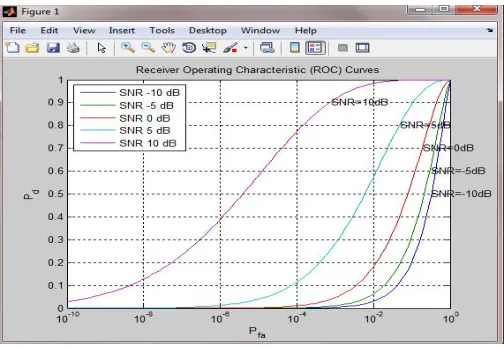
Fig. 1PfavsPdfor different SNR
As we go on increasing the value of SNR, the probability of false alarm decreases and vice-versa, and the performance comparatively upgrades as shown in Fig 4.1 and Fig 4.2.
For small values of thresholds, there is greater chance of detection of spectrum even on low SNR. Another point here is that all these curves are bell shaped[4].
The multipath channel is considered here for detection of primaryuser, for whichspectrumis AWGN. Noise variance plays an important role in deciding the performance of energy detector, especially in low SNR.As we move to high SNR, we can use the estimated variance of noise, as received signal is well distinguished there.The perfect knowledge of noise variance is advantageous in case of low SNR conditions.
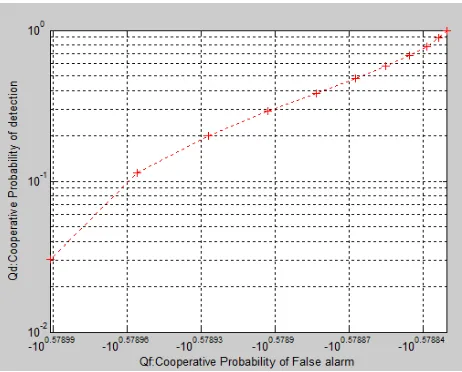
Now,Performance of cooperative spectrum sensing results are shown in Figure 4.3 and 4.4 [1].
Shadowing and fading are ignored. Some common simulation parameters are given below:
Number of cognitive users,N=3 Time bandwidth product,u=5
Fig. 3Qdvs.Qf
A high Qm(low Qd) would result in missing the presence of the primary user with high probability which interferes the primary user.
Fig.4Qm vs. Qf
B.With NETSIM version 7
Scenario forspectrum sensing with two cognitive users is shown in Fig 4.6.The cognitive users is connected to their respective base stations, which further connected to a router. Here the operational interval is varied, and its impact over the traffic is displayed.
Assumptions:
For Base Stations: Operational frequency: 54 to 60 MHz
Operational Time: 10sec (constant),Operational interval: 2, 4, 6,8,10 sec. For Cognitive Radio Users:
Fig. 5 Scenario with two cognitive users
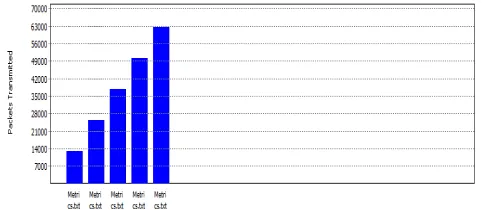
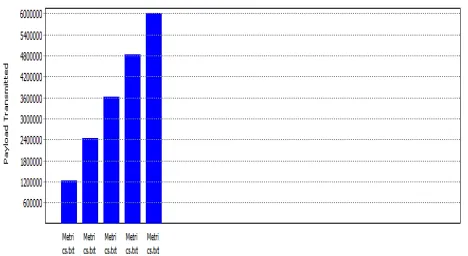
Fig 6,7,8,9 is the resultant graphs taken directly from NETSIM environment for comparison of the metrics with various operational interval values (2, 4, 6,8,10 sec respectively).
Fig. 6Comparison of packets transmitted
Fig. 8Comparison of payload transmitted
Fig. 9Comparison of overhead Transmitted
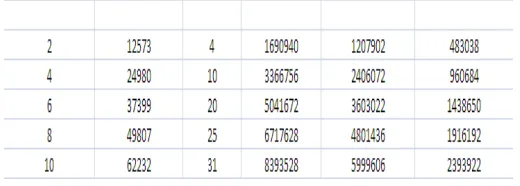
As the operational time is constant and operational interval is increased, the more is the opportunity for CR users to access the channels. Hence the data traffic increases through the channels.
Overhead is the extra bit or information which is added to guide the data packets.And payload is the actual data received by the destination node in a communication network.Hence these two parameters also increase as packets transmitted increases as shown in Fig 10.
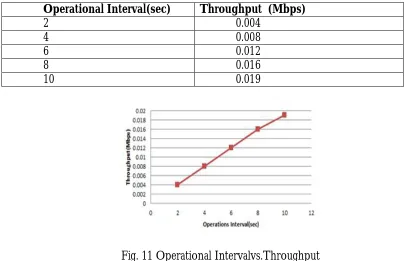
Now in terms of throughput, it also increases with increase in operational interval, as shown in Table I and in Figure 11.
Table I: Operational Interval Versus Throughput
Operational Interval(sec) Throughput (Mbps)
2 0.004
4 0.008
6 0.012
8 0.016
10 0.019
Fig. 11 Operational Intervalvs.Throughput
Table II: Results Obtained
V. Conclusion
In this paper, through MATLAB,ROC graphs tellthat SNRand probability of false alarm plays crucial role in deciding the performance of spectrum sensing. It can be enhanced by increasing the value of SNR or by decreasing the value of probability of false alarm.Cooperative probability of detection increases or cooperative probability of miss-detection decreases with decrease in cooperative probability of false alarm and gives more accurate results.
With NETSIM, it’s been shown that throughput of spectrum increases almost proportionally with increase in operational interval.Along with that overhead transmission and payload transmission also increases.
References
Jiang Zhu, ZhengguangXu, Furong Wang, Benxiong Huang, Bo Zhang, “Double Threshold Energy Detection of Cooperative Spectrum Sensing in Cognitive Radio” Proceedings of the 3rd International Conference on Cognitive Radio Oriented Wireless Networks and Communications, CrownCom 2008.
Sun Yuhang,”Spectrum Sensing in Cognitive Radio Systems using Energy Detection” Bachelor’s Thesis 09/2011,University of Gavle.
Sithamparanathan Kandeepan1,GianmarcoBaldini and RadoslawPiesiewicz,”UBW Cognitive Radios”Novel Applications of the UWB Technologies, Dr. Boris Lembrikov (Ed.), ISBN: 978-953-307-324-8, InTech, 2011