Parametric Study of Grout Mix Design using SNP
Admixture with Cement Fly Ash Proportion 1:2
Pratik. D. Patel Prof. M. G. Vanza
PG Student Associate Professor
Department of Applied Mechanics Department of Applied Mechanics L D College of Engineering L D College of Engineering
Abstract
An experimental investigation of grout is to be carried out with fly ash as a replacement of sand. In this study cement fly ash proportion used as 1:2. The experiments are conducted with and without different dosage of sulfonated naphthalene polymer (SNP) & using different methods of curing condition. Grout mix is designed with three water/solid ratio. In this parametric study workability, stability of fresh grout is to be measured and compressive strength is measured for 7 days and 28 days. After performing tests it is observed that in water/solid ratio 0.4, with addition of 0.5% sulfonated naphthalene polymer (SNP) admixture the strength is found to be maximum under type III curing condition at 28 days.
Keywords: Fly Ash Grout, Curing Condition, Grout Properties, Water Solid Ratio, Dosages of Admixture
________________________________________________________________________________________________________
I.
INTRODUCTION
The flow-able plastic materials called Grouts, which can be injected into a structural member under pressure to fill interior space within the concrete or masonry created due to cracks, voids or honeycomb are used for repairing of cracks, strengthening of masonry and Honey combed concrete. Grout is generally a mixture of water, cement, sand, often color tint, and sometimes fine gravel (if it is being used to fill the cores of concrete blocks). It is applied as a thick emulsion and hardens over time, much like its close relative mortar. Unlike other structural pastes such as plaster or joint compound, grout, when mixed and applied correctly, creates a waterproof seal.
In this experimental work grout mixture has been prepared using Fly ash as a partial replacement for Portland cement and full replacement for sand. Fly ash contributions to the use of recycled materials and besides improving the strength the fine spherical properties of fly ash enhance the flow ability and pump ability properties of grout.
II.
EXPERIMENTAL WORK
Material Used: A.
1) Cement:-In this experimental study “J.K.LAXMI” OPC of 53 grades will be used. The cement used is tested for various proportions as per IS 4031-1988 and found to be confirming to various specifications of as per IS 12269-1987.
2) Fly Ash: - Class f fly ash with low calcium obtained from the Sabarmati torrent power station, Ahmedabad, Gujarat, India, is used as a sources material.
3) Water: - Normal tap water is use to mixing and curing of the grout.
4) Admixture: - FAIRFLO is a high range water reducing admixture for concrete conforming to BS 5075 part 3and ASTM C-494 type „f‟ &is 9103‟1999.
Proportions: B.
Mix Procedure: C.
First the OPC and fly ash were dry mixed in a clean dry pan for about 3 minutes until they were blended uniformly and intimately. All the lumps of fly ash were properly broken down by hands so that it results into a uniform mix. Then the tap water measured on the base of water/solids ratio was added to the dry mix along with the measured quantity of the admixture. Grout was again mixed thoroughly by help of trowel to get a uniformly coloured mix. Measured the fresh grout workability and stability and then the mixed grout was then filled into the cube moulds of size 7.07 cm. All the moulds before filling were oiled with the greasing agent. The edges of the moulds were tamped so that any air bubbles are forced out. When filling the mould, sufficient material was used so that mould is slightly over filled. The extra material was then striked off with the edge of the trowel. After 24 hours, the cubes were carefully stripped off from the moulds to be subjected to different curing conditions and then tested at 7 days.
Rheological Properties of Fly Ash and Cement Based Grout: D.
To find out workable and stable grout mix following two tests can be carried out
1) Marsh cone test: -As per ASTM C939-94a, „Standard test method of flow of Grout for preplaced-aggregate concrete (flow cone method)‟ 470-471.
2) Bleeding potential test: - ASTM-C 940-98A “Standard Test Method for Expansion and Bleeding of Freshly Mixed Grouts for Preplaced-Aggregate Concrete in the Laboratory.”
Curing & Testing: E.
The curing conditions adopted in this experimental program were (i) Type-I : Air curing until the time of testing the cubes (ii)Type- II : 10min air drying immediately after cubes taken out (iii)Type-III : 4 hrs air drying after the cubes were taken out from curing tank.
These cubes were then loaded in the Compression testing machine and were loaded until failure. The compressive strength for each batch of grout mix was recorded.
III.
EXPERIMENTAL RESULT
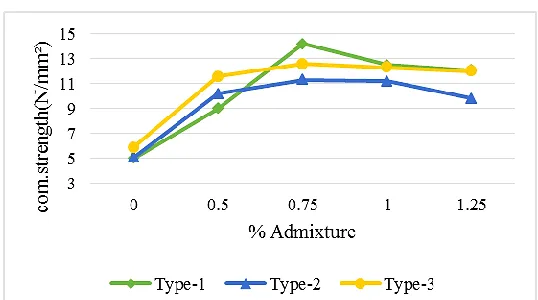
Graph 1 to 10 represent the average compressive strength of the cubes of the grout mix for varied dosage of admixtures and three different curing condition as mentioned above.
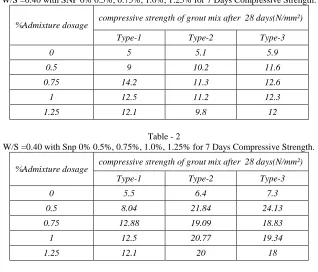
Table – 1
W/S =0.40 with SNP 0% 0.5%, 0.75%, 1.0%, 1.25% for 7 Days Compressive Strength.
%Admixture dosage compressive strength of grout mix after 28 days(N/mm²)
Type-1 Type-2 Type-3
0 5 5.1 5.9
0.5 9 10.2 11.6
0.75 14.2 11.3 12.6
1 12.5 11.2 12.3
1.25 12.1 9.8 12
Table - 2
W/S =0.40 with Snp 0% 0.5%, 0.75%, 1.0%, 1.25% for 7 Days Compressive Strength.
%Admixture dosage compressive strength of grout mix after 28 days(N/mm²)
Type-1 Type-2 Type-3
0 5.5 6.4 7.3
0.5 8.04 21.84 24.13
0.75 12.88 19.09 18.83
1 12.5 20.77 19.34
Fig. 1: Graph – 1: % Admixture (SNP) To Comp.Strength (N/Mm²) With 0.40 W/S for 7 Days
Fig. 2: Graph – 2: % Admixture (SNP) To Comp.Strength (N/Mm²) With 0.40 W/S for 28 Days
Table - 3
W/S =0.45 With SNP 0.5%, 0.75%, 1.0%, 1.25% For 7 Days Compressive Strength
%Admixture dosage compressive strength of grout mix after 28 days(N/mm²)
Type-1 Type-2 Type-3
0.5 9.03 10.2 9.03
0.75 14.2 11.3 10.33
1 12.5 11.2 9.5
1.25 12.1 9.8 9
Table - 4
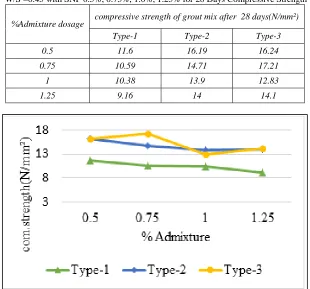
W/S =0.45 with SNP 0.5%, 0.75%, 1.0%, 1.25% for 28 Days Compressive Strength
%Admixture dosage compressive strength of grout mix after 28 days(N/mm²)
Type-1 Type-2 Type-3
0.5 11.6 16.19 16.24
0.75 10.59 14.71 17.21
1 10.38 13.9 12.83
1.25 9.16 14 14.1
Fig. 4: Graph – 4: % Admixture (SNP) To Comp.Strength (N/Mm²) With 0.45 W/S for 28 Days
Table – 5
W/S =0.50 with SNP 0.0%, 0.5%, 0.75%, 1.0%, 1.25% for 7 Days Compressive Strength
%Admixture dosage compressive strength of grout mix after 28 days(N/mm²)
Type-1 Type-2 Type-3
0 3 3.1 3.5
0.5 7.5 7.5 7.02
0.75 8 7.4 9.5
1 7.4 8.82 8.02
Fig. 5: Graph – 5: % Admixture (SNP) To Comp.Strength (N/Mm²) With 0.50 W/S for 7 Days
Table - 6
W/S =0.50 with SNP 0.0%, 0.5%, 0.75%, 1.0%, 1.25% For 28 Days Compressive Strength
%Admixture dosage compressive strength of grout mix after 28 days(N/mm²)
Type-1 Type-2 Type-3
0 3.9 4.3 4.9
0.5 8.52 12.3 13
0.75 10.59 14.71 17.21
1 10.38 13.9 12.83
1.25 9.16 14 14.1
Fig. 6: Graph - 6 % Admixture (SNP) To Comp.Strength (N/Mm²) With 0.50 W/S for 28 Days
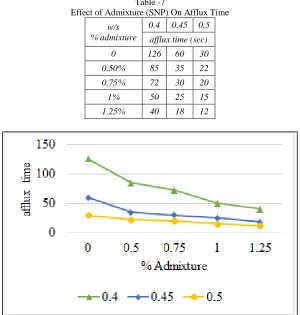
Table -7
Effect of Admixture (SNP) On Afflux Time w/s
% admixture
0.4 0.45 0.5
afflux time (sec)
0 126 60 30
0.50% 85 35 22
0.75% 72 30 20
1% 50 25 15
1.25% 40 18 12
Table -8
Effect of Admixture (SNP) On Bleeding Potential w/s
% admixture
0.4 0.45 0.5
% bleeding potential
0 2.4 2.8 3.2
0.50% 1.8 2.2 2.8
0.75% 1.4 1.9 2.4
1% 1.2 1.8 2.3
1.25% 1 1.5 2
Fig. 8: Graph - 8 Water/Solid Ratios to Afflux Time (Sec)
Fig. 10: Graph-10 water/ solid ratio to bleeding potential%
IV.
CONCLUSION
The compressive strength increases as dosage of admixture increases but addition of more than 0.75% dosage of admixture slightly strength decreases for 7 days and 28 days. In case of using 0.4 w/s ratio addition of 0.5% dosage of admixture found maximum strength on 28 days in type 3 curing condition. The afflux time of fresh grout mix design decreases as w/s ratio and dosage of admixture increases.
The bleeding potential decreases with increases of admixture dosages & increases with increases of w/s ratio.
REFERENCES
[1] M.s.shetty “Concrete technology” [2] E.Nonveller “Grouting theory and practice”
[3] A.V. Shroff and D. L. Shah, “Grouting technology in tunneling and Dam construction”, 1992, ISBN 81-204-0736-9, Oxford & IBH Publishing Co. Pvt. Ltd.
[4] IS 13935-2009 “seismic evaluation, repair and strengthening of masonry buildings - guidelines” [5] ASTM – c 476 “standard specification for grout masonry”
[6] ASTM-C 940-98A “Standard Test Method for Expansion and Bleeding of Freshly Mixed Grouts for Preplaced-Aggregate Concrete in the Laboratory.” [7] ASTM C939-94a, „Standard test method of flow of Grout for preplaced-aggregate concrete (flow cone method)‟ 470-471.
[8] J. Mirza, M.S. Mirza, V. Roy, K. Saleh “Basic rheological and mechanical properties of high-volume fly ash Grouts” Construction and Building Materials 16 (2002) 353–363.
[9] Costas A. Anagnostopoulos “Effect of different superplasticizers on the physical and mechanical Properties of cement grouts”
[10] Yu-you YANG, Jian-qiang WANG, Hai-jun DOU “Mechanical properties of anti-seepage grouting materials for heavy metal contaminated soil” Trans. Nonferrous Met. Soc. China 24(2014) 3316-3323.
[11] Burak Felekog‟lu “Optimization of self-compacting filling grout mixtures for repair purposes.” Construction and Building Materials 22 (2008) 660–667. [12] M. Jamal Shannag “High-performance cementations grouts for structural repair” Cement and Concrete Research 32 (2002) 803–808.