ISSN 0000 ©2014 WEJ Journal
Climate change adaptation strategies for sheep
production in range land of Kordofan Region
A. Idris
1, C. Kijora
2, F.M. El-Hag
3, A. M. Salih
4and Sayed Ali Fadul Elmola
51. Faculty of Natural Resources and Environmental Studies, Peace University, P.O. Box 20, El Fulla, Sudan. 2 . Department of Plant and Animal Sciences, Humboldt-University of Berlin, Philippstr.13, Building No. 9, 10115
Berlin, Germany.
3. Agricultural Research Corporation, El-Obeid Research Station, Box 429, El Obeid, Sudan. 4. Faculty of Animal Production, University of Khartoum, P.O. Box 32, Khartoum-North, Sudan.
5. Department of Rural Development, Faculty of Administrative, Economics & Social Sceinces, Unversity of West Kordofan
Corresponding author email: [email protected]
ABSTRACT :Climate changes had great impact on livestock production systems in semi-arid zone. The effect of climate change on the stock raised under traditional nomadic system, that involving to extensive seasonal migratory movements for search of water and pasture, the stock of thus subjected of combination of stress such as long journeys, extensive of heat, insufficient water supply, an scarcity and low nutritive quality of pasture particularly during the long dry season. This study was carried out to decrease the effect of long dry season on sheep productivity in north Kordofan state. A total of 340 ewes and 18 rams of desert sheep were selected from the nomadic herds, animals were divided randomly into four groups, group one was as farmer’s practice (not supplement) and the other three groups were supplemented. The breeding is controlled with application of “Kunan” during the breeding season (February to March). Supplementation in the dry season had improved the reproductive and productive performance of the ewes. Lambs borne from group one had less body weight gain. These results of the study indicated the importance of the nutritional status of the animals to adapt the effect of climate chances on rangeland by supplementation strategies during the long dry season, also the application of breeding control increased lambing % in the rainy season and growth rate of lambs was improved. The sududy showed that, supplementation and application ofKunanduring breeding season are very important strategies to adapt climate change in the rangeland of Kordofan.
Keywords:Climate change, desert sheep, supplementation strategies, productivity, North Kordofan State
INTRODUCTION
Livestock system play an important role in livelihoods in many rural communties in the Sudan. The desert sheep and their crosses make about 80 % of the sheep found in Sudan and mainly predominant north of 12º N (Devendra and Mcleroy, 1982), they are raised mainly under harsh dry land farming conditions for meat production (Khalafalla and Sulieman, 1992). The nutritional limitation, low nutritive value of the range, high ambient temperature, scarcity of feed and water are have great effect on the production of the sheep in semi arid area of Kordofan states as compared to that in temperate regions.
Livestock are particularly important for increasing the resilience of vulnerable, poor people, how are subject to climatic, market and desiease shocks, through diversifying risk and assets (Krisna etal,2004, freeman etal, 2008). There are many ways in which climate change may effect the livelihood, food security and health of vulnerable people through its effects on livestock and livestock systems. Such as changes in water and feed availblity changes in biodiversity and animal health (Thorntan etal, 2007,2009). climate changes could impact the economic viability of livestock production systems worldwide. Surrounding environmental conditions directly affect mechanisms and rates of heat gain or loss by all animals. Lack of prior conditioning to weather events most often results in catastrophic losses in the domestic livestock industry. This study was undertaken to reduce the impact of climate change on ewe's production and reproductive performance in rangeland of kordofan. The main ultimate objective was to introduce supplementation concept to nomadic herd owners in the dry season.
MATERIAL AND METHODS
Study area
The study was carried at Agricultural Research station, El-Obeid, North Kordofan state,(latitude11˚:15̀-16˚:30̀ N and longitudes 27˚-32˚ E ), Sudan.
Experimental work
A total of 340 desert ewes (1 to 6) years old reared in natural range condition were selected during the normal breeding season (February-March). Ewes were divided into four groups. One group (60 ewes) was used as a control (CTL) (like in farmer traditional practice). The second group (92 ewes) was supplemented with ration A (GNC), the third group (97 ewes) was supplement with ration B (GNC-M) and the fourth group (92 ewes) was supplemented with ration C (RS-M) (Table1). Supplementary feeding practices were imposed on ewes prior to mating (flashing) for 45 days and during late pregnancy (Steaming-up) for 45 days in the long dry season. Mature 18 rams introduced to all experimental ewes, the ratio of the sex were 1:20. All Rams were divided to 3, 5, 6 and for the first, second, third and fourth group respectively, and they were supplemented with same ration B (GNC-M). Rams were allowed to mix with the ewes twice daily: at 6:00 and 18:00 h.
Animals were then allowed to graze normally under range conditions. Ewes were offered 450 g / head of the ration every three days at the watering periods and the rams 600 g / head for three days, ewes fed in small groups in the watering points in period from 6:00 am to 9:00 am and rams were fed individually in the same period. Ewes were monitored for signs of behaviour estrous and those detected were serviced naturally, those returned to estrous were serviced again, ewes demonstrating were naturally mated twice daily at 6:00 and 18:00 h. The experiment extended to 330 days, including 15 days of adaptation period and feeding supplementation period 90 days.
Weight of dams was recorded during mating, mid-pregnancy and late-pregnancy time. The body condition score (BCS) was determined according to 1 to 5 scale (Russel 1991) and recorded in breeding, mid pregnancy and lambing period. The lambs were weighed after birth, then at 15, 30, 45,60,75,90,105 and 120 days of age. Born lambs were identified by ear tag to follow lamb growth rate every 15 days till 120 days of lamb age.
Control breeding by application of (Kunan)
The control of breeding is by tied the reproductive organs of the ram(Kunan),this is a common practice to control breeding which is usually carried out during (February -March) with subsequent lambing during autumn (July-September).This practice would ensure good grazing for lambs. However, weaned lambs may be exposed to long dry winter and summer period when agricultural by products and residues, especially groundnut seed cake and hay are widely used by sheep owners.
Statistical analyses
Data were analyzed by least square mixed model (Harvey 1990).
Analytical procedures
RESULTS
All treatments improved (P < 0.05) ewes BCS in mid pregnancy and at birth compared with farmers practice (Table 2). Ewes in first, second and the third parity number loss more (P < 0.05) condition in parturition than of their fourth and fifth parity. Sex of lamb and birth type had significant (P < 0.05) effect on ewes BCS, ewes born male lambs were lost more BCS than ewes born female lamb, dams born twins lost more BCS compared with that born single.
Table1. Chemical composition (g/kg dry matter) of the supplements and calculated energy content
Ingredients Ration A
(GNC)
Ration B (GNC-M)
Ration C (RS-M)
Molasses − 10 10
Roselle seeds 99 89 −
Groundnut seed cake − − 89
Common salt 0.75 0.75 0.75
Salt lick 0.25 0.25 0.25
Nutrient (g/kg DM)
Dry matter 941 940 942
Crude protein 557 504 303
Crude fibre 72 65 144
Crude fat 72 66 212
Ash 52 55 101
NFE 247 310 240
NDF 129 116 244
ADF 95 86 169
ADL 15 13 61
g Ca/ kg DM 0.73 0.74 2.16
g P/ kg DM 5.42 4.87 4.42
Energy density (ME, MJ/kg DM) 12.5 12.4 13.1
In vitro OM digestibility (%) 80.9 87.7 62.2
ME metabolizable energy calculated from literature values.
GNC Ground nut cake; GNC-M Ground nut cake and Molasses; RS-M Roselle seeds and Molasses; CTL Control
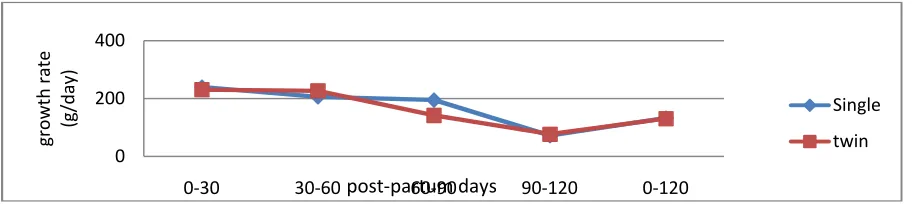
Pre-partum supplementation of the dams had significant (P<0.05) effect on lamb daily growth rate (Table 3). In general, ewes' pre-partum supplementation improved lambs daily growth rate and there were significant (P< 0.05) difference in lamb growth before and after weaning. lambs whose dams were supplemented with RS-M had slightly higher growth rates, also the study revealed that supplementation had no significant (P> 0.05) effect on lambs growth rate in the intervals 90-120 days of age(after weaning). Type of birth and sex had significant effect on daily lamb growth rate (figure 1 and 2), also dam parity had significant effect on lamb growth rate (figure 3).
Table 4 presents the effect of pre-partum supplementary feeding on lamb weight from birth to 120 days of age. During long dry period, supplemented dams had heavier (P<0.05) lambs weight than the farmer practice (control), dams supplemented with GNC significantly had (P<0.05) heavier lambs at 120 days than those supplemented with GNC-M and RS-M. Dam parity had significant effect on lamb birth weight; late parties were significant difference from the other parties’. Type of birth had significant (P < 0.05) effect on birth weight and over all age period, single lambs were significantly heavier than twins. Male lambs recorded significantly (P < 0.05) heavy weight at birth to 120 days of age than female lambs.
0 200 400
0-30 30-60 60-90 90-120 0-120
gro
w
th
ra
te
(g/d
ay
)
post-partum days
Figure 2. Effect of sex on lamb growth rate (g ⁄day).
Figure 3. Effect of parity number on lamb growth rate (g ⁄day).
DISCUSSION
In lambing season, the BCS was reduced in the animals. During this period the nutritive value of the forage are low and the supplements are not enough for ewe maintenance and fetal growth .Under such conditions, it would be expected that the ewes would have used their body reserves to meet the increased nutrients demand for final fatal growth. Concentrate supplementation might also decrease the loss of body reserves. These are similar with results of Sairanenet al(2006) and. In late gestation, ewes on farmer's practice were grazed on fibrous forage of low nutritive value without any concentrate supplementation.
Inadequate feed intake during late pregnancy has been found to cause a reduction in birth weight, mammary gland development and milk production. Similar results were obtained by Mellor and Murray (1985). Lambs whose mothers were treated with supplementation had higher body weight than lambs suckling control ewes; this explanation is in line with findings of Rafiq et al (2006). Dam parity had an influence on lamb birth weight, lambs born on fifth parity recorded heaviest weight than the other parities and ewes on fourth parity born had lightest lambs. The results also indicated that, dam parity had no significant effect (P > 0.05) on lamb weight in the interval, 15 days to 120 days; this may be due that lactation curve.
In this study sex of lamb had significant (P < 0.05) effect on lamb weight, single lambs recorded heavier weight than twins and male lambs were heavier than female lambs, these results are in general agreement with research workers, Hassen et al (2002). On the contrary El-Toum (2005) indicated that, Lambs sex had no significant effect on lamb weight at birth, 45, 60 and 75 days of age. Similar results were obtained by Schoemanet al(1993). Type of birth had significant effect on lamb weight at birth and over all age period, similar results were obtained by Cloeteet al.(2007). Ewes' pre-partum supplementation improved lambs growth rate before weaning (0-90). Hence lambs born to ewes with supplementation had highest growth rate than those suckling non supplemented ewes (framer's practice), Supplementation of pregnant ewes during late gestation may provide adequate energy and protein to support maintenance of animal.
0 50 100 150 200 250
0-30 30-60 60-90 90-120 0-120
gr
ow
th
rat
e
(g
/d
ay
)
post-partum days
Male Female
0 100 200 300
0-30 30-60 60-90 90-120 0-120
gro
w
rh
ra
te
(g/d
ay
)
post-partum days
Table 2. The main effect of supplementation and Parity Number on body condition score (mean± S.E) of desert ewes at different physiological states.
Factor
BSC at mating BSC at mid pregnancy BSC at lambing
Treatment
GNC 2.6±0.04c 2.6 ±0.05a 2.3±0.07a
GNC-M 2.9±0.04ab 2.7±0.05a 2.2±0.06a
RS-M 2.9±0.04ab 2.6±0.06a 2.0±0.08b
CTL 2.8±0.05bc 2.5±0.07b 2.1±0.10b
Dam parity
Primiparous 2.9±0.04a 2.7±0.07ab 2.1±0.07
2nd parity 2.7±0.05bc 2.5±0.06c 2.2 ±0.08
3rd parity 2.8 ±0.03b 2.6±0.04ab 2.0±0.05
4th parity 2.7±0.04c 2.5±0.06c 2.1±0.07
5th parity 2.7±0.07bc 2.6±0.09ab 2.3±0.12
overall mean 2.8±0.01 2.6±0.02 2.2±0.02
abc
means in the same column bearing different superscripts are significantly different (P<0.05)
GNC Ground nut cake; GNC-M Ground nut cake and Molasses; RS-M Roselle seeds and Molasses CTL Control. N; Number of animals
Table 3. Effect of pre-partum supplementary feeding on lamb growth (mean ±S.E) g ⁄day.
Treatment 0–30 days 30–60 days 60–90 days 90–120 days 0–120 days
GNC 229 ± 16a 204 ± 22b 182± 16a 71 ± 13 127 ± 6a
GNC-M 225 ± 17a 204 ± 23b 173 ± 17ba 79 ± 14 125 ± 6a
RS-M 226 ± 18a 229 ± 25a 156 ±18c 70 ± 15 130 ± 7a
CTL 217 ± 19b 189 ± 26c 168 ±19abc 77 ± 16 116 ± 7c
abc
means in the same column bearing different superscripts are significantly different (P<0.05) GNC Ground nut cake; GNC-M Ground nut cake and Molasses ; RS-M Roselle seeds and Molasses
; CTL Control abc
means in the same column bearing different superscripts are significantly different (P<0.05)
GNC Ground nut cake; GNC-M Ground nut cake and Molasses; RS-M Roselle seeds and Molasses; CTL Control.
Table 4. The effect of treatments, dam parity, Birth type and the sex on weight growth of the lambs (mean ±S.E) Kg.
Treatment Birth weight 15 days 30 days 45 days 60 days 75 days 90 days 105 days 120 days
GNC 3.6 ± 0.1a 7.2 ± 0.27a 10.5 ± 0.64a 13.2 ± 0.6a 16.1 ± 0.6a 19.2 ± 0.8a 22.1 ± 0.7a 26.0 ± 0.8a 28.3 ± 0.9a GNC-M 3.6 ± 0.1a 6.9 ± 0.3a 10.5 ± 0.7a 13.2 ± 0.6a 16.5 ± 0.6a 18.9 ± 0.7a 21.2 ± 0.7a 23.2 ± 0.8a 26.4 ± 0.9b RS-M 3.6 ± 0.1a 7.0 ± 0.3a 10.2 ± 0.7a 13.6 ± 0.6a 16.8 ± 0.7a 19.6 ± 0.8a 21.2 ± 0.8a 23.9 ± 0.8a 26.1 ± 0.8b CTL 3.0 ± 0.2b 5.8 ± 0.4b 9.0 ± 0.9b 11.1 ± 0.9b 13.4 ± 1.0b 16.4± 1.1b 18.8 ± 1.1b 21.7 ± 1.1b 24.1 ± 1.0c Dam parity
Primiparous 3.6 ± 0.2abc 6.8 ± 0.3 10.6 ± 0.7 12.6 ± 0.6 15.8 ± 0.7 18.6 ± 0.8 21.0 ± 0.8 23.4 ± 0.8 26.0 ± 0.9
2ndParity 3.6 ± 0.2ac 7.0 ± 0.3 10.0 ± 0.8 13.7 ± 0.8 15.7 ± 0.8 18.5 ± 1.0 20.5 ± 0.9 23.5 ± 1.1 26.3 ± 1.1
3rdParity 3.3 ± 0.1ab 6.7 ± 0.2 9.6 ± 0.6 12.6 ± 0.5 15.8 ± 0.6 18.9 ± 0.7 20.9 ± 0.7 23.2 ± 0.7 25.6 ± 0.7
4thParity 3.4 ± 0.1b 7.0 ± 0.3 10.4 ± 0.7 13.0 ± 0.6 16.0 ± 0.7 18.6 ± 0.8 21.0 ± 0.9 23.9 ± 0.8 26.3 ± 0.9
5thParity 3.5 ± 0.2c 6.2 ± 0.5 9.7 ± 1.1 12.1 ± 1.0 15.3 ± 1.1 18.1 ± 1.3 20.7 ± 1.3 24.5 ± 1.3 27.7 ± 1.2
Birth type
Single 3.6 ± 0.08a 7.2 ± 0.2a 11.1 ± 0.4a 14.1 ± 0.3a 17.3 ± 0.4a 20.4 ± 0.4a 23.4 ± 0.4a 25.5 ± 0.4a 27.9 ± 0.40a Twin 3.3 ± 0.18b 6.2 ± 0.4b 9.0 ± 0.9b 11.5 ± 0.8b 14.1 ± 0.9b 16.6 ±1.0b 18.3 ± 1.0b 21.9 ± 1.1b 24.7 ± 1.2b Sex of lamb
Physiological needs mammary gland growth, colostrums and milk yield. This result was in line with findings of Oeak et al (2005). In this study, higher growth rates in lambs suckling supplemented ewes are expected to increase milk production as supported by observations by Rafiq et al (2006). Supplementation had no effect on lambs' growth rate after weaning (90-120 days of age). This may be due to the short lactation period of the desert sheep. The sex had no effect on lambs' growth rate in the intervals 90-120 days of age. Similar results were obtained by El-Hag et al (2001). Male lambs indicated higher growth rate only in the interval 60–90 days.
CONCLUSION AND RECOMMENDATION
The study indicated that, flushing and steaming-up during breeding period improved the body condition and lambs born from supplemented ewes recoded better production characteristic compared with farmer's practice. The study indicated the importance of the nutritional status of the nomadic ewes at mating and supplementation reduced the effect on the climate chance on productive and reproductive performance. Supplementation and application of Kunan during breeding season are very important strategies to adapt climate change in the rangeland of Kordofan.
ACKNOWLEDGEMENTS
The authors wish to thank Baballa El-Faki, Abdalla Fadllalmula, Hassan Yassen, G.Khair, Sarsor, G and Hella,
REFERENCES
AOAC. 1995. Association Official Analytical Chemical Methods of Analysis .16th endo.,AOAC INTERNATIONAL .Arlingoton,USA.
Cloete JJE, Cloete SWP, Olivier JJ, Hoffman LC. 2007. Terminal crossbreeding of Dorper ewes to Ile de France, Merino Landsheep and SA Mutton Merino sires: Ewe production and lamb performance. Small Ruminant Research 69, 28–35.
Devendra C, Mcleroy GB.1982. Goats and sheep production in the tropics .London Longman Singapore Publishers, London.
El-Hag FM, Fadlalla B, Mukhtar HK.2001. Some production characteristics of Sudan Desert sheep under range conditions in North Kordofan. Sudan. Tropical Animal Health and Production 33, 229-239.
El-Toum A.2005. Effect of pre-partum supplementary feeding on desert ewe productivity under rangelands in north Kordofan, Sudan. M.Sc. Thesis, University of Khartoum.
Goering H, Van Soest P. 1991. Nutritional aspect of dietary fibres. Animal Feed Science Technology 32,143 - 158. Harve WR.1990.Use guide for LSML (Least square maximum Likelihood) Computer Program.Ohio,USA.pp.157. Harvey WR.1990. User guide for LSML (Least Squares Maximum Likelihood) computer program. Ohio, USA. pp. 157.
Hassen Y, Sölkner J, Gizaw S, Baumung R. 2002. Performance of crossbred and indigenous sheep under village conditions in the cool highlands of central-northern Ethiopia: growth, birth and body weights. Small Ruminant Research 43,195-202.
Khalaffala AM, Sulieman YR.1992. Some observations on reproductive traits in the flock of Sudan Desert sheep. Sudan Journal of Animal production 5, 81− 86.
Mellor DJ, Murray I.1985. Effects of maternal nutrition under development during pregnancy on colostrums production in Scottish Black face ewes with twin lambs. Research Veterinary Science, 39:230 -234.
Mukhtar HK. 1985. Constrains of desert sheep production in the sedentary and nomadic systems of north Kodofan .In : M.E.Lazim (ed.) Annual Research Report ( 1984-85 ) ElObied Research Station, Agricultural Research Corporation (ARC), Wad Medani, Sudan .pp 40 –55. Oeak N, Cam MA, Kuran M.2005. The effect of High Dietary protein levels during late gestation on colostrums yield and lamb survival rate in
singleton-bearing ewes. Small Ruminant Research 56, 89-94.
Owen JG, Norman GA, Fisher IL, Frost RA.1977. Studies on the meat production characteristics of Botswan goats and sheep .part 1.Sampling ,methods and materials, and measurements on the live animals .meat Science, 1:63- 69.
Rafiqa M, Mumtazb S, Akhtar N, Khana MF.2006. Effect of strategic supplementation with multi-nutrient urea molasses blocks on body weight and body condition score of Lohi sheep owned by tenants of Pakistan. Small Ruminant Research 61, 29–38.
Russel A.1991. Body condition score of sheep,In:E.Boden (Ed.) sheep and Goat practice. P3.Bailliere Tindall, Philadelphia.
Sairanen A, Khalili H, Virkaja¨rvi P.2006. Concentrate supplementation responses of the pasture-fed dairy cow. Livestock Science 104, 292– 302.
Schoeman SJ, De Wet R, Van der Merwe CA. 1993. Assessment of the reproductive and growth performance of two sheep composites, developed from the Finnish Landrace, compared to the Dorper. South Africa Journal of Animal Science 23, 207-210