Determining Formability Function of Worsted Woven
Fabrics in Terms of Fabric Direction
Nazanin Ezazshahabi,PhD, Fatemeh Mousazadegan, PhD, Siamak Saharkhiz, PhD, Masoud Latifi, PhD
Textile Engineering Department, Textile Excellence & Research Centers, Amirkabir University of Technology, Tehran, IRAN
Correspondence to:
Siamak Saharkhiz email: [email protected]
ABSTRACT
Formability is a characteristic which determines fabric behavior during garment manufacturing and wear. It depends on fabric properties such as weave type, fabric density, warp and weft yarn twist, bending rigidity, and fabric tensile behavior, while tolerating small load values. It should be noted that this property changes with fabric direction and is not constant. In this research, fabric formability was investigated for worsted woven fabrics by evaluating this property in various fabric directions. It was concluded that fabric formability could be expressed as a Gaussian function of sample orientation in the warp direction. By studying several weave structures with different weft densities, the effect of firmness on fabric formability was clarified, which lead to better interpretation of fabric adaptability to the applied deformations.
Keywords: Fabric formability; Fabric direction; Bending rigidity; Extension; Weave structure
INTRODUCTION
Fabric mechanical properties have important
influence on fabric behavior during garment manufacturing and final product appearance. Fabric formability is a property which determines its behavior during sewing and its form during wear. Fabric formability as defined by Linberg et al. (1960) is the maximum value of fabric in-plane compression that can be tolerated before buckling [1].
De Boos et al. (1996) tried to modify fabric formability through finishing process by increasing fabric extensibility. However, fabric bending rigidity which influences hand of fabric should remain constant [2]. Fan et al (1997) studied causes of fused parts’ surface distortion in a garment, and their results show that rippling degree depends on differential shrinkage, fabric formability, extensibility, or compressibility of outer fabric and fusible interlining and bond strength [3]. Kim et al. (1998) examined suitability of nonwoven fusible
investigated the influence of fabric properties and sewing parameters on seam puckering formation. Their results demonstrate that fabric properties affect sewn fabric appearance considerably compared to sewing parameters; and among various fabric’s properties, fabric bending rigidity and formability are the determinant factors [12].
In this study, we analyzed the influence of fabric parameters such as weave structure and fabric density on fabric formability. As it is important to study the trend of formability variation against fabric direction, the aim of this investigation was to measure and analyze fabric formability in order to develop a precise function of formability in the terms of fabric direction.
EXPERIMENTAL WORK Material
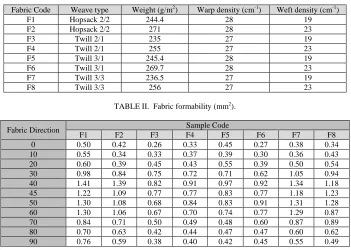
This study was carried out to discover detailed information about the formability of worsted woven fabrics in several directions of specimen. In this regard, eight various worsted woven fabrics with different weave structure and density were used. Fabric yarns in both warp and weft directions were 40/2 Nm comprised of 45/55 wool-polyester. The specifications of samples are shown in Table I. Test Method
Fabric formability depends on fabric bending rigidity and extension in case of small load values [1]. In this regard, the formability can be calculated by Eq. (1) which is proposed in the FAST system.
7 . 14 ) 5 ( ) 20
( gcm Ext gcm Ext B F − × = (1) Where:
F : Fabric formability B: Bending rigidity
Ext: Fabric extension during exertion of specific
load values.
In order to calculate fabric formability, it is necessary to measure bending rigidity and extension by applying small forces specified by the FAST testing
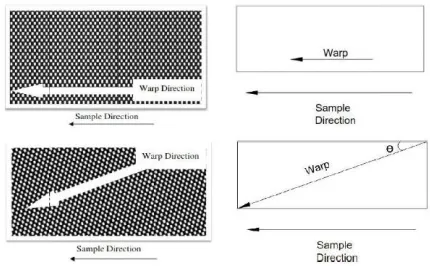
FIGURE 1. Fabric Direction.
It should be noted that 0 and 90 degree means the warp and weft directions, respectively. It is apparent that 10 degree is used as degree interval. However, fabric properties are measured at 45 degrees as well, since this direction is an influential degree and kind of turning point in fabric properties. Fabric bending and extension values were obtained using five samples. A Shirley Stiffness Tester was used to find bending length and bending rigidity, according to ASTM D1388 standard test method. Fabric bending rigidity was calculated by Eq. 2.
3
C W
B= × (2)
Where:
W : Fabric weight per unit area C: Bending length
To analyze extension behavior of fabric, a tensile testing machine (Instron 5566) was used. Gauge length was set at 100mm, and pre-load equal to 20% of fabric weight was used to obtain more precise results.
Fabric extension at 5 g/cm and 20 g/cm was found in accordance to the FAST method, and fabric formability was calculated using Eq. (1). The results of fabric formability in each direction can be observed in Table II.
RESULTS AND DISCUSSION
As fabric is a non-isotropic material, its mechanical behavior is not similar in various directions. This
Bending Rigidity Behavior in the Terms of Fabric Direction
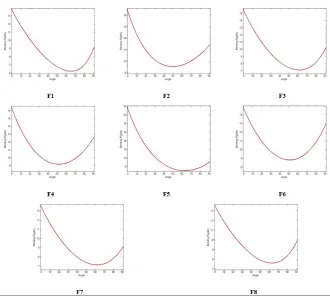
As was mentioned before, bending rigidity in each fabric direction is calculated based on fabric bending
length. The results of bending rigidity in the term of fabric angle towards warp direction are shown in
Figure 2. TABLE I. Specifications of the worsted fabrics.
Fabric Code Weave type Weight (g/m2) Warp density (cm-1) Weft density (cm-1)
F1 Hopsack 2/2 244.4 28 19
F2 Hopsack 2/2 271 28 23
F3 Twill 2/1 235 27 19
F4 Twill 2/1 255 27 23
F5 Twill 3/1 245.4 28 19
F6 Twill 3/1 269.7 28 23
F7 Twill 3/3 236.5 27 19
F8 Twill 3/3 256 27 23
TABLE II. Fabric formability (mm2).
Fabric Direction Sample Code
F1 F2 F3 F4 F5 F6 F7 F8
0 0.50 0.42 0.26 0.33 0.45 0.27 0.38 0.34 10 0.55 0.34 0.33 0.37 0.39 0.30 0.36 0.43 20 0.60 0.39 0.45 0.43 0.55 0.39 0.50 0.54 30 0.98 0.84 0.75 0.72 0.71 0.62 1.05 0.94 40 1.41 1.39 0.82 0.91 0.97 0.92 1.34 1.18 45 1.22 1.09 0.77 0.77 0.83 0.77 1.18 1.23 50 1.30 1.08 0.68 0.84 0.83 0.91 1.31 1.28 60 1.30 1.06 0.67 0.70 0.74 0.77 1.29 0.87 70 0.84 0.71 0.50 0.49 0.48 0.60 0.87 0.89 80 0.70 0.63 0.42 0.44 0.47 0.47 0.60 0.62 90 0.76 0.59 0.38 0.40 0.42 0.45 0.55 0.49
It is obvious that bending rigidity of all samples has similar trend and it depends on fabric direction or angle towards warp direction following Eq. (3):
) (θ
B
B= (3)
Where
θ: Angle to warp direction
According to Figure 2, it can be claimed that variation of bending rigidity in the term of angle is kind of exponential function. By application of the curve-fitting toolbox of MATLAB software, it was found that bending rigidity alteration could be found from Eq. (4):
θ
θ ebBi
Bi a n i
B ∑
= =
1 )
( (4)
,.... 2 , 1 =
i
Where:
Bi b Bi
a , : Constant values, which depend on fabric properties
The results of curve fitting for bending rigidity variation are shown in Figure 3.
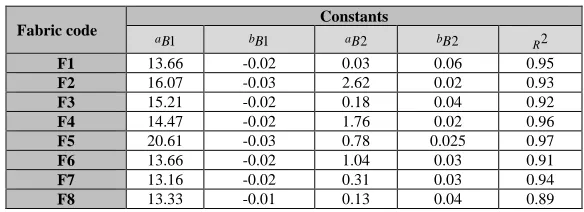
It was noticed that bending rigidity variation in all fabric samples, follow an exponential trend. In addition, a good correlation for bending rigidity values can be achieved. The values of constants are summarized in Table III.
TABLE III. Bending rigidity equation constants.
Extension Behavior in the Terms of Fabric Direction
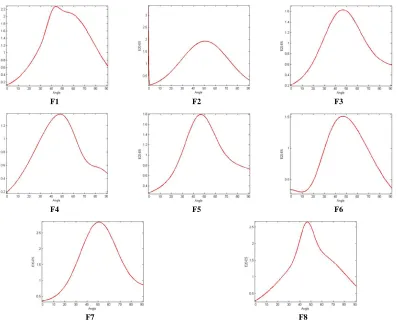
In order to assess fabric formability, its tensile behavior while bearing small magnitudes of load should be considered. According to Eq. (1), fabric extension in case of loads 5 and 20 g/cm was measured and their differences computed. Variation of extension difference in the term of fabric direction is gathered in Figure 4.
Based on Figure 4, it is clear that fabric tensile behavior or in other words, its extension differences under low loads, changes considering fabric orientation towards the warp direction (Eq. (5)). Although there are some defects on the experimental data which can be assigned to tests errors, it was interesting to declare that its trend is approximately symmetric around angle 45 degrees. This means that its variation possibly can be stated by the Gaussian distribution function which has a symmetric shape.
) (θ
Ext
Ext= (5)
Where:
Ext: Extension differences under loading condition
of 5 and 20g/cm.
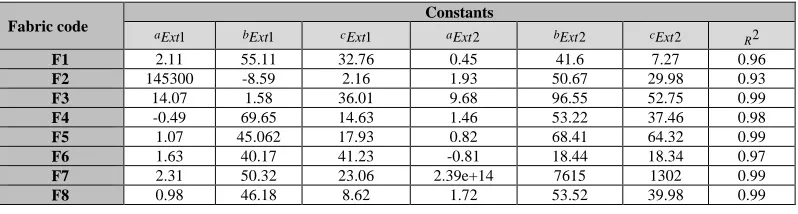
The MATLAB curve-fitting toolbox was applied and it was found that variation of extension differences in the term of angle towards the warp direction could be stated by the Gaussian function with high correlation (Eq. (6)). ∑ = − = n i Exti b Exti c e Exti a Ext 1 2 ) ( ) (θ θ ,.... 2 , 1 = i (6) Where: Exti c Exti b Exti
a , ,
: Constant values depending on fabric properties
The results of the curve-fitting process for extension differences are shown in Figure 5.
As is clear in Figure 5, the results of the curve fitting process confirm that extension differences of fabric is a Gaussian function in the term of fabric direction. Moreover, when i=2, there is a good correlation between extension differences and fabric direction. The values of equation constants are gathered in
Table IV.
According to the Table IV there is high correlation (more than 93%) between extension differences and curve fitting results. This reveals that fabric extension trend considering angle towards warp direction, follows Gaussian functions.
Fabric code Constants
1
B
a bB1 aB2 bB2 R2
F1 F2 F3
F4 F5 F6
F7 F8
FIGURE 4. Variation of extension differences in the term of fabric direction.
F1 F2 F3
TABLE IV. Values of constants for extension difference.
Formability Behavior in the Terms of Fabric Direction
As was mentioned earlier, fabric formability is calculated by Eq. (1) and its results are shown in
Table II. Fabric formability values rely on extension differences during application of small load values,and bending rigidity, so based on Eq. (4) and Eq. (6), they demonstrate Gaussian and Exponential functions of fabric direction, respectively. Therefore, it was anticipated that fabric formability has the Gaussian or Exponential tendency. The results of fabric formability variation in each direction are shown in Figure 6.
In Figure 6, it is seen that fabric formability variation is close to Gaussian behavior which is approximately symmetric around 45 degrees (Eq. (7)).
) (θ
F
F = (7)
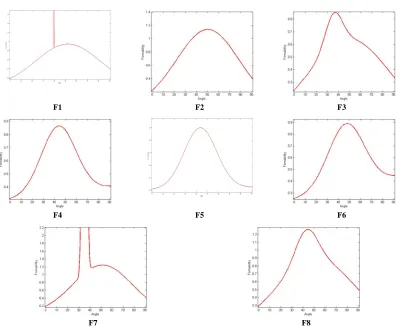
By means of the Matlab curve-fitting toolbox, it was concluded that fabric formability could be expressed by the Gaussian function, which is in accordance with our expectation. Fabric formability function in terms of angle to warp direction is shown in Eq. (8).
∑ = − = n i Fi b Fi c e Fi a F 1 2 ) ( ) (θ θ ,.... 2 , 1 = i (8) Where: Fi c Fi b Fi
a , , : Constant values, which depend on
fabric properties
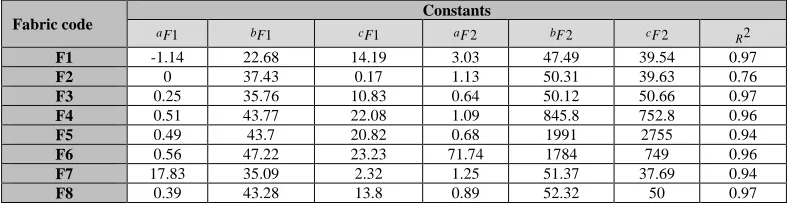
The outcome of curve fitting for fabric formability is provided in Figure 7. It is shown in Figure 7 that formability of fabric in terms of fabric direction has a Gaussian tendency except for samples F1 and F7, which have some discontinuity in their shape which may be caused by test errors. Similarly, there is a good correlation between formability values and curve fitting results regarding fabricdirection.
The values of equation constants are collected in
Table V. Which reveals that fabric formability in each orientation towards the warp direction, pursue Gaussian functions.
Fabric code Constants
1
Ext
a bExt1 cExt1 aExt2 bExt2 cExt2 R2
F1 2.11 55.11 32.76 0.45 41.6 7.27 0.96
F2 145300 -8.59 2.16 1.93 50.67 29.98 0.93
F3 14.07 1.58 36.01 9.68 96.55 52.75 0.99
F4 -0.49 69.65 14.63 1.46 53.22 37.46 0.98 F5 1.07 45.062 17.93 0.82 68.41 64.32 0.99 F6 1.63 40.17 41.23 -0.81 18.44 18.34 0.97 F7 2.31 50.32 23.06 2.39e+14 7615 1302 0.99
F1 F2 F3
F4 F5 F6
F7 F8
FIGURE 6. Variation of fabric formability in different directions.
F1 F2 F3
TABLE IV. Values of constants for formability.
CONCLUSION
Fabric as the main part of garments determines its behavior during manufacturing and wear and significantly affects garment aesthetic quality. According to the Linberg definition, fabric formability is the product of bending rigidity and tensile behavior. Since fabric is woven from warp and weft yarns, their interlacing points change from warp direction to weft direction and can affect its behavior. Because fabric is a non-isotropic material and due to its construction, mechanical properties like bending rigidity and tensile behavior vary in different directions. According to Eq. (4) and Eq. (6), it was found that these characteristics could be stated in term of sample angle (angle between warp direction and sample cutting direction). By substituting Eq. (4) and Eq. (6) in Eq. (1), fabric formability can be found from Eq. (9).
(9)
i=1,2,…
Simplification of Eq. (9) leads to Eq. (10):
(10)
Based on Eq. (10) it was found that multiplication of bending rigidity and tensile behavior under low loads, present a Gaussian function as it was stated before in Eq. (8).
It was found that in all samples, fabric stiffness follows an Exponential function, while tensile behavior and formability pursue a Gaussian function and there is a turning point in fabric behavior at about the 45 degree direction.
REFERENCES
[1] Linberg, J.; Waesterberg, L.; Svenson, R., "Wool Fabrics as Garment Construction Materials", Journal of Textile Institute, 51, 1960, pp 475-493.
[2] De Boos, A.G.; Roczniok, A.F., "Engineering the Extensibility and Formability of Wool Fabrics to Improve Garment Appearance",
International Journal of Clothing Science and Technology, 8(5), 1996, pp 51-59.
[3] Fan, J.; Leeumner, W., "The Causes and Prevention of Rippling or Localized Delamination in Fused Garment Parts",
International Journal of Clothing Science and Technology, 9(3), 1997, pp 228-235. [4] Kim, S.J.; Kim, K.H.; Lee, D.H.; Bae, G.H.,
"Suitability of Nonwoven Fusible Interlining to the Thin Worsted Fabrics", International Journal of Clothing Science and Technology, 10(3/4), 1998, pp 273-282.
[5] Giorgio Minazio, P., "The Fabric Pressing Performance and Its Role in Predicting the Appearance of Men’s Wool Suit Jackets",
International Journal of Clothing Science and Technology., 10(3/4) , 1998, pp 182-190. [6] Wang, G.; Postle, R.; Zhang, W., "Tailorability
of Lightweight Wool and Wool-blend Fabrics", Journal of Textile Institute., 94(3/4) , 2003, pp 212-222.
[7] Hui, C.L.; Ng, S.F., "A New Approach for Prediction of Sewing Performance of Fabrics in Apparel Manufacturing Using Artificial Neural Networks", Journal of Textile Institute, 96(6), 2005, pp 401-405.
[8] Zhang, P.; Liu, X.; Wang, L.; Wang, X., "An Experimental Study on Fabric Softness Evaluation", International Journal of Clothing Science and Technology. 18(2), 2005, pp 83-96.
[9] Behara, B.; Mishera, R., “Effect of Crease Behavior, Drape and Formability on Appearance of Light Weight Worsted Suiting Fabrics", Indian Journal of Fiber and Textile Research, 32, 2007, pp 319-325.
Fabric code Constants
1
F
a bF1 cF1 aF2 bF2 cF2 R2
F1 -1.14 22.68 14.19 3.03 47.49 39.54 0.97
F2 0 37.43 0.17 1.13 50.31 39.63 0.76
F3 0.25 35.76 10.83 0.64 50.12 50.66 0.97 F4 0.51 43.77 22.08 1.09 845.8 752.8 0.96
F5 0.49 43.7 20.82 0.68 1991 2755 0.94
F6 0.56 47.22 23.23 71.74 1784 749 0.96
F7 17.83 35.09 2.32 1.25 51.37 37.69 0.94
[10] Alamdar Yazdi, A.; Bidoki, S.M., "The Effect of Yarn Twist Direction on the Formability of Woven Fabrics", Journal of Textile Institute, 101(8), 2010, pp 739-745.
[11] Doustar, K.; Shaikhzadeh Najar, S.; Maroufi.M, "The Effect of Fabric Design and Weft Density on Bagging Behavior of Cotton Woven Fabrics", Journal of Textile Institute, 101(2), 2010, pp 135-142.
[12] Ah Kim, H.; Jin Kim, S., "Seam Pucker and Formability of the Worsted Fabrics", Fibers and Polymers, 12(8), 2011, pp 1099-1105.
AUTHORS’ ADDRESSES Nazanin Ezazshahabi, PhD Fatemeh Mousazadegan, PhD Siamak Saharkhiz, PhD Masoud Latifi, PhD
Textile Engineering Department Textile Excellence & Research Centers Amirkabir University of Technology, No. 454 Hafez Ave.