Surveying the effect of brand equity dimensions on
customer response (case study: Pegah Guilan Dairy
company of Guilan province)
Froogh PoorAmiri Helestani
1, Mostafa Ebrahimpour
21. M.A. Student of Business Management, Rasht Branch, Islamic Azad University, Rasht, Iran 2. Assistant Professor, Department of Business Management, University of Guilan, Rasht, Iran
ABSTRACT: Companies which have higher brand equity can develop their brand successfully. Powerful support that brand equity of transferring knowledge related to the product to others and the effect that has on emotions of consumers, directly affects attitude of consumers toward developing brand. Therefore current research considers the effect of dimensions of brand equity on customer response. Current research is descriptive and regarding goal it is applied. Regarding data collection it is counted field. For achieving research goals, customers of the product of Pegah Dairy Company in Rasht city have been considered. Applied sampling method at choosing sample in doing research is available improbable sampling method. For data collection standard questionnaire has been used. Scale of measuring items in questionnaire is 5-item likert spectrum from totally agree to totally disagree. Validity of questionnaire has been considered by viewpoint of professors and experts and its reliability was confirmed by using cronbach alpha. For analyzing obtained data and testing hypothesis structural equation modeling has been used. The result of cause model test of research indicates that awareness of brand affects brand association and perceived quality. Also the effect of brand association and perceived quality on loyalty to a brand and brand equity and also effect of loyalty to a brand on brand equity was confirmed. Also it was distinguished that brand equity affects brand development, tendency to additional payment, brand preference and tendency to shopping. Finally the effect of brand preference on tendency to shopping was confirmed. Generally the result of this research shows that applied model in current research, predicted brand equity very well and helps managers and authorities of industries at identification and writing proper strategies for affecting and penetration of brand among customers.
Key words: brand equity, consumer’s response, Pegah dairy company, brand development, brand
preference.
Problem statement
In the early years of establishing pegah company there wasn’t many competitors. Pegah Companyhas produced its product at massive level and in the form of standard and due to severe need of market, customers who absorbed by products rapidly. Therefore a company acted as a powerful arm of producing dairy products. Sale and market share of this company has got increasing process but these success encompassed success of Pegah Company by entering of competitors. Sale of the company has deteriorated and it has lost important part of its market and therefore competitors devoted great part of success of Company’s success. Competitors by presenting various products with different marks and better quality and proper price could direct many customers of Pegah toward themselves. By entering of competitors of dairy companies and variety of products and sale marks, market share and loyalty of customers of Pegah Company was exposed to threat. The most important problem that Pegah Company is facing now is more related to the process of consumer response and factors related to the process of shopping. Therefore the main question of current research is that if brand equity dimensions affect consumer’s response in Pegah dairy companies of Guilan province?
Research hypothesis
H1: awareness of brand affects perceived quality.
H2: awareness of brand affects brand association.
H3: perceived quality affects loyalty to a brand.
87
H5: brand equity affects brand loyalty.
H6: brand association affects brand equity.
H7: loyalty to a brand affects brand equity.
H8: brand equity affects developing brand.
H9: brand equity affects tendency to additional payment for brand.
H10: brand equity affects band preference. Hypothesis 11: brand equity affects tendency to shopping.
Hy12: brand preference affects tendency to brand shopping.
Research theoretical principles
Nowadays constructing strong brand due to great advantage that it creates has become priority of marketing of many organizations. Strong brands for a company creates an identity in the market. In total value measurement of a brand, marketing researchers start assessing concept of brand equity that say total equity that a brand name brings for producer, retailer and customers. Brand equity is the result of perception of customers about a brand that is affected by many factors. Therefore increasing brand equity includes increasing perception of customers of the quality of a product that is consumed (Yasin et al, 2007).
Nowadays the concept of brand includes all things that a product or service presents, such as how a product is felt or forms thought of customers. In fact a brand is a commitment for presenting value to customers (Roli, 2007).
Weak brands due to being unknown and little volume of sale are endangered dually by stronger brands. as firstly its purchasers is less and secondly these less purchasers have more limited loyalty and repeat of purchasing, therefore the loss resulted from these brands becomes multiple(Miler and Mour, 2006, 100).
Tangible and intangible features that are companion of name, logo or fame of a brand, makes perceptional equity of good consumption and services of that brand less or more in the view of customers. When this process is positive brand equity enhances, otherwise brand has negative equity. In other word when brand equity is low, the cost that a customer pays for good or service is higher than equity that a customer gives for that food or service and vice versa, when brand equity is high, a customer willingly pays the cost of that good and services, because the combination of tangible and intangible good or service of that brand has equity of requesting cost for a customer (Giler, 2007).
Brand equity has significant effect on tendency of customers to additional payment for a product. As it increases price elasticity of consumers and consumers tend to pay higher price. Because they perceive unique equity in the product that other replacing products don’t provide such equity. On the other hand companies that have higher brand equity can develop their brand successfully. Powerful support that brand equity does for transferring knowledge related to the products to others and the effect that has on emotions of customers, directly affects customers’ attitude toward brand development. Also brand equity has also affected purchase of customers. Available literature indicates that stronger brands with higher brand equity obtain higher preferring evaluation and proper to this subject customers tend more to purchasing brand (Boyel and Martinz, 2013).
Any research needs a theoretical framework. Theoretical framework is the basis on which all researches are located (Khaki, 2003, 163). By this interpretation, research conceptual model is taken from the model in the research of “Boyel et al” (2013) is as below:
88 Perceived quality: it means customers’ perception of total quality or preference of a good or service toward customer’s desire to replacing it for perceiving perceived quality (Peyk et al, 2010).
Brand awareness: one aspect of brand equity is awareness and visibility of name and trade mark. Findings shows that people tend to purchase familiar name because they feel more comfortable with familiar names (Broylez and Ligpibol, 2010).
Loyalty to a brand: loyalty to a trade mark and name can be defined as the degree of positive attitude that a customer has toward a trade mark and name and the degree of his adherence to the mentioned mark and name and the intention to purchase in the future (Hosseini et al, 2009).
Brand association: Brand association is defined as especial meaning of a brand and also means assets that are attached implicitly to a brand. This variable is assessed by indices such as brand personality, honesty and reliance, organizational association (social responsibility of brand)(Acker, 1991,66).
Additional payment for purchasing brand: it points out the degree that a customer tend to pay for a brand in comparison with other brands that present similar advantages (Boyel and Martinz, 2013).
Brand extension: brand development is a marketing strategy in which a company evaluates a product with a good image that benefits brand name but is different in product class. Organizations use this strategy for increasing and making leverage of brand equity. Development of a brand depends on this action that how much customers association of values and goals of brand is strong (chen, 2013).
preference: it means customer preference to familiar brands that is coordinated with his personality characteristics (Borour and Boler, 2012).
Tendency to brand purchase: strong brands obtain preference evaluation and higher total priorities. Also similarly customer who perceive higher equity in a brand, more probably buy the product(Boyel and Martinz, 2013). Brand equity: a set of capabilities and limitations of a brand in relationship with commitment and necessities related to a brand is name and trade mark of that brand that causes increase or decrease of that product or service (chen, 2010).
Undoubtedly a strong brand is one of the most important goals and management of a brand. Having powerful brand in success of activities of research and development is helpful and speculation of the organization about future leads activities and creativities in the direction of business value. Best brands are able to stimulate excitements and emotions of customers. Customers trust these names and expect them to create better idea and innovation in their products more than other brands (Malekzadeh, 2010).
Oly at the second half of 19s using brand as a mean of developing marketin evolved and gradually brands instead of remaining limited price and local distributions, did big leap toward goods with quality in great markets. Changes was made in the law of brand, although brand developed, its management remained fixed and owners and managers of companies have taken its responsibility (Komber, 2002 p20).
After First World War, brands located in their real location. At this period customers waned of Ford not motor vehicle. Little by little companies started to owe a number of brands that was produced, distributed and sold extensively. Separation of duties of production, marketing and sale, was encouraged severely. Ford believed that managers should work separately; so that they don’t get stuck into their colleague problems and concentrate easily on the work that they employed. In 1925, General motors by new organizing and commitment and annual changes in models of Pontiac, oldsmobile, Chevrolet, Cadillac, Buiek took over Ford company. Now all knew that what personality has the person who get on Pontiac (Komber, 2002, p 20-21).
In 1931 Procter and Gamble in functional organizing proceeded one step and defined new function and that was brand management. P & G believed that by having names such as soap of ivory and Camay the best way for organizing them is that responsibility of each brand should be given to distinct person named manager of the brand. This action became pervasive in 5s. In 1980 increase of globalization of trade affectsbrands. Making king new brands was not affordable. Therefore companies moved toward brands to be able to cover the dimension of their products. In fact a change has been made in perceiving brand. Companies for purchasing brands paid 7-8 times of their income. Therefore practically brand enters into blalnce0sheet (RahimiHelri, 2005,14,15).
This happening took place in Europe sooner than U>S(Komber, 2002, p 21-23).
Brand has social nature and the powerful brands are those who all people related to it had sense of ownership and belonged them to themselves and say about it <<brand name is is my favourit>>(sanayi, 2010).
In the view of Young and Rubicam the greatest advertisement organization in the world, successful brands have two quality of vitality and magnitude and price.Katler, 2006,139-140).
89 components of brand and other assets such as privilege, invention and relations with distribution channel, is the right of name and sign(Izadian, 2007,14).
Lazar et al denote brand equity as customer prioritizing of a brand in comparison with other brands in a class of product. To Gil and et al believes (2007) brand equity is the value that a brand adds to the product. Generally brand equity is customer perception of all excellence that a brand has in comparison with other competitors. In Lizavodbelief (2000) brand equity means: full equity of a brand as an independent asset when it is sold and or scale for measuring the degree of dependency of customers to a brand or description of relationship and believes that customers have toward brand.
Methods based on financial equity, have extracted brad equity from other assets of company (Aker, 1991). Based on this approach, brand equity has had increasing cash flow that named products are obtained besides cash flow of selling unnamed products (Farkower, 1989).
The goal of approach based on customer is analysis of customer’s reaction to a brand that leads to mental image of brand and loyalty to a brand (Shaker, 1994, 150). KovinKolerbelieves that brand equity based on positive customer forms when customers show positive reaction to the products having brand in comparison to the products without brand(Boren Mark, 2005). In Keler viewpoint brand encompasses two dimensions of brand and image of brand. Awareness of brand includes identification and degree of reminding brand (Lee and Beck, 2009).
Atilgan confirmed this finding and stated that loyalty is the only factor that affect brand equity directly (Atilgan, 2006,206). Loyalty id defined repeatedly as making commitment in a customer for doing transaction with a especial organization and purchasing goods and services (Sosana et al, 2004). However there is comprehensive definition of loyalty (Oliver, 1994, 33-34). In this viewpoint loyalty is called strong commitment to repurchasing a best product or service in the future, as the same mark with product is purchased by existence of effects and potential marketing attempts (Karolin, 2002, Kim et al, 2003). Brand loyalty can be defined as the degree of positive attitude that a customer has toward a brand, the degree of his adherence to mentioned brand and intention of purchasing in future. Loyalty to a brand directly is affected by satisfaction or dissatisfaction of brand that was collected over time and is affected by product quality (Kim, 2003).
Javalji and Memberg(1997, 170) have defined brand loyalty in connection with behavioral, attitudinal and selective viewpoints. In this case behavioral viewpoint is based on the degree of purchasing an especial brand and connects attitudinal viewpoint of customer’s interest about brands.
Keler(2002, 37) considered loyalty to a brand entitled as brand resonance. By correct and exact brand resonance customers are more loyal, they are active at interaction with a brand and share their experience with others.
Awareness of a brand can be defined as the ability of customer at identifying or reminding a brand in the class of a distinct product (Aker, 1991).
By strengthening business competition and the growing process of globalization, the role of a customer from a consumer has changed into consumptive role including cooperation at production line, in construction, colleague in creating value and development of knowledge and advantages that includes success more important than ever about customer(Wang et al, 2004, 171).
Zitamil(1988) presented one of the most famous definition of customer expected value: general evaluation of customer about profit of a product based on awareness and information of the thing that is paid and the thing that is received.
Monrodefinition (1990), perception of purchasers presents replacing relationship that exist among quality and identified benefits through ratio of the product the degree of losing money that is perceived through paying price of the product.
Customer preference based on identification and evaluation of that group of products characteristics-famous and significant efficiency-result of application that facilitates achieving goals while using, for customers.(Woodraf, 1997, 139-15).
<< value= obtained advantage/lost >> his ratio shows that we can increase customer’s perception: 1- advantages that customers have it 2- lost things that causes the sense of annoyance and discomfort(heidarzadeh, 2010,13). RezaeiDolatabadi et al(2013) showed that the importance of the role of brand personality on brand effect, brand preference and reliance at predicting loyalty is confirmed.
Sehhat et al(2012) showed that severity of distribution, promotion of company and price have the highest degree of effectiveness than other factors in equity of name and trade mark of Karafarin insurance company. Also the result showed that perceived quality, awareness of brand, association of brand and brand connection has significant effect on brand equity.
90 Ebrahimi et al (2009) price, family, advertisement and distribution indirectly and by affecting dimensions of brand equity affects brand equity. Familiarity with a brand, brand association, perceived quality indirectly affects loyalty to a brand. Also it directly affects brand equity. Finally family as the most effective factor that causes increase of brand equity was identified.Hosseini et al(2009) showed that three dimensions of perceived quality, awareness and loyalty to name and trade mark has positive and meaningful relationship with both response of customers. However the relationship between connections of name and trade mark with customer’s response didn’t find out. There is positive and extreme meaningful relationship between brand equity and customer’s response. Iranol name has got privilege higher than average just in dimension of advertisement. In other dimensions its privilege was lower in the view of customers.
Boyel et al(2013) showed that dimension of brand equity are related to each other. Awareness of brand had has positive effect on perceived quality and brand association. Loyalty to a brand is affected brand connections severely and finally perceived quality, brand connections and loyalty to a brand are the main stimulators of brand equity. Also it was distinguished that brand equity has positive relationship with customer’s response.
Chen(2009) showed that green satisfaction, green reliance and gree brand image are affective factors on brand equity.
Reyce and Riklame(2008) showed that loyalty and equity have direct function on creating brand equity. Loyalty to a brand due to direct effect and role of modifying that have at creating equity have been known as its most important source.
METHODOLOGY
Current research regarding classification based on method of data collection or in other words research design are counted as descriptive research that describe sample characteristics and then generalize these feature to the statistical society. Also current research based on goal is an applied research and since it considers effect of dimensions of brand equity on response of customers of Pegah dairy company in a multi-variable model, based on method it is correlation type.
Society and statistical sample
Statistical sample in this research are customers of Pegah dairy company in Rasht city that purchased products in 2014. Since the volume of statistical sample is unlimited, so collecting data from all people of statistical society is not possible. Therefore a sample of statistical society will be chosen. Applied sampling method in choosing sample for doing research is available improbable sampling method and sample volume is calculated by using Cochran formula due to unlimited volume of statistical society. Therefore questionnaires were distributed among 300 customers of products of Pegah dairy company in Rasht city that finally 246 questionnaires were analyzed.
METHODS AND TOOLS OF DATA COLLECTION
Tool of research is questionnaire. In current research for using viewpoint and attitudes of customers of products of Pegah dairy company in Rasht city standard questionnaire has been used.
Reliability
For determining reliability of questionnaire before its final distribution, a introductory study was done by distributing questionnaire among 30 customers of products of Pegah dairy company and then cronbach alpha coefficients was calculated through SPSS software. Regarding that favorable reliability coefficient for research questionnaire is more than 0.70, it is regarded that obtained cronbach alpha coefficient for all variables is higher than this amount. Therefore it can be claimed that reliability and credit of questionnaire has been favorable.
Method of data analysis
In this research for analyzing obtained data of sample descriptive statistic method and inferential statistic methods have been used. In fact by using SPSS software, each variable was described in the form of able and statistical index and then for analyzing data, hypothesis assessment and totally for generalizing result of sample to statistical society structural equation modeling has been used through LISREL software.
91 Describing age of respondents: obtained data of questionnaire shows that 49 people(19.9%) of respondent were under 30 years old, 93 people (37.8%) between 30-39, 74 people(30.1%) between 40-49 and 30(12.2%) were over 50 years old.
Describing education of respondents: obtained data of questionnaire shows that 136 people (55.3%) of respondent have under diploma and diploma, 24 people (9.8%) post-secondary, 72 people(29.3%) B.A and 14 people (5.7%) have M.A and higher education.
Describing variable of brand awareness: obtained data of questionnaire shows that the least amount of the variable of brand awareness is 1 and its highest amount is 5, mean is 3.18 and standard deviation is 0.85 and its variance is 0.722.
Describing variable of perceived quality: obtained data of questionnaire shows that the least amount of the variable of perceived value is 1 and its highest amount is 5, mean is 3.23 and standard deviation is 0.74 and its variance is 0.550.
Describing variable of brand association: Obtained data of the questionnaire shows that the least amount of the variable of brand association is 1 and its highest amount is 5, mean is 3.32 and standard deviation is 0.77 and its variance is 0.596.
Describing variable of loyalty to a brand: Obtained data of the questionnaire shows that the least amount of the variable of loyalty to a brand is 1 and its highest amount is 5, mean is 3.15 and standard deviation is 0.99 and its variance is 0.985.
Describing variable of Brand equity: Obtained data of the questionnaire shows that the least amount of the variable of brand equity is 1 and its highest amount is 5, mean is 3.02 and standard deviation is 0.93 and its variance is 0.868.
Describing variable of additional payment for a brand: Obtained data of the questionnaire shows that the least amount of the variable of additional payment for brand is 1 and its highest amount is 5, mean is 3.18 and standard deviation is 0.95 and its variance is 0.919.
Describing variable of brand extension: Obtained data of the questionnaire shows that the least amount of the variable of brand extension is 1 and its highest amount is 5, mean is 3.33 and standard deviation is 0.96 and its variance is 0.931.
Describing variable of brand preference: Obtained data of the questionnaire shows that the least amount of the variable of brand preference is 1 and its highest amount is 5, mean is 3.30 and standard deviation is 0.95 and its variance is 0.913.
Describing variable of tendency to brand purchase: Obtained data of the questionnaire shows that the least amount of the variable of tendency to brand purchase is 1 and its highest amount is 5, mean is 3.09 and standard deviation is 0.97 and its variance is 0.954.
Data distribution normality test
Regarding table 1 it is observed that amount of obtained significance for Kolmogorov-smirnov test of research variables is higher than 0.05. Therefore variables of research in considering sample have normal distribution.
Table 1.the result of kolmogorov-smrnov test
Variable Number sig
Brand awareness 246 0.102
Perceived quality 246 0.055
Brand association 246 0.128
Loyalty to a brand 246 0.060
Brand equity 246 0.080
Additional payment for a brand 246 0.090
Brand extension 246 0.212
Brand preference 246 0.102
Tendency to brand purchase 246 0.052
Correlation matrix between variables
92 Table 2. correlation matrixes of research variables
Variables BAW PQ BA LB BE APB BE BP TBP BAW 1 PQ 0.193 1 BA 0.355 0.305 1 LB 0.432 0.638 0.252 1 BE 0.525 0.525 0.343 0.481 1 APB 0.648 0.719 0.460 0.331 0.565 1 BE 0.313 0.431 0.586 0.444 0.363 0.449 1 BP 0.426 0.123 0.318 0.540 0.322 0.288 0.552 1 TBP 0.325 0.580 0.455 0.544 0.751 0.271 0.467 0.455 1
BAW=Brand awareness PQ= Perceived quality BA= Brand Association BE= Brand Equity APB= Additional Payment to Brand BE= Brand Extension BP= Brand Preferences TBP= Tendency to Brand Purchase
Regarding table 2 it is observed that there is linear relationship between research variables. Therefore fundamental needs of structural equation are met.
Signs of the model of measuring research variables
Table 3. applied signs in the model Variable Signs Brand awareness AWA Perceived quality PQ Brand association ASSOC
Loyalty to brand BL
Brand equity BE
Additional payment for brand PP
Brand extension EXP
Brand preference PREF
Tendency to brand purchase PI
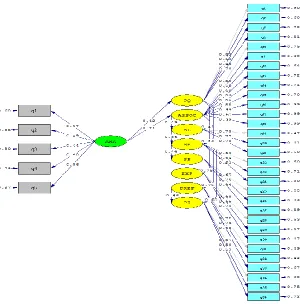
Research standard model
93
Testing research hypothesis
H1- Awareness of brand affects perceived quality.
Coefficient direction of awareness of brand on perceived quality (0.42) with amount of t equals 3.54 is meaningful at the level of p<0.05.Therefore null hypothesis is rejected and the contrast hypothesis is accepted. That is awareness of brad affects perceived quality.
H2- Awareness of brand affects brand association
Coefficient direction of awareness of brand on brand association(0.71) with amount of t equals 6.58 is meaningful at the level of p<0.05.Therefore null hypothesis is rejected and the contrast hypothesis is accepted. That is awareness of brad affects brand connection.
H3- Perceived quality affects loyalty to a brand.
Coefficient direction of perceived quality on loyalty to a brand (0.41) with amount of t equals 10.76 is meaningful at the level of p<0.05.Therefore null hypothesis is rejected and the contrast hypothesis is accepted. That perceived quality affects brand loyalty.
H4- perceived quality affects brand equity.
Coefficient direction of perceived quality on brand equity (0.43) with amount of t equals 5.46 is meaningful at the level of p<0.05.Therefore null hypothesis is rejected and the contrast hypothesis is accepted. That is perceived quality affects perceived quality.
H5- Brand association affects loyalty to a brand.
Coefficient direction of brand association on loyalty to a brand (0.49) with amount of t equals 6.11 is meaningful at the level of p<0.05.Therefore null hypothesis is rejected and the contrast hypothesis is accepted. That is brand asociation affects loyalty to a brand.
H6: Brand association affects brand equity.
Coefficient direction of brand association on brand equity (0.86) with amount of t equals 9.05 is meaningful at the level of p<0.05.Therefore null hypothesis is rejected and the contrast hypothesis is accepted. That is brand association affects brand equity.
H7: Loyalty to a brand affects brand equity.
Coefficient direction of awareness of loyalty to a brand on brand equity (0.86) with amount of t equals 9.05 is meaningful at the level of p<0.05.Therefore null hypothesis is rejected and the contrast hypothesis is accepted. That is loyalty to a brand affects brand equity.
H8: Brand equity affects brand extension.
Coefficient direction of brand equity on brand extension(0.78) with amount of t equals 8.08 is meaningful at the level of p<0.05.Therefore null hypothesis is rejected and the contrast hypothesis is accepted. That is brand equity affects brand extension.
H9- Brand equity affects additional payment for brand.
Coefficient direction of brand equity on additional payment to a brand (0.44) with amount of t equals 4.78 is meaningful at the level of p<0.05.Therefore null hypothesis is rejected and the contrast hypothesis is accepted. That is brand equity affects additional payment for a brand.
H10- Brand equity affects brand preference.
Coefficient direction of brand equity on brand preference (0.79) with amount of t equals 8.40 is meaningful at the level of p<0.05.Therefore null hypothesis is rejected and the contrast hypothesis is accepted. That is brand equity affects brand preference.
H11-brand equity affects tendency to brand purchase.
Coefficient direction of brand equity on tendency to brand purchase (0.55) with amount of t equals 4.26 is meaningful at the level of p<0.05.Therefore null hypothesis is rejected and the contrast hypothesis is accepted. That is brand equity affects tendency to brand purchase.
Hypothesis 12- Brand preference affects tendency to brand purchase.
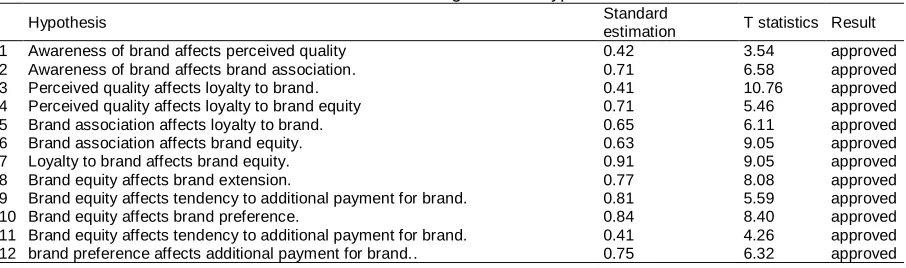
94 Table 4. result of testing research hypothesis
Hypothesis Standard
estimation T statistics Result
1 Awareness of brand affects perceived quality 0.42 3.54 approved
2 Awareness of brand affects brand association. 0.71 6.58 approved
3 Perceived quality affects loyalty to brand. 0.41 10.76 approved
4 Perceived quality affects loyalty to brand equity 0.71 5.46 approved
5 Brand association affects loyalty to brand. 0.65 6.11 approved
6 Brand association affects brand equity. 0.63 9.05 approved
7 Loyalty to brand affects brand equity. 0.91 9.05 approved
8 Brand equity affects brand extension. 0.77 8.08 approved
9 Brand equity affects tendency to additional payment for brand. 0.81 5.59 approved
10 Brand equity affects brand preference. 0.84 8.40 approved
11 Brand equity affects tendency to additional payment for brand. 0.41 4.26 approved
12 brand preference affects additional payment for brand.. 0.75 6.32 approved
CONCLUSION
Brand equity is a key and determining factor at company equity and market share equity and it is due to the power that a brand has at attracting new customers and keeping them. In this research different factors that affect dimensions of brand equity on consumer’s response directly or indirectly have been considered. These factors are: awareness of brand, brand association, perceived quality, loyalty to a brand, brand equity, brand development, tendency to additional payment for a brand, brand preference, tendency to purchasing. For indicating the relationship between variables 12 hypothesis were identified. The result of cause model test of the research showed that awareness of brand affects brand association and perceived quality. Also the effect of brand association and perceived quality on loyalty to a brand and brand equity and loyalty t a brand on brand equity was confirmed. Also it was distinguished that brand equity affects brand extension, tendency to additional payment, brand preference and tendency to purchasing. Finally the effect of brand preference on tendency to purchasing was confirmed that these results is adapted with the results of researches of researchers such as Sehat et al(2011). Generally the result of this research shows that applied model in the current research predicts effective factors on brand equity very well and helps managers and authorities of industries at identification and writing proper strategies for effect and penetration of brand among customers.
suggestions
It is suggested that rewards and values that we devote to a brand should be coordinated with expectations of customers. As level of expectation of customer is higher, reward equity for customer is more and so attractiveness of brand becomes more. This action makes the probability higher that a brand can affect customer’s behavior. In fact, one parameters of brand power is that to what extent it remains in the mind of customer.
It is suggested that besides enhancing quality and favorability of brand toward competitors it should be tried and products should be distributed among different purchasers so that determination and fixing proper price doesn’t face problem.
A company should invest more at enhancingfavorable mental image through which achieve more benefits such as satisfaction of customers. Such actions are presenting innovative services and using new technologies.
Educating staff of company for making correct interaction with customers, observing ethical principles, skill at meeting customers’ need for satisfaction and finally their loyalty.
Making positive viewpoint of brand in the society, through participation and activities in benefiting actions, emphasis on public relations and client-centering, making reliance among customers and attention to their needs.
REFERENCES
Aaker DA.1991. “Managing Brand Equity: Capitilizing on the value of brand name”, The Free Press, New York, NY.
Atilgan E, Aksoy S, Akinci S.2006. “Determinants of the brand equity. A verification approach in the beverage industry in Turkey”, Marketing Intelligence and Planning, Vol. 23, No. 3, pp. 237-48.
Bornmark H, Goransson A, Svensson C.2005. “ A study to indicate the importance of brand awareness in brand choice”, Bachelor degree dissertation International Business Program, Kristianstad University.
Broyles SA, Leingpibul T, Ross RH, Foster BM. 2010. Brand equity’s antecedent/consequence relationships in cross-cultural settings. Journal of Product and Brand Management, Vol. 19. No. 3. 159-69.
Bruwer J, Buler C.2012. Country of origin brand preference and associated knowledge levels of Japanese wine consumers. Jurnal of product & brand management, 21 (5). 307-316
95 Chen ACh. 2010. Using free association to examine the relationship between the characteristics of brand association and brand equity. Journal
of Product & Brand Management. Vol.10. No.7. 439 – 451.
Chen HL.2009. Gray marketing and It's Impacts on Brand Equity. Journal of product & brand management. Vol. 16. No.4. 247–256 Coomber S. 2002. Branding. Capstone Publishing Oxford.
Ebrahimi AH, Kheiri B, YadegariNiyaraki S.2009.<< evaluating effective factors on brand equity based on custmers’ viewpoint(6 classes of product introduction at Refah stores in Tehran)>> marketing management journal, fourth year, No 7, 159-186
Farquhar Peter H. 1989. “Managing Brand Equity”, Marketing Research, 1, 24-33.
Gil R, Bravo E, Fraj A, Martinez Salinas E.2007. “Family as a source of consumer-based brand equity”, Journal of Product & Brand Management, Vol. 16, No. 3, pp. 188–199.
Gilr .2007. Family as a source of consumer- based brand equity. Journal of Product & Brand Management. Vol. 30. No. 7. 215-235
Heydarzadeh K, Alvani SM, Ghalandari K.2010. considering effect of dimensions of social power of brand based on mental preparation levels of customers on decision to purchase, Management research, No 86.
Hosseini SM, Kambiz SM, Ghalandari Rahimidehlori M.2009. considering the effect of brand on customers’ response, management viewpoint, No 32.
Izadian MR.2007. national sign as leverage of export development, monthly journal of export message, No 23, 12 -19
Keller KL. 2002. “Strategic Brand Management: Building, Measuring and Managing Brand Equity” , 2nd ed., Prentice-Hall,Englewood Cliffs, NJ. Khaki GhR.2003. research method in management. Second edition, Tehran, Center of scientific publication of Islamic Azad university
Kotler F.2006. Kotler in market management. Translated by AbdolrezaRezaeinejad, The, Fara press Miler J, Mour D.2005. business of trademarks, translated by Atiyeh Bathayi and ParvizDargi, Tehran, Rasa.
Monroe KB, Chapman JD. 1990. Framing effects on buyers’ subjective product evaluations. Advances in Consumer Research, 14, 193-197 Pike S, Bianchi C, Kerr G, Patti C.2010. Consumer-based brand equity for Australia as a longhaul tourism destination in an emerging market.
International Marketing Review, Vol. 27. No. 4. 434-49.
RahimiDehlori M.2005.<< considering the effect of brand equity on custpmers response(case study: Iranol company trade mark)>> , M.A thesis, Shahidbeheshti university
RezaeiDolatabadi H, KhazaeiPoul J, Amani M.2013. effect of brand personality on brand loyalty: considering mediating role of constructions of effect, reliance and brand preference, Iran management science quarterly, eight year, No 29, 73-88.
Rios R, Riquelme HE.2008. Brand equity for online companies. Journal of Intelligence & Planning, Vol. 26. No.7.719-742.
Rowley J. 2007.Online branding: the case of McDonald's. British Food Journal. Emerald Group Publishing limited. Vol. 106. No. 3. 228–237 Salar J, AlikhanGorgani H, JafariAlkami V.2011. effective factors on brand equity based on customer, second national conference of brand. Sanayi V.2010. brand management. Management news, managers’ global village.
Sehhat S, Bajamalvey Rostami H, Kashkouli M.2012.effect of marketing combined on trade mark of K arafarin insurance company, business management, period 4, No 12, 2012
Shocker RK, Srivastava, Ruechkert RW.1994. “Challenges and opportunities Facing brand management: an introduction to a Special issue Opportunities Facing brand management” journal of marketing Research, 31, pp. 149-158.
Susanna H, Larsson S.2004. “Managing customer loyalty in the automotive industry”, Master’s Thesis, Departement of Business A dministration and Social Sciences, Lulea University of Technology.
Wang Y, Polo H, Chi R, Yang Y.2004. An integrated Framework for Customer Value and Customer-Based Perspective from China, Managing Service Quality,14,2/3,169-181
Wood L. 2000. Brand and brand equity: definition and management. MCB University Press. 662–669 Woodruff RB. 1997. Customer value: The next source for competitive advantage, Journal
Yasin MN, Noor MN, Mohamad O.2007. “Does image of country origin matter to brand equity”, Journal of product and brand management 1-16 Zeithaml VA.1988. “Consumer perceptions of price, quality, and value: a means-end model and synthesis of evidence”, Journal of Marketing,