Volume-7 Issue-2
International Journal of Intellectual Advancements
and Research in Engineering Computations
Optimal scheduling of solar-wind systems and evaluating the demand
response impacts on effective load carrying capability
Manikanth, Manikandan
Electrical and Electronics of Engineering, Muthaiyammal College of Engineering, Tamilnadu, India
ABSTRACT
This paper proposes a multi-source multi-product framework for coupled multi carrier energy supplies with a solar-wind hybrid renewable system. In this framework, the solar-wind complementary are fully exploited based and its performance has been analyzed effective load in carrying capability for solar -wind Renewable systems interactions of electricity, solar and heating energy flows, and a coupling for the modeling of production, conversion, results demonstrate that the proposed scheme can lower the battery charging/discharging actions as well as the degradation cost, and also confirm its capability to accommodate high penetration of variable renewable.
Keywords:
Energy hub, Energy storage, Renewable energy multi-energy systems.INTRODUCTION
The importance of Hybrid Renewable Energy System (HRES) has been increasingly recognized for providing sustainable and reliable energy supply with low emissions and high fuel flexibility, especially for stand-alone power systems in remote areas. The inherent intermittency and volatility of wind and solar power have raised concerns regarding the integration and utilization of high-penetration renewables in power systems.
The environmental concerns and depletion of traditional energy lead to the booming development of distributed generation (DG) in the past decade. DG units are typically small in size and supply power to end-users by connecting to local distribution systems. Compared with conventional centralized generating units, DG is considered as one of the most promising forms of generation due to its promising social benefits, together with lower capital costs and stronger government support. With the continuous integration of DG, distribution systems are evolving from the traditional passive unidirectional low networks to
much more complicated distributed generation systems (DGS).
However, in practice, as most DG units are based on renewable energy sources (e.g. wind, solar, etc), the intermittency nature of natural resource supply could make the power output of DG highly uncertain. Because of this uncertainty, it is necessary to study the reliability of the system. Therefore, to the utility, to what extent renewable distributed generation could provide capacity contribution to distribution systems becomes an urgent issue to be explored.
Hybrid systems
source generation. And also it increases the reliability and reduces the dependence on one single source. These hybrid solar-wind power systems generating a suitable for the industries and also domestic location areas. The environmental concerns and depletion of traditional energy lead to the booming development of Distributed Generation (DG) in the past decade. DG units are typically small in size and supply power to end-users by connecting to local distribution systems.
Solar Wind Hybrid Energy System
Solar-Wind hybrid Power system is the combined power generating system by wind mill and solar energy panel. It also includes a battery used to store the energy generated from both the loads. Using this system power generation by wind and solar systems when generation from PV module when light radiation is available can be said. Both loads can be generated power when both power sources. By providing the battery uninterrupted power supply is possible when both loads.
Fig:1 Block Diagram
Solar-Wind Power system is the combined power generating system by wind and the solar energy panel. It also includes a battery which is used to store the energy generated from both the loads. Using this system power generation when windmill and solar source is available and generation from PV module when light radiation is available. Both units can be generated power when
both sources loads are available. By providing the battery uninterrupted power supply load. Fig.2 shows the functional block diagram of hybrid wind solar energy system.
The power generated from windmill is of AC voltage which is converted through AC-DC rectifier.
The type of converting is used to step up or step down through switching called “BOOST” converter for wind mill. For solar system converter is used for the regulation. The micro controller incorporated in this scheme, which regularly refers the operation of sources and switches the
corresponding converters and fed into change the battery or to the load through inverters. The output of the inverter is connected with the load and after that the voltage. The driver circuit is used to give the signal for the BOOST of converters.
Fig.3 Block Diagram of Boost Converter
Photovoltaic solar power
Solar power panels are the medium to convert energy into the electrical sources. Solar panels it can convert the energy directly or heat the water with induced Energy. PV cells are made up from semiconductor structures as in technologies.
Sun produces the heat rays are absorbed with this material and electrons are emitted from the atoms. Photovoltaic is known as the radiation between absorbed and the electricity induced. Solar power is converted into the electric power by a common principle called photo electric effect.
Fig.4 Matlab Representation of Photo voltaic Solar Power
This release activates a current. Photovoltaic is known as the radiation absorbed and the electricity induced. Solar power is converted into the electric power by the principle called photo electric effect.
Fig.5 Matlab Representation of Wind Energy Source
The energy produced by wind turbines depends on the wind velocity action on the turbine. Wind power is able to feed both energy production and demand in the rural areas. It is used to run a wind source which in turn drives a wind generator or wind turbine to produce an electricity.
Working and Operation
The modified of the sine wave output such an inverter is the sum of two square waves one of which is phase shifted 90 degrees relative to the other one. The result are three level waveform with equal intervals of the zero volts; peak positive volts; zero volts; peak negative volts and then zero volts. The sequence will be repeated. The results of wave very roughly resembles the shape of a sine waves. Most inexpensive consumer power inverters can produce a modified sine wave a pure sine wave.
The waveform in common available modified-sine-wave inverters resembles a square wave but with a passage during the polarity reversal. Switching states are develop for positive, negative and zero voltages. Generally, the peak voltage to RMS voltage ratio does not maintain the same relationship for a sine wave. The DC bus voltage may be active regulated, or the "on" and "off" times can be modified to maintain the same RMS
value output up to the DC bus voltage to compensate for DC bus voltage variations.
Output frequency
The AC output frequency of a power inverter device is usually the same standard power line frequency, from 50 or 60 hertz
If the output of the device or circuit is to be further conditioned the frequency may be more higher for good transformer efficiency.
Output voltage
The AC output voltage of a power inverter is often regulated as the same as the grid level line voltage, typically 120 or 240 VAC at the distribution line level, even when there are changes in the load that the inverter is driving. This allows the inverter to power numerous devices designed for standard power line.
Some inverters are allows the selectable or continuously variable output voltages.
Output power
A power inverter will often have an overall the power rating expressed in watts and kilowatts. This power.
that will be available to the sources device is driving and indirectly, the power that will be needed from the DC source. Smaller popular consumer and commercial devices designed to the line power typically range from 150 to 3000 watts.
Va Vb Vc RMS
voltage 225 V 255 V 254 V
LCfilter
Phase 195 V 195 V 195 V
Voltage
PHASE 1000 V 1000 V 1000 V VOLTAGE
Inverter
voltage 980 V 980 V 980 V
Renewable energies and energy storage
systems
In a stable and reliable grid electricity supply must always matching the electricity demand. Providing the exact amount of electricity to the customers is a technical challenging task. Typically in a well-developed grid various types of based and peak load generation capacities are available and are managed according to the forecasted demand schedule.
Usually generation is based on conventional sun rays or windmill energy, where the electricity output can be controlled. A growing level of grid penetration of intermittent renewable energy sources like wind and solar increases the need for additional control electricity.
That could be conventional power plants, but from generation costs would be relatively high due
to a low number of full load hours and operation at levels of low efficiency.
They can store excess electricity from intermitted energy sources and Stored electricity can be dispatched on demand and storage system can therefore replace inflexible conventional generation systems for controlling power sources. In very basic terms, the storage systems store electricity when demand for electricity is lower than supply. Now these storage capacities can be managed just like conventional power generation capacity. Meaning, if forecasted demand for electricity is higher than the expected supply, the storage system can provide the required amount of electricity at a specific time. Thus storage systems are an important element for the deployment of intermittent renewable energy systems
RESULT AND DISCUSSIONS
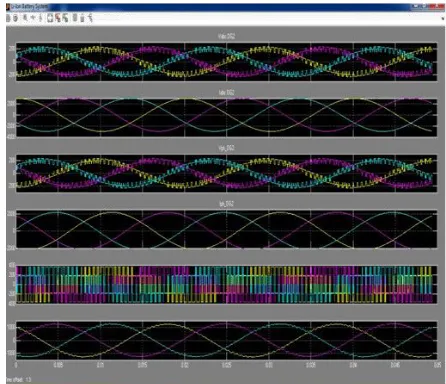
Thus the two energy sources energy are combined and successfully connected to the grid
with effective voltage and effective way to utilize the battery storage for the future use was detail reported with voltage comparison.
Fig. 6 Graphical Representation of RMS Voltage in Each Phase
CONCLUSION
In the present work of Solar and Wind Energy System was implemented. A portion of the energy requirement for a private house, farm house, a small company, an educational institutions or an apartment house depending on the need at the site
where used has been supply with the electricity generated from the wind and solar power. It reduces the depends on one single source and has increased the reliability. Hence we could improve the efficiency of the system as compared with their individual mode of generation.
REFERENCES
[1]. M. H. Nehrir, C. Wang, K. Strunz, et al., “A review of hybrid renewable/alternative energy systems for electric power generation: Configurations, control, and applications,” IEEE Trans. Sustain. Energy, 2(4), 2011, 392-403.
[2]. T. A. Nguyen and M. L. Crow, “Stochastic optimization of renewable-based Microgrid operation incorporating battery operating cost,”IEEE Trans. Power Syst., 31(3), 2015, 2289-2296.
[3]. W. Su, J. Wang, and J. Roh, “Stochastic energy scheduling in Microgrid with intermittent renewable energy resources,” IEEE Trans. Smart Grid, 5(4), 2014, 1876-1883
[4]. A. Arabali, M. Ghofrani, and M. Etezadi-Amoli, etal., “Stochastic performance assessment and sizing for a hybrid power system of solar/ wind/energy storage,” IEEE Trans. Sustain. Energy, 5(2), 2014, 363-371. [5]. C. O'Dwyer, L. Ryan, and D. Flynn, “Efficient large-scale energy stor-age dispatch: Challenges in future high
renewables systems,”IEEE Trans. Power Syst., 32(5), 2017, 3439-3450.
[6]. L. Feng, J. Zhang, G. Li, et al., “Cost reduction of a hybrid energy storage system considering correlation between wind and PV power,” Protection and Control of Modern Power Systems, 2016, 1-9.