INTRODUCTION
In general, both naturally formed bottom sediments and also sewage sediments, play vari-ous roles in the environment. They perform en-vironmental, geochemical and economic func-tions. As regards the environmental function, the sediments formed in the stormwater system, also categorised as the aquatic environment, provide a habitat to an enormous number of plant and animal organisms. The geochemical function of sediments is related to the fact they are thought to operate as the sites of deposition of pollutants that enter the water environment. Then, due to their properties and composition, sediments can be treated as natural geosorbents. As regards their economic value, sediments are considered a natu-ral resource, widely used in agriculture to supply organic matter, in construction industry as a build-ing material, and also to support the ecosystems of swamps and beaches [Królikowska 2012].
Sediments are formed at different points of
the stormwater system, including catchments
that are diversified in character. As a result, sedi
-ments differ in the physicochemical properties,
particle size distribution, and primarily, in the content of various kinds of pollutants [Marsalek 1997, Bojakowska 2006]. When the stormwater system is in operation, sediments come as a by-product of the system function; they should be removed from it and managed. However, in or-der to correctly evaluate the means of renor-dering the wastes harmless, it is necessary to determine the contents of substances that are hazardous to the natural environment. They include petro-leum substances, heavy metals, and polycyclic aromatic hydrocarbons. The presence of organ-isms that may pose a sanitary threat is another
issue. It is difficult to conduct a risk analysis,
considering that no regulations to control the management of sediments derived from storm-water system facilities are currently in force. That refers to both the chemical pollution and biological hazard [Hvitved – Jacobsen 1991, Samara 2016]. The Regulation of the Minis-ter of Environment on conditions to be met for the introduction of wastewater into the water or the ground, and the substances particularly Published: 2018.11.01
Volume 19, Issue 6, November 2018, pages 241–246
https://doi.org/10.12911/22998993/91930
Dynamics of Changes in Microbiological Composition
of Stored Sediments
Aleksandra Sałata
1*, Renata Stoińska
1, Lidia Dąbek
11 Faculty of Environmental Engineering, Geomatics and Power Engineering, Kielce University of Technology,
Aleja Tysiąclecia Państwa Polskiego 7, 25-314 Kielce, Poland * Corresponding author’s e-mail: [email protected]
ABSTRACT
The composition of the sediments formed in the process of stormwater pretreatment is diversified and depends on
many parameters, mainly on the quality of stormwater and the land use of the catchment. The stormwater sedi-ments are characterized by heterogeneous chemical and microbiological composition. The aim of this paper was the microbiological evaluation of the sediments from four stormwater catchments in terms of hazard to humans and the environment. The pH, and the content of organic and mineral matter were determined for the examined sediments. The microbiological analysis included the determination of the total number of psychrophilic, meso-philic, and coliform bacteria, including E. coli, and also the number of faecal Enterococci, Salmonella and Shi-gella. The study was conducted for fresh deposits and those stored for one year in order to determine the dynamics of changes in their biological activity.
harmful to the aquatic environment refers only to the stormwater and does not account for the sediments formed in it. On the other hand, the Regulation of the Minister of Environment of 06 February 2015 on municipal sewage sediments could be applicable, but only to the situations in which sediments are intended for non-industrial use, namely they are to be used for soils [Regu-lation of the Minister of Environment… 2002]. In this document, § 2.1. states that “Municipal sewage sediments can be applied to soils if the following conditions are met:
1. the content of heavy metals in these sediments
does not exceed the amount specified in Annex
1 to the regulation;
2. in the case these sediments are used in agricul-ture, and for soil reclamation for agricultural purposes, when Salmonella bacteria were not isolated from the representative sample, 100 g in weight, obtained in accordance with § 5 sub-paragraph 3;”
The microbiological tests conducted for the study aimed at specifying the hazards potentially posed by the sediments obtained from the storm-water system, both in real time when the material was collected, and after one-year storage under variable temperature conditions.
MATERIALS AND METHODS
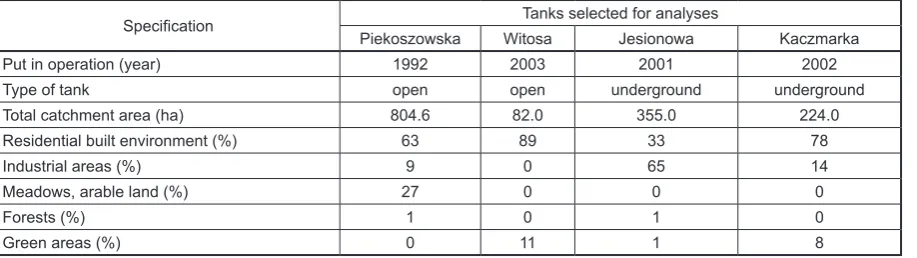
The investigations concerned the sediments collected from the storage tanks of stormwater treatment plants located in the city of Kielce. Four facilities were selected and named after the street they are situated: Piekoszowska (P), Witosa (W), Jesionowa (J)) and Kaczmarka
(K). They differ in terms of the time they have
been in operation, the type of the catchment management, and also the type of the tank for
sediment storage [Statement of water manage-ment…2007, State of the environment 2011]. The parameters of all facilities are shown in Ta-ble 1. The samples of sediments were collected from the sedimentation tanks of the treatment facilities in the spring of 2015. The samples were taken in accordance with the recommended methodology [PN-EN ISO 5667–15:2009] using an Eijkelkamp sampler. Directly after collection, pH, dry residue, the content of organic compo-nents, and grain size composition of the samples were analysed. Additionally, the sediments were subjected to the microbiological analysis. In May 2016, the same tests were carried out on the same samples of sediments stored under variable temperature conditions (+4°C ÷ +25°C) to iden-tify the changes in microbiological composition. The parameters were determined in accordance with the current standards [PN-EN 12176:2004, PN-78/C-04541, Regulation of the Minister of Environment…2002].
Grain size distribution was measured with the wet laser diffraction method (Mastersizer 3000, Malvern Instruments). Microbiological analyses involved specifying the total number of psychrophilic and mesophilic bacteria, number of coliforms, E. coli, faecal Enterococci, Salmo-nella and Shigella. The samples of sediments in-tended for microbiological determinations were stored in sterile containers. The determinations were performed immediately after the sediments were transported to the Laboratory of Micro-biological Analysis. The samples of sediments underwent appropriate preparations prior to per-forming determinations. For that purpose, sam-ples were homogenized. A 1 g sample was col-lected and placed in the centrifugal test tube that contained 10 cm3 of sterile water. Then, the
sam-ples of sediments were subjected to subsequent 9-fold dilutions (the serial dilution method).The quantitative analysis of the microorganism was
Table 1. Characteristics of catchments and tanks selected for research
Specification Tanks selected for analyses
Piekoszowska Witosa Jesionowa Kaczmarka
Put in operation (year) 1992 2003 2001 2002
Type of tank open open underground underground
Total catchment area (ha) 804.6 82.0 355.0 224.0
Residential built environment (%) 63 89 33 78
Industrial areas (%) 9 0 65 14
Meadows, arable land (%) 27 0 0 0
Forests (%) 1 0 1 0
carried out using the surface plate method and dilutions from 10–1 to 10–5. The cultures were
inoculated into Petri dishes solidified with a
suitable medium (Table 2) and incubated in the laboratory POL ECO’s incubator. The number of microorganisms was determined in colony
forming units / gram of dry weight [cfu∙g-1 d.w.]
according to the PN-78/C-04541 standard [Wa-ter and wastewa[Wa-ter…2001]. The standard used for the soil analysis, PN-Z-19000–1:2001, was used for the determination of Salmonella bac-teria, because there is no uniform methodology for the sediments from stormwater drainage system. This standard is based on the detection of the presence of Salmonella bacteria by
cul-turing on propagating and differential-selective media and confirming the results by biochemi
-cal or serologi-cal identification. The sediments
from the stormwater drainage system can be also compared to both bottom sediments and soil.
The confirmation tests were performed using
ready-made API 20E tests.
The methodology of the microbiological tests of sediments from stormwater system is not stan-dardised; therefore, the procedures in the deter-minations of microorganisms were based on the
standards applied to the microorganism identifi -cation in water, wastewater, soil, and municipal solid wastes samples (Table 2).
RESULTS AND DISCUSSION
The materials collected from four
stormwa-ter treatment facilities showed differences already
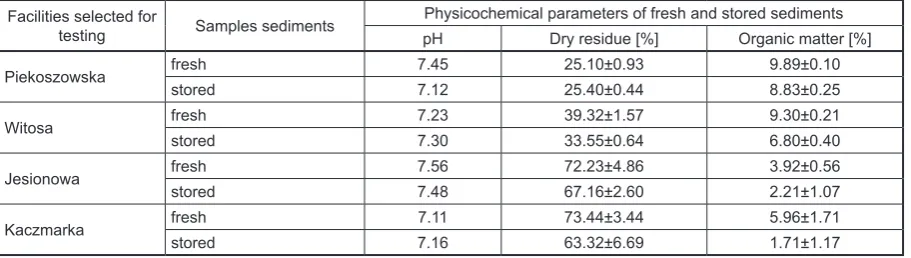
at the stage of initial visual and organoleptic ex-amination. The results of the analysis pertaining to the basic physicochemical parameters of sedi-ments are summarised in Table 3.
All examined samples had alkaline pH values ranging from 7.11 to 7.56; in stored sediments the pH values were slightly reduced. The sediments collected from two open tanks, namely “P” and “W”, were dark grey to black in colour and had rather loose, sticky texture. High hydration of samples (61% ÷ 75%) resulted in strong cementa-tion when they were dried. With respect to this
parameter, no significant changes were observed
between the fresh and stored samples. The co-lour of the samples from underground tanks, “J” and “K”, ranged from light yellow to dark grey. The share of sand/gravel fraction was predomi-nant (63%÷80%), by contrast, the sediments from open tanks had a substantial, over 90%, content of dust/clay fraction, d<0.063 mm in diameter. Additionally, the hydration of sediments from those facilities was much lower than from the two
others, and ranged from 28% to 37%. The differ -ences in hydration and grain size composition be-tween the fresh and stored samples were
relative-Table 2. Methodology of microbiological analysis
Type of analysis Standard Substrate Temperature and incubation time Mesophilic bacteria PN-A-75052–05:19902 Nutrient agar 36°±2C, 24–48h Psychrophilic bacteria PN-A-75052–05:19902 Nutrient agar 20°±2C , 48–72h
Salmonella and Shigella PN-Z-19000–1:2001 SS substrate; propagating media, API 20E tests 36°±2C, 24h Faecal Enterococci PN-EN ISO 7899–1:2002 Slanetz-Bartley agar 36°±2C, 24–48h
Coliforms and E.coli PN-EN ISO 9308–1:2014–12 Lactose-TTC-Agar-with-Tergitol-7; test for cytochrome
oxidase; test for indole detection 36°±2C, 24–48h
Table 3. Selected physical and chemical parameters of fresh and stored sediments
Facilities selected for
testing Samples sediments
Physicochemical parameters of fresh and stored sediments
pH Dry residue [%] Organic matter [%]
Piekoszowska fresh 7.45 25.10±0.93 9.89±0.10
stored 7.12 25.40±0.44 8.83±0.25
Witosa fresh 7.23 39.32±1.57 9.30±0.21
stored 7.30 33.55±0.64 6.80±0.40
Jesionowa fresh 7.56 72.23±4.86 3.92±0.56
stored 7.48 67.16±2.60 2.21±1.07
Kaczmarka fresh 7.11 73.44±3.44 5.96±1.71
ly small. Both hydration and grain size
composi-tion of sediments is primarily affected by the type
of catchment and its management. Piekoszowska and Witosa stormwater treatment plants serve the catchments with prevalent residential built envi-ronment, 63% and 89% respectively, but green areas and meadows are also found there, despite the fact that the catchments are located within the city’s administrative borders. The prevalence of
the finest fraction in the samples collected from
those tanks is mainly attributable to the products of road surface and pavement abrasion. Another
contributing factor is the runoff from the areas
with typically agricultural land use. As regards Jesionowa and Kaczmarka stormwater treatment plants, hydration and grain size composition of the sediments were largely diverse. That is also closely related to the character of the catchments, as in addition to residential buildings, their built environment includes industrial facilities, and the share of green areas is low.
Microbiological analyses were conducted for all samples of sediments. After storage under
different temperature conditions, the biological
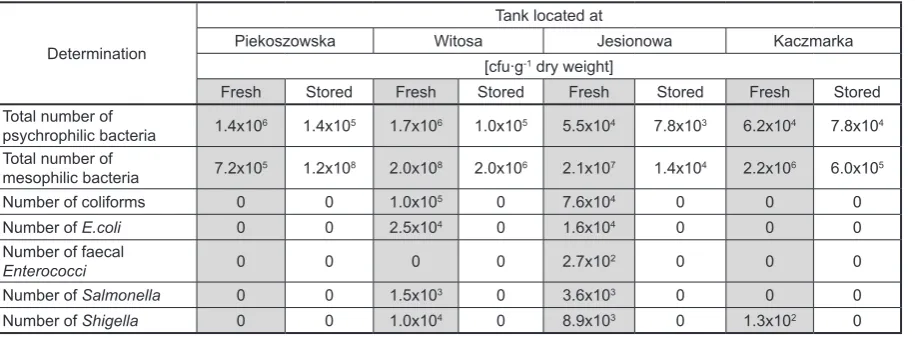
activity of selected organisms was examined as well. Table 4 shows the averaged results of the microbiological analyses for fresh and stored sediments collected from four treatment facilities.
As regards fresh sediments, the highest num-ber of psychrophilic bacteria, namely 1.4×10⁶
and 1.7×10⁶ cfu.g-1, was found at Piekoszowska
and Witosa facilities. For the two other tanks, the values were a hundred times lower. More diverse results were obtained for the mesophilic bacteria count analysis. As a result, the tanks could be ar-ranged in the decreasing order of the number of bacteria, namely Witosa > Jesionowa>
Kaczmar-ka > PiekoszowsKaczmar-ka. Coliforms and Salmonella were present in two tanks, i.e. in the sediments collected from Witosa and Jesionowa, addition-ally, E.coli was also found in both of those tanks. Faecal Enterococci were observed exclusively in the Jesionowa tank. As regards Shigella, the Piekoszowska tank did not show any colonies, whereas in the other tanks small quantities were found (from 1.3×10² in the sediments from the
Kaczmarka tank, to 1.0×10⁴ cfu∙g-1 dry weight in
the Witosa tank sediments).
The physicochemical and microbiological analyses were repeated on the same sediments after they were stored for a year. The sediments were kept in closed polyethylene containers at room temperature. A change in the temperature conditions meant that the containers with sedi-ments were periodically placed in the laboratory refrigerator, in which the temperature was in the range of 4°C÷8°C. It turned out that the biologi-cal activity of the selected living organisms did not cease, and in some cases, on the contrary, it
increased. Definitely, coliforms, and thus E.coli, faecal Enterococci, Salmonella or Shigella were not found. A tenfold decrease in the psychrophilic bacteria count was recorded in Piekoszowska, Witosa and Jesionowa tanks, whereas in the Kac-zmarka tank, the number almost did not change. The most spectacular changes in the bacterial count, however, were observed for the mesophilic bacteria. In the sediments from the Piekoszows-ka tank, the count in these bacteria increased a thousand times. For all other cases, the number of bacteria decreased tenfold or a hundred times. In order to explain this phenomenon, it is necessary to consider the content of the organic matter in the sediments, and also the occurrence of a
num-Table 4. The results of microbiological analyses of fresh and stored sediments
Determination
Tank located at
Piekoszowska Witosa Jesionowa Kaczmarka [cfu∙g-1 dry weight]
Fresh Stored Fresh Stored Fresh Stored Fresh Stored Total number of
psychrophilic bacteria 1.4x10⁶ 1.4x10⁵ 1.7x10⁶ 1.0x10⁵ 5.5x10⁴ 7.8x10³ 6.2x10⁴ 7.8x10⁴ Total number of
mesophilic bacteria 7.2x10⁵ 1.2x10⁸ 2.0x10⁸ 2.0x10⁶ 2.1x10⁷ 1.4x10⁴ 2.2x10⁶ 6.0x10⁵ Number of coliforms 0 0 1.0x10⁵ 0 7.6x10⁴ 0 0 0 Number of E.coli 0 0 2.5x10⁴ 0 1.6x10⁴ 0 0 0 Number of faecal
Enterococci 0 0 0 0 2.7x10² 0 0 0
ber of other substances that facilitate or hamper
the growth of bacterial flora. The living organ -isms that constitute the sediment can show very intense metabolic activity, closely related to the content of the organic matter [Bobrowski 2002, Kulikowska 2009]. The storage of the sediments leads to a clear decrement in the organic compo-nents in the samples collected from three tanks (Table 3). That is caused by the mineralisation processes and the fact that organic components are used by various microorganisms as a source of carbon [MacDonald 1994]. In the Piekoszows-ka tank, the degradation of the organic compo-nents was low and the organic matter content was
reduced by 1% (9.89%→8.83%). That could cre -ate perfect conditions for the bacteria to multiply. Additionally, in the city of Kielce, the catchment of concern is the largest, the oldest and the most
diversified one with respect to the built environ -ment. As a result, the substances that contribute to the growth of microorganisms may have been de-livered to the tanks together with stormwater. The presence of such a high number of mesophilic bacteria may indicate the occurrence of pathogens in the examined sediments. As regards the utilisa-tion of stormwater system sediments in agricul-ture and land reclamation, the sediments from Wi-tosa and Jesionowa tanks could not be employed for that purpose. In the other tanks, Salmonella was not found in the sediment samples. Thus, a problem arises how sediments could be evaluated with respect to the sanitary hazards. The issue has not been addressed by current legal regulations. In their study, Królikowska et al. [Królikowska 2012] proposed the limit values for the selected microbiological parameters that indicate the pol-lution of sediments. The parameters concern coli-forms (limit value> 106), faecal coliforms (limit
value> 105), Enterococci (limit value> 105) and
Clostridium sp. (limit value> 106). The results of
tests both on fresh and stored sediments do not show the exceedance of the limit values given above for the sediments of concern. Therefore, it is not necessary to disinfect sediments as they do not pose a hazard to the environment.
CONCLUSIONS
1. The sediments collected from four different
tanks of the stormwater treatment facilities
showed alkaline pH and substantial hydration. Another characteristic was the predominant dust-clay fraction. The physicochemical prop-erties of sediments were closely related to the type of the catchment, its built environment and the length of time the facility had been in op-eration. The content of organic matter in sedi-ment samples was reduced due to the miner-alisation processes taking place in the material. 2. The microbiological analysis confirmed the
presence of the microorganisms of concern, in-cluding, among others, psychrophilic and me-sophilic bacteria, coliforms, Escherichia coli bacteria, faecal Enterococci, Salmonella and Shigella. The examined sediments, both fresh sediments and also stored ones, were charac-terised by high counts of psychrophilic (of the order of 103 to 106) and mesophilic bacteria (of
the order of 104 do 108), which may indicate the
presence of pathogenic organisms. The occur-rence of coliforms and also of Salmonella was found in the sediments collected from two fa-cilities, namely OWDW and OWDJ. The occur-rence of E.coli was also observed in the tanks of these two facilities. Faecal Enterococci oc-curred only in the tank of the Jesionowa OWD. As regards Shigella, the colonies of this type of bacteria were not found in the Piekoszowska tank, in the remaining tanks, only small quanti-ties were present. In the stored sediments, co-liforms, including E.coli, faecal Enterococci, Salmonella and Shigella were not found. Due to the presence of Salmonella (fresh samples from Witosa and Jesionowa tanks) sediments could not be used in agriculture or land recla-mation. As regards all cases under analysis, the results of the tests conducted on both fresh and stored sediments do not indicate the exceedance of the limit values proposed by Królikowska et al. [Królikowska 2012]. Consequently, it is not necessary to disinfect sediments as they do not pose a hazard to the environment.
Aknowledgments
The research was carried out as part of the statutory work 05.0.10.00/2.01.01.02.0020 MNSC.IKTW.16.001
REFERENCES
1. Bobrowski M. 2002. Fundamentals of sanitary
biology, Wydawnictwo Ekonomia i Środowisko, Białystok.
2. Bojakowska I., Gliwicz T., Małecka K. 2006. Geo -chemical tests of aquatic sediments in the years 2003–2005 (in Polish). Environmental Protection Inspection. Warszawa.
3. Bojakowska I., Sokołowska G. 1998. Geochemical
classes of aquatic sediment purity (in Polish). Pol-ish Geological Review. 46 (1), 49–54.
4. Hvitved – Jacobsen T., Yousef Y.A. 1991. Stud-ies in Environmental Science, 44, 165–208, doi: 10.1016/S0166–116(08)70083–9.
5. Królikowska J., Królikowski A. 2012. Stormwater. Drainage, management, pre-treatment and use (in Polish). Wydawnictwo Seidel – Przywecki. 6. Kulikowska D., Bilicka K. 2009. Analysis of
changes in organic matter and nitrogen compounds
in sludge composting. Środowisko, Czasopismo
Techniczne, Wydawnictwo Politechniki
Kra-kowskiej, Series 11, 3-Ś.
7. MacDonald D.D. 1994. Approach to the assess-ment of sediassess-ment quality in Florida Coastal Wa-ters. Volume 1 – Development and evaluation of sediment quality assessment guidelines. Florida
Department of Environmental Protection Office
of Water Policy.
8. Marsalek J., Marsalek P.M. Water Science and Technology, 36(8), 117–122, doi: 10.1016/ S0273–1223(97)00610–0.
9. PN-EN ISO 5667–15:2009. Water qual-ity. Sampling. Part 15: Guidance on the preservation and handling of sludge and sediment samples (in Polish).
10. PN-EN 12176:2004. Characteristics of sludge. De-termination of pH value (in Polish).
11. PN-78/C-04541. Water and wastewater. De-termination of dry residue, residue on ignition, loss on ignition and dissolved sub-stances, dissolved mineral substances and dissolved volatile substances (in Polish). 12. Regulation of the Minister of
Environ-ment of 9 September 2002 on soil and land quality standards (in Polish), Journal of Laws 2002, No. 165, item 1359.
13. Samara F., Elsayed Y., Soghomonian B., Knuteson L.S. 2016. Chemical and biological assessment of sediments and water of Khalid Khor, Sharjah, United Arab Emirates. Marine Pollution Bulletin, 111(1–2), 15, 268–276.
14. Statement of water management conditions for the purposes of discharge of stormwater and thaw wa-ters (in Polish), Kielce 2007.
15. State of the environment in the świętokrzyskie
province in the years 2009–2010 (in Polish). Re-port developed at the Province Environmental Protection Inspectorate under the direction of