Automation
Mirlan Ipasov*
Abstract
This paper sets as its central aim the design and formalization of business processes in education management and governance sys-tem to implement a new University Information Management Syssys-tem. Specifically we aim to identify each of the business process and roles involved in governance and management of education and develop tools methods and modules to automate these processes.
Keywords: Business Process Automation, Education Management, Informatıon Management Systems.
1. Introduction
In the modern communication age, education is not bonded to some place anymore. The increasing use of computers, mobile phones, and hand-held devices, which are connect-ed to internet, makes connect-education to be available everywhere by making governance and management of this educational
process more complicated and difficult. Before automating
any kind of a system, it is very important to identify and describe all related business processes. It is also essential to identify all related roles and specify the privileges of
these roles bounded to specific business processes. As pro -cesses are live and mobile, it is important to manage them
efficiently. Because life cycle of particular process will ef -fect life cycle of overall process of education management. Outline of this article is organized as follows.
Sec-tion 2 gives explanaSec-tions about “work flow management”
and “business processes”. Section 3 gives detailed infor-mation about business processes in education management and their automation. Our new and exciting results are described in Section 4. Finally, Section 5 gives the conclu-sions.
2. Work Flow Management and Business Processes
A business process is an activity or set of activities that
will accomplish a specific organizational goal. Automation
of business processes means identifying them according to the operations and roles involved in these processes.
Work-flow Management is supporting and controlling the work
-flow. An important objective in Work flow Management
is to automatically route artifacts (documents, messages,
e-mails) through a network to actors having predefined roles (T. Stoilov & K. Stoilova, 2006). Workflow manage
-tions and it involves managing the flows of work through
an organization (W. M. P. Van der Aalst, 1998)
3. Business Processes in Education Management
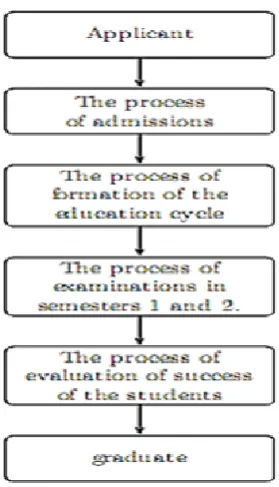
All business processes related education management we grouped into six groups see table 3.1.2.
3.1 The Process of Admissions /Entrant Enrolment
This process is the beginning of the education process ac-cording to the student. Acac-cording to the system, we offer
the student must have unique student identification num -ber, which must be used in all parts of the processes. It
means student should use same identification number for
libraries and even for offering meals. The process has been described in (I. Mirlan and M. Yuliya, 2008) Figure 2. This process consists of three main steps:
• Examination for entrants • Contract subscription • Group Arrangement
3.1.1 Examination for Entrants
Figure1: General business processes outline
3.1.2 Contract Subscription
Inputs for this step are:
• Faculty: In which student is going to be enrolled • Course Card: Academic Plan, list of the subjects
which student should be attends.
• Payment History: Payments for the necessary ser -vices (academic fee for instance)
Outputs are:
• Contract: The contract of agreement between student
and university.
• Student ID Card: This card is combination of student identification number and some other needed information.
Student ID number is ten digit number. For example,
Table 1:Student Identification Number Definitions
3.1.3 Group Arrangement
This process simple arranges students into the groups and assigns one of the lecturers as a supervisor. The desired aim is to assign one supervisor for one group but it is pos-sible to assign several groups to one supervisor or vice versa. After this process, the students are ready to register for courses.
3.1.4 Involved Roles
• Student services • Accounting services • Vise rector
3.2 The Process of Formation of the Education Cycle
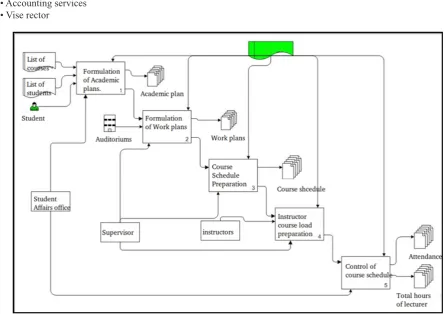
This process is done through four steps, it is described in Figure 3.
• Step 1 Building educational plans of faculties and
departments
• Step 2 Building working plan of faculties and depart -ments
• Step 3 Timetable planning
• Step 4 Load distribution of teachers
For each step, we have developed special interfaces. In each of the interface, it is easily seen in which step pro-cess is. The main inputs to this propro-cess are students and the courses. The academic plan generation is done manually as it is hard to full automate this process. However, time-table generation is fully automated. According to the given
inputs, timetable-generating process (I. Bondarev.A &
Boukar.M.M., 2011) gives as an output read schedule of the courses. The payloads of the instructors are calculated automatically and all the courses related to some instructor are automatically added to special interface of the instruc-tor in the system. Involved roles can see all the changes throughout the process.
3.3 The Process of Examinations
To evaluate the knowledge of students in each subject the
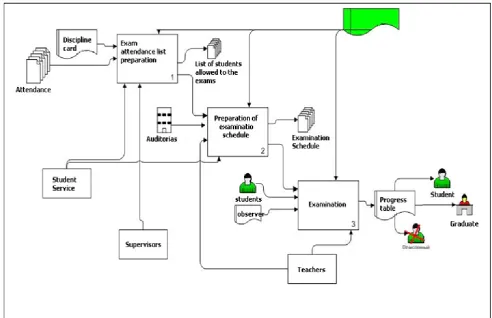
exams must be held. System is configured for three main exams: midterm, final and make up. In the middle of se -mester, the students have the midterm examination in each subject they are registered to. Teachers prepare examina-tion quesexamina-tions and measure the results to 100 (one hun-dred) mark system. The general scheme of the examination
process can be seen in figure 4.
3.3.1 Signature Lists
Before each exam secretaries or teachers by themselves print out the signature lists of students formed by the sys-tem for each group, subject and teacher separately. This procedure is formed with in-coordination of accounting department. Students who has not paid the same amount of contract fee until midterm exams, results will be marked as WBI (Will Be Ignored) status. This means that if
this student will not pay the money until deadline specified
by accounting administration, his results of all subjects, which he has gained during current midterm will be
ig-3.3.2 Result Lists
Certain subject also prints out result Lists for teachers to write the results of students of each group. These lists will be stored in archive.
3.3.3 Entering Results to the System
In some amount of days (can be configured on system)
after examination the lecturer must enter the results of students to the system, they have easy interface for this procedure. All they have to is just enter the marks, if by human factor, lecturer makes the mistake and writes the result incorrectly, for example negative number or string value, the system checks it automatically and informs the users immediately, because this marks are later used in evaluating process, and if they stored in database wrongly all process would come wrong. We must decrease such kind of risks. In the end the user just saves all en-tered marks in one click, and they will be saved directly in database.
3.3.4 Exam Result Lists
After entering the marks, instructor or secretary can print out the lists with marks to inform the students with their re-sults of each subject. If the student have not paid the
speci-fied amount of his contract due to this exam his results will
be hidden and marked again as WBI status until he pays or until the accounting administrator ignores the results of not paid students.
3.3.5 Average Lists
Students average of each subject are evaluated by formula
(Midterm mark) * 0.4 + (final mark) * 0.6 = average
40% are taken from midterm examination of result
subject, in other case he fails this subject and next year will have to take it again.
3.4 The Process of Evaluation of Success of the Stu-dents
This process is run once in each academic semester, twice
in academic year. This process is one of the complicated and heavy processes. Heavy in case of memory usage in running evaluation algorithms. This process is consisting of two parts:
• Student attendance evaluation
• Evaluation of educational success of student.
Figure 4: The process of examinations
3.4.1 Student Attendance Evaluation
This evaluation happens before examinations. Accord-ing to the work plan of the faculties and departments the amount of allowed days are calculated.
For example allowedDays = 3 * subjectHourAmount/
week. Therefore, algorithm is as below:
3.4.2 Student Educational Success Evaluation
This process calculates average of each examination grades for each course of every student see section 3.3.5. If the average of the course is 49.5 than student automati-cally enrolled to this subject for next year but he has option of not attending the class but attend just the examinations.
Results
The printouts that could be taken after the educational pro-cess automation:
• Registration Form • Contract
• Student ID card • List of attendance • Work Plan
• Load of the teacher and group
These are the essential documents in any university. Each of these documents is the outputs of automated busi-ness processes (M. Ipasov, 2010)
Conclusions
In this paper, we identified and described main business
processes of education management. It is hard to describe all process in one paper therefore in the paper we described and explained only main processes
References
I. Bondarev.A and Boukar.M.M. Timetable organizer for university in- formation and management system. IKECCO, 8(1):146–155, 2011.
M. Ipasov. Report engine for information and management system.
IKECCO, 7(1):74–77, 2010.
A. Jolbunov. Report generating system. IAAU Diploma Projects, 1(1), 2008.
I. Mirlan and M. Yuliya. Automation and management system to control the education system of university. IKECCO, 5(5):146–155, 2008.
T. Stoilov and K. Stoilova. Automation in business pro-cesses. 2006.
W. M. P. van der Aalst. The application of petri nets to
workflow management. The Journal of Circuits,