Volume 38, 2011 61
Pantić, N. (Ed.). (2008) Tuning Teacher Education in the Western Balkans. Belgrade: Centre for Education Policy.
MES (2008). National Strategy of Higher Education (2008-2013) Tirane.
MES (2008). National Strategy of Pre-university Education (2009-2013) Tirane.
The Common European Framework of Reference for Languages Learning, Teaching, Assessment (CEFR). 2002, Cambridge University Press.
Widdowson, H. G. (2002). Language teaching: defining the subject. In Language in Language Teacher Education / edited by Hugh Trappes-Lomax and Gibson Ferguson. John Benjamins Publishing Co.
Zeichner, K. M., & Liston, D. P. (1996). Reflective teaching: An introduction. Philadelphia: Lawrence Erlbaum Associates.
Zgaga, P. (ed.) (2006). The Prospects of Teacher Education in South-east Europe. Ljubljana: University of Ljubljana, Faculty of Education.
Advised by Ilo Stefanllari, University of Tirana, Tirana, Albania
Received: October 14, 2011 Accepted: November 01, 2011
Esmeralda Kromidha PhD, Vice Dean, Faculty of Foreign Languages, University of Tirana, Tirana, Albania.
Phone: +355 682066460. E-mail: [email protected]
Elida Tabaku Assoc.Professor, PhD , Head of the English Department, Faculty of Foreign Languages, University of Tirana, Tirana, Albania.
Phone: +355 673078819. E- mail: [email protected]
EVALUATION INSTRUMENT OF STYLES OF
LEARNING FOR SMALL CHILDREN
Evelise Maria Labatut Portilho University Católica do Paraná, Brazil E-mail: [email protected]
Kátia Beltrami Colégio Nossa Senhora de Sion, Brazil E-mail: [email protected]
Abstract
In order to identify the students’ Learning Style of Early Childhood Education, it has been prepared the Portilho / Beltrami Children’s Learning Styles Inventory which presents 12 learning situations, including the four styles: active, reflective, theoretical and pragmatic. The development of this instrument was based on Alonso’s theory (1994) on Learning Styles. The learning situations contain sentences and images with different ethnicities, cultures and genres. For the trust and validation process, the instrument was initially used on 28 children from a private school. The analysis method called test-retest was used and the collaboration from teachers and researchers experts in the learning field. The learning situations reproducibility was assessed with an estimated Kappa’s coefficient and observing its statistical significance at a 5% level. The second stage of the research comprised seventy-six students aged from five to six years old from a private school and a public city school in Curitiba/PR. The results obtained after the implementation of the Portilho/Beltrami Inventory found that the predominant Learning Style for children aged five and six years old is reflective, both in the private and public city schools. There is no significant difference between the students’ gender and age.
Key words: earlychildhood education, inventory,learning, learning styles. Introduction
Society in the XXI century has requirements related to education. The scenario and current trends of knowledge and learning stress the need for a significant inversion in the teaching/ learning process, in which the teacher needs, first of all, to focus attention on her own way of learning, and then, turn to her students’ learning and to the group’s significant contents.
Arroyo (2004), suggests an alternative in this comprehension process:the teachers’ view and sensitivity reeducation towards the students, as a primary point in understanding the change facing the learning issue.
Reeducating the view can be understood as a change in the teaching/learning process, that is, before the teacher worries about organizing and planning the lessons, he/she should be alert to the knowledge brought by the students.
62 Upon this finding, Fernandez (1994, p. 73) says: “Learners are each one of us, adult or
child, facing another one as teacher.”
Thus, it shows that teacher and students are at the same time learners and teachers, with a sharp duality which is applied to each one of the subjects.
This way, the variety of news and information which invades the classrooms becomes overwhelming, forcing the teacher to take certain attitudes towards this situation: to be updated, to select the questions brought by the students to be worked on, to explore the different situations which arise in the classroom and, the most significant, to develop learning to learn, which is directly linked to learning. For Claxton (2005), “each learning situation is an opportunity to strengthen and develop the learning potential.”
In the learning/teaching process, it is the teacher who has the task of organizing the activities where all the students can develop and use their favorite learning style. So, as the school is the responsible institution in administrating and promoting an environment which fosters the building of the students’ learning and knowledge, the teacher, in this context, besides getting prepared to observe how the students access the received information, should also and, especially, try to work with this information and its processing, having as objective to transform it into knowledge.
This suggests a change in attitude, and therefore the new built concept can be demonstrated to the existing society, which is called the learning society. From this on, it appears that the goals and interests of this new society are different and that the needs are linked to learning.
Within this new context, Assmann (2004) statement is relevant “With the expression learning society, it is intended to inculcate that the entire society must enter into a state of learning and become a huge network of cognitive ecologies (p. 19)”.
It is understood by “network of cognitive ecologies”, the cognitive relationships and connections that people can develop, which allows for a dynamic strengthening and expansion of learning. In the educational context, this means that the teacher, together with the students’ interaction can form such a network, offering a new dynamics to the learning process.
Pozo (2002) in turn, when handling his learning society proposition, clarifies that “Finally, we can say that in our culture the need to learn was extended to almost all corners of the social activity. It is learning that doesn’t cease (...) We are in the learning society” (p. 32).
This learning society, together with the culture that surrounds it, asks people to notice the style in which they learn and the skills that they have to deal with the different learning situations. The competences related to learning are developed from early on and accompany the person throughout life, because the way they act while being learners is linked to the skills and strategies they have.
This request from society just ends up by reinforcing the importance of the teacher to know and study another perspective that is the Learning Styles theory, and consequently, to understand and identify the students’ styles. This, then, suggests understanding the approaches and gaps found in the learning process.
Based on studies conducted by British researchers Honey and Mumford, is that teacher Catalina Alonso presents in her doctoral thesis, in 1993, the research on the Learning Styles of Spanish university students. In the following year, in 1994, she publishes the book Los Estilos de Aprendizaje, together with Domingo Gallego and Peter Honey (PORTILHO, 2003). To start her writings on the Learning Styles, Alonso (1994, p.48) states that “Learning Styles are physiological, affective and cognitive features which serve as relatively stable indicators on how students perceive, interact and answer to their learning environments”.
in the 21st century Volume 38, 2011 63
complement each other, we propose a specific material for small children, which helps the teacher to work in a meaningful learning way with them in the classroom.
The Inventory’s Construction
The instrument we propose was created based on Honey-Alonso’s Questionnaire on Learning Styles (CHAEA), elaborated by Catalina Alonso, translated and adapted to Portuguese in 2003.
CHAEA is an instrument for adults, which allows to identify the predominantly Learning Style. It is composed by eighty learning situations, structured in four groups with twenty situations each, respectively related to the four Learning Styles: the active, the reflective, the theoretical and the pragmatic. It should be pointed out that the learning situations are found in CHAEA in an elevator form; they do not follow any specific sequence. In this questionnaire the person marks the items which he/she most identifies with.
For the preparation of the Portilho / Beltrami Learning Styles Inventory for Children, it was necessary to consider aspects referent to the five and six year-old age group, as children in this stage require concrete and illustrative activities. They are, according to Jean Piaget’s epistemological theory (2006), in the pre-operative stage, using mental symbols, images, words to represent objects, people and facts.
Therefore, based on Piaget and Inhelder’s (2006) studies and professional experience with small children, it is how the Inventory’s structure was drawn up.
Thus, there was the need to observe Kindergarten III daily classrooms activities, which is currently 1st grade elementary school, in order to register the main situations which happen
with five and six year-old children.
On this occasion, important issues were observed, like: the relationship among the children, with the teacher and with the educational environment; the activities done in the classroom; the children’s attitudes facing the learning situations, the colleagues and the teacher, choosing materials to perform a task, the children’s behavior while using the computer, among others.
Given the range of learning situations, the next stage was to select and define the amount of questions in the inventory. It is worth saying that the time factor influenced in choosing the number of learning situations to be selected, since the children scatter about and tire easily when facing activities which require attention and concentration. There were 12 learning situations selected, each one with four answers, referring to the four styles: active, reflective, theoretical and pragmatic.
Aware that the children could mark all the options, in case the children’s inventory presented only written items, which would prevent obtaining data about their learning style, it was established that there would be pictures in order to illustrate the answers. Such decision was taken as an illustration facilitates the visualization of the proposed situation, besides representing a more accessible language to the age group.
With the structure of the Portilho/Beltrami Inventory defined, it was necessary to decide, together with the illustrator, important aspects in preparing the pictures. The first decision was according to the standardization of the figures, so choosing the answers would not happen because of the picture. Following, it was decided to use images which would show different ethnicities, cultures and genres. Finally, it was explained to the illustrator the instrument’s dynamics, as well as the main features of each Learning Style.
64 The learning situations are done on size A4 paper, having two situations per sheet. The
Portilho/Beltrami Inventory is also made up of a feedback sheet in black and white, which reports all the learning situations. This feedback sheet allows the test giver to record the answers given by the children.
There is also the identification sheet with the child’s data, in which the test giver fills out with name, age, sex, teacher’s name, the school, the grade in which the child is at and the activity’s beginning and finishing time.
The final sheet is made up of a table with learning situations’ classification, allowing the test giver to identify the predominant Learning Style.
Children’s Learning Styles Characteristics
The adjectives which characterize the Learning Styles were the propellants for the development and, later, for the creation of the Portilho/Beltrami Learning Styles Inventory for Children. The lack of specific material for the evaluation of the Children’s Learning Style was a factor which contributed towards creating this instrument directed to small children. There was the need to adapt the qualities and characteristics for each one of the styles of the children’s attributes, also adapting the activities and situations independent of the environment.
Integrating the studies about the Learning Styles theory, by Alonso (1994), to the situations experienced by five and six-year old children, it can be stated that the characteristics for each one of the styles are:
• The child with more features in the active style proves to be cheerful, communicative and quick to perform the tasks or what has been asked, curious, meaning, the child likes to discover new things. The child also prefers to diversify the environment where he/she studies or plays. In the classroom, is the student who, at the same time, works and also talks and does not stay doing the same activity for too long. Their creativity allows doing things which go beyond what was requested. The teacher identifies this student as being the one who is always ready to help both her and the classmates. The student shows enchantment upon new contexts, revealing the desire to learn. In games with the classmates, he/she is the leader, inventing games and activities, and may be considered the “protagonist” of the situations presented. The student is extrovert, enjoying being the center of attention. The student is also responsible for reconciling conflict situations which arise among classmates, willing to help.
• The child who presents the reflective style as predominant, has the following characteristics: first observes, analyses the environment, and then begins to participate. At school, specifically in the classroom, the teacher identifies as the student who first waits for all the classmates to talk, and only afterwards makes comments or conclusions. This prudence makes the student to consider the alternatives before being exposed. So, the student thinks and analyses the lessons before doing them, and this same attitude is repeated during games. During lucid and fun activities, and games, the student first observes the classmates playing, and only later joins them. Faced with several color options, for example, the student first observes, thinks, and then chooses the one which he/she likes the most. Another feature of this style is that the child likes details: either painting or doing another activity, the child tries to be neat and very careful in order to do the best and in the most perfect way as possible.
in the 21st century Volume 38, 2011 65
• The pragmatic style can be identified in children whose attitudes are based on self-confidence and determination upon what has to be done. That means not listening, not taking into consideration what classmates comment about his/her tasks. They are determined and practical, which can be perceived at the time of selecting games, the color to paint a picture, the clothes to go out. The choices are made in a fast, objective and useful manner. These children have autonomy in carrying out tasks. If a problem arises, the pragmatic child wants to solve the situation right away, likes the practicality of things and the new things that come from the tasks.
Methodology of Research
Inventory’s Application
The first step in completing the application is the identification sheet. Then, it is suggested to explain to the child that the “game” will start, in which the child will choose the best alternative for him/her. It is important to stress that the child should only choose one alternative and there is no right or wrong answer. If the child needs the situation to be repeated, the test giver can have it redone as often as needed. As the inventory Portilho / Beltrami was prepared from the observation of the situations experienced by the five and six year-old children, the vocabulary used is also relevant to this age group. However, if the child does not understand a word, the test giver can provide a synonym.
It is necessary to give the feedback paper to the child, explaining its purpose and therefore mark the chosen alternative. If the child makes a comment during the application, the test giver can write it down on this feedback page.
As some of the learning situations present in its entirety more than one character, which may hinder the child’s visual understanding, the test giver can contextualize the character, relating it to the child himself. As for example: “in this situation you are this child...”
The Instrument’s Validity and Reliability
The Portilho / Beltrami Learning Styles Inventory for Children went through a process of validity and reliability. According to Cozby (2003, p. 108), the definition of reliability “refers to the consistency or stability of a measure of behavior. For this, it was used an analysis method called test-retest. This procedure puts the subject in focus, but what differs it from the others are the times when the applications are done. The application is done in two different stages, with a specific time range and by the same person.
In the case of the Portilho / Beltrami Inventory there was an interval of twenty one days between the first and second application, considered sufficient time for the 28 (twenty eight) children in the project not to remember the answers given previously. Urbina (2005, p. 128) clarifies this issue by stating that “Therefore, there is no fixed interval which can be recommended for all the tests”.
The test-retest was done for two reasons: to check the extent of this construct and for being the instrument’s validation object. In it, the following guidelines were met: the application range between the two tests and the application being done by the same researcher.
One of the problems likely to occur between the two applications of the same instrument is remembering the answer, which can lead to a false reproducibility. On this issue, Cozby (2003) states that “ the calculations of the test-retest reliability implies that the same test is applied twice, the correlation may be artificially high, because the subjects remember how they answered the first time (p. 111)”.
66 Aiming to achieve criteria of validity and reliability from the Portilho / Beltrami Learning
Styles Inventory for Children, it was requested the collaboration of researchers and teachers expert in the field of learning to evaluate the suitability of the Learning Styles to the figures and to the children’s age group.
The researched teachers have the following qualifications:
• Professor 1: Doctor of Psychology, professor at the Autonomous University of Madrid, with published research in the area of Learning Styles.
• Professor 2: Doctor of Psychology, professor at the Autonomous University of Madrid, with published research in the area of Teacher Training and Learning Evaluation.
• Professor 3: Doctor of Education, professor at the Sacred Heart University – (USC).
In the process of building the instrument, it is important to emphasize that the first version had only two responses related to the learning styles. After the experts’ analysis, it was established that the Inventory should have twelve learning situations, each one with four answers, that is, each one referring to one learning style.
In an attempt to better adapt the instrument to the children, the second version of the inventory was revised, based on the suggestions and considerations done by the area specialists sanctioned as follows:
a) The number of issues is relevant for being a multiple of four and also for taking into consideration the children’s attention span;
b) Despite the beauty of the drawings, they are merely illustrative, as the text itself can be understood;
c) The drawings do not reveal the styles’ four different expressions;
d) The context of each environment should be the same, with the only change being a visual element referring to the style.
In the opinion of all involved experts, the pictures and the sentences properly measure each learning style, making the instrument valid.
In view of the comments made, some situations and drawings have been adapted. So, the pilot study plus the area experts’ contributions were the determining factors in validating the Portilho / Beltrami Inventory.
With the second application of the test-retest finished, the next step was to perform a statistical analysis of the results.
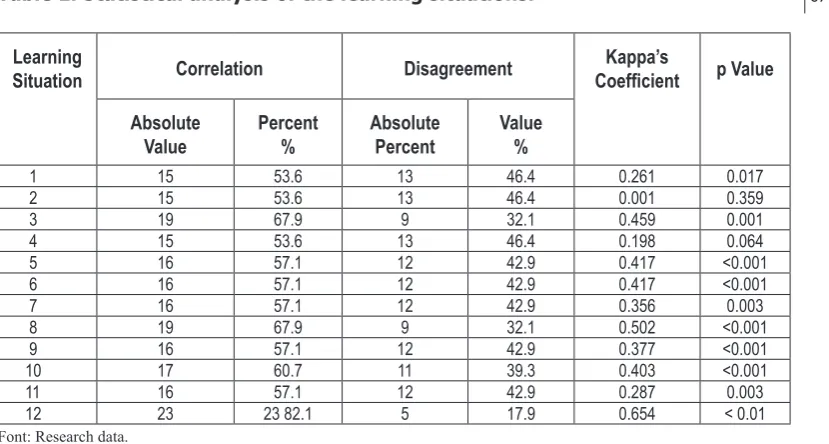
The analysis objective was to evaluate the situations reproducibility, considering the four styles. Thus, it was estimated Kappa’s coefficient (0= absence of agreement between the two evaluations; < 0.4, poor agreement; from 0.4 to 0.75, good agreement; above 0.75, excellent agreement). Moreover, for each situation it was tested the null hypothesis that there is no correlation between the two evaluations (there is no reproducibility) versus the alternative hypothesis that there is correlation.
in the 21st century Volume 38, 2011 67
Table 1. Statistical analysis of the learning situations.
Learning
Situation Correlation Disagreement CoefficientKappa’s p Value
Absolute
Value Percent% Absolute Percent Value %
1 15 53.6 13 46.4 0.261 0.017
2 15 53.6 13 46.4 0.001 0.359
3 19 67.9 9 32.1 0.459 0.001
4 15 53.6 13 46.4 0.198 0.064
5 16 57.1 12 42.9 0.417 <0.001
6 16 57.1 12 42.9 0.417 <0.001
7 16 57.1 12 42.9 0.356 0.003
8 19 67.9 9 32.1 0.502 <0.001
9 16 57.1 12 42.9 0.377 <0.001
10 17 60.7 11 39.3 0.403 <0.001
11 16 57.1 12 42.9 0.287 0.003
12 23 23 82.1 5 17.9 0.654 < 0.01
Font: Research data.
The table above shows the answers’ agreement and disagreement for the twelve learning situations in the first application and in the retest, with the 28 children participating in this stage of the research. The agreement of the answers in each one of the learning situations, from first to second application, indicates that there was loyalty to the learning style in both moments.
The learning situations reproducibility was assessed with an estimated Kappa’s coefficient and observing its statistical significance at a 5% level.
According to statistical analysis, the learning situations 3, 5, 6, 7, 8, 10 and 12 show good response reproducibility, in accordance to the Kappa coefficient, and the p-value significantly greater than 0. The learning situations 1, 2, 7, 9 and 11 showed poor reproducibility, after examining the Kappa coefficient and the p-value significantly greater than 0. The Kappa’s coefficients found reflect weak or good reproducibility, indicating that the children respond in a different manner in two consecutive evaluations.
However, the results of the statistical tests indicate that, despite this, the children’s responses are reproduced for all questions, with exception of situation 4. Because this learning situation has presented a greater discrepancy of results, regarding the use of paint by the child, it has been revised. The drawings and the answers which make up the situation in question were reviewed and, therefore, it was found that the images did not show a correspondence to the written answer. This determined its change so that the inventory could be applied in other research subjects.
Results of Research
Following the instrument’s validation phase, the next step was the application on a larger sample of participating subjects, seventy six five and six-year old male and female students, from a public and a private school. The choice of the educational institutionsaimed, in addition to the necessary population increase, to check if there was or not difference of Learning Styles between the private and public educational system.
68 percentages and so it was used the Chi-square test, in which the values of p<0.05 indicated
statistical significance.
Table 2. Variable gender.
Gender Absolute Value Percent %
Female 32 42.11
Male 44 57.89
Total 76 100
Font: Research data
The second table shows the number of participating subjects in this research: thirty two girls and forty four boys.
Table 3. Variable school.
School Absolute Value Percent, %
Private 27 35.53
Public 49 64.47
Total 76 100
Font: Research data
Among the seventy six students who participated in the study, twenty seven students are from private school and forty nine, from public school.
Table 4. Variable age.
Age (years) Absolute Value Percent, %
5 51 67.11
6 24 31.58
7 1 1.32
Total 76 100
Font: Research data
Of the seventy six students who participated in the study, fifty one are five years old, twenty four are six and only one child is seven years old.
in the 21st century Volume 38, 2011 69
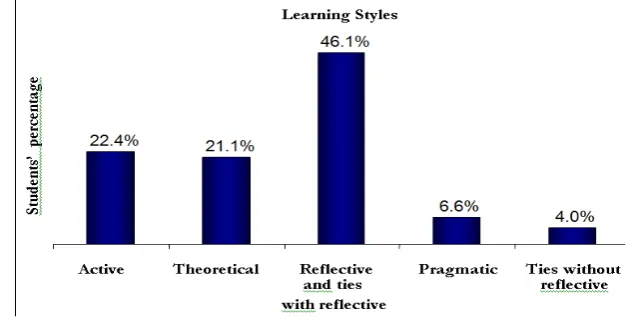
The above figure 1 indicates a general classification of all seventy six students who participated in the research, according to the answer given to each one of the learning situations. The analysis showed that from the seventy six children, seventeen students (22.4%) are in the predominant active style, while sixteen students (21.1%) are in the theoretical style. Only five students (6.6%) are in the predominant pragmatic style. And still, three students (4.0%) are tied for styles without the reflective. In the general classification, the reflective style and the ties in styles with the reflective are shown by thirty five students (46.1%).
It shows the high level of the reflective Learning Style and the ties with the style in the general classification.
The range of 95% confidence for the percentage of students with reflective style / ties with reflective is from 34.85% to 57.26%. This indicates that there is 95% of confidence that this range has the true percentage (population) of students with the reflective style / ties with reflective.
The Learning Styles predominant in the seventy six students who participated in the research are the reflective and ties with reflective.
The comparison between boys and girls, shows that both have the reflective style and ties with the reflective predominant. However, the girls stand out with more than 50% in choosing these styles, with the other styles. While the boys, about 40%, have the predominant reflective style and ties with reflective.
In the private school there is a tie on the predominance of reflective styles and ties with reflective and the theoretical style. In the public school, most of the students selected the reflective style and ties with reflective against the others.
The reflective Learning Styles and ties with reflective stood out both with five year-old and six year-old students. What is different in the variable age, is that the theoretical learning style appears in second place for the five-year old students. While six-year old children show the active style.
Final Contributions
The conducted research found that the predominant Learning Style in five and six-year old children from the Early Childhood Education is predominantly reflective, considering the researched educational institutions, a private school and a public city one.
The Portilho/Beltrami Inventory contributes to the teaching practice for representing a new tool to the Early Childhood Education teacher. It is believed that it gives Early Childhood Education teachers the opportunity of getting to know the five and six-year old children’s Learning Styles and the consequences of its applicability in the classroom, suggesting the rethinking of planning and of the teaching strategies, of the learning assessment and the changes in teaching styles according to the children’s different learning styles.
When identifying the predominant style still in the early stage in school, the teacher has the possibility of promoting an education which develops characteristics of the other learning styles, which can play in a significant manner in the students’ academic background. It is known that during the school years, they will have contact with different teachers and, consequently, with different Learning Styles and also different teaching from their teachers. The identification of the predominant style in the stage of Early Childhood Education allows the student to reinforce the other styles in different learning situations, being able of achieving more meaningful learning.
70 References
Alonso, C., Gallego, D. J., Honey, P. (1994).Los Estilos de Aprendizaje: Procedimentos de Diagnostico y Mejora. 4 ed. Madrid: Ediciones Mensajero.
Learning styles. Presente y Futuro. Revista de Estilos de Aprendizaje. n.1, v. 1, Apr. 2008. Available in: <http://www.learningstylesreview.com/portugues/>. Retrieved Retrieved:30 May, 2010.
Arroyo, M. G. (2004). Imagens quebradas:� trajetórias e tempos de alunos e mestres.Petrópolis: Vozes.
Assmann, H.(2004). Reencantar a educação: rumo à sociedade aprendente. 8 ed. Petrópolis: Vozes.8 ed. Petrópolis: Vozes.
Bransford, J. D., Brown, A. L., Cocking, R. R. (2007). Como as pessoas aprendem: cérebro, mente, experiência e escola. São Paulo: Senac.
Claxton, G. (2005). O desafio de aprender ao longo da vida. Porto Alegre: Artmed.
Cozby, P. C. (2003). Métodos e pesquisa em Ciências do Comportamento. São Paulo: Atlas.
Fernandez, A. (2004). A mulher escondida na professora: uma leitura psicopedagógica do ser mulher, da corporalidade e da aprendizagem. Porto Alegre: Atmed, 1994.
Piaget, J., Inhelder, B. (2006). A psicologia da Criança. 2 ed. Rio de Janeiro: Difel.
Portilho, E. (2003).2003). Aprendizaje Universitario: un enfoque metacognitivo. 346 f. Thesis (doctorate), Universidad Complutense de Madrid, Madrid.
Pozo, J. I. (2002). Aprendizes e mestres. A nova cultura da aprendizagem A nova cultura da aprendizagem. Porto Alegre: Artmed.
Urbina, S. (2005). Fundamentos da Testagem Psicológica. Translation: Dornelles, C. Porto Alegre: Artmed.
Advised by Agnaldo Arroio, University of Sao Paulo, Brazil
Received: October 14, 2011 Accepted: November 05, 2011
Evelise Maria Labatut Portilho Full Professor of Post Graduate Studies in Education, University �at�lica University �at�lica do Paraná, Rua �hichorro Junior, 220 ap. 1001, �uritiba/Parana, Brazil. E-mail: [email protected]
Website: http://www.pucpr.br/
Kátia Beltrami MSc, �oordinator of Pre-School and Pedagogical �oordinator of the Su-perior Institute of Education, �olégio Nossa Senhora de Sion, Alameda Julia da �osta, 1640, ap. 302 – �EP 80.730-070, �uritiba, Brazil. E-mail: [email protected]