
Page 284
THE VIEWS OF MEDICAL STUDENTS ON THE CHOSEN DIDACTIC MEANS USED IN THE PRACTICAL TRAINING ON MEDICAL BIOPHYSICS
Eva Kralova
Institute of Medical Physics, Biophysics, Informatics and Telemedicine, Faculty of Medicine Comenius University in Bratislava, Sasinkova 2, Bratislava 843 72, Slovakia
Abstract
Student of medicine as direct participant of pregradual university education, according generally accepted norms, can take part not only in the creation of study programmes, syllabus of scientific subjects, but also in their evaluation and qualitative improvement.
On the other hand, the role of university medical teacher generally consists in the preparation of optimal study conditions, providing impulses and directions for student´s individual study work, and in the same time, in the creation of good-quality teaching programmes and study literature compatible with the valid standards for medical study.
Pedagogical investigation using anonymous questionnaire was used with the aim to specify respondents (1st year students Faculty Medicine Comenius University in Bratislava) attitudes and opinions toward some aspects of teaching and didactic means used in the practical training on medical biophysics.
Key words: medical education, pedagogical investigation, student´s attitudes, medical biophysics
1. INTRODUCTION
The applications of physics, mainly of medical biophysics, are fundamental for both medical study and medical practice, but students´ opinions and expectations regarding the medical biophysics are often negative. The teacher should try to make physical base of medicine more interesting for students and emphasize its usefulness for medicine. The different tools, including appropriate students’ feedback (e.g. anonymous questionnaire), can be used for an enhancement of the teaching process.
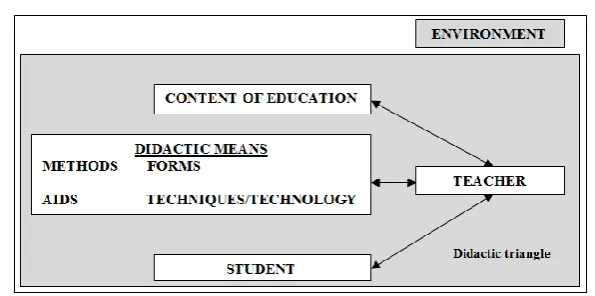
By generalizing and simplifying a complex phenomenon such as teaching, it is possible to create a model in which the participants of education are in their mutual positions and relationships, on the base of which their roles and functions are defined.
There are currently many views how to teach at university. The primary objective is to make the student be able use the obtained knowledge and skills in his/her specialization and practical life. This should help the student to understand the basic phenomena/concepts/laws valid in the real surrounding world. In addition, emphasis is placed on the development of logical thinking capabilities, scientific way of thinking and the use of scientific research methods. Besides, to the cognitive component, this goal also interferes with the affective and creative component of the student´s personality development (Kralova 2008).
Page 285
Fig. 1. Model of teaching, the participants of teaching modified by Slavík (2012).
Didactic aids have always been an inseparable part of the educational process. There are a lot of categories of didactic material resources contributing to achieving educational goals, to presentation and demonstration of the curriculum in different ways, to activation of students, to motivation to learn, to rationalization and intensification the work of teachers, and many others (Slavík 2012).
Teaching and learning innovations through new technologies can take place in several ways. One option is to use interactive technologies whose using in teaching requires the teacher to use them properly in the educational process. The teacher should have the competence to use them in conjunction with multiple didactic means at the same time, both material and non-material. Nowadays, with the continuous development of technology supported learning environment in the digital age and with increasing demands on technology skills of teachers, it is essential to ensure quality of teaching and learning in connection with the effective and trouble free integration of teaching aids in education, too (Nemejc 2017).
An important role in the teaching of the theoretical and clinical subjects at the medical faculties play didactic aids, which create a set of material facilities in theoretical and practical teaching.
Basic didactic aids used in the medical studies:
- preparations, samples, collections;
- models - show the principle or structure of the organ;
- two-dimensional views - allow to display certain processes in the human organism in a particular form or graphically (images, diagrams, photographs);
- audio tools (tape, film, video, etc.);
- text means – books, textbooks, atlases, tables;
- PowerPoint presentations;
- Internet resources.
Special teaching aids reflect the nature of individual medical subjects. They include:
- preparations of laboratory animals;
- autopsy of the human body (anatomy, pathological anatomy, forensic medicine);
- laboratory methodology (chemistry, microbiology, hygiene);
- experimental measurements (medical physics, physiology, pathological physiology);
- special laboratory equipment used in the teaching of clinical subjects (Trnka 2018).
Page 286
underlined today (Balazsiova 2014). In the scholar literature, documents of the educational policy, in the academic events of university teachers is mentioned as the primary source of the transformation the student entity, which determines not only the understanding of teaching, but also the ways of improving it. The new position of students in higher education and the changes in the personality of university students, the diversity of cognitive styles, the range of individual strategies and approaches to learning, motivation to university study, individual learning needs and interests, are part of the whole set of aspects that should be taken into account in educational concepts and innovations.
According to current literary sources from the field of university education, the basic characteristics of good university teaching include the effort to provide students with quality feedback so that they have the opportunity to apply their opinions, attitudes and comments on the forms and methods of university teaching and the way of control acquired knowledge.
At the Slovak universities, including Comenius University in Bratislava, students have commented for several years the teaching process in the form of an anonymous electronic questionnaire.
Also a medical student, as a direct participant of university undergraduate education, is supposed to participate in the curriculum development, syllabus of individual subjects, as well as in their evaluation and qualitative improvement, according to norms formulated by the World Federation for Medical Education. On the other hand, the role of the medical teacher generally consists in the preparation of optimal conditions, the provision of impulses and the direction of the individual study work of the student. At the same time, it is also the creation and implementation of quality study programs and appropriate study literature in accordance with accepted standards of medical study.
An adequate feedback is needed to get students opinions and suggestions (Kukurová, Ferencová, Bernadič 2002). Therefore, an anonymous questionnaire was prepared for respondents – 1st
year students of medicine at Faculty of Medicine Comenius University in Bratislava (FM CU). Results obtained by collecting and analysing student´s opinions and suggestions concerning teaching methods and didactic aids are applied in practical training of medical biophysics.
The paper discuss the results of an analysis of respondents´ responses to questions of the anonymous questionnaire and their attitudes and opinions regarding the practical training of medical biophysics, including the use of ICT.
2. MATERIALS AND METHODS
Respondents (92 in acad. year 2010/2011 and 112 in acad. year in 2018/2019) participated in the anonymous questionnaire survey conducted in the winter semester after completing medical biophysics. The statistical sample consisted of respondents of the 1st year of medicine study.
Questions were focused on respondents´ opinions and suggestions on:
a) attitudes toward physics before university study and towards medical biophysics after completing of medical biophysics course at FM CU in Bratislava;
b) importance of written record sheets from experiments;
c) elaboration of the semester project focused on applications of medical biophysics in medicine as one of the forms of individual study and defence it at the final exam in medical biophysics;
d) personal preferences in the use of different didactic means (school board, PowerPoint, printed documents, internet, etc.).
Page 287
3. RESULTS
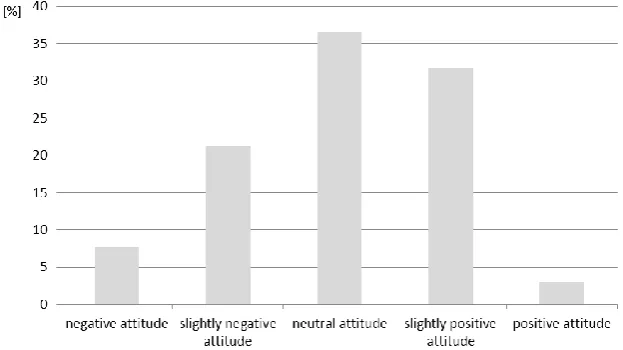
a) Analysis of results of attitudes toward physics before university study and towards medical biophysics after completing of medical biophysics course at FM CU in Bratislava showed (Fig. 2., Fig. 3.) showed:
31.5 % / 45.5 % of respondents had a negative and very negative attitude to the physics before university study, but 47.8 % / 53.6 % of respondents better understood physical laws in the medical applications after completing the medical biophysics course in acad. years 2010/2011 and 2018/2019, respectively.
Respondents wanted to learn physical principles of the biological processes (57.1 % / 52.7 %), physical principles of the medical devices (30.8 % / 33.0 %), applications of physics in medicine (38 % / 58.0 %) and to train a logical thinking (24.2 % / 39.0 %), respectively.
They evaluated importance of the medical biophysics for their future careers as medium and large (61.9 % / 71.2 %). Respondents consider medical biophysics as useful to acquire knowledge about physical principles of modern diagnostic and therapeutic methods in medical practice (90.2 % / 73.2 %) and physical principles of physiological processes (46.2 %/ 56.3 %).
Results are given in order acad. years 2010/2011 and 2018/2019, respectively.
Fig. 2. What was your attitude toward physics before university study?
Page 288
b) 33.7 % / 31.3 % of respondents considered importance of written record sheets from experiments useful for systematic study, 45.7 % / 27.7 % considered them an appropriate way of consolidating and sorting knowledge, but 28.3 % / 36.6 % regarded them as a waste of time 5,4 % / 13,4 % had a different opinion (Fig. 3.).
Fig. 4. The importance of written record sheets (protocols) from experiments [%]
c) 21.7 % / 32.5 % of respondents considered the preparation of a semester project on medical biophysics to be extremely suitable, 52.3 % /, 53.8 % suitable, moreover 42.8 % / 87.6 % of respondents considered the possibility to defence it at the final exam in medical biophysics as extremely positive and rather positive than negative, 28.7 % / 7.5 % as neutral.
d) 45.7 % / 33.9 % of respondents preferred any type of school board, 21.3 % / 44.6 % printed documents, 28.3 % /42.0 % Internet and multimedia and 64.1 % /74.1 % preferred PowerPoint presentations (Fig. 5.).
Page 289 4. DISCUSSION
Despite negative attitudes of respondents towards physics and its applications in medicine at the beginning of a medical study, respondents considered the study of medical biophysics as useful and important for their future career. Results of our continuous research could be considered in management of teaching process, preparation of new teaching materials and modification of didactic approaches. The relevance of medical biophysics as a teaching subject in the undergraduate medical curriculum was justified once again. Students´ evaluation of teaching process provides the inevitable feedback information and can help to make teaching of medical biophysics more attractive.
Respondents did not confirm importance of written record sheets from experiments for their continuous individual study. There were identified several reasons for this result: a large number and range of protocols, a high amount of time consuming and too many statistical calculations.
Acquired results concerning semester projects as one of the most effective motivation factors confirm our assumption that the majority of respondents positively accept elaboration of semester project and its defence in the exam (Kralova, Kukurova, Kecskes 2005).
We were not surprised that in last academic year increased number of respondents who prefer Internet, multimedia and PowerPoint presentations. We are thinking that creative work with various study information resources of medical applications (compulsory study literature, self-notes, Internet, multimedia, PowerPoint presentations) promotes the development of cognitive skills of students, changes individual learning from passive receiving and reproducing information to active application of knowledge. The message followed from our survey is that modern technologies could be used in the teaching process more extensively.
5. CONCLUSIONS
In each type of school, appropriate, effective and advantageous information and communication technologies (ICT) must be identified, and teachers need to be constantly acquiring knowledge and skills in teaching methods and forms of education, and devote sufficient attention to modern didactic means. However, it is necessary to say that there is no need to completely eliminate, or even "condemn" conservative teaching methods and techniques. It is possible to teach modern and interactive without the use of ICT, only with paper and blackboard, pencil and chalk, but also without them, and students can remember their lessons for life. We do not consider to overestimate or underestimate the role of ICT in teaching. ICT in interactive lessons is helping teachers to engage and activate students. The role of teachers is to find the right amount of their use (Kralova, Ferencova, Trnka 2017).
The university teachers, especially a teachers of science at the medical faculty, should therefore master the full range of technological means and resources, pedagogical approaches and strategies that motivate students to learn. They should also know their students and know what patterns are significant in a given group or individuals.
A central role in the evaluation process is played by the students’ opinions and attitudes regarding the way in which university teachers conduct their educational activities. At this step, we agree that the students’ perception on the teaching aids can help the teacher to make a course more interesting and to transform a difficult discipline into a very pleasant one.
ACKNOWLEDGEMENTS
Page 290 REFERENCES
1.
Balazsiova, Z, 2014, “Level of elementary physical knowledge in health-care professionals may be the reason for innovative teaching of (Bio)physics”, New Technologies in Science Education, Kraków : Pedagogical University of Kraków, 2014. p. 38-40.2.
Kralova, E, 2008, “Physical education in the professional preparation of future physician at the faculties of medicine”, Dissertation Thesis. Nitra : Constantine the Philosopher University in Nitra, 103 p.3.
Kralova, E, Ferencova, E, Trnka, M, 2017, “Semester projects in Medical Biophysics promoteactive learning”, Edulearn 17 Proceedings (L. Gómez Chova, A. López Martinéz, I. Candel Torres eds.) (pp. 9302-9306). Valencia : IATED Academy, 2017. ISBN 978-84-697-3777-4.
4.
Kralova, E, Kukurova, E, Kecskes, A, 2005, “Contribution of teacher-student communication to the physical subjects’ conception”, Research and Teaching of Physics in the Context of University Education, Nitra : Slovak University of Agriculture, 2005, p. 138-141. ISBN 80-8069-528-8.5.
Kukurova, E, Ferencova, E, Bernadic, M, 2002, “The pedagogical aspects in the physical measurements provided in medicine”, BRATISL MED J, 103 (2), 2002, p. 86-89. ISSN 0006-9248.6.
Nemejc, K, Smekalova, L, Slavik, M, 2017, “Teaching aids requiring educational technologies inthe context of evaluation of education”, Edulearn 17 Proceedings. Valencia : IATED Academy, 2017. [cited 2019-05-07]. Available at https://library.iated.org/view/NEMEJC2017TEA.
7.
Slavík, M, et al., 2012, “Vysokoškolská pedagogika [Higher education pedagogy]”, Praha: GradaPublishing a.s., 256 p. ISBN 978-80-247-4054-6.
![Fig. 4. The importance of written record sheets (protocols) from experiments [%]](https://thumb-us.123doks.com/thumbv2/123dok_us/94669.1509914/5.595.139.464.508.669/fig-importance-written-record-sheets-protocols-experiments.webp)