www.hist-geo-space-sci.net/5/175/2014/ doi:10.5194/hgss-5-175-2014
© Author(s) 2014. CC Attribution 3.0 License.
Erich Regener and the ionisation maximum of the
atmosphere
P. Carlson1and A. A. Watson2
1KTH and the Oscar Klein Centre, Stockholm, Sweden 2School of Physics and Astronomy, University of Leeds, Leeds, UK
Correspondence to: A. A. Watson ([email protected])
Received: 4 June 2014 – Revised: 4 November 2014 – Accepted: 10 November 2014 – Published: 18 December 2014
Abstract. In the 1930s the German physicist Erich Regener (1881–1955) did important work on the measure-ment of the rate of production of ionisation deep under water and in the atmosphere. Along with one of his stu-dents, Georg Pfotzer, he discovered the altitude at which the production of ionisation in the atmosphere reaches a maximum, often, but misleadingly, called the Pfotzer maximum. Regener was one of the first to estimate the energy density of cosmic rays, an estimate that was used by Baade and Zwicky to bolster their postulate that supernovae might be their source. Yet Regener’s name is less recognised by present-day cosmic ray physicists than it should be, largely because in 1937 he was forced to take early retirement by the National Socialists as his wife had Jewish ancestors. In this paper we briefly review his work on cosmic rays and recommend an alternative naming of the ionisation maximum. The influence that Regener had on the field through his son, his son-in-law, his grandsons and his students, and through his links with Rutherford’s group in Cambridge, is discussed in an appendix. Regener was nominated for the Nobel Prize in Physics by Schrödinger in 1938. He died in 1955 at the age of 73.
1 Introduction
Erich Regener was born in West Prussia in 1881. He studied physics at the University of Berlin, and his 1905 thesis (Re-gener, 1905) concerns the interaction of UV light with oxy-gen and ozone molecules and the equilibrium between them, a topic that he revisited on several occasions. In Berlin he chose as the subject for his Habilitationsschrift the determi-nation of the elementary electric charge using different meth-ods, including alpha-particle scintillations (Regener, 1911). His accurate determination ofeis very close to today’s ac-cepted value.
After a period as professor at the Agricultural University of Berlin and as X-ray field technician during the 1914–1918 war, Regener became a full professor of physics at the Tech-nical University of Stuttgart in 1920. A hot topic at this time was the study of atmospheric ionisation following the 1912 discovery of cosmic rays1by Victor Hess (1883–1964), and,
1Before ca. 1930 “Höhenstralung” and “Ultrastrahlung” were
terms often used for what are now known as “cosmic rays”.
from the second half of the 1920s, Erich Regener made sig-nificant contributions to the study of this field, both through work that he carried out himself and through stimulating work carried out by his son and by his students, both with him and independently: some of these activities are related in Appendix A. Regener realised that ionisation measurements had to be made deep in lakes and at the highest altitudes and developed the necessary instruments, along with innovative recording techniques, to make such measurements.
radiation” is difficult for several reasons: the instrument can contain radioactive material, the air can contain radioactive emanations and the ground contains radioactive radium. Any instrumental radioactivity can be investigated by measuring the ionisation in deep lakes, while measurements at high al-titudes avoid the ground radioactivity.
Regener was an ingenious experimentalist and soon es-tablished a depth record for observations of the rate of pro-duction of ion pairs. He tackled the problem of measur-ing the decrease in ionisation as a function of increasmeasur-ing depth by submerging a quartz-fibre electrometer and a pres-sure chamber in the waters of Lake Constance. He suc-ceeded (Regener, 1933a) in measuring the rate of ionisa-tion (pairs of ions produced cm−3s−1) down to a depth of 231 m, where the rate was found to be very low and of the or-der 0.05 ion pairs cm−3s−1. Millikan and Cameron (1928a), working in the US, reached a depth of 50 m, where the ioni-sation was about 2.6 ion pairs cm−3s−1. The “steel bomb” in which Regener measured the ionisation weighed 130 kg and contained CO2 at a pressure of 30 atmospheres. His early work, carried out using a hand-operated winch on a row-ing boat, was so successful that it attracted sufficient fund-ing to purchase a motor boat for later work. He named this boat “Undala”, reflecting his belief, and one that was widely held at that time, that cosmic rays were photons with wave-like properties rather than particles. Interesting accounts of the underwater research have been given by Paetzold et al. (1974) and by Pfotzer (1985). Pfotzer worked with Re-gener, first as a student from 1929 and later, after the war, as a senior scientist.
Regener’s work in Lake Constance (Regener, 1931) was highly regarded by eminent physicists of the day, including Bruno Rossi (1905–1993), a close friend despite their differ-ing views on the nature of cosmic radiation (Rossi, 1985). At the Royal Society discussion meeting of 1931 (Geiger et al., 1931), attended by the likes of Geiger, Rutherford, Wilson and Bragg, both Geiger and Rutherford praised Regener’s work although they disagreed as to whether it provided ev-idence for the particle (Geiger) or wave (Rutherford) nature of the radiation. In Rossi’s 1985 article there is a photograph of Rossi with Lise Meitner – also a supporter of the wave hypothesis – and Erich Regener (two of Rossi’s “dearest
Figure 1.Erich Regener, on the left, on board the Undula on Lake Constance ∼1933. Credit: Archiv der Max-Planck-Gesellschaft, Berlin-Dahlem.
and most respected friends”) aboard Regener’s boat on Lake Constance. Part of the caption reads “Regener had baptized the boat “Undula” to reaffirm his faith in the wave nature of cosmic rays. Here, following a discussion on this subject, he was telling me: “If it turns out that you are right, I would have to rename my boat “Korpuskel”, which does not sound as nice as “Undula”.”” No date is given for this photograph, but it was presumably taken in the early 1930s and before the discovery of the East–West effect that did much to establish the particulate nature of the radiation (Johnson, 1933; Al-varez and Compton, 1933). A photograph of Regener work-ing aboard the Undula is shown in Fig. 1.
In the early 1930s Regener started a research program aimed at extending the atmospheric measurements of Hess and of Werner Kolhörster (1881–1945), who, in 1914, un-dertook a flight to 9300 m. Millikan and Bowen (1926) had found it difficult to keep their instruments working at the cold temperatures encountered at high altitudes, and Regener overcame this problem by enclosing his equipment in a light gondola encased in cellophane. The cellophane turned the gondola into an effective greenhouse against the low tem-peratures, and the apparatus was operated at what was effec-tively room temperature. Again, Georg Pfotzer (1909–1981) has given a good description of the challenges Regener faced and the solutions that he adopted (Pfotzer, 1985).
2.1 Results with a balloon-borne electrometer and the energy density of cosmic rays
Figure 2. Ionisation data from Regener (1932) taken using an electrometer and a 2.1 L ionisation chamber. The ionisation rate (ion pairs cm−3s−1) is shown as function of decreasing pressure (mm Hg). Also shown are data from Kolhörster and Piccard. The extrapolated value is shown as 275 ion pairs cm−3s−1. As was cus-tomary at the time, no errors are shown on the data points. Using these data Regener was able to confirm the results of Kolhörster and infer that the rate of production of ionisation had reached a maximum value, which he extrapolated to 275 ion pairs cm−3s−1. He defined this as the “intensity of the cosmic radiation” at “its en-trance to the atmosphere”.
or four lifting balloons burst, ozone interacting with the rub-ber probably being the cause of the rupture.
In a paper submitted on 31 December 1932 (Regener, 1933b) and published only 4 weeks later, Regener reported the results of integrating the ionisation as a function of height to obtain the total number of ions, produced by the absorp-tion of cosmic rays by a column of air of 1 cm2 cross sec-tion, as 1.02×10⁸ion pairs, to be compared with the value of 1.28×10⁷ion pairs estimated by Millikan and Cameron (1928b) from a larger extrapolation. Taking 32 eV (about 6% lower than modern measurements) as the energy needed to produce an electron–ion pair in air, he deduced that the energy reaching the earth in the form of cosmic rays was 5.2×10⁻²erg cm−2s−1. In a later paper (Millikan et al., 1933), a value of 3.2×10⁻²erg cm−2s−1 was derived and compared with the energy falling to the earth as starlight, 6.91×10⁻³erg cm−2s−1. Millikan and his co-authors made no reference to Regener’s paper although it had been pub-lished, in English, nearly 6 months prior to their own work being submitted.
Of course, both values for the energy flux are low as both Millikan and Regener were unaware that the bulk of the cos-mic rays are charged particles. Both subscribed to the photon view, and the values are about a factor 2 lower than modern estimates. These numbers were used by Baade and Zwicky in their classic paper as evidence to support their theory
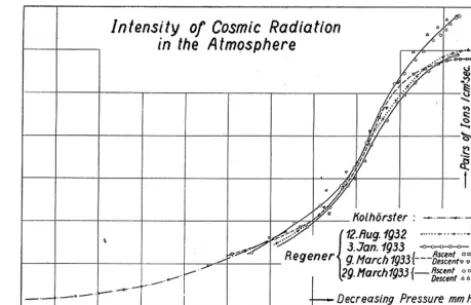
Figure 3.Ionisation data from Regener (1933c). The ionisation rate (ion pairs cm−3s−1) is shown as function of decreasing pres-sure (mm Hg). Results from four flights during 1932–1933 with data corrected to one atmosphere pressure. Also shown are Kolhörster’s data.
that cosmic rays were produced in supernovae (Baade and Zwicky, 1934).
From a series of balloon flights in 1932 and 1933, Regener reported the data shown in Fig. 3. The three lower curves of Fig. 3 are in good agreement, and there is evidence that the rate of production of ion pairs has reached a maximum value. It was normal practice to correct the rate of production of ion pairs to a pressure of one atmosphere: the pressures in the ionisation chamber monitored by the electrometer varied considerably over the range of three to four atmospheres in different flights.
The results from the flight of 29 March 1933 are of particu-lar interest. The instrument was apparently working well, and no instrumental reason could be identified to account for the much higher rate of ionisation. Regener considered the possi-bility that radioactivity from the moon might be responsible. He rejected this as he did the possibility that “a magnetic disturbance of medium strength” that occurred on that day, while it was magnetically calm on the other days, had an in-fluence. He noted that “it would be remarkable if there were a connexion between the magnetic intensity and the intensity of cosmic rays in the highest part of the atmosphere, and only in the highest parts: that is to say, that there are additional rays (soft rays) there perhaps coming from a sunspot”. Of course, with the benefit of hindsight one might remark that the solar connection should have perhaps been given more attention, but the statement demonstrates the strong adher-ence that Regener, and others, had to the photon hypothesis. Indeed he discusses the shape of the curve at the highest alti-tudes as being evidence of an electromagnetic component.
2.2 Discovery of the maximum
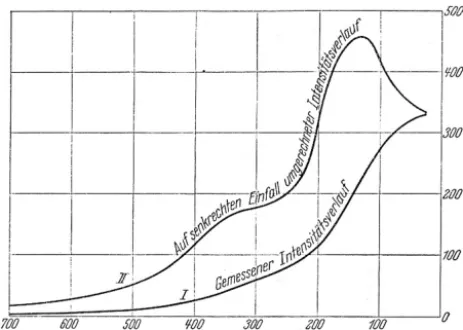
direc-Figure 4.The ionisation rate (ion pairs cm−3s−1) as function of decreasing pressure (mm Hg) from the work of Gross (1933). Line I shows the measured rate (Regener data) for rays from all directions. Line II is the calculated rate for vertically incident rays, showing a clear maximum at about 130 mm Hg and a shoulder at 350 mm Hg.
tions. He then went on to report that his collaborator, Bern-hard Gross, had calculated the ionisation data for vertically incident rays, showing that the intensity diminished towards the top of the atmosphere, i.e. shows a maximum. In that pa-per (Gross, 1933), received on 6 April 1933 and published 14 June 1933, Gross acknowledges Regener for suggesting the problem and for his help with the work. The results of Gross’s calculations are shown in Fig. 4.
As an excellent experimentalist, Regener wanted to exploit the Geiger–Müller (GM) tubes, developed in 1928, so that he could register single charged particles. He involved Georg Pfotzer, one of his students, in this work. Their first results, obtained with one tube carried to an altitude of 28 km, were published in September 1934 (Regener and Pfotzer, 1934), with the ionisation measured found to be the same above 18 km height as reported earlier with an ionisation chamber.
A year later, in November 1935, Regener and Pfotzer de-scribed the results from two ascents with three GM tubes in coincidence, arranged to measure the vertical intensity. The solid angle was 20 degrees about the zenith (Regener and Pfotzer, 1935). Data show a clear maximum for 100 mm Hg pressure (∼16 km) and a bump at 300 mm Hg; see Fig. 5. Note the author ordering in these two Nature papers.
Pfotzer gives a detailed account of this work together with results from other flights in his 1936 thesis, presented on 15 May 1936 and in part published in Zeitschrift f. Physik (Pfotzer, 1936). In the acknowledgements Pfotzer thanks Re-gener warmly: “My sincere thanks to my idolized teacher Prof. Regener for organizing the ascents and for continuous support and help.”
Pfotzer went on to have a distinguished career in physics, following Regener as Director of the Max-Planck-Institut für Stratosphärenforschung in 1956. However, it is clear to us
Figure 5.Data from coincidence measurements by Regener and Pfotzer (1935). The coincidence rate per 4 min at a solid angle of 20 degrees about the zenith is shown as function of decreasing pres-sure (mm Hg) (data points and line I). Data, corrected for dead-time losses, are shown as line II. Note the clear maximum at about 100 mm Hg.
that the real discoverer of the maximum in the rate of pro-duction of ion pairs with altitude, misleadingly called the Pfotzer maximum, was Erich Regener, with the 1935 result essentially confirming those shown in Fig. 4.
3 Why not the Regener maximum or even the Regener–Pfotzer maximum?
Pfotzer maximum”. In this paper, and many subsequent pa-pers, the maximum is generally and, we contend, mislead-ingly referred to as the Pfotzer maximum, without citation.
It is our speculation that Regener advised Pfotzer against joint authorship as, by 1936, his difficulties with the Na-tional Socialist Party were increasing. A fascinating account of these difficulties, based on letters between her parents, has been given by the daughter of one of Regener’s students (B. Hoerlin, 2011). In 1933, during the period of book burn-ing in Germany, Regener, along with the Jewish librarian in Stuttgart, were rumoured to be targets of angry students sup-portive of the National Socialists. Accordingly, Hermann Ho-erlin appointed himself as guardian of Regener and his family and, armed with a wooden ice axe, slept on the floor behind the door of Regener’s apartment. Bettina Hoerlin also notes that Regener was one of 75 established physicists (including Heisenberg) who, in October 1936, sent a petition to the Re-ich’s Minister of Education warning of the declining state of German physics. She remarks that “the contrarian act of sign-ing the petition” – along with the issue of his wife – “sealed Regener’s removal from the Stuttgart Faculty”.
Regener was nominated by Schrödinger for the Nobel Prize in Physics in 1938 for his detailed measurements of ionisation rates, both in the atmosphere and deep under wa-ter.
1933) and confirmed the results of Clay and Berlage (1932) and of Compton (1933), obtained only slightly earlier: Hoer-lin’s work preceded that of Millikan. Hoerlin, too, married a woman with Jewish ancestry, and they emigrated to the United States in 1938. There, Hoerlin continued working for AGFA, the German manufacturers of photographic material and equipment with whom he had found a job in Germany after completing his PhD. In 1953, with the encouragement of Hans Bethe, he moved to Los Alamos, where he headed the Nuclear Weapons Effects group. After the war, he stud-ied the fluorescence emission from nuclear explosions (Ho-erlin, 1963) and was regarded as one of the world’s experts on high-altitude nuclear detonations (Bethe et al., 1984). This method of explosion monitoring was an idea of Teller’s (Mead, 1963) and may have been an inspiration for Greisen’s proposal of the fluorescence technique for the observation of the highest-energy cosmic rays. Hoerlin was deeply devoted to Regener, as an example cited in Section 3 of the main text illustrates.
Regener’s son, Victor (1913–2006), emigrated to the United States before the start of World War II to work with Compton in Chicago. He moved to the University of New Mexico in Albuquerque and established a well-known cos-mic ray group there (Swinson, 1995), dedicated to the study of the time variations of low-energy cosmic rays. He had made an early foray into cosmic ray work when he accom-panied Hoerlin on an expedition to the Jungfraujoch in 1933, while, with his father, he studied ozone at high altitudes (Re-gener and Re(Re-gener, 1934). Victor Re(Re-gener had a strong inter-est in statistics and was one of the first physicists to address the question of how to assign uncertainties to small samples in a paper entitled Statistical Significance of Small Samples of Cosmic Ray Count (Regener, 1951). Later, with his son, Eric, a mathematician and a musician, Victor Regener devel-oped a mathematical analysis of importance in establishing correlations between interplanetary magnetic-field parame-ters and cosmic ray diurnal variations as measured with un-derground data (Regener and Regener, 1970).
an important role in McCusker’s air shower work until his early death in 1969. A scholarship was established at the Uni-versity of Sydney by his parents in his name in 1971.
Author contributions. The authors have contributed equally to the writing of this paper.
Acknowledgements. A. A. Watson would like to thank Virginia Trimble for pointing out the use of Regener’s data on the energy density of cosmic rays by Baade and Zwicky. We are grateful to Derek Swinson for drawing our attention to his 1995 paper. Edited by: K. Schlegel
Reviewed by: M. Witte, K. L. Aplin, and one anonymous referee
References
Alvarez, L. and Compton, A. H.: A Positively Charged Component of the Cosmic Rays, Phys. Rev., 43, 835–836, 1933.
Baade, W. and Zwicky, F.: Cosmic Rays from Super-Novae, P. Natl. Acad. USA, 20, 259–263, 1934.
Bethe, H. A., Kerr, D. M., and Jeffries, R. A.: Obituary H. W. Ho-erlin, Phys. Today, 82–83, 1984.
Bhabha, H. J. and Heitler, W.: The Passage of fast Electrons and the Theory of Cosmic Showers, Proc. Roy. Soc. A, 159, 432–458, 1937.
Blackett, P. M. S.: Obituary: Erich Regener, Nature, 175, 1107– 1108, 1959.
Carmichael, H.: Edinburgh, Cambridge, and Baffin Bay, edited by: Sekido, Y. and Elliot, H., Early History of Cosmic Ray studies, D. Reidel 1985, 99–113, 1985.
Carmichael, H. and Dymond, E. G.: High-Altitude Cosmic Radi-ation Measurements near the Magnetic Axis-Pole, Nature 141, 910–911, 1938.
Clay, J. and Berlage, H. P.: Variation der Ultrastrahlung mit der geographischen Breite und den Erdmagnetismus (in German), Naturwiss., 20, 687–688, 1932.
Compton, A. H.: A Geographic Study of Cosmic Rays. Phys. Rev. 43, 387–403, 1933.
Geiger, H.: Lord Rutherford, Regener, E. et al. Discussion on Ultra-Penetrating Rays, Proc. Roy. Soc. A, 132, 331–352, 1931. Greisen, K.: Highlights in Air Shower Studies, 1965. Proceedings
of the 9th International Conference on Cosmic Rays, Inst. Phys., 2, 609–615, 1966.
Gross, B.: Zur Absorption der Ultrastrahlung (in German), Zeit. Phys., 83, 214–221, 1933.
Hess, V. F.: Über Beobachtungen der durchdringenden Strahlung bei sieben Freiballonfahrthen. Phys. Zeits., 13, 1084–1091 (In German: On the observation of the penetrating radiation from seven balloon flights), 1912.
Hoerlin, B.: “Steps of Courage” My Parents’ Journey from Nazi Germany to America, p. 49 and p. 130, USA, 2011.
Hoerlin, H.: Latitude Effect of Cosmic Radiation, Nature, 132, 61– 61, 1933.
Hoerlin, H.: Air Fluorescence Excited by High Altitude Nuclear Ex-plosions. Los Alamos Report, LA-3417-MS, 1–74, 1963. Johnson, T. H.: The Azimuthal Asymmetry of the Cosmic
Radia-tion, Phys. Rev., 43, 834–835, 1933.
Kolhörster, W.: Messungen der durchdringenden Stralungen bis in Höhen von 9300 m (In German), Verh. deutsche phys. Gesellschaft, 16, 719–721, 1914.
McCusker, C. B. A., Winn, M. M., and Rathgeber, H. D.: Two Large Air Shower Experiments, Proceedings of 8th International Con-ference on Cosmic Rays, Jaipur, 4 pp., 306–309, 1963.
Mead, J. B.: Properties of Teller Light (Air Fluorescence) induced by 22 MeV electrons, CRD Sigma 3, UCRL-7604, Lawrence Ra-diation Laboratory, 1963.
Millikan, R. A. and Bowen, I. S.: High Frequency Rays of Cosmic Origin I. Sounding Balloon Observations of Extreme Altitudes, Phys. Rev., 27, 353–361, 1926.
Millikan, R. A. and Cameron, G. H.: New Results on Cosmic Rays, Nature, 121, 19-26, 1928a.
Millikan, R. A. and Cameron, G. H.: New Precision in Cosmic Ray Measurements; Yielding Extension of Spectrum and Indications of Bands, Phys. Rev., 31, 921–930, 1928b.
Millikan, R. A., Bowen, I. S., and Neher, H. V.: New High-Altitude Study of Cosmic-Ray Bands and a new Determination of Their Energy Content, Phys. Rev., 44, 246–252, 1933.
Paetzold, H. K., Pfotzer, G., and Schopper, E.: Erich Regener als Wegbereiter der extraterrestrischen Physik, edited by: Birett, H., Helbig, K., Kertz, W., and Schmucker, U., in: Zur Geschichte der Geophysik, Springer Berlin, 167–188, 1974.
Pfotzer, G.: Dreifachkoinzidenzen der Ultrastrahlung aus vertikaler Richtung in der Stratosphäre (in German), Zeit. Phys. 102, 23– 58, 1936.
Pfotzer, G.: On Erich Regener’s cosmic-ray work in Stuttgart and related subjects, edited by: Sekido, Y. and Elliot, H., edited by: Early History of Cosmic Ray Studies, D. Reidel, 75–89, 1985. Regener, E.: Über die chemische Wirkung kurzwelliger Strahlung
auf gasförmige Körper (In German), thesis univ. Berlin, 1905. Regener, E.:. Über Ladungsbestimmungen an Nebelteilchen, Phys.
Zeit., 12, 135–141, 1911.
Regener, E.: Über neuere Versuche über die sogennante durchdrin-gende Höhenstrahlung in der Erdatmosphäre (in German), Natur-wissentschaftlige Monatshefte 25, 240, 1928.
Regener, E.: Spectrum of Cosmic Rays, Nature 127, 233–234, 1931. Regener, E.: Intensity of Cosmic Radiation in the High Atmosphere,
Nature 130, 364-364, 1932.
Regener, E.: Die Absorptionskurve der Ultrastrahlung und ihre Deutung (in German), Phys. Z., 34, 306–323, 1933a.
Regener, E.: Energy of Cosmic Rays. Nature, 131, 130–130, 1933b. Regener, E.: New Results in Cosmic Ray Measurements, Nature,
132, 696–698 1933c.
Regener, E. and Regener, V. H.: Aufnahme der ultravioletten Son-nenspektrums in der Stratosphäre und vertikale Ozonverteilung (in German), Phys. Zeit. 35, 788–793, 1934.
Regener, E. and Pfotzer, G.: Messungen der Ultrastrahlung in der oberen Atmosphäre mit dem Zählrohr (in German), Phys. Zeit. 35, 779–784, 1934.
Regener, E. and Pfotzer, G.: Intensity of the Cosmic Ultra-Radiation in the Stratosphere with the Tube-Counter, Nature, 134, 325– 325, 1935.
Regener, E. and Pfotzer, G.: Vertical Intensity of Cosmic Rays by Threefold Coincidences in the Stratosphere, Nature, 136, 718– 719, 1935.