".1'11!1
MEMBER'S
COpy
N A rvl
E. .,., ... ••••••
. , 7 ( b 1982J(Saleable
to
l.S.P.P. only)
Indian J. Plant PhYSIOI., Vol. XXV, No.4. pp. 31 -323 Decem er
SUBCELLULAR LOCALIZATION OF MULTIPLE FORMS OF
STARCH PHOSPHORYLASE IN PLANT LEAVES DURING
DEVELOPM ENT
ANIL KUMAR AND G. G. SANWAL Department of Biochemistry
Lucknow University Lucknow 226007. U. P.• India (Received: August 11, 1981 ; Revised: December 16, 1981)
SUMMARY
Four multiple forms (enzymes A, B,
e
andoj
of starch phosphorylase (Ee 2.4.1.1) in plant leaves were detected by polyacrylamide gel electrophoresis with the following electrophoretic mobilities (cm/2t h) in the respective order: 1.9, 2.2,3.2 and 4.2. In Marigold leaves, one starch phosphorylase, enzyme B, was present throughout the maturation stage and was localized in the soluble fraction. Cabbage leaves, contained four multiple forms of the enzyme (enzymes A, B, C and D) in young leaves Which decreased to one (enzyme C) in the mature leaves. !n cabbage. the enzyme detected in mature leaves (enzyme C) was in the soluble fraction whereas, in the young leaves three of the four (enzymes A, B and OJ were partially localized in the chloro plast and partially in the soluble fraction. Potato leaves contained three starch phosphorylases (enzymes B,e
and 0), one (enzyme B) was partially localized in the chloroplast and partially in the soluble fraction while the other two (enzymes C and 0) were in the soluble. fraction throughout maturation. Two enzymes (enzymes B and e) were present in the brinjal leaves. one (enzyme B) was partially localized in the chloroplast and partially in the soluble fraction while the other (enzyme C) was totally in the soluble fraction. Arhar leaves contained two enzymes (enzymes C and OJ throughout maturation, one (enzyme C) was partially localized in the soluble fraction and the other (enzyme 0) was entirely in the soluble fraction. Turnip leaves had one enzyme (erzyme B) which was localized in the soluble fraction throughout maturation.INTRODUCTION
Multiple forms of starch phosphorylase (SP) exist in plant tissues (Khanna
et al..
1971; Kumar and Sanwal. 1977; Shivaram, 1976). Chen et al. (1970)
demonstrated that in Xanthium leaves, the number of SP isoenzymes decreased from
four to one with leaf maturity. Singh and Sanwal (1975) demonstrated two and
three forms of SP in young and mature banana fruit, respectively. Earlier, we
demonstrated different forms of SP in banana leaves during development (Kumar
and Sanwal, 1977). Several workers have shown the presence of SP in chloroplasts
(Defekete, 1968; Gerbrandy and Verleur, 1971) and interpreted its involvement
Instarch biosynthesis. In this communication we report our results on the multiple
forms and subcelh,ilar localization of SP in marigold, turnip, cabbage, brinjal, arhar
and potato leaves during their development.
318
KUMAR AND SANwALMATERIALS AND METHODS
Leaf' tissue.
Marigold (Tagites erecta). turnip (Brassica rapa), brinjal
(Solanum melongena), arhar (Cajanus indicus), cabbage (Elephantopus scabar) and
potato (Solanum tuberosum) leaves were collected from plants grown in the depart
mental garden and used for the assay.
Isolation of chloroplast.
Leaf tissue, 10 g was cut into small pieces and
homogenized at 0-4°C in a glass bowl of a Waring blender using 70 ml homogeni
zing medium consisting of 0.01 M Tris-HCI buffer pH 7.5, 0.02 M 2-mercaptoetha
nol, 0.5% (wt/vol) PVP (MW 40,000), 5 mM MgClz and 0.5 M sucrose. The
homogenate was fIltered through two layers of muslin and the volume made up to
100 ml. The filtrate was designated as enzyme homogenate. Subsequently this
homogenate was centrifuged at
1500xg
for 10 min in a refrigerated centrifuge to
sediment the chloroplasts. After decanting the supernatant the chloroplast fraction
was washed with the isolation medium and centrifuged to obtain the chloroplasts.
The two supernatants were combined. The particulate fraction was suspended in
10
011
of the isolation medium using a hand operated glass homogenizer.
Electrophoresis.
Polyacrylamide gel electrophoresis was carried out
(Weber and Osborn, 1969) but without SDS employing 6% gel. Tris-HCI (0.05 M,
pH 7.5) was used as the electrode as well as gel buffer. Electrophoresis was done
in the cold and 8 mA current per tube for 2!- h. After electrophoresis, gels were
removed and incubated overnight in a mixture consisting of 0.02 mM NaF. 0.02
M Tris-maleate buffer pH 6.0. 0.3% starch (freshly prepared) and 5 mM glucose-1
P04. Gels were stained with 12 reagent (Krisman. 1962). Place (s) with SP activity
became dark on staining.
Enzyme assay. SP was assayed in the direction of polysaccharide synthesis
as described earlier (Kumar and Sanwal. (1981).
Protein determination.
Proteins were determined according to Lowry
et al. (1951) and modified by Khanna et al. (1969) using bovine serum albumin as a
standard.
RESULTS AND DISCUSSION
As determined by polyacrylamide gel electrophoresis. four multiple forms of
SP were observed during maturation of plant leaves. The electrophoretic mobility of
these multiple forms is shown in Table II. The multiple forms have been numbered
according to their increasing electrophoretic mobility.
PLANT STARCH PHOSPHORYLASB
319
TABLE I. Suggested forms of SP
Multiple forms of the enzyme Electrophoretic mobility (cm/2t h)
---~---A 1.9
B 2.2
-
C 3.2\
o
4.2
- - -
---
Electrophoresis was carried out for 2! h at constant current using 8 mA current per tube. The length of the gel was
J
0 em.TABLE
II.
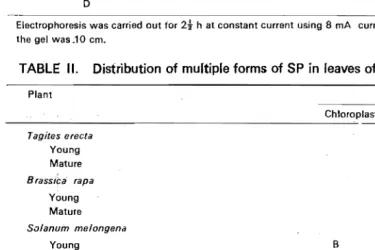
Distribution of multiple forms of SP in leaves of differing maturity
Plant Multiple form
Supernatant (1500xg)
Tagites erecta
Young 6
Mature B
B rassica rapa
Young B
Mature B
Solanum melongena
Young B
B,C
Mature B
B,C
Caianus indicus
Young C
C,O
Mature
C
C,O
Elephantopus scabar
Young
A. B,O
A, B, C, 0Mature C
Solanum tub~rosum
Young B . S, C, 0
Mature B B, C, 0
potato. In contrast, in cabbage, the number of multiple forms changes from four
to one during maturity similar to Xanthium leaves (Chen et aI., 1970).
There is no specific rule for the change in the multiple forms of SP during
development of plant leaves. PerhapsSP might be involved either in starch biosyn
thesis or degradation. Some workers.CGerbrandy et al., 1975) have observed a
. change in isozymic pattern due to proteolysis. We believe that changes in the
pattern of SP during development may
be
dependent on the physiological state
of the leaves.
I
.~
320
KUMAR AND SANWAL-n
•
...
u
~
Q 0'
0'"
b
b' b"
c
c' c...
d
d'
d"
e
.'
eO<
,
"
f"w
,
"
, .I..
,
.
..
-....-.--
A
B
C
0
E
F
+
9
g'
g"
n
h'h
i
I.
,
iN
j
j'
t
k
Ie'
k'"l'
I"~ ~
..
.
..
PLANT STARCH PHOSPHORYLASE
321
TABLE III. Distribution of starch phosphorylase in isolated chloroplast fractions
. _ - - - - _ .
Tissue Young leaf Mature leaf
Enzyme Protein SP act Enzyme Protein SP act activity (mgfg (nkatslmg activity (mgfg (nkats! (nkatsf tissue) protein) (nkatsl tissue) mg pro
-
1
gtissue) g tissue) tein).--~---...
Marigold
Enzyme homogenate 2.53 10.00 0.25 2.53 5.63 0.45
..
•
1500"g particulate fraction 0 1.00 0 0 0.63 01500xg supernatant 2.22 8.75 0.25 2.53 5.00 0.51 Turnip leaves
Enzyme homogenate 3.03 15.63 019 4.55 21.25 0.21
1500"g particulate fraction 0 1.75 0 0 2.50 0 1500xg supernatant 2.63 13.03 0.20 4.24 17.50 0.24 Brinjalleaves
Enzyme homogenate 2.02 7.50 0.27 2.53 12.50 0.20 1500xg particulate fraction 0.35 1.00 0.35 0.40 1.63 0.25 1500xg supernata nt 1.62 6.25 0.26 2.02 10.00 0.20 Arhar leaves
Enzyme homogenate 3.03 11.88 0.26 3.54 21.25 0.17 1500xg particulate fraction 0.40 1.38 0.29 0.40 2.50 0.16 1500xg supernatant 2.53 10.63 0.24 3.03 18.75 0.16 Cabbage leaves
Enzyme homogenate 2.00 10.00 0.20 3.54 17.50 0.20 1500xg particulate fr!lction 0.45 1.75 0.26 0 2.63 0 1500xg supernatant 1.52 7.50 0.20 3.23 14.38 0.22 Potato leaves
Enzyme homogenate 4.04 17.50 0.23 5.05 15.63 0.32 1500xg particulate fraction 0.'l1 3.38 0.27 0.70 3.13 0.22 1500xg supernatant 3.03 13.75 0.22 3.54 11.88 0.30 10% homogenate was prepared using 0.01 M Tris-HCI buffer pH 7.5 containing 0.02 M 2-mercaptoethanol, 0.05% (w/v) PVP and 5mM MgCh.
Fig. 1. Multiple forms of starch phosphorylase in developing leaves. A. young marigold leaves; (a) homogenate (a') 1500 xg particulate fraction (a") 1500 xg supernatant; B, mature marigold leaves (b) homogenate (b') 1500 xg particulate fraction (b") 1500 xg superna tant; C. young turnip leaves (c) homogenate (c') 1500 xg particulate fraction (c") 1500 xg supernatant; D. mature turnip leaves (d) homogenate (d') 1500 xg particulate fraction (d") 1500 xg supernatant; E. young brinjal leaves (e) homogenate (e') 1500 xg particulate fraction (e") 1500 xg supernatant; F. mature brinjal leaves (1) homogenate (f') 1500 xg
particulate fraction (r') 1500 xg supernatant; G. young arhar leaves (g) homogenate (g') 1500 xg particulate fraction (g") 1500 xg supernatant; H. mature arhar leaves (h) homo genate (h') 1500 xg particulate fraction (h") 1500 xg supernatant; I. young cabbage leaves
322
KUMAR AND SANwALThe enzyme activity in the case of marigold was same in both young and
mature leaves but protein concentration was less in mature leaves as compared to
that in the young leaves, so the specific activity increased in mature leaves. In
turnip leaves, the enzyme activity as well as sp act of SP was
~reaterin mature
leaves compared to 'young leaves. In brinjal leaves, the enzyme activity was greater
in mature leaves but sp act was less as compared to that in the young leaves due
to high protein concentration in mature brinjal leaves.
In arhar leaves, the enzyme
activity was greater but sp act was less in mature leaves as compared to that in the
young leaves. The enzyme activity was greater in mature cabbage leaves than in
young leaves but sp act did not change during maturation.
In potato, like turnip
leaves, the enzyme activity and sp act were greater in the mature leaves than in the
young reaves.
Clearly, there is no correlation between starch biosynthesis and distribution
of SP in chloroplasts. Presence of SP in chloroplasts may
be
due to physical adsor
ption (ike the attachment of glycogen phosphorylase on glycogen particles (Fischer
et al.,
1971). On the basis of partial localization of SP in chloroplasts Defekete
(1968) and Peavey
et al.
(1977) have hinted at the role of SP in starch biosynthesis.
ACKNOWLEDGEMENTS
We thank the University Grants Commission, !\lew Delhi for financial assis
tance. The authors wish to thank Professor Joe H. Cherry, Purdue University,
U. S.
A. for suggestions and going through the manuscript.
REFERENCES
Chen, S. L., Towill. L. R. and Lowenberg. J. R. (1970). Isozyme patterns in developing Xanthium leaves.
Physiol. Plantarum. 23 : 434-43.
Defekete. M. A. R. (1968). Die Rolle der phosphorylase in stoff wechsel der starke in den plastiden.
Planta. 79: 208-21.
Fischer. E. H., Helmeyer, L. M. G. Jr. and Has~hke, R. H. (1971). Phosphorylase and control of glycogen degradation. CUff. Top. Cell Reg., 4: 211-51.
Gerbrandy. Sj. J. and Verleur, J. D. (1971). Phosphorylase isoenzymes: Localization and occurrence in different plant organs in relation to starch metabolism. Phytochemistry. 10: 261-66.
Gerbiandy. Sj: J .. Shanker, V., Shivaram, K. N. and Stegemann, H. (1975). Conversion of potato phospho rylase isoenzymes. Phytochemistry, 14: 2331-33.
Khanna, S. K., Mattoo. R. L., Viswanathan, P. N., Tewari, C. P. and Sanwal, G. G. (1969). Colorimetric determination of protein and orthophosphate. Indian J. Biochem., 6 : 21-25.
Khanna, S. K., Sanwal, G. G. and Krishnan, P. S. (1971). Glucan phosphorylase in the leaves ot
Dendrophthoe faleata: Purification and characterization of enzyme. Phytochemistry, 10: 551-60.
Krisman, C. R. (1962). A method for the colorimetric estimation of glycogen with iodine. Anal. Biochem.,
4: 17-23 .
PLANT STARCH PHOSPHORYLASB
323
Kumar, A. and Sanwal. G. G. (1977). Multiple forms of starch phosphorylase from Musa paradisiaca leaves. Phytochemistry, 16: 327-28.
Kumar, A. and Sanwal, G. G. (1931). Immobilized starch phosphorylase from mature banana (Musa
p;uadisiaca) leaves. Indian J. Biochem. Biophys., 18: 114-19.
lowry, O. H., Rosebrough, N. J., Farrh, A. l. and Randall, R. J. (1951). Protein measurement with lolin phenol reagent. J. BioI. Chem" 193 : 265-75.
Peavey, D. G., Steup, M. and Gibbs, M. (1977). Characterization of starch breakdown in isolated spinach chloroplast. Plant Physio{., 60 : 305-08.
Shivaram, K. N. (1976). Purification and properties of potato phosphorylase isoenzymes. Z. NaturForsch,
31e : 424-32.
Singh, S. and Sanwal, G. G. (1975). CharacteriZ3tion of mUltiple forms of a-glucan phosphorylase from
Musa paradisiaca leaves. Phytochemistry, 14 : 113-18.