CZECH SOCIALLY EXCLUDED ROMA PARENTS AND THE CONTEXT OF EDUCATIONAL PROCESS
Martin Kaleja
University of Ostrava, Faculty of Education, Department of Special Pedagogy, Czech Republic
Abstract
The text is about Czech socially excluded Roma parents, about what their attitudes on school education are like. The empirical research brings the concrete results about the dimension of social exclusion in the context of Roma parents, and shows what the opinions on the educational process are like.
Key words: Roma parents, school educationa, Roma pupils, primary school, The Czech Republic,
research
Several groups of the Roma live in the Czech Republic. The most numerous subethnic group are the so-called Slovak Roma, who came to the area of the current Czech Republic after World War II and account for about three quarters of the Roma population in the Czech Republic. The group most isolated from both the majority population and other Roma are the so-called Vlachika Roma (about 10%). There are also several dozens of families of Czech and Moravian Roma who have inhabited Bohemia and Moravia for several hundred years. These Roma were nearly eradicated by the Nazi during WWII; only about 30 families, i.e. approximately 600 Roma survived. The least represented subgroups of the Roma population are the so-called Sinti Roma – German Roma, and French and Hungarian Roma (Ungrike Roma), the so-called “mundane” Roma.
Even though no data concerning specifically Roma migration is available, it can be estimated that a great migration of the Roma from Slovakia into the Czech Republic took place in the 1970s and 1980s. The same migration trend has prevailed even after the separation of the two states. As many as 382,500 Slovak citizens have obtained Czech citizenship to whom the Czech network of social services pertains. It is, however, not known how many of them are Roma people. Similarly, no statistical data is available as to how many Roma people who are Slovak citizens live in the Czech Republic as a part of the free mobility between the two countries. In 2002, 843 petitions for Czech citizenship were submitted by members of Roma communities, Slovakia thus becoming the third country by the number of applicants on the list. In 2003, there were 687 applicants for asylum from Slovakia. The Czech Republic is an attractive migration target country for Slovak Roma (both as an asylum country and a target of “long-term visits”) due to the strong family links with members of local Roma communities, who are themselves overwhelmingly Slovak ethnic Roma (Serviko), due to the low language barrier and due to good chances of social advancement.
The Slovak Roma immigration into the Czech Republic is a continuing process. The immigrants are most often inhabitants of Roma settlements on the outskirts of East-Slovakian “gadja” villages. They tend to settle down with their relatives in socially secluded communities distributed across all districts of the CR (6 locations in Prague, 4 locations in Brno, 10 locations in Ostrava)
The total number of these Roma communities suffering from social seclusion identified in the CR is 310 (year 2006), most of them having come into existence as late as in the 1990s due to the post-socialist transformation. 65% of them have existed for over 10 years and to most of them further Roma move and/or are moved. 35% of the communities came into existence within last 10 years. Social problems of Roma communities living in socially excluded locations:
• unemployment, dependent on social benefints • very low qualification/ educational level
• low motivation to work
• high level of indebtenness of families (loans, usury, seizure) • drug abuse and other social pathology phenomena
• youth criminality
• little involvment in social, sporting and culturalvents • lack of appropriate model in the families
• ignorance or indifference on the information
• missing information in the field of health care, healthy nutrition, registration of citizens in general practitioners, poor sanitary conditions, mess around common areas
The following diagram represents real-life problems and their consequences in Roma families as seen by teachers who participated in a research project undertaken among basic school teachers in Ostrava educating mainly Roma children. The results of the research highlight aspects of Roma families regarded by teachers as problematic (Kaleja, M. 2014).
Graph no 1: Roma families and social exclusion – the phenomena
Surveying of the social exclusion in the conditions of the Czech Republic is taking place continuously. The Agency for Social Inclusion is a means of the Government of the Czech Republic to ensure the support in the process of social integration. Already, in 2006 GAC, Ltd. /in Czech spol. s r. o./ (2006) carried out a sociological study focused on the phenomenon of social exclusion. It says that in the given year there we approximately 310 socially excluded localities and nowadays we know that the number is only orientational. The trend of so called “modern poverty” (Svoboda, Z., Morvayová, P. et al. 2010) is progressing. In 2006 socially excluded localities were inhabited by approximately 120 thousand people, about 90 % out of them were Roma people. People living in these localities are
FAMILIES
PATHOLOGICAL PHENOMENA
alcohol abuse gambling drug abuse aggression criminality different limits
SUBSISTENCE PROBLEMS
often inadequate housing poor hygiene bad eating habits
unemployment loans, usury, seizure
SOCIAL ASPECTS
premature pregnancies setting up families too early
many children per family siblings substituting parents
different role of parents material orientation
EDUCATION
lack of motivation lack of interest education is not a priority absence of models to follow
parents are poor motivators different life style
characterised by social exclusion, whose consequences are social, socio-economic and political. Exclusion on the general scale concerns groups that are in the analysis defined as “insufficiently educated individuals, long-term or repeatedly unemployed, people with mental or physical disability, people suffering from various kinds of addictions, senior citizens living alone, immigrants, members of variously defined minorities (ethnical, religious, connected with sexual orientation, etc.) people that are in a difficult life situation they cannot handle themselves …” (pg. 9). From the perspective of social politics and using the localised example of the Moravian-Silesian Region, according to Integration Strategy for the Roma Community in the Moravian-Silesian Region 2006-2009 (MSK 2009), that is supported by the revised governmental “The Roma Integration Concept 2005” and some other documents, we can observe the current state of social issues of Roma people in chosen socially excluded areas and areas endangered by social exclusion. The issues of Romani people (MSK 2009) are the following:
• unemployment, addiction to social support, low level of education, the offered work opportunities are rejected because the salary is low – there is a lack of motivation,
• high level of indebtedness of families (consumer credits, door to door loan, usury), • distraint orders also on social support,
• drug addiction in children and the youth (sniffing toluene), youth criminality, • little involvement in the social, sport and cultural events,
• the lack of positive role models in the families, general unawareness or no interest in information, • the lack of alternative accommodation for those moved out of the city property,
• the lack of information in the area of caring about the health, healthy diet, registration of citizens at the general practitioner, bad hygienic conditions, mess in the surroundings and in common areas.
The above mentioned problems are the key determinants in the process of social integration and they also play a key role in the educational process of Roma pupils in primary schools. M. Rabušicová, L. Kamanová a K. Pevná (2011) highlight in their publication intergeneration learning. They appeal that all the family members are participants in the process of learning. In the family we learn the way to approach to oneself, how to behave in order to live well. The phenomenon of social exclusion therefore definitely determines the life development and fates of all the people living and growing up in social exclusion. Social learning is transformed by this phenomenon. In the family an individual obtains some kind of “directions” or “methods” for the existence of one’s own life. H. Ch. Y Cherri (2008) found out that the parents pass on their children mainly their own life experience; they teach them the values, principles and moral rules. Therefore it is primarily social learning in the family environment. D. Caloňová and M. Kravárová (in Mátel, A. - Janechová, L. - Roman, L. (eds.) 2011) say that every family has its own specific system of values and its preference influences the behaviour in mutual interactions with social environment. The value orientation generally changes quite rapidly in families and also in the society, which has a negative effect on the increasing rise of social-pathological phenomena. In the towns, where socially excluded localities are found and in which Roma ethnic group form the majority, so called “Roma schools” are established. The school appears in such a situation that most of the pupils are of Roma pupils (cf. Nikolai, T., Sedláčková, P. 2007, Kaleja, M. 2011). The professional public perceives such a school as segregational. The parents of the pupils of the majority society transfer their children to different schools. T. Nikolai (2010) assumes that such a school gradually decreases the educational requirements for pupils, by which in our opinion they reduce opportunities in their educational trajectories.
From the sociological perspective education and educational inequality can be viewed in two different ways. “On one hand there is the equality of (relative) chances – usually called the allocation of education – on the other hand there is the equality in the final distribution of education in the society.”
(Kreidl, M. 2008:30). The inequality in the allocation of education means uncertain relative probability of success in educational transition for those pupils and students that come from various social classes or have different given social status. The relationship between distribution and allocation in education in the society is very subtle and multi-layered (Shavit et al. 2007). According to the authors (Bar-Haim, E, Shavit, Y., Ayalon, H. 2007, Kreidl, M. 2008) balancing the distribution of education will not necessarily lead to the balance in inequalities in allocation of educational chances. The analysis from 2009 called Educational Trajectories and Educational Chances of Roma pupils in Primary Schools in the Surroundings of Excluded Roma Localities states that only 72 % of Roma pupils attend a school of the main educational stream, almost one third is educated outside this stream (primary practical school, special primary school). There is 3.5 times higher probability that a Roma pupil will be transferred to special education. The critical moments in their educational trajectories are entering the primary school and the transition from the first grade of the primary school to the second one. During the 3rd year pupils already have problems with the Czech language, in the second grade of the primary education the problematic subject is mathematics (GAC 2009).
The socio-economic status of a family has, according to OECD research, in the European context quite considerable direct influence on the level of success of pupils in the educational trajectories. It is known that if a pupil with low socio-economic status systematically shows unsuccessful in school tasks, his / her motivation and chances in education decrease proportionally (P. Van Avermeat 2006). At the same time, generally, the level of education with constantly increasing competitiveness on labour market, is increasing, both abroad (cf. Cantu, R. 2003) and in the Czech Republic. The document “The Frame of the strategy of competitiveness” (Mejstřík, M. et al. 2011: 123) says: “therefore grows the importance of education as the factor of economic and social success of an individual and the quality of life of the whole society.”, it further states (ibidem: 124): “… for the suggested complex changes there must exist adequate consensus about their necessity, their visions and sufficient political and social determination to implement the changes. The existing imperfect reformatory attempts were also caused by insufficient political and public interest in the problematic of education, insufficient understanding of the importance of education and still quite widely spread satisfaction with the current state that is kept by the lack of trustworthy information.”
In 2009-2010 we implemented a research focused on finding out the attitudes of parents of Roma children to education. The investigation took place in the Moravian-Silesian Region and 183 parents (N183) participated in it. Defined research objectives were directly associated with the knowledge of Roma issues relating primarily to an archetypal Roma family and a contemporary Roma family in the conditions of the Czech Republic. The objectives also reflected historic, cultural-anthropological and ethnological and social point of view. The primary aim of the research was to analyse the attitudes of Roma parents towards the education. In other objectives we wanted to monitor the attitudes towards:
• the selected aspects of education, • the school as an educational institution, • the teachers,
• the position of the teacher’s assistant, • the education as a value.
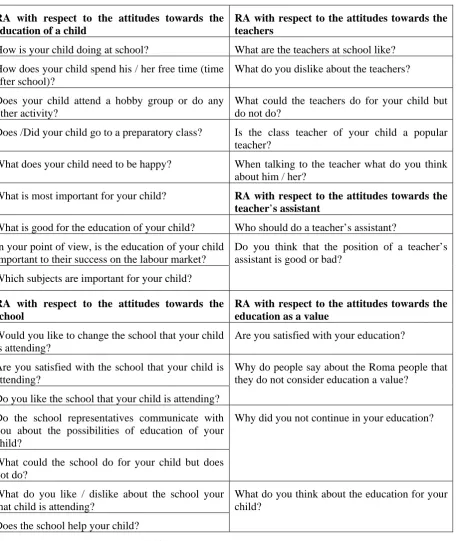
For the purposes of the implemented research were divided into 5 spheres (O1-5):
• the success of a child as a potential of an educational pathway (school requirements imposed on a pupil, the pupil’s success on the labour market, help of the school and teachers),
• the school (change of school, satisfaction with the school),
• the teachers (satisfaction with a teacher, teacher’s misunderstanding of the difference in pupil, teacher’s understanding),
• the position of the teacher’s assistant (Roma origin, benefit for pupils), • the education as a value (value, status of a value).
RA with respect to the attitudes towards the education of a child
RA with respect to the attitudes towards the teachers
How is your child doing at school? What are the teachers at school like?
How does your child spend his / her free time (time after school)?
What do you dislike about the teachers?
Does your child attend a hobby group or do any other activity?
What could the teachers do for your child but do not do?
Does /Did your child go to a preparatory class? Is the class teacher of your child a popular teacher?
What does your child need to be happy? When talking to the teacher what do you think about him / her?
What is most important for your child? RA with respect to the attitudes towards the teacher’s assistant
What is good for the education of your child? Who should do a teacher’s assistant?
In your point of view, is the education of your child
important to their success on the labour market? Do you think that the position of a teacher’s assistant is good or bad?
Which subjects are important for your child?
RA with respect to the attitudes towards the school
RA with respect to the attitudes towards the education as a value
Would you like to change the school that your child is attending?
Are you satisfied with your education?
Are you satisfied with the school that your child is attending?
Why do people say about the Roma people that they do not consider education a value?
Do you like the school that your child is attending?
Do the school representatives communicate with you about the possibilities of education of your child?
Why did you not continue in your education?
What could the school do for your child but does not do?
What do you like / dislike about the school your that child is attending?
What do you think about the education for your child?
Does the school help your child?
Table no. 1: Questionnaire inquiries
It was necessary to take into account that the research instrument is addressed to the Roma ethnic group, in which the Czech language is above all a secondary language (i.e. a language difference), it was also necessary to take into account the fact that the research instrument is addressed to Roma people with a variable level of education (which begins with a former special school), and therefore the formulation of some questions must be of an unambiguous and simple character. The purpose is
to get a simple, nevertheless current and relevant knowledge pertaining to the determinants of inclusive education of Roma pupils.
The research group consists of Roma parents from the Moravian-Silesian Region (MSR) from socially excluded localities and localities endangered by social exclusion defined by The Analysis of Socially
Excluded Roma Localities and the Absorption Capacity of Subjects Operating in the Area (GAC
2006).
Table no. 2 Socially excluded localities and localities endangered by social exclusion within the Moravian-Silesian Region
The Moravian-Silesian Region
Number of Towns/Localities
Estimated
Number of Roma People of All Age Groups
Names of the Localities
10/29 10,000 – 10,500 Bohumín (4), Bruntál (1), Frýdek-Místek (1), Havířov (2), Karviná (3), Krnov (2), Nový Jičín (2), Opava (2), Orlová (2), Ostrava (10)
The number of Roma parents living in these areas cannot be precisely quantified. Assuming the above mentioned estimation (i.e. 10 000 – 10 500), we take into account that the stated number of Roma population is an absolute number of entirely all age groups (i.e. of children and young people of different ages, parents and "not parents"). If we determine that in a nuclear Roma family the number of members varies between 5 – 8 people it can be roughly estimated that with a number of 10,000 Roma population in socially excluded localities and localities endangered by social exclusion in the Moravian-Silesian Region there are approximately 2,000 – 1,250 Roma families. However, only parents with at least one child of a compulsory school attendance were included in the research.
183 respondents from the total number participated in the research:
• N1: 114 mothers (62,30 %) and 69 fathers (37,70 %), all of them come from socially excluded localities and localities endangered by social exclusion in the Moravian-Silesian region as defined in The Analysis of Socially Excluded Localities…(GAC 2006, online).
• N2: The respondents were divided into 6 groups according to the acquired education: 54 respondents with a former special school (29,51 %), 45 respondents with a primary school (24,59 %), 51 respondents with a secondary vocational school (27,87 %) and 21 respondents with a secondary school (11,48 %). Nobody attended a higher vocational school (0%) and 12 respondents were of an university education (6,56 %).
• N3: In terms of age of the respondents there were only 3 of them younger than 25 years of age. 57 respondents between 26 – 30 years of age (31,15 %), at the age between 31 – 40 there were 87 respondents (47,54 %) a 41 respondents at the age of 41 and more (19,67 %).
• N4: Regarding the number of children, 93 parents stated that they have 1 – 2 children (50,82 %), 60 parents stated that they have 3 – 4 children (32,79 %) and 30 parents stated that they have 5 or more children (16,39 %).
• N5: In relation to whether a parent has currently a child of a compulsory school attendance only 21 respondents said no (11,48 %) and 162 said yes (88,52 %).
Interpretation of the empirical investigation
87 Roma parents (48 %) of the total of 183 parents stated that their children like going to school. Parents’ attitudes to the school in terms of changing or not changing the school that their child attends are unambiguous. 117 parents (64 %) would not change the school or do not consider doing so, because there is no reason for it.
Parents evaluate positively teacher’s relationship to a child (N114, 63%). Roma parents approach the education differently depending on all of the above mentioned categories. When specifying the query to know what the most important for a child is and what the child needs to be happy, the order of offered answers (family, education, work, money) differs significantly.
When asked why parents did not continue their studies, 57 parents (31 %) stated that they reached a level of education, which is sufficient for them. 51 parents (28 %) stated that they were never led to study and had no reason to continue in studying. 96 parents (53 %) are aware that the education is necessary for the child but express concern whether the child can handle the requirements of the education (school curriculum).
63 parents (35 %) do not talk to their child about his / her performance at school, whether their class teacher is the favourite one, etc. Moreover, some of them (N30, 17 %) even do not know a class teacher personally.
Parents’ attitudes towards teachers are ambivalent; however, there are more of those who claim that not all teachers are the same (N99, 54 %). The parents perceive positively the establishment of the position of a teacher’s assistant. They are aware of the importance of education for their child / children. There are also opinions that this teaching position should be carried out by a member of the Roma ethnic group (N78, 43 %) or only members of the majority society (N48, 26 %). 48 parents (26 %) think it is not important whether the teacher’s assistant is a Roma person or not (it is Gádžo in Roma language). However, 45 parents (25 %) said that it is important to have the position of teacher’s assistant in the class, and that the assistant should help children / a child in education.
Parents of Roma pupils are aware of the importance of education for their children; however, there are worries whether the Roma pupils can succeed in the curricular content of education (because of its complexity). In relation to the above mentioned, they are paradoxically aware of the fact that the level of education in the Roma ethnic group does not decide about the success in the labour market. Furthermore, they understand that for the education of Roma pupils it is important that in the process of education both the school and teachers are significantly helpful and also that the pupils need to have the right role models who are able to motivate them, etc.
The parents of Roma children are satisfied with the school that their child / children attend; therefore there are no reasons that would lead them to change the school. In connection with the above mentioned they express satisfaction with the overall operation of the school. Because of that they like the schools.
The parents of Roma children express overall satisfaction with the teachers of their child / children. They realize that not all teachers are the same and they also think that the teachers really do for the education of Roma pupils as much as possible, even though some parents argue that the teachers sometimes do not understand the difference of an ethnic pupil.
Most parents of Roma pupils think that in the position of teacher’s assistant there should be a Roma person, who would be also a role model for the education of Roma pupils. However, some parents argue that it is not important who performs the position of the teacher’s assistant. What is important is the importance of the position itself. Generally, the teacher’s assistant is viewed quite positively; parents understand its usefulness for the educational career of Roma pupils.
The parents of Roma children say that only non-Roma population (called Gadžo in Roma language) claim that the education is not considered a value for them; however it is not true. They argue that the value scale of the Roma people in relation to education is totally different. This opinion is also
encouraged by their belief that even the educated Roma person is not able to get a job. The education as a value is not listed last from the four offered fundamental values.
REFERENCES
ARUM, R., GAMORAN, A., SHAVIT, Y. Stratification in Higher Education: A Comparative Study. Stanford, CA: Stanford University, 2007.
AVERMEAT, P. V. Socially Disadvantaged Learners and Languages of Education. Language Council of Europe: Policy Division, Strasbourg. Centre for Diversity and Learning, Ghett University, 2006.
BAR-HAIM, E., SHAVIT, Y., AYALON, H. Expansion and Inequality of Educational Opportunity: A Comparative Multi-Level Analysis. Presentation at the Montreal Meeting of RC28, August 14-17, 2007 (online).
CALOŇOVÁ, D., KRAVÁROVÁ, M. Prevenci sociélnopatologických javov v rodinách. In Mátel, A.- Janechová, L.-Roman, L. (eds.) Sociálna patologia a intervenci sociálnej práce. Zborník z medzinárodnej vedeckej konferencie. Bratislava: VŠZaSP sv. Alžbety, 2011. ISBN 978-80-8132-018-7.
CANTU, R. What is the Value of an Education? Texas Labor Market Review Newsletter. Labor Market Information Department of the Texas Workforce Commision, 2003.
GABAL ANALYSIS & CONSULTING. Analýza sociálně vyloučených romských lokalit a absorpční
kapacity subjektů působících v této oblasti. Praha, 2006. Zadavatel projektu: MPSV a Rada vlády pro záležitosti ČR.
GABAL ANALYSIS & CONSULTING. Vzdělanostní dráhy a vzdělanostní šance romských žákyň a
žáků základních škol v okolí vyloučených romských lokalit. Závěrečná zpráva projektu MŠMT ČR, 2009. Sociologický výzkum zaměřený na analýzu podoby a příčin segregace dětí, žákyň, žáků a mladých lidí ze sociokulturně znevýhodňujícího prostředí.
GABAL ANALYSIS & CONSULTING. Závěrečná zpráva výzkumného projektu Analýza postojů a
vzdělávacích potřeb romských dětí a mládeže. Praha, 2007.
GRUBEROVÁ, A. Zpráva z pilotního kvalitativního výzkumu: „Motivace romských rodičů na poli
vzdělávání“. Poradna pro občanství/ Poradna pro lidská práva, 2009.
KALEJA, M. Determinanty hodnotových konstruktů ve vzdělávání romských žáků základních škol. Ostrava: PdF OU. ISBN 978-80-7464-233-3.
KALEJA, M. Determinanty edukace sociálně vyloučených žáků z pohledu speciální pedagogiky. Ostrava: PdF Ostravské univerzity v Ostravě, 2014. ISBN 978-80-7464-544-0.
KALEJA, M. Romové a škola versus rodiče a žáci. Ostrava: PdF OU, 2011. ISBN 978-80-7368-943-8
KREIDL, M. Vzdělanostní dráhy a vzdělanostní nerovnosti v socialismu. Plzeň: ZČU, 2008. ISBN 978-80-7043-678-3.
MEJSTŘÍK, M. a kol. Rámec Strategie konkurenceschopnosti. Úřad vlády České republiky. NERV,
2011. ISBN 978-80-7440-0506.
MORAVSKOSLEZSKÝ KRAJ. Strategie integrace romské komunity Moravskoslezského kraje na období 2006–2009. Ostrava: MSK, 2009.
MORVAYOVÁ, P. Děti „All Exklusive“ – Prostředí sociálně vyloučené lokality a jeho vliv na školní (ne)úspěch. In Svoboda, Z., Morvayová, P. a kol. Schola excludus. Ústí nad Labem: UJEP, 2010. ISBN 978-80-7414-221-5.
NIKOLAI, T. Principy inkluze v psychologickém poradenství – Příspěvek k psychologické diagnostice inteligence a kognitivních funkcí u dětí ze sociokulturně odlišného prostředí. In Svoboda, Z. – Morvayová, P. Schola Excludus. Ústí nad Labem: UJEP, 2010. ISBN 978-80-7414-221-5.
NIKOLAI, T., SEDLÁČKOVÁ, P. Příběhy ze špatné čtvrti, aneb, Jak pracovat s tématem segregace nejen ve školství.Praha: Člověk v tísni, 2007. ISBN 9788086961453.
RABUŠICOVÁ, M., KAMANOVÁ, L., PEVNÁ., K. O mezigeneračním učení. Brno: Masarykova univerzita, 2011. ISBN 978-80-2105-7500.
SHAVIT, Y., ARUM, R., GAMORAN, A. (eds.). Stratification in higher education: a comparative study. Stanford: Stanford University Press, 2007.
SVOBODA, Z., MORVAYOVÁ, P. a kol. Schola excludus. Ústí nad Labem: UJEP, 2010. ISBN 978-80-7414-221-5.
ZEZULKOVÁ, E. Jazyková a komunikativní kompetence dětí s mentálním postižením. Ostrava: PdF, OU, 2012. ISBN 978-7368-991-9.