HOW TO BRING TOGETHER THE FUTURE AND PRESENT VETERINARIANS IN BULGARIA AS EMPLOYEES AND EMPLOYERS?
Gergana N. Balieva
Faculty of Veterinary Medicine, Trakia University, Stara Zagora 6000, Bulgaria
Abstract
Professional realization is a great challenge to all new graduates. Lack of experience, high levels of unemployment, employers` unwillingness to hire newly graduated specialists are just few of the obstacles young people encounter in seeking a job. On the other hand, professional realization is one of the main indicators of the university education quality. Modern higher education has to prepare today` s students in a way that provides they will be tomorrow` s labor market specialists. In Bulgaria such opportunity for modernization of higher education is provided by the EU Operational Programme “Human Resources Development”. A project within the Programme helps the students to acquire practical skills in real work situations and thus to get professional experience and contacts with employers even before graduation. As this project covers wide professional range, we set up the aim to study its implementation at the Faculty of Veterinary Medicine at Trakia University (Bulgaria).
Key words: veterinary medicine, students practices, development of human resources, labor market
Introduction
Modern industry requires veterinarians armed not only with traditional competencies. Additional training in advanced skills increases the value of the veterinary services for the clients, the employers, veterinarians themselves and the whole society. With the progressive accumulation of knowledge in every field of veterinary medicine, however, the time available for students to learn and improve their specific skills within the conventional veterinary curriculum significantly reduces. This is the reason for development of new alternative approaches for education, for example the initiatives. at the College of Veterinary Medicine at Cornell University, USA for implementation of Summer Dairy Institute for advanced training of young veterinary specialists (Nydam, C. W. et al., 2012) or Leadership Programme for acquainting the students with career paths in pharmaceutical companies (McGregor, D. D. et al., 2007).
A serious problem in the pharmaceutical industry in UK appears to be the lack of veterinary pathologists and in particular specialists in toxicological pathology. Scudamore and Smith (2007) concluded that efforts to encourage veterinarians to choose an alternative career as pathologists instead of the usual clinical practice, should start at early stage of their university training, by providing advice and guidance on career development and introducing strong role models in the field of pathology and research disciplines.
The difficulties of getting employed, professional attitudes and work experience of recently graduated veterinarians in UK are subject of a survey of the Royal College of Veterinary Surgeons (Robinson, D., Buzzeo, J., 2013). As results showed, more than a half of the respondents declared lack of professional support by their employer and colleagues and besides that – low level of practice management. As a consequence it took longer to some of the young veterinarians to complete their PDP – professional development phase (Johnson, J. B. J., Andrews, F. M., 2006; Johnson, J. B. J., Andrews, F. M., 2007).
Unusual approach to help the newly graduated veterinarians to overcome the obstacles to their professional realization was developed by VetCoach (Nap, R. C., 2009). The organization conducted a survey in 26 countries among veterinary practitioners with small or large animals, researchers, academicians and also veterinarians within the animal feed business and pharmaceutical companies,
and as a result provided an advice book for the graduates accumulated the respondents`practical experience.
Although the heterogeneity of the programmes and projects for training in veterinary medicine due to local, regional and national requirements, all of them appeared to be a consequence of global processes for transformation of the profession. Assuming that veterinary services constitute public good, we see veterinarians (regardless their field of practice) as integral partners in the “One Health” Strategy for assuring human, animal and environmental health. In order to perform their duties, the veterinarians should be prepared not only with profound knowledge, but with various advanced competencies (OIE, 2012).
The ongoing initiatives worldwide drove our scientific interest towards the opportunities for acquiring such advanced skills by veterinary medicine students in Bulgaria. In regard with this, our attention focused on the present alternative projects for collaboration in real working environment between students and veterinary practitioners.
Aim and objectives
Provoked by the events, taking place in the field of veterinary education and practice worldwide, we set up the aim to explore the ways of collaboration between Trakia University – Stara Zagora, particularly the veterinary students, and veterinary professionals from both the public and private sector for improvement of competencies, knowledge and practical skills within the modern veterinarian`s portfolio.
In regard with the aim we analyzed some of the main aspects of the veterinary students` training: - Requirements for practices and internships within the regular course of education;
- Introduction and implementation of the "Student Practices" project within the Faculty of Veterinary Medicine at Trakia University;
- Effects on the students` career orientation after their participation in the project.
Material and methods
In order to determine the requirements for practices and internships, obligatory for all veterinary students, we made a content analysis of the relevant official documents of the European and national legislation (European Union, 1978; 2005) (Bulgaria, National Assembly of the Republic of Bulgaria, 2004).
For studying the implementation of “Student practices” project we analyzed data available on its site for all registered users (“Student practices”, 2014). A parallel survey was conducted (phone interview) with 42 trainees in Year 6 of their education, who were asked to answer the following questions: 1) “Did your participation in the “Student practices” project give reflections on the development of your professional orientation in a certain sphere of veterinary medicine?” with six optional fields of veterinary activities to choose from (small animals practice; large animals practice; veterinary products & drugs; research; state veterinary administration; other activities). 2) “Did your participation in the “Student practices” project give any effect on your professional realization?” with three possible options to choose from (I am unemployed at the present moment; I am employed due to contacts established during the practice; I am employed but my realization has no link with the practice).
The methodology of the empiric sociological survey (Orloev, N., 2002) was used for preparation of the questionnaire. All data were statistically processed and presented on diagrams.
Results and Discussion
1. Practical training of students in veterinary medicine - established mechanisms and new opportunities
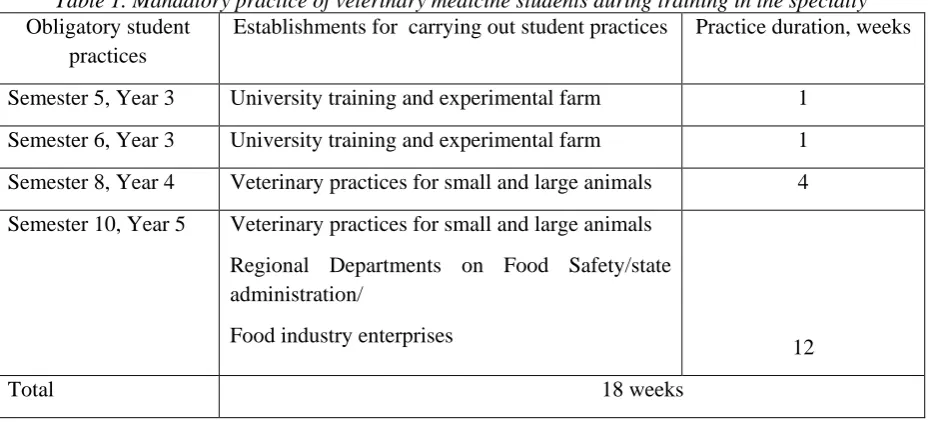
Part of the practical training of students at the Faculty of Veterinary Medicine in Stara Zagora – Bulgaria is conducted through extramural studies which take place in the summer holiday months (Trakia University, 2009). It is obligatory for all students in semesters 5 and 6 to carry out a practice in animal husbandry for 1 week at the University training and experimental farm. At the end of semester 8 there is another obligatory practice for clinical training for 4 weeks at different practices for small or large animals, chosen by the students. Just after semester 10 and before graduation all veterinary students have to carry out undergraduate practice for 12 weeks. During this time they improve their skills and knowledge at small and large animal practices, food industry enterprises and state veterinary administration departments.
Table 1. Mandatory practice of veterinary medicine students during training in the specialty Obligatory student
practices
Establishments for carrying out student practices Practice duration, weeks
Semester 5, Year 3 University training and experimental farm 1
Semester 6, Year 3 University training and experimental farm 1
Semester 8, Year 4 Veterinary practices for small and large animals 4
Semester 10, Year 5 Veterinary practices for small and large animals
Regional Departments on Food Safety/state administration/
Food industry enterprises
12
Total 18 weeks
The described mechanism of practical training of veterinary students is not an object of financial provisions. This is not an obstacle when the practice is carried out within the state veterinary departments, as according to Article 20 of the Veterinary Activities Law (VAL) the Executive Director of Bulgarian Food Safety Agency arranges with an order all regional structures of BFSA to be involved in the training in veterinary medicine (Bulgaria, National Assembly of the Republic of Bulgaria, 2011). Regarding the private sector establishments, however, arrangements for practical training between students and veterinary practitioners are based only on voluntary mutual agreements. This means that student does not receive any payment for his/her work on the farm or clinic and, similarly, veterinarian is not financially stimulated to accept trainees at his/her practice.
2. Introducing "Student practices" project at Trakia University
Opportunity to overcome the difficulties and to improve the quality of education by strengthening the students` practical skills appears to be “Students practices” project, introduced in summer 2013. This project is funded by “Human Resources Development” Operational Programme, co-financed by the European Social Fund, and implemented in all 51 higher education establishments in Bulgaria. According to the instructions on the project activities all regular and part-time students can apply for
such practice once in their training for each university degree (“bachelor” and “master” degrees). The approved trainees carry out practice which is not part of the obligatory practical training.
The project gives the applicants the opportunity to gain practical experience in real work environment for 240 working hours, equivalent to 6 weeks with approved 8-hours/5-day working week (according to the Labour code – Bulgaria, National Assembly of the Republic of Bulgaria, 2001). Each trainee after completing the practice, is paid the sum of 480 Bulgarian leva (equivalent approximately to 240 euro). Financial provisions from the budget of the project are made also for mentors and academic tutors involved in the practices (see Table 2).
Table 2. * Characteristics of participants involved in the "Student practices" project
Participants Characteristics
„Training organization” Organization – employer, where the student practice takes place, and appears to be employer of the mentor.
„Trainee” Student who has been chosen by the organization – employer and has confirmed his/her participation in practical training at training organization.
„Mentor“ Individual who is in labour or other permitted by law relations with organization-employer, where student practices take place.
„Academic tutor” Lecturer at the higher school where are educated the students, participating in the practical training.
„Functional expert“ Representative from the higher school who supports, organizes and monitors the implementation of the project activities within the corresponding higher school – project partner.
„Leading functional expert“
Representative from the higher school who is appointed by the higher school managers to be responsible for the organization and control of realization of the project activities and appears to be contact person with the project managing team at Ministry of Education and Science.
* Terminology according (“Student practices”, 2013).
Being one of the educational institutions in Bulgaria involved in the project, Trakia University – Stara Zagora performs successfully all activities, planned in “Student practices”. Since the launch of the project till now (June 2014) 3084 students are registered in its specially designed web-based system. Confirmed by employer to carry out practice are 2494 of them (80,87% of all registered), while 2165 applicants (70,20% of all registered) have signed contract and participate in practical training (have started practice or have already completed it).
3. “Student practices” project at Faculty of Veterinary Medicine
Studying the implementation of the project at the Faculty of Veterinary Medicine, we find out that students demonstrate strong interest and active participation in the new opportunities for practical training. As 136 employers throughout the country, registered in the “Veterinary medicine” professional sphere of occupation, have declared their participation, totally 562 veterinary undergraduates have created profile within the web system. Already (“Student practices”, 2014), 440 trainees (78,57% of the registered students) have successfully started practical training after contract assignment, and 347 trainees (78,86% from the contract students) have completed the practice and received the provided project grant.
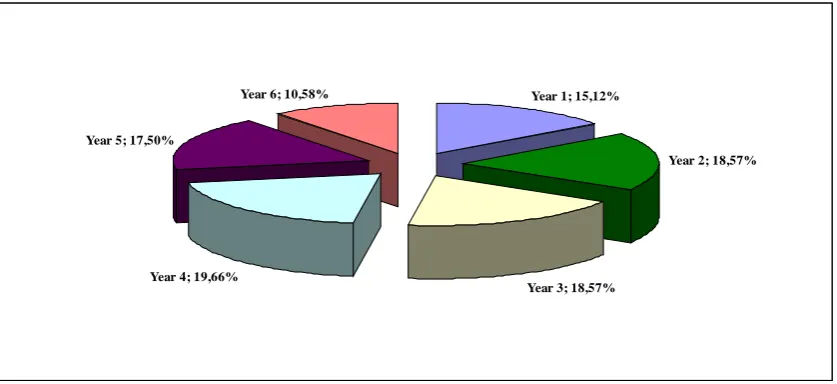
In order to determine the training stage at which the undergraduates decide to acquire practical experience in real working environment and to establish contacts with veterinarians – potential employers after graduation, we studied the distribution of trainees (Fig. 1) by year of education.
Fig. 1. Undergraduate course distribution of trainees
The results show that interested in the project and in the opportunity to carry out a paid practice outside the faculty, appeared to be students from the first to the last year of training in veterinary medicine. They are distributed in the following order:
- First Year students – 15,21% of all trainees with contracts; - Second Year students – 18,57% of all trainees with contracts; - Third Year students – 18,57% of all trainees with contracts; - Fourth Year students – 19,66% of all trainees with contracts; - Fifth Year students – 17,50% of all trainees with contracts; - Sixth Year students – 10,58% of all trainees with contracts.
It is visible that values appeared to be similarly close but we find the percentages for first and second year students to be high for undergraduates with no practical experience at all. It is clear that they are just in the beginning of their training in fundamental disciplines without direct exposure to clinical activities. Their graduation is too remote, as well, and establishing contacts with veterinary practitioners during the project probably will not be useful for their future professional realization. The first and second year students` active participation we think is likely to be determined by some of the following factors: family relationships with veterinarians and thus accumulated initial professional skills and attitudes; graduation from vocational veterinary schools (qualification “veterinary technician”); university degree in other applied biological sciences (animal husbandry, etc.); existing family veterinary practice or farm.
Analyzing the distribution of trainees from the upper courses, we recognize their relative values as similar (with insignificant difference of 1-2%) - respectively 18,57% for the third year students, 19,66% for the fourth year students and 17,50% for the fifth year students. As these students have to complete practice in animal husbandry in semester 5 of year 3, we find their willingness to participate in the project for professionally motivated. At this stage of training students also start developing clinical skills, which could be improved within “Student practices”.
Very puzzling at first glance seem to be the results for the trainees from year 6 – 10,58% of all participants, signed contract for practice. The last-year students appear to be young specialists personally interested to establish contacts with potential employers and on the other hand – to gain
Year 1; 15,12%
Year 2; 18,57%
Year 3; 18,57% Year 4; 19,66%
Year 5; 17,50%
Year 6; 10,58%
greater professional experience in order to be more competitive on the labour market after graduation. Our opinion is that, concerning the project, their activity is influenced by the fact they have to complete 3-months practice (see Table 1) after semester 10 of year 5, starting in June (as June is the month after the launch of the project on 23.05.2013 and also is the end of the period for which present data analysis is made in 2014 – note of the author) and afterwards to defend practice report and take two state exams.
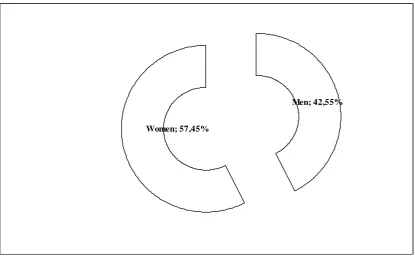
Besides the undergraduate course distribution of trainees, we divided them by gender in two categories.
Fig. 2. Proportion of male and female students participated in “Student practices” project
Analysis of data (Fig. 2) shows the relative values of the female participants registered for practice are predominantly higher than those of male students with 14,9% (respectively 57,45% women to 42,55% men). This fact is not new for us as it confirms the tendency of feminization of profession, established worldwide (Kostelnik, K. 2010; Kumar, G. S. et al., 2012; Kinnison, T. & May, S. A., 2013; Robinson, D. & Buzzeo, J., 2013).
It is worth to study and discuss the type of training establishments, chosen by the students for their practice. Regarding this, we distributed the training establishments into several categories, based on the main type of performed veterinary activities.
- Establishments for diagnostics, therapy and management advices for small/companion animals (veterinary clinics and dispensaries);
- Establishments for diagnostics, therapy and management advices for large/production animals (farms, horse sports clubs);
- Establishments for veterinary products & drugs trade; - State veterinary administration departments;
- Research and laboratory structures;
- Other establishments (stray animals shelters; pet shops; wild animals rescue centre).
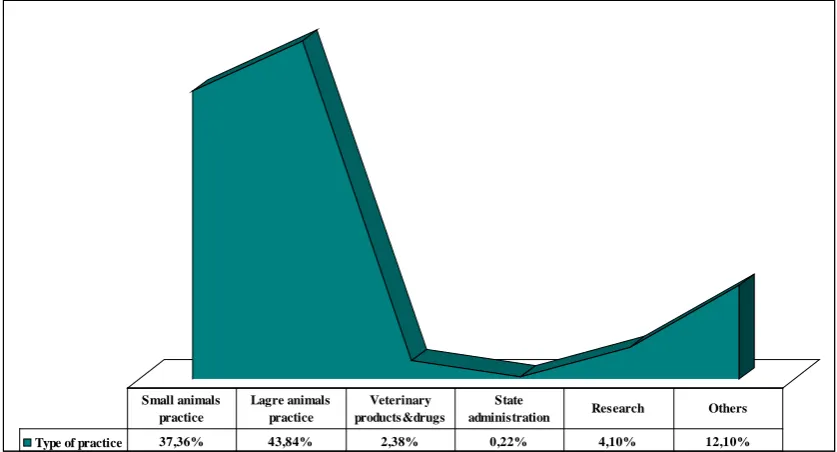
Data presented on Fig. 3 clearly show that traditionally the establishments, where students have the opportunity to strengthen their clinical skills – small animals practices (37,36%) and large animal practices (43,84%) receive the highest share of 81,20% in total. In descending order the rest of the
Men; 42,55%
Women; 57,45%
establishments, chosen by the trainees, are distributed as follows: other establishments – 12,10% of all practices (predominantly represented by training at zoo and wild animals rescue centre); research and laboratory structures – 4,10% of all practices; establishments for veterinary products and drugs trade – 2.38% of all practices; state veterinary administration departments – 0,22% of all practices.
Fig. 3. Establishments, chosen for training within “Student practices” project, distributed by type of performed activities
The choice of the majority of students to perform clinical activities with small or large animals is not surprising for us. Their orientation logically reflects the applied characteristics of the profession. On the other hand, we find out that quite a few of the trainees (12,10% of participants in the project) have chosen an alternative way for their practical training improvement. Such opportunity appear to give the zoo and the wild animals rescue centre at Stara Zagora. Although the veterinary profile of work with wild and exotic animals is less paid attention in the country, these practices help the students to stand eye-to-eye with crucial tasks for the profession as conservation and biodiversity and human-animal-environment interactions (Casares, C., Rubiños, C. 2013).
Significantly less are the proportions of practices for research and laboratory and for state veterinary administration activities (respectively 4,10% and 0,22% of all establishments). However, we assume that trainees completed those practices, will become qualified veterinarians aware of all crucial professional challenges for assuring national veterinary services of quality as recommended by World Animal Health Organization (OIE, 2012), as well as implementing the EU Research and Innovations Strategy 2014-2020 (European Union, 2014).
The percentage of students who have chosen establishments for veterinary products and drugs trade, is low, too – 2,38% of all practices. The lack of interest in this sphere of veterinary activities probably is due to saturation of labour market with that kind of services.
4. Impact of the “Student practices” project on the trainees` professional orientation
Our scientific interest focused also on the impact of the project implementation on the professional orientation of the participants. Based on results from sociological survey – questionnaire among the last-year trainees, we tried to determine if the training within the project have given any reflection on the students` career orientation and development (Fig. 4).
Type of practice 37,36% 43,84% 2,38% 0,22% 4,10% 12,10% Small animals
practice
Lagre animals practice
Veterinary products&drugs
State
administration Research Others
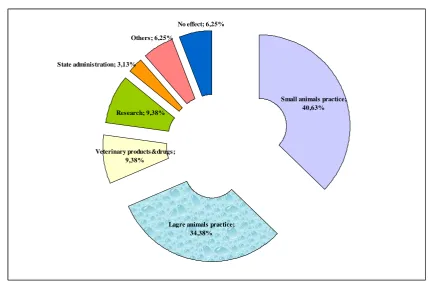
Fig. 4. Interest in certain professional spheres *, developed/strengthened due to “Student practices” training
* The values exceed 100% in total as some of the respondents have given more than one answer
In agreement with the results obtained for the practice establishment distribution (see Fig. 3), we found that 75,01% of the graduates declared strengthening of their interest in clinical fields again – small animals practice (40,63% - 13 respondents) and large animals practice (34,38% - 11 respondents). It is logically to explain these facts with the upcoming graduation which is strong motivation for the participants in the project to broaden their professional attitudes and improve skills and competencies in direct contact with potential employers.
With equal values of 9,38% in the last-year students` preferences (3 respondents for each sphere) appeared to be the research and laboratory activities and the veterinary products and drugs trade activities. Probably development of professional interest in both spheres had arisen during their work at site with small or large animals in order to acquire advanced competencies besides the routine clinical skills. The same factors, we think, had driven the trainees` orientation towards other kind of activities (e.g. work with exotic animals), pointed out by 6,25% of the graduates (2 respondents). Extremely low is the share of trainees, interested in veterinary administration – 3,13% (1 respondent). As this orientation had developed during the student`s direct work with companion animals, we assume she likely declared need for management skills and team approach, rather than an intention to seek realization within the public sector.
We found for quite unsatisfactory the answer of 6,25% of the trainees (2 respondents) that the practice within the project had not give any effect on their professional orientation, qualification and realization at all. Even the share of these students compared to the share of the rest graduates is negligible, it is worthy to analyze the situation and search for the reasons, caused such professional dissatisfaction (probably personal conflicts with employer; not been given opportunity for practical performance; mentor`s lack of teaching skills, etc.).
Small animals practice; 40,63%
Lagre animals practice; 34,38% Veterinary products&drugs;
9,38% Research; 9,38% State administration; 3,13%
Others; 6,25%
No effect; 6,25%
For the assessment of the impact of “Student practices” project on veterinary graduates` career development it is necessary to analyze the rate of their realization by determining the level of employment (Fig. 5).
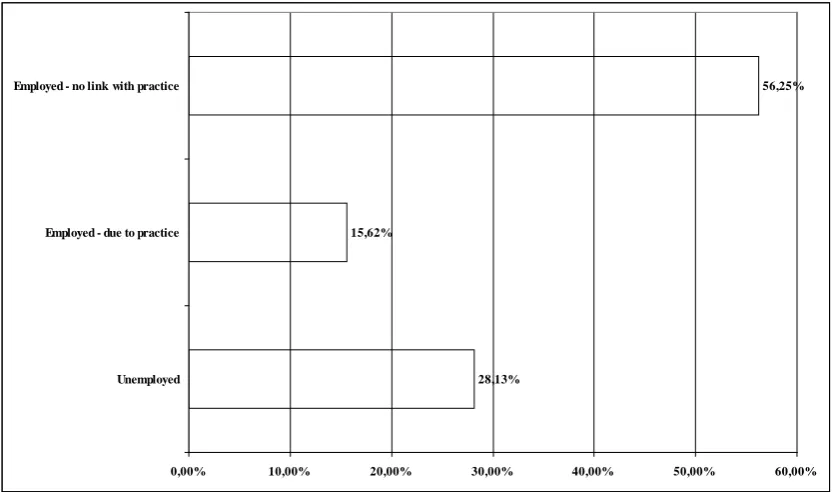
Fig. 5. Effects of the trainees` participation in “Student practices” project on their level of employment after graduation
More than half of the participants in the survey – 56,25% (18 respondents) have stated they found realization in the veterinary medicine sphere after graduation, but the project practice has no impact on their employment and personal contacts with employer have arisen in different situations. Analyzing the results we found satisfactory the fact that most of the newly graduated veterinarians had succeeded in their career start. Even though the respondents disclaimed any relation between their project practice and professional realization, we assume there is indirect positive effect as the improved practical skills and competencies have certainly contributed to their higher competitiveness on the labour market.
Employment due to contacts, established during the training within “Student practices” project have succeeded to find 15,62% of the graduates (5 respondents). Their professional realization appears to be part of the successfully achieved goals of the project, namely increasing the number of students who find a job immediately after graduation and also enabling the employers to select students with skills proven in real working environment.
Unfortunately, nearly one-third of the trainees – 28,13% (9 respondents) do not succeed in their career start and remain unemployed. Our opinion is that an explanation of these results appears to be not the lack of qualification and competencies of graduates, but more common factors as saturation of the market with veterinary services, overall level of unemployment in the country, etc.
Conclusion
The analysis of implementation the “Student practices” project at Faculty of Veterinary Medicine at Trakia University – Stara Zagora, showed several main effects on the participated students` professional training and development:
28,13% 15,62%
56,25%
0,00% 10,00% 20,00% 30,00% 40,00% 50,00% 60,00% Unemployed
Employed - due to practice Employed - no link with practice
- All veterinary medicine students (from year 1 to year 6) demonstrated strong interest in participation in practical training in real working environments and improvement of their clinical skills;
- With highest relative values of 81,20% appeared to be the practices at establishments for diagnostics, therapy and management advices for companion and production animals – trainees have used the project opportunities to gain practical experience and competencies in accordance with the needs of the labour market;
- In addition to the traditional clinical fields of veterinary medicine, the project helps the students to broaden their professional horizon towards important areas as work with wild and exotic animals and research;
- Student practices have direct and indirect impact on the trainees` professional realization by facilitating the transition from university to the workplace and thus increase the share of successfully placed on the market young veterinary practitioners.
References
Bulgaria. National Assembly of the Republic of Bulgaria (2001). Labour Code. Off. Gazette 26/01.04.1986, amended Off. Gazette 25/16.03.2001.
Bulgaria. National Assembly of the Republic of Bulgaria (2004) Regulation on the state requirements for acquiring university degree in “Veterinary medicine” in Bulgaria. Off. Gazette 56/29.06.2004.
Bulgaria. National Assembly of the Republic of Bulgaria (2011). Law on veterinary activities. Off. Gazette 87/01.11.2005, amended Off. Gazette 08/25.01.2011.
Casares, C.; Rubiños, C. (2013) Professional expectations: role of wildlife and zoo animals veterinary. Spanish Journal of Rural Development. 4 (Especial 1), p. 25-30.
European Union (1978) Council Directive 78/1026/EEC of 18 December 1978 concerning the mutual recognition of diplomas, certificates and other evidence of formal qualifications in veterinary medicine, including measures to facilitate the effective exercise of the right of establishment and freedom to provide services. OJ L 362/1, 23/12/1978.
European Union (2005) Directive 2005/36/EC of the European Parliament and of the Council of 7 September 2005 on the recognition of professional qualifications.OJ L 255/22, 30/09/2005.
Haden, N. K., Chaddock, M., Hoffsis, G. F., Lloyd, J. W., Reed, W. M., Ranney, R. R., Weinstein, G. J. (2010) Preparing faculty for the future: AAVMC members' perceptions of professional development needs. Journal of Veterinary Medical Education. 37 (3). p. 220-232.
Johnson, J. B. J., Andrews, F. M. (2006) Designing a more coherent framework for lifelong veterinary education: introducing the RCVS 'Professional Development Phase' (PDP). Cattle Practice. 14 (3). p. 181-185.
Johnson, J. B. J., Andrews, F. M. (2007) PDP: from pilot to practice. In Practice. 29 (3). p 166-169. Kinnison, T., May, S. A. (2013) Veterinary career ambitions correlate with gender and past experience, with current experience influencing curricular perspectives. Veterinary Record. 172 (12). p 313.
Kostelnik, K. (2010) Shortage of food supply veterinarians. Der Mangel an tierärztlichem Nachwuchs in der Nutztiermedizin. p iii-72.
Kumar, G. S., Subramonian, B. S., Gnanaraj, P. T., Pandian, A. S. S., Varathan, B. J. (2012) Analysis of intention of professional students to become Livestock Business Entrepreneurs in Tamil Nadu. Indian Journal of Field Veterinarians. 7 (3). p. 43-44.
McGregor, D. D., Fraser, D. R., Haven, M. L., Hickey, G. J. (2007) Acquainting veterinary students with careers in the pharmaceutical industry. Journal of Veterinary Medical Education. 34 (2). p. 139-142.
Nap, R. C. (2009) VetCoach: career reflections of veterinary professionals. VetCoach: career reflections of veterinary professionals. p. 171.
Nydam, C. W., Nydam, D. V., Guard, C. L., Gilbert, R. O., Eicker, S. (2012) The Summer Dairy Institute: advanced training for young dairy veterinarians. Proceedings of the 45th Annual Conference of the American Association of Bovine Practitioners, Montreal, Canada. p. 28-35.
Orloev, N. (2002) Research methodology. Rousse: Centre for higher education training and management.
Robinson, D., Buzzeo, J. (2013) RCVS survey of recent graduates. The Institute for Employment Studies, Brighton, UK. RCVS survey of recent graduate. p. 63.
Scudamore, C. L., Smith, S. H. (2007) Future directions in training veterinarians for careers in toxicological pathology in the United Kingdom. Journal of Veterinary Medical Education. 34 (4). p. 450-457.
European Union (2014). Research and Innovation. [Online] Available from: http://europa.eu/pol/rd/index_en.htm. [Accessed: 23th June 2014].
OIE (2012) OIE recommendations on the Competencies of graduating veterinarians (‘Day 1 graduates’) to assure National Veterinary Services of quality. [Online] Available from: http://www.oie.int/fileadmin/Home/eng/Support_to_OIE_Members/Vet_Edu_AHG/DAY_1/DAYON E-B-ang-vC.pdf. [Accessed: 22th February 2014].
“Student practices” project (2013) Instruction on the order and terms for performing the activities within the “Student practices” project. [Online] Available from: http://praktiki.mon.bg/sp/docs/SP_Instruktsia.pdf. [Accessed: 8th November 2013].
“Student practices” project (2014) Data on implementation of the project at Trakia University. [Online] Available from: http://praktiki.mon.bg/sp/?m=6&p=8&c=3&cc=604. [Accessed: 16th June 2014].
Trakia University (2009) Rules for organization, performance and management of the Faculty of Veterinary Medicine at Trakia University – Stara Zagora. [Online] Available from: http://www.uni-sz.bg/engl/node/610. [Accessed: 10th May 2014].