Open Access
BMC Endocrine Disorders 2002,
2 x
Research article
Treatment of hyperfunctioning thyroid nodules by percutaneous
ethanol injection
Bagher Larijani*
1
, Mohammad Pajouhi
1
, Hossein Ghanaati
2
,
Mohammad-Hassan Bastanhagh
1
, Fereshteh Abbasvandi
1
, Kazem Firooznia
2
,
Mahmood Shirzad
1
, Mohammad-Reza Amini
1
, Maryam Sarai
1
,
Nasreen Abbasvandi
1
and Reza Baradar-Jalili
1
Address: 1Endocrinology & Metabolism Research Centre, Tehran University of Medical Sciences, Tehran, Iran and 2Medical Imaging Centre, Imam
Khomeini University Hospital, Tehran, Iran
E-mail: Bagher Larijani* - [email protected]; Mohammad Pajouhi - [email protected]; Hossein Ghanaati - [email protected]; Mohammad-Hassan Bastanhagh - [email protected]; Fereshteh Abbasvandi - [email protected];
Kazem Firooznia - [email protected]; Mahmood Shirzad - [email protected]; Mohammad-Reza Amini - [email protected]; Maryam Sarai - [email protected]; Nasreen Abbasvandi - [email protected]; Reza Baradar-Jalili - [email protected] *Corresponding author
Keywords: Hot Thyroid Nodules, Treatment, Ethanol, Thyrotoxicosis, Ultrasonography
Abstract
Background: Autonomous thyroid nodules can be treated by a variety of methods. We assessed the efficacy of percutaneous ethanol injection in treating autonomous thyroid nodules.
Methods: 35 patients diagnosed by technetium-99 scanning with hyperfunctioning nodules and suppressed sensitive TSH (sTSH) were given sterile ethanol injections under ultrasound guidance. 29 patients had clinical and biochemical hyperthyroidism. The other 6 had sub-clinical hyperthyroidism with suppressed sTSH levels (<0.24 µIU/ml) and normal thyroid hormone levels. Ethanol injections were performed once every 1–4 weeks. Ethanol injections were stopped when serum T3, T4 and sTSH levels had returned to normal, or else injections could no longer be performed because significant side effects. Patients were followed up at 3, 6 and, in 15 patients, 24 months after the last injection.
Results: Average pre-treatment nodule volume [18.2 ± 12.7 ml] decreased to 5.7 ± 4.6 ml at 6 months follow-up [P < 0.001]. All patients had normal thyroid hormone levels at 3 and 6 months follow-up [P < 0.001 relative to baseline]. sTSH levels increased from 0.09 ± 0.02 µIU/ml to 0.65 ± 0.8 µIU/ml at the end of therapy [P < 0.05]. Only 3 patients had persistent sTSH suppression at 6 months post-therapy. T4 and sTSH did not change significantly between 6 months and 2 years [P > 0.05]. Ethanol injections were well tolerated by the patients, with only 2 cases of transient dysphonia.
Conclusion: Our findings indicate that ethanol injection is an alternative to surgery or radioactive iodine in the treatment of autonomous thyroid nodules.
Published: 6 December 2002
BMC Endocrine Disorders 2002, 2:3
Received: 13 July 2002 Accepted: 6 December 2002
This article is available from: http://www.biomedcentral.com/1472-6823/2/3
Background
Conventional therapy for hyperfunctioning thyroid nod-ules includes radioactive iodine, surgery, and long-term pharmacotherapy [1,2]. Radioactive iodine therapy is ac-companied by a 10–40% risk of hypothyroidism [1–3]. A third option, introduced over the past twelve years, has been percutaneous ethanol injection (PEI) [4–19]. This method was first used in the treatment of hepatic adeno-mas and, subsequently, thyroid nodules [4,5,8]. It is par-ticularly suitable for patients who are not candidates for surgery or radioiodine therapy. The tissues inside the nod-ule undergo fibrosis following ethanol injection [6]. The present study aims to evaluate the outcome and complica-tions of PEI therapy for hyperfunctioning nodules. No study of this type and size has so far been carried out in Iran, a country with a significant prevalence of thyroid dis-orders and, until recently, an endemic goitre region.
Methods
Patients
This is a prospective study of the efficacy of percutaneous ethanol injection in a consecutive series of patients with a hyperfunctioning thyroid nodule. Patients meeting entry criteria were enrolled in the study and then followed up at specific times following completion of therapy. Entry cri-teria were a dominant hyperfunctioning thyroid nodule, as determined by technetium-99 scanning, a suppressed sensitive TSH (sTSH), and negative thyroid aspiration cy-tology. Patients on methimazole had their medication gradually tapered during the second and third PEI ses-sions, and discontinued before completion of therapy. Complete response was defined as normalisation of thy-roid function tests and absence of clinical symptoms. Written informed consent was obtained from every pa-tient. The study was approved by the relevant institutional review committee.
Thyroid Function Tests
Thyroid function tests were measured by second-genera-tion radioimmunoassay (Kavoshyar, Tehran, Iran), and sTSH by immunoradiometric assay (same manufacturer), with intra- and inter-assay coefficients of variation for T3 of 3.3% and 7.5%, for T4 of 6.8% and 8.0%, and for TSH of 5.8 and 4.9 percent. The normal ranges were T3 = 80– 230 ng/dl, T4 = 4.5–12.8 µg/ml, and TSH = 0.2–5 µIU/ml.
Imaging
Nodule volume was calculated automatically by the ultra-sound machine, using the formula: length × width × thick-ness × π/6, which provides an approximation to the volume of a spheroid, and is reported to be 80–85% accu-rate [7].
Nodule Cytology
Every patient underwent a fine needle aspiration biopsy to rule out malignancy. In patients with multinodular goitre, the dominant nodule, as reported by 99Tm scanning, was
aspirated. In the single patient with two co-dominant nodules, both nodules were aspirated. The cytology report for every specimen was cystic colloid goitre, consisting of abundant colloidal material, with many haemosiderin-laden macrophages and scanty follicular cells, dispersed throughout the specimen or else forming a loose honey-comb monolayer of cells. The distinction between the lat-ter entity and follicular neoplasia, a source of diagnostic confusion when FNA is performed in patients with a hot nodule, where the aspirate is commonly highly cellular, was, in our samples, quite clear.
Ethanol Injection
The dimensions and volume of the nodules were meas-ured by linear real-time ultrasonography, using a General Electric Sonochrome machine, with an 8 MHz probe. Un-der direct ultrasound guidance, 0.5–10 ml of sterile 95% ethanol (Pasteur Institute Production Centre – Tehran, Iran) was injected inside each nodule (0.1 ml per ml nod-ule volume, using a disposable plastic syringe and 22-gauge needle). Two patients had cystic nodules, which were drained completely before administration of PEI. The injection needle was kept in place for 1–2 minutes in order to avoid any ethanol leakage, and patients were ad-vised to take oral analgesia before injection. Injections were performed once every 1–2 weeks. Patients were as-sessed at the end of the treatment cycle and at 3 and 6 months afterwards. Thyroid function tests were per-formed on 15 patients at the end of 2 years. Thyroid func-tion tests were performed after 3–4 rounds of injecfunc-tion. When hormone levels were found to be within the normal range, PEI therapy was deemed successful and the injec-tions, discontinued.
Statistical Analysis
The repeated measures and paired-t tests were used to compare baseline and follow-up values, and Pearson's correlation test to measure the strength of the linear rela-tionship between initial nodule size and reduction in nodule volume. Complete response was defined as a re-duction in both nodule size and thyroid hormone levels, and normalization of sTSH levels.
Results
Demographics
35 patients (30 women, 5 men) aged 16–70 years (mean age ± SD: 38.6 ± 12.4) received PEI therapy. 18 patients (54%) had solitary hyperfunctioning nodules on 99Tc
two hot nodules. 29 patients (82.9%) were hyperthyroid (suppressed sTSH and elevated T3 and T4 levels), and 6 pa-tients (17.1 %) had sub-clinical hyperthyroidism with sTSH suppression and normal levels of thyroid hormones.
Nodule Size
Mean pre-treatment volume in the 36 nodules was 18.2 ± 12.7 ml (range = 4–44 ml). Mean post-PEI nodule volume decreased to 7.5 ± 5.3 ml (range = 1–21 ml), reaching 5.7 ± 4.6 ml (range 0.5–20 ml) at 6 months follow-up [P < 0.001]. Average volume reduction was 12.48 ± 10.6 ml, with a linear correlation between initial nodule volume and the magnitude of volume reduction: the greater the initial nodule volume, the greater the reduction in nodule volume [r = 0.94, P = 0.007].
Thyroid Function Tests
Sensitive TSH levels were suppressed in every patient be-fore start of therapy, with a mean level of 0.09 ± 0.02 µIU/ ml. In the sub-clinical hyperthyroid group, sTSH had risen to a mean of 0.42 ± 0.47 µIU/ml by the end of treatment, with 3 out of 6 patients still having sTSH levels below the normal range. At 3 months, the mean sTSH level in this group increased to 1.18 ± 1.3 µIU/ml, with only 1 patient showing persistent TSH suppression. At 6-months follow up, sTSH levels had normalised in all 6 patients, with a mean sTSH level of 1.15 ± 0.97 µIU/ml [P = 0.04].
In the hyperthyroid group, mean sTSH concentration at the end of therapy had risen to 0.69 ± 0.9 µIU/ml [P = 0.02]. Of the 9 hyperthyroid patients (31.0% of the hyper-thyroid group) whose sTSH levels had not shown a satis-factory response to PEI therapy, only 3 patients (10.3%) had suppressed TSH at 6 months follow-up. By the end of therapy, all patients were clinically asymptomatic, with normal levels of T3 and T4 [P < 0.001]. The success rate for PEI was 91.4%, with only 3 patients (8.6%) exhibiting
persistent sTSH suppression with normal peripheral thy-roid hormone levels. These three patients all had solitary hot nodules. Two were women, aged 37 and 25, and the third was a 44 year-old man.
Complications
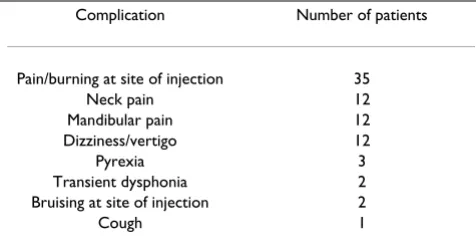
No lasting or serious complication was observed with PEI therapy. 2 cases of transient dysphonia were reported. Both patients recovered completely. Examination by an ENT specialist showed transient vocal cord paralysis and subsequent full recovery. Table 2 shows the number of pa-tients experiencing complications during treatment. All complications improved within minutes, except for 2 ep-isodes of fever, which persisted for 24–48 hours, and 2 cases of transient dysphonia, which resolved fully after 1 week and 6 months.
Discussion
Hyperfunctioning thyroid nodules are common, yet there is controversy about their management [1,2,21]. The dif-ferent modalities used include surgery, radioiodine, and
Table 1: Pre- and post-pei thyroid function in 35 patients with hot nodules
Initial Assessment and Follow-up
Before PEI (n = 35) After PEI (n = 35) 3 months (n = 35) 6 months (n = 35) 2 years (n = 15)
T3 270.6 ± 99.6 169.05 ± 58.3* 164.5 ± 52.5* 157.6 ± 46.7* 189.2 ± 61.7‡
T4 14.9 ± 4.6 9.6 ± 3.04* 9.9+2.8* 9.4+2.4* 10.2 ± 2.46‡
TSH 0.09 ± 0.02 0.65 ± 0.8† 0.62 ± 0.8† 0.71 ± 0.8† 0.86 ± 1.5†
NV (ml) 18.2 ± 12.7 7.5 ± 5.3 - 5.7 ± 4.6
-TTV (ml) - - - -
-Normal Ranges: T3 = 80–230 ng/dl T4 = 4.5–12.8 µg/ml TSH = 0.2–5 µIU/ml Legend: * Significant change [P < 0.001] compared to pre-treatment †Significant change [P < 0.05] compared to pre-treatment ‡ No significant change [P > 0.05] compared to follow-up at 6 months Abbreviations: NV: nodule volume TTV: total thyroid volume PEI: percutaneous ethanol injection
Table 2: Complications of Therapy in 35 Patients with Hot Nod-ules Treated by Percutaneous Ethanol Injection
Complication Number of patients
Pain/burning at site of injection 35
Neck pain 12
Mandibular pain 12 Dizziness/vertigo 12
Pyrexia 3
Transient dysphonia 2 Bruising at site of injection 2
percutaneous ethanol injection [1,22]. The studies carried out over the past decade on the efficacy of PEI in the treat-ment of autonomous thyroid nodules indicate that it is ef-fective, requires no anaesthesia, and carries minimal risk [19,23]. In our study, PEI also proved to be an effective treatment for patients with hyperfunctioning thyroid nod-ules and either clinical or sub-clinical hyperthyroidism. None of our patients reported symptoms of hyperthy-roidism after PEI and all of them achieved normal periph-eral thyroid hormone levels. At 3 months follow-up, only 3 patients showed persistent sTSH suppression in spite of normal thyroid hormone levels. Reduction in the volume of nodules was significant at 3 months [P < 0.001], with an average value of l2.48 ± 10.6 ml per nodule. The suc-cess rate for this study (91.3%) is consistent with that re-ported elsewhere (54–100%) [18,19,23,25]. Two large studies from Italy, one on 132 patients followed up over 8.5 years [23] and the other on 117 patients followed up over 5 years [24], suggest that PEI be recommended as treatment for hyperfunctioning thyroid adenoma with sub-clinical hyperthyroidism. The success rate in our pa-tients is higher, however, than that reported in a number of larger series, notably that reported by Lippi et al [24], in which the overall success rate was 45.9% at 3 months, in-creasing to 73.9% at one year. 99 Tm scans were only per-formed before treatment in our patients; follow-up scanning may well have reduced our success rate too.
PEI can also be recommended as alternative therapy in pa-tients at high-risk for surgery (even when the nodules are large) or for patients in whom radioactive iodine may have relative contraindication(s) [2,18,25,27]. Many au-thors further stress that PEI should only be carried out in centres thoroughly familiar with the technique required [28–31]. Transient dysphonia (spontaneous recovery over a period of weeks or months) has been reported in 2–5% of cases [20,30,32]. The pathology in every case has been either direct chemical injury to the recurrent laryngeal nerves, secondary to alcohol leakage outside the nodule, or nerve injury due to a sudden elevation in pressure in-side the nodule. Two cases of transient vocal cord paraly-sis were seen in our patients; one recovered fully after 1 week, the other fully after 6 months. Real-time ultrasound used to monitor the PEI procedure can identify ethanol leakage, which shows up as a hyperechogenic area, as it is happening. One group has suggested that, in order to minimise the risk involved, a bolus of 2% Xylocaine (0.2– 0.5 ml) should be injected first in order to mark the injec-tion path before PEI itself is begun [9]. We omitted this approach because the nodules were all clearly identifiable by ultrasound and there was little risk of leakage. Studies have shown that ethanol produces coagulative necrosis of nodular tissue through hemorrhagic infarction and vascu-lar thrombosis [33,34]. Furthermore, in the area of viable tissue surrounding the zone of biochemical ablation,
en-zyme activity is reduced. The areas of necrotic thyroid pa-renchyma are clearly distinguishable from the seemingly normal thyroid tissue surrounding them, which is free of any evidence of inflammation [33,34]. The probability of recurrence is virtually eliminated once granulation scar tissue replaces the nodule. Hypothyroidism is not ob-served even after prolonged follow-up [26,35]. Recurrence of hyperthyroidism has not been reported in patients who have had a complete response to PEI [26,35]. Our study confirms this. It should be noted that a number of our pa-tients had multinodular goitre, with more than one hot nodule being detected on radioisotope scanning. In expe-rienced hands, major complications of PEI, such as fibro-sis of adjacent tissues or thrombogenefibro-sis within the large vessels of the neck, are unlikely [33]. T3 and T4 levels in
both pre-toxic and toxic patients decreased significantly [P < 0.001], and sTSH levels increased significantly, in re-sponse to PEI [P < 0.01]. The most important factors in predicting response to PEI are initial nodule volume and the level of skill possessed by the physician performing the procedure. Significant nodule shrinkage following PEI has already been reported in the literature [36]. Our find-ings confirm this. There exists a direct linear relationship between reduction in nodule volume and initial nodule volume (r = 0.94, p = 0.007), that is to say the greater the initial size of the nodule, the larger the reduction in size.
PEI is also effective in non-toxic thyroid nodules in young patients [6,36]. However, since the conversion rate for non-toxic nodules (to toxic nodules) is 1.2–5.7 percent/ year depending on the follow-up series [37,38], many au-thors recommend conservative therapy for patients with non-toxic hot nodules. Furthermore, given that long-term sub-clinical hyperthyroidism is associated with increased bone turnover and accelerated bone demineralisation, and that in patients with concomitant heart disease, the increased quantity of hormone secreted by an autono-mous nodule may produce arrhythmias or lead to cardiac failure, treatment of hyperfunctioning nodules with sup-pressed sTSH becomes necessary and PEI may be a reason-able alternative in some cases [1,2,14,36,39].
Conclusions
We conclude that PEI is a method that is relatively inex-pensive and does not require bed rest or hospitalisation. It combines convenience with avoidance of surgical risks and hypothyroidism associated with radioiodine therapy. PEI is a more practical option in younger patients because it leaves no residual surgical scar, involves no exposure to radiation, is not associated with a long-term risk of hy-pothyroidism, and leads to a reduction in nodule volume without recourse to surgery.
Competing interests
Authors' contributions
BL, MP and MHB conceived and designed the study, and drafted the original and revised drafts of the article. FA, NA, MS and MS recruited patients and performed the ini-tial and follow-up clinical evaluations. HG and KF carried out the ultrasound examinations and ethanol injections. MRA and RBJ carried out the data analysis.
All authors read and approved the final manuscript.
Acknowledgements
The authors would like to thank Vahab Fatourechi, M.D., of the Mayo Clinic for his critical review of the paper, Ms. Michelle K. Papaconstandinou, of the same institution, for her secretarial support, as well as Mohammad Tavan-gar, M.D., of the Department of Pathology, Dr Shariati Hospital, for his ex-pert guidance.
References
1. David E, Rosen IB, Bain J, James J, Kirsh JC: Management of the Hot Thyroid Nodule.Am J Surg 1995, 170:481-3
2. Giuffrida D, Gharib H: Controversies in the Management of Cold, Hot, and Occult Thyroid Nodules. Am J Med 1995,
99:642-50
3. Zingrillo M, Torlontano M, Ghiggi MR, et al: Radioiodine and Per-cutaneous Ethanol Injection in the Treatment of Large Tox-ic Thyroid Nodules: A Long-Term Study.Thyroid 2000, 10:985 4. Livraghi T, Paracchi A, Ferrari C, et al: Treatment of Autonomous Thyroid Nodules with Percutaneous Ethanol Injection: Pre-liminary Results [Work In Progress].Radiology 1990, 175:827-9 5. Monzani F, Goletti O, De Negri F, et al: Autonomous Thyroid Nodule and Percutaneous Ethanol Injection. Lancet 1991,
337:743
6. Martino E, Murtas ML, Loviselli A, et al: Percutaneous Intranodu-lar Ethanol Injection for Treatment of Autonomously Func-tioning Thyroid Nodules.Surgery 1992, 112:1161-5
7. Brunn J, Block U, Ruf G, et al: Accuracy of the clinical assessment of thyroid size.Dan Med Bull 1991, 38:87
8. Goletti O, Monzani F, Caraccio N, et al: Percutaneous Ethanol In-jection Treatment of Autonomously Functioning Single Thy-roid Nodules: Optimisation of Treatment and Short-Term Outcome.World J Surg 1992, 16:784-90
9. Paracchi A, Ferrari C, Livraghi T, et al: Percutaneous Intranodular Ethanol Injection: A New Treatment for Autonomous Thy-roid Adenoma.J Endocrinol Invest15:353-62
10. Mazzeo S, Toni MG, De Gaudio C, et al: Percutaneous Injection of Ethanol to Treat Autonomous Thyroid Nodules.AJR Am J Roentgenol 1992, 161:871-6
11. Papini E, Panunzi C, Pacella CM, et al: Percutaneous Ultrasound-Guided Ethanol Injection: A New Treatment of Toxic Au-tonomously Functioning Thyroid Nodules?J Clin Endocrinol Me-tab 1993, 76:411-6
12. Monzani F, Del Guerra P, Caraccio N, et al: Percutaneous Ethanol Injection Therapy of Autonomous Nodule and Amiodarone-Induced Thyrotoxicosis.Thyroidology 1994, 6:99-102
13. Livraghi T, Paracchi A, Ferrari C, et al: Treatment of Autonomous Thyroid Nodules with Percutaneous Ethanol Injection: 4-Year Experience.Radiology 1994, 190:529-33
14. Di Lelio A, Rivolta M, Casati M, Capra M: Treatment of Autono-mous Thyroid Nodules: Value of Percutaneous Ethanol In-jection.AJR Am J Roentgenol 1995, 164:207-13
15. Nakada K, Katoh C, Kanegae K, et al: Percutaneous Ethanol In-jection Therapy for Autonomously Functioning Thyroid Nodule.Ann Nucl Med 1996, 10:171-6
16. Mincheva L, Simeonov S, Troev D, et al: Percutaneous Ethanol Sclerotherapy of Autonomous Thyroid Nodules: Prelimi-nary Results.Folia Med 1997, 39:49-54
17. Komorowski J, Kuzdak K, Pomorski L, Bartos M, Stepien H: Percu-taneous Ethanol Injection in Treatment of Benign Non-Functional and Hyperfunctional Thyroid Nodules. Cytobios 1998, 95:143-50
18. Solbiati L, Lerace T, Cova L, Dellanoce M, Marelli P: Percutaneous Ethanol Injection of Autonomously Functioning Thyroid Nodule.Rays 1999, 24:348-57
19. Tarantino L, Giorgio A, Mariniello N, et al: Percutaneous Ethanol Injection of Large Autonomous Hyperfunctioning Thyroid Nodules.Radiology 2000, 214:143-8
20. Brkljacic B, Sucic M, Bozikov V, Hauser M, Hebrang A: Treatment of Autonomous and Toxic Thyroid Adenomas By Percutane-ous Ultrasound-Guided Ethanol Injection.Acta Radiologica 2001,
42:477-81
21. Eyre-Brook La, Talbot CH: The Treatment of Autonomous Functioning Thyroid Nodules.Br J Surg 1982, 69:577-9 22. Ferrari C, Reschini E, Paracchi A: Treatment of the Autonomous
Thyroid Nodule: A Review.Eur J Endocrinol 1996, 135:383-90 23. Monzani F, Caraccio N, Goletti O, et al: Treatment of
Hyperfunc-tioning Thyroid Nodules with Percutaneous Ethanol Injec-tion: Eight Years' Experience.Exp Clin Endocrinol Diabetes 1998,
106:S54-8
24. Lippi F, Ferrari C, Manetti L, Rago T, Santini F, Monzani F, et al: Treat-ment of Solitary Autonomous Thyroid Nodules by Percuta-neous Ethanol Injection: Results of an Italian Multicenter Study.J Clin Endocrinol Metab 1996, 81(9):3261-64
25. Caraccio N, Goletti O, Lippolis PV, et al: Is Percutaneous Ethanol Injection a Useful Alternative for the Treatment of the Cold Benign Thyroid Nodule? Five Years' Experience.Thyroid 1997,
7:699-704
26. Monzani F, Caraccio N, Goletti O, et al: Five-Year Follow-Up of Percutaneous Ethanol Injection for the Treatment of Hyper-functioning Thyroid Nodules: A Study of 117 Patients.Clin En-docrinol (Oxf) 1997, 46:9-15
27. Zingrillo M, Torlontano M, Chiarella R, et al: Percutaneous Etha-nol Injection may be a Definitive Treatment for Symptomat-ic Thyroid CystSymptomat-ic Nodules Not Treatable by Surgery: Five-Year Follow-Up Study.Thyroid 1999, 9:763-7
28. Spiezia S, Cerbone G, Assanti AP, et al: Power Doppler Ultrasono-graphic Assistance in Percutaneous Ethanol Injection of Au-tonomously Functioning Thyroid Nodules. J Ultrasound Med 2000, 19:39-46
29. Cerbone G, Spiezia S, Colao A, et al: Percutaneous Ethanol Injec-tion Under Power Doppler Ultrasound Assistance in the Treatment of Autonomously Functioning Thyroid Nodules.
J Endocrinol Invest 1999, 22:752-9
30. Schumm-Draeger PM: Ultrasound-Guided Percutaneous Etha-nol Injection in the Treatment of Autonomous Thyroid Nod-ules: A Review.Exp Clin Endocrinol Diabetes 1998, 106:S59-62 31. Verde G, Papini E, Pacella CM, et al: Ultrasound-Guided
Percuta-neous Ethanol Injection in the Treatment of Cystic Thyroid Nodules.Clin Endocrinol (Oxf) 1994, 41:719-24
32. Papini E, Pacella CM, Verde G: Percutaneous Ethanol Injection (PEI): What is its Role in the Treatment of Benign Thyroid Nodules?Thyroid 1995, 5:147-50
33. Monzani F, Caraccio N, Basolo F, et al: Surgical and Pathological Changes After Percutaneous Ethanol Injection Therapy of Thyroid Nodules.Thyroid 2000, 10:1087-92
34. Miccoli P, Bendinelli C, Monzani F: Surgical Aspects of Thyroid Nodules Previously Treated by Ethanol Injection.Exp Clin En-docrinol Diabetes 1998, 106:S75-7
35. Janowitz P, Ackmann S: [Long-Term Results of Ultrasound-Guided Ethanol Injections in Patients with Autonomous Thyroid Nodules and Hyperthyroidism]. Med Klin 2001,
96:451-6
36. Monzani F, Goletti O, Caraccio N, et al: Percutaneous Ethanol In-jection Treatment of Autonomous Thyroid Adenoma: Hor-monal and Clinical Evaluation.Clin Endocrinol (Oxf) 1992, 36: 491-7
37. Thomas CG Jr, Croom RD: Current Management of the Patient with Autonomously Functioning Nodular Goitre. Surg Clin North Am 1987, 67:315-28
38. Kunori T, Shinya H, Satomi T, et al: Management of Nodular Goi-tres and their Operative Indications.Surg Today 2000, 30:722-6 39. Mann K: Evaluation of Risk in Autonomously Functioning
Thyroid Nodules.Exp Clin Endocrinol Diabetes 1998, 106:S23-6 40. Zbranca E, Mogos V, Vulpoi C, et al: [Fine Needle Puncture –
Method of Treatment in Nodular Pathology of the Thyroid].
41. Goletti O, Monzani F, Lenziardi M, et al: Cold Thyroid Nodules: A New Application of Percutaneous Ethanol Injection Treat-ment.J Clin Ultrasound 1994, 22:175-8
Pre-publication history
The pre-publication history for this paper can be accessed here:
http://www.biomedcentral.com/1472-6823/2/3/prepub
Publish with BioMed Central and every scientist can read your work free of charge "BioMed Central will be the most significant development for disseminating the results of biomedical researc h in our lifetime."
Sir Paul Nurse, Cancer Research UK
Your research papers will be:
available free of charge to the entire biomedical community
peer reviewed and published immediately upon acceptance
cited in PubMed and archived on PubMed Central
yours — you keep the copyright
Submit your manuscript here:
http://www.biomedcentral.com/info/publishing_adv.asp