R E S E A R C H A R T I C L E
Open Access
The effect of nurse empowerment
educational program on patient safety
culture: a randomized controlled trial
Maryam Amiri
1, Zahra Khademian
1*and Reza Nikandish
2Abstract
Background:The complexity of patients’condition and treatment processes in intensive care units (ICUs) predisposes patients to more hazardous events. Effective patient safety culture is related to lowering the rate of patients’ complications and fewer adverse events. The present study aimed to determine the effect of empowering nurses and supervisors through an educational program on patient safety culture in adult ICUs.
Methods:A randomized controlled trial was conducted during April–September 2015 in 6 adult ICUs at Namazi
Hospital, Shiraz, Iran. A total of 60 nurses and 20 supervisors were selected through proportional stratified sampling and census, respectively, and randomly assigned to the experimental and control groups. The intervention consisted of a two-day workshop, hanging posters, and distributing pamphlets that covered topics such as patient safety, patient safety culture, speak up about safety issues, and the skills of Team Strategies and Tools to Enhance Performance and Patient Safety. Data were collected through a hospital survey on patient safety culture. Eventually, 61 participants completed the study. Data were analyzed using descriptive statistics, independent-samples t-test, paired-samples t-test, and Chi-square test.P< 0.05 was considered statistically significant.
Results:In the experimental group, the total post-test mean scores of the patient safety culture (3.46 ± 0.26) was significantly higher than that of the control group (2.84 ± 0.37,P< 0.001). It was also higher than that of the pre-test (2.91 ± 0.4,P< 0.001). Additionally, significant improvements were observed in 5 out of 12 dimensions in the experimental group. However, dimensions such as non-punitive response to errors and the events reported did not improve significantly.
Conclusion:Empowering nurses and supervisors could improve the overall patient safety culture. Nonetheless,
additional actions are required to improve areas such as reporting the events and non-punitive response to errors.
Trial registration:IRCT2015053122494N1. Date registered: March 2, 2016.
Keywords:Culture, Intensive care units, Nursing, Supervisory, Nurses, Patient safety, Patient safety culture, Safety
Background
Patient safety is an important element in offering high-quality health care services. However, it is esti-mated that approximately 400,000 annual deaths are
re-lated to preventable harms [1]. The complexity of
patients’condition and treatment processes in Intensive Care Unit (ICU) predisposes patients to more hazardous
events [2]. In a prospective study, during 2013–2014, the rate of adverse events per 1000 patient-days in an ICU
was 80.5 in which 45% were preventable [3]. The
epi-demiology of medical errors in Iran is ambiguous. Zar-garzadeh has estimated that 24,500 annual deaths are related to medical errors [4]. In addition, in an ICU, among 307 medication doses, 214 (69.7%) errors were identified during administration (n= 132, 42.99%), pre-scription (n= 74, 24.1%), and transcription (n= 8, 2.61%) of medications [5]. Moreover, 48 medication errors per 100 orders were observed in a pediatric ICU [6].
* Correspondence:[email protected];[email protected];
1Department of Nursing, School of Nursing and Midwifery, Shiraz University of Medical Sciences, Shiraz, Iran
Full list of author information is available at the end of the article
Poor communication and collaboration [7], lack of knowledge, and inadequate training were among the main causes of nursing errors in ICUs [8]. Studies have shown the lack of communication skills in nurses and nursing students [9, 10]. Hence, a training program for nurses on patient safety alongside with strategies to prove professional communication is required to im-prove patient safety.
High mortality and morbidity associated with medical errors indicate the importance of promoting patient safety in critical care units. Nurses play a key role in im-proving patient safety due to their continuous presence at patients’ bedsides and interaction with their families and other healthcare professionals [11]. For instance, critical care unit nurses have often reported that they identified and corrected errors such as medication and procedural errors related to nurses and other caregivers [12]. Henneman et al. identified multiple strategies to identify the patient, recognize other team members, and the plan of care, which nurses used to detect, discon-tinue, and correct errors in critical care settings [13].
Research findings indicated that a strong patient safety culture is associated with a lower rate of patients’ com-plications and fewer adverse events [14,15]. It is defined as a culture whereby nurses are aware of errors and are encouraged to discuss them. This, in turn, improves their ability to learn from past mistakes and take cor-rective measures [16].
A meta-analysis, including 11 descriptive studies on hospital staff, showed that only 8.3 and 32.3% of the re-spondents of the reviewed articles have rated patient safety culture in Iran as excellent and very good, respect-ively [17]. The important role of patient safety culture necessitates improvement of these strategies in clinical settings. Nevertheless, interventions that may improve patient safety culture are not adequately defined [18]. In a study, the positive effects of some interventions, such
as executive walk rounds [19] and the role of nurse
managers in regular assessment and support of the safety culture were reported [20]. Consequently, the par-ticipation of nurse managers in the planning and imple-mentation of strategies, to improve patient safety culture, may reinforce these strategies [18].
Several studies have reported the effects of nurse em-powerment interventions on patient safety culture. A type of strategy is an educational program, such as on-line module, addressing patient safety which increases positive scores of nurses in two dimensions of patient safety culture (i.e.“non-punitive response to errors”and “frequency of event reporting”) [21]. Teaching teamwork also improves staff perception of patient safety culture in
the emergency department [22]. Another empowerment
strategy is to encourage nurses to speak up. Sayre (2010) reported that nurses behavior towards patient safety
protection increased when encouraged to speak up in a situation of a threat to patient safety [23].
In order to improve the quality of care and patient safety, the Institute of Medicine (2003) recommended a reform in health profession education [24]. Accordingly, the Quality and Safety Education for Nurses (QSEN) pro-ject was introduced to train nurses on the required com-petencies to improve the quality of care and patient safety [25]. Considering the important role of nurses and leaders in ensuring patient safety and in providing a strong patient safety culture, we developed and studied the effects of an innovative empowerment program on patient safety cul-ture. This program is unique in a sense that it involves nurses and supervisors with an integrated exclusive educa-tional program which encourages them to speak up. The present study aimed to determine the effect of empower-ing nurses and supervisors through an educational pro-gram on patient safety culture in adult ICUs.
Methods
This randomized controlled trial with a pre-test and
post-test control groups was conducted during
April–September 2015 in 6 adult ICUs at Namazi Hospital, Shiraz, Iran. All the above-mentioned ICUs were similar in terms of patient safety policies. The study popu-lation included 160 nurses and 20 supervisors. The nurse:-patient ratio in these wards was 1:2. The sample size consisted of 60 nurses and 20 supervisors. The nurses were selected based on proportional stratified sampling. Therefore, the number of selected nurses from each ICU was proportional to the total number of its nurses. Supervisors were nurses with at least a Bachelor’s de-gree and responsible for oversight nursing services in the studied ICUs. Note that the supervisors did not provide direct patient care. All supervisors at the hos-pital participated in the study. To randomly allocate nurses, a number was assigned to each ICU and catego-rized into the control and experimental groups, based on permuted block randomization. In total, 30 nurses from ICUs number 1, 3, and 6 (surgical, neurosurgical, and general ICU) were assigned to the experimental group. In addition, 30 nurses from ICUs number 2, 4, and 5 (medical, neurosurgical, and general ICU) were assigned to the control group. Based on permuted block randomization, all supervisors at the hospital
were assigned to the experimental (n= 10) and control
(n= 10) groups. The experimental group, including 30
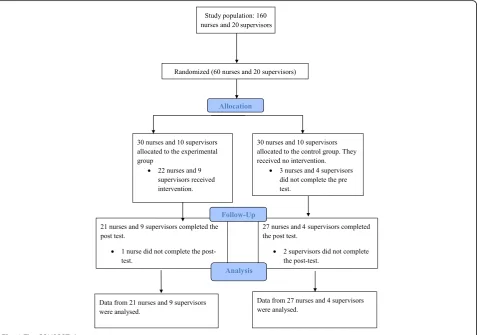
were the unwillingness to participate, failure to complete the pre-test, and lack of participation in train-ing sessions. A total of 61 out of 80 individuals
(experi-mental group:n= 30, control group: n= 31) completed
the post-test questionnaire (Fig.1).
The educational empowerment program
The educational empowerment program was carried out by one of the researchers. This program started with a two-day workshop (8 h), followed by hanging posters and handing out educational pamphlets to the nurses and supervisors of the experimental group at their work-place. The educational contents of the workshop, post-ers, and pamphlets were matched. The workshop included education on patient safety, patient safety cul-ture, speak out in a situation of a threat to patient safety, and the skills of Team Strategies and Tools to Enhance Performance and Patient Safety (TeamSTEPPS). Team-STEPPS was developed by the Agency for Healthcare Research and Quality (AHRQ) to improve patient out-comes. It included communication, leadership, mutual
support, and situational monitoring skills [26]. The
workshop consisted of a lecture, group discussion, and presenting scenarios. In addition, some textual and
graphical posters (related to TeamSTEPPS skills, speak up, and patient safety culture) were placed on the walls of patient’s unit in the ICUs of the experimental group for a period of 6 weeks. During the following 6 weeks, every week one pamphlet was handed out to the nurses in the experimental groups. Pamphlets contents included communication, mutual support, situation monitoring, leadership, speak up, and patient safety culture.
Data collection
Data were collected using the Persian version of Hospital Survey on Patient Safety Culture (HSOPSC) developed by the AHRQ. The validity of the HSOPSC in Iran was verified by 15 experts and its reliability measured by Cronbach’s alpha coefficient (0.84) [27]. This question-naire has 42 items in 12 dimensions. These dimensions include: teamwork within units, manager expectations and actions promoting patient safety, organizational learning and continuous improvement, management support for patient safety; overall perception of patient safety, feedback and communication on errors, commu-nication openness, frequency of events reported; team-work across hospital units, staffing, handoffs and transitions, non-punitive response to errors. The items
were answered on a five-point Likert scale, from com-pletely disagree (1) to comcom-pletely agree (5) or from never (1) to always (5). There were a few negatively worded items in the questionnaire that were reverse coded. If
the proportion of respondents who answered
“com-pletely agree”/“agree”, or“always”/“most of the time” on each item was more than 50%, this was considered as strong, otherwise (below 50%) as the weak point of the safety culture. In addition to these 42 questions, there was a single item on patient safety grading in the unit. This item was answered on a five-point Likert scale from excellent (score = 5) to failing (score = 1) and was ana-lyzed separately as a single item [20, 28]. The pre-test was completed individually before the workshop. Three months after the workshop, the post-test was conducted individually in both groups.
Data analysis
Statistical analysis was carried out using the SPSS
soft-ware version 18.0. The results of One-Sample
Kolmogorov-Smirnov showed normal distribution of data before (P= 0.72) and after (P= 0.96) the interven-tion, except for the single item on patient safety grading. Descriptive statistics was used to describe age, sex, edu-cation, position, and the total scores of the patient safety culture and its dimensions. To compare the mean scores between the two groups and within each group, the independent-samples t-test and paired-samples t-test were used. The single item on patient safety grading was compared between the control and experimental groups using the Mann-Whitney test. This item was compared before and after the intervention in each group using the Wilcoxon test. The effect size for paired t-test was calcu-lated by the Cohen (1988) equation as follows:
Effect size¼d¼ M1‐M2
S pooled; Spooled¼
ffiffiffiffiffiffiffiffiffiffiffiffiffiffiffiffiffiffiffiffi
S12þS22
2
r
Where M1 and M2 are post-test means of the experi-mental and control groups, respectively. Spooled: Pooled standard deviation, and S1 and S2: Post-test standard
deviations of the experimental and control groups, respectively.
The effect size of 0.2, 0.5, and 0.8 was considered small, medium, and large, respectively [29].P< 0.05 was considered statistically significant.
Results
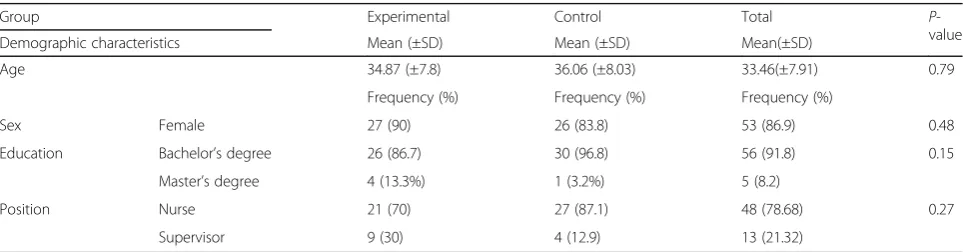
The sample size included 48 nurses and 13 supervisors. The experimental and control groups were homoge-neous in terms of age, sex, marital status, education, and position (Table1).
Table 2: The response of all participants, both in the experimental and control groups, on patient safety cul-ture prior to the intervention. The findings showed that before the intervention, the organizational learning and continuous improvement (72.46% of positive responses) and staffing (9.95% of positive responses) were the stron-gest and the weakest dimensions of patient safety culture (Table2).
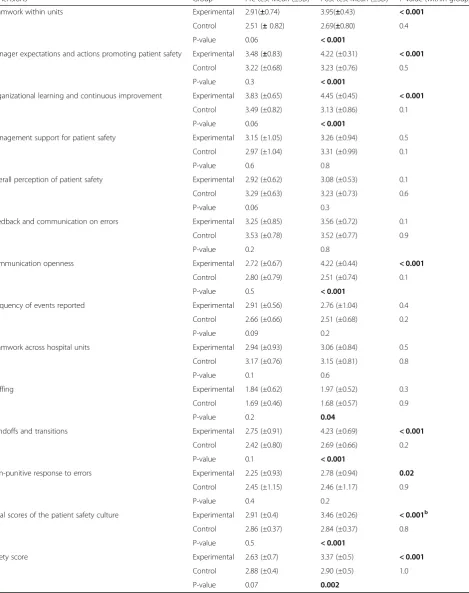
The pre-test means of the experimental and control groups of the total scores of patient safety culture and its dimensions were not statistically different. However, in the experimental group, the total post-test mean scores of patient safety culture was significantly higher than that of the control group (3.46 ± 0.26 vs. 2.84 ± 0.37, P< 0.001), and it was also higher than that of the pre-test (3.46 ± 0.26 vs. 2.91 ± 0.4,P< 0.001, effect size (d)= 1.94). In addition, significant improvements were observed in 5 out of 12 dimensions in the experimental group. The mean scores of teamwork within units (3.95 ± 0.43 vs. 2.91 ± 0.74,
P< 0.001, d= 1.03), manager expectations and actions promoting patient safety (4.22 ± 0.31 vs. 3.48 ± 0.83,
P< 0.001, d= 0.84), and organizational learning and continuous improvement (4.45 ± 0.45 vs. 3.83 ± 0.65,
P< 0.001, d= 0.83) increased significantly in the ex-perimental group. Furthermore, the post-test means of communication openness (4.22 ± 0.44 vs. 2.72 ± 0.67,
P< 0.001, d= 1.82) and handoffs and transitions (4.23 ± 0.69 vs. 2.75 ± 0.9, P < 0.001, d= 1.30) increased significantly in the experimental group. However,
Table 1Distribution of demographic characteristics of the participants
Group Experimental Control Total P
-value Demographic characteristics Mean (±SD) Mean (±SD) Mean(±SD)
Age 34.87 (±7.8) 36.06 (±8.03) 33.46(±7.91) 0.79
Frequency (%) Frequency (%) Frequency (%)
Sex Female 27 (90) 26 (83.8) 53 (86.9) 0.48
Education Bachelor’s degree 26 (86.7) 30 (96.8) 56 (91.8) 0.15
Master’s degree 4 (13.3%) 1 (3.2%) 5 (8.2)
Position Nurse 21 (70) 27 (87.1) 48 (78.68) 0.27
there was no significant change in the control group mean scores (Table 3).
Discussion
In the present study, the effect of an innovative educa-tional empowerment program on patient safety culture is investigated. The finding suggests that the empower-ment program improved the total score of patient safety culture. The effect size of this score was large (1.94) [29]. This shows that the effect of the intervention is strong and clinically important.
The results of the present study showed that commu-nication openness improved after the intervention. This domain indicates member’s ability to question decisions and actions of individuals with more authority and the ability to speak up when there is a concern about patient safety. This finding was in line with the findings of a study by Andreoli et al. in which SBAR was used to communicate and manage fall risk, [30] and also by Kha-demian et al. in which the anesthesia and operating
room nursing students’ perceptions of communication
dimension improved after TeamSTEPPS training [31].
However, it was in contradiction with the results of two other studies in which patient safety education and teamwork training of nurses and hospital staff did not improve their attitudes on communication openness [21, 22]. In the current study, one aspect of the intervention was training in speaking up, which may explain the dif-ferences between the current findings and those from previous studies. Evidence show that hospital staff are not competent enough in speaking up. This is based on the fact that, among the 447,584 hospital staff in the
United States, 65% of the respondents stated that they were afraid of asking questions when they felt something was wrong [20]. Iranian nurses noted a sense of power-lessness, due to dominance by the medical staff, prevents them from talking in favor of their patients [32]. There-fore, empowering nurses to speak up might help them to overcome these barriers.
In the pre-test, dimensions of teamwork within units and handoffs and transition were the weak aspects of pa-tient safety culture. However, after the intervention, some improvements were observed in the experimental group and these were elevated to the strong dimensions. Similar results in previous studies have shown that train-ing teamwork skills, ustrain-ing SBAR tool, and interventions based on HSOPSC domains enhanced teamwork within units [30, 33, 34]. However, in some other studies, no improvement was achieved after training [21, 22]. Simi-lar to our findings, other studies showed improvement on handoffs and transitions [22,30]. Therefore, we could suggest a similar empowerment program to improve teamwork within units and handoff and transitions.
In the present study, “teamwork across the units” did
not improve significantly after the intervention. We in-volved supervisors in addition to nurses in the empower-ment program to reinforce their role in patient safety culture improvement. We expected that empowering su-pervisors would improve coordination and teamwork across units. These findings may be related to the small sample size of supervisors. We should bear in the mind that this dimension was strong before the intervention; however, we expected more improvement. Similarly, in other studies in which education was the main
interven-tion, “teamwork across the units” did not improve
sig-nificantly [21,22].
The dimensions of “non-punitive response to errors”
and “the frequency of events reported” were among the weakest dimensions of patient safety culture before the
intervention. The mean scores of“non-punitive response
to errors” after the intervention had significantly
in-creased in the experimental group. However, these scores were not significantly different to that of the con-trol group. Therefore, we could not conclude that this dimension improved due to the intervention. In addition, the frequency of events reported did not show
any improvement. In a previous study,“non-punitive
re-sponse to errors” had improved while “the frequency of
events reported” did not improve [30]. In another study, using a single group pre-test post-test design, the only two dimensions that had improved after safety training were “non-punitive response to errors” and “the fre-quency of events reported” [21]. Consequently, based on the current results, we could not conclude that educa-tion can improve non-punitive response to errors. Therefore, there is a need for collaboration among all
Table 2The mean, standard deviation, and percentage of positive responses to the 12 dimensions of patient safety culture by all participants before the intervention
Dimensions Mean (±SD) Percent (%)
Teamwork within units 2.71 (±0.8) 45.65
Manager expectations and actions promoting patient safety
3.39 (±0.75) 59.9
Organizational learning and continuous improvement
3.65 (±0.73) 72.46
Management support for patient safety 3.08 (±1.04) 55.53
Feedback and communication on errors 3.39 (±0.81) 60.86
Communication openness 2.77 (±0.72) 23.27
Frequency of events reported 2.77 (±0.62) 26.46
Teamwork across hospital units 3.08 (±0.84) 53.2
Staffing 1.76 (±0.54) 9.95
Handoffs and transitions 2.56 (±0.86) 28.15
Non-punitive response to errors 2.36 (±1.03) 21.66
Overall perception of patient safety 3.08 (±0.66) 51.2
Table 3Comparison of patient safety culture before and after the intervention within and between groups
Dimensions Groupa Pre-test Mean (±SD) Post-test Mean (±SD) P-value (within group)
Teamwork within units Experimental 2.91(±0.74) 3.95(±0.43) < 0.001
Control 2.51 (±0.82) 2.69(±0.80) 0.4
P-value 0.06 < 0.001
Manager expectations and actions promoting patient safety Experimental 3.48 (±0.83) 4.22 (±0.31) < 0.001
Control 3.22 (±0.68) 3.23 (±0.76) 0.5
P-value 0.3 < 0.001
Organizational learning and continuous improvement Experimental 3.83 (±0.65) 4.45 (±0.45) < 0.001
Control 3.49 (±0.82) 3.13 (±0.86) 0.1
P-value 0.06 < 0.001
Management support for patient safety Experimental 3.15 (±1.05) 3.26 (±0.94) 0.5
Control 2.97 (±1.04) 3.31 (±0.99) 0.1
P-value 0.6 0.8
Overall perception of patient safety Experimental 2.92 (±0.62) 3.08 (±0.53) 0.1
Control 3.29 (±0.63) 3.23 (±0.73) 0.6
P-value 0.06 0.3
Feedback and communication on errors Experimental 3.25 (±0.85) 3.56 (±0.72) 0.1
Control 3.53 (±0.78) 3.52 (±0.77) 0.9
P-value 0.2 0.8
Communication openness Experimental 2.72 (±0.67) 4.22 (±0.44) < 0.001
Control 2.80 (±0.79) 2.51 (±0.74) 0.1
P-value 0.5 < 0.001
Frequency of events reported Experimental 2.91 (±0.56) 2.76 (±1.04) 0.4
Control 2.66 (±0.66) 2.51 (±0.68) 0.2
P-value 0.09 0.2
Teamwork across hospital units Experimental 2.94 (±0.93) 3.06 (±0.84) 0.5
Control 3.17 (±0.76) 3.15 (±0.81) 0.8
P-value 0.1 0.6
Staffing Experimental 1.84 (±0.62) 1.97 (±0.52) 0.3
Control 1.69 (±0.46) 1.68 (±0.57) 0.9
P-value 0.2 0.04
Handoffs and transitions Experimental 2.75 (±0.91) 4.23 (±0.69) < 0.001
Control 2.42 (±0.80) 2.69 (±0.66) 0.2
P-value 0.1 < 0.001
Non-punitive response to errors Experimental 2.25 (±0.93) 2.78 (±0.94) 0.02
Control 2.45 (±1.15) 2.46 (±1.17) 0.9
P-value 0.4 0.2
Total scores of the patient safety culture Experimental 2.91 (±0.4) 3.46 (±0.26) < 0.001b
Control 2.86 (±0.37) 2.84 (±0.37) 0.8
P-value 0.5 < 0.001
Safety score Experimental 2.63 (±0.7) 3.37 (±0.5) < 0.001
Control 2.88 (±0.4) 2.90 (±0.5) 1.0
P-value 0.07 0.002
a
The between groupsP-value is provided b
team members and leaders towards problem-solving and to increase the number of events being reported.
It seems that the involvement of nurses and supervisors in the empowerment program was not sufficient to im-prove three important dimensions: staffing, error report-ing, and non-punitive response to errors. Therefore, we recommend that in the future higher-level hospital execu-tives should also be involved in empowerment programs.
Limitations of the study
The main limitation of the present study was related to the use of a self-reported instrument in order to explore the effects of empowerment on the patient safety cul-ture. It is recommended that further studies should be conducted using observational data collection methods. Additionally, studies that assess the viewpoints of other parties such as patients are recommended.
Conclusion
This innovative empowerment program which involved nurses and supervisors resulted in improved patient safety culture scores and development in some dimen-sions. Communication openness, handoffs and transi-tions, teamwork within units, learning and continuous
improvement, manager’s expectations and actions
pro-moting patient safety improved significantly after the intervention. Therefore, this program can be utilized to promote these important dimensions of patient safety culture. However, dimensions such as staffing, “ non-pu-nitive response to errors”, and“frequency of events that
were reported”continued to be the weak domains of the
patient safety culture throughout the study. Thus, to im-prove these dimensions, conducting long-term studies and additional actions are also required. Given the portance of reporting errors and adequate staffing in im-proving patient safety, it is recommended that these items should be considered as a top priority for health-care managers and hospital policymakers.
Abbreviations
AHRQ:Agency for Healthcare Research and Quality; HSOPSC: Hospital Survey on Patient Safety Culture; ICU: Intensive care units; SPSS: Statistical Package for Social Science; TeamSTEPPS: Team Strategies and Tools to Enhance Performance and Patient Safety
Acknowledgments
This article was extracted from the MSc thesis by Maryam Amiri, and approved by Vice Chancellor of Research of Shiraz University of Medical Sciences, Shiraz, Iran. Hereby, the officials in Namazi Hospital, Ms. Somayeh Zahraei and Fatemeh Azadi, ICU nurses and supervisors are highly appreciated. Appreciation goes to the Center for Development of Clinical Research at Namazi Hospital and Dr. Nasrin Shokrpour, Mrs. Sareh Keshavarzi, Dr. Najaf Zare, and Dr. Jamali for their collaboration in editorial assistance, design, statistics, and data analysis. The authors would also like to thank the Research Consultation Center at Shiraz University of Medical Sciences and Mr. Argasi and Dr. N. Pakshir for their editorial assistance.
Funding
The present study was financially supported by the Vice Chancellor of Research of Shiraz University of Medical Sciences, Shiraz, Iran (Grant No. 5793). The funding body did not play any roles in the design of the study and collection, analysis, and interpretation of data and in writing the manuscript.
Availability of data and materials
The dataset of the present study is available upon request.
Authors’contributions
All authors made substantial contributions to the conception and design of the study. Data was collected by MA. Data analysis and interpretation were done by ZKh and MA. RNN also participated in data interpretation. MA, RNN, and ZKh conducted the intervention. ZKh and MA participated in drafting the manuscript. All authors revised the manuscript critically for important intellectual content and final approval of the manuscript.
Ethics approval and consent to participate
The present study was approved by the Ethics Committee of Shiraz University of Medical Sciences (Shiraz, Iran) and the authorities at Namazi Hospital (No. 93–7397). Written informed consent was obtained from all participants and confidentiality of the information was assured.
Consent for publication
Not applicable.
Competing interests
The authors declare that they have no competing interests.
Publisher’s Note
Springer Nature remains neutral with regard to jurisdictional claims in published maps and institutional affiliations.
Author details 1
Department of Nursing, School of Nursing and Midwifery, Shiraz University of Medical Sciences, Shiraz, Iran.2Anesthesia and Critical Care Emergency Medicine Department, Namazi Hospital, Shiraz University of Medical Sciences, Shiraz, Iran.
Received: 18 July 2017 Accepted: 12 June 2018
References
1. James JT. A new evidence-based estimate of patient harms associated with hospital care. J Patient Saf. 2013;9(3):122–8.
2. Lyle-Edrosolo G, Waxman K. Aligning healthcare safety and quality competencies: quality and safety education for nurses (QSEN), The Joint Commission, and American Nurses Credentialing Center (ANCC) magnet® standards crosswalk. Nurse Leader. 2016;14(1):70–5.
3. Ravi P, Vijai M. Errors in ICU: how safe is the patient? A prospective observational study in a tertiary care hospital. J Anesth Clin Res. 2015;6(6):535. 4. Zargarzadeh AH. Medication safety in Iran. J Pharm Care. 2013;1(4):125–6. 5. Vazin A, Fereidooni M. Determining frequency of prescription,
administration and transcription errors in internal intensive care unit of Shahid Faghihi Hospital in Shiraz with direct observation approach. Iran J Pharm Sci. 2012;8(3):189–94.
6. Haghbin S, Shahsavari S, Vazin A. Medication errors in pediatric intensive care unit: incidence, types and outcome. Trends Pharm Sci. 2016;2(2):109–16. 7. Farzi S, Irajpour A, Saghaei M, Ravaghi H. Causes of medication errors in
intensive care units from the perspective of healthcare professionals. J Res Pharm Pract. 2017;6(3):158–63.
8. Nezamodini Z, Khodamoradi F, Malekzadeh M, Vaziri H. Nursing errors in intensive care unit by human error identification in systems tool: a case study. Jundishapur J Health Sci. 2016;8(3):e36055.
9. Khademian Z, Sharifi F, Tabei Z, Bolandparvaz S, Abbaszadeh A, Abbasi HR. Teamwork improvement in emergency trauma department. Iran J Nurse Midwifery Res. 2013;18(4):333–9.
11. Patient Safety Network. Nursing and Patient Safety. 2017.https://psnet.ahrq. gov/primers/primer/22/nursing-and-patient-safety. Accessed 25 Nov 2017. 12. Rogers AE, Dean GE, Hwang WT, Scott. Role of registered nurses in
error prevention, discovery and correction. Qual Saf Health Care. 2008; 17(2):117–21.
13. Henneman EA, Gawlinski A, Blank FS, Henneman PL, Jordan D, McKenzie JB. Strategies used by critical care nurses to identify, interrupt, and correct medical errors. Am J Crit Care. 2010;19(6):500–9.
14. Mardon RE, Khanna K, Sorra J, Dyer N, Famolaro T. Exploring relationships between hospital patient safety culture and adverse events. J Patient Saf. 2010;6(4):226–32.
15. Wang X, Liu K, You L, Xiang J, Hu H, Zhang L. The relationship between patient safety culture and adverse events: a questionnaire survey. Int J Nurs Stud. 2014;51(8):1114–22.
16. Sammer CE, Lykens K, Singh KP, Mains DA, Lackan NA. What is patient safety culture? A review of the literature. J Nurs Scholarsh. 2010;42(2):156–65. 17. Azami-Aghdash S, Ebadifard Azar F, Rezapour A, Azami A, Rasi V, Klvany K.
Patient safety culture in hospitals of Iran: a systematic review and meta-analysis. Med J Islam Repub Iran. 2015;23(29):251.
18. Weaver SJ, Lubomksi LH, Wilson RF, Pfoh ER, Martinez KA, Dy SM. Promoting a culture of safety. In: Making health care safer II: An updated critical analysis of the evidence for patient safety practices. Rockville: Agency for Healthcare Research and Quality; 2013. https://www.ncbi.nlm. nih.gov/books/NBK133394/. Accessed 23 Jun 2017.
19. Morello RT, Lowthian JA, Barker AL, McGinnes R, Dunt D, Brand C. Strategies for improving patient safety culture in hospitals: a systematic review. BMJ Qual Saf. 2013;22(1):8–11.
20. Famolaro T, Yount ND, Burns W, Flashner E, Liu H, Sorra J. Hospital survey on patient safety culture: 2016 user comparative database report. 2016. (Prepared by Westat, Rockville, MD, under Contract No. HHSA 290201300003C). Rockville: Agency for Healthcare Research and Quality. AHRQ Publication No. 16–0021-EF
21. AbuAlRub RF, Abualhaja AA. The impact of educational interventions on enhancing perceptions of patient safety culture among Jordanian senior nurses. Nurs Forum. 2014;49(2):139–50.
22. Jones F, Podila F, Power C. Creating a culture of safety in the emergency department:The Value of Team Training. J Nurse Adm. 2013;93(4):194–200. 23. Sayre MM. Improving collaboration and patient safety by encouraging
nurses to speak-up: Overcoming personal and organizational obstacles through self-reflection and collaboration . Available from ProQuest Dissertations and Theses Global. (753487229). http://search.proquest.com/ docview/753487229?accountid=41313. 2010. Accessed 10 Jun 2016. 24. Institute of Medicine. Committee on the Health Professions Education
Summit. Health professions education: a bridge to quality. 2003.https:// www.ncbi.nlm.nih.gov/books/NBK221528/[Internet]. National Academies Press (US). Accessed 15 Jun 2017.
25. Cronenwett L, Sherwood G, Barnsteiner J, Disch J, Johnson J, Mitchell P. Quality and safety education for nurses. Nurs Outlook. 2007;55(3):112–31. 26. AHRQ. About TeamSTEPPS®. 2016.
https://www.ahrq.gov/teamstepps/about-teamstepps/index.html. Accessed 10 Mar 2017.
27. Izadi AR, Drikvand J, Ebrazeh A. The patient safety culture in Fatemeh Zahra Hospital of Najafabad, Iran. Health Information Management. 2013;9(6):895–907.
28. Agency for Healthcare Research and Quality, Rockville. Surveys on Patient Safety Culture™. https://www.ahrq.gov/sites/default/files/wysiwyg/sops/ quality-patient-safety/patientsafetyculture/hospitalscanform.pdf. Accessed 10 Mar 2018.
29. Nakagawa S, Cuthill IC: Effect size, confidence interval and statistical significance: a practical guide for biologists. Biological reviews 2007, 82(4):591–605.
30. Andreoli A, Fancott C, Velji K, Baker GR, Solway S, Aimone E. Using SBAR to communicate falls risk and management in interprofessional rehabilitation teams. Healthc Q. 2010;13:94–101.
31. Khademian Z, Pishgar Z, Torabizadeh C. Effect of training on the attitude and knowledge of teamwork among anesthesia and operating room nursing students: a quasi-experimental study. Shiraz E Med J. 2018;19(4):e61079.
32. Negarandeh R, Oskouie F, Ahmadi F, Nikravesh M, Hallberg IR. Patient advocacy: barriers and facilitators. BMC Nurs. 2006;5(1):3.
33. Adams-Pizarro I, Walker Z, Robinson J, Kelly S, Toth M: Using the AHRQ Hospital Survey on patient safety culture as an intervention tool for regional clinical improvement collaboratives. In: Henriksen K, Battles JB, Keyes MA, et al., editors. Advances in patient safety: new directions and alternative approaches (vol. 2: culture and redesign). Rockville: Agency for Healthcare Research and Quality (US); 2008. Available from: https://www.ncbi.nlm.nih. gov/books/NBK43728/. Accessed 10 Mar 2017.