DOI 10.1007/s10152-007-0100-9 S H O R T C O M M U N I C A T I O N
Comparative evaluation of the DNA damage response in two
Peruvian marine bivalves exposed to changes in temperature
Giovanna Sotil · Juan Tarazona · Rafael Alvis · Juan C. Francia · Betty Shiga
Received: 29 July 2007 / Revised: 22 October 2007 / Accepted: 27 November 2007 / Published online: 12 January 2008 © Springer-Verlag and AWI 2008
Abstract The comparison of temperature responses of two mytilids from the high (Brachidontes purpuratus) and low (Semimytilus algosus) intertidal zone of the Peruvian coast was carried out focusing on the production of micronucleus and nuclear abnormalities in gill tissue. Two temperatures (23 and 11°C) were evaluated, in presence of three mitomycin C concentrations as a stressor (0.02, 0.04 and 0.06£10¡6), simulating hypothetical El Niño and La Niña conditions. Responses to extreme temperatures between both species were signiWcantly diVerent (P= 0.008). Frequency of micro-nuclei and nuclear abnormalities in S. algosus did not diVer statistically among the temperature treatments, whereas in
B. purpuratus there was an observed signiWcant decrease in nuclear abnormalities (P= 0.012) and micronuclei frequen-cies (P= 0.002) between both temperature treatments. The low frequency of micronuclei observed at high temperature and mitomycin C suggests a better eYciency to stress resis-tance, as occurs during El Niño events, of the species from the higher intertidal zone of B. purpuratus compared to
S. algosus from the lower intertidal zone.
Keywords DNA damage · Micronuclei test ·
Brachidontes purpuratus · Semimytilus algosus · Temperature stress
Introduction
The rocky intertidal zone constitutes a stressful environ-ment were organisms are adapted to severe abiotic condi-tions like desiccation, thermal stress, salinity or exposure to UV radiation. Moreover, and in the particular case of the Peruvian coast, additional thermal variations are related to El Niño and La Niña events. Many marine organisms developed a physiological plasticity to respond to these Xuctuating environmental conditions (Gosselin and Chia 1995; Przeslawski 2004), which are expressed for example in biochemical responses, oxygen consump-tion, reproducconsump-tion, growth, behavior and in consequence in the distribution of the organisms (Morgan et al. 1999; Langston et al. 2002). The physiological response is related to the genetic regulation at which extreme condi-tions of stressors, including pollutant exposure, could aVect in a negative way at this level (Tikhomirova et al. 1994). This could be inducing the occurrence of mutations (Dixon et al. 2002), with implications over the adaptive population capacities and the decrease of the genetic diversity. For example, high temperatures can induce the increment of DNA damage (Anitha et al. 2000), as well as changes over the expression of heat shock proteins (Dietz and Somero 1992) or oxidative stress (Gosslau et al. 2001). In summary, the eVects of physical stressors can be evaluated at a genetic and molecular level (Pigliucci 1996). One of the easiest methods used for the genotoxic evaluation and for biomonitoring of marine environmental conditions, is the analysis of macrolesions occurring in the Communicated by Sven Thatje.
Special Issue: Climate variability and El Niño Southern Oscillation: implications for natural coastal resources and management. S. Thatje (ed.).
G. Sotil · J. Tarazona · R. Alvis · J. C. Francia · B. Shiga Facultad de Ciencias Biológicas,
Universidad Nacional Mayor de San Marcos, Av. Venezuela s/n, Lima 1, Peru
G. Sotil (&)
DNA and observed as micronucleus formations (Kim and Hyun 2006). Micronucleus is expressed as an index of chromosomal damage during cell division by the exclu-sion of DNA strand breaks, mitotic loss of acentric frag-ments or altered segregation of the whole chromosome from the main nucleus (Dolcetti and Venier 2002). Levels of micronucleus frequency can vary depending on the species, the physiological stage (e.g. age, growth activity) or intensity of the abiotic factors (Brunetti et al. 1992).
Anitha et al. (2000) and Strunjak-Perovic et al. (2003) demonstrated the eVect of the heat shock in the induction of micronuclei and DNA strand breaks in Wsh, while studies in marine bivalve species have particularly focused on the evaluation of DNA damage caused by chemical pollution (Dolcetti and Venier 2002; Dixon et al. 2002; Wrisberg et al. 1992). Studies in gill cells of Mytilus edulis, Mytilus
spp., and Mytilus galloprovincialis showed DNA modiW ca-tions due to chemical stressors (Brunetti et al. 1992). Only few studies have focused on the eVects of seasonal changes over micronuclei induction, and no information exists about the eVects of thermal changes occurring at this level during El Niño and La Niña.
The aim of our study was to determine if related species occupying diVerent zone levels of the rocky shore have diVerent DNA macrolesions induction at simulated condi-tions of El Niño and La Niña events. We compared the micronuclei and nuclear abnormalities frequencies of two bivalve species from the low (Semimytilus algosus) and high (Brachidontes purpuratus) intertidal zone. A geno-toxic agent mitomycin C was used in the experiments as a stressor, due to its known cytogenetic damage eVect (Maj-one et al. 1987). We described the successful application of the micronuclei test in gill cells exposed at two tempera-tures simulating the occurrence of warm and cold-water temperature changes resembling conditions found during El Niño and La Niña, respectively.
Materials and methods
Results
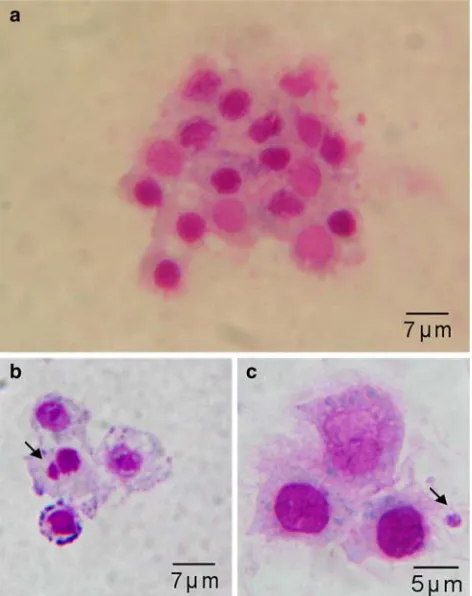
Evaluation of micronuclei
A diVerent response in frequency of micronucleated cells was observed according to the intertidal zone distribution of the species. Temperature did not produce statistically signiWcant micronuclei frequencies diVerences, except when organisms were exposed to mitomycin (Table1). Average micronuclei values of S. algosus groups exposed to low (1.17§0.75‰) and high (1.58§1.20‰) tempera-tures were higher than the mean of in situ samples (0.88§ 1.37‰). On the other hand, for B. purpuratus mean values in situ samples was 0.33§0.52 and 0.83§0.98‰ for low
and 0.17§0.41‰ high-temperatures, observing a statisti-cally signiWcant diVerence (P= 0.005) between tempera-ture treatments. The eVect of mitomycin on the frequency of micronuclei in both species at the end of the treatment was proportional to the concentrations, except at the highest concentration where frequencies diminished. With the increase of concentration of mitomycin, at 0.04£10¡6M, and of the temperature were observed the maximum micro-nuclei frequencies in S. algosus with 3.02§3.14‰ and in
B. purpuratus with 1.0§1.41‰. At the highest concentra-tion (0.06£10¡6M) of mitomycin, a reduction in the mean level of micronuclei was detected in S. algosus
(2.25§2.27‰) and in B. purpuratus (0.5§0.84‰) at 23°C. Also, the micronuclei frequency of both species var-ied signiWcantly (P= 0.008) according to the temperature exposure (Fig.2a, b).
Evaluation of nuclear abnormality
Only for B. purpuratus a signiWcant diVerence was observed between temperature treatments (P= 0.012). The maximum average values were observed at 0.04£10¡6M of mitomy-cin, with a signiWcantly diVerence between the treatments and the in situ samples (P= 0.003) (Table1). Comparing the temperature treatments in this species, the frequency of nuclear abnormalities was of 23§9.72 and 20.20§8.40‰ for 11 and 23°C, respectively, while the in situ samples showed a frequency of 9.67§5.28‰ (Fig.2c, d).
Table 1 P values of Tukey test comparing micronuclei and nuclear abnormalities frequencies according to the temperature treatments in S. algosus and B. purpuratus
SigniWcance at P< 0.05* and P< 0.005**
Treatment Micronuclei Nuclear abnormalities B. purpuratus S. algosus B. purpuratus S. algosus
In situ vs. 11°C 0.100 0.264 0.001** 0.348 In situ vs. 23°C 1.000 0.142 0.060 0.797 11°C vs. 23°C 0.005** 0.854 0.049* 0.460
Discussion
It is known thermal stress aVects the structure and func-tion of the centrosome in a negative way (Brown et al. 1996), causing chromosome damages, increment of micronuclei and delay in cell cycle progression, as was reported in the Wsh Carassius auratus exposed to high temperature (Anitha et al. 2000). In the particular case of bivalve species from the intertidal zone, organisms are exposed to a wide range of environmental changes show-ing an eYcient mechanism for DNA repair, which can explain the slight increase of micronuclei observed when both species were exposed to high and low temperatures, as it was also reported in Mytilus galloprovincialis (Maj-one et al. 1987).
The latitudinal and vertical distribution of the species is conditioned by their limits of thermal tolerance. Our results demonstrated that diVerent genetic responses under stress exist in species according to their vertical distribu-tion characterizing diVerences in habitat conditions of both species. The low frequencies of micronuclei and nuclear abnormalities observed in B. purpuratus at high tempera-ture simulating the El Niño event, suggests a better eYciency of the species from the high intertidal zone to adapt to thermal anomalies, as shown by the homogeneous response in this species. Instead, species from the low intertidal zone did not show any diVerences in response under temperature eVects with respect to the simulated conditions for El Niño and La Niña. Wrisberg et al. (1992) mentions that organisms can exhibit diVerent physiologi-cal behaviors related to the intensity of a stressor, for example the induction of valve closure in M. galloprovin-cialis. Organisms can also decrease their metabolic rate, and delay the replication rate of damaged cells, which is related to the reduction of the micronuclei formation (Anitha et al. 2000).
The heat shock impact is increased by the presence of contaminants as mutagenetic agents, producing a strong clastogenic eVect. This can explain the decrease of the micronuclei frequency observed in both species at the
Conclusions
Only B. purpuratus from the high intertidal zone showed a signiWcantly diVerent response in micronuclei and nuclear abnormalities frequencies at the two temperatures evalu-ated, indicating a better adaptation to extreme thermal con-ditions in this species. In contrast, the nuclear damage evaluated in S. algosus from the low intertidal zone did not show any signiWcant diVerence between both temperature treatments. The lack in adaptive response in this species is possibly related to less extreme changes in environmental factors in the lower intertidal area.
Acknowledgments This study was Wnanced and conducted in the frame of the FP6 EU-project CENSOR (Climate Variability and El Niño Southern Oscillation: Implications for Natural coastal Resources and Management, contract 511071) and is CENSOR publication 0316.
References
Anitha B, Chandra N, Gopinath PM, Durairaj G (2000) Genotoxicity evaluation of heat shock in gold Wsh (Carassius auratus). Mut Res 469:1–8
Brown C, Brown Q, Doxsey S, Welch W (1996) Molecular chaperones and centrosomes. J Biol Chem 271(2):833–840
Brunetti R, Gabriele M, Valerio P, Fumagalli O (1992) The micronu-cleus test: temporal pattern of baseline frequency in Mytilus galloprovincialis. Mar Ecol Prog Ser 83:75–78
Dietz T, Somero G (1992) The threshold induction temperature of the 90 kDa heat shock protein is subject to acclimatization in the eurythermal goby Wshes (genus Gillichthys). Proc Natl Acad Sci 89:3389–3393
Dixon D, Pruski A, Dixon L, NJha A (2002) Marine invertebrate eco-genotoxicology: a methodological overview. Mutagenesis 17(6):495–507
Dolcetti L, Venier P (2002) Susceptibility to genetic damage and cell types in Mediterranean mussels. Mar Env Res 54:487–491 Gosselin L, Chia F (1995) Characterizing temperate rocky shores from
the perspective of an early juvenile snail: the main threats to sur-vival of newly hatched Nucella emarginata. Mar Biol 122:625– 635
Pigliucci M (1996) How organisms respond to environmental changes: From phenotypes to molecules (and vice versa). Trends Ecol Evol 11:168–173
Przeslawski R (2004) A review of the eVects of environmental stress on embryonic development within intertidal gastropod egg mass-es. Mollus Res 24:43–63
Strunjak-Perovic I, Coz-Rakovac R, Topic-Popovic N (2003) Micro-nucleus occurrence in diploid and triploid rainbow trout (Oncorhynchus mykiss Walbaum). Vet Med 48(8):215–219
Tikhomirova M, Vatti K, Mamon L, Barabanova L, Kutskova Y (1994) Mechanisms underlying the resistance of genetic material of animal cell to stress treatment. Genetika 30(8):1097–1104 Venier P, Maron S, Canova S (1997) Detection of micronuclei in gill
cells and haemocytes of mussels exposed to benzo(a)pyrene. Mut Res 390:33–44