Helgol~inder wiss. Meeresunters. 25, 347-356 (1973)
A new method for the detection and enumeration of
manganese oxidizing and reducing microorganisms
~V r. F . K R U M B E I N ~X: H .
J.
ALTMANN':"Biologiscbe Anstalt Helgoland (Meeresstation);
Helgoland, Federal Republic of Germany
KURZFASSUNG: Eine neue Methode zum Nachweis und zur Z~ihlung von Mangan oxidie- renden und reduzierenden Mikroorganismen. Berbelinblau I (N.N'-Dimethylamino-p,p'-tri~ phenylmethan-o"-sulfons~ure) ist die Leukobase eines neuen Farbstoffes und bildet mit Mn(III)- Mn(VII)-kationen einen intensiv blau gefiirbten Farbstoff. Die Reaktion ver1~iuf~ quantitativ, indem die Leukobase (FH) zum Farbstoff (F+) oxidiert wird. Sie entwickelt sich am gtinstig- sten in Acetatpuffer. Eine intensive und schnelle Reaktion mit anwesenden Mangan-III-VII- kationen l~iufL jedoch auch im pH-Bereich zwischen 4 und pH 7 ab. Bei Verwendung yon kon- zentrierteren L/isungen yon Berbelinblau I entstehen in Anwesenheit oxidierter Stufen des Mangans gut erkennbare Farbkomponenten noch bis pH 10. Die Verwendungsf~ihigkeit des neuen Farbstoffes als Beimengung zu N~hrbSden wurde getestet. Mangan oxidierende Bakte- rien und Pilze wa&sen auf N~ihrbSden, in denen der Farbstoff in Konzentrationen zwischen 10 -4 and 10 -5 g/100 ml impr~igniert wurcle, ohne erkennbare Behinderung gegentiber nicht- behandelten N~hrbSden. Bereits frtiher als die Bildung yon schwarzbrannen Manganoxid- hydratablagerungen im N~ihrboden tritt eine Blanverf~rbung der Kolonien ein, die Mangan oxidieren. Berbelinblau I eignet sich deshalb ausgezeichnet ftir die Frtiherkennung yon Mangan oxidierenden Mikroorganismen in selektiven N~ihrbSden. Bei einem Vergleich der Benzidin- methode nach FEIaL (1958) mit dem neuen Farbstoff ergab si& ein erkennbarer Vorteil yon Berbelinblau I. Das Testreagens kann dem N~hrboden oder den Kulturen in schwa& saurem Pufer zugeftihrt werden und die Isolation yon Mikroorganismen ist nach Anf~irbung noch ohne weiteres mgglich. Kulturen und Kolonien yon Mangan reduzierenden Bakterien und Pil- zen lassen sich deutlich yon unspezifis&en Kolonien unters&eiden, wenn nach der Anfiirbung mit Berbelinblau ungefiirbte H6fe gez~ihlt werden. An& in diesem Fall ist elne Isolation ohne weiteres m/Sglich, wghrend dies bei der Verwendung yon FEIGLS Reagens in konzentrierter Essigs~iure auf Schwierigkeiten stSgt. Quantitative Bestimmung yon Mangan (und Sauerstoff tiber die Winklermethode) in N~hrbSden und bakterM1 gefiillten Manganablagerungen ist ohne weiteres m/Sgli&.
I N T R O D U C T I O N
Since first reports on manganese-oxidizing micro-organisms (MoLISCH 1910, BEIJERINCK 1913, 1915; WINOG~ADSKI 1922 and others), work on biological man- ganese metabolisation has developed considerably. Media favouring the population growth of such organisms are numerous and m a y be separated into several groups.
Autotrophic growth and reproduction of these organisms and energy gains by iron and manganese oxidation have been discussed previously (Pt~INCSHEIM 1949, MuI~I)~l~ & VAN V E ~ 1963). They need low concentrations of organic matter for growth. Growth and manganese oxidation have been controlled by occurrence of black-brown deposits on and close to the cells.
(2) Media for enumeration and enrichment of heterotrophic bacteria and fungi oxidizing or reducing manganese. These organisms have been described from various environments ~EIJeV, INCK 1913, BROMFIELD & SKERtvlAN 1950, M6SE & BtANTNER 1970, SCHW~IS~URtCH 1968). Growth and occurrence of manganese oxide deposits have been controlled by occurrence of brown deposits or by the benzidine reagent after FEIaL (1958).
(3) Media for the cultivation of manganese-oxidizing fungi which are thought to be the symbiont of
Metallogenium
(ZAv~RZlN 1964a, b, DtrBININA 1970).Isolation and description of manganese-oxldizing and reducing organisms from the marine environment has been carried out by THIEL (1925), EHt~LICH (1963), EHR- HCH et aI. (1972), KALIN~NKO et al. (1962) and KRIJMBEIN (1971). GRAHA~a & Coo- vEI~ (1959) suggest biogenic deposition o£ manganese minerals in the sea without having conducted cultivation experiments. In case of quantitative and especially qualitative determination of manganese oxidation or reduction, most of the authors have used benzidinium-chloride solution in concentrated acetic acid as suggested by FamE (1958). On several cruises with R.V. "Friedrich Heincke" in the Bay of Biscay, the Baltic Sea and the North Sea we have determined quantitative distribution of manganese- oxidizing and reducing micro-organisms heterotrophic and autotrophic bacteria in recent marine sediments. During these cruises we have frequently observed dark brown and black or blue-black to green-black pigmented bacteria and fungi falsifying results of direct reading without chemical tests. In addition, we observed weak oxidizers which give no brown-black deposits at all. The same has been reported by EHRLICtt et al. (1972). This led us to look for another suitable method for the detection of biological manganese oxidation and/or reduction.
One of us (A~'r~aAI~N 1972) synthetized a new triphenyl-compound sensitive to Mn III to Mn VII but insensitive to Mn II and other metals in trace concentrations. This reagent seemed suitable for detection and enumeration of manganese metabolising micro-organisms. Cultivation experiments in the laboratory and field trips were con- ducted to test the new reagent.
MATERIAL AND METHODS
During experiments with marine manganese-oxidizing organisms and hetero- trophic bacteria and fungi capable of reducing Mn IV-compounds, we have tested altogether 15 different media, of which the most suitable are cited below:
Manganese oxidizing and reducing microorganisms 349
(b) Manganese oxidation by marine fungi: Malt extract (Biomalz, Andreas Kg, Kirn, Germany, but other malt products should do as well), 1-2 g; MnSO4 X H~O, 100 rag; FePO4, 10 rag; Difco-Bacto-agar, 15 g; aged sea water, 750 ml; distilled water, 250 ml; pH, 6.4.
(c) Manganese-reducing micro-organisms: Peptone 2-5 g; Glucose, 2.5 g; FePO4, I0 rag; Difco-Bacto-agar, 15 g; artificial, manganese-free sea water, 1000 ml; pH, 7.6. Aider sterilisation and cooling to 48 ° C 1-1.5 ml of 2°/0 KMnO4-solution is added per 100 ml of medium prior to pouring plates.
(d) Manganese reduction by marine micro-organisms: Peptone, 2-5 g, glucose, 2.5 g, MnO2, 2-5 g (the MnO2 powder delivered by the chemical companies has to be ground sometimes to finer grain size to obtain better suspension and surface ratios); manganese-free artificial sea water, 1000 ml; pH, 7.6.
Iron phosphate was added to the media since iron is rapidly flocculated in sea water, and its addition ot-~en enhances growth of marine micro-organisms by releasing traces of iron and phosphate. All media have been tried with success also without addition of agar in shaking incubators.
Reagent: Berbelin blue-I (N.N'-Dimethylamino-p,p'-triphenyhnethane-o"-sul- phonic acid). Synthesis and specifications of the reagent are described by ALTlVIANN (•972). The reagent is available from M~:cl~oN G m b H (D-1 Berlin, Hauptstr. 76, Germany).
The leucobase of the above-mentioned triphenyl compound is oxidized in a few seconds to the colour compound in the presence of Mn I I I - M n V I I I . Mn I I and other metals do not influence the leucobase, in case of quantitative estimations of Mn or oxygen, the colour is measured for optical density at 618 nm with any commercial photometer.
The reagent may be stored in the dark at 7 ° C for several weeks before the oxi- dized form builds up on the crystal surfaces. In this case, a faint blue colour occurs on the originally white crystals. The aqueous solution is stable for more than a year if several drops of
NH4OH-solution
are added. The optical density is not influenced by acetate buffer.A concentrated stock solution of Berbelin blue-I has been prepared as follows: 4 g Leukoberbelin blue I are dissolved in 80 ml of boiled distilled water (prior to distillation the water was acidified with phosphoric acid), 0.3 ml of concentrated N H 4 O H solution are added and the solution is filled up to 100 ml. This stock solution may be stored more than a year. Reaction of Berbelin blue-I-solutions with manganese particles and solutions has been checked for different concentrations and different p H values. It must be mentioned that at high concentrations and pH-values between 5 and 10 reprecipitations may occur. For final test series with manganese media we prepared sub-solutions of 0.4 g/100 ml which were added to media in portions between 0.1 and i0 ml/100 mi of medium. For manganese tests after cultivation by addition of test reagent to the Petri dishes we used solutions from 0.2 g/100 ml to 1 g/100 ml. The test was successful between p H 3.5 and 10. The optimal results are observed at p H 4-6.
P l a t e counts w e r e m a d e before t r e a t m e n t w i t h a n y of the reagents b y c o u n t i n g colonies which s h o w e d b r o w n o r black p i g m e n t a t i o n o r precipitates.
R E S U L T S
Test series h a v e been run w i t h pure cultures of m a n g a n e s e - o x i d i z i n g fungi and b a c t e r i a i n o c u l a t e d to manganese m e d i a c o n t a i n i n g various c o n c e n t r a t i o n s of Berbe- l i n - I p r i o r to i n o c u l a t i o n and to media w i t h o u t Berbelin-I solutions. I n the l a t t e r case, results w e r e checked after 3 weeks of culture, first by c o u n t i n g b r o w n colonies t h e n by a d d i n g FEIGL'S reagent of Berbelin-I solutions.
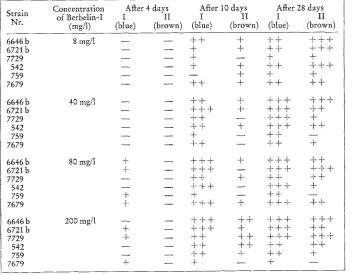
T a b l e i gives results o f t h e test series w i t h Berbelin-I solutions a d d e d p r i o r to i n o c u l a t i o n c o m p a r e d to t h e occurrence of b r o w n spots due to manganese o x i d a t i o n . A n o t h e r series of experiments was carried o u t by i n c o r p o r a t i o n of Berbelin b l u e - I solutions to media w h i & then w e r e i n o c u l a t e d by suspension dilutions of recent sedi- ments f r o m the N o r t h Sea. Results of this e x p e r i m e n t are given in T a b l e 2,
Table 1
Comparison of positive reactions after 4, 10, and 28 days of culture for different pure strains of manganese oxidizers on medium b. First column indicates degree of blue colour at the place of colonies in Berbelin-I-impregnated media. Second column indicates degree of brown- bla& manganese colours on parallel inoculates without addition of Berbelin blue-I. Number
of colonies / plate averages 5-15 colonies
Concentration APcer 4 days Aider 10 days Atier 28 days
Strain of Berbelin-I I II I II I II
Nr. (mg/1) (blue) (brown) (blue) (brown) (blue) (brown)
6646 b 8 mg/l - - - - + + + + + "-F + +
6721 b - - - - + + + + ÷ + +
7729 - - - - + - - + +
542 - - - - + + + + ~- + +
759 - - - - - - + + +
7679 - - - - + + + + + + +
40 mg/l - - - - + + + + + + + + +
_ _ - - + + + + + + + - F +
_ _ _ _ + + - - + + + +
_ _ _ _ + + + + + + + +
_ _ _ _ + - - + + - -
- - - - t - + - - + + +
80 mg/I + - - + + + + + + + + +
+ - - + + + - - + + + + + + _ _ _ _ + + + + + + + _ _ _ _ + + + - - + + + + + - - + - - + + - - + - - + + + + + + + + + _ _ _ _ + + + + + + + + + + + + - - + + + + + + + + + + - - + + + + + + + + + + _ _ _ _ + + + + + + + + _ _ _ _ + + + + + +
+ - - -F - - + - -
6646b 6721b 7729 542 759 7679 6646b 6721b 7729 542 759 7679 6646b 6721 b 7729 542 759 7679
Manganese oxidizing and reducing microorganisms
351
0
0 . ~ ~
~ o 0
o ~
' ~ ~ o o
o , ~
. ~ o ~
0 . . . ~ ° ~ ' . ~
O ~ ~ 0
. ~ ~ o ~ . ~ ~ - ~
~.o ~ ~
0 ~ ~ ~
• ~ 0 ~ ~ ~ . - ~ ~ ' ~
~ 0 0
b O ~ - ~ , , ~
o'-~ ~
o~ ~'~
. ~ - ~ :
° ~ ~ ~
0
t ~
0~
~ o ~.~
~'~
o o ~ o o
~ ~ ' ~
0 2 o 2 02
0 0 0 0 0 0
0 0 C~I
~ ~ ' ~
~ ~ 0
O4 ~
0 0
O0 r~l 0 ~
0 0 0 0
• -~ 0
0 0
~ o o
From Table I we can see that Berbelin blue-I incorporated in media reacts rapidly with traces of precipitated Mn IV compounds and as well with Mn IV or Mn I I I ions in solution. This allows faster and more exact detection than mere observation of brown-bla& deposits occurring.
Data in Table 2 indicate, that Berbelin blue-I incorporated in enrichment media allows separation of dark bacteria and fungal pigments from real manganese oxide precipitates. It should be stated, nevertheless, that heavy manganese-oxide production in the Petri dish leads, after some time, to migration of the colour and may falsify the results. Parallel tests with addition of Berbelin I solutions to the culture flasks or Petri- dishes ai°cer incubation resulted in better limited coloured zones at places of manganese
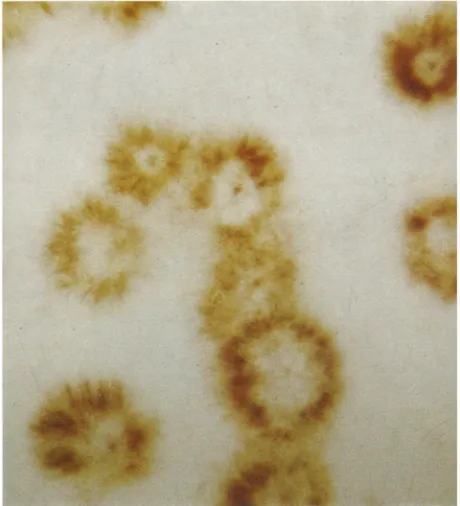
Fig. 1: Pure culture of manganese oxidizing fungus with light centers and brown deposits of manganese oxides. (Scale 1.4:1)
Manganese oxidizing and reducing microorganisms 353
Therefore, impregnation of Berbelin-I to media for enrichment of manganese-reducing organisms is not suitable.
Figures 1 and 2 give an impression of differentiation of manganese oxidizing microorganisms with and without Berbelin blue-I. Figures 1 and 2 show a pure culture of manganese oxidizing fungus before and after treatment with Berbelin blue-I. The center of fungal colonies frequently shows zones of little oxidation sometimes (mainly on media with organic manganese salts) even reducing parts. Oxidized manganese salts invisible in brown photograph will be coloured blue after treatment with reagent. Parts of the mycelium will sometimes oxidize only iron. This may be shown by micro- scopic preparations of colonies treated with reagent.
Fig. 2: Culture from Figure 1 treated with Berbelin blue-I solution. (Scale 2.1:1)
In some other experiments with fungi associated with
Metallogenium symbioticurn
the typical round spots of Metallogenium were coloured blue while fungal mycelium was brown due to iron oxidation. Treatment of microscopic slides also revealed that sometimes iron was deposited on normal mycelium while manganese oxidation took place on Clamydospores.
DISCUSSION
of tow concentrations of Berbelin blue-I to media below p H 7 and of higher concen- trations of the reagent to media with pH-values above 7 prior to incubation made direct quantitative estimation of manganese oxidizing microorganisms easier and safer than estimation of brown and black colonies. Impregnation of Berbetin blue-I solutions to media prior to or affer inoculation and cultivation makes elimination of dark pigmented colonies of bacteria and fungi possible which, without the reagent, had to be differentiated by subcultivation on media with and without Mn II sources.
Direct isolation of positive colonies is possible a&er treatment with slightly acid Berbelin-I solutions, while isolation from plates treated with F~ior's reagent was al- ways difficult or impossible due to high acetic acid concentrations. Isolation had to be completed before treating with acetic acid reagent by replica plates or another sub- culture method.
It must be noted that Berbelin blue-I solutions which have already formed the oxidized colour compound may migrate through agar plates. Therefore, it is advisable, in case of difficulties, to add the reagent only after incubation is finished or atter a certain cultivation time.
Manganese reduction by micro-organisms can be detected more easily and safely when media containing Mn VII solutions or Mn IV oxide powders are treated with Berbelin blue-I solution affer cultivation.
White halos of reducing zones around bacterial and fungal colonies are much more distinct and easier to distinguish than the disappearance of the faint brownish colour of permanganate or black particles of oxide or powdered manganese nodules.
Manganese oxidation in liquid media may be detected very fast and long before brown or black deposits are visible at the bottom of the culture flasks.
It is important to change the concentration of the reagent when p H of media is rised above 6.7. The reagent gives positive results even at p H 8-10 when higher con- centrations are applied. In this case, the blue colour may turn to blue-green. The reagent is not affected by other elements at concentrations occurring in fresh water, seawater or sediments. Care has to be taken in the case of cultural work with crushed manganese nodules, since smaII nodule particles may sometimes be taken for bacteria colonies with blue halo.
Ecological work on the distribution of manganese-oxidizing or reducing micro- organisms on board research vessels is easier and less dangerous with Berbelin blue-I solutions than with Frmr's reagent which usually gives the best results in concentrated acetic acid. Relations to manganese concentration and colour stability is better than with benzidinium. [Berbelin blue-I may also be employed for quantitative Mn deter- minations and for a modified WINKLER-oxygen method (ALTMANN 1972).1
Manganese oxidizing and reducing microorganisms 355 S U M M A R Y
1. Berbelin blue-I (N.N.'-Dimethylamino-p, p'-triphenylmethane-o'-sulphonic acid) has been examined as a reagent for the detection of manganese oxidation and man- ganese reduction in microbial culture media.
2. Berbelin blue in slightly acid solution may be added to media without influencing population growth of micro-organisms. The oxidation of Mn I I solutions to Mn I I I and IV is detected by occurrence of deep blue colours.
3. In case of long-term culture experiments, it is more advisable to add Berbelin blue-I solutions only a&er cultivation.
4. Berbelin blue-I solutions react with manganese IV V I I in p H ranges between 3.5 and 10, thus allowing tests at desired p H values.
5. Reduction of manganese V I I or manganese IV by micro-organisms may be detected by addition of Berbelin blue-I solutions aider cultivation periods. White halos within dark-blue coloured media indicate reduction of M n - I V compounds better than occurrence of white spots in slightly violet or grey media, as produced by the incorporation of manganese oxides or permanganate solutions to test media. 6. Ecological work and quantitative work on board research vessels is much easier
and less dangerous with Berbelin-I solutions than with FEIGL'S Benzidinium reagent. 7. BerbeIin blue-I m a y be used for quantitative determination of manganese and oxygen when measuring optical density of the colour complex at 618 nm in wide concentration ranges and working in acetate buffer.
L I T E R A T U R E C I T E D
ALTMANN, H. J., 1972. Bestimmung yon in Wasser gel6stem Sauerstoff mit Leukoberbelinblau I. Eine schnelle Winklermethode. Z. analyt. Chem. 262, 97-99.
BEIJ~RINCK, M.W., t913. Oxydation des Manganbikarbonats durch Bakterien und Pilze. Folia microbioI., Delf~ 2, 123-134.
BRO~HELD, S. M. & St~:~MA~, V. B. D., 1950. Biological oxidation of manganese in soils. Soil Sci. 69, 337-348.
DtJBINmA, G. A., 1970. Untersuchungen tiber die Morphologie yon
Metallogenium
und die Be- ziehungen zuMycoplasma.
Z. allg. Mikrobiol. 10, 309-320.EHRLIC~, H. L., 1963. Bacteriology of manganese nodules. I. Bacterial action on manganese in nodule enrichments. App1. Microbiol. 11, 15-19.
- - GmORSE, W. C. & JOHNSON, G. L., 1972. Distribution of microbes in manganese nodules from the atlantic and pacific oceans. Dev. ind. Microbiol. 13, 57-65.
FEIGL, F., 1958. Spot tests in inorganic analysis. Elsevier, Amsterdam, 600 pp.
GRAHAM, J. W. & Coov~R, S., 1959. Biological origin of manganese rich deposits of the sea floor. Nature, Lond. 183, 1050-1051.
KALmEN~O, V. O., BELO~OVYTOVA, O. V. & NIXOLAJEVA, G. G., 1962. Bacteriogenic forma- tion of iron-manganese concretions in the Indic Ocean. Okeanologiya 11, 1050-1059. K~UMBEIN, W. E., 1971. Manganese oxidizing fungi and bacteria in recent shelf sediments.
Naturwissenschai~en 88, 56-57.
M6SE, J. R. & BRANTNER, H., 1970. Untersuchungen zur Biologischen Eisen- und Mangan- oxidation. Zentbl. Bakt. Parasitkde (Abt. 2) 124, 412-426.
MULDER, E. G. &VEEN, W. L. VAN, 1963. Investigations on the Sphaerotilus-Leptothrix group. Antonie van Leeuwenhoek 29, 121-153.
PRINGSHEIM, E. G., 1949. Iron bacteria. Biol. Rev. 24, 200-245.
SCHW~ISrUt~TH, R., 1968. Untersuchungen iiber manganoxydierende und reduzierende Mikro- organismen. Mitt. int. Verein. theor, angew. Limnol. 14, 179-186.
THIEL, G. A., 1925. Manganese precipitated by microorganisms. Econ. Geol. 20, 301-310. ~VINOGRADSKI, S., 1922. Eisenbakterien als Anorgoxydanten. Zentbl. Bakt. Parasitkde. (Abt. 2)
57, 1-21.
ZAvAI~zm, G. A., 1964a. The mechanism of manganese deposition on mollusc shells. Dokl. Akad. Nauk SSSR 154, 944-945.
- - 1964b.
Metallogeniurn symbioticum.
Z. allg. MiKrobiol. 4, 390-395. First author's address: Dr. W. E. KRUMBEINBiologlsche Anstalt Helgoland (Meeresstation)
2192 Helgoland