Open Access
Study protocol
WHEDA study: Effectiveness of occupational therapy at
home for older people with dementia and their caregivers - the
design of a pragmatic randomised controlled trial evaluating a
Dutch programme in seven German centres
Sebastian Voigt-Radloff*
1, Maud Graff
†2, Rainer Leonhart
†3,
Katrin Schornstein
†3, Myrra Vernooij-Dassen
†4, Marcel Olde-Rikkert
†5and
Michael Huell
†6Address: 1Department of Occupational Therapy, Centre of Geriatric Medicine and Gerontology Freiburg, University Hospital Freiburg, Germany, 2Alzheimer Centre Nijmegen, Scientific Institute for Quality in Health Care, Rehabilitation-Occupational Therapy, Radboud University Medical Centre Nijmegen, The Netherlands, 3University of Freiburg, Department of Social Psychology and Methodology, Germany, 4Alzheimer Centre Nijmegen, Scientific Institute for Quality in Health Care, Radboud University Medical Centre Nijmegen, The Netherlands, 5Alzheimer Centre Nijmegen, Department of Geriatrics, Radboud University Medical Centre Nijmegen, The Netherlands and 6Centre of Geriatric Medicine and Gerontology Freiburg, University Hospital Freiburg, Germany
Email: Sebastian Voigt-Radloff* - [email protected]; Maud Graff - [email protected];
Rainer Leonhart - [email protected]; Katrin Schornstein - [email protected]; Myrra Vernooij-Dassen - [email protected]; Marcel Olde-Rikkert - [email protected]; Michael Huell - [email protected]
* Corresponding author †Equal contributors
Abstract
Background: A recent Dutch mono-centre randomised controlled trial has shown that occupational therapy improves daily functioning in dementia. The aim of this present study is to compare the effects of the Dutch community occupational therapy programme with a community occupational therapy consultation on daily functioning in older people with mild or moderate dementia and their primary caregivers in a German multi-centre context.
Methods/Design: A multi-centre single blind randomised controlled trial design is being used in seven health care centres (neurological, psychiatric and for older people) in urban regions. Patients are 1:1 randomised to treatment or control group. Assessors are blind to group assignment and perform measurements on both groups at baseline, directly after intervention at 6 weeks and at 16, 26 and 52 weeks follow-up. A sample of 140 community dwelling older people (aged >65 years) with mild or moderate dementia and their primary caregivers is planned. The experimental intervention consists of an evidence-based community occupational therapy programme including 10 sessions occupational therapy at home. The control intervention consists of one community occupational therapy consultation based on information material of the Alzheimer Society. Providers of both interventions are occupational therapists experienced in treatment of cognitively impaired older people and trained in both programmes. 'Community' indicates that occupational therapy intervention occurs in the person's own home. The primary outcome is patients' daily functioning assessed with the performance scale of the Interview for Deterioration in Daily Living Activities in Dementia and video tapes of daily activities rated by external raters blind to group
Published: 2 October 2009
BMC Geriatrics 2009, 9:44 doi:10.1186/1471-2318-9-44
Received: 8 September 2009 Accepted: 2 October 2009
This article is available from: http://www.biomedcentral.com/1471-2318/9/44 © 2009 Voigt-Radloff et al; licensee BioMed Central Ltd.
assignment using the Perceive, Recall, Plan and Perform System of Task Analysis. Secondary outcomes are patients' and caregivers' quality of life, mood and satisfaction with treatment; the caregiver's sense of competence, caregiver's diary (medication, resource utilisation, time of informal care); and the incidence of long-term institutionalisation. Process evaluation is performed by questionnaires and focus group discussion.
Discussion: The transfer from the Dutch mono-centre design to the pragmatic multi-site trial in a German context implicates several changes in design issues including differences in recruitment time, training of interventionists and active control group treatment.
The study is registered under DRKS00000053 at the German register of clinical trials, which is connected to the International Clinical Trials Registry Platform.
Background
Dementia is a progressive, irreversible neurodegenerative disorder. The main symptoms are decline of memory and other cognitive functions associated with deterioration in daily functioning [1]. Several types of dementia are differ-entiated by aetiology including 72% Alzheimer, 16% vas-cular and 11% other types [2]. In the year 2000, there were 7.1 million people with dementia and 493 million per-sons of working-age [3] within Europe. Age is associated with increasing prevalence [4] with rates estimated at 6% in people aged over 65 and 30% in the over 80s [5]. Inci-dence rates range from 1.4% [6] to 3.2% [7]. Wancata and colleagues [3] predict the number of people with demen-tia in Europe to be 16 million or above in the year 2050. Bickel [8] estimates these numbers for Germany at 1.2 million in 2010, 1.7 million in 2020 and 2.3 million in 2050. In Germany, more than two thirds of people with dementia are women. 50% of community dwelling peo-ple with need of nursing care suffer from dementia. The disease constitutes the main cause of admission to long-term nursing homes with 60% of nursing home residents being affected by dementia. However, in Germany the majority of people with dementia (60%) live in the com-munity and receive care by family members [9].
Direct costs of dementia in the year 2003 were estimated at 156 billion USD worldwide and 60.5 billion USD in the EU-25 region [10]. Direct costs in Germany amount to 5.6 billion Euros in the year 2002, including the major part of 3.6 billion Euros for dementia care in nursing homes [11]. Considering direct and indirect costs in Ger-many, Hallauer et al. [12] calculated dementia costs of 43,767 Euros per year and per patient, divided into 2.5% medical costs (medication, consultation, hospital stays), 29.6% nursing care costs and 67.9% costs borne by the patients' families. International studies demonstrate sim-ilar results and confirm the fact that family caregivers bear the main burden of dementia [13,14].
Deficits in daily functioning are used as threshold criteria in standardized diagnostic procedure [15,16]. Within the progress of disablement, cognitive decline leads to limita-tions in activities of daily living, which often affect the quality of life of patient and caregiver [17]. The new Inter-national Classification of Functioning, Disability and Health [18] is based on the bio-psycho-social model of health and consequently assumes that the negative impact of cognitive deficits on activities can be diminished by improving facilitation in the patients' physical and social environment. The task performance of people with dementia can be improved by reducing distraction and arranging clear structures in the physical environment [19]. Research on caregiver interventions provides evi-dence that those educational and psychosocial approaches targeting at the optimisation of the social environment delay nursing home placement [20-22]. Tai-loring the activity to patients' capability may enhance activity engagement and reduce challenging behaviour [23].
A Dutch intervention programme in dementia care sys-tematically integrated environmental adaptations, sup-port of caregivers as well as selecting and tailoring everyday activities with regard to patients' occupational preference and cognitive abilities [24]. This programme demonstrated positive impacts on patients' daily func-tioning, caregivers' sense of competence in interaction with the patient, on quality of life and mood of both and on costs of dementia care [25-28].
Methods
Design
In this pragmatic non-pharmacological intervention trial, a randomised controlled design is being used in seven health care centres and has the following research aims:
Primary outcome
To compare the effects of a community occupational therapy programme (COTP) with a community occu-pational therapy consultation (COTC) on daily func-tioning of older people with dementia.
Secondary outcomes
• To evaluate the effectiveness of the COTP on patients' and caregivers' quality of life, mood and sat-isfaction with treatment and on caregivers' sense of competence and hours of care compared to those hav-ing a COTC.
• To evaluate the cost of both interventions from a societal perspective.
The intervention group receives ten sessions of occupa-tional therapy during five weeks of one hour duration. The control group receives one home consultation of one hour duration by an occupational therapist within the same period. Measurements for both groups are at base-line before intervention (week 0), after intervention (week 6) and at follow-up (week 16, 26 and 52). Measure-ments of cognitive decline are applied one week before baseline and at week 11 and week 21 after baseline.
Participants
The seven participating centres are located throughout Germany in urban regions. The catchment areas of the centres vary from about 70,000 to 700,000 inhabitants. Five outpatient memory centres are participating and are departments of university hospitals (one neurological clinic, two psychiatric clinics and two geriatric centres). One centre is part of a municipal hospital specialising in geriatric medicine. The seventh centre, a neurological pri-vate practice, collaborates with an occupational therapy private practice. The WHEDA study centres have several years of experience in providing outpatient dementia care ranging from three to fifteen years. Their standard service comprises diagnostic work-up for dementia and related diagnoses as well as recommendation of risk reduction, dementia medication and non-pharmacological treat-ments. Study leaders of the centres are medical specialists (psychiatrists, neurologists or geriatricians) with six to thirteen years of experience in dementia care. The occupa-tional therapists and assessors involved in the study have a minimum of one year's professional experience with older people or those who are cognitively impaired. The
assessors' professions are physician, psychologist, occupa-tional therapist and nurse.
The inclusion criteria are as follows:
▪ Mild to moderate dementia of the type Alzheimer's
disease or mixed type diagnosed according to ICD-10 by physicians who are geriatric or geronto-psychiatric specialists with more than five years of experience. Diagnosis usually included lab investigations and CT or MRI scan of the brain.
▪ Mini Mental State Examination (MMSE [32]) ranging
from 14 to 24.
▪ People dwelling at home either together with their
primary caregiver or the primary caregiver provides care at least twice a week.
The exclusion criteria are:
▪ A score on the 30-items Geriatric Depression Scale is > 12.
▪ The people are in major need of nursing care (level 2 and 3. In Germany special physicians and nurses involved in allocation of sickness funds have the legal mandate to evaluate the need of nursing care accord-ing to criteria determined by law. They assign a patient to one of four levels: 0 = best, no need, 3 = worst, severe need [33]).
▪ Unstable medical conditions or severe behavioural
disturbances, which do not allow participation in the study as judged by the physicians of the study centres.
Discontinuation criteria:
▪ Death of patient or primary caregiver
▪ Patient is admitted to a nursing home
▪ Development of unstable medical conditions or
severe behavioural disturbances as assessed by the physicians of the study centres
Registration and ethical considerations
Number 110/08. The study was considered as a therapeu-tic intervention to be carried out in subjects, whose capa-bilities to consent might not be possible every time. Therefore, and because the proxy caregivers are also inter-viewed, it was proposed that double written consent was given, ie. both from person with dementia and his/her caregiver.
Recruitment
A leaflet with consistent and consumer-friendly informa-tion about the WHEDA study was prepared for the recruit-ment procedure. The recruitrecruit-ment period lasted nine months, from August 2008 to April 2009. Former and cur-rent patients of the participating centres with mild to moderate dementia were informed about the WHEDA study during a routine visit at the study centre or via an invitation letter. General practitioners and medical spe-cialists who usually cooperate with the centres received information about the WHEDA study via mail, e-mail or telephone. Community nursing and dementia care serv-ices also received information letters or a telephone call. Several centres published information via the local press.
A meeting was arranged at each centre for eligible patients and their primary caregivers together in order to receive verbal and written information from the study physician about the study protocol. This included the contents of the two occupational therapy interventions, the randomi-sation procedures and the kind and duration of measure-ments. Within this, or at a further visit, the study physician received written informed consent and full agreement with the contents and procedures of the study from both patients and primary caregivers. This was essen-tial before allowing participation in the study.
Comparison with 'usual' dementia care
The characteristic of the study design, inclusion and exclu-sion criteria as well as participating centres and recruit-ment processes were determined in such a way, to assure that the study sample and procedures are approximately congruent with the structures and processes of usual dementia care in Germany. For this and other reasons, the design of the WHEDA study differs from the original Dutch trial. There is a higher number of participating cen-tres and therapists; less years of experience of the thera-pists; as well as the inclusion of an active control treatment arm, a longer follow up period and study sites other than university centres.
The Intervention Group (COTP)
Intervention group participants receive COTP with ten sessions of one hour duration held over five weeks. The intervention aims at the improvement of daily function-ing of both the patients and their primary caregivers. The treatment of the patient focuses on enabling the successful performance of highly meaningful daily activities.
There-fore, the occupational therapist explores the patient's pref-erences and history of activities using the one hour Occupational Performance History Interview [34]. In the second session, the occupational therapist observes the patient's ability to perform relevant daily activities and to use compensatory strategies within his/her familiar envi-ronment and then evaluates the possibility of modifying the patient's home and surroundings if necessary.
The intervention focus for the caregiver is on enhance-ment of successful interaction with the person with dementia by improving the caregiver's skills in communi-cation, supervision and problem solving. In addition, the caregiver is supported in caring for his own wellbeing by enabling meaningful and recreational daily activities. Therefore, the occupational therapist explores the car-egiver's preferences of activities using the one hour Ethno-graphic Interview [35]. He/she also observes the interaction between caregiver and patient.
After three or four sessions of interviews and observation in the familiar surroundings, the occupational therapist summarizes the meaningful activities that were named in both the interviews with the patient and the caregiver. Patient and caregiver together prioritise the proposed activities. In discussion with the occupational therapist, they identify those which are
• most meaningful and motivating for the patient (patient's perspective)
• most helpful or recreational for the caregiver (car-egiver's perspective)
• most promising to be adapted and stabilised as activ-ities that the patient and caregiver can perform suc-cessfully in the future (occupational therapist's perspective)
included a literature review, theoretical modelling, an advisor panel of international experts, draft manuals, pilot testing in practice, case study analyses, pilot study and an RCT on effectiveness and on cost-effectiveness [25-28,36]. For the WHEDA study, the Dutch manual was translated into German. The main author (Maud Graff, MG) taught the content of this manual to 14 study thera-pists from seven centres in 16 hours of seminars. Seminar methods included presentation, videos and role play with feedback and group discussion. The study therapists had to have at least one year of professional experience in the treatment of older persons with cognitive impairments. Within the pilot phase after the seminars, every therapist had to treat at least one patient with a full treatment series of ten sessions. The therapist also had to provide a video-tape of one key session (interview with patient or car-egiver or shared goal finding session) and a quality report reflecting on the whole series. Videotapes were evaluated by MG and quality reports by the study manager, Sebas-tian Voigt-Radloff (SVR). The expenditure of time for the seminars and learning on the job within the pilot phase was about 40 hours per therapist while in the Netherlands it was 80 hours including more skill training, learning on the job and feedback.
The following arrangements were provided to enhance and evaluate the adherence of the therapists to the man-ual:
• A mailing list for e-mail exchange of all study thera-pists and the study manager.
• On-call telephone coaching by SVR for the thera-pists.
• Therapy evaluation form for every treatment case, where therapists assess their adherence to the manual and describe their problems within the eleven differ-ent intervdiffer-ention steps.
• Questionnaire, by which therapists retrospectively evaluate the whole intervention phase after it is fin-ished.
• The study protocol demands adherence to the stand-ard procedures of the manual. However, a therapist may deviate from the manual in cases, where strict adherence would lead to any harm to patient or car-egiver; if very poor motivation; or to withdrawal. The deviation must be reported on the therapy evaluation form. In general, the manual sets standards for the procedures, but an inherent part of the treatment is the individualised tailoring of activities to patients' and to caregivers' preferences and abilities. The demands for adherence and rules for exceptions do not differ between centres, therapists or participants.
In Germany, a series of ten home visits is within the nor-mal range of time that occupational therapists use for the treatment of older outpatients diagnosed with other dis-eases, such as stroke or rheumatoid arthritis. A directive governs the service delivery and utilisation of occupa-tional therapy in German private practices. It gives per-mission to do home visits, but they are not often used. No additional legal or organisational structures are being added for the new intervention programme. However, home visits of occupational therapists working with peo-ple with dementia are not established yet due to the lack of evidence-based interventions in Germany. A seminar and learning time of 40 hours is quite common in the field of occupational therapy, in order to implement an innovative intervention.
Control Group
The patients and care givers in the control group, together receive one COTC of one hour's duration by the same study therapists who carry out the treatment intervention. The visit is not time-matched to the intervention group. The control intervention is carried out as a semi-structured consultation, half is an explanation using a brochure; and half is a talk on individual problems in everyday life. Two occupational therapists with a high level of experience in dementia care prepared the brochure of ten pages espe-cially for the WHEDA control intervention. It is based on two brochures of the German Alzheimer Society [37,38]. During a three hour session, SVR taught the WHEDA ther-apists the content of the control intervention, using pres-entations and role plays. Within the pilot phase, the study therapists of each centre have had to collect contact data of dementia care services in their region and add it to the brochure, which is then given to caregivers and patients during the home consultation. Furthermore they are obliged to carry out one full pilot COTC and write a qual-ity report on problems and facilitation of this consulta-tion visit. SVR evaluates this quality report. The protocol of the control intervention was determined as follows:
• 10 minute warm-up phase including the welcome and introduction of the scope and purpose of the con-sultation;
• 20 minute structured explanation of how patients and caregivers may deal with the consequences of dementia in every day life;
The outcome for the patient is to:
ⴰ stay active, undertaking usual everyday activities
ⴰ keep social contacts
ⴰ support patient, but not to make him/her inac-tive;
ⴰ take time for self;
ⴰ keep social contacts and look for support for self;
ⴰ discuss what a successful interaction with the
patient may look like, especially when challenging behaviour occurs;
ⴰ use data of local dementia care services such as day care clinics, caregiver or dementia outpatient groups, outpatient nursing care, home help or occupational therapy private practices.
• 25 minute talk on individual problems that arise from the patients' and the caregivers' needs;
• 5 minute completion and farewell.
The focus of the control intervention is on the encourage-ment to stay active in everyday life, keep social contacts and use resources within the environment.
The same arrangements as in the intervention group are provided to enhance and evaluate the therapists' adher-ence to the structure and procedure of the introduction to the control group. The control group protocol leaves the occasional decision to the therapist, whether the 20 minute block with structured explanations is to be timed before, after or in between, the talk on individual prob-lems. Problems and deviations from protocol must be documented in the therapy evaluation form. Rules of pro-cedures and exceptions apply to therapists of all study cen-tres in the same way.
Consultations of 30 minutes up to one hour duration are common in German dementia care. However, social workers, physicians or special nurses mainly give advice on local care services, on progress and medication in dementia and on nursing care problems. The focus on occupational therapy and everyday activities is innovative, but needs no additional resources.
Objectives
The aim of this study was to compare the effects of the COTP and the COTC on functioning in everyday life of people with mild or moderate dementia and their primary caregivers within a German routine care context. The null hypothesis is that there is no significant difference between the intervention group and the control group. The significance for rejecting this hypothesis will be tested two-sided. The secondary research questions are as fol-lows:
• Impact of COTP and COTC on the:
ⴰ quality of life of patients and caregivers
ⴰ mood of patients and caregivers
ⴰ caregivers' competence in the interaction with the patients
ⴰ utilisation of resources for patients and caregivers
ⴰ time of informal care given by the primary
car-egivers
• Costs and feasibility of COTP and COTC
• Patients' and caregivers' acceptance and satisfaction with COTP and COTC
• Incidence of admissions to long-term nursing care homes one year after baseline
Outcomes
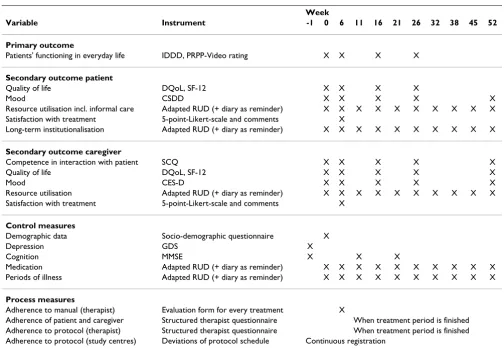
The primary endpoint is the comparison between the intervention group and control group in the change in daily functioning from baseline to follow-up as indicated by the Interview for Deterioration in Daily Living Activi-ties in Dementia (IDDD) over three post intervention time points. The WHEDA measurement scheme with dependent variables and measurement instruments is provided in table 1. The primary and most secondary out-comes are oriented to patient and caregiver. Daily func-tioning, quality of life, mood and daily interaction are directly related to individual everyday life and represent the user's perspective in most self- and proxy-assessments used in the WHEDA study. It is of great importance to know how long a therapeutic approach may stabilise daily functioning after the intervention is finished. The cogni-tive decline in dementia is a strain on patients and caregiv-ers. Its progress varies, but major and consistent changes are mostly not observable before a half year progress of disease. Consequently, the follow-up assessments are appointed at week 16 and 26 after baseline. In order to justify a potential implementation in practice, service pro-viders as well as political and economical decision-makers within the health care system need trustworthy evidence about an innovative intervention. Hence feasibility, acceptance and costs of active and control treatment are additional outcomes of the WHEDA study.
• An 8 hour seminar trains the study assessors in inter-viewing patients, taking videotapes of patients' every-day activities, handing over questionnaires to caregivers and checking completed forms for com-pleteness and plausibility.
• The main assessor of every study centre performs two pilot assessments including videotaping and his/her deputy performs one assessment.
• All questionnaires and video tapes of pilot assess-ments and, additionally, a quality report reflecting problems and facilitation within this pilot phase, are sent to the WHEDA-headquarters. Video tapes are evaluated by a rating specialist for the Perceive, Recall, Plan and Perform System of Task Analysis (PRPP) and
questionnaires and quality reports by SVR. A positive rating of all pilot material is required, in order to achieve approval for starting the study.
• The 'blind' raters of the videos give feedback on visi-bility and appropriateness of instructions on every tape. Based on this feedback, the WHEDA headquar-ters gives assessors recommendations for the improve-ment of videotaping in case the visibility or instructions are lower than the defined quality level.
• A mailing list for an online exchange of study asses-sors has been established.
• Any problem with assessment arising during the study is added to the problem solving list. Problems
Table 1: WHEDA measurement scheme
Week
Variable Instrument -1 0 6 11 16 21 26 32 38 45 52
Primary outcome
Patients' functioning in everyday life IDDD, PRPP-Video rating X X X X
Secondary outcome patient
Quality of life DQoL, SF-12 X X X X
Mood CSDD X X X X X
Resource utilisation incl. informal care Adapted RUD (+ diary as reminder) X X X X X X X X X X Satisfaction with treatment 5-point-Likert-scale and comments X
Long-term institutionalisation Adapted RUD (+ diary as reminder) X X X X X X X X X X
Secondary outcome caregiver
Competence in interaction with patient SCQ X X X X X Quality of life DQoL, SF-12 X X X X X
Mood CES-D X X X X X
Resource utilisation Adapted RUD (+ diary as reminder) X X X X X X X X X X Satisfaction with treatment 5-point-Likert-scale and comments X
Control measures
Demographic data Socio-demographic questionnaire X Depression GDS X
Cognition MMSE X X X
Medication Adapted RUD (+ diary as reminder) X X X X X X X X X X Periods of illness Adapted RUD (+ diary as reminder) X X X X X X X X X X
Process measures
Adherence to manual (therapist) Evaluation form for every treatment X
Adherence of patient and caregiver Structured therapist questionnaire When treatment period is finished Adherence to protocol (therapist) Structured therapist questionnaire When treatment period is finished Adherence to protocol (study centres) Deviations of protocol schedule Continuous registration
IDDD = Interview of Deterioration in Daily Living Activities in Dementia PRPP = Perceive, Recall, Plan and Perform System of Task Analysis DQoL = Dementia Quality of Life Instrument
SF-12 = Short Form of the SF-36 measuring health-status CSDD = Cornell Scale for Depression in Dementia RUD = Resource Utilization in Dementia
SCQ = Sense of Competence Questionnaire CES-D = Center for Epidemiologic Depression Scale GDS = Geriatric Depression Scale
are promptly analysed and instructions for problem solving are given by SVR via this list, which is sent out to the study centres as soon as a new item is added.
Primary outcome measures
• The Interview of Deterioration in Daily Living Activ-ities in Dementia (IDDD [39]) consists of two scales recording the caregivers' rating of patients' initiative and performance of daily living activities. The Initiative Scale measures the initiative for (1) washing oneself, (2) making tea or coffee, (3) dressing, (4) combing one's hair and brushing one's teeth, (5) shopping, (6) using the phone, (7) preparing a meal, (8) cleaning the house or doing minor repair work and (9) han-dling finances. The Performance Scale records the need of assistance in the performance of the same nine activities plus eating and using the toilet. Both domains of the IDDD are constructed as five-point-Likert-scales with the ratings never = 4, seldom = 3, sometimes = 2, often = 1, always = 0 in the Initiative Scale and values vice versa in the Performance Scale. Scores of the Initiative Scale range from 0 to 36 (higher scores indicate less initiative). The Performance Score
ranges from 0 to 44 (higher scores indicate higher need for assistance). In a Spanish sample of 451 per-sons, the IDDD demonstrated great internal consist-ency (Cronbach's alpha = .99), reproducibility (intraclass correlation coefficient ICC = .94) and sig-nificant differences between groups of patients with mild cognitive impairment and patients with demen-tia [40]. In a Dutch sample of 25 primary and second-ary caregiver pairs, the IDDD interrater reliability was high (ICC: .85 for the Initiative Scale and .74 for the
Performance Scale, [39]). Within the Dutch original study the Performance Scale demonstrated a very high responsiveness by indicating clinically relevant improvement in 78% of cases in the intervention group and 12% of cases in the control group 6 weeks after baseline and 82% and 10% respective after 12 weeks [26].
• With the Perceive, Recall, Plan and Perform System of Task Analysis (PRPP) occupational therapists evalu-ate a usual daily activity as performed by the patient as well as the impact of the cognitive performance com-ponent on this performance [41]. In the first of two assessment stages, the rater defines single steps of the performed activity to be analysed and identifies any activity step in which errors of accuracy, omission, rep-etition or timing occur. The number of activity steps rated as incorrectly performed is divided by the total number of activity steps, resulting in an independ-ence-score indicated in percent (100% = all steps are error-free). In the second stage, the therapist rates 34 items of observable behaviour representing the
patients' use of information processing strategies while performing the activity. On the three-point-Lik-ert-scale the value 1 indicates incomplete or non-timely or jeopardising task performance or the need of significant assistance. Value 2 indicates a complete and non-jeopardising task performance but with problems in timing and possible need of assistance. Value 3 indicates a complete, timely and non-jeopard-ising task performance without any need of assistance. The 34 unweighted items are summed up by four main scales Perceive, Recall, Plan and Perform each with three subscales and a PRPP global processing score ranging from 35 to 103 (higher scores denotes better performance). The PRPP-System was systemati-cally developed over the last 12 years including the fol-lowing steps and results [41]:
ⴰ Content validity was shown in a comparative
analysis of the same activities of daily living in a sample of 25 healthy adults and a sample of 20 persons with brain injury. Variations of individual performance but no errors occurred within the healthy sample whereas clearly observable errors within the sample with brain injury could be cata-logued in the four main categories accuracy, omis-sion, repetition or timing. Interrater agreement of six raters was high (>90%) for both samples.
ⴰ A microanalysis of more than 4000 errors
occur-ring in the performance of dressing, eating and grooming of 45 patients with brain injury revealed four broad errors types in cognitive processes of perceiving, recalling, planning and performing. Error analyses in subsequent investigations of other samples led to a stable pattern of 34 items which describe observable behaviour.
ⴰ Aubin et al. [42] found moderate indicators for
the construct validity of the PRPP in a small sam-ple of 10 adults with schizophrenia. The scores of the PRPP total and three of four scales differed sig-nificantly comparing a simple and a complex
activ-ity of meal preparing (p ≤ .01). The correlation
between PRPP global score on the complex task and the Independent Living Skills Survey [43] was moderate (r = .67, p = .03).
ⴰ Interrater reliability of three raters in a sample of 15 adults with schizophrenia was moderate (ICC:
PRPP total .77, Perceive .65, Recall .65, Plan .69, Per-form .63 [42]). An investigation of interrater relia-bility of nine raters in a sample of five adults with brain injury and symptoms of agitation and confu-sion demonstrated similar results (ICC: PRPP total
[44]. Nott and colleagues (2008) found fair test-retest reliability and high internal consistency (ICC > .8).
ⴰ A high responsiveness of the instrument was indi-cated by significant improvement and large treat-ment effects as measured by the PRPP in seven adults with post-traumatic amnesia and symptoms of agitation [45].
Within the WHEDA-study, videotapes of two activities familiar to the patient and chosen out of a list of 28 defined activities of daily living are scored with the PRPP. Less and more difficult variations are described for every activity and can be applied according to the patient's cog-nitive ability. The WHEDA assessors must document the variant, which is noted at the first measurement time point and initiate and tape this variant at the follow up measurements.
Secondary outcome measure
• The Dementia Quality of Life Instrument (DQoL) is a 30-item self-assessment. 5 subscales and one global item are assessed with a five-point-Likert-scale: positive affect (6 items), negative affect (11 items), feelings of belonging (3 items), self-esteem (4 items), and sense of aesthetics (5 items). The ranges of scores differ from scale to scale (from 5-15 to 5-55). Higher scores indi-cate better quality of life, except in the subscale nega-tive affect. The DQoL was developed specifically to be completed by people with dementia. The develop-ment process included consultation with people with dementia, caregivers, and professional care providers. In an American sample, 96% of 99 people with dementia (MMSE > = 13) were able to respond to questions appropriately [46]. This study revealed moderate to high internal consistency (.67 - .89) and a good two-week test-retest reliability (.64 - .90). There were no significant differences between patient groups with mild (MMSE > 17) and moderate (MMSE < = 17) dementia severity in terms of scale reliability. Correla-tion of DQol subscales and the Geriatric Depression Scale ranged from -.42 to -.64. A Japanese study repli-cated similar results for understanding, internal con-sistency and convergent validity at baseline and in a one year follow up. The sample consisted of 72 people with dementia with MMSE score > = 13 [47,48]. In a British study on longitudinal change in quality of life, 60% of people with a MMSE of 10 could complete the DQoL [49]. In an American study with 67 patients diagnosed with mild cognitive impairment or mild Alzheimer's disease, a three-factor solution emerged reliably from factor analyses corresponding to positive affect, negative affect and aesthetics. This DQoL factor structure was nearly identical between ratings of
patient and caregiver [50]. Within the WHEDA study, the DQoL is applied to primary caregivers as self-assessment. With the patients, it is performed as an interview, in order to ensure the validity of rating. Patients are asked to answer three screening questions and data will not be collected, if more than one answer is missing.
• The SF-12 is the reduced version of the SF-36, a generic self-assessment evaluating health status and disability. The instrument generates a mental and a physical component summary score from 12 weighted items with response categories varying from dichoto-mous, to six-point scales using a complex algorithm based on norm data of a major American sample. Higher scores indicate better health status. Metric properties are excellent [51] and German norm data are available [52]. The instrument supports the calcu-lation of Quality Adjusted Life Years (QALY). The SF-12 has been applied to people with dementia recently [53] and to caregivers [54]. The SF-12 appears to iden-tify under-reported mental health problems in demen-tia caregivers [54]. In addition, this assessment tool seems to be appropriate for the evaluation of health-related quality of life from both the caregiver's and the patient's perspective. Arlt and colleagues [53] found that family caregivers tend to rate the patient's health-related quality of life lower than the person with dementia him/herself. For that reason the SF-12 is applied in the WHEDA-study to both the caregiver and the patient. In order to ensure quality of patients' data, the WHEDA-assessor applies the SF-12 as an interview to the patient and checks his/her understanding by means of the DQoL screening questions.
• In the Sense of Competence Questionnaire (SCQ [55]), caregivers rate their agreement with 27 state-ments on the experience of caregiving on a five-point-Likert-scale (from agree very strongly to disagree very strongly). The SCQ records three domains: Conse-quences of involvement in care for the personal life of the caregiver (8 items), satisfaction with one's own perform-ance as a caregiver (12 items) and satisfaction with the person with dementia as a recipient of care (7 items). Scores range from 27 to 135 (higher scores denote a greater sense of competence). The three domains of the SCQ and its internal consistency are confirmed in validation studies involving people with stroke and dementia (variance explained by three factors: 49% respective 42%, Cronbach's alpha: .68 - .77, .83 - .85 respectively [56,57].
dementia [27,59-62]. Caregivers rate the occurrence of 20 symptoms on a four-point Likert Scale (from seldom
to mostly). Scores range from 0-60, lower scores indi-cate less depressive indicators. Robust metric proper-ties of the CES-D are established [63]. Correlations with Hamilton Depression Scale and Becks Depres-sion Inventory are moderate to high (.49 to .94). Sen-sitivity to change in individuals within samples treated with anti-depressive drugs was significant (.0001 to .0004). Cronbach's alpha of .89 indicates high inter-nal consistency. In the WHEDA study, the CES-D is applied as self-assessment.
• With the Cornell Scale for Depression in Dementia (CSDD), the caregiver rates 19 symptoms of the patient within four domains: (1) mood and related signs
(2) behavioural disturbance (3) cyclic function and idea-tional disturbance and (4) physical signs [64]. All 19 symptoms are rated on a three-point continuum: 'absent', 'mild or intermittent' or 'severe'. Scores range from 0-38, lower scores indicate less depressive char-acteristics, nine or more points indicate a depressive disorder. Müller-Thompsen et al. [65] found signifi-cant high correlations between the CSDD and three other scales for depression in a sample of patients with mild Alzheimer Disease (Geriatric Depression Scale: .70; Montgomery and Åsperg Depression Scale: .93; Nurses Observation Scale for Geriatric Patients, Mood: .72) and high correlations with the Montgomery and Åsperg Depression Scale (.74) in the more severely impaired group. Cronbach's alpha of .81 and .82 indi-cated high internal consistency in both, the mild and severe dementia group. The validation study of Korner and colleagues [66] revealed high inter-rater reliability for a sub-sample of 15 people with dementia video-taped and rated by independent raters (ICC: .84). Lam et al. [67] compared four depression scales in 88 eld-erly outpatients with dementia. They found different cut-off values for sensitivity and specificity of the CSDD in subgroups of patients with mild (91.7%, 80% respectively, cut off 6/7) and moderate to severe dementia (70%, 87% respectively, cut off 12/13).
• The primary caregiver provides data on his/her own and the patient's resource utilization in a self- and proxy-report (adapted Resource Utilization in Demen-tia RUD [68]). The adapted RUD records resource uti-lization in the following fields:
a. Medical care for the patient: (1) periods of ill-ness, nights in hospital or nursing home, number of consultations and purchase of technical aids within the last six weeks. (2) Number and duration of therapy sessions (such as physical or
psycho-therapy), nursing care or home care and visits to day care groups within the last two weeks;
b. Informal care for the patient: (1) Hours per day of the primary caregiver for assistance in activities of daily living, instrumental activities of daily liv-ing and supervision; and also hours per day the patient is without supervision. (2) Hours of super-vision by others, informal or professional caregiv-ers within the last two weeks (as recommended by Neubauer et al. [69]);
c. Medication of the patient within the last two weeks;
d. Medical care for the caregiver: (1) periods of ill-ness, nights in hospital or nursing home, number of consultations and purchase of technical aids within the last six weeks. (2) Number and duration of therapy sessions, nursing care or home care, vis-its to groups for caregivers of people with dementia within the last two weeks;
e. Amount of work per week and days absence from work of the primary caregiver;
f. Medication taken by the primary caregiver within the last two weeks.
Wimo and Nordberg [70] found fair to high correlations between times of caregiving as observed by a special team and estimated in RUD by the caregivers in twenty institu-tionalized persons with dementia (correlation coefficients in ADL-time .81, p < .001; in IADL .29, p = .03; supervision .51, p < .001). In the WHEDA-study, the adapted RUD is applied at every measurement time point after recruit-ment, in order to record the full resource utilization until the one year follow up. For supporting the retrospective data collection, the caregiver keeps a diary of periods of illness, nights in hospital or nursing home, number of consultations and purchase of technical aids.
• Patient and caregiver rate their satisfaction with experimental and control treatment on a five-point Likert scale on five items: How (1) patient, (2) sympa-thetic and (3) encouraging was the therapist? How much did the treatment deal (4) with your everyday life and (5) goals that are important to you? How sat-isfied are you in general with the treatment? The ques-tionnaire also asks for comments and suggestions.
Control measures
patient and caregiver and their housing. It is a self- and proxy-report of the primary caregiver.
• The study physician evaluates the patient's cognitive status using the Mini Mental State Examination, a broadly applied performance test with established metric properties [32]. The MMSE ranges from 0 to 30. The higher the score the better the cognitive status.
• The Geriatric Depression Scale (GDS [71]) is a self-rating scale consisting of 30 questions to be answered dichotomously as 'yes' and 'no'. The GDS score ranges from 0 to 30; higher scores indicate major depressive indicators. The cut-off point for depression is 12. Cor-relation of GDS and CSDD scores was .70 in a German sample of 140 patients with mild dementia [65]. The authors found sufficient internal consistency in
sub-groups of patients with mild (MMSE ≥ 18) and
mod-erate to severe (MMSE<18) dementia (Cronbach's alpha: .83, .74 respectively).
Process measures
• Problems during treatment and adherence to the manuals are recorded by an evaluation form for every treatment case in both study groups.
• The study therapists evaluate their adherence to the study protocol as well as barriers and facilitators of the treatment process within a self-report questionnaire for the relevant period (seminar, pilot phase, treat-ment series). In addition, this questionnaire collects the therapists' ratings and comments on the adherence of patients and caregivers to therapeutic recommenda-tions (intervenrecommenda-tions group only, since follow up visits are missing in control group and control for adherence is not possible). The summarised self-report results are reflected in a focus group discussion for all therapists involved in the study.
• Further indicators of adherence to protocol are the numbers of treatments, assessments and medical con-trol visits inside, versus outside, the protocol schedule. Additionally, the completeness of measurements at every time point is evaluated (eg. videotape or patient interview might be missing due to reduced cognitive capacity).
Sample size
Although the Dutch original randomised control trial [26] found very large effect sizes on the performance scale of the Interview of Deterioration in Daily Living Activities in Dementia (at 12 weeks follow-up d-value = 2.4), the power of the WHEDA-study is calculated conservatively in order to detect small effects. The rationale is the change in design; that there is an active control treatment, less
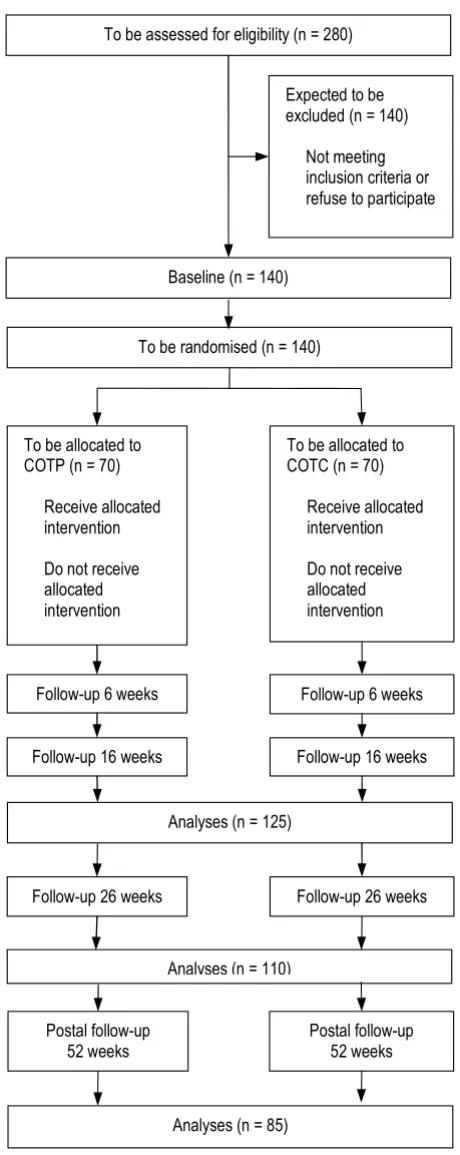
pro-fessional experience in the experimental treatment in Ger-many, less patients per therapist and a longer follow-up in a sample with expected progress in dementia, may reduce the expected effects. The power calculation is based on an analysis of variance of two groups and four measurement time points (since in the postal follow up at 52 weeks the IDDD is recorded, too). Hypothesising an alpha of .05 (two-sided), a power of .80 and a correlation of .7 between four measurement time points, a sample of 84 persons is needed, in order to detect an effect of f = .10 [72]. According to drop out rates of the Dutch study, 280 patients must be screened and 140 recruited (see figure 1).
Randomisation
After the recruitment of an individual, the physician of the study centre e-mailed the request of randomisation to a statistician at a distant site. The physician also informed the assessor (and optionally a co-ordinator of the study centre) and asked him/her to schedule all assessment dates according to the protocol. After the referral by the centre physician, the independent statistician allocated the individual to COTP or COTC. The randomisation sequence was computer-generated with blocking by cen-tre and groups of two persons, without stratification and in a ratio of 1:1. Group allocation was e-mailed to the therapists at the study centre. The therapists decided who would be responsible for this case and the lead therapist confirmed reception of group allocation to the independ-ent statistician. In addition, the lead therapist informed his centre team that he had received group allocation. In order to avoid any contamination, the centre therapists must schedule treatment sessions on their own. He/she also has to fax the records to the WHEDA-headquarters and retain their records, strictly separated from any other centre staff. Masking of patients and caregivers is not pos-sible due to the different quantity of home visits between intervention and control group. Assessors might be con-taminated by hints of patients or caregivers during the assessments at home. Assessors, patients and caregivers are asked to avoid any talks about the treatment. The extent of assessor 'blinding' will be evaluated by the com-parison of actual group assignment and the assessor's esti-mation of group assignment. The procedure of video-rating ensures the full 'blinding' of the Dutch raters of an individual's assignment to group. Independent staff of the WHEDA-headquarters check and 'clean' the videotapes from any hint of group assignment or personal data, before the tapes are transferred to the Netherlands.
Statistical methods
sig-nificantly differing at baseline in intervention and control group and control measures are used as co-variates in an analysis of variance with repeated measures with two groups and four measurement time points. If the diagno-sis of extent and type of missing data reveal that the pre-condition is given, the Full Information Maximum Likelihood (FIML) method will be applied for data replacement [73]. The primary intention-to-treat analysis, including all participants with valid data (whether they did or did not receive the intervention), will be compared with a per protocol analysis excluding all participants with documented deviations from the protocol (ie. not receiv-ing the entire intervention or receivreceiv-ing an incomplete fol-low-up). The comparison of these groups will be adjusted for baseline imbalance and process variations. Variations in the adherence to protocol; to the treatment manual and to therapeutic recommendations; variations in medica-tion and progress of cognitive decline as well as variamedica-tions in the quality of supporting or hindering structures and processes at the study sites are considered as possible mediators. All statistical tests will be two-sided on an alpha level of .05.
Discussion
The WHEDA-study evaluates whether the improved effects on daily functioning in people with dementia, found in a Dutch RCT within a community occupational therapy programme, can be replicated in a single blind German randomised controlled multi-centre design with prolonged follow-up assessment. The transfer from the Dutch mono-centre design to the pragmatic multi-site trial in a German context implicated several determina-tions in design issues.
1. The decision for a multi-centre design is justi-fied by a short time frame for recruitment and the necessity to anticipate the variability of contexts possibly given later when the intervention might be delivered in routine care.
2. An active control intervention is applied, since a consultation on how to deal with the conse-quences of the disease is normal in outpatient dementia care in Germany and the WHEDA-study aims at the evaluation of potential effects addi-tional to standard care. Furthermore waiting group control conditions may lead to disappointment and feelings of neglect in the waiting group after randomisation and may enhance the contrast between intervention and waiting group.
3. The follow-up period is prolonged from 12 weeks in the Dutch trial to 26 weeks in the WHEDA study, in order to assess the long-term treatment potential to reduce the negative
conse-WHEDA flow chart (planned progress)
Figure 1
WHEDA flow chart (planned progress).
To be assessed for eligibility (n = 280)
To be randomised (n = 140) Expected to be excluded (n = 140)
Not meeting inclusion criteria or refuse to participate
To be allocated to COTP (n = 70)
Receive allocated intervention
Do not receive allocated intervention
To be allocated to COTC (n = 70)
Receive allocated intervention
Do not receive allocated intervention
Follow-up 6 weeks Follow-up 6 weeks
Follow-up 16 weeks Follow-up 16 weeks
Follow-up 26 weeks Follow-up 26 weeks
Postal follow-up 52 weeks
Postal follow-up 52 weeks Analyses (n = 110)
quences of cognitive decline in everyday function-ing. The additional one-year follow-up intends to evaluate the impact of interventions on the inci-dence of nursing home placements.
4. The Assessment of Motor and Process Skills (AMPS) used in the original Dutch study was replaced by the PRPP, since AMPS was not availa-ble in Germany and the PRPP shows better feasi-bility. Since PRPP pilot data are not available, the power calculation was based on the IDDD.
5. The 14 German occupational therapists with a minimum of one year's experience in the treat-ment of people who are cognitively impaired, undertook a 16 hours post-graduate skills training course and exercise their skills in training on the job for about 35 hours within the WHEDA pilot phase. The two Dutch occupational therapists had four years experience in the treatment of people who were cognitively impaired and each had 240 hours of experience in treatment according to the guidelines after post-graduate skill training course of 80 hours. The WHEDA recruitment period of nine months is shorter than in the Dutch trial which had three years and nine months recruit-ment time. The reduced recruitrecruit-ment period, the extended number of involved therapists and the shortened seminar time all match routine condi-tions, which would be found in an implementa-tion of standard dementia care.
6. The WHEDA study does not determine stable medication for people with dementia as inclusion criteria, since changes in medication are common in dementia care. In contrast to the Dutch original trial, the WHEDA study is kept open to patients, for whom occupational therapy goals cannot be defined before the start of the treatment. This is congruent to the routine situation, since German physicians cannot explore possible occupational therapy goals before prescribing this treatment.
According to the arguments listed above, effects as revealed by the Dutch original study may be reduced in the multi-centre prolonged WHEDA design. For this rea-son, the statistical power was calculated conservatively and a process evaluation assessing variations in settings and delivery processes as well as treatment fidelity and adherence to therapeutic recommendations was planned. Adjusted analyses considering the variations in settings, structures and processes should be able to provide expla-nations for outcomes differing between the Dutch origi-nal study and the German replication.
Competing interests
The authors declare that they have no competing interests.
Authors' contributions
MG, MH, RL and SVR contributed to study conception and design. SVR drafted and MG helped to draft the man-uscript. MH, MOR and MVD revised the manuscript criti-cally for important intellectual content. KS and SVR participated in data and study management. KS and RL performed the statistical analysis. All authors read and approved the final manuscript.
Acknowledgements
The WHEDA-study is funded by the German Federal Health Ministry (Ref-erence Number: IIA5-2508FSB111/44-004. We acknowledge Professor Chris Mayers, Chair in Occupational Therapy, York St John University for critical reading and English correction.
References
1. Blennow K, de Leon MJ, Zetterberg H: Alzheimer's disease. Lancet
2006, 368(9533):387-403.
2. Ott A, Breteler MM, van Harskamp F, Stijnen T, Hofman A: Inci-dence and risk of dementia. The Rotterdam Study. Am J Epi-demiol 1998, 147(6):574-80.
3. Wancata J, Musalek M, Alexandrowicz R, Krautgartner M: Number of dementia sufferers in Europe between the years 2000 and 2050. Eur Psychiatry 2003, 18:306-313.
4. Lobo A, Launer LJ, Fratiglioni L, Andersen K, Di Carlo A, Breteler MM, Copeland JR, Dartigues JF, Jagger C, Martinez-Lage J, Soininen H, Hofman A: Prevalence of dementia and major subtypes in Europe: A collaborative study of population-based cohorts. Neurology 2000, 54(Suppl 5):4-9.
5. Hofman A, Rocca WA, Brayne C, Breteler MM, Clarke M, Cooper B, Copeland JR, Dartigues JF, da Silva Droux A, Hagnell O: The preva-lence of dementia in Europe: a collaborative study of 1980-1990 findings. Eurodem Prevalence Research Group. Int J Epi-demiol 1991, 20:736-748.
6. Fratiglioni L, Launer LJ, Andersen K, Breteler MM, Copeland JR, Dar-tigues JF, Lobo A, Martinez-Lage J, Soininen H, Hofman A: Incidence of dementia and major subtypes in Europe: A collaborative study of population-based cohorts. Neurologic Diseases in the Elderly Research Group. Neurology 2000, 54(11 Suppl 5):S10-5.
7. Jorm AF, Jolley D: The incidence of dementia. A meta-analysis. Neurology 1998, 51:728-733.
8. Bickel H: Epidemiologie und Gesundheitsökonomie. In Demen-zen. Referenzreihe Neurologie Edited by: Wallesch CW, Förstl H. Stutt-gart: Thieme Verlag; 2005:1-15.
9. Robert Koch-Institut: Gesundheitsberichterstattung des Bundes, Heft 28 Altersdemenz Robert Koch-Institut. Berlin; 2005.
10. Wimo A, Jonsson L, Winblad B: An estimate of the worldwide prevalence and direct costs of dementia in 2003. Dement Ger-iatr Cogn Disord 2006, 21(3):175-81.
11. Statistisches Bundesamt: Gesundheit. Krankheitskosten 2002 Statis-tisches Bundesamt. Wiesbaden; 2004.
12. Hallauer JF, Schons M, Smala A, Berger K: Untersuchung von Krankheitskosten bei Patienten mit Alzheimer-Erkrankung. Gesundheitsökonomie und Qualitätsmanagement 2000, 5:73-79. 13. Ernst RL, Hay JW, Fenn C, Tinklenberg J, Yesavage JA: Cognitive
function and the costs of Alzheimer disease. An exploratory study. Arch Neurol 1997, 54(6):687-93.
14. Hux MJ, O'Brien BJ, Iskedjian M, Goeree R, Gagnon M, Gauthier S:
Relation between severity of Alzheimer's disease and costs of caring. CMAJ 1998, 159(5):457-65.
15. World Health Organization: ICD-10: International statistical classification of diseases and related heath problems World Health Organization. Geneva; 1992.
17. Muò R, Schindler A, Vernero I, Schindler O, Ferrario E, Frisoni GB:
Alzheimer's disease-associated disability: an ICF approach. Disabil Rehabil 2005, 27(23):1405-13.
18. World Health Organization: International Classification of Functioning, Disability and Health (ICF) 2001 [http://www3.who.int/icf/icftem plate.cfm]. World Health Organization. Geneva
19. Giovannetti T, Bettcher BM, Libon DJ, Brennan L, Sestito N, Kessler RK: Environmental adaptations improve everyday action performance in Alzheimer's disease: empirical support from performance-based assessment. Neuropsychology 2007,
21(4):448-57.
20. Gitlin LN, Hauck WW, Dennis MP, Winter L: Maintenance of effects of the home environmental skill-building program for family caregivers and individuals with Alzheimer's disease and related disorders. J Gerontol A Biol Sci Med Sci 2005, 60:368-74. 21. Mittelman MS, Haley WE, Clay OJ, Roth DL: Improving caregiver well-being delays nursing home placement of patients with Alzheimer disease. Neurology 2006, 67(9):1592-9.
22. Spijker A, Vernooij-Dassen M, Vasse E, Adang E, Wollersheim H, Grol R, Verhey F: Effectiveness of nonpharmacological interven-tions in delaying the institutionalization of patients with dementia: a meta-analysis. J Am Geriatr Soc 2008, 56(6):1116-28. 23. Gitlin LN, Winter L, Burke J, Chernett N, Dennis MP, Hauck WW:
Tailored activities to manage neuropsychiatric behaviors in persons with dementia and reduce caregiver burden: a ran-domized pilot study. Am J Geriatr Psychiatry 2008, 16(3):229-39. 24. Graff MJL, Melick van MBM: The development, testing and
implementation of an occupational therapy guideline. The guideline for the OT diagnosis and treatment of older per-sons with cognitive impairments. Ned Tijdschr Ergother 2000,
28:169-74. In Dutch
25. Graff MJL, Vernooij-Dassen MJFJ, Hoefnagels WHL, Dekker J, Witte de LP: Occupational therapy at home for older individuals with mild to moderate cognitive impairments and their pri-mary caregivers: a pilot study. Occup Ther J Res 2003, 23:155-63. 26. Graff MJ, Vernooij-Dassen MJ, Thijssen M, Dekker J, Hoefnagels WH, Rikkert MG: Community based occupational therapy for patients with dementia and their care givers: randomised controlled trial. BMJ 2006, 333(7580):1196.
27. Graff MJ, Vernooij-Dassen MJ, Thijssen M, Dekker J, Hoefnagels WH, Olderikkert MG: Effects of community occupational therapy on quality of life, mood, and health status in dementia patients and their caregivers: a randomized controlled trial. J Gerontol A Biol Sci Med Sci 2007, 62(9):1002-9.
28. Graff MJ, Adang EM, Vernooij-Dassen MJ, Dekker J, Jönsson L, Thijs-sen M, Hoefnagels WH, Rikkert MG: Community occupational therapy for older patients with dementia and their care giv-ers: cost effectiveness study. BMJ 2008, 336(7636):134-8. 29. Boutron I, Moher D, Altman DG, Schulz KF, Ravaud P, for the
CON-SORT Group: Methods and Processes of the CONSORT Group: Example of an Extension for Trials Assessing Nonp-harmacologic Treatments. Ann Intern Med 2008, 148: W-60-W-66.
30. Boutron I, Moher D, Altman DG, Schulz KF, Ravaud P, for the CON-SORT Group: Extending the CONSORT Statement to Rand-omized Trials of Nonpharmacologic Treatment: Explanation and Elaboration. Ann Intern Med 2008, 148:295-309. 31. Zwarenstein M, Treweek S, Gagnier JJ, Altman DG, Tunis S, Haynes B, Oxman AD, Moher D, for the CONSORT and Pragmatic Trials in Healthcare (Practihc) groups: Improving the reporting of prag-matic trials: an extension of the CONSORT statement. BMJ
2008, 337:a2390.
32. Folstein MF, Folstein SE, McHugh PR: Mini-mental state: a practi-cal method for grading the cognitive state of patients for the clinician. J Psychiatr Res 1975, 12:189-98.
33. Medizinscher Dienst der Spitzenverbände der Krankenkassen e.V:
Richtlinien der Spitzenverbände der Pflegekassen zur Begutachtung von Pflegebedürftigkeit nach dem XI. Buch des Sozialgesetzbuches. Version von
2006 [http://www.mdk.de/media/pdf/ Begutachtungsrichtlinien_screen.pdf].
34. Kielhofner G, Mallinson T, Crawford C, Nowak M, Rigby M, Henry A, Walens D: Occupational performance history interview II. German Version 2.1: Interview zur Betätigungsgeschichte Idstein: Schulz-Kirchner; 2008. 35. Hasselkus BR: Ethnographic interviewing: a tool for practice with family caregivers for the elderly. Occup Ther Pract 1990,
2:9-16.
36. Graff MJL, Vernooij-Dassen MJ, Zajec J, Olde Rikkert MGM, Hoef-nagels WHL, Dekker J: How can occupational therapy improve the daily performance and communication of an older patient with dementia and his primary caregiver? A case study. Dementia 2006, 5:503-32.
37. Deutsche Alzheimer Gesellschaft e. V: Leben mit Demenzkranken
Deutsche Alzheimer Gesellschaft e. V. Berlin; 2003.
38. Deutsche Alzheimer Gesellschaft e. V: Ratgeber Häusliche Versorgung Demenzkranker Deutsche Alzheimer Gesellschaft e. V. Berlin; 2006. 39. Teunisse S, Derix MM: The interview for deterioration in daily
living activities in dementia: agreement between primary and secondary caregivers. Int Psychogeriatr 1997, 9(Suppl 1):155-62.
40. Böhm P, Peña-Casanova J, Aguilar M, Hernández G, Sol JM, Blesa R:
Clinical validity and utility of the interview for deterioration of daily living in dementia for Spanish-speaking communities NORMACODEM Group. Int Psychogeriatr 1998, 10(3):261-70. 41. Chapparo C, Ranka J: The PRPP System of Task Analysis:
User's Training Manual. In Research Edition Sydney: OP Network; 2006.
42. Aubin G, Chapparo C, Gélinas I, Stip E, Rainville C: Use of the Per-ceive, Recall, Plan and Perform System of Task Analysis for persons with schizophrenia: A preliminary study. Australian Occupational Therapy Journal 2009, 56(3):189-99.
43. Cyr M, Toupin J, Lesage A, Valiquette M: Assessment of independ-ent living skills for psychotic patiindepend-ents: Further validity and reliability. Journal of Nervous and Mental Disease 1994, 182:91-97. 44. Nott M, Chapparo C, Heard R: Reliability of the Perceive, Recall,
Plan and Perform System of Task Analysis: a criterion refer-enced assessment. Australian Occupational Therapy Journal 2008 [http://www3.interscience.wiley.com/journal/121387238/abstract]. 45. Nott MT, Chapparo C, Heard R: Effective occupational therapy
intervention with adults demonstrating agitation during post-traumatic amnesia. Brain Inj 2008, 22(9):669-83.
46. Brod M, Stewart AL, Sands L, Walton P: Conceptualization and measurement of quality of life in dementia: The dementia quality of life instrument (DQoL). The Gerontologist 1999,
39:25-35.
47. Suzuki M, Uchida A, Kanamori M, Ooshiro H: Development of the Dementia Quality of Life Instrument - Japanese version. Nip-pon Ronen Igakkai Zasshi 2005, 42(4):423-31.
48. Suzuki M, Kanamori M, Greiner C, Ito K, Ooshiro H: Follow-up study on subjective quality of life for elderly persons with dementia using the Japanese version of Dementia Quality of Life Instrument (JDQoL). Nippon Ronen Igakkai Zasshi 2006,
43(4):485-91.
49. Selwood A, Thorgrimsen L, Orrell M: Quality of life in dementia - a one-year follow-up study. Int J Geriatr Psychiatry 2005,
20:232-237.
50. Ready RE, Ott BR, Grace J: Factor structure of patient and car-egiver ratings on the dementia quality of life instrument. Neuropsychol Dev Cogn B Aging Neuropsychol Cogn 2007, 14(2):144-54. 51. Bullinger M, Kirchberger I: SF36 Fragebogen zum Gesundheitszustand -Handanweisung (SF-36 and SF-12 Test Manual) Göttingen: Hogrefe Ver-lag; 1998.
52. Ellert U, Bellach BM: The SF36 in the Federal Health Survey -description of a current normal sample. Gesundheitswesen 1999,
61(Spec No):184-90.
53. Arlt S, Hornung J, Eichenlaub M, Jahn H, Bullinger M, Petersen C: The patient with dementia, the caregiver and the doctor: cogni-tion, depression and quality of life from three perspectives. Int J Geriatr Psychiatry 2008, 23(6):604-10.
54. Bruce DG, Paley GA, Nichols P, Roberts D, Underwood PJ, Schaper F: Physical disability contributes to caregiver stress in dementia caregivers. J Gerontol A Biol Sci Med Sci 2005,
60(3):345-9.
55. Vernooij-Dassen MJM, Persoon JM, Felling AJ: Predictors of sense of competence in caregivers of demented individuals. Soc Sci Med 1996, 43:41-9.
56. Scholte op Reimer WJ, de Haan RJ, Pijnenborg JM, Limburg M, Bos GA van den: Assessment of burden in partners of stroke patients with the sense of competence questionnaire. Stroke
1998, 29:373-379.
Publish with BioMed Central and every scientist can read your work free of charge
"BioMed Central will be the most significant development for disseminating the results of biomedical researc h in our lifetime."
Sir Paul Nurse, Cancer Research UK
Your research papers will be:
available free of charge to the entire biomedical community
peer reviewed and published immediately upon acceptance
cited in PubMed and archived on PubMed Central
yours — you keep the copyright
Submit your manuscript here:
http://www.biomedcentral.com/info/publishing_adv.asp
BioMedcentral with dementia symptoms: A psychometric evaluation.
Clini-cal Practice and Epidemiology in Mental Health 2007, 3:11.
58. Radloff LS: The CES-D scale: a self-reported depression scale for research in the general population. Appl Psychol Measure-ment 1977, 1:385-401.
59. Joling KJ, van Hout HP, Scheltens P, Vernooij-Dassen M, Berg B van den, Bosmans J, Gillissen F, Mittelman M, van Marwijk HW: Cost-effectiveness of family meetings on indicated prevention of anxiety and depressive symptoms and disorders of primary family caregivers of patients with dementia: design of a ran-domized controlled trial. BMC Geriatr 2008, 8:2.
60. Taylor DH Jr, Ezell M, Kuchibhatla M, Østbye T, Clipp EC: Identify-ing trajectories of depressive symptoms for women carIdentify-ing for their husbands with dementia. J Am Geriatr Soc 2008,
56(2):322-7.
61. Adams KB: Specific effects of caring for a spouse with demen-tia: differences in depressive symptoms between caregiver and non-caregiver spouses. Int Psychogeriatr 2008, 20(3):508-20. 62. Gallicchio L, Siddiqi N, Langenberg P, Baumgarten M: Gender differ-ences in burden and depression among informal caregivers of demented elders in the community. Int J Geriatr Psychiatry
2002, 17(2):154-63.
63. Hautzinger M, Bailer M: Allgemeine Depressions Skala (ADS Test Manual)
Göttingen: Beltz Test GmbH; 1992.
64. Alexopoulos GS, Abrams RC, Young RC, Shamoian CA: Cornell Scale for Depression in Dementia. Biological Psychiatry 1988,
23:271-84.
65. Müller-Thomsen T, Arlt S, Mann U, Mass R, Ganzer S: Detecting depression in Alzheimer's disease: evaluation of four differ-ent scales. Arch Clin Neuropsychol 2005, 20(2):271-6.
66. Kørner A, Lauritzen L, Abelskov K, Gulmann NC, Brodersen AM, Wedervang-Jensen T, Marie Kjeldgaard K: Rating scales for depression in the elderly: external and internal validity. J Clin Psychiatry 2007, 68(3):384-9.
67. Lam CK, Lim PP, Low BL, Ng LL, Chiam PC, Sahadevan S: Depres-sion in dementia: a comparative and validation study of four brief scales in the elderly Chinese. Int J Geriatr Psychiatry 2004,
19(5):422-8.
68. Neubauer S, Holle R, Menn P, Grässel E: A valid instrument for measuring informal care time for people with dementia. Int J Geriatr Psychiatry 2009, 24(3):275-82.
69. Neubauer S, Holle R, Menn P, Grossfeld-Schmitz M, Graesel E: Meas-urement of informal care time in a study of patients with dementia. Int Psychogeriatr 2008, 20(6):1160-76.
70. Wimo A, Nordberg G: Validity and reliability of assessments of time. Comparisons of direct observations and estimates of time by the use of the resource utilization in dementia (RUD)-instrument. Arch Gerontol Geriatr 2007, 44(1):71-81. 71. Yesavage JA, Brink TL, Rose TL, Lum O, Huang V, Adey M, Leirer VO:
Development and validation of a geriatric depression screen-ing scale: a preliminary report. J Psychiatr Res 1983,
17(1):1982-37.
72. Cohen J: Statistical Power Analysis for the Behavioral Sciences 2nd edition. Hillsdale, New Jersey: Lawrence Erlbaum Associates; 1988. 73. Allison P: Missing data Thousand Oaks: Sage; 2002.
Pre-publication history
The pre-publication history for this paper can be accessed here: