87
TRANSITION OF THE ENGINE POWERED
CONDITIONING SYSTEM TO THE SOLAR POWERED
AIR-CONDITIONG SYSTEM IN A BUS: A FEASIBILITY STUDY
Zulpattah Yusoff1 and Boon Cheong Chew
Faculty of Technology Management & Technopreneurship (FPTT), UTeM, Melaka,
Corresponding E-mail : [email protected], [email protected]
Abstract
Developing and generating a better way of the fossil fuel exertion is necessary in today’s transportation technology. Fossil fuels are of great importance in transport systems because they can be burned and producing significant amounts of energy to move the vehicle along. Generally usage of the air-conditioning system in the transportation will increase the usage of the fossil fuel, since the fuel is used to power the air-conditioning system, as well as to power the movement of the vehicle. The additional energy resource such as solar can be used in a vehicle to generate adequate energy to power the air-conditioning system. The research was grounded on an exploratory study. A qualitative case study approach was adopted. The data collected was analyzed to get the most efficient way to install the solar panel on a roof top of a bus. As the conclusion, the solar application will be benefit to a bus. The consumption of the fossil fuel is lowered and the efficiency of the engine is enhanced since the energy input is maximizing for the movement of the bus alone. Besides, this application also benefits to the environment as it produces lower carbon.
Keywords: solar application, ;energy effeciency.
1.0
Introduction
The existing air conditioning system in the vehicle uses fossil fuel to operate. According to Johnson (2002), the amount of fuel used for air conditioning is significant. In an absolute term, 7.1 billion gallons of gasoline (approximately 27 billion liters) are used in the US for air conditioning light duty vehicles. Put in a relative term, the air-conditioning fuel use is equivalent to 6% of domestic petroleum consumption, or 10% of important crude oil to perform this function. As the research goes deep into the context of the air-conditioning system of a vehicle, more problems can be found on the impact of the system. However, it is not the best way to completely remove the conditioning system since the hot climate like Malaysia needs the air-conditioning system to comfort the passengers and driver. We just need an innovative idea to transform the energy used and to minimize the implications (reduce the carbon footprint from a vehicle) for the benefits of the environment.
88
Aligned with the outcomes targeted, the objectives of the study are:
(1) To investigate how to implement the solar powered air–conditioning system to replace the existing engine powered system in a bus.
(2) To investigate how the implementation of the solar powered air-condition system can enhance the efficiency of the air-conditioning operation in a bus.
(3) To suggest innovative solution on the application of the solar air-conditioning system to improve the engine performance of a bus on its mobility.
2.0
Literature Review
2.1
Introduction
This section will be presents the theories and retrospective on the previous studies related to this research. These substances can be used to help the researchers to understand and internalize the research. In addition, this section will describe the approach and findings of previous studies, either from within or outside the country associated with this study. Some interest topics of the earlier research that are closely related by this research will be taken as a references for doing this research and some of it will be discuss in this section.
2.1
Conceptual
Perspective
on
System Innovation and Technological Transition
For this research, the level of the technological niches was being chosen. Mokyr (2002) defines technological niches as radically new technologies usually emerge as hopeful monstrosities. They are hopeful because they can perform a particular new function but they are monstrous because their performance characteristics are still new, yet could be explore further for its feasibility and practicality.
Two main theoretical concept (TC) has been identify for this research. After considering several factors which may involve in this research, finally the researchers conclude that this two TC should be grounded, analyze and discuss further as the theoretical factors which lead to successes for this research. The two theoretical concepts that will discuss are:
(a) Theoretical concept of engine powered air-conditioning system (b) Theoretical concept of solar powered air-conditioning system
2.2.
Theoretical
Concept
of
Engine
Powered
Air-Conditioning System
Automobile air-conditioning systems cools the occupants of a vehicle in a hot weather, and it has come into wide use from the late twentieth century. According to Daly (2006) the Packard marketed the first mechanical automotive air-conditioning (AC) system which worked on a closed cycle in 1939. The system used a compressor, condenser, receiver drier and evaporator to operate the system. However this system has a major problem that affects its efficiency. Yet, it was a good invention that can be improved to enhance the usage of an AC in the automotive.
Starting from 1939, the researcher (automotive) around the world has put some of their efforts to improving the mechanism of the AC system operates in a vehicle. Few or much innovations have been made. As time passes, today we have stabilized the AC system in a vehicle that gets the power source from the mechanism of an engine. This knowledge has been practically implemented most of the vehicles.
89 in the bigger cabin (refer to figure 1)
Figure 1: The Bus Air Conditioning Refrigeration Cycle
According to the Trans/Air Manufacturing Corp, the mechanism of the engine powered AC in a bus start with a thermostat, located in the interior of the vehicle which is call for cooling. Based on a signal from the thermostat, by means of an internal connecting electrical system, the electromagnetic clutch on the compressor engages. The compressor is a belt-driven, high pressure pump, which circulates the refrigerant through the air-conditioning system. Compressors are mounted via brackets in the engine compartment. Some systems can have one or more compressors.
Once engaged, the compressor then circulates refrigerant through the system which connects the hoses. A refrigerant (exists as a gas), and containing the heat from the passenger compartment, is pumped by the compressor, under high pressure, into the condenser coil. Then, the fans in the condenser pull cool air through the condenser coil, which contains refrigerant exists as hot gas. The refrigerant undergoes a change-of-state, from gas to liquid, through the condensation process. During condensation, the hot gas rejects its heat loads to the outside, which is transferred from the passenger compartment, into the refrigerant by the evaporator. The refrigerant now exists as cool liquid, which passes through the filter drier, to remove moisture and impurities. Then, the sight glass which enables visual inspection of the refrigerant. The cool liquid is then pumped to the evaporator where an expansion valve meters the refrigerant into the evaporator coil. Fans pull passenger compartment air through a filter, which removes particulate matter, then passes the cleaned air through the evaporator coil.
The refrigerant undergoes a change of pressure from high to low, and a corresponding change-of-state from liquid to gas, through an evaporation process. During evaporation, the heat contained in the air in the passenger compartment is absorbed by the gaseous refrigerant. A warm air passes through the evaporator coil, moisture condenses, and it is collected and drained to the exterior of the vehicle. The hot gas is then suctioned back to the compressor and pumped to the condenser.
2.3
Theoretical
Concept
of
Solar
Powered
Air-Conditioning System
90
bus. According to Oxlade (2012) there are two different ways to use the solar energy. The first is to heat water and building. This is known as solar thermal. The second is to produce electricity, known as solar voltaic. In this research, we will use the solar voltaic to supply the enough electric power to power the condenser to operates. The solar energy can be harvest by using the solar panel or known as Photovoltaic (PV).
Photovoltaic (PV) is a method of generating electrical power by converting solar radiation into direct-current electricity using semiconductors that exhibit the Photovoltaic effect Photovoltaic power generation employs solar panels composed of a number of solar cells containing a photovoltaic material. This panel will be attached on the roof top of a bus to harvest the sun energy. Typically, the angle of the solar array is set a range between sile-latitude-plus 15 degrees and sile-latitude-minus 15 degrees, depending on whether a slight winter or summer bias (or monsoon season and summer season in Malaysia) is desirable in the system. By converting the solar power to the electrical source, this power can be stored to be used in the AC system. After the solar power is turned to the electrical source, this energy can be used to power the condenser of a bus subsequently to power the AC system. The electric power (c) will supply enough energy that is needed to move the fan and completed the cycle of hot air and cool air circulation. This theory is more practical, interesting and innovative that using the existing method which is using the engine to power the AC system.
2.4
Comparison between Engine Powered Air-Conditioning System with Solar
Powered Air-Conditioning System
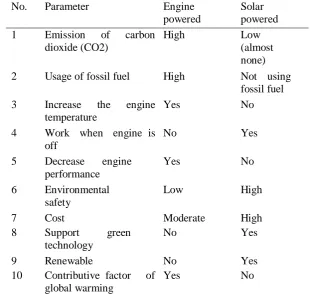
After we understand the significant differences between engine powered AC and solapowered AC, we can make the comparison between these two (refer to table 1).
Table 1: Comparison between engine powered and solar powered air-conditioning system
Source: Summarized from Johnson (2002), Daly (2006), Rand (2010).
By refering to some sources of the knowledge and previous research projects, we conclude that the usage of the solar powered AC can decrease the usage of the fossil fuel, increase the engine performance and it is environmentally green and sustainable. So these characteristics match
No. Parameter Engine
powered
Solar powered 1 Emission of carbon
dioxide (CO2)
High Low
(almost none)
2 Usage of fossil fuel High Not using
fossil fuel 3 Increase the engine
temperature
Yes No
4 Work when engine is off
No Yes
5 Decrease engine performance
Yes No
6 Environmental safety
Low High
7 Cost Moderate High
8 Support green
technology
No Yes
9 Renewable No Yes
10 Contributive factor of global warming
91
perfectly with the intended outcomes, as well as the objectives of this research. Next section, we will analyze the technical factor which need to be considered when adopting this new technology (the solar powered air-conditioning system).
2.5
Technical Factor
The technical factors that are being considered in this research will be briefly discussed. According to Chew (2012) there are four technical sub-factors under the technical factors, which are: (a) Demand and usage of this new technology
(b) Technology life cycle (TLC)
(c) Competitive advantages that the new technology bring
Figure 2: Theoretical framework
2.5.1
Demand and Usage of This New Technology
According to IEA data from 1990 to 2008, the average energy use per person increased 10% while world population increased 27%. In 2008, total worldwide energy
consumption was 474 exajoules . This is equivalent to an average power use of 15 terawatts. The potential for renewable energy is: solar energy 1600 EJ, wind power 600 EJ, geothermal energy 500 EJ, biomass 250 EJ, hydropower 50 EJ and ocean energy 1 EJ 280.
Therefore, it is evidenced that the energy consumption around the world is continuously increasing. The world is exhausting for the primary energy sources such as fossil fuel. There are a lot of potential for developing the renewable energy. Solar is a one of the potential renewable energy. The Photovoltaic for powering an air-conditioning system does not require a bigger space. Besides, solar is one types of the renewable energy that is green and sustainable. When solar is used to power the AC system in a bus, it lowers the fossil fuel consumption and helps to protect the environment.
2.5.2
Technology life cycle (TLC)
92
must be closely monitored between the fundamental science, technology, engineering and social science research. A lot of data must be gained to make sure a good innovation idea could be materialized at the end.
Figure 2: Technology Life Cycle
2.5.3
Competitive
Advantages that the New Technology Brings
Business dictionary defines competitive advantage as a superiority gained by an organization results from matching core competencies to the opportunities. According to Chew (2012), there are some parameters used to indicate the value of competitive advantage of the product or services that been adopt. One of the parameters highlighted is about the benefits, strengths or potentials bring by using this new technology.
Firstly, by referring to the TLC (shown in figure 2), we acknowledge that this technology is still in R&D phase, which is still lacking of stiff competition. Hence, it will make the company which adopts this technology, could gain significant profit as the leading pioneer who owes this technology. Secondly, by referring to the comparison between engine powered air-conditioning system with solar powered air-conditioning system (as discussed in Section 2.4), we can conclude that, this technology provides tremendous benefits to our national transport system-that relies heavily on inter-city transportation (buses) system-that centralized on the environmental vision and mission. Furthermore, it has significant potential to be commercialized, that will change the entire national or world transport landscape to be low carbon, greener and more sustainable.
3.0
Research Method
93
about well-defined population. This population need not necessarily consists of person. Typically, information is collected by asking questions to the representatives of the elements in the populationAccording to Merriam (2003), a case study is a design particularly suited to situation in which it is impossible to separate the phenomenon’s variables from their context. Case study research is a qualitative approach in which the investigator explores a bounded system (a case) or multiple bounded systems (cases) over time, through detailed and in-depth data collection.
The survey conducts using the questionnaire to be distributing at the Melaka. Melaka is being chosen as the location of the research because there are many bus companies in here that can allow many information can be get from them about the research. The question on “how” and “why” give the answer for the research questions through case study. It may be the exploratory or maybe the descriptive data. The reason to do the survey is try to figure out the adoption of a bus engineer towards the transition of the power supply energy of air conditioning system in a bus.
3.2
Research design
This research is conduct as an exploratory research. This research explore about new technology which are not be develop yet or not a sustain technology yet. Cooper and Schindler (2010) states that the exploratory studies tend forward loose structure with the objective of discovering future research tasks. The immediate purpose of exploratory is usually to develop hypotheses or question for further research.
According to Saunders (2012), research design is a framework for the collection analysis of data to answer research question and meet research objectives providing reasoned justification for choice of data sources, collection methods and analysis techniques. In research design, there are many elements that need to be cover up in order to answer all the objectives of the research. It contain clear objectives derived from research questions, specify the sources from which the researcher intend to collect data, how the researcher propose to collect and analyze these, the ethical issues and the constraint that will inevitably.
It is mostly the master plan that specifies the methods and procedures for collecting and analyzing needed information. According to Kumar (2011) research design is a blueprint or detailed plan for how a research study is to be complete. The researcher wills operational variables so they can be measured, selecting a sample of interest to study, collecting data to be used as a basis for testing hypothesis and analyzing the results. The blueprint includes the interview, survey, observation, experiment or combination of them.
However, only the case study and the quantitative questionnaire are applied in this research. Firstly, case studies will be conduct around Melaka. This case study will take place among the engineer of a bus. The type of relevant information is been collected through the both qualitative and quantitative method to get the answer for the research question and to achieve the objective of the research on how the people/engineers can adopt with this transition. Secondly, the framework is setup for specifying the relationship among the variables. Thirdly, the blueprint that outlines each procedure from the beginning of the analysis is setup.
3.3
Mixed method research
94
operationalism, in which more than one method is used as part of a validation process that ensures that the explained variance is the result of the underlying phenomenon or trait. Saunders (2012) claim that in reality many business and management research are likely to combine the quantitative and qualitative element to seek explains findings from the questionnaire. Johnson et. al (2007) admit that mixed research is a synthesis that includes ideas from qualitative and quantitative research.
Johnson et .al (2007) note that mixed research, in its recent history in the social and behavioral or human sciences, started with researchers and methodologists who believed qualitative and quantitative viewpoints and methods were useful as they addressed their research questions. By using this method, the research can get much information to be analyzed for getting the better innovation suggestion. Bouchard (1976) argued that the convergence of findings stemming from two or more methods enhances our beliefs that the results are valid and not a methodological artifact.
In this case study research, the field study was replied. The field studies are simply a form of research in which the researcher gathers data directly from in the real social environment through some types of data gathering such as observation, interview and another ways that makes sense in the field. Therefore in this case study, there are two types of data gathering which are:
i) Case study for an in-depth contextual analysis of few events or condition ii) In-depth interview that usually conversational rather than
structured.
4.0
Discussion and Analysis
In this research, this chapter presents the data gathered from of the study, interpretation of the results from the interview and the quantitative questionnaire analysis. The respondents consist of 35 bus engineer from several selected companies. The group of respondent is divided into two categories. The first one is through interview and the other one is from quantitative questionnaires. For the interview, the researcher collected about 10 respondents whereas another 25 respondents made through quantitative questionnaires.
In 4.1, the researcher will analyze and show the results of the first objective which is to investigate how to implement the solar powered air –conditioning (AC) system to replace the engine powered system in a bus. Then, in 4.2, the researcher will analyze the second objective. The second objective is to investigate how the implementation of the solar powered AC system can enhance the efficiency of the AC operation in a bus. It will be continued by 4.3 in which the researcher suggested innovative solution on the application of the solar AC system to improve the engine performance. Lastly, in 4.4, there will be a summarization on this chapter.
4.1
Investigation on the Implementation of the Solar Powered Air –Conditioning
System to Replace the Engine Powered System in a Bus.
95
The respondent think that the green technology is a better choice to use for empower a AC system in a bus. The neutral result that been get is from the respondent that not really know about the benefit of green technology. Respondent 2 state that this technology are needed because “it can reduce the consumption of the fossil fuel” that will help to save nature. Respondent 3 respond “it will benefit to all passenger and the bus company. By the result, the researcher conclude that majority of the respondent are agree with the argument for the government support to take over for this implementation. Respondent 2 state that “this implementation will be a great succes if it got the support from the government and public sectors.
4.1.2 Suggestion / Researcher Opinion
In the researcher opinion, the government should involve in this implementation of this technology because the government has much capital and can supply knowledge to implement this technology. Most of the bus company is a privetely own and usually do not having much capital and knowledge to implement this technology. Therefore, the government should taken their action to develop and introduce this kind of technology for the benefit of users, bus company and the nature.
According to the data collection from the respondent, the researcher get much suggestion on how to implementing the system. However, there are also arguments for this implementation. Some of the respondents voiced out about their concerns of the number of the expertise for this system. The ability of the maintenance should be increase to be able for this technology to be use in our country. In the researcher opinion, the expertise/ mechanics is important for implement this technology. They will be really helpful to maintenance or repair the technology when it is broke down. So that, the number of the expertise should be increase first before this technology can be apply in our country.
4.2 Bus Performance Enhancement through the Implementation of the Solar
Powered Air-Condition System
The new innovative ideas which implementing this technology in bus, will bring a good environmental result to the earth. Bogue (2012) stated that the latest innovation of the “Sun-Bus Power System,” which was developed to allow bus owners to meet new state mandated requirements for improving air quality and lowering fuel consumption by eliminating excessive stationary bus idling time. It is means that, by using this solar system, a bus can save the fuel, reduce the emission of the hazard gasses and will improve the performances of the bus as the engine will only focus to the movement of a bus. According to SunPods Inc., this implementation really gives green contribution to the planet as it is a green technology.
The researcher gained all the data from the respondents about the response on the how the implementation of the solar powered condition system can enhance the efficiency of the air-conditioning operation in a bus. In the researcher opinion, this implementation will help to lower the usage of the fossil fuel by a bus. When the AC is generating by the solar powered system, the engine do not need to use much fossil fuel. Respondent 4 state that, “this system can be used to reduce the usage of the fossil fuel in a bus by reduce the usage of the AC based fuel”. It showed that, when we apply this technology in a bus, it will reduce the fossil fuel consumption.
4.2.1 Suggestion / Researcher Opinion
96
A part of that, the usage of the fossil fuel can be reduce. The engine can save the fuel when it not be used to powered the air-conditioning system. Respondent 18 agree that “it can save the usage of petrol/diesel”. Respondent 19 also agree with the statement, he state “it can reduce the fuel consumption and can save the environment when apply...” Besides, respondent 21 also agree that it will help to reduce the fossil fuel consumption. From the data that been gained, the researcher conclude that majority of the respondent giving positive result for this technology to help in reduce the fossil fuel consumption.
4.3
Innovative Solution on the Application of the Solar Air- Conditioning System to
Improve the Engine Performance.
In recent years, the number of record-breaking hot summer days, especially in those regions with a usually moderate climate, has been increasing. Malaysia is one of the country that having the equatorial climate. This has led to a growing demand for climatisation in, for example, the transportation like car and bus has been equipped with air conditioning systems. Air-Conditioning (AC) is one of the most reliable creations by human. Since it was create, there was many innovation that been made to make it more useful and adding a better features like smaller and cooler.
However, this creation also brings some side effect to the vehicle and the environment. By using the air-conditioning system, the vehicle may use more fossil fuel. The addition fuel will be used by the engine to power the AC. Some the AC that been used in the vehicle may release dangerous gases such as CO2, and CFC that a major gases that increase the greenhouse effect.
One of the actions that we can take to reduce the emission of the CO2 and other hazards gases is by using the green technology for the vehicle. Introduction of the solar powered AC in a bus is aimed to harvest the enough energy for the AC. By using these types of technology, the fossil fuel used can be reduced and will benefit of decreasing the gases emission.
According to the Respondent 1 that says “the transition of the solar powered air-conditioning is a great idea. But it needs to have high capacity of energy storage, to make it able to store much energy to be used when the solar energy is not available like night and raining day”. Therefore battery is required to solve this problem. Besides, the respondent 2 give opinion “the cost of the transition might be high, government should support for the capital and research and development for this technology. There is more great suggestion from the respondent. All this will be used in generate a better idea for the implementation of solar powered AC in a bus.
5.0
Conclusion
This chapter has been divided into several sub-topics to make it easier to arrange the data that get and to make the conclusion for this research. In 5.1, the researcher will state the summary of the finding in this research. It is the conclusion of the data that been gain from all respondent for this research. After that, it will continue with 5.2, the conclusion. Then in 5.3, the researcher will state the recommendation for this research.
5.1
Summary of Findings
The validity of this research shows that, all the respondents gave full contribution towards the quantitative questionnaire and also interview done by the researcher. Majority of the respondents gave the agree statement on this new creative and innovative technology that can be implementing in a bus. All the 35 respondents fully supported the idea and give the good comment that can be used by the researcher in the findings recommendation on the project report. The summary of findings will be explained in detail based on the research questions of this project.
97
5.1.1 Implementation of the Solar Powered Air –Conditioning System to Replace the
Engine Powered System in a Bus.
The finding shows that there are two main idea on how to implement the solar powered air – conditioning system to replace the engine powered system in a bus. The ideas include the government support and also the technician requirement to make this technology success. The detailed of these ideas will be explained as follows:
5.1.1.1 Government Support
The implementation of the solar powered air conditioner system will be not successful if the government does not support the idea. In order to achieve the mission of green technology country by 2020, government should take the opportunities to use the renewable energy to replace the non-renewable energy in Malaysia. The respondents agree with the statement by giving the 100% commitment on this idea.
There are lots of opportunities that can be taken by the government in order to implement this new innovative technology. Sustainable Energy Development Authority Malaysia (SEDA), is of the department of the government that are responsible for the green technology development. SEDA Malaysia is a statutory body formed under the Sustainable Energy Development Authority Act 2011 [Act 726]. The key role of SEDA is to administer and manage the implementation of the feed-in tariff mechanism which is mandated under the Renewable Energy Act 2011 [Act 725]. They also run many research about the solar power and can supply their knowledge to this project implementation. Therefore, the government should have the steps to be taken as they forecast the requirement of solar increase by years. The researcher can conclude the government should play role to handle this opportunities especially implementing them in bus.
5.1.1.2 Technical Support
According to Durgin (2005), technician is a person employed to look after technical equipment or do practical work in a laboratory. New repair techniques and changing technology are important for automotive service technicians and mechanics with formal training. Automotive service technicians inspect and maintain bus that is diesel and petrol powered. Their duties include basic care maintenance including changing tires, performing oil changes, testing and diagnosing more complex problems and performing the repairs. In this case, the technician in a bus is needed.
The technician is one of the main important factors that are really needed to implement the solar powered air –conditioning system to replace the engine powered system in a bus. Without the technician, no adequate support for repair, services etc. if there is a damage or problem relate to the solar panel on the top of the bus roof. Based on the findings, 18 respondents agree with the statement which the technician is the main person needed in order to implement the solar powered system in air conditioner. The role of technician in doing their expertise will expand the technology into more advanced.
5.1.2 Solar Powered Air-Condition System Can Enhance the Efficiency of a Bus
Performance
98
5.1.2.1 Improve the Bus Performance
The solar powered AC in bus is generate the power from the solar power system that been install in a bus. By using the Photovoltaic (PV), it can absorb the power from the sun and turn it into electric that will be used to power up the AC in a bus. When the AC system is generating by the solar power, it will decrease the dependence to the engine of a bus. Therefore, engine will no longer are require powering the AC and can be more focus to the movement of a bus. The usage of the fossil fuel can be lower due to this solar power implementation. From that, it shows that, the performance of the bus can be efficient if the bus used the solar power in air-conditioner. The engine can be more effective and excellent.
5.1.2.2 Reduction of Fossil Fuel
The solar powered systems offer potentially improved fuel economy during a time of fuel economy penalties for diesel engines with added emissions control systems. This means that, the fuel will be safe from the air-conditioner usage and it also will give the greater control in the emission of diesel engines. The use of solar power like a fuel for bus is gaining high significance as the fossil fuels are acquiring depleted at fast rates. In contrast to the typical internal combustion engine powered vehicles, solar powered bus does not pollute the atmosphere.
5.1.2.3 Environmental Condition
The improvement of environmental condition also becomes one of the effects from the solar powered systems. This technology can be one of the green technologies offered to be used in Malaysia. The field of green technology encompasses a continuously evolving group of methods and materials, from techniques for generating energy to non-toxic cleaning products. By 2020, governments the world over are promoting measures to reduce airborne emissions and greenhouse gases (GHG’s) from motor vehicles, including mass transit buses. Conventional urban diesel buses produce carbon dioxide emissions that cause deterioration in air quality. Reducing GHG emissions and air pollutants produced by buses will pave the way to a cleaner, healthier environment. This technology is really good to be implementing.
5.2
Conclusion
Based on finding evaluation above, it shows that this innovative idea has been accepted by the community and also the technician in the transportation industry. It is a productive product that can be used in bus. The solar power air-conditioner in a bus is the future of the automobile industry. They are highly feasible and can be manufactured with ease. The main advantages of a solar power air-conditioner in a bus are that they are pollution less and are very economical. Since they cause no pollution they are eco-friendly and are the only answer to the increasing pollution levels from automobiles in the present scenario. By harvesting the renewable sources of energy like the solar energy we are helping in preserving the non-renewable sources of energy.
The solar AC solves many problems related to the environment and is the best pollution free method. The solar power air-conditioner in a bus do have some disadvantages like initial cost is high, lack of expertise, no adequate research on R&D and high cost in maintenance. These disadvantages can be easily overcome by conducting further research in this area like the problem of solar cells can be solved by using the ultra-efficient solar cells on the roof of bus that give about 22-23% efficiency.
99
technology really gives lots of benefit to community, Transportation Company, government, environment and also to the country. The efficiency of bus can be increase and required less amount of fuel. Hence, the environment will be less polluted.
100
Reference
Ameen, A. (2006). Refrigeration and air conditioning. PHI Learning Pvt. Ltd..
Bethlehem, J. (2009). Applied survey methods: A statistical perspective (Vol. 558). John Wiley & Sons. Bouchard, R. A. (1976). DNA amount and organization in some lower vascular plants (Doctoral dissertation,
University of Chicago).
Blank, R. (2004). The Basics of Reliability. SteinerBooks
Chew, B. C. (2012). Academia.Edu. Retrieved 30 September 2012, from www.academia.edu Cooper, D. R., & Schindler, P. S. (2003). Business research methods.
Cohen, L. Manion. L. and Morrison, K.,(2007). Research Methods in Education.
Campbell, D. T., & Fiske, D. W. (1959). Convergent and discriminant validation by the multitrait-multimethod matrix. Psychological bulletin, 56(2), 81.
Creswell, J. W. (2013). Research design: Qualitative, quantitative, and mixed methods approaches. Sage. Carmines, E. G., & Zeller, R. A. (1979). Reliability And Validity Assessment (Quantitative Applications In The
Social Sciences) Author: Edward G. Carmines, Richard.
Cronbach, L. J., & Meehl, P. E. (1955). Construct validity in psychological tests. Psychological bulletin, 52(4), 281.
Daly, S. (2011). Automotive air conditioning and climate control systems. Butterworth-Heinemann. Gratton, C., & Jones, I. (2010). Research methods for sports studies. Taylor & Francis.
Gangopadhyay, A. (Ed.). (2002). Managing business with electronic commerce: issues and trends. IGI Global. Hesse-Biber, S. N. (2010). Mixed methods research: Merging theory with practice. Guilford Press.
Iyyer, K. (2010). The E-Commerce Book: Building The E-Empire. Global India Publications Pvt Ltd. Johnson, V. H. (2002). Fuel used for vehicle air conditioning: a state-by-state thermal comfort-based
approach (No. 2002-01-1957). SAE Technical Paper.
Johnson, N. L., Kemp, A. W., & Kotz, S. (2005). Univariate discrete distributions (Vol. 444). John Wiley & Sons.
Kuratko, D. F., & Hodgetts, R. M. 2004. Entrepreneurship, Theory, Process, Practice, 6.
Kothari, C. R. (2009). Research Methodology Methods and Techniques 2 nd Revised edition New Age International publishers.
Last, J. M. (Ed.). (2001). A dictionary of epidemiology (Vol. 4). New York: Oxford University Press. Lewis, P., Thornhill, A., & Saunders, M. (2007). Research methods for business students. Pearson Education
UK.
Mokyr, J. (1990). The lever of riches: Technological creativity and economic progress. Oxford University Press. Merriam, S. (2009). Qualitative Research: a guide to design and interpretation. San Francisco.
Oxlade, C. (2012). Solar Power. Chris Oxlade. Raintree.
Panneerselvam, R. (2004). Research methodology. PHI Learning Pvt. Ltd.
Pimentel, D. (2008). Biofuels, solar and wind as renewable energy systems.Benefits and risks. New York: Springer.
Plant, R. T. (2000). eCommerce: formulation of strategy. Prentice Hall PTR.
Rayport, J. F., & Jaworski, B. J. (2002). Introduction to e-Commerce. McGraw-Hill/Irwin marketspaceU. Rand, T. (2010). Kick the Fossil Fuel Habit: 10 Clean Technologies to Save Our World. Greenleaf Book Group. Smith, A. M. (2012). Research Methodology: A Step-by-step Guide for Beginners.
Van den Bergh, J. C., & Bruinsma, F. R. (Eds.). (2008). Managing the transition to renewable energy: theory and
practice from local, regional and macro perspectives. Edward Elgar Publishing.