EXAMINING THE IMPACT OF HUMAN RESOURCE
MANAGEMENT PRACTICES ON EMPLOYEES’
TURNOVER INTENTION
Choi Sang Long♣
Universiti Teknologi Malaysia
Panniruky Perumal Wawasan Open University
ABSTRACT
It is important for human resource (HR) managers to overcome employees’ turnover intention. Issues encountered may be in the areas of shrinking pool of entry-level workers, individual differences, use of temporary workers, productivity and competitiveness, retirement benefits and skills development. Therefore, this paper discusses extensively on the impact of human resource practices that can alter the negative effect on the organization due to high employees’ turnover. The population sample of this study was drawn from among the grounds security officers and supervisors of a Singapore based security company (Company ABC) for the purpose of this study to test for compensation and benefits, training, career development, performance management and employee relations. Analysis of findings are presented and conclusions and recommendations drawn for professionals and decision makers in the industry. Keywords: Turnover Intention; Career Development; Employee Relations; Performance Management; Compensation.
1. INTRODUCTION
Turnover is defined as the “individual movement across the membership boundary of an Organization” (Price, 2001; Thwala et al., 2012). Interestingly unlike actual turnover, turnover intent is not explicit. Intentions are a statement about a specific behaviour of interest (Berndt, 1981). Studies have shown that turnover is one of the most researched phenomena in organizational behaviour (Price, 2001). The broad range of turnover studies is indicative of the significance and complexity of the issue. The phenomenon attracts interest due to its psychological dimension, its organizational significance, and its economic dimension. Thus it is imperative for HRM managers to understand that there are several factors inherent to counter staff intentions or turnover. One theory specifies that employees’ decision to resign is influenced by two factors: their “perceived ease of movement”, which refers to the assessment
♣ Corresponding Author: Faculty of Management, Universiti Teknologi Malaysia, 81310 Skudai-Johor Bahru. Email:
of perceived alternatives or opportunity and “perceived desirability of movement”, which is influenced for instance by job satisfaction (Morrell et al., 2004; Abdullah et al., 2012). This describes how balance is struck both for the organization and its employees in terms of inducements, such as pay, and contributions, such as work, which ensures continued organizational efficiency. In general, when inducements are increased by the company, this will lower the tendency of the worker to leave and vice versa (Morrell et al., 2004). At the same time, managers should also be aware that of the question whether the decision to leave could have been prevented by the organization. This is important for the planning of interventions. It would be realistic to manage this turnover as unavoidable rather than spend on theorized preventive measures, such as increasing pay. These losses of employees can also be described as “necessary causalities” (Morrell et al., 2004).
The impact of Human Resource Mismanagement can have a profound negative effect on the Organization. The expectancy theory predicts that one’s level of motivation depends on the attractiveness of the rewards sought and the probability of obtaining these rewards can hold sway in any current organization management’s objective to achieve high productivity and competitive edge in the ‘market place’. Employees desire compensation system that they perceive as being fair and commensurate with their skills and expectations. Pay therefore is a major consideration in an organization because it provides employees with a tangible reward for their services as well as source of recognition and livelihood (Howard, 1993; Thwala et al., 2012; Abdullah et al., 2012).
2. LITERATURE REVIEW 2.1. Relationship between HRM Practices and Turnover Intention
2.1.1. Compensation and Benefit
In a research study by Shahzad et al. (2008), findings revealed a positive relationship of reward practices with the performance of university teachers in Pakistan. This is important especially when countering the other factor of turnover intentions in the long run. It is a known fact that employees desire a compensation system that they perceived as being fair and commensurate with their skills, experiences and knowledge. Therefore HRM must take note that pay is the main consideration because it provides the tangible rewards for the employees for their services as well as a source for recognition and livelihood. Employee compensation and benefits includes all form of pay, rewards, bonuses, commissions, leaves, recognition programs, flexi work hours and medical insurance (Sherman et al., 1998). In a study involving data from 583 participants in Hong Kong and 121 participants in China, it was revealed that compensation components are important factors to retain and motivate employees (Chiu et al., 2002). Scholars agree that the way compensation is allocated for employees actually send messages about the management believes and what is important in the types of activities it encourages. Roberto and Arocas (2007) from the University of Valencia, Spain opine that salary strategies and job enrichment strategies were positively related to job satisfaction and thus has an effect negatively on turnover intentions. This was mediated by positive employee commitment. As turnover continues to be very serious problems in many organizations including the company related to this study, the research had suggested specific practises to develop strategies as an immediate step to lower turnover. In a similar survey conducted on 666 Thai workers, results revealed beside fairness and growth opportunities as job satisfaction for these workers, rewards was also cited as an important criteria for job satisfaction and negate turnover intention (Lobburi, 2012).
2.1.2. Training
2.1.3. Performance Management
It cannot be denied that the success or failure of performance management programs of any organization depends on the philosophy that it is connected to business goals and the attitudes and skills of those responsible for its implementations and operations. There are many methods available to gather information of an employee performance in the appraisal process. This information must be used for organizational needs and communicated to employees so that it will result in a high level performance (Lee, 1996; Thwala et al., 2012; Abdullah et al., 2012). Performance management can focus on the performance of an organization, a department, employee, or even the processes to build a product or service, as well as many other areas. It is acknowledged that a lack of performance appraisal can have adverse effect on employees’ motivation and contribute to employees’ turnover intentions (Struebing, 1996; Abdullah et al., 2011). An example is the research by the National University of Malaysia in 2004, in regards to performance appraisal and employee’s perception and intention to leave. It was revealed that whenever performance appraisal is perceived by employees’ to have organization political motives, this affect their job satisfaction and prone to turnover intentions (Poon, 2004; Abdullah et al., 2011).
In a study of data collected from 65 studies conducted on performance management and turnover intention, results revealed that there is relationship between employees’ job performance management and their intention to quit (Zimmerman, 2009). In 2001, American Psychological Association conducted a research on 130 employees of a medical services organization. This research revealed that despite the importance of understanding the conditions under which high performing employees are more likely or less likely to voluntarily leave an organization, the nature of the relationship between job performance and voluntary turnover has proven to be elusive.
2.1.4. Career Development
workforce requirements, it is important for an organization commitment in the program (Lips & Hall, 2007).
2.1.5. Employee Relations
Using the underlying social exchange theory (Blau, 1964) and the norm of reciprocity (Gouldner, 1960), Eisenberger et al (1986) it was suggested that individual attitudes and behaviours are affected by generalized perception of care and support from organizations. Employees feel obliged to repay organization with extra effort and loyalty when such favourable supportive treatments are discretionary-based (Eisenberger et al., 2001). This is emphasised in a study on 437 Chinese employees from multinational companies revealed that perceived supervisory support has a direct relation to turnover intentions (Newman, 2012). Employee relations in an organization is simply described as maintaining a healthy working relationship between management and employees. This will contribute and sustain a satisfactory productivity, motivation and high morale work environment that enhance job satisfaction for the employee and meet goals of the organization. Workplace employer-employee relationship will be the employment topics into the 20th century especially when there are growing attention to employee rights. This is more so when the need arises to balance employee rights and employee discipline. Managers have reported that it has become very stressful and unpleasant for managers and supervisors when they need to mete out disciplinary actions. In today’s organizations’ context of discipline, most opt for counselling rather than punishment to achieve individual and organizational objectives (Sherman et al., 1998). As more and more businesses recognise the enthusiastic and committed employees that add values to their organization. The values created are not just in terms of productivity but also enhancing customer satisfaction, retention, profitability and long term stakeholder value (Cook, 2008). In a research article by Greenbaum (2012), from Oklahoma State University, a study was undertaken in regards to condition under which supervisor undermining is related to perceptions of leader hypocrisy that then lead to employee turnover intentions. Based on 200 scenario-based experiments and 300 survey based study, the results revealed a general support to the author’s hypothesis that supervisors hypocritical behaviours do motivate staff turnover intentions. In a survey on 279 young professionals in china where a strong link on loyalty to organization and turnover intention was listed as a strong predictor. Another study of 1187 registered nurses in the west revealed that unsupportive work environment and poor leadership quality which is an indicator of poor employee and employer relationship have implication for nurses to resign in a year (Beatrice, 2009).
3. RESEARCH HYPOTHESIS
Base on the above literature review, the following hypothesis will be tested:
H1: Compensation and Benefits is significantly related to staff turnover intention H2: Training is significantly related to staff turnover intention
H3: Performance Management is significantly related to staff turnover intention H4: Career Development is significantly related to staff turnover intention
4. RESEARCH METHOD
The population sample of this study was drawn from among the grounds security officers and supervisors of a Singapore based security company (Company ABC) for the purpose of this study. As for compensation and benefits, training, career development, performance management and employee relations are each measured by adopting 6 items of questions in each variable partly based on the job diagnostic survey and HRM practises, with 5 points likert scale ranging from “strongly disagree” to “strongly agree”. The total score for such scale range from 6 to 30 in each variable and then it is averaged by the number of questions in each variable to obtain the mean score. This instrument is adapted from instrument developed by Edgar et al, (2005) and Chang (2005).
Of the total 80 valid survey forms given out, a total of 69 forms were returned. These represent a total of 86.25% respondents from the overall available population sample. One form was incomplete and thus only 68 forms were usable. These represent a net usable response rate of 85%. This may imply that the result of the study can be generalised as a greater population sample as sampling size has a direct impact on the power of statistical analysis and the generalization of results. All the survey instruments employed in the study were examined for reliability and internal consistency using the Cronbach’s alpha.
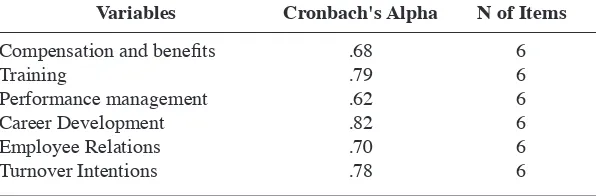
Table 1: Reliability Statistics for the instrument tested N of Items Cronbach's Alpha
Variables
Compensation and benefits .68 6
Training .79 6
Performance management .62 6
Career Development .82 6
Employee Relations .70 6
Turnover Intentions .78 6
Table 1 shows the cronbach alpha level for compensation and benefits independent variable at 0.68. The reliability test result for training was 0.79, whilst the test result for performance management was 0.62. The reliability test results for career development was 0.82 which is the highest among all the other independent variables and employee relations at 0.70. After measuring the training, performance management, career development and employee relations of the interviewed respondents the cronbach alpha coefficient was found to be in the range of 0.62 to 0.82, while turnover intentions were found to be 0.78.
5. DATA ANALYSIS
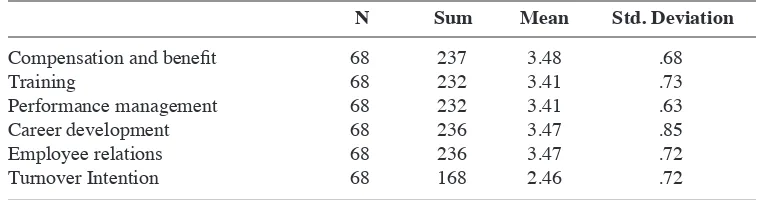
Independent variable, compensation and benefit have a high average score of 3.48 with standard deviation at 0.68, followed closely by career development with an average score of 3.47 and standard deviation at 0.85. Similarly, employee relations also have an average score of 3.47 respectively with a standard deviation of 0.72. Whilst training and performance management average score is at 3.41 respectively, the standard deviation for training is 0.73 whereas performance management standard deviation is at 0.63. The average score of the dependent variable, intention to leave is at 2.46 while the standard deviation is at 0.72. 5.1. Correlation Analysis Results
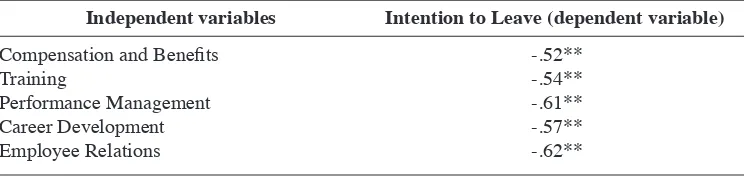
Correlation analysis was conducted on the data of the survey based on the independent variables of compensation and benefits, training, performance management, career development and employee relations against the dependent variable of intention to leave. This is aimed at establishing if there is any correlation through bivariate normality using Pearson Correlation’s theory and 2-tailed tests, the result is indicated in Table 3.
The result shows that each independent variable has a significant correlation to the dependent variable of intention to leave. The high value of each independent variable close to +1 and the value of intention to leave close to -1 are significant as it indicate correlation in the relationship of the determinant and intention to leave.
For compensation and benefit, the correlation to intention to leave is at -0.52 which is significant as the correlation is at 0.01 level for 2-tailed test.
As for training it is at -0.54, performance management is at -.63, career development is at -0.57 and employee relations at -0.62. Based on the results, the indication of the strongest correlation found is between employee relations and intention to leave, R=-0.62.
This sum up that the probability (p) <0.001. Thus, the Barlett’s test of sphericity revealed the importance of the general correlations within the correlation matrix where p<0.001.
Table 2: Descriptive Statistics of independent variables and dependent variable Std. Deviation Mean
Sum N
Compensation and benefit 68 237 3.48 .68
Training 68 232 3.41 .73
Performance management 68 232 3.41 .63
Career development 68 236 3.47 .85
Employee relations 68 236 3.47 .72
5.2. Regression Analysis Results
Based on Regression Analysis results which include the ANOVA analysis, the hypotheses will be examined. Results of regression analysis displayed the value of R, R squared, adjusted R squared and standard error. Apparently, R showed the correlation between the observed and forecasted values of the criterion variable. Generally, R ranged from -1 to 1. The positive and negative sign denotes the direction of the relationship while the magnitude indicates the strength of relationships. Meanwhile, R squared that ranged from 0 to1 signifies the adequacy of the model in the population. Adjusted R square tries to modify R square in order to reflect the appropriateness of the model in the population.
Table 4 on next page shows the R at 0.67 and Rp at 0.45.The relationship between the predictors which are compensation and benefits, training, career development, performance management and employee relations has a direct and significant relation to the dependent variable of intention to leave.
Table 3: Correlations matrix of the independent variables against the dependent variable Intention to Leave (dependent variable) Independent variables
Compensation and Benefits -.52**
Training -.54**
Performance Management -.61**
Career Development -.57**
Employee Relations -.62**
Notes: (a) predictors: (Constant), Employee relations, Career development, Training, Performance
management, Compensation and benefits. (b) Dependent variable : Intention to leave. Change Statistics Std. Error
of the Estimate
1 .67a .45 .41 .55 .45 10.32 5 62 .000
R Adjusted
R Square Model
Sig. F Change F Change
R Square
Change df1 df2
R Square
Table 4: Summary on correlation coefficient between Predictors and dependent variable
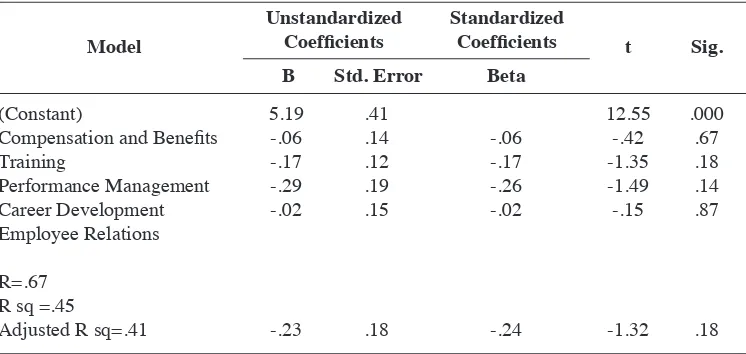
Table 6 indicates the results of the linear regression analysis on the predictors of compensation and benefit, training, career development, performance management and employee relations with dependent variable of intention to leave. The beta for compensation and benefit is -0.06. The beta for training is -0.17. The beta for performance management is -0.26, while the beta for career development is -0.02. Employee relations beta is -0.24. The result indicates that performance management has a significantly high relation to dependent variable of intention to leave as compared to the other independent variables. Notwithstanding, all the other results of the other predictors were also below 0.05. Thus all the independent variables of compensation and benefits, training, career development, performance management and employee relations are significantly and directly connected to the dependent variable of intention to leave.
Table 5: Result of ANOVA analysis on predictors and dependent variable Sig. Mean Square
Sum of Squares df F
Model 1
Regression 15.77 5 3.15 10.32 .000a
Residual 18.94 62 .30
Total 34.71 67
Notes: (a) Predictors: (Constant), Employee Relations, Training, Compensation and Benefits,
Performance Management, Career Development. (b) Dependent Variable: Intention to Leave
Table 6: Regression Analysis between independent variables and dependent variable
Notes: (a) Dependent Variable: Intention to Leave. *p (probability) ≤.05.
(Constant) 5.19 .41 12.55 .000
Compensation and Benefits -.06 .14 -.06 -.42 .67
Training -.17 .12 -.17 -1.35 .18
Performance Management -.29 .19 -.26 -1.49 .14
Career Development -.02 .15 -.02 -.15 .87
Employee Relations R=.67
R sq =.45
Adjusted R sq=.41 -.23 .18 -.24 -1.32 .18
Sig. t
Model Unstandardized Coefficients Standardized Coefficients Beta Std. Error
5.3. Hypothesis testing
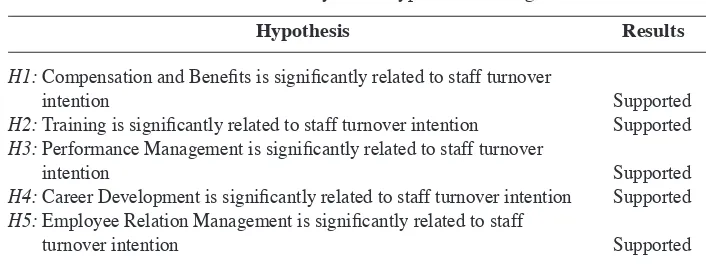
Table 7: Summary of the hypotheses testing
H1: Compensation and Benefits is significantly related to staff turnover
intention Supported
H2: Training is significantly related to staff turnover intention Supported
H3: Performance Management is significantly related to staff turnover
intention Supported
H4: Career Development is significantly related to staff turnover intention Supported
H5: Employee Relation Management is significantly related to staff
turnover intention Supported
Results Hypothesis
6. DISCUSSION 6.1. Hypothesis 1
The first hypothesis proposed was that Compensation and Benefits is significantly related to staff turnover intention. The reliability test, correlation and linear regression analysis result indicate a direct link and relation between compensation and benefits and intention to leave. As discussed in the literature review previous authors emphasize on the relationship between compensation and benefit with turnover intentions. In fact the result of the research is similar to the study by Shahzad et al. (2008), whose findings revealed positive relationship between reward practices and the performance of university teachers in Pakistan when countering the other factor of turnover intentions in the long run. Another similarity was found in the study of Chiu et al (2002) involving data from 583 participants in Hong Kong and 121 participants in China which revealed that compensation components are important factors to retain and motivate employees. Scholars agree that the way compensation is allocated for employees actually send messages about the management believes and what is important in the types of activities it encourages.
employers to pay high rate and also other benefit and compensation package thus creating large pools of applicants and probably attract better qualified and educated employees (SAS, 2011). This areas may be considered for implementation in the future in ensuring job satisfaction for the employees such as flexi time, shorter working hours and even providing child care services for the woman employees with children as part of the compensation package.
6.2. Hypothesis 2
Hypothesis 2 refers to the proposed theoretical objective that training is significantly related to staff turnover intention. According to empirical literature, training was found to have become increasingly vital to the success of any modern organizations. Nowadays organizations need to have competencies and especially core sets of knowledge and expertise that will give the companies an edge over its competitors. The only way to arrive at this is through having a dedicated training program that plays a central role to nurture and strengthen these competencies (Sherman et al, 1998). It is acknowledged that training forms the backbone of strategy implementation and that industries such as the security industry must have trained security officers, who must be competent in the basic laws, rescue operations, emergency response, crowd control and public management skills to be able to perform their job efficiently. The lack of these will definitely result in complaints, further injuries to public and damages to properties. It has always been extolled in law enforcement manual and frequently heard the saying that law enforcement agencies must always be one step ahead of the criminals and would be perpetrators to be able to prevent crimes and what better ways can officers be prepared if not through continuous training to hone the officers knowledge, skills, abilities to cope with new processes and systems, (Raffee, 2001). Studies have shown that one of the variables of human resources practises of providing continual training and development programs to the employees supported the hypothesis that training and employee development has a direct link to staff turnover intentions. Although training has been shown to be linked to employees turnover intentions, managers must be aware that there are a variety of methods that can be employed and the organizations must ensure that the method used provides the advantage for the organization and it’s potentially effective in training employees.
6.3. Hypothesis 3
similar research by Zimmerman, (2009) with data collected from 65 studies conducted on performance management and turnover intention revealed that there is relationship between employees’ job performance management and their intention to quit.
It is acknowledged that a lack of performance appraisal can have adverse effect on employees’ motivation and contribute to employees’ turnover intentions (Struebing, 1996). Theoretically it was mentioned that employee performance management also emphasized that appraisal is also related to promotion, transfer, and layoff and in legal matters relating to allegation of discrimination. Newer approaches have identified performance appraisal linked to training needs and developed growth plans for employees and thus the idea of performance management is to provide the opportunity to identify weaknesses and strength and work towards achieving organization’s goals and targets. It should not be used for reprimanding and disciplining employees. The new focus will be whether there is a need to change the current performance management program from one being a judge to a coach.
6.4. Hypothesis 4
The hypothesis is supported by the analyzed results of this study that there is a significant relation and direct link between career development and staff turnover intention. This supports findings from previous studies such as from Sherman et al. (1998) and Muliawan (2009). As organizations traditionally engaged in HRM planning and development for its large numbers of employees through various positions, roles and responsibilities, it is imperative that it must also identify future staffing needs through expansion, increase in business and productions and includes employees’ development needs. Therefore career development programs, with much emphasis on the individual, has a personalised aspect to it whereby it is integrated with all other HR functions to create synergy. This effort can be considered or perceived as organizational support by employees. It is a process where employees in planning careers need organization information from essential areas such as strategic planning, forecasting, succession planning and skill inventories to allow them to know the organization’s career paths available within the organization and at the same on how management views their performance (Filipova, 2011). Therefore the significant of career development in the organization should be viewed as a very dynamic process that attempts to meet the needs of managers, subordinates and the organization.
6.5. Hypothesis 5
stress that employees generally interact with their supervisors who are involved in feedback, evaluation of performance and career development program and therefore view their actions as important in attaining good relationship with the organization. Any unfavourable actions that seems unfair will definitely effect the relationship with the organization and management.
7. CONCLUSIONS AND RECOMMENDATIONS
REFERENCES
Abdullah, A., Bilau, A. A., Enegbuma, W. I., Ajagbe, A. M., Ali, K. N., & Bustani , S. A. (2012). Small and Medium Sized Construction Firms Job Satisfaction and Evaluation in Nigeria. International Journal of Social Science and Humanity, 2(1), 35-40.
Abdullah, A., Bilau, A. A., Enegbuma. W. I., Ajagbe, A. M. and Ali, K. N. (2011). Evaluation of Job Satisfaction and Performance of Employees in Small and Medium Sized Construction Firms in Nigeria. Paper presented at 2nd International Conference on
Construction and Project Management, IPEDR. Singapore, IAZSIT Press.
Beatrice, I. J. M. (2009). Intention to leave nursing. Career Development International, 14(7), 44-54.
Berndt, T. (1981). Effects of Friendship on Prosocial Intentions and Behavior. Child
Development, 52, 636-643.
Blau, P. (1964). Exchange and Power in Social Life. New York: Wiley. Brian, D. (1994, Dec). Why do we work? Fortune magazine, 26, 194-204.
Chang , P. L., Chou, Y. C., & Cheng, F. C. (2007). Career needs, career development programmes, organizational commitment and turnover intention of nurses in Taiwan.
Journal of Nursing Management, 15, 801–810
Chang, E. (2005). Employee’s overall perception of HRM effectiveness. Human relations,
58(4), 523-544
Chen, T. Y., Chang, P. L., & Yeh, C. W. (2004). A study of career needs, career development programs, job satisfaction and the turnover intentions of R&D personnel. Career
Development International, 9(4), 424 – 437.
Chiu, R. K., Luk, V. W. M., & Tang, T. L. P. (2002). Retaining and motivating employees: Compensation preferences in Hong Kong and China. Personnel Review, 31(4), 402-431. Cook, S. (2008). Essential Guide to Employee Engagement- Better Business Performance
through staff Satisfaction. USA: Kogan Publication.
Edgar, F., & Geare, A. (2005). HRM practise and employee attitudes: Difference measures and different results. Personnel review, 34(5), 534-549.
Eisenberger, R., Huntington, R., Hutchinson, S., & Sowa, D. (1986). Perceived organizational support. Journal of Applied Psychology, 71, 500–507.
Filipova, A. A. (2011). Relationships Among Ethical Climates, Perceived Organizational Support and Intent to Leave for Licensed Nurses in Skilled Nursing Facilities. Journal
of Applied Gerontology, 30(1), 44–66.
Gouldner, A. W. (1960). The norm of reciprocity: A preliminary statement. American
Sociological Review, 25, 161-178.
Greenbaum, R. L. (2012). When Leaders fail to “Walk the Talk”: Supervisor Undermining and Perceptions of Leader Hypocrisy. Journal of Management, 38, 103-114.
Hall, A. (2008). Managing Compensation and Rewards. Unpublished Dissertation, Capella University.
Howard, W. R. (1993). Strategic salary planning. Compensation and Benefit Review, 25(1), 47. Kotter, J. P. (1995). Leading change: why transformation efforts fail. Harvard Business Review,
March-April, 57-69.
Lam, T., Lo, A., & Chan, J. (2002). New Employees' Turnover Intentions and Organizational Commitment in the Hong Kong Hotel Industry. Journal of Hospitality & Tourism
Research, 26(3), 217-234.
Lee, C. (1996). Performing appraisal. Training review, 33(5), 44-59.
Lips-Wiersma, M., & Hall, D. T. (2007). Organizational career development is not dead: A case study on managing the new career during organizational change. Journal of Organizational Behavior, 28(6), 771-792.
Lobburi, P. (2012). The Influence of Organizational and Social Support on Turnover Intention in Collectivist Contexts. Journal of Applied Business Research, 28(1), 93-104.
Morrell, K., Loan-Clarke, J., & Wilkinson, H. (2004). Organizational Change and Employee Turnover. Personnel Review, 33, 161-173.
Muliawan, A. D. (2009). The turnover intention of information system auditors. International
Journal of Accounting Information Systems, 10(3), 117-136.
Poon, J. M. L. (2004). Effects of performance appraisal politics on job satisfaction and turnover intention. Personnel Review, 33(3) 322 – 334.
Price, J. L. (2001). Reflections on the Determinants of Voluntary Turnover. International
Journal of Manpower, 22, 600-624.
Raffee, S. (2001). Motivating Security Guards: A Management Perspective in the Private
Security Guarding Industry in Singapore. Unpublished Dissertation, Scarman Centre
for the Study of Public Order, Leicester University, UK.
Roberto, L., & Arocas, H. (2007). A model of high performance work practises and turnover intentions. Personnel Review, 37, 26-46.
Security Association of Singapore, SAS (2011). SAS has a race towards excellence. Retrieved April 19, 2012, from www.sas.org.sg
Shahzad K., Bashir S., & Ramay, M. I. (2008). Impact of HR practices on the perceived performance of University teachers in Pakistan. International Business Review, 4(2), 110-123.
Sherman, B., & Snell, A. (1998). Managing Human Resources, incentives and rewards. Ohio: International Publishing.
Struebing, L. (1996). Is performance being managed for the long term. Quality Progress,
29(2), 14.
Tan, F. M. (2008). Linking Career Development Practices to Turnover Intention: The Mediator of Perceived Organizational Support. Business Public Affairs Journal, 2(1), 23-35. Thwala, D. W., Ajagbe, M. A., Choi, S. L., Bilau, A. A., & Enegbuma, W. I. (2012). Sudanese
Small and Medium Sized Construction Firms: An Empirical Survey of Job Turnover.
Journal of Basic, Applied Social Research (JBASR), 2(8), 7414-7420.