Vol. 7, No.1| June 2015| ISSN 2229-8932 Journal of Technical Education and Training (JTET) |67
SOFTWARE BASED APPROACH FOR CLASSROOM TEACHING OF
ELECTRICAL ENGINEERING COURSES: A CASE STUDY
Mehar, H. and Nebhnani, N.
Department of Electrical & Electronics Engineering Institute of Engineering & Science,
IPS Academy
ABSTRACT
Electrical engineering concepts are abstract in nature and difficult to explain using conventional teaching tools. The use of software in teaching holds the potential in providing better learning support as these tools can provide visual representations of complex circuits operation and waveforms for enhanced concept and procedural learning in power electronics. The software packages available for simulation of power electronic circuits include MATLAB, PSPICE and PSIM. In this study the author takes an example of an AC voltage controller to explain the software based teaching approach. The author used two software based simulation tools to explain the AC voltage controller concept and compare the software based approach with the blackboard and power point presentation based technique. Results of different approaches are compared in the last session of this paper, so it’s helpful for the faculty of electrical engineering to find the various applications of MATLAB/SIMULINK and PSIM in teaching. Overall students find the simulation approach is helpful for their learning.
Vol. 7, No.1| June 2015| ISSN 2229-8932 Journal of Technical Education and Training (JTET) |68
1 INTRODUCTION
Teaching engineering is challenging for educators in higher educational institution. Innovative teaching approach and techniques are required in order to deliver the content effectively, so that students can acquire better and in-depth knowledge of the subject matter. For example, in electrical and electronics engineering, practitioners typically work with complex procedures and processes in planning, designing, simulating, and testing of equipment (Kuo, 2007; Verma, 2008). It has been found that computer aided design (CAD) software is helpful not only in performing the complex work and procedures, but also in teaching engineering students.
Lately, software applications have grown in popularity in education; in fact its usage in the educational field has become important for more and more universities all over the world. CAD for designing and simulation such as MULTISIM, PSCIPE, EAGLE, MATLAB and PSIM and are some of the software adopted in education as they have been shown to provide a suitable platform for better lesson delivery in the classroom (Mehar, 2012). In electrical engineering courses where the nature of the subject matter if often abstract and complex, educators often find great difficulty in delivering its content knowledge to students. Students cannot imagine how current flows and how a particular circuit such as AC Voltage controllers works (Rahman, 1994; Cooley, 1991; Abramovitz, 2011; Felder, 2007). However, software like MATLAB and PSIM has the potential to enhance the presentation of content of a large variety of courses, offering teachers the opportunity to develop new educational delivery method. Therefore, a case study was conducted to make a comparison between of Blackboard / PowerPoint and Software simulation based in teaching electrical engineering concepts.
2 METHODOLOGY
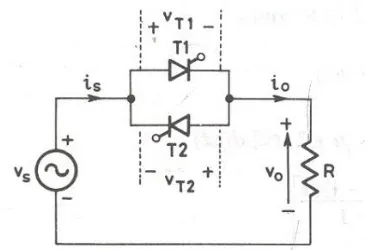
Vol. 7, No.1| June 2015| ISSN 2229-8932 Journal of Technical Education and Training (JTET) |69 Figure 1: Single phase full wave AC Voltage Controller
2.1 Participants
There were total 60 students enrolled, but this study was conducted with the group of 10 – 10 students by making two batches, all students from III year B.E. class. The ratio of male to female is approximately 6:4; the age group is around 18-20 year old.
In the first week, students were taught using blackboard, second week using PPT slides and in the third week using simulations. At the end of each session, students were given a feedback form and a set of a questionnaire to answer. The feedback form based on all used approaches were filled by the student. Feedback forms were designed to elicit students’ feedback on the various parameters including firing angle, modification, clarity, communication level, and creativeness. To complement data from the feedback form, short questionnaires were given which comprises of six items regarding approach, explanation level, and understanding of topic, communication, usefulness and creativeness. On the basis of this feedback and questionnaire from students, the level of applicability and effectiveness of the proposed approach were assessed.
2.2 Procedures
The case study is done on the topic of AC voltage controller from the power electronics subject under the electrical engineering courses. The teaching materials used to teach the unit based on the different presentation medium i.e., blackboard, ppt slides and software is here discussed.
(i) Blackboard technique in real classroom
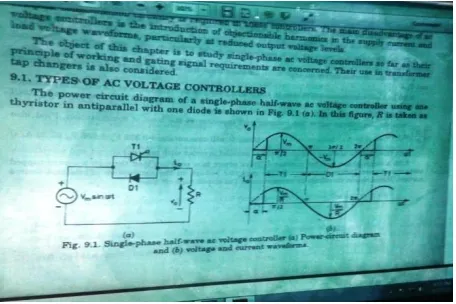
Vol. 7, No.1| June 2015| ISSN 2229-8932 Journal of Technical Education and Training (JTET) |70 Figure 2: Blackboard captured image from classroom
Here the author drew the circuit on blackboard first and followed by the waves for this particular circuit by taking some imaginary angle α. In this blackboard the author took the angle at 90 degrees. The author needed a lot of time to construct this circuit and the respective waves and even if change is to be made for the firing angle, it cannot be done was unable to do it at the simultaneously without a messy presentation on the blackboard. Furthermore, when blackboard was used, learning of the operation process of the devices could only be done through imagination. Furthermore, drawing the waves which is the typical way of teaching this unit using blackboard are consuming tasks.
(ii) PPT slides presentation technique in real classroom
PPT slides presentation can provide better visuals and save time. However, the materials need to be prepared in advance before the actual teaching. In this study, the author prepared a presentation on AC Voltage controller. The teaching materials are shown in the figure 3.
Vol. 7, No.1| June 2015| ISSN 2229-8932 Journal of Technical Education and Training (JTET) |71 Although using PP slides eliminates drawings while teaching, providing lots of simplicity to explain the working concepts of AC voltage controller, but with medium, students still need to understand the operation of circuits using their imagination.
(iii) Simulation technique in real classroom
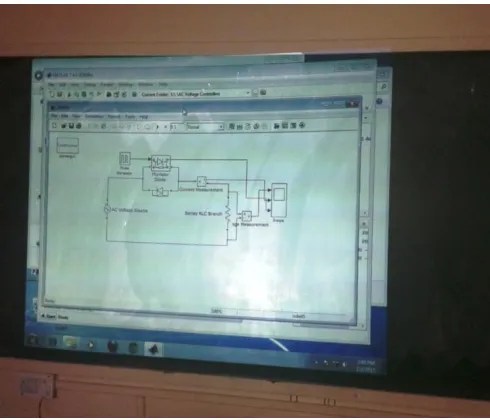
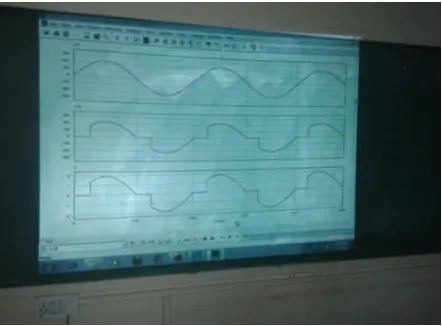
Simulation technique provides solutions to teaching this unit. Figure 4 -7 illustrates the applicability of the simulation method. Here the authors use the two simulation tools for explaining the AC voltage controller, i.e. MATLAB/SIMULINK and PSIM. Here the author could easily explain the operation of these circuits by drawing just in a few seconds or by pre preparing for this circuit and just simulate and run it in front of the student in the classroom. These provide a virtual operation and with the help of the input pulses the author can easily change the shape / performance of the circuit and devices Mehar (2012), Khader (2010).
Vol. 7, No.1| June 2015| ISSN 2229-8932 Journal of Technical Education and Training (JTET) |72 Figure 5: MATLAB/SIMULINK Software based captured image from classroom
Figure 6: PSIM Software based captured image from classroom
Vol. 7, No.1| June 2015| ISSN 2229-8932 Journal of Technical Education and Training (JTET) |73
3 FINDINGS AND DISCUSSION
The perceptions of students on the different types of teaching medium for AC voltage controller will be presented first followed by detailed explanation on the simulation based approach.
3.1 Students’ feedback on the use of the three different teaching mediums
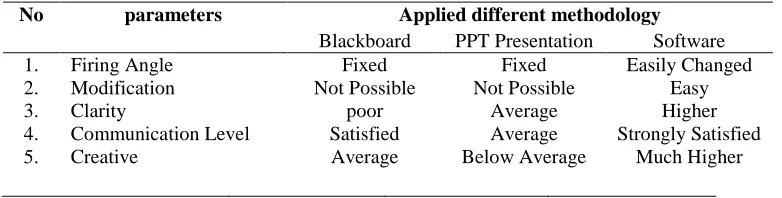
A feedback is taken from the students based on the different parameters, a feedback summary is provided in table 1, as the evidence of this case study.
Table 1: Comparison between Blackboard, PPT Presentation & Software Approach
No parameters Applied different methodology
Blackboard PPT Presentation Software
1. Firing Angle Fixed Fixed Easily Changed
2. Modification Not Possible Not Possible Easy
3. Clarity poor Average Higher
4. Communication Level Satisfied Average Strongly Satisfied 5. Creative Average Below Average Much Higher
The result from the feedback form indicate that students found that software approach were easily changed in term of firing angle compared to blackboard and PPT presentation, in addition with the circuit and can be easily modified at any time during the delivery of the lecture. This gives a strong and effective communication and showing some creative work.
Table 2: A questionnaire of Case Study
No parameters Applied different methodology*
Blackboard PPT Presentation Software
1. Approach 2 3 5
2. Explanation Level 3 3 4
3. Understanding of Topic 4 2 4
4. Communication 3 4 3
5. Usefulness 2 3 4
6. Creative 1 2 5
*Points given by student based on 1 – poor, 2 – good, 3 – medium, 4 – average, 5 - best
Vol. 7, No.1| June 2015| ISSN 2229-8932 Journal of Technical Education and Training (JTET) |74
3.2 Using MATLAB/SIMULINK based simulation
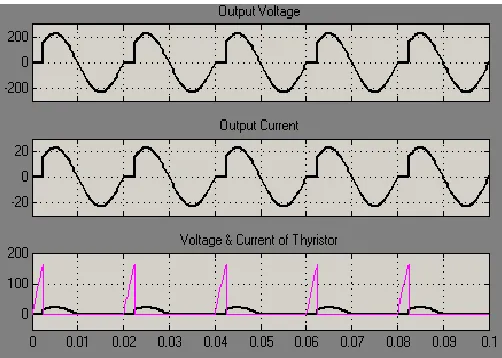
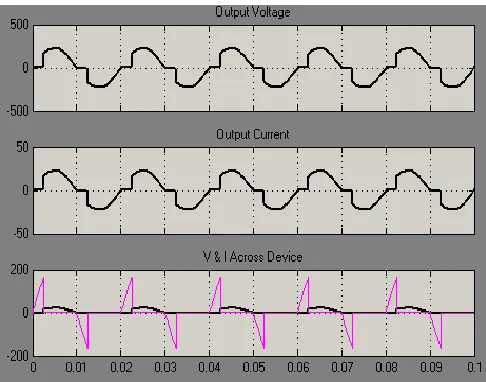
MATLAB/SIMULINK based Simulation model for AC voltage controller is shown in figure below. The performance of the devices is represented with the help of waveforms in fig. in this fig the waves for output voltage, current and V & I across the device are shown, for the simplicity of the concept of learning and presentation of proposed method here only a resistive load is considered (Mehar, 2012; Silva, 2013).
Figure 8: Simulation model of single phase half wave ac voltage controller
Vol. 7, No.1| June 2015| ISSN 2229-8932 Journal of Technical Education and Training (JTET) |75 Figure 10: Simulation model of single phase full wave ac voltage controller
Here with the change of the setting of the Pulse Generator we can easily change the firing angle of the device. We can also adopt the different firing schemes, but for this particular application the pulse generator is the best suitable option. For the different type of the load we can choose the different types of filtering circuits to improve the operation.
Vol. 7, No.1| June 2015| ISSN 2229-8932 Journal of Technical Education and Training (JTET) |76
3.3 PSIM based simulation
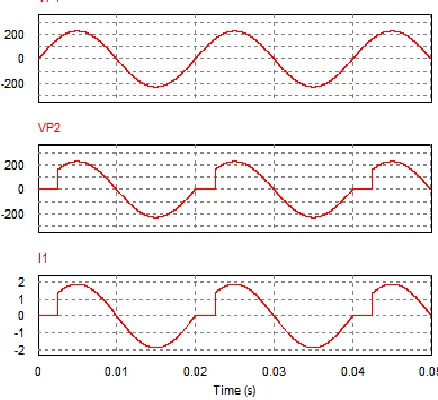
A PSIM based Simulation model for AC voltage controller is shown in figure below. The performance of the devices is represented with the help of waveforms in figure in this figure the waves for output voltage, current and V & I across the device are shown. For simplicity of the concept of learning and presentation of proposed method here only a resistive load is considered (Mehar, 2013; Canesin, 2010).
Figure 12: Simulation model of single phase half wave ac voltage controller
Vol. 7, No.1| June 2015| ISSN 2229-8932 Journal of Technical Education and Training (JTET) |77 Figure 14: Simulation model of single phase full wave ac voltage controller
Figure 15: Output results of single phase full wave ac voltage controller
Vol. 7, No.1| June 2015| ISSN 2229-8932 Journal of Technical Education and Training (JTET) |78
4 RECOMMENDATION
The following advantages derived when using Software in teaching power electronics courses:
1. It provides better visual operation of power electronics converters. 2. Use of software in classroom save the time of the faculty.
3. With user-friendly interface, simulation speed, capability of simulating any type of power converters and control circuits.
4. Students can use this software for their project works.
This paper provides a basic approach to deal with the software. The only limitation with this software approach is that a teacher needs to have computer knowledge and in-depth knowledge of power electronics to assess the accuracy of the results.
5 CONCLUSION
This paper provides a comparison between blackboard and PPT slides presentation approach versus software approach for teaching a unit in power electronics. As power electronic systems are getting more complex today, the simulation used for education requires more features. This approach is time saving and some directions in the development of simulation are discussed in this paper, with the help of available model; students can simulate the power electronics circuit with various load and conditions.
Reference
Hemant Mehar, (2012) “Software Application In Under Graduate Electrical Engineering Education”, International Journal of Engineering Research & Technology (IJERT), Vol. 1 (10).
Bhimbra, P. S., Power Electronics, 4th Ed., Khanna Publication, 2007.
Muhammad H. Rashid, Power electronics, circuit devices and application, 3rd Ed., Pearson education Inc., 2007. P.C. Sen, Power electronics, Tata McGraw-Hill publishing company, 2008.
BK khanchandani, Power electronics, Tata McGraw-Hill publishing company, 2008.
Hemant Mehar, (2012) “MATLAB Simulation Techniques in Power Electronics”, IEEE Technology and Engineering Education (ITEE), vol. 7 (4), pp. 62.
Chung Kuo, Jack Hsieh, FiruzZare, (2007), Senior Member IEEE, Gerard Ledwich, Senior Member IEEE “An Interactive Educational Learning Tool for Power Electronics” Conf. Power Engineering, Australasian Universities, AUPEC.
Rajesh Verma, Ashu Gupta and Kawaljeet Singh, (2008), “Simulation Software Evaluation and Selection: A Comprehensive Framework”, J. Automation & Systems Engineering, pp. 221-234.
Sameer Khader, “The Application of PSIM & MATLAB/SIMULINK in power electronics courses”, Conf. "Learning Environments and Ecosystems in Engineering Education"; IEEE Global Engineering Education Conference (EDUCON) – April 4-6, 2010, Amman, Jordan.
Kapilevich, B. Shaibon, H. ; Rahman, T.A. “Simulation modeling in electrical engineering: experience of teaching in University Technology of Malaysia”, IEEE First International Conference on Multi-Media Engineering Education Proceedings, 1994., pp. 92-98, July 1994.
Vol. 7, No.1| June 2015| ISSN 2229-8932 Journal of Technical Education and Training (JTET) |79 W. W. Cooley, P. Klinkhachorn, R. L. McConnell, and N. T. Middleton, (1991) “Developing professionalism in the
electrical engineering classroom,” IEEE Trans. Educ., vol. 34, pp. 149–154.
EuzeliCipriano dos Santos, Edison Roberto Cabral da Silva, (2013), “Power Block Geometry Applied to the Building of Power Electronics Converters” IEEE Trans. Educ., vol. 56 (2), pp.191–198.
A. Abramovitz, (2011) “Teaching behavioral modeling and simulation techniques for power electronics courses,” IEEE Trans. Educ., vol. 54, no. 4, pp. 523–530,.
M. Prince and R. Felder, “The many faces of inductive teaching and learning,” J. College Sci. Teaching, vol. 36, pp. 14–20, Mar. 2007.