CORRESPONDING AUTHOR: Dr Feroze Kaliyadan, Department of Dermatology, College of Medicine, King Faisal University, Al Hasa, Kingdom of Saudi Arabia And Department of Dermatology, Amrita Institute of Medical Sciences, Kochi, India
Introduction
Problem-based learning is being increasingly advocated by many medical schools as it is considered to be more effective in terms of developing life-long learning skills. Problem-based learning is an educational format in which learning takes place in small, self-directed
groups with actual problems and experiences forming the basis of active learning. The learning process commences with a ‘trigger’ which could be a clinical case scenario, a photograph or a video (1). PBL stimulates analytical thinking, application of thought process and acquisition of a broad spectrum of knowledge. The process is facilitated by a tutor who is trained in the process © Medical Education Department, School of Medical Sciences, Universiti Sains Malaysia. All rights reserved.
ABSTRACT
Problem-based learning is being increasingly advocated by many medical schools as it is considered to be more effective in terms of developing life-long learning skills. While there are many studies which have evaluated students’ attitudes and perceptions towards PBL, there are no studies which have evaluated whether these perceptions change with time. Our study aimed to assess whether students’ perception of a short module of PBL changed with time as they moved to higher years of study.Two groups of students who had been exposed to a short 6 weeks module of PBL were compared after 1 and 2 years of completing the modules respectively. Attitudes and perceptions were compared using a 5 point Likert-scale questionnaire.Both groups showed a positive perception to the PBL process especially with regards to areas like developing communication skills and motivation to study. There was no statistical difference with regard to the positive attitudes between the two groups. A positive attitude was seen to a short course of PBL in our institute and this did not change with time as students proceeded to higher years of study.
Students’ perceptions of a short Problem Based Learning module in an Arab
university: Do perceptions change with time?
Shivaraj Gowda1, Feroze Kaliyadan2, Tarek Tawfik Amin3, Fahad Al Wadani4, Surendra
Bathula5
1
Department of Biochemistry & Genetics, College of Medicine, King Faisal University, Al Hasa, Kingdom of Saudi Arabia and Department of Biochemistry, Subbiah Institute of Medical Science, Shivamogga, India. 2
Department of Dermatology, College of Medicine, King Faisal University, Al Hasa, Kingdom of Saudi Arabia And Department of Dermatology, Amrita Institute of Medical Sciences, Kochi, India. 3Department of Family and Community medicine, College of Medicine, King Faisal University, Al Hasa, Kingdom of Saudi Arabia. 4
Department of Ophthalmology, College of Medicine, King Faisal University, Al Hasa, Kingdom of Saudi Arabia. 5Department of Internal Medicine, College of Medicine, King Faisal University, Al Hasa, Kingdom of Saudi Arabia.
Volume 5 Issue 4 2013
DOI:10.5959/eimj.v5i4.158 www.eduimed.com
ARTICLE INFO
Received : 23/02/2013 Accepted : 05/06/2013 Published : 01/12/2013
KEYWORD
Problem Based Learning Attitudes
of small group facilitation (2). There has been a progressive shift in the way medical education is delivered; moving from traditional, didactic lecture based teaching methods towards a more 'problem-based' approach. Conventional teaching tends to separate the basic science segment from the clinical segment. In the conventional curriculum, teaching is tutor-centered and is essentially based on large group lectures, tutorials, structured laboratory experience, and periodic tests of achievement (3). Several studies have compared PBL with conventional teaching. In our institution we essentially had a traditional teacher centered curriculum. The undergraduate medical course lasts for 6 years (including one preparatory year). The students are exposed to the concept of PBL through a single 6 week module of PBL, which students undergo during the 4th year of study, after completing their basic science courses. Other than this the students are not exposed to standard PBL at any point before or after. Our study aimed to assess the outcome of a short 6 weeks module PBL on the attitude and perception of medical students in our institute. The focus of our study was to assess if the attitudes to a single module of PBL change with time as students progress through the years after completion of the module.
Method
The study was a cross-sectional survey. A total of 30 students each from the 5th and 6th year of the undergraduate medical course participated in the study. The 5 point Likert scale questionnaire to assess attitudes and perception was used (table 1) which was adapted from a study done by Klegeris, et al (4). All these students had been exposed to the short 6 week PBL module during the beginning of their 4th year course. This study was approved by the institutional ethical committee and participation in the study was voluntary after the students were given proper orientation regarding the study and informed consent was taken.
The reliability of the questionnaire was assessed using the Cronbach’s alpha. Mann-Whitney U and Kruskall Wallis tests were used to compare the responses between the two groups to PBL
and also to compare responses to PBL vs. traditional in the all the students. Statistical analysis was done using SPSS® version16.
Result
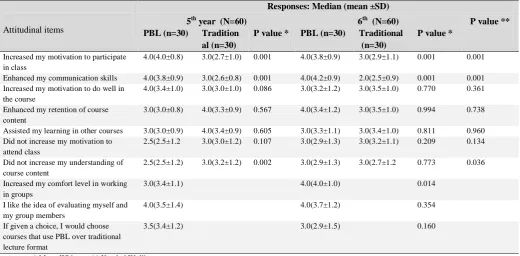
The questionnaire had a Cronbach’s alpha of 0.75, indicating good reliability. The summary of the frequency of responses to various items included are given in table 1. The mean, median and standard deviation of the responses in both groups are given in table 2 with levels of significance (Mann-Whitney and Kruskal-Wallis test). The statistical analysis showed that there was no significant difference in the students’ attitudes towards PBL according to the year of study. There was a statistically significant difference between the PBL and traditional curriculum mainly with respect to motivation and communication skills, with majority of students (both 5th and 6th year) feeling that PBL increased their motivation to study and their communication abilities (p value = 0.001 – Mann Whitney and Kruskal-Wallis tests). In the attitudinal score–75% of the students agreed or strongly agreed that the PBL module ‘Increased my motivation to participate in class’, while only 18.3% of true students agreed or strongly agreed with this statement in the context of the traditional teaching. Of the total 76.7% of the students agreed or strongly agreed that the PBL module ‘Enhanced my communication skills’ while in the case of the traditional teaching only 13.4% agreed or strongly agreed with the same statement.
Discussion
among PBLC students and teachers (6). In another study from Harvard University it was suggested that a PBLC helped develop interpersonal skills, psychosocial, knowledge and attitudes towards patients. They found PBLC were found to be better group (7). A similar study from McMaster University (8) showed that medical graduates of the PBLC were better prepared than their peers at independent learning, problem solving, self-evaluation, data gathering, behavioural sciences, and dealing with social and emotional problems of patients. Our results showed a statistically significant difference between the PBL and traditional curriculum mainly with respect to motivation and communication skills, with majority of students (both 5th and 6th year) feeling that PBL increased their motivation to study and their communication abilities and importantly there was no statistically significant difference in these positive perception between the two years.
Our study suggests that student's attitudes to the positive attribute of PBL continue to persist in spite of being exposed to only a small module. Our work was similar to one of the study done by Winning and Townsend (9). Interestingly another study has suggested that when continuously exposed to PBL, senior students tends to be more hesitant in having an open ended active discussion compared to the junior students. In this study an attitude scale was developed and compared students’ attitudes toward problem solving, self-directed learning, group based learning, web supported environments and the role of facilitator. The study involves second year students who have met PBL for the second time and for the first year students it was for the first time. The observation were first year students have more courage to develop hypotheses to solve the problems and have more ability to test and eliminate the hypothesis. The second year students who have more knowledge may be more hesitant to eliminate hypothesis without discussing them in detail (10). A similar attitude in our study may be attributed to the fact the students were more circumspect in developing and discussing hypothesis because of their initial knowledge.
They also found that students enjoyed PBL-based programs more than conventional programs because of the enhanced learning benefits, including understanding and retention of course materials. (10) Positive results in the development of communication skills, knowledge transfer, and self-directed learning skills, including problem-solving abilities were the findings of a study on PBL by Pastirik et al. (11). Klegeris, et al (4), also showed that their student responses towards communication skills, comfort level with group work, and ability to assess others were important positive outcomes of PBL. The same work indicated that participation in a hybrid course (a mix of PBL and traditional lecture) improves students’ ability to solve the problem. Thus our study of a short 6 weeks module PBL proved very effective in motivation and communication skills than the traditional curriculum.
The other main objective of our study was to assess if students’ attitudes to PBL change over the years, after being exposed to a single, short module. Our study suggests that in spite of being exposed to a single module, the positive attitude does not change as the students proceed to the higher years of study. We could not find any literature which has focused on this aspect with regard to PBL in medical education
The primary limitation of our study is the small study sample. Also the quality of the short module of PBL would be subject to various factors like the quality of cases and facilitation which might be different in different years of study, thereby making comparisons across students in different years of study difficult
Conclusion
A positive attitude was seen to a short course of PBL in our institute and this did not change with time as students proceeded to higher years of study.
Reference
2. Kilroy DA.Problem based learning. Emerg
Med J 2004;21: 411–413.
3. Nandi PL, Chan JNF, Chan CPK, Chan P, Chan LPK. Undergraduate medical education: comparison of problem-based learning and conventional teaching.
HKMJ 2000; 6: 301-306.
4. Klegeris A,Heather H. Impact of problem-based learning in a large classroom setting: student perception and problem-solving skills. Advan in Physiol Edu 2011; 35: 408-415.
5. Patel VL, Groen GJ, Norman GR. Effects of conventional and problem-based medical curricula on problem solving. Acad Med 1991; 66: 380-9.
6. Kaufman DM, Mann KV. Comparing students’ attitudes in problem-based and conventional curricula. Acad Med 1996; 71: 1096-1099.
7. Moore GT, Block SD, Style CB, Mitchell R. The influence of the New Pathway curriculum on Harvard medical students.
Acad Med 1994; 69: 983-989.
8. Woodward CA, Ferrier RM. The content of the medical curriculum at McMaster University: graduates’ evaluation of their preparations for post-graduate training. Med Educ 1983;17: 54-60.
9. Winning T, Townsend G. Problem-based learning in dental education: what’s the evidence for and against.. and is it worth the effort? Aust Dent J 2008; 52: 2-9.
10. Alper A. Attitudes Toward Problem Based Learning in a New Turkish Medicine Curriculum. World Applied Sciences Journal 2008; 4: 830-836.
Table 1 Responses to attitudinal items distributed by the type of curriculum among medical students, King Faisal University.
Attitudinal items
Responses: No. (%)
PBL (N=60) Traditional teaching (N=60)
1 2 3 4 5 1 2 3 4 5
Increased my motivation to participate in class
0 (0) 5(8.3) 10(16.7) 29(48.3) 16(26.7) 4(6.7) 19(31.7) 25(41.7) 6(10.0) 5(8.3)
Enhanced my communication skills
1(1.7) 4(6.7) 9(15.0) 27(45.0) 19(31.7) 7(11.7) 23(38.3) 22(36.7) 7(11.7) 1(1.7)
Increased my motivation to do well in the course
3(5.0) 12(20.0) 13(21.7) 27(45.0) 5(8.3) 2(3.3) 17(28.3) 20(33.3) 16(26.7) 5(8.3)
Enhanced my retention of course content
2(3.3) 12(20.0) 18 (30) 22(36.7) 6(10.0) 3(5.0) 9(15.0) 19(31.7) 20(33.3) 9(15.0)
Assisted my learning in other courses
2(3.3) 12(20.0) 19(31.7) 21(35.0) 6(10.0) 2(3.3) 9(15.0) 19(31.7) 25(41.7) 5(8.3)
Did not increase my motivation to attend class
13(21.7) 15(25.0) 17(28.3) 9(15.0) 6(10.0) 7(11.7) 9(15.0) 21(35.0) 17(28.3) 6(10.0)
Did not increase my understanding of course content
10(16.7) 24(40.0) 11(18.3) 9(15.0) 6(10.0) 8(13.3) 10(16.7) 24(40.0) 11(18.3) 7(11.7)
Increased my comfort level in working in groups
2(3.3) 7(11.7) 14(23.3) 21(35.0) 16(26.7)
I like the idea of evaluating myself and my group members
4(6.7) 7(11.7) 11(18.3) 24(40.0) 14(23.3)
If given a choice, I would choose courses that use PBL over traditional lecture format
11(18.3) 8(13.3) 15(25.0) 14 (23) 12(20.0)
1=strongly disagree, 2=disagree, 3=neither agree or disagree, 4=agree, 5=strongly agree
Table 2 Attitude scores according to year at college and curriculum, medical students, King Faisal University.
Attitudinal items
Responses: Median (mean ±SD)
5th year (N=60) 6th (N=60) P value **
PBL (n=30) Tradition al (n=30)
P value * PBL (n=30) Traditional (n=30)
P value *
Increased my motivation to participate in class
4.0(4.0±0.8) 3.0(2.7±1.0) 0.001 4.0(3.8±0.9) 3.0(2.9±1.1) 0.001 0.001
Enhanced my communication skills 4.0(3.8±0.9) 3.0(2.6±0.8) 0.001 4.0(4.2±0.9) 2.0(2.5±0.9) 0.001 0.001
Increased my motivation to do well in the course
4.0(3.4±1.0) 3.0(3.0±1.0) 0.086 3.0(3.2±1.2) 3.0(3.5±1.0) 0.770 0.361
Enhanced my retention of course content
3.0(3.0±0.8) 4.0(3.3±0.9) 0.567 4.0(3.4±1.2) 3.0(3.5±1.0) 0.994 0.738
Assisted my learning in other courses 3.0(3.0±0.9) 4.0(3.4±0.9) 0.605 3.0(3.3±1.1) 3.0(3.4±1.0) 0.811 0.960
Did not increase my motivation to attend class
2.5(2.5±1.2 3.0(3.0±1.2) 0.107 3.0(2.9±1.3) 3.0(3.2±1.1) 0.209 0.134
Did not increase my understanding of course content
2.5(2.5±1.2) 3.0(3.2±1.2) 0.002 3.0(2.9±1.3) 3.0(2.7±1.2 0.773 0.036
Increased my comfort level in working in groups
3.0(3.4±1.1) 4.0(4.0±1.0) 0.014
I like the idea of evaluating myself and my group members
4.0(3.5±1.4) 4.0(3.7±1.2) 0.354
If given a choice, I would choose courses that use PBL over traditional lecture format
3.5(3.4±1.2) 3.0(2.9±1.5) 0.160