Playout Buffer Aware Adaptation Scheme over Multi-client
LTE networks
Yuchen Chen
School of Electronic andInformation Engineering Xi’an Jiaotong University
Xi’an, China
[email protected]
Guizhong Liu
School of Electronic and Information Engineering Xi’an Jiaotong UniversityXi’an, China
[email protected]
Qinli Wang
School of Electronic and Information Engineering Xi’an Jiaotong UniversityXi’an, China
[email protected]
ABSTRACT
Nowadays, HTTP adaptive streaming (HAS) has become a cost-effective solution in delivering the video content. Dif-ferent from the one-client HAS, the HAS over multi-client faces many challenges. Due to the lack of the knowledge of the networks, one-client HAS will leads to the low efficien-cy in utilizing the limited bandwidth over the multi-client circumstance. In this paper, a playout buffer aware adapta-tion scheme over multi-client (PBMC) LTE networks is pro-posed to improve the performance of HAS. Firstly, a QoE metric is given that considers both the static quality and the quality smoothness. Secondly, to maximize the QoE, an integer programming problem is formulated. By consider-ing the playout buffer level, the resource requirement, which can guarantee the playout continuity, is formulated as a con-straint of the problem. Then, the feasibility of the problem is analyzed. If the problem is infeasible, a method is given to exclude the users as less as possible to obtain the fea-sibility. When the problem is feasible, a graph model can be constructed based on the resource requirement and the playout buffer level. With the model, the solution can be converted to finding a feasible path with the highest QoE in the graph, which can be solved by employing the dynamic programming. Finally, the simulation results can verify the performance of PBMC in both improving the static quality and guaranteeing the playout continuity.
Categories and Subject Descriptors
H.4 [Information Systems Applications]: Miscellaneous
General Terms
Algorithms,Performance
Keywords
Playout Buffer, Adaptation, streaming, LTE, Multi-client
1.
INTRODUCTION
With the development of the wireless networks and the mo-bile equipments, video streaming has increased its popular-ity dramatically in the recent years. According to the re-port from Cisco, the mobile video will grow faster than any other mobile service with the CAGR (Compound Average Growth Rate) of 69 percent from 2013 to 2018[4]. Thanks to the flexibility of the Web platform, HTTP adaptive stream-ing (HAS) has become a cost-effective solution in deliverstream-ing video content. The source video sequences are pre-encoded into several versions with different quality level. Meanwhile, a video sequences will be split into small segments, each of which contains several video frames. The clients dynamical-ly request the video segments at each switching point based on its estimated network condition and its playout status.
The basic objective of HAS is to sustain the continuous play-out process. In [2], the transmission capability of the net-work is estimated used to decided which version to request. In [10], a more complicated estimation method is proposed, which considers both the past and instant throughput. In fact, not only the throughput but also the playout buffer s-tatus should be taken into consideration when making adap-tation decisions. In [9], the buffer level is split into several ranges. According to the range that the buffer level lies in, different actions will be applied to keep the buffer level steady. For instance, if the buffer level is low, the UE would request for the version with low quality to avoid the playout interruption. On the contrary, when the buffer level is high, the higher version would be requested to improve the static quality and the quality smoothness. Although the schemes described above can bring some improvements of the perfor-mance, experimental results showed that the competition of the shared network resource in the bottleneck could lead to degradation in fairness, stability and efficiency, which would negatively impact the QoE of the HAS users[1][8]. In [3], the disadvantage of the client-side adaptation is introduced specifically, which can be described as follows. Because of lacking the knowledge of other UEs, the client-side solutions cannot control the UEs to share the resource in a coordi-native way, which would results in incorrect throughput es-timations, unnecessary quality oscillations and suboptimal decisions. The possibility of locating the adaptation in net-work has been shown in this paper. In [12], the adaptation problem is formulated as an optimization problem, which jointly determine the requests of all the UEs together. How-ever, the playout continuity cannot be guaranteed by the model, which is an important QoE factor. This would bring
MOBIMEDIA 2015, May 25-27, Chengdu, People's Republic of China Copyright © 2015 ICST
eNodeB UE
UE
UE
UE
Video Server
Router
Router
GW
Figure 1: The Topology of the Network
a severe limitation of its performance in improving the HAS performance over multi-client circumstance.
To improve the performance of HAS, the playout buffer aware adaptation scheme over multi-client LTE networks is proposed in this paper, which has the novel aspects as follows:
1) QoE assessing metric. By analyzing the weaknesses of the existing assessing schemes, an novel QoE assessing met-ric is given, which considers the static quality and the qual-ity variation, where the qualqual-ity variation is considered as a modification of the static quality.
2) Adaptation problem formulation. The adaptation prob-lem is formulated as an integer programming probprob-lem, aim-ing at maximizaim-ing the total QoE of all the users. By con-sidering the occupancy of the playout buffer, the continuity of the playout process is formulated as several constraints of the problem. The buffer level can be interpreted as the urgency of the users, based on which the adaptation could be more reasonable and the radio resource can be utilized more efficiently.
3) Solution of the problem. Due to the scarce and unsta-ble features of the wireless channel, the prounsta-blem might be infeasible. If the adaptation problem is feasible, the integer programming problem can be solved by a graph model us-ing dynamic programmus-ing. Otherwise, a method is given to exclude the users as less as possible to obtain the feasibility.
The remaining of the paper is organized as follows. Section 2.1 introduces the system model. The proposed scheduling scheme is described in detail in Section 3. The simulation re-sults of our algorithm are evaluated and analyzed in Section 4. Finally, a conclusion is drawn in Section 5.
2.
SYSTEM MODEL
2.1
System Architecture
The system architecture is shown in Fig.1. In this paper, we study a normal Long Term Evolution (LTE) wireless system with one eNodeB (Base Station) and several downlink UEs (Mobile Stations). The active users use different categories of UEs to adaptively request the video content stored in the video server. After the video server receives the requests
HAS Server
HTTP request User 1
User 2
User K . . . Video 1
Video 2
Video K . . .
User 1
User 2
User K
. . . . . . Transmitter
Play Buffer
Play Buffer
Play Buffer
Data Decision Making Input
Adaptation Decision Playout Buffer
Information
Adaptation Module
Adaptation Decision
Radio Resource Information
eNodeB
MPD
Figure 2: The System Block Diagram
sent by the UEs, the video data will firstly be transmitted to the eNodeB through several wired networks, which are shown as the routers in the figure. Then, according to the resource allocation scheme, the video data will be scheduled and transmitted to the UEs. After all the frames belong to the segment have been fully received, the video segment can be decoded and put into the playout buffer. Finally, the HTTP streaming client can playout the buffered video frames.
The block diagram of the system is shown in Fig.2, which describes the functionality of the adaptation module more specifically. Initially, the server will send the media presen-tation description (MPD) to the HAS clients so that both the eNodeB and the UEs will get the information of the video segments. Then, the UEs will request for the content according to their interest. For the client-side adaptation schemes, the UEs are responsible for periodically requesting for the segments , while the eNodeB will be responsible for that in our algorithm. The eNodeB will jointly considers the playout buffer level, MPD and the radio resource informa-tion to accomplish the adaptainforma-tion. Here, we assume that the length of the request period equals to the playout duration for a video segment.
As the most promising cellular system, LTE is considered in this paper. Moreover, the extraordinary transmission rate of LTE make it more suitable for providing HTTP streaming services than the other systems. Although LTE is considered specifically here, the algorithm proposed is generic and can be easily extended to some other cellular networks such as Worldwide Interoperability for Microwave Access (WiMAX) and High Speed Downlink Packet Access (HSDPA).
2.2
QoE Assessing Metric
The objective of the proposed scheme is to improve the QoE of the video streaming users. Hence, the QoE assessment method could significantly influence the performance of the adaptation. According to the existed works, there are three factors that influence the QoE most.
playout process for a while. Nevertheless, when the channel quality doesn’t recover from the bad condition, the buffer might be underflow and the playout would be interrupted. According to the analysis in [5], the playout discontinuity could have a severer deterioration to the QoE of the users than the other factors. Frequent or constant interruptions would severely disrupt the users’ QoE. To effectively preven-t preven-the inpreven-terruppreven-tions, HAS is designed preven-to mapreven-tch preven-the bipreven-t rapreven-te of the video and the transmission capability of the wireless channel. Therefore, the playout continuity is regraded as the basic requirements of the users in this paper. By con-sidering the playout buffer level, the resource requirement, which can guarantee the playout continuity, is formulated as a constraint of the problem described in Section 3.
2) Static quality. This metric refers to the quality of a sin-gle video frame, which corresponds to the different quality versions. And the higher quality always means the higher bit rate. In this paper, Peak Signal to Noise Ratio (PSNR) is used. It is assumed that there is no packet loss in the network by utilizing the retransmission. Then, the PSNR of each version can be calculated previously in the HAS server, which reduces the requirement of the knowledge of the orig-inal video sequence in assessing the QoE. When the eNodeB receives the MPD information, the average PSNR for each segment on each version can be obtained. The PSNR for the
l-th version of the segment that thek-th UE will request is denoted asP SN Rk,l.
3) Quality smoothness. Although the quality switches can be used to guarantee the continuity, they would deteriorate the QoE if they appear frequently and/or drastically. In [11] and [6], the quality variation is considered as the standard deviation of the quality level of the past several video seg-ments, which is unreasonable. From the perceptual perspec-tive, the more frequent the variations there are, the worse QoE the users will experience even if the static quality is the same. For instance, assume the PSNR of the five consecutive segments are (33,36,33,36,33). Although the PSNR of the first and the fifth segment are the same, the QoE the fifth segment brings is much worse than the first one. Assume there beS switches in the past T seconds and the PSNR variation for each switch is ∆P SN Rs,1 ≤s ≤S. In this
paper, the quality variation is considered as a negative
influ-ence to the static quality and is denoted asS∗
S ∑ s=1
∆P SN Rs.
Therefore, the QoE metric for thek-th user to request the
l-th version can be written as in Eq.1, wherea is a tunable parameter that is set empirically.
QoEk,l=P SN Rk,l−a∗S∗ S ∑
s=1
∆P SN Rs (1)
3.
PROPOSED PLAYOUT BUFFER AWARE
ADAPTATION SCHEME OVER
MULTI-CLIENT LTE NETWORKS
3.1
Problem Formulation
The parameters to be determined are the adaptation deci-sions τk,l fork-th user on thel-th version, where the k-th
user will request for the l-th version if τk,l = 1. The
ob-jective of the problem is to maximize the total QoE of the users, which has been defined in Eq.1. The total number of
the active UEs in the network is K and the total number of the quality versions isL. By considering the information of the playout buffer and the radio resource, the problem is formulated as the following integer programming problem.
max
K ∑ k=1
L ∑ l=1
QoEk,l∗τk,l
s.t. (1)Tk∗N≥ L ∑ l=1
k ∑ i=1
Si,l Ri ∗τi,l
(2)
L ∑
l=1
τk,l= 1,1≤k≤K
(3)τk,l∈ {0,1}
. (2)
The constraints will be explained as follows:
1) The constraint (1) corresponds to the guarantee of the playout continuity. As described above, the playout buffer is mainly for storing the unplayed video content to with-stand the fluctuation of the wireless channel. The playout duration of the buffered data in the buffer of thek-th UE is denoted asTk. To avoid the playout interruption, the
re-quested data should be fully received by the UE inTk. More
specifically, the transmission rate that the available radio re-source can provide should be larger than the requirement of the UE, which is the contraint (1). The left part refers to the available resource. In the LTE system, the smallest re-source allocation period is the Transmission Time Interval (1ms). In each TTI, there areN Resource Blocks (RB) can be used and the RBs could be multiplexed in the next TTI. Therefore, the number of the available RBs before thek-th UE uses up the buffered data isTk∗N. Then, the right part
corresponds to the requirement of the k-th UE, where Sk,l
is the total size of thel-th version of the segment andRk is
the average transmission capability of one Resource Block (RB) for the k-th UE.Rk is calculated asRk = RBN umT Ck
k,
where RBN umk is the number of the RBs that have been
allocated to thek-th UE andT Ck is the total transmission
capability provided by theRBN umk RBs. Therefore, the
RB requirement of the l-th version for UEk is (Sk,l/Rk).
In addition, the initial condition and the behavior in a spe-cial case are discussed. when the algorithm initiates, all the UEs will request for the lowest version of the first segmen-t. Moreover, due to the fluctuation of the wireless channel, the video segment requested in the last request period might cannot arrive on time, which would makeTkbe 0. IfTk= 0,
thek-th UE will continue to wait for the previous requested segment instead of requesting for new segments. So theTk
will be set to the length of the requesting periodTreq and
the resource requirementSk,lwill be set to the residual size
of the previous requested segment which can be obtained in the eNodeB.
2) The constraint (2) and (3) are the constraints of the in-teger adaptation decision variable τk,l. The constraint (2)
indicates that one UE can only request for one version at each adaptation point. And the constraint (3) means the decision for one version can only have two states (1:request-ed, 0:not requested).
small and the UE would request for the low quality version to satisfy the constraint and keep the continuous playout. Otherwise, if the level is high, the constraint can be easi-ly satisfies and the UE can request for the higher versions to maximize the QoE. In fact, the playout buffer level is an important indication of urgency of the clients. The idea here is similar to the one in [9], while it is considered more intelligently in our model. Secondly, the radio resource in-formation is considered, such as the number of the available RBs and the average transmission rate for the UEs , which can effectively prevent the on-off problem mentioned in [8]. Since the UEs are considering jointly in the eNodeB, the UEs would not compete for the shared resource blindly and the resource can be utilized in a rational way to maximize the total QoE.
3.2
Problem Solving
Since the wireless channel is unstable, the radio resource might cannot satisfy the requests of all the users, which would make the problem in Eq.2 infeasible. In this subsec-tion, the feasibility of the problem has to be analyzed firstly. Then, the solving method (if feasible) and the method to ob-tain the feasibility (if infeasible) are described respectively
From the theoretic perspective, the problem is feasible if the radio resource can meet the requirements when all the UEs request for the lowest quality version. The condition can be formulated in Eq.3. The number of the RBs required to keep the continuous play if thek-th UE request for thel-th version is denoted asN(k, l) =Sk,l/Rk, where the version 1
is the lowest version. Then, based on the playout duration
Tk, the UEs can be sorted into an ascending order, where UE
1 has the minimum durationT1and UEkhas the maximum
durationTK.
(1)N1,1≤T1∗N
(2)N1,1+N2,1≤T2∗N
...
(K)
K ∑ k=1
Nk,1≤TK∗N
(3)
If all the above constraints are satisfied, the problem is fea-sible. Otherwise, to obtain the feasibility, some UEs have to be chose to not request in the current period. Then, the solution will be discussed in these two conditions.
1) The solution when the problem is feasible
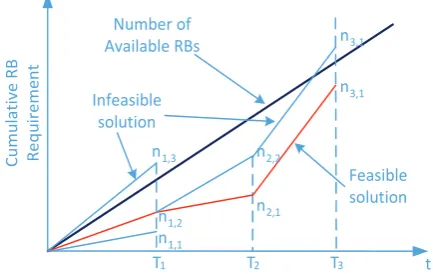
Based on the constraints (1) in Eq.2, the solution of problem can be converted to finding a path in a graph model. The graph model is noted asG= (N, E), whereN is the set of the nodes andE is the set of the edges. InN, each node
nk,lrepresents a quality version of a specific user, which has
three attributes: the UE indexkp, the version indexlpand
the number of RBs requiredNk,l. Given two arbitrary nodes
nkp,lp andnlkq, lq, if they satisfy
kq=kp+ 1, (4)
there exist a edge ep,q ∈ E which is direct from nkp,lp to
nkq,lq. The path pis a direct simple path, which consists
of a sequence of nodes (n1,l1, n2,l2, ..., nK,lK) connected by
t
C
u
m
u
la
ti
v
e
R
B
R
e
q
u
ir
e
m
e
n
t
T 1,1
T2 T1
Number of Available RBs
n 1,2 n
1,3 n
2,1 n
2,2 n
3,1 n
3,1 n
Feasible solution Infeasible
solution
3
Figure 3: Analysis of the Feasibility
a sequence ofK−1 edges. Each pathprepresents an adap-tation decision of all theKUEs. Letn1,l1be the start node
andnK,lK be the last node. Then only the path that
satis-fies the constraints in 3 is a feasible one. For a given path, the QoE for each user can be calculated by Eq.1, where the optimal path is the one with the largest total QoE of all the users. The graph model can be explained in Fig.3, where the black bold line refers to the available RBs and the blue line stands for the cumulative requirement of the RBs. A path is feasible if it is always below the the curve of the avail-able RBs, where the path (n1,2, n2,1, n3,1) plotted as the red
line is a feasible one. As we can see, the version 3 of UE 1 is not acceptable and all the paths start fromn1,3 are not
feasible. Meanwhile, any path includesn1,2 andn2,2) is
in-feasible because even if the lowest version of UE 3 cannot be satisfied.
Based on the graph model, the optimal path can be obtained by the dynamic programming.
2) The method to obtain the feasibility when the problem is infeasible
In this case, some UEs have to be excluded, which mean-s themean-se UEmean-s will not requemean-st in the current requemean-st period. The UEs will be excluded one at a time until the problem is feasible. The infeasibility is induced by violating the con-straints (1) in Eq.2. The satisfiability will be test according to the ascending order of the playout duration Tk. If the
k-th constraint is violated, one of the firstkUEs should be excluded, which is selected according to the following rules:
• The UEs whose playout durationTkis longer than the
length of the request periodTreq will be excluded.
S-ince even if these UEs don’t request for new segments, their playout process will not be interrupted and the exclusion of these UEs would deal little damage to the users’ QoE. Moreover, these UEs will be reordered ac-cording to the value ofTk−Treq. The UEs with higher
Tk−Treq are less urgent and will be excluded earlier
than the other.
• If there isn’t any UE with positiveTk−Treq, an
Table 1: The configurations of the LTE network
RB number 10
Active UE number 6
Propagation Model Macro-Cell Urban Mode Turbo Coding Rate 1/2 or 3/4
eNodeB Power 43 dbm
uniformly distributed among RBs
CQI Full bandwidth
report period = 1 ms scheduler Rate Guaranteed (RG) in [7]
as
mk=
Rk
Sk,l/Tk
. (5)
The UEs will be excluded according to the ascend or-der of the efficiency metric, where the UE with the leastmkwill be the first. The UE with worse channel
quality and larger rate requirement will be excluded firstly. In this way, the number of the excluded UEs can be as less as possible to obtain the feasibility of the problem.
When the problem becomes feasible, the solution can be ob-tained as described in the condition if the problem is feasible.
Last but not least, after the optimal solution is found, the number of the available RBsTreq∗N might be larger than
the total requirements
K ∑ k=1
L ∑ l=1
Sk,l∗τk,l/Rk. Although the
playout continuity of the excluded UEs cannot be guaran-teed, the left RBs can be utilized for them to request. The excluded UEs with the highest efficiency metric (defined in Eq.5) will acquire the opportunity and will request for the lowest quality version. This procedure will execute until
K ∑
k=1 L ∑
l=1
Nk,lτk,l>=N∗Treq.
4.
PERFORMANCE EVALUATION
4.1
Experiment Setup
The evaluation is based on a NS3 based LTE simulation platform. Through modifying the application layer in the platform, we embed the real H.264 video encoder and de-coder (JVT reference software, JM 16.2) to better simulate the video traffic characteristics. The simulation is based on the network topology as shown in Fig.1 and the details of the LTE networks is shown in Table.1. The scheduler used is the Rate Guaranteed (RG) which can guarantee the min-imum serving rate of each user. The video sequence used in the test isF oremanthat is encoded with the frame rate 30 fps, GOP (Group Of Picture) 12 frames. The total length of the sequence is 3000 frames (50 segments), which is built by duplicating the original sequence (300 frames) 10 times. The original sequence is encoded into five quality versions, of which the bit rate and PSNR for each segment are shown in Table.2 and Table.3 respectively.
The compared algorithms involve some client-side schemes that solve the problem in the perspective of a single clien-t(such as Throughput Based scheme (TB) [10] and Buffer
Table 2: Average Bit Rate (kbps) for each segment
Ver Seg
1 2 3 4 5
1 276.772 276.652 349.024 361.864 307.148 2 316.912 316.412 400.604 426.148 368.648 3 360.828 358.128 455.016 489.436 432.208 4 406.768 404.12 510.948 559.816 500.908 5 470.664 464.868 589.392 646.668 600.804
Table 3: Average PSNR for each segment
Ver Seg
1 2 3 4 5
1 34.7673 34.9400 35.0512 34.3863 32.0121 2 35.4151 35.6063 35.7463 35.1485 32.8418 3 35.9606 36.1530 36.3010 35.7509 33.4494 4 36.5297 36.7192 36.8643 36.4059 34.1282 5 37.1930 37.3587 37.5627 37.1145 34.9534
Based scheme (BB)[9]), the existing scheme for multi-clients such as Continuum Driven adaptive scheme (CD)[12] and our proposed Playout-Buffer Aware adaptive Scheme over Multi-Client environment (PBMC).
4.2
Performance of PBMC
In this subsection, the continuity, static quality and the quality smoothness will be evaluated for the compared al-gorithms. Firstly, the continuity of the playout process is evaluated. The results of the interruption duration for each algorithm are shown in Fig.4. Based on the playout buffer level, the continuity of the playout process is considered as the constraints in our model, which can effectively avoid or shorten the playout interruption compared with other adap-tation schemes. Hence, PBMC acquires the lowest inter-ruption duration as shown in the figure. Since the playout buffer information is ignored by CD, the interruption dura-tion is longer than PBMC. Different from the TB and BB, the adaptation of all the active UEs are considered jointly in PBMC and CD, which can make the decisions more ra-tionally and reasonably and the on-off problem can be well solved. Therefore, the performance of BB and TB are much worse than PBMC and CD. Owing to the consideration of the buffer level, BB behaves better than TB. The reason is that when the buffer level is low, BB will actively degrade the requested level to prevent the buffer underflow, while the requests of TB are determined only based on the estimated transmission capability.
UE 1 UE 2 UE 3 UE 4 UE 5 UE 6 MEAN 0
1 2 3 4 5 6 7 8
In
te
rr
u
p
ti
o
n
D
u
ra
ti
o
n
(s)
PBMC CD BB TB
Figure 4: Interruption Duration for the six users under each adaptation scheme
quality, the poor playout continuity makes CD cannot meet the requirement of the HAS over multi-client environmen-t, while both the static quality and the continuity can be guaranteed by PBMC.
UE 1 UE 2 UE 3 UE 4 UE 5 UE 6 MEAN 30
31 32 33 34 35 36 37 38 39 40
A
ve
ra
g
e
P
S
N
R
PBMC CD BB TB
Figure 5: Average PSNR for the six users under each adaptation scheme
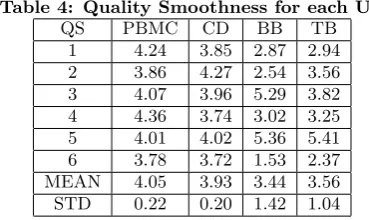
Then, the quality smoothness is evaluated. The metric in [12] is employed, which considers the number of quality switches and the intervals between the switches. The quality smoothness metric (QS) is defined as
QSk= v u u u t
S ∑ s=1
n2 s
S , (6)
where S is the total number of the switches andns is the
number of the segments between thes-th ands+1-th switch-es.
As the results in Table.4 show, PBMC and CD can obtain better performance in both the quality smoothness and the fairness by considering the quality smoothness in QoE.
4.3
Impact of the Available RB
Table 4: Quality Smoothness for each UE
QS PBMC CD BB TB
1 4.24 3.85 2.87 2.94 2 3.86 4.27 2.54 3.56 3 4.07 3.96 5.29 3.82 4 4.36 3.74 3.02 3.25 5 4.01 4.02 5.36 5.41 6 3.78 3.72 1.53 2.37 MEAN 4.05 3.93 3.44 3.56 STD 0.22 0.20 1.42 1.04
The beahvior of the adaptation scheme largely depends on the transmission capability of the system. Therefore, the performance of the schemes are tested when the number of the available RBs in the system changes. Firstly, Fig.6 de-picts the average interruption durations for the six users. With the increase of the available RBs, the interruption du-ration decreases because the packet delay decreases. When the RB number increases, the playout buffer level will stay at a high level, which makes the decision of BB mainly de-pends on the estimated transmission rate that is the same as TB. Hence, the performance of BB is approaching the one of TB. The main difference between CD and PBMC is whether to consider the playout buffer level to guarantee the continuity. When the resource is abundant, the high play-out buffer level reliefs the weakness of CD, which makes it acquire the performance near to PBMC.
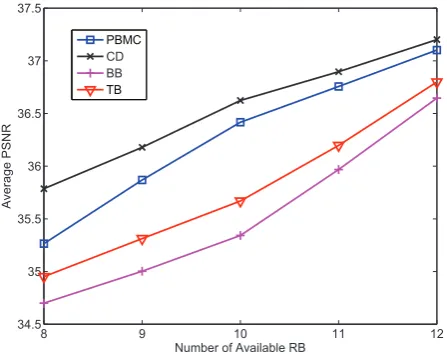
Then, how the average PSNR changes with the number of the available RBs is shown in Fig.7. When the radio re-source increases, the PSNR that the user experience increas-es as well, which means the increasing rincreas-esource can afford for the transmission of the version with high quality. With the increase of the resource, the performance of TB and BB increase dramatically for the reason that the on-off problem disappears gradually when there is enough resource for all the users to transmit high level versions. From the results shown in Fig.6 and Fig.7, all the schemes can perform well when the radio resource is abundant, while only the PBMC can leads to the least the performance degradation when the radio resource is scarce.
5.
CONCLUSIONS
perfor-8 9 10 11 12 0
1 2 3 4 5 6 7 8 9
Number of Available RB
A
ve
ra
g
e
I
n
te
rr
u
p
ti
o
n
D
u
ra
ti
o
n
(s)
PBMC CD BB TB
Figure 6: Average Interruption Duration under each adaptation scheme when RB number changes
8 9 10 11 12
34.5 35 35.5 36 36.5 37 37.5
Number of Available RB
A
ve
ra
g
e
P
S
N
R
PBMC CD BB TB
Figure 7: Average PSNR under each adaptation scheme when RB number changes
mance of PBMC in guaranteeing the QoE of all the users in the networks.
The objective of scheduling and adaptation are the same, which is to improve the QoE of the users. Hence, the future work can be considered to improve the performance of HAS by jointly determining the adaptation and the scheduling decisions.
6.
ACKNOWLEDGMENTS
This work is supported by the National Natural Science Foundation of China Project No.61173110.
7.
REFERENCES
[1] S. Akhshabi, L. Anantakrishnan, A. C. Begen, and C. Dovrolis. What happens when http adaptive streaming players compete for bandwidth? In
Proceedings of the 22nd international workshop on Network and Operating System Support for Digital
Audio and Video, pages 9–14. ACM, 2012.
[2] S. Akhshabi, S. Narayanaswamy, A. C. Begen, and C. Dovrolis. An experimental evaluation of rate-adaptive video players over http.Signal
Processing: Image Communication, 27(4):271–287,
March 2012.
[3] N. Bouten, S. Latre, J. Famaey, W. Van Leekwijck, and F. De Turck. In-network quality optimization for adaptive video streaming services.Multimedia, IEEE
Transactions on, 16(8):2281–2293, November 2014.
[4] Cisco. Cisco visual networking index: Global mobile data traffic forecast update, 2013´lc2018. InCisco
Systems Inc ,Feb. 5, 2014.
[5] T. De Pessemier, K. De Moor, W. Joseph, L. De Marez, and L. Martens. Quantifying the influence of rebuffering interruptions on the user’s quality of experience during mobile video watching.
Broadcasting, IEEE Transactions on, 59(1):47–61,
February 2013.
[6] J. De Vriendt, D. De Vleeschauwer, and D. C. Robinson. Qoe model for video delivered over an lte network using http adaptive streaming.Bell Labs
Technical Journal, 18(4):45–62, July 2014.
[7] P. A. Hosein. Qos control for wcdma high speed packet data. InMobile and Wireless Communications
Network, 2002. 4th International Workshop on, pages
169–173. IEEE, 2002.
[8] J. C. Jiang, V. Sekar, and H. Zhang. Improving fairness, efficiency, and stability in http-based adaptive video streaming with festive.Networking, IEEE/ACM
Transactions on, 22(1):326–340, February 2014.
[9] C. M, S. Lederer, and C. Timmerer. An evaluation of dynamic adaptive streaming over http in vehicular environments. InProceedings of the 4th Workshop on
Mobile Video, pages 37–42. ACM, 2012.
[10] T. C. Thang, Q. D. Ho, J. W. Kang, and A. T. Pham. Adaptive streaming of audiovisual content using mpeg dash.Consumer Electronics, IEEE Transactions on, 58(1):78–85, March 2012.
[11] X. L. Deng, L. Chen, F. Wang, Z. S. Fei, W. Bai, C. Chi, G. L. Han, and L. Wan. A novel strategy to evaluate qoe for video service delivered over http adaptive streaming. InVehicular Technology
Conference (VTC Fall), 2014 IEEE 80th, pages 1–5.
IEEE, September 2014.
[12] Z. S. Yan, J. T. Xue, and C. W. Chen. Qoe continuum driven http adaptive streaming over multi-client wireless networks. InMultimedia and Expo (ICME),
2014 IEEE International Conference on, pages 1–6.