MiTigaTiNg dySfuNCTiONal audiT
BEhaViOR: aNalySiS Of ORgaNiZaTiONal
COMMiTMENT, audiTOR PERfORMaNCE
aNd TuRNOVER iNTENTiON
rizqa Anita1, Muhammad rasyid Abdillah1*
rita Anugerah2 and Nor balkish Zakaria3
1College of Management,
Da-Yeh University, Taiwan.
2Department of Accounting, Faculty of Economics,
Universitas riau, Indonesia.
3Accounting Research Institute,
Universiti Teknologi MArA, Malaysia. E-mail: [email protected]
AbSTrACT
Public accounting firms are expected to increase audit quality with
mitigating dysfunctional behavior. Understanding what causes dysfunctional audit behavior is critical for public accounting firms. The purposes of this
study are to investigate the effects of organizational commitment on auditor acceptance of dysfunctional audit behavior through turnover intention and auditor performance. The Partial Least Square analysis was applied to a questionnaire survey data from 129 auditors working in public accounting
firms in Sumatera Island (Indonesia). results indicate that auditors who are
more accepting of dysfunctional audit behavior tend to possess an exhibit higher turnover intention, report lower level of auditor performance and
weak organizational commitment. Further analysis found that turnover
intention and auditor performance mediate the effect of organizational commitment on auditor acceptance of dysfunctional audit behavior.
Keywords: auditor acceptance of dysfunctional audit behavior, organizational commitment, turnover intention, and auditor performance.
ArTIClE InFO Article History:
iNTROduCTiON
Auditors are responsible for planning and implementing audits appropriately (Arens et al., 2012). Audit planning is needed to ensure that the opinions
of audited financial statements are free of material misstatements and errors. An unqualified opinion can be given if the auditor believes that
the supporting evidence has been collected according to the procedures
established (Arens et al., 2012; Angkoso et al., 2014). To obtain audit
quality, auditors should comply with all of the audit programs and audit procedures properly (Malone and Roberts, 1996). However, Angkoso et al. (2014) found that auditors do not perform audit procedures that have been established. In fact, research shows dysfunctional audit behavior such as premature sign-off, underreporting of time and altering /replacement of audit procedures performed by the auditor can certainly decrease audit quality (Donnelly et al., 2003a). Dysfunctional audit behavior is a violation of audit programs and audit procedures that have been established (Donnelly et al., 2003a). Dysfunctional audit behavior is a very important issue for
the public accounting firms because it can reduce audit quality and even
cause the failure of audits. Prior research hasshown that dysfunctional audit behavior shown by auditors such as underreporting of time (Smith and
Marguerite, 1995). Underreporting of time is the time required to report
the audit activity made shorter than the actual time (Kelley and Margheim, 1990). Studies showed that auditors complete the audit assignment by using
personal time in public accounting firms (Smith and Marguerite, 1995; Donnelly et al., 2003a; Outley and Pierce, 1996). Donnelly et al. (2003a)
reported that more than 50% of AICPA members confessed to sign off on audit step or conduct an audit below the standard quality. The survey on
senior auditors in six large public accounting firms in Ireland also showed
that 89% of respondents reported some form of audit quality reduction behaviors (eg premature sign off) and estimate that an average of 12.2% forms of deviations are reported and a total audit time with a shorter time than the actual time (outley and Pierce, 1996). Research conducted by Alkautsar (2014) in Indonesia also indicates that 8 public accountants (AP)
and the public accounting firms were given a business license suspension by the finance minister because they were not following auditing standards
Auditors’ personal characteristics such as organizational commitment,
auditor performance, and turnover intention cause auditors to commit
dysfunctional audit behavior (Donnelly et.al, 2003a; Kelly and Margheim,
1990). Paino et al. (2012) found that auditors with weak organizational
commitment are likely to accept dysfunctional audit behavior. While
Donnelly et al. (2003a) and Paino et al. (2014) also found that auditors with
low performance tend to accept dysfunctional audit behavior. Furthermore,
research by Paino et al. (2014), found that auditors who have a tendency to accept dysfunctional audit behavior are auditors who have a high desire to leave the organization.
Previous research (Outley dan Pierce, 1996; Donnelly et al., 2003a; Donnelly et al., 2003b; Paino et al., 2012; Paino et al., 2014) showed
that auditors with strong organizational commitment would have high
performance and a low desire to leave the organization. Furthermore,
auditors who have a high performance and low turnover intention were less likely to accept dysfunctional audit behavior. Hence it is predicted that auditors with strong organizational commitment were less likely to accept dysfunctional audit behavior. In line with prior research, it is predicted that auditors with strong organizational commitment would also have a higher performance and lower turnover intention. As a consequence, the auditors will not accept dysfunctional audit behavior. Therefore, from these studies, it can be predicted that auditor performance and turnover intention are mediating variables between organizational commitment and dysfunctional audit behavior.
The purpose of this study was to examine factors contributing to auditor acceptance of dysfunctional audit behavior, such as organizational
commitment, auditor performance, and turnover intention. Specifically,
this study aimed to investigate the effects of organizational commitment on auditor acceptance of dysfunctional audit behavior through turnover intention and auditor performance. The results of this study are expected to enhance our understanding about the negative effect of dysfunctional audit behavior, therefore premature sign-off, underreporting of time and altering or replacing audit procedures will be hindered.
followed by the research method in Section 3, Data analysis, results and discussion in Section 4. The last section (Section 5) provides conclusions, limitations and suggestions for future research.
liTERaTuRE REViEwS aNd hyPOThESES
Organizational Commitment and auditor acceptance of dysfunctional audit Behavior
organizational commitment is the relative strength of an individual to
an organization’s identification and involvement in a particular organization
(Mowday et al., 1979). Three factors involved in the organization, which
are a definite confidence and acceptance of the values and goals of the organization; willingness to bend over backward for the interest of the organization; and a strong desire to remain as a member of the organization (Mowday et al., 1979; Mindarti and Elen, 2014). Auditors with strong
organizational commitment want the organization to succeed (Paino et al., 2012). Auditors who have a strong commitment will expend effort on behalf of the organization even when such effort do not directly contribute to compensation or career opportunities for the auditor (Donnelly et al., 2003b). If such auditors view certain behaviors as dysfunctional audit behavior, they may be less accepting of these activities or these behavior (Donnelly et al., 2003a). Conversely, auditors with weak organizational commitment may be more interested in pursuing self-interest rather than organizational interests. Thus, auditors possessing lower levels of organizational commitment are more likely to view dysfunctional audit behavior as acceptable for the
purpose of self-promotion (Anugerah et al., 2016a; Donnelly et al., 2003b).
This discussion leads to the following hypothesis:
H1: organizational commitment has a negative effect on auditor acceptance of dysfunctional audit behavior.
auditor Performance and auditor acceptance of dysfunctional audit Behavior
Auditors with low performance will be more difficult to get a chance to
behavior occurs in situations where individuals feel that they do not have the
ability achieve a specified performance or results expected by the supervisor
(Donnelly et al., 2003a). Individuals who show a substandard performance or who are not in accordance with the expectations of supervisors are more likely to accept and perform dysfunctional audit behaviors. This behavior is carried out because they are not able to get the support needed to survive
in the organization through their own efforts. While individuals who have
performed according to expectations supervisors will likely not accept a dysfunctional audit behavior (Mindarti and Elen, 2014). Individuals with a high performance will strive to implement work in accordance with the
standards and procedures specified because they believe individuals with
a high performance are more likely to survive in the work and even be promoted to a higher position (Anugerah et al., 2016a). The following hypothesis was tested:
H2: Auditor performance has a negative effect on auditor acceptance of dysfunctional audit behavior.
Turnover intention and auditor acceptance of dysfunctional audit Behavior
Malone and Roberts (1996) suggest that auditors with an intention to
leave the firm would be more willing to engage in dysfunctional behaviors
due to the decreased fear of possible termination if the behavior was
detected. Furthermore, individuals intending to leave the firm are arguably
less likely to be concerned with the potential adverse impact of dysfunctional
behaviors on performance appraisal and promotion (Aranya and Ferris,
1984). Thus, auditors possessing higher turnover intentions may be more accepting of dysfunctional behaviors. This leads to the following hypothesis:
H3: Turnover intention has a positive effect on auditor acceptance of dysfunctional audit behavior.
Organizational Commitment and auditor Performance
Numerous studies have viewed organizational commitment as an antecedent to performance. Highly committed employees perform better than less committed ones (Mowday et al., 1979). Performance exhibited by junior-level professional accountants, are in part affected by their level of organizational commitment (Donnelly et al., 2003a). Auditor performance is, in part, a function of organizational commitment (Donnelly et al., 2003a). In the current study, auditors with greater organizational commitment are expected to exhibit better performance. Thus, the following hypothesis is thus proposed:
H1a: organizational commitment has a positive effect on auditor performance
Organizational Commitment and Turnover intention
organizational commitment has often been used as an antecedent in studies predicting withdrawal behaviors. Mowday et al. (1979) predicted and found that the strongest and most predictable behavioral consequence of organizational commitment was lower turnover rates. Results of the Mathieu and Zajac (1990) meta-analysis illustrate that organizational commitment is positively associated with attendance and negatively associated with lateness and turnover. In addition, organizational commitment demonstrated a larger association with turnover-related intentions, including intention to leave one job (Donnelly et al., 2003a). Therefore, the following hypothesis is proposed:
H1b: organizational commitment has a negative effect on turnover intention.
auditor Performance and Turnover intention
Performance as a cause of turnover of employees has received a lot
of attention (Donnelly et al., 2003a; Paino et al., 2014). For example, the
work being done by auditors that did not result in good performance, will
raise a conflict with a boss or a senior auditor for the work performed. If the conflict cannot be resolved, the auditor will tend to have a desire to get out from the office of a public accountant. But this does not rule out someone
turnover (Donnelly et al., 2003a). Recent studies have shown that this is not possible, the fact that individuals performing well are more likely to be promoted and remain in the organization than the ones showing bad
performance (Vecchio and norris, 1996; Dreher, 1982; Donnelly et al., 2003a; McEvoy and Cascio, 1987). Based on these findings, it is expected
that performance will be inversely related to turnover intentions. Thus, the following hypothesis is proposed:
H2a: Auditor performance has a negative effect on turnover intention.
In summary, based on the discussion above, organizational commitment is expected to be negatively related to auditor acceptance of dysfunctional audit behavior. In addition, organizational commitment is also expected to be positively related to auditor performance and to be negatively related to turnover intention. In turn, auditor performance is expected to have a negative effect and turnover intention is expected to have a positive effect with auditor acceptance of dysfunctional audit behavior. These relationships therefore suggest that the effects of organizational commitment on auditor acceptance of dysfunctional audit behavior may be indirect through auditor performance and turnover intention. Thus, the following hypotheses were tested:
H1c: organizational commitment has an indirect effect on auditor acceptance of dysfunctional audit behavior through auditor performance.
H1d: organizational commitment has an indirect effect on auditor acceptance of dysfunctional audit behavior through turnover intention.
H1e: organizational commitment has an indirect effect on auditor acceptance of dysfunctional audit behavior through auditor performance and turnover intention.
RESEaRCh METhOd
data Collection
rate of 37.50 percent. A demographic analysis of the respondents revealed
that most respondents were male (57.36 percent); they had worked in public accounting firms, on average, for 5.24 years (range 1–30 years);
which consisted of as partners, managers, supervisors, senior auditors and junior auditors.
instruments
The variable was measured by instruments that had been previously
developed and used (Anugerah et al., 2016a; Donnelly et al., 2003a; Mowday et al., 1979; Paino et al., 2014; Paino et al., 2012). The instrument
was constructed using a seven-point Likert-type scale ranging from 1 = strongly disagree to 7 = strongly agree. organizational commitment (oC)
was measured using a summed total of 9-item Mowday et al.’s (1979). Sample items include “I found that my values and my organization’s values are similar”, “For me, this is the best of all possible organizations for which
for work”, and “I talk up to my friends as a great organization to work for.”
Auditor performance (AP) was measured using the instruments
modified by Donnelly et al. (2003a). respondents were asked to evaluate
their individual performance with regard to six performance dimensions, including planning, investigating, coordinating, supervising, representing
and staffing. Sample items includes “My performance with regard to
planning (i.e. determining goals and policy, budgeting, preparing agendas)”, “My performance with regard to investigating (i.e. collecting and preparing
information, financial report, inventorying), and “My performance with
regard to representing (i.e. advancing general organizational interest).”
Accounting studies have used somewhat different measure of employee turnover intention (TI) (Scandura and Viator, 1994). Given the promotion/tenure characteristic of the public accounting profession, the
current study captured respondents’ immediate turnover intention and their
long-term intent (Donnelly et al., 2003a). A summed three-item turnover
intentions scale assessed the respondent’s immediate turnover intentions
(within 2 years), middle term turnover intentions (within 5 years), and long-term intentions (until retirement). This multi-period approach is supported
by prior literature in auditing studies (Donnelly et al., 2003a; Paino et al.,
until I retire”, and “I plan to remain with my current organization l for at least two more years.”
Auditor acceptance of dysfunctional audit behavior (DAB) measured through three major types of dysfunctional audit behavior deemed harmful to audit quality were used: premature sign-off, underreporting of time and
altering/replacement of audit procedures (Kelley and Margheim, 1990;
Donnelly, et al., 2003a). A 12-item, three-part dysfunctional audit behavior instrument was used to measure how accepting an auditor was to the various
forms of dysfunctional behavior (Donnelly et al., 2003a; Paino et al., 2014;
Paino et al., 2012). Sample items included “I am more accepting of auditors engaging in premature sign-off if on previous audits there were no problems with this part of the client system/records”, “I am more accepting of auditors underreporting their time if it improves their performance evaluation”, and “I am more accepting of auditors altering/replacing audit procedures if they
do not believe the original procedure would find anything wrong.”
analysis, Result and discussion
To test the hypotheses, a structural equation modeling with partial least squares (PLS-SEM) approach was employed because the study had a small sample size and exploratory in nature (Hair et al., 2014). However, PLS can
also be used for confirmation of theory (Chin, 1998). The application of the PlS model was done two steps (Abdillah et al., 2016; Anugerah et al., 2016). Firstly, the reliability and validity of the measurement model was assessed. Secondly, the structural model itself was assessed (Chin, 1998; Hulland, 1999; Hair et al., 2012; Hair et al., 2014). In this study we used the WarpPlS 5.0. software.
Measurement Model analysis
The measurement model analysis was used to evaluate the relationship between measures and constructs by assessing the reliability and validity of
measures (indicators) relating to specific constructs. The first step is using composite reliability to evaluate the construct measures’ internal consistency
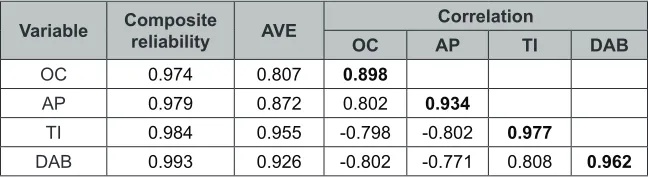
reliability. As shown in Table 1, the composite reliability for each variable was above 0.70, which demonstrated that each variable had an acceptable
Table 1: Reliability and aVE and Correlation
Variable Composite reliability aVE Correlation
OC aP Ti daB
OC 0.974 0.807 0.898
AP 0.979 0.872 0.802 0.934
TI 0.984 0.955 -0.798 -0.802 0.977
DAB 0.993 0.926 -0.802 -0.771 0.808 0.962
Note: Diagonal elements are the square root of the AVE statistics. Off-diagonal elements are the correlation between the latent variable calculated in PLS
The second step is the assessment of validity. Construct validity was assessed in terms of convergent validity and discriminant validity. Convergent validity was assessed using factor loading and the average variance extracted (AVE). As shown in Table 2 factor loading of all the instruments in the model were greater than 0.70 and the AVE values for all the constructs were above 0.50. The result demonstrated an acceptable
convergent validity (Hair et al., 2012; Hair et al., 2014).
Discriminant validity assesses whether a construct shares more variance with its measures than with other constructs. It is evaluated by comparing the square root of AVE compared to the correlations among the
latent constructs (Chin, 1998; Hair et al., 2012; Hair et al., 2014). When the
square root of AVE of a construct is greater than the correlation between the construct with another construct, it is deemed valid. As shown in Table 1 the square roots of the AVE were all greater than the respective correlation between constructs. The results demonstrated adequate discriminant validity. overall, the result from the PLS measurement model indicated that each
construct exhibited satisfactory reliability and validity (Chin, 1998; Hulland, 1999; Hair et al., 2012; Hair et al., 2014).
Structural Model analysis
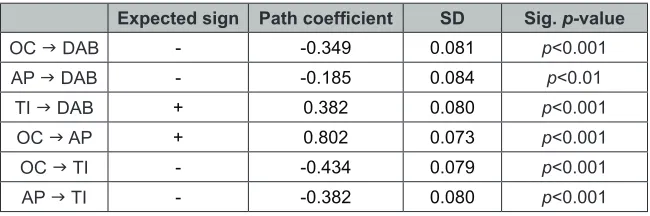
Table 2: Path analysis Result
Expected sign Path coefficient Sd Sig. p-value
OC g DAB - -0.349 0.081 p<0.001
AP g DAB - -0.185 0.084 p<0.01
TI g DAB + 0.382 0.080 p<0.001
OC g AP + 0.802 0.073 p<0.001
OC g TI - -0.434 0.079 p<0.001
AP g TI - -0.382 0.080 p<0.001
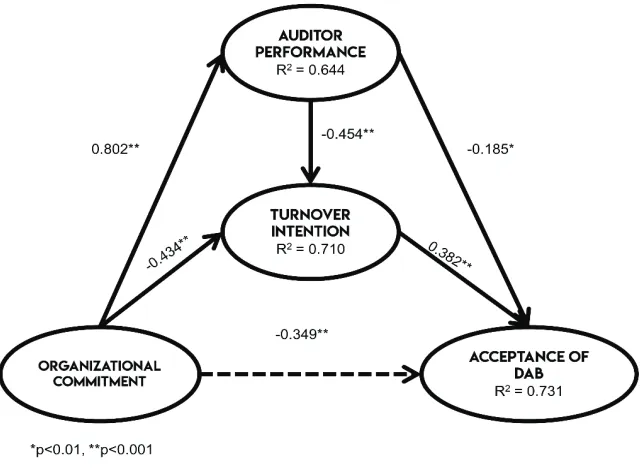
The results presented in Table 2 indicate that organizational commitment
has a significant negative effect on auditor acceptance of dysfunctional audit behavior (γ = -0.349, p<0.001). This supports H1 which stated that
organizational commitment has a negative effect on auditor acceptance of dysfunctional audit behavior. The results are consistent with research conducted by Donnelly et.al (2003b) which shows that organizational commitment owned by an auditor negatively affects dysfunctional audit behavior. This indicates that auditors who have a strong organizational commitment will be less likely to demonstrate a dysfunctional audit behavior, whereas, auditors who have a low organizational commitment will tend to demonstrate dysfunctional audit behavior.
A significant negative effect was observed for auditor performance on auditor acceptance of dysfunctional audit behavior (β = -0.185, p<0.01). This
support H2 which stated that auditor performance has a negative effect on
auditor acceptance of dysfunctional audit behavior. A notable finding was the fact that employee performance was a significant variable (p = 0.01 at the 5 percent level) for an acceptance to prematurely sign-off, underreporting
of time and altering audit procedures. This finding appears to suggest that
dysfunctional audit behavior is acceptable when a high employee self-rated performance is concerned. The results from this hypothesis indicate that self-reported, high performance is associated with higher acceptance of dysfunctional behavior.
A significant positive effect was observed for turnover intention on auditor acceptance of dysfunctional audit behavior (β = 0.382, p<0.001).
that individuals intending to leave the firm are arguably less likely to be
concerned with the potential adverse impact of dysfunctional behaviors
on performance appraisal and promotion (Aranya and Ferris, 1984). Thus,
auditors possessing higher turnover intentions may be more accepting of dysfunctional audit behaviors.
The finding of the direct effect of organizational commitment on
auditor acceptance of dysfunctional audit behavior reveals a positive effect as predicted in the hypothesis (H1). This study also extended the analysis on organizational commitment by demonstrating the indirect
effect of organizational commitment. These indirect effects may reflect the influence auditor performance and turnover intention have on organizational
commitment with regard to auditor acceptance of dysfunctional audit
behavior. A significant positive impact of organizational commitment on auditor performance was found (γ = 0.802, p<0.001). This supports H1a
which stated that organizational commitment has a positive impact on auditor performance. The results are consistent with Mowday et al. (1979) that highly committed employees perform better than less committed ones.
A significant negative effect of organizational commitment on turnover intention was found (γ = -0.434, p<0.001). This support H1b which stated
that organizational commitment has a negative effect on turnover intention. organizational commitment demonstrated a larger association with turnover-related intentions, including intention to leave the job (Donnelly
et al., 2003a). These findings suggest that auditors who have a strong
commitment to the organization will tend to survive than auditors who have low commitment.
In addition, auditor performance has a significant negative effect on turnover intention (β = -0.382, p<0.001). This supports H2a which stated that auditor performance has a negative effect on turnover intention. This finding
figure 1: PlS Result
The results presented in Table 3 indicate that the path coefficient of the influence of organizational commitment on auditor acceptance of
dysfunctional audit behavior without auditor performance and turnover
intention was significant (z = -0.802, p<0.001). However, when auditor performance and turnover intention were controlled, the path coefficient was reduced in magnitude (γ = -0.307, p<0.001) but remained statistically significant. Since the direct effect was significantly different from zero, ,
Table 3: direct Effect OC on auditor acceptance of daB without aP and Ti
Expected sign Path Coefficient Sd P-ValueSig.
OC g DAB - -0.802 0.073 p<0.001
To examine whether the mediating effect of auditor performance in the
influence of organizational commitment on acceptance of dysfunctional audit behavior is significant, the Sobel test was used (Baron and Kenny, 1986;
Preacher and Andrew, 2004). This gave a statistic of 2.151 (p<0.05) indicating that the mediating effect is significant. This supports H1c which stated that
organizational commitment has an indirect effect on auditor acceptance of dysfunctional audit behavior through auditor performance. These results indicate that auditors who have a low organizational commitment will receive a dysfunctional audit behavior through low performance. In contrast, auditors who have weak organizational commitment will reject dysfunctional audit behavior through high performance.
Furthermore, to examine whether the mediating effect of turnover intention in the influence of organizational commitment on acceptance of dysfunctional audit behavior is significant, the Sobel test was also used (Baron and Kenny, 1986; Preacher and Andrew, 2004). This gave a statistic
of 3.570 (p<0.01) indicating that the mediating effect is significant. This
supports H1d which stated that organizational commitment has an indirect effect on auditor acceptance of dysfunctional audit behavior through turnover intention. The results indicate that an auditor who has a low organizational commitment will be receiving dysfunctional audit behavior through a strong desire to leave his job. Conversely, an auditor who has a weak organizational commitment will refuse dysfunctional audit behavior through a strong desire to survive in his job.
The indirect association or effect of organizational commitment on auditor acceptance of dysfunctional audit behavior was then measured by the intervening variables of auditor performance and turnover intention as per Hypothesis 1e (H1e). The indirect effects of organizational commitment on auditor acceptance of dysfunctional audit behavior were calculated based
Table 4: The indirect, direct, and Total Effects of OC on auditor acceptance of daB
Path (OC-AP-DAB) 0.802 x (-0.185) -0,148
Path (OC-AP-TI-DAB) 0.802 x (-0.382) x 0.382 -0,166
Path (OC-TI-DAB) -0.434 x 0.382 -0,117
Indirect effect -0,431
Direct effect -0,349
Total effect -0,780
The results as in Table 4 indicate that path coefficient of indirect effect
organizational commitment on auditor acceptance of dysfunctional audit behavior via auditor performance and turnover intention was -0.431. The indirect effect via auditor performance and organizational commitment is more than 0.05 (Bartol, 1983). This supports H1e which stated that organizational commitment has an indirect effect on auditor acceptance of dysfunctional audit behavior through auditor performance and turnover
intention. To assess the practical significance of the study and to estimate the extent to which our statistical findings exist in the population, data
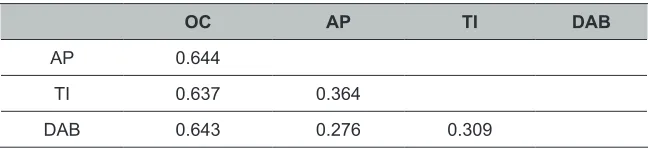
was computed using the effect size test as suggested by Cohen (1988) and Hair et al. (2014). The effect size (f2) based on the R2 of 0.731, was
0.643. Calculation of effect size aims to see whether the impact of a particular independent organizational commitment on auditor acceptance of dysfunctional audit behavior has a substantive impact in the model (Cohen,
2010). According to Cohen (1988) the 0.643 figure suggested that there is
a medium effect from “organizational commitment” to “auditor acceptance of dysfunctional audit behavior” in the research model.
Table 5: Effect Size for Total Effect
OC aP Ti daB
AP 0.644
TI 0.637 0.364
CONCluSiONS, liMiTaTiONS aNd fuTuRE
RESEaRCh
This study investigated whether organizational commitment affects auditor’s
acceptance of dysfunctional audit behavior and if so, whether the effect is mediated by auditor performance and turnover intention. By using a sample
of 129 auditors working at public accounting firms in Sumatera Island Indonesia, this study finds that organizational commitment negatively affects
auditor acceptance of dysfunctional audit behavior. It means, auditors with a high organizational commitment are unlikely to accept DAB. Results of this study are supported by Donnelly et al. (2003b) and Paino et al. (2012) who found that organizational commitment negatively affects auditor acceptance of dysfunctional audit behavior. The study also proved that auditor performance and turnover intention partially mediate the effect of organizational commitment on auditor acceptance of dysfunctional audit behavior. In contrast, a previous study (Paino et al., 2012) found that organizational commitment directly affect dysfunctional audit behavior. our study further found that there are other variables such as auditor performance and turnover intention that mediate the relationship between organizational commitment and auditor acceptance of dysfunctional audit behavior.
This study has some implications for public accounting firms. Some
form of policies on organizational commitment can be done by public
accounting firms to avoid auditors from performing dysfunctional audit behavior. Public accounting firms may have to consider improving and fixing a system of compensation, career flexibility, safety, improving education and
training (Alwi, 2008). However, this study has limited generalizations due to a relative small sample size used. In addition, this study only examined the consequences of organizational commitment without looking further at the antecedents of organizational commitment. Therefore, future research should increase the sample and add other variables such as professional commitment and locus of control which are antecedent variables for
REfERENCES
Abdillah, M.R., Anita, R. & Anugerah, R. (2016). Dampak iklim organisasi terhadap stres kerja dan kinerja karyawan. Jurnal Manajemen, 20(1), 121-141.
Anugerah, R., Anita, R. Sari, R.N. & Zenita, R. (2016a). External locus of control and reduced audit quality behavior: Th e mediating effects of auditor performance and organizational commitment. Journal of
Economics, Business and Management,4(5), 353-357.
Anugerah, R., Anita, R., Sari, R. N., Abdillah, M. R., & Iskandar, T. M., (2016b). The analysis of reduced audit quality behavior: The intervening role of turnover intention. International Journal of Economics and
Management, 10(S2), 341-353.
Alkautsar, M., (2014). Locus of control, commitment professional, and dysfunctional audit behavior. International Journal of Humanities and
Management Sciences, 2(1), 2320–4044.
Angkoso, C. D., Bambang, S., & Sutrisno (2014). The role of situational and individual factors on the premature sign-offs of audit procedures.
IOSR Journal of Economics and Finance, 5(6), 57-68.
Alwi, S. (2008). Manajemen Sumber Daya Manusia: Strategi Keunggulan
Kompetitif. BPFE, Yogyakarta, pp. 57
Arens, A., Elder, R. J. & Beasley, M. (2012). Auditing and assurance service:
Integrated approach (14th ed.). New Jersey: Prentice-Hall.
Aranya, n., & Ferris, K. r. (1984). A reexamination of accountants’ organization-profesional conflict. The Accounting Review, 59(1), 1-15.
Bartol, K. M., (1983). Turnover among DP Personnel: A causal Analysis.
Communications of the ACM, 26, 807-811.
statistical considerations. Journal of Personality and Social Psychology. 51(6), 1173-1182.
Chin, W. W. (1998) The Partial least Squares Approach for Structural
Equation Modeling. In G.A. Marcoulides (Ed.), Modern Methods for
Business Research, Lawrence Erlbaum Associates, London, 295-236.
Chin, W. W. (2010). How to Write Up and report PlS Analyses. In Esposito Vinzi, V., Chin, W. W., Henseler, J. & Wang, H. (Eds.) Handbook
of Partial Least Squares: Concepts, Methods and Applications,
Heidelberg: Springer, 655-690.
DeAngelo, L. E. (1980). Auditor size and auditor quality. Journal of
Accounting and Economics, 3(3), 183-199.
Donnelly, P. D., Quirin J. J., & O’Bryan D. (2003a). Auditor acceptance
of dysfunctional audit behavior: An explanatory model using personal caracteristics. Behavioral Research in Accounting, 15, 87-110.
Donnelly, P. D., Quirin J. J., & O’Bryan D. (2003b). Attitudes toward
dysfunctional audit behavior: The effects of locus of control, organizational commitment, and position. The Journal of Applied
Business Research, 19(1), 95-108.
Dreher, D.F., (1982). The role of performance in the turnover process.
Academy of Management Journal, 25, 137-147.
Hair, J. F., Sarstedt, M, ringle, C.M, & Mena, J.A. (2012). An assessment of
the use of partial least squares structural equation modeling in marketing research. Journal of the Academy of Marketing Science, 40(1), 414-433.
Hair, Joe, F., Marko, S., lucas, H., & Volker, G. (2014). Partial least squares
structural equation modeling (PLS-SEM): An emerging tool in business research. European Business Review, 26(2), 106-121.
Hulland, J. (1999). Use of partial least squares (PlS) in strategic
management research: A review of four recent studies. Strategic
Kelley, T., & Margheim, L. (1990). The impact of time budget pressure, personality and leadership variables on dysfunctional audit behavior.
Auditing: A Journal of Practice and Theory, 9(2), 21-42.
Smith, W. r., & Marguerite, r. H. (1995). Underreporting of time: An analysis of current tax practice. Journal of Applied Business Research, 11(1), 39-45.
Malone, C. F., & roberts, r. W. (1996). Factors associated with the
incidence of reduced audit quality behavior. Auditing: A Journal of
Practice and Theory, 15(2), 49-64.
Mathieu, J. & D. Zajac. (1990). A review and meta-analysis of the antecedent, correlates, and consequences of organizational commitment.
Psychological Bulletin, 108, 171-194.
McEvoy, G. M., & W. F. Cascio. (1987). Do good performers leave? A
meta-analysis of the relationship between performance and turnover.
Academy of Management Journal, 30, 744-762.
Mindarti, C. S., & Elen, P. (2014). The role of organizational commitment
on individual characteristics that influence of auditor acceptance
of dysfunctional audit behavior. International Journal of Business,
Economics and Law, 5(1), 2289-1552.
Mowday, R.T, Steers, R.M, & Porter, R.M. (1979). The measurement of organizational commitment. Journal of Vacational Behavior, 14, 224-227.
Nitzl, C., Roldan, J. L., & Cepeda, G. (2016). Mediation analysis in partial least squares path modelling: Helping researchers discuss more sophisticated models. Industrial Management & Data Systems, 116(9), 1849-1864.
Paino, H., Azlan, T. & Syed, I.Z. (2012). organizational and professional commitment on dysfunctional audit behaviour. African Journal of
Business Management, 6(4), 1434-1440.
Paino, H., Ismail, Z. & Smith, M. (2014). Modelling dysfunctional behavior:
individual factors and ethical financial decision. Procedia-Social and
Behavioral Sciences, 145, 116-128.
Public oversight Board (2000) AICPA’s Public Oversight Board: Panel of
Audit Effectiveness. American Institute of Certified Public Accountants
(AICPA).
Preacher, K, J., & Andrew F. H. (2004). SPSS and SAS procedures for
estimating indirect effects in simple mediation models. Behavior
Research Methods, Instrument & Computers, 36(4), 717-731.
Scandura, T.A., & R.E. Viator. (1994). Mentoring in public accounting
firm: An analysis mentor protégé relationships, mentorship function,
an protégé turnover intention. Accounting, Organizations, and Society, 19, 717-734.
Vecchio, r. P., & norris, W. r. (1996). Predicting employee turnover from
performance, satisfaction, and leader-member exchange. Journal of