http://www.sciencepublishinggroup.com/j/bmb doi: 10.11648/j.bmb.20180301.11
ISSN: 2575-5064 (Print); ISSN: 2575-5048 (Online)
New Nickel Metal Complex towards Biomimetic
Catecholase Enzyme Oxidation: Synthesis and Kinetics
Studies
Mohamed M. Al-Sayed
Chemistry Department, Faculty of Science & Arts Al-Mukhwah, Al-Baha University, Al-Baha, Saudi Arabia
Email address:
To cite this article:
Mohamed M. Al-Sayed. New Nickel Metal Complex Towards Biomimetic Catecholase Enzyme Oxidation: Synthesis and Kinetics Studies.
Biochemistry and Molecular Biology. Vol. 3, No. 1, 2018, pp. 1-5. doi: 10.11648/j.bmb.20180301.11
Received: August 24, 2017; Accepted: October 8, 2017; Published: January 12, 2018
Abstract:
Pyrano[2,3-c]pyrazole ligand and their transition metal complex with nickel (NiIIMPC) were synthesized and characterization by elemental analyses, magnetic susceptibility, FT IR, UV-Vis, and mass spectroscopy. Complex have been investigated as functional models for catechol oxidase activity by using a catechol as a model substrate. According to the kinetic measurement results, the rate of catechol oxidation follows first order kinetics. Nickel complex has been used in homogenous oxidation of catechol in presence of a green oxidant H2O2. kinetic parameters were obtained Vmax= 2.698×10⁻³MS-1, Km = 7.878M,kcat= 4.496×10⁻²S-1 and kcat/Km = 0.5707 M-1S-1.
Keywords:
Pyrano[2,3-c]Pyrazole, Nickel, Oxidation, Catecholase1. Introduction
Metals have an esteemed place in medicinal chemistry. Transition metal complexes have been widely studied in the area of bio-inorganic and catalytic chemistry [1, 2] Metal complexes with active drugs as ligands is a research area of increasing interest for inorganic and medicinal chemistry and has concentrated much attention as an approach to new drug development [3, 4].
The oxidation of phenols compounds under moderate conditions is very important in the decay of aromatic compounds and in industrial catalysis for environmental ecology [5]
Latterly much works have been based on pyrazole ligands to form metal complex to mimic catecholase enzyme function [6-7] pyrazole ligand have identical structure of imidazole ring, the imidazole ring of amino acid remains is combined ligands at the energetic sites of metalloproteinase which guided to employ pyrazole to mimic the function of catecholase [8].
Pyrano[2,3-c]pyrazoles has been many applications in the field of pharmaceuticals [9] these compounds have biological activity and pharmacological [10] anticancer, [11, 12] anti-inflammatory, [13].
Catecholase widespread in plant enzyme, to save plant from harm result by insects and pathogens by catalytic oxidation of catechol to o-quinones in the presence of oxygen air [14, 15] catecholase activity mimicking by bio-materials structural, metal complexes considered in recent years the most important in a study of their catalytic activity in oxidation reactions [16] in spite of the powerful site of catecholase enzyme consists of a hydroxo-bridged dicopper(II) center, it is fully certified that many monometallic complexes of Mn(II) [17], Ni(II) [18], copper(II) [19] and Fe(II) [20] are show catecholase activity.
To more recognize the effect of concentration and nature of substrate the reaction follow up Michaelis-Menten [21] to study the kinetic of enzymatic reaction to limitation the kinetic parameters.
2. Experimental
2.1. Materials and Methods
purchased from Aldrich Chemical Co. malononitrile,
3-methyl-1-phenyl-2- pyrazolin-5-one and
triethylbenzylammonium chloride (TEBA) were purchased from Across Organics Co. (Belgium). Nickel chloride was obtained from Merck Co., Germany.
2.2. Synthesis of (6-amino-4-(4-methoxyphenyl)-3-methyl- 1-phenyl-1,4-dihydropyrano[2,3-c]pyrazole-5-carbonitrile) (MPC)
When aromatic aldehydes (1), malononitrile (2), 3-methyl-1-phenyl-2- pyrazolin-5-one (3), and triethylamine were heated under reflux, the products (4) were obtained in good yields [22] The infrared spectrum of the (MPC) shows band at 3382 cm-1 with one at 3317 cm-1 assigned to νNH2. The ligand also shows strong bands at 2190 cm-1, 1511 cm-1 assigned to ν C=C, ν C≡N. the mass spectroscopy (m/z = 358.1) M. p. 173–1758C (Lit. [23] 170–1728C).
1
H NMR (DMSO-d6, d, ppm): 1.78 (3H, s, CH3), 3.74 (3H, s, CH3O), 4.63 (1H, s, C4-H), 6.90 (2H, d, J ¼ 8.4 Hz, ArH), 7.16–7.17 (4H, m, NH2 ArH), 7.30–7.34 (1H, m, ArH), 7.47– 7.51 (2H, m, ArH), 7.78 (2H, d, J ¼ 8.8 Hz, ArH).
Anal. Calcd. for C21H18N4O2: C 70.38, H 5.06, N 15.63; found C 70.54, H 4.89, N 15.40 [24]. (“Figure 1”).
Figure 1. Synthesis of MPC ligand.
2.3. Synthesis of [NiMPC] Complex
Nickel (II) chloride (0.1 mole) was dissolved in ~ 40 ml absolute ethanol, then added to 0.1 mole of the prepared ligand (MPC) dissolved in ~ 40 ml absolute ethanol. The mixture was heated under reflux for two hrs. A bluish precipitate was formed that was filtered off and finally washed by hot ethanol several times.
2.4. Catecholase Activity and Kinetic Measurements of Oxidation Activities
The kinetics measurements of the reactions were studied spectroscopically the catalytic activity of the NiIIMPC complex toward the homogenous oxidation of catechol in methanol solution at 25°C was determined by measuring the initial rate of catechol oxidation. The increase of the absorption at 390 nm [25] due to the oxidation product with time was obtained on a Varian Cary 3E spectrophotometer. A plot of the formation of the product with respect to time gives the initial rate. 60µM of the NiIIMPC catalyst has been used in the oxidation of different concentrations of the substrate
(5–150µM) in presence of 100 µM H2O2 to study the effect of catechol concentration on the reaction. The rate laws were determined and rate constants obtained.
2.5. Instrumentation
Carbon, hydrogen and nitrogen contents were determined at the Micro analytical Unit, Cairo University, Egypt. IR spectra of the ligand and its solid complexes were measured in KBr on a Mattson 5000 FTIR spectrometer. The electronic spectra and kinetic measurements were performed using Varian Cary 4 Bio UV/VIS spectrophotometer. 1H- NMR spectrum of the ligand was recorded on Joel-90Q Fourier Transform (200 MHz) spectrometers in [D6] DMSO. The mass spectra of Thermal analysis measurements (TGA) were recorded on a Shimadzu thermo-gravimetric analyzer model TGA -50 H, using 20 mg samples. The flow rate of nitrogen gas and heating rate were 20 cm3 min-1 and 10°C min -1 respectively. The magnetic susceptibility measurement for the nickel (II) complex was determined by the Gouy balance using Hg[Co(NCS)4] as a calibrate at room temperature.
3. Results and Discussion
3.1. FT-IR
The pyrazolyl derivative was synthesized and characterized by 1H NMR, IR, mas and elemental analysis [22].
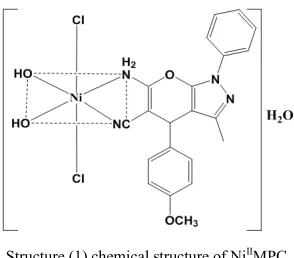
By compering of FT-IR of ligand (MPC) and NiIIMPC complex strong band appeared at 2195 cm-1 which is given to the C≡N vibrations in ligand this band was vanish in the Ni (II) complex. Shifting in νNH2 bands to higher wavelength (3430 and 3320 cm−1) and this is supported the Ni(II) bind to MPC ligand through the nitrogen atom of NH2 and nitrogen atom of CN. a new band at 475 cm-1 due to νNi– N [26]. This also confirming structure by the presence of new band at 545 cm−1 to νNi– O [27].
3.2. Electronic Spectral Data
At room temperature these complexes show magnetic moment in the range 2.98 BM. These values are in tune with a high spin configuration and show the presence of an octahedral environment [28] around the Ni (II) ion in the complexes. Exhibit absorption bands in the range 260 nm and 480nm. An examination of these bands indicates that the complexes have an octahedral geometry. The ground state of Ni (II) in an octahedral coordination is 3A2g. Thus, these bands may be assigned to the three spin allowed transitions [29]. 3A2g (F) → 3T2g (F)—(ν1), 3A2g (F) → 3T1g (F)—(ν2),
3
A2g (F) → 3T1g (P)—(ν3), Respectively these support an
octahedral geometry [30].
3.3. Mass Spectrum
(C21H22Cl2NiN4O5). The base peak was found in the spectrum at m/z = 54 (100%) mass fragmentation pattern of metal complex shows in “Figure 3”
Figure 2. Mass spectrum of [Ni(MPC)(OH)2Cl2]H2O.
Figure 3. Mass fragmentation pattern of metal complex.
3.4. Elemental Analysis
NiIIMPC complex shown% C (cal; 46.71, foud; 46.31)% H (cal; 4.11, Foud; 4.02)% N (cal; 10.38 foud; 10.24)% Ni (cal; 10.87 foud; 10.78).
The elemental analysis addition to IR, mass spectroscopy, magnetic moment and electronic spectral all this give the structure (1) of NiIIMPC.
Structure (1) chemical structure of NiIIMPC
3.5. Catalytic Activity and Kinetic Study of Catecholase
3.5.1. Effect of Concentration of Catalyst
In order to investigate the effect of the concentration of catalyst on the oxidation of catechol with different concentrations of the nickel complex NiIIMPC have been used in the oxidation of catechol. The initial rate Vi=9 × 10⁻⁴
was found to be linear till 60 µM and then reach a saturation stage “Figure 4”
3.5.2. Effect of Substrate
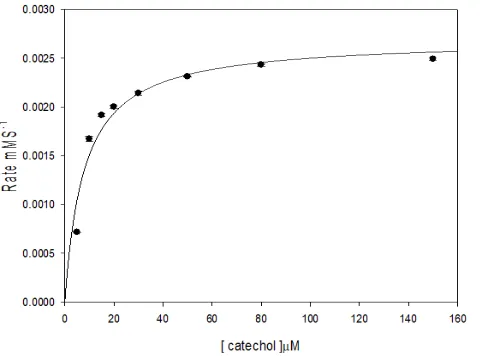
Since catechol is instantaneously oxidized by activated H2O2, the rate-determining step in this case is the activation of H2O2. Thus, catechol here serves as a “redox indicator”. In order to establish the rate law for the homogeneous catechol oxidation by nickel complex, the rate is further determined at various concentrations of catechol at 25°C in ethanol solution. The rate of catechol oxidation using 60µM complex NiIIMPC against different concentrations of catechol is measured and found to be hyperbolic with respect to [catechol], suggesting the possibility of a pre-equilibrium kinetics. This kinetics can be described as the binding of the substrate catechol (S) to the metal center NiIIMPC to form the intermediate Pyrano[2,3-c]pyrazole nickel complex, followed by the conversion of the bound substrate into the product. The first order rate constant kcat and dissociation constant Km are found. The small value of the Km indicates a very good binding between the nickel complex and substrate catechol.
The catecholase activity of the complexes was studied using catechol as substrate in ethanol at temperature 25°C is observed in catechol was determined by measuring The increase of the absorption at 390 nm with time due to the oxidation product with time was obtained “Figure 4” on a Varian Cary 3E spectrophotometer in the presence of H2O2 solution as an oxygen source. By applying traditional the Michaelis–Menten approach “Figure 5”, values of the kinetic parameters Vmax, Km, kcat and kcat/Km were obtained from the corresponding plot of Vi versus [S] (different concentration catechol) in “Figure 6” Vmax= 2.698×10⁻³, Km = 7.878M, kcat=
4.496×10⁻²S-1. The reaction in concentration of catalyst NiIIMPC complex 60 µM and in the presence of saturation amount of H2O2 (200 µM). produces important catalytic efficiency kcat/Km = 0.5707 M-1S-1 as second order rate
constant.
(1)
(2)
(3)
Figure 5. Oxidation of catechol to o-quinone.
3.5.3. Effect of Concentration of Hydrogen Peroxide
The rate of oxidation of catechol at various Concentrations of hydrogen peroxide using 60 µM of the catalyst catechol complex shows saturation pattern at 200µM “Figure 7”. This saturation behavior indicates that the hydrogen peroxide binds to the nickel complex or nikel complex banded to the substrate catechol.
Figure 6. Plot of initial rate (mMS-1) VS [Substrate] µM of catechol in
presence of catalyst complex NiIIMPC 60 µM at 25°C.
Figure 7. Oxidation of 1.0 mM catechol using 60 µM NiIIMPC with different
concentrations of H2O2 at 25°C.
4. Conclusion
In this studies a new complex of Nickel was synthesized with pyrano[2,3-c]pyrazoles This complex was fully characterized by different tools (FT-IRI, Electronic spectral data, magnetic moment, Mass spectrum, Elemental analysis) The Ni(II) bind to MPC ligand through the nitrogen atom of NH2 and nitrogen atom of CN. The geometry around the Nickel ion is found to be octahedral geometry. In this study The [NiIIMPC] complex has been used as a catalyst in the oxidation of catechol in presence of H2O2 as a green oxidant and this reaction biomimetic enzyme reaction and study the Effect of concentration of catalyst and Calculates The initial rate Vi.,study the effect of substrate (catechol) and Calculates the kinetic parameters Vmax, Km, kcat and kcat/Km. in the end study Effect of concentration of hydrogen peroxide in oxidation of catechol.
References
[1] E. V. Akimova, D. H. Busch, P. K. Kahol, N. Pinto, N. W. Alcock, H. J. Clase, Inorg. Chem. 36 (1997) 510.
[2] H. Okawa, H. Sakiyama, Pure Appl. Chem. 67 (1995) 273. [3] R. Cini, Inorg Chem. 22 (2000)151.
[4] D. Kovala, J Inorg Biochem 79 (2000)153. [5] J. Haggin, Chem. Eng. News 71 (1993) 23.
[6] N. Boussaleh, R. Touzani, I. Bouabdallah, S. Ghalem, S. El Kadiri, Int. J. Acad. Res. 2 (2009) 137.
[7] A. Djedouani, F. Abrigach, M. Khoutoul, A. Mohamadou, A. Bendaas, A. Oussaid, R. Touzani, Orient. J. Chem. 31 (1) (2015) 97.
[8] A. Mouadili, A. El Ouafi, A. Attayibat, S. Radi, R. Touzani, J. Mater. Environ. Sci. 6 (2015) 2166.
[10] E. C. Witte, P. Neubert, A. Roesoh,. Chem. Abstr. 104 (1986) 224915f.
[11] J. L. Wang, D. Liu, Z. J. Zheng, S. Shan, X. Han, S. M. Srinivasula, C. M. Croce, E. S. Alnemri, Z. Huang, Proc. Natl. Acad. Sci. U.S.A. 97 (2009) 7124.
[12] M. E. A. Zaki, E. M. Morsy, M Abdul, Heterocycl. Commun. 10 (2004) 97.
[13] (a) M. E. A. Zaki, H. A. Saliman, O. A. Hickal, A. E. Rashad, Natureforsch, C: Biosci. 61 (2006)1. (b) C. K. Sheng, J. H. Li, N. J. Hideo, Med. Chem. 27 (1984) 539.
[14] SK. Mal, M. Mitra, H. Yadav, CS. Purohit, AR. Choudhury, R. Ghosh, Polyhedron. 111 (2016) 118.
[15] N. Beyazit, D. Çakmak, C. Demetgül, Tetrahedron 73 (2017) 2774.
[16] KC. Gupta, AK. Sutar, Coord Chem Rev. 252 (2008) 1420. [17] M. Mitra, AK. Maji, BK. Ghosh, et al. Polyhedron. 61 (2013)
15.
[18] AK. Ghosh, M. Mitra, A. Fathima, et al. Polyhedron. 107 (2016) 1.
[19] S. Anbu, A. Paul, APC. Ribeiro, Inorg Chim Acta. 450 (2016) 426.
[20] T. Megyes, Z. May, G. Schubert, T. Grosz, LI. Simandi, T. Radnai, Inorg Chim Acta. 359 (2006) 2329.
[21] L. Michaelis, M. L. Menten, Biochem. Z 49 (1913) 333. [22] S. R. Mandha, S. Siliveri, M. Alla, V. R. Bommena, M. R.
Bommineni, S. Balasubramanian, Bioorganic and Medicinal Chemistry Letters 22 (2012) 5272.
[23] J. F Zhou, S. J. Tu, Y. Gao, M. Ji, J. Org. Chem. 21 (2001) 742.
[24] S. R. Mandha, S. Siliveri, M. Alla, V. R. Bommena, M. R. Bommineni, S. Balasubramanian, Bioorganic and Medicinal Chemistry Letters 22 (2012) 5272.
[25] Z. Bouanane, M Bounekhel, M. Elkolli, F. A. brigach, M. Khoutoul, R. Bouyala, R. Touzani, A. Hellal, Journal of Molecular Structure 1139 (2017) 238.
[26] S. J. Zhuang, Q. X. Wang, J. Chem. Res. (2004)821. [27] J. R. Ferraro, Plenum, New York (1971).
[28] A. A. El-Asmy, Y. M. Shaibi, I. M. Shedaiwa, M. A. Khattab, Inorg. Met. Org. Chem. 18 (1988)331.
[29] A. B. P. Lever, “Inorganic Electronic Spectroscopy”, Elsevier, Amsterdam, (1986).