Long-Term Thermal Stability of Reduced Activation
Ferritic
/
Martensitic Steels as Structural Materials of Fusion
Blanket
Yanfen LI
1,3), Takuya NAGASAKA
2)and Takeo MUROGA
2)1)The Graduate University for Advanced Studies, 322-6 Oroshi, Toki, Gifu 509-5292, JAPAN 2)National Institute for Fusion Science, Oroshi, Toki, Gifu 509-5292, JAPAN 3)Institute of Plasma Physics, Chinese Academy Sciences, Hefei, Anhui, China
(Received 7 January 2009/Accepted 8 June 2009)
In this work, the effects of thermal ageing on mechanical properties of JLF-1 and CLAM steels have been studied at temperatures in a range of 823-973 K. The results showed that the hardness increased slightly and the creep properties improved after ageing at 823 K for 2000 h for the both steels. On the other hand, the hardness decreased after ageing above 823 K, especially at 973 K for 100 h, and the creep property degraded at 973 K for 100 h. The Larson-Miller parameter was used for predicting the long-term creep performance based on the short-term experiments at higher temperature with higher stress including the pre-ageing effects. By extrapolation to the typical blanket condition, 823 K for 100 000 h, the rupture stress was estimated to be about 140 MPa for the both steels. The present thermal ageing treatments influence the estimated rupture stress for about±10 MPa for both steels.
c
2010 The Japan Society of Plasma Science and Nuclear Fusion Research
Keywords: fusion blanket, reduced activation ferritic/martensitic steel, thermal stability, thermal ageing, creep property, Larson-Miller parameter
DOI: 10.1585/pfr.5.S1036
1. Introduction
Blanket is one of the important components of fusion reactors, which provides the primary heat transfer and tri-tium breeding systems. Currently, reduced activation fer-ritic/martensitic (RAFM) steels are considered as the pri-mary candidates for blanket structural materials because of their most matured industrial infrastructure and relatively good irradiation resistance [1].
In fusion applications, RAFM steels need to withstand high temperature under long-term loading. When the ab-solute service temperature is higher than about 700 K, the creep deformation of these steels will occur [2]. Since the maximum operation temperature of blanket structural materials will be determined mainly by the thermal creep deformation, evaluation of the thermal creep performance in the blanket condition is the key necessity [3]. In addi-tion, the thermal ageing during the operation may affect the creep properties [4]. However, the research into the thermal ageing effects on the creep deformation is quite limited.
Since testing materials for the actual operation time is extremely costly and time-consuming, prediction of creep rupture performance based on the results of short-term creep experiments at higher temperature with higher stresses has been explored using stress-time parameters. Many efforts to estimate the long-term creep properties author’s e-mail: [email protected]
have been done for the steels which are being used in fis-sion power plant [5, 6], but only limited data are available for RAFM steels [7]. No effort has been made to include the thermal ageing effects on the prediction of the long-term creep performance of RAFM steels.
Because of the limited irradiation volume, the small specimen testing technology has been developed and widely used in the fission and fusion field in the world. In this work, thermal ageing experiments with the Japanese small specimen (SSJ) has been carried out at temperatures in a range of 823-973 K for JLF-1 and CLAM steels and the creep properties were tested. As the ageing temper-ature, 823 K was chosen to test as the upper temperature limit in fusion blanket, and 973 K to accelerate the ageing processes, especially recovery of martensitic structures. The Larson-Miller parameter was proposed to describe the long-term behavior necessary for the blanket design.
2. Experimental Procedure
The materials used are JLF-1 (JOYO-II-HEAT) and CLAM (HEAT 0603) steels. The chemical compositions of these two steels (in weight %) are 9.00 Cr, 1.98 W, 0.49 Mn, 0.20 V, 0.083 Ta, 0.09 C, and balance Fe for JLF-1 and 8.94 Cr, JLF-1.45 W, 0.44 Mn, 0.JLF-19 V, 0.JLF-15 Ta, 0.JLF-13 C, and balance Fe for CLAM. The heat treatments included normalization and tempering. The normalization treat-ments were carried out by heating at 1323 K for 1 hour for
c
2010 The Japan Society of Plasma
JLF-1 and 1253 K for 0.5 hour for CLAM and then cooled by air. The tempering treatments were carried out by heat-ing at 1053 K for 1 hour for JLF-1 and 1033 K for 1.5 hr for CLAM and then cooled by air.
The SSJ specimens with a gauge size of 5 × 1.2
× 0.25 mm3 were machined along the rolling direction.
Then, these specimens underwent ageing experiments in the temperature range of 823 to 973 K under high vacuum in order to avoid high oxidation of the materials.
The Vickers hardness was measured under a load of 300 g with loading time of 30 s at room temperature. All the measurement was carried out with SSJ or small plates with the same thickness and machining condition.
The uniaxial creep experiments up to rupture were performed at 823 to 923 K with the applied stresses be-tween 150 and 300 MPa. They were tested in a vacuum of <1×10⁻⁴Pa to avoid formation of the oxide film which can accelerate the cracking. The loading was carried out by a simple suspension, which has a high stability of the applied load. Creep strain was measured by double linear variable differential transformers (LVDTs) with increased precision.
3. Results
3.1
Hardness measurement
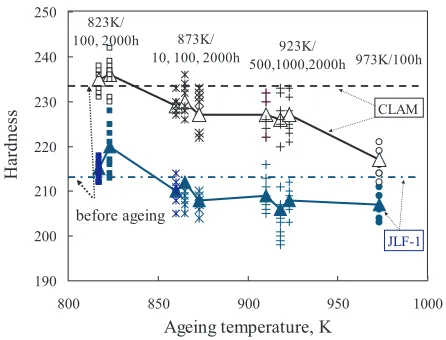
The hardness results are plotted in Fig. 1. It shows that the hardness values of CLAM steel were higher than those of JLF-1 at all conditions. After ageing at 823 K for 100 and 2000 h, the hardness increased slightly for the both steels. On the contrary, softening occurred above 823 K. The softening of CLAM steel was larger than that of JLF-1. In addition, by the ageing at 873 to 923 K, the hardness was almost independent on the ageing time.
3.2
Creep properties
The uniaxial constant load creep tests were conducted at 823 to 923 K with the applied stresses between 150 and 300 MPa. In all cases, the specimens displayed normal be-havior with respect to the applied stress and temperature, where at any constant temperature the deformation rate in-creased with increasing the stress.
Figs. 2 and 3 show the creep curves obtained at 823 K with 250 MPa in different ageing conditions for JLF-1 and CLAM, respectively. The typical creep curves of the present steels, similar to those observed in other RAFMs, were composed of the short primary or transient region, where the creep rate decreases with time, the steady state region which is a linear process with a minimum creep rate, and the tertiary or accelerated creep region characterized by an increasing creep rate with time until the material rup-tured.
For CLAM steel, after ageing at 823 to 873 K up to 2000 h, the minimum creep rate decreased and rupture time increased. Similar to CLAM, the creep rupture time of JLF-1 increased by ageing at 823 and 873 K for 2000 h.
Fig. 1 Hardness change of JLF-1 and CLAM steels by ageing.
Fig. 2 Creep curves of JLF-1 steel at different ageing conditions (tested at 823 K with 250 MPa).
Fig. 3 Creep curves of CLAM steel at different ageing condi-tions (tested at 823 K with 250 MPa).
But the further ageing at 923 K for 2000 h returned the properties to almost the level of no ageing. On the other hand, ageing at 973 K for 100 h caused a significant degra-dation in creep properties, which is consistent with the re-sults of hardness measurements.
rupture time was longer for CLAM than those of JLF-1, CLAM was more susceptible to ageing than that of JLF-1. The high susceptibility of CLAM to ageing with respect to the hardness and creep properties suggests that the present heat treatment condition for CLAM may not the best one.
4. Discussion
4.1
Larson-Miller parameter
Prediction of long-term creep rupture performance based on the results of short-term creep experiments at higher temperature with higher stresses has been carried out based on stress-time parameters. Larson-Miller (L-M) parameter is one of the popular methods, which is based on a model of the rate processes [8]:
rc=A×exp(−Q/RT) (1)
where
rc=minimum creep rate
A=constant
exp=natural logarithm base
Q=activation energy for process
R=gas constant
T =absolute temperature
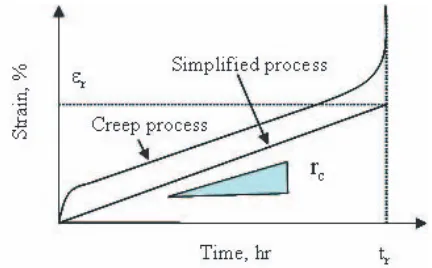
Assuming the times of primary and tertiary creep are much shorter than that of the secondary creep, and the ter-tiary creep begins when total strain reached a critical value (εr), the creep curve can be simplified, as schematically
presented in Fig. 4. In this case,rc×tr =εr, wheretris the
rupture time. Thus, equation (1) can be written as
1/tr =A/εr×exp(−Q/RT) (2)
Taking the logarithm for eq. (2), then L-M equation is:
T(C+logtr)=Q/2.3R=PLM×1000 (3)
Therefore, the L-M Parameter can be obtained:
PLM=T(C+logtr)×0.001 (4)
whereCis a material constant.
Fig. 4 Schematic illustration of the creep and its simplified pro-cesses.
The L-M equation assumes that the activation energy
Q, hencePLM, is independent from T andtr but only the
function of the applied stressσ. AssumingPLM=P0−ασ,
theσgndPLMshould show linear relation (L-M diagram).
L-M parameter assumes that temperature and time can be interchanged, provided no important microstructural change occurred during the test. When the creep mecha-nism changes, the use of this parameter for predicting long-term performance is not accurate. It was also suggested to use the Monkman-Grant equation [9] together with the Norton law [10] for predicting creep properties of 9 % Cr steels:
logrc=−1/n×logtr+D (5)
wherenandDare the constants.
Figs. 5 and 6 present the minimum creep rate (rc) as
a function of rupture time (tr). The minimum creep rate is
determined from the creep data by linear regression anal-yses. It showed that the constant n in eq. (5) was almost equal to 1. This means that the simplification shown in Fig. 4 and thus the L-M parameter are appropriate for the present prediction.
Fitted by the present experimental data with different
Fig. 5 Minimum creep rate as a function of rupture time (Monkman - Grant equation) for JLF-1 steel.
Fig. 7 Fitting of L-M parameter with applied stress for various
Cvalues for JLF-1 and CLAM steels before ageing. C
=30 was chosen because data were almost on a straight line.
Fig. 8 Applied stress as a function of Larson-Miller parameter for JLF-1 steel.
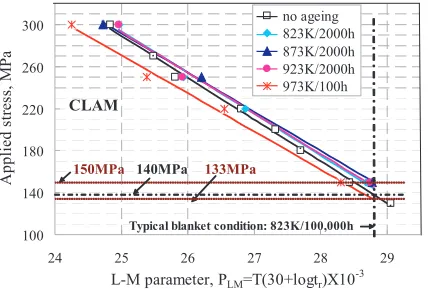
Fig. 9 Applied stress as a function of Larson-Miller parameter for CLAM steel.
C, it was found that the C =30 is suitable for the both steels, as shown in Fig. 7.
Figs. 8 and 9 present the L-M data with different age-ing conditions fitted by a method of least squares. The diagrams show an increase of PLM, hence the activation
energy for the creep process, by ageing at 823 and 873 K,
and a decrease by ageing at 973 K.
In the typical blanket condition, 823 K for 100 000 h, the L-M parameter is equal to 28.8. By predicting, the rupture stress was estimated to be about 140 MPa for the both steels.
Based on ASTM VIII guideline, approximate accept-able stress limit of 2/3×140=93 MPa was derived for the both steels.
The L-M parameter cannot incorporate the ageing ef-fects. Figs. 8 and 9 include the data of pre-ageing exper-iments for predicting possible ageing effects on L-M dia-gram. The present ageing treatments influenced the rupture stress by about±10 MPa for the both steels. These vari-ation need to be considered during the design for fusion blanket.
4.2
Thermal activation analysis
The present experiments and analysis showed that hardening and increase in the creep activation energy took place by ageing at 823 K, and softening and the decrease in the creep activation energy occurred by ageing at 973 K. In this section correlation of the hardness data is attempted based on the thermal activation process.
In this analysis ageing is assumed to be induced by migration of the constituent species (most probably car-bon) with activation energy ofEm. The total number of
jumps of the species during the ageing is given by: υ=υ0×exp(−Em/kT)×ta (6)
where
υ0=jump frequency, 1013/s
Em=migration energy, eV
k=Boltzsman energy, 0.8625*10−4ev/K
T =absolute temperature, K
ta=ageing time, s
Figs. 10 and 11 show the hardness changes against the total number of jumps assuming the migration energy of 1.6, 2.0 and 2.4 eV for JLF-1 and CLAM, respectively. As shown in these figures, the total number of jumps was not an appropriate correlation parameter in any case of the ac-tivation energy. This means that the hardness change by ageing is not the thermally activated process with particu-lar activation energy.
Before ageing, both steels exhibited the full tempered martensitic structure with two types of precipitates, M23C6
and TaC [11]. After ageing at 823 K for 2000 h, the previ-ous work reported that the hardening by ageing was due to the new formation of fine TaC [12]. Therefore, the increase in the creep activation energy by ageing at 823 K for 2000 h is also considered to be originated from the precipitation of TaC.
Fig. 10 Hardness change versus total number of jumps in diff er-ent ageing conditions for JLF-1 steel.
Fig. 11 Hardness change versus total number of jumps in diff er-ent ageing conditions for CLAM steel.
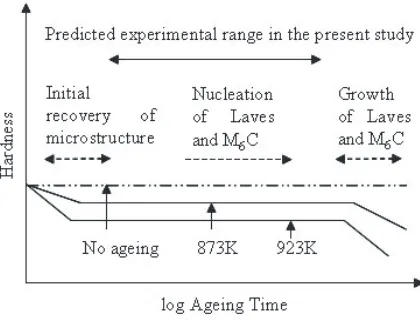
Fig. 12 The proposed dependence of hardness on ageing time at 873 to 923 K for JLF-1 and CLAM steels.
new phases such as Laves and M6C. This is consistent with
the observed precipitation in F82H by Tanigawaet al. [13], which showed that the present ageing conditions are before the formation of those phases.
5. Summary
The ageing experiments were carried out for JLF-1 and CLAM in the temperature range of 823 to 973 K fol-lowed by mechanical properties tests. The conclusions of the study are listed below:
(1) The hardness increased slightly after ageing at 823 K for the both steels. However, ageing at >823 K caused a decrease in hardness.
(2) The minimum creep rate decreased and the rupture time increased after ageing at 823 and 873 K for 2000 h for the both steels, suggesting the increase in the activation energy for the creep process. However, the creep property degraded significantly after ageing at 973 K for 100 h, in-dicating the decrease in the energy.
(3) The Larson-Miller parameter was used to predict long-term creep performance based on the short-term ex-periment at higher temperatures with higher stresses. In the typical blanket condition, 823 K for 100 000 h, the pre-dicted rupture stresses were estimated to be 140 MPa for the both steels. The present thermal ageing treatments in-fluenced the rupture stress by±10 MPa for the both steels. (4) From the activation analysis, it suggests that the present ageing conditions are located after the initial mi-crostructural recovery and before the softening by forma-tion of Laves and M6C phases.
Acknowledgements
This work was carried out based on NIFS Budget Code NIFS07UCFF003 and NIFS07GCFF003. This work was also supported by JSPS-CAS Core University Pro-gram.
[1] T. Muroga, M. Gasparotto and S.J. Zinkle, Fusion Eng. Des.61-62, 13 (2002).
[2] A.-A. F. Tavassoli, J. Nucl. Mater.302, 73 (2002). [3] F. Abe, Mater. Sci. Eng. A319-321, 770 (2001).
[4] J. Lape˜na, M. Garcia-Mazario, P. Fern´andezet al., J. Nucl. Mater.283-287, 662 (2000).
[5] P.J. Ennis, A. Zielinska-Lipiec, O. Wachter et al., Acta Mater.45, 4901 (1997).
[6] G. Dimmler, P. Weinert and H. Cerjak, Int. J. Press. Vess. Pip.85, 55 (2008).
[7] P. Fern´andez, A.M. Lancha, J. Lape˜naet al., Fusion Eng. Des.75-79, 1003 (2005).
[8] F.R. Larson and J. Miller, Trans. ASTM74, 765 (1952). [9] F.C. Monkman, N. J. Grant, Proc ASTM56, 593 (1956). [10] F.H. Norton, The Creep of Steels at High Temperatures
(McGraw-Hill, Dordrecht, 1929) p. 67.
[11] Y.F. Li, Q.Y. Huang, Y.C. Wuet al., J. Nucl. Mater. 367-370, 117 (2007).
[12] Y.F. Li, T. Nagasaka and T. Muroga, Fusion Sci. Technol. 56, 323 (2009).