Experience of application of network technologies in
engineering education
B. Katalinic
1, A.Eliseev
2, I. Breido
3,*, A.Bobryakov
4, A.Kabanov
5, V.Khomchenko
6, V.Potekhin
7,
S.Stazhkov
8, V.Filaretov
91Vienna University of Technology, DAAAM International 2Formerly Festo-Russia
3Karaganda State Technical University, No.56, Mira B., Karaganda, 100027, Kazakhstan 4National Research University “Moscow Power Engineering Institute”
5Sevastopol State University 6Omsk State Technical University
7The Great St.Petersburg Polytechnic University 8BSTU "VOENMEKh" them. D.F. Ustinov 9Far Eastern Federal University
Abstract
Leading technical universities of Russia and Kazakhstan, preparing engineers in the field of mechatronics, robotics and automation, combined their intellectual and material resources within the International University network project "Synergy".
For practical training, FESTO equipment and its virtual counterparts are used primarily.
Training of university students participating in the project has been organized, with lectures by leading professors on the Internet. Scientific Internet conferences of young scientists are regularly held.
International Association DAAAM International regularly organizes international student practices. A doctoral school is being conducted, at the DAAAM annual symposium, the development of project participants is presented.
Keywords: education, electrical engineering, automation, information technology, microprocessor, computer, industry, telecommunication, network, project, synergy.
Received on 04 December 2017, accepted on 20 January 2018, published on 31 January 2018
Copyright © 2018B. Katalinic et al., licensed to EAI. This is an open access article distributed under the terms of the Creative Commons Attribution licence (http://creativecommons.org/licenses/by/3.0/), which permits unlimited use, distribution and reproduction in any medium so long as the original work is properly cited.
doi: 10.4108/eai.30-1-2018.153817
1. Introduction
A transition to a post-industrial society, that is focused on innovative high-performance production, requires new approaches to the training of modern engineers. Herewith new principles of teaching, based on modern information
*Email:[email protected]
technologies and methods of distant education, are introduced.
2
In the tradition of higher education a lecturer has a special part of not only giving knowledge, but also developing personality of a student.
Outstanding science and educational schools originated when a mentor was not only an unique specialist, but also a man of marked individuality.
Consequently, despite all the attempts to reform higher education, that include introduction of new technologies of education, a teacher remains the key person of a high-quality educational process, who transfers knowledge in a process of a personal interaction with a student.
Modern network educational technologies became possible, as a rule, because of the development of ways and methods of distant education, which are focused on independent studies and acquisition of “knowledge”. Yet “skills” and “abilities”, two other important components of the triad, that forms the engineers competence, is difficult to realize through the distance education.
It is worth noting, that there are virtual simulators of educational laboratory facilities, though, it is required a direct or distant online contact of a student with the hardware to form a full-fledged engineer.
Another problem of modern engineer training is that modern engineering education becomes more and more narrow and special. Therefore a student, trying to focus on rapidly changing priorities of modern engineering, has no possibility to redirect his professional interests into most promising spheres of knowledge. In other words, a number of specializations of universal engineers is reducing. Exceptions to this rule are such specializations as “Mechatronics and robotics” and “Automation of technological processes and production”, and also a related to them specialization “Control in technical systems”.
2. Orientation to modern industrial
equipment
An attempt to solve the problem of qualitative training of specialists, based on best traditions of the higher education in combination with modern advanced technologies of teaching, was made by several leading Russian universities, that have specializations in mechatronics, robotics and production processes automation.
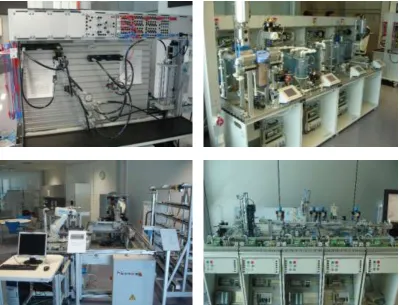
Figure 1. Concern FESTO training stands
EAI Endorsed Transactions on
Energy Web and Information Technology
A collaboration with FESTO contributed to this process. FESTO is an European leader in mechatronic systems elements and automated equipment production.
For years of work in Russia and countries of former Soviet Union FESTO company has not only registered its offices for production automation and staff training in many big cities and industrial centers, but also has built industrial enterprises, manufacturing and producing automatics elements to Russian consumers.
The introduction and further operation of the FESTO equipment needed to increase qualification and to retrain engineers. Solving this problem, the concern by means of its structural subdivision FESTO-DIDACTIC RF organized a network of retraining and refreshing course canters, and provided them with its unique laboratory facilities.Modularization, that is used in present equipment, allowed to conduct laboratory works for not only analytical study of mechatronical systems, but also for assembling them using elements of automatics that are actually in use. Some of the canters of retraining and refreshing were founded, basing on departments of a number of leading technical universities of Russia and countries of former Soviet Union.
These canters in their turn served as the basis for foundation of FESTO university canters, aimed at targeted training of engineers in the spheres of mechatronics, automation of technological processes and production and controls in technical systems within the framework of major educational programmes in the higher education.
3. Development of the project
Synergy-Network
In 2006 three universities, that had been the first to be equipped with FESTO training stands and to get actively functioning FESTO university canters: National Research University “MPEI”, Baltic State Technical University “VOENMEH” named after D. F. Ustinov, Omsk State Technical University decided to unite their intellectual and material resources for training of highly qualified engineers using innovative methods of network education within the framework of the International University Network Project “Synergy”. In 2007 Sevastopol National University (currently Sevastopol State Technical University) joined them, and in 2008 Karaganda State Technical University entered the project.
From the first steps of the project implementation, the members tried innovative at that time method of laboratory works with remote access to the training stands along with the known forms of the network cooperation.
It became possible due to presence of the FESTO unique training laboratory equipment in the universities by that time and provision the universities with the reliable dedicated channel of a quality Internet connection with the help of FESTO company.
Figure 2. The FESTO concern owner doctor Stoll at the opening of the International scientific and
educational canter BSTU–FESTO “Synergy”
Figure 3. The structure of the dedicated channel of the Internet connection of the “Synergy” project
The first successful laboratory session with the remote access to the laboratory training stands of the 3 universities took place in November 2006. In parallel with this process the universities almost in every sphere of educational activities were exploring the methods of the network training of engineers that had been in use.
4 Figure 4. The head of MPEI–FESTO Centre,
cosmonaut, Twice Hero of the USSR, Professor Eliseev A.S.
Figure 5. A group of students in Vienna University of Technology within the framework of the international
educational practice
The network cooperation of the universities reflected also in a sphere of scientific and technical creativity of the youth. University teams participate in different engineering competitions and Olympiads not only as rivals, but also take part as inter-universities teams. An example of this cooperation can be the victory of the united teams of “VOENMEH” and “MPEI” at first All-Russian festival of robotics in 2009.
One of the most prestigious and perspective international competition is “WorldSkills”. In this competition the students of the “Synergy” project participate with an active help of FESO Didactic RF.
In 2010 the first open graduation theses defense of “VOENMEH”, “MPEI”, OmSTU and KarSTU was held. This event increased a degree of students responsibility while writing the theses and, consequently, increased the quality of the works.
Figure 6. Regional competitions World Skills 2015 in Saint–Petersburg
Figure 7. An open defence of the Master thesis at BSTU in 2011
In recent years in regard to a significant increase of a number of graduation theses several best works from each universities are selected. The students are encouraged with certificates and recommendations for entrance to a postgraduate programme, publications in scientific journals and collections of scientific papers of various Russian and international conferences. Several theses have defences in the English and German languages annually.
Participation in the “Synergy” project of the unique association DAAAM International has radically changed scientific activity of the universities.
The annual DAAAM International Symposium significantly raised scientific indicators of the universities, posting work papers in prestigious world print publications, indexed in Scopus and Web of Science.
Within the frameworks of DAAAM Symposium a separate section was organized to analyze achievements and ways of further development of the “Synergy” project.
Organized in 2012, the unique Doctoral School DAAAM International annually provides to Russian post-graduate students together with PhD students from other countries an opportunity to communicate with leading world scientists, who also participate in the symposium.
EAI Endorsed Transactions on
Energy Web and Information Technology
Figure 8. XX Symposium DAAAM International 2009 in Vienna (Austria)
Figure 9. Participants of the International Doctoral School DAAAM International 2015 in Zadar (Croatia)
The conversation takes place in an informal setting and covers a wide range of issues – from narrow-profile to common, performing not only a scientific, but also an educational function.
Since 2010 within the frameworks of the “Synergy” project youth scientific and technical Internet conferences in mechatronics, robotics, automation and controls have been annually held. These events are organized by SevSTU and OmSTU with the active involvement of the other universities.
Over the years of these conferences existence more than 200 scientific works of young scientists from the universities–members of the “Synergy” project has been published and indexed Russian Science Citation Index. The best works are selected and recommended for revision and publishing in prestigious scientific journals indexed Higher Certification Commission RF, Scopus and Web of Science.
In the sphere of the highest qualification specialists training within the framework of an interuniversity scientific council pre-defences of theses of academic degree candidates are regularly held.
Figure 10. The International youth Internet conference OmSTU “Automation, mechatronics,
information technologies”
Figure 11. The open preliminary defense of the Candidate of Science thesis at BSTU “VOENMEH”
in 2015
6
4. Development of Internet technologies
for distributed learning Conclusion
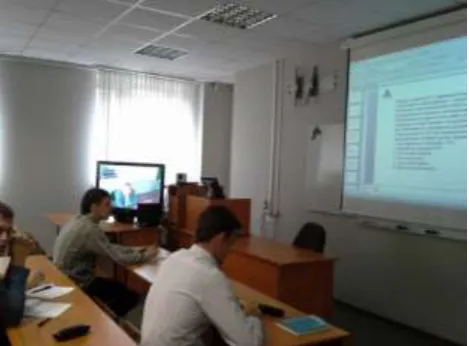
At the forefront of the network cooperation of the “Synergy” project members is the development and implementation into educational process of the real-time distant education technologies. The first experience of online lectures took place during modular specialised course for Master students.
Figure 12. One of the first online lectures of the “Synergy” project
A successful conduction of these courses served as the basis for full-semester distant courses, provided by leading lecturers of the university on the terms of interchange. However, there were some educational, organizational and financial difficulties, that project participants were to face. Courses of lectures that are held on different universities as a rule have different duration, amount of information and structure. Course content also depends on professionals views and scientific experience of a lecturer. There is a problem of a real-time objective and comprehensive rating of students knowledge. The last but not the least is a question of lecturers working hours and financial relations between the universities.
These problems prompted in 2014 the project members to found an interuniversity teaching and methodological council of “Synergy” that aimed a number of objectives of coordination of educational activity and of development of new forms and methods of the network education. Its first result was development and implementation into an educational process of a new in its structure and realization “joint” course “Intellectual control systems” for the project members Master students. The main idea of the course is that it is aligned in a flexible modular-topical principle, and every module is assigned to each of the universities– participants.
In the lent-term of 2015-2016 academic year, the course, consisted of 4 modules (each one of them consisted of 3 lectures or 6 academic hours), was lectured by teachers of “MPEI”, KarSTU, OmSTU and Peter the Great St. Petersburg Polytechnic University, that entered the project in 2014. Along with the students of the presented universities the students of first Mater year of “VOENMEH” have attended these lectures.
Figure 13. The joint network course “Intellectual control systems”
The teachers from each university after finishing their modules provided organizational and consultative functions. In the end of the whole course they tested knowledge of students from their universities.
An experience that was obtained with the implementation of the modular course allowed to draw preliminary statements.
First of all the work of a teacher becomes less routine and more methodical and organizational. That fact has a positive impact on the educational process quality. A lecturer can emphasize his attention on educational work and constantly improve teaching methods due to the time that became vacant.
The quality of the educational process has been also increasing because of natural mutual influence that different science school have on each other. Lecturing one subject by different teachers makes it more interesting for students.
Students knowledge appraisal is done by their lecturers throughout the course. Such an approach increases students responsibility and discipline of learning subjects.
Within the present distant education system a subject is lectured by two teachers and it doesn’t require some extra staff.
It is worth noting, that the course can be easily transformed and developed at the expense of reforming the present subjects or including new educational modules, lectured by leading teachers of other universities, including foreign.
EAI Endorsed Transactions on
Energy Web and Information Technology
Universities, that have an access to this course, can include separate modules or the whole course into their educational programs, solving a problem of the lack of lecturers of high qualification. In a natural way, an experience of an older generation is transferred to the younger generation. A positive experience, obtained at the development and implementation of the first cooperative course, allowed to develop and implement into the fall semester 2016-2017 educational process one more joint course “Modern Control Theory”, consisted of 5 modules by OmSTU, “VOENMEH”, KarSTU, “MPEI” and SpbPU. This course was also attended by students of SevSTU, Novgorod State University and Ural Federal University.
The particularity of engineering education lies in the fact that it requires not only theoretical, but also practical training using modern laboratory equipment. In present time such a practice is held by teachers of each university separately. However, the participants of the “Synergy” project have an experience of such laboratory works using the stands of the “FESTO” concern in the remote access mode. This experience can be used in further cooperative courses.
5. Conclusion
Finally, it is worth noting, that the new network education technology, designed and tested in a real teaching process,
almost solves the problems, that occurs while using distant methods of education. With an access to other educational schools, traditions and intellectual resources of the leading Russian and foreign engineering universities, in this case, a direct contact between a student and a lecturer is kept, so the education is not only about giving knowledge.
References
[1] Shestack V.p., Vesna E.B., Platonov V.N. (2013). Network education: the best domestic and foreign practices//Contemporary problems of science and education. – 2013. – No. 6.
[2] Zajakina R.A. (2012).Innovative University as a subject of networking//Higher education in Russia. – 2013. – No. 4. [3] Stazhkov S.M. (2012) Modern opportunities for integrating
and use educational resources engineering universities//Materials of the international scientific and technical conference "Control, automation and environment", Sevastopol (Ukraine). – 2012.