The Relationship between High Performance Work System and
Continuance Commitment to Change: An Economic Exchange
Perspective
Aqsa Akbar∗ Muhammad Amir Rashid† Omer Farooq‡
Abstract: In response to the recently announced privatization of public sector banks of Pakistan, the current study attempts to investigate the impact of perceived high performance work systems on contin-uance commitment to change along with its interlinking mechanisms. A total of 1000 full-time employees were surveyed through self-administered questionnaires during August-December 2017. Out of 670 returned questionnaires, 591 completed questionnaires were analyzed. Goodness of the measures was tested by employ-ing Confirmatory Factor Analysis. Proposed Hypotheses were tested through Structural Model in AMOS. The data largely substantiated by our theoretical framework. The findings revealed that the perceptions of eco-nomic exchange fully mediate the relation between HPWS and continuance commitment to change. Finally, theoretical and managerial implications are discussed, highlighting the issues that must be focused during chaotic nature of large-scale implementation of change initiatives in public sector.
Keywords:High performance work systems, continuance commitment to change, Public sector of Pakistan, Economic exchange perceptions.
Introduction
With the increasing demand to improve organizational efficiency, public sector around the world has been undergoing massive organizational changes to revamp its functions. Where such reforms can aid to bring positive outcomes, often overlooked areas during these reforms lies at the heart of the individuals, who are considered to be the key source of implementing changes initiatives (Bartunek, Rynes, & Ireland,2006;Smollan & Sayers,
2009). Though large-scale organizational changes do requires structural and functional changes, it also requires a change in employees’ mindset that can increase the chances of change success or failure (Fedor, Caldwell, & Herold,2006). Despite the growing im-portance of understanding employees’ psychological responses during change, managers often fail to address this issue (B. Becker & Gerhart,1996). Thus, recent studies highlight the need to study employees’ attitudes towards change as essential for successful imple-mentation of change initiatives. In this regard, one of the most profound change attitude
∗Department of Management Sciences, COMSATS Institute of Information Technology, Lahore Campus.
E-mail: [email protected].
†Department of Management Sciences, COMSATS Institute of Information Technology, Lahore Campus.
E-mail: [email protected].
revealed by the change literature behind successful change implementation is commit-ment to change (Herscovitch & Meyer,2002). it is defined as “a force or a mind-set that binds an individual to a course of action deemed necessary for the successful implemen-tation of change initiative”(Herscovitch & Meyer,2002). Based on theoretical foundations of the universally acknowledged model of organizational commitment (Meyer & Allen,
1991; Meyer, Allen, & Allen,1997). Herscovitch and Meyer (2002) developed a three-component commitment to change construct. The three three-component model consists of Af-fective, normative and continuance commitment to change. Affective commitment (ACC) represents “a desire to provide support based on its inherent benefits” whereas normative commitment (NCC) to change is a sense of social obligation to support a change. Contrary to this, continuance commitment (CCC) to change recognizes the cost of withholding sup-port for change. The concept of continuance commitment is similar to the definitions of exchange based or calculative commitment. The three different forms of commitment rest on the underlying unified approach that employees tend to stay with an organization be-cause of several reasons which may be an emotional attachment, moral obligation or cal-culative. However, in comparison to affective and normative forms of commitment, the literature lacks attention towards exchange-based or continuance commitment to change. Especially, the development of more short-term and transactional form of employment relationships within organizations (Herriot & Pemberton, 1997), highlights the need to refocus on this form of commitment. Moreover, in Asian context, continuance commit-ment have significance due to high collectivism, acceptance of high power distance & lack of other alternatives (Bouckenooghe, De Clercq, & Deprez,2014). The current study, therefore attempts to study the management of continuance commitment to change.
Prior studies suggest the significance of high performance work system in influencing employees attitudes and behaviors. Since the primary objective of any change initiative is to manage employees attitudes towards change by fostering more readiness and less re-sistance, the study proposed that HPWS may add value by managing employees CCC for better implementation of change initiatives. The association between HPWS and affective commitment to change has already well-documented in the literature. Nevertheless, the impact of HPWS on continuance commitment to change has yet to be unfolded. Also, investigating the impact of HPWS on continuance commitment to change is important as continuance commitment to change either had no association or even poses negative re-lation with desired change outcomes (Baraldi, Kalyal, Berntson, Naswall, & Sverke,2010;
Meyer, Srinivas, Lal, & Topolnytsky,2007).
implementation of change initiatives in public sector.
Theoretical Framework of the Study
High Performance Work System
Based on Strategic HRM, High performance work practices (HPWPs), seems to capture the attention of current change researchers and have been identified as crucial for orga-nizational change (Conway & Monks,2008;Tummers, Kruyen, Vijverberg, & Voesenek,
2015). However, researchers acknowledge the merits of systematic approach of HPWP called as high performance work systems (HPWS)“a group of separate but interrelated HRM practices, designed to improve employees competence, attitudes & motivation to enhance both individual and organizational performance” (Huselid,1995;Delery,1998;
Combs, Liu, Hall, & Ketchen,2006;Boxall & Macky,2009). Where majority of the stud-ies in literature have used HPWS to see its impact on organizational outcomes such as profitability (Wright, Gardner, Moynihan, & Allen, 2005) and productivity (MacDuffie,
1995;Askenazy,2001) as performance indicators, a less succinct impression begins to un-fold, raising questions about connecting HPWS with employees’ level variables (Kroon, Van de Voorde, & Van Veldhoven,2009) and financial sustainability (Raziq & Wiesner,
2016). The mainstream perspective suggests beneficial effects of HPWS on employees level outcomes (Garc´ıa-Chas, Neira-Fontela, & Varela-Neira,2016). Contrastingly, we do find studies where HPWS has no statistically significant impact or even negative impact on employees’ outcomes (Ramsay, Scholarios, & Harley,2000;Van De Voorde, Paauwe, & Van Veldhoven,2012). Based on such contrasting outcomes view about the effects of HPWS on employees level variables, recent researchers have called for more investiga-tion to assess the impact of HPWS on employees outcomes (Takeuchi, Chen, & Lepak,
2009;Wright et al.,2005;Garc´ıa-Chas et al.,2016) and specifically on the processes linking HPWS and employees’ outcomes (Harley, Sargent, & Allen,2010;Van De Voorde & Beijer,
2015). Focusing on the potential connection between HPWS with employee’s level out-comes, further examining the effects of HPWS on change related attitudes and underlying processes might aid for better understanding the change implementation process.
Continuance Commitment to Change
Continuance commitment to change refers to the recognition of cost in case of failure to support the change initiative. This form of commitment evolves from a different driving force. Unlike affective commitment which captures how people are emotionally attached to the change, continuance commitment to change derives out of people recognition of the cost of withholding the support for change. Based on Side-bets theory (H. S. Becker,
other employment opportunities and financial concerns make people to think more to-wards the cost of withholding support for change. Moreover, continuance commitment has often found to be positively related with negative outcomes such as stress, burnout and has no or even negative association with positive outcomes such as work behaviors (Rizzuto,2004;Cunningham,2006). According toRomzek(1990), continuance commit-ment entails a transactional attachcommit-ment. His view suggests that employees calculate the cost associated with leaving the organization versus the benefits associated with staying.
Best(1994) argues that this form of commitment is strongest when people are available with fewer employment opportunities and when their stakes are quite high. Both of these conditions fulfill the characteristics of public sector employees in developing nations such as Pakistan. Having job security, long-term benefits, a public employees image and other benefits coupled with less employment opportunities develops a strong sense of continu-ance commitment. Therefore, it becomes imperative to manage such form of commitment during change initiatives.
High Performance Work System and Continuance Commitment to Change
The impact of employees’ perceptions of HPWS on employees attitudes has been empir-ically tested in many previous researches (Macky & Boxall,2007;Kehoe & Wright,2013;
Mao, Song, & Han, 2013). One of the dominant approaches is to provide its rationale through social exchange theory (Blau,1964) and norms of reciprocity (Gouldner,1960). According to this, social exchange relationships formed through the way organizations’ treat its employees (Gould-Williams & Davies,2005). It suggests when individuals are in-volved in rewarding relationships, they become bound to return favors to exchange part-ner (Blau,1964). Similarly, when HPWS are implemented effectively, it causes employees to perceive their relationship with organization as supportive and meaningful. In other words, when employees perceive human resource practices as a sign of appreciation, they reciprocate through favorable attitudes such as increased commitment (Hornung, Rousseau, & Glaser,2008) and vice versa.
As earlier mentioned, continuance commitment to change develop when employees perceives that it’s costly not to support the change (Herscovitch & Meyer,2002). This hap-pens when an organization fails to develop a socioemotional relationship with employees through its practices such as HPWS. Connecting the same line, when employees perceive HPWS as not supportive, it would not be able to create any emotional or moral bound with the organization, rather just an expensive option not to support the change other-wise. Based on above discussion, we argue that change managers can reduce continuance commitment to change through effective HPWS. Expecting a negative relationship, we hypothesize
Mediating Impact of Perceptions of Economic Exchange
Most of the previous researches investigated the direct impact of HPWP on commitment to change (Conway & Monks, 2008; Fugate, 2012, 2012; Tummers et al., 2015), yet the interlinking mechanisms received less attention. Few studies have focused on the micro-mechanisms of black box linking HPWS and employees outcomes from the employees’ perspective (Takeuchi et al.,2009;Mao et al.,2013). Though many mediating factors have been found to influence the perceived HPWS and employees attitude relationship such as the role of employees climate between HPWS and job satisfaction (Takeuchi et al.,2009), the mediating role of behavioural script, skill variety, and autonomy between HPWS and job satisfaction and affective commitment (Mao et al.,2013), the results are quite mixed as more mediating variables can possibly influence this relationship. This offers the op-portunity to unearth the processes through more mediating variables between employees level HPWS and employees attitudes (Mao et al.,2013). We also aim to fill this gap by exploring the mechanisms that link the employees level HPWS and employees attitudes with the help of social exchange theory (Blau,1964).
In addition to general reciprocation as embedded in social exchange theory, the theory can explain why individuals express favorable attitudinal & behavioral returns to organi-zations (Settoon, Bennett, & Liden,1996). A central tenet of this theory revolves around the idea that employees develop such exchanges for two basic reasons (i.e. socioemo-tional and economic reasons) & that the perceptions of the nature of such exchanges in employee-employer relationships can predict employee side attitudes & behaviors with regard to the employer (Kuvaas & Dysvik,2009). Both HR and commitment literature have emphasized on significance of social & economic exchanges as explanatory mech-anisms for linking them with other variables (Shore, Tetrick, Lynch, & Barksdale,2006;
Kuvaas & Dysvik, 2009), but received less attention in explicitly measuring employee perceptions of social & economic exchanges independently in employee-employer rela-tionship (Coyle-Shapiro & Conway,2004). Literature found that organizational actions or practices proved to be significant antecedents of nature of the social and economic exchanges (Kuvaas & Dysvik, 2009). Thus we propose that employees perceptions of exchanges may mediate the relationship between perceived HPWS and commitment to change.
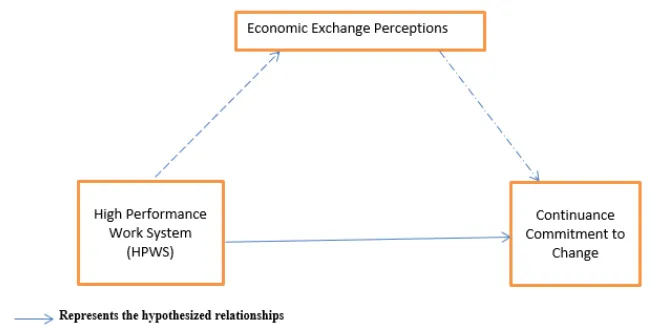
Hypothesis 2: Employees’ perceptions of economic exchanges mediate the relationship between perceived HPWS and continuance commitment to change.
The Conceptual Framework of the Study
Figure 1
Theoretical Model
Research Methodology
Sample and Procedure
To test the proposed theoretical framework, data is collected through a survey from the employees of the largest state-owned bank of Pakistan, recently announced for privati-zation. Employees from the Punjab region of the bank filled self-administered question-naires. In this regard, we contacted the regional head office to get the permission and administrative support. To ensure the confidentiality of employees, we did not include the information regarding names and locations. Around 1000 questionnaires were sent to regional head offices during August-December 2017. Due to top management’s en-dorsement, we could be able to receive 650 filled questionnaires (73% return rate). After carefully scrutinizing the questionnaire by deleting all missing data cases, a usable sample of 591 was selected for final analysis.
Survey Instrument
de-mographic variables. All the variables used in the present study has already established measures.
Measures
Continuance Commitment to Change
Continuance commitment to change is measured through 6-items adapted fromHerscovitch and Meyer(2002) commitment to change scale. A sample item for measuring normative commitment to change includes “I have no choice but to go along with the Privatization program”. The reliability of this scale for the current study is (Cronbach alpha=0.91).
Economic Exchange
Measure for social exchange is used by 6 items developed byShore et al.(2006), All the items are measured on a 5 point Likert scale ranging from strongly disagree to strongly agree. Sample items include “My relationship with my organization is strictly an eco-nomic one, I work and they pay me”. The reliability of this construct is (Cronbach al-pha=0.83).
Perceived HPWS
28 item scale of HPWS is selected from the work ofSiddique(2014) framework that were used in the state-owned bank to measure the employee’s perceptions of HPWS. As widely recommended in the literature, an additive approach has been used to aggregate the uni-tary index of HPWS (Huselid,1995; Chuang & Liao,2010; Pak & Kim,2016;Ostroff & Bowen,2000;Liao, Toya, Lepak, & Hong,2009). This approach is based on a fundamental assumption of strategic human resource management that system approach of HPWS is better than testing the impact of individual HR practices (Lepak, Liao, Chung, & Harden,
2006). The Practices include job/ employment security, employees’ participation, train-ing, information shartrain-ing, job clarity/ JD as role clarity, compensation, performance ap-praisals. These practices besides being universal in nature also have relevance to change management literature and have well-validated measures as well. Sample items include “My job is secure as long as I perform well”, “My job has an up to date job description”. The Cronbach alpha of HPWS is 0.93.
Results
Respondents Descriptive
is just 10.7%. The respondents’ level of qualification shows that majority of the respon-dents are highly qualified with 60.7% lies in Postgraduate qualification domain. 29.9 % are graduate and only 10 % are undergraduate. Such qualification distribution shows that this bank prefers highly qualified professionals. As far as respondents’ experience is concerned, the largest percentage of respondents of the current study have more than 15 years of experience in the banking sector with 34.5% lies in above 15 years of experience domain. 26.9 % respondents belong to the experience domain of 5-10 years and 23.9% lies in 11-15 years of experience domain. The smallest percentage of respondents i.e. 14.7% have less than 5 years of experience. Such heavy distribution of respondents’ experience towards more than 10 years shows that the bank emphasis on HR practices such as job security. Gender distribution of respondents’ shows the dominance of males with 75.6% as compared to females which comprise of only 24.4%. There are several reasons that account for male dominance in Pakistani workplaces especially in banking sector such as social and cultural issues.
Reliabilities and Validities
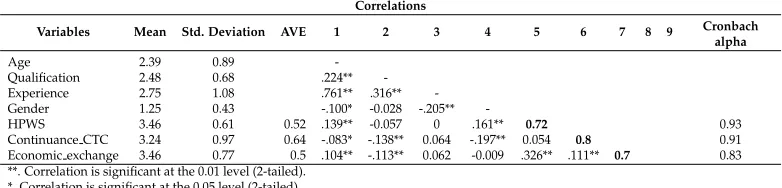
Table 1 presents the means, intercorrelations, standard deviations, Cronbach alpha, con-vergent and discriminant validity of all variables .The appropriateness of this study mea-surement model is assessed by first performing a confirmatory factor analysis (CFA) us-ing the Analysis of moment structures (AMOS 21) (Arbuckle,1997). The 5-factor model showed a good model fit withX2= 5260.891 p<.000 df= 1204;X2/df= 4.3; Root mean square error of approximation (RMSEA)=0.7; Tucker-Lewis index(TLI)= 0.77; Normed fit index (NFI)=0.74 and comparative fit index (CFI) of 0.78.
Table 1
Means, Standard Deviations, intercorrelation, Average Variance Extracted, Reliabilities and Discriminant Validity test for all Variables Correlations
Variables Mean Std. Deviation AVE 1 2 3 4 5 6 7 8 9 Cronbach alpha
Age 2.39 0.89
-Qualification 2.48 0.68 .224**
-Experience 2.75 1.08 .761** .316**
-Gender 1.25 0.43 -.100* -0.028 -.205**
-HPWS 3.46 0.61 0.52 .139** -0.057 0 .161** 0.72 0.93
Continuance CTC 3.24 0.97 0.64 -.083* -.138** 0.064 -.197** 0.054 0.8 0.91 Economic exchange 3.46 0.77 0.5 .104** -.113** 0.062 -0.009 .326** .111** 0.7 0.83 **. Correlation is significant at the 0.01 level (2-tailed).
*. Correlation is significant at the 0.05 level (2-tailed).
Notes: 1. Diagonal bold values represent the Square root of average variance extracted values of each variable.
2. For discriminant Validity, diagonal value for each variable should be greater than its corresponding off-diagonal correlation coefficients. 3. The Cronbach Alpha shows the Reliability of each variable.
Estimation of Model
Standardized and Unstandardized Estimates
computed through Maximum likelihood (Arbuckle,1997). In unstandardized model solu-tion, AMOS shows regressions weights, variances, and co-variances. According toByrne
(2016), regression weights indicates the impact of one variable over another. On the other hand, standardized regressions model presents standardized regression weights, squared multiple correlations and correlations.
Testing the Direct Effects
After the fit indices, results show the testing of hypothesized relationship. The hypothesis of the current study are :
Hypothesis: A negative association exists between employees’ perception of HPWS and continuance commitment to change. Table 2 shows the coefficient of the hypothesized regression path and its significance.
Table 2
Coefficient of Direct Effect Regression Path
Estimate S.E. C.R. P Results
CCC <— Performance -0.072 0.062 -1.16 0.245 H1 System (Not Supported) Where CCC stands for Continuance Commitment to Change.
Test of Mediation
The mediation hypothesis was tested through SEM by first controlling the effects of age, gender, qualification, and experience. After that, direct, indirect and mediations effects were tested without including our proposed moderating variables. According toIacobucci, Saldanha, and Deng(2007), direct and indirect paths must be simultaneously specified to estimate either effect. Moreover, all the insignificant paths must also be removed from the model. The hypothesized effect along with the direct effect of HPWS on continuance commitment to change has been incorporated to specify the model. As the direct effect of HPWS on Continuance commitment to change was insignificant, this path was removed in the model (Iacobucci et al.,2007;Kline,2011;Farooq, Rupp, & Farooq,2017). Though not much improved, fit indices showed model fit with X2 = 3282.571 p<.000; df=690 X2/df= 4.7; Root mean square error of approximation (RMSEA)=0.075; Tucker-Lewis
Table 3
Direct and Indirect effects (via Economic Exchange ) of HPWS on Continuance CTC
Economic Exchange Continuance Commitment to Change
Factors Direct Direct Effect Indirect Effect Total Effect Type of Mediation
HPWS -0.341*** NS .048* 0.048 Full Mediation Values are standardized Regression weights
***p<0.001 * p<0.05
Discussion
Increasing prevalence of change in today’s organizations is becoming theoretically and pragmatically imperative for better survival (Gordon, Stewart Jr, Sweo, & Luker, 2000;
markets while understanding exchange relationships. Moreover, since HPWS is assumed to create social exchanges, throwing a light on the economic aspect of HPWS might be able to explain the links where it negatively influences the employees’ outcomes.
Practical Implications
The current study has significant implications for change implementers. Although other environmental factors are likely to influence change initiative success, committed em-ployees form a groundwork to ensure smooth change implementation. Change managers should direct their attention towards the nature of exchange dynamics while implement-ing HPWS, whose impact on employees attitudes have been widely attested in the liter-ature (Liao et al.,2009;Mao et al.,2013). Moreover, change initiatives that tend to attract high resistance, economic exchanges may be encouraged for a short term to ensure min-imum reciprocation through continuance commitment. Understanding the key determi-nants of employees positive attitudes towards change with respect to exchange dynamics can assist the managers in the pro-active planning of change process for maximizing the probability of successful change interventions.
Direction for Future Research
References
Arbuckle, J. L. (1997). Amos user’s guide version 3.6. Chicago.SmallWaters Corporation. Askenazy, P. (2001). Innovative workplace practices and occupational injuries and
ill-nesses in the United States. Economic and Industrial Democracy,22(4), 485–516. Baraldi, S., Kalyal, H. J., Berntson, E., Naswall, K., & Sverke, M. (2010). The importance
of commitment to change in public reform: An example from Pakistan. Journal of Change Management,10(4), 347–368.
Bartunek, J. M., Rynes, S. L., & Ireland, R. D. (2006). What makes management research interesting, and why does it matter? Academy of Management Journal,49(1), 9–15. Becker, B., & Gerhart, B. (1996). The impact of human resource management on
organiza-tional performance: Progress and prospects. Academy of Management Journal,39(4), 779–801.
Becker, H. S. (1960). Notes on the concept of commitment. American Journal of Sociology, 66(1), 32–40.
Best, P. W. (1994). Locus of control, personal commitment and commitment to the orga-nization. Unpublished MCom thesis, University of South Africa, Pretoria.
Blau, P. (1964). Exchange and power in social life. New York: Wiley.
Bouckenooghe, D., De Clercq, D., & Deprez, J. (2014). Interpersonal justice, relational con-flict, and commitment to change: The moderating role of social interaction. Applied Psychology,63(3), 509–540.
Boxall, P., & Macky, K. (2009). Research and theory on high-performance work sys-tems: progressing the high-involvement stream. Human Resource Management Jour-nal,19(1), 3–23.
Byrne, B. M. (2016).Structural equation modeling with amos: Basic concepts, applications, and programming. Routledge.
Chuang, C.-H., & Liao, H. (2010). Strategic human resource management in service con-text: Taking care of business by taking care of employees and customers. Personnel Psychology,63(1), 153–196.
Combs, J., Liu, Y., Hall, A., & Ketchen, D. (2006). How much do high-performance work practices matter? A meta-analysis of their effects on organizational performance. Personnel Psychology,59(3), 501–528.
Conway, E., & Monks, K. (2008). HR practices and commitment to change: An employee-level analysis. Human Resource Management Journal,18(1), 72–89.
Coyle-Shapiro, J. A., & Conway, N. (2004). The employment relationship through the lens of social exchange. Oxford University Press, Oxford, UK.
Cunningham, G. B. (2006). The relationships among commitment to change, coping with change, and turnover intentions. European Journal of Work and Organizational Psychology,15(1), 29–45.
Delery, J. E. (1998). Issues of fit in strategic human resource management: Implications for research. Human Resource Management Review,8(3), 289–309.
Farooq, O., Rupp, D. E., & Farooq, M. (2017). The multiple pathways through which internal and external corporate social responsibility influence organizational identi-fication and multifoci outcomes: The moderating role of cultural and social orienta-tions. Academy of Management Journal,60(3), 954–985.
Fedor, D. B., Caldwell, S., & Herold, D. M. (2006). The effects of organizational changes on employee commitment: A multilevel investigation. Personnel Psychology,59(1), 1–29.
Fugate, M. (2012). The impact of leadership, management, and HRM on employee reactions to organizational change. Emerald Group Publishing Limited.
Garc´ıa-Chas, R., Neira-Fontela, E., & Varela-Neira, C. (2016). High-performance work systems and job satisfaction: A multilevel model. Journal of Managerial Psychology, 31(2), 451–466.
Gordon, S. S., Stewart Jr, W. H., Sweo, R., & Luker, W. A. (2000). Convergence versus strategic reorientation: The antecedents of fast-paced organizational change.Journal of Management,26(5), 911–945.
Gouldner, A. W. (1960). The norm of reciprocity: A preliminary statement. American Sociological Review, 161–178.
Gould-Williams, J., & Davies, F. (2005). Using social exchange theory to predict the ef-fects of HRM practice on employee outcomes: An analysis of public sector workers. Public Management Review,7(1), 1–24.
Harley, B., Sargent, L., & Allen, B. (2010). Employee responses to ‘high performance work system’ practices: An empirical test of the disciplined worker thesis. Work, Employment and Society,24(4), 740–760.
Herriot, P., & Pemberton, C. (1997). Facilitating new deals. Human Resource Management Journal,7(1), 45–56.
Herscovitch, L., & Meyer, J. P. (2002). Commitment to organizational change: Extension of a three-component model.Journal of Applied Psychology,87(3), 474–487.
Hornung, S., Rousseau, D. M., & Glaser, J. (2008). Creating flexible work arrangements through idiosyncratic deals. Journal of Applied Psychology,93(3), 655–664.
Huselid, M. A. (1995). The impact of human resource management practices on turnover, productivity, and corporate financial performance. Academy of Management Journal, 38(3), 635–672.
Iacobucci, D., Saldanha, N., & Deng, X. (2007). A meditation on mediation: Evidence that structural equations models perform better than regressions. Journal of Consumer Psychology,17(2), 139–153.
Kehoe, R. R., & Wright, P. M. (2013). The impact of high-performance human resource practices on employees’ attitudes and behaviors. Journal of Management,39(2), 366– 391.
Kline, R. B. (2011). Convergence of structural equation modeling and multilevel modeling. Kroon, B., Van de Voorde, K., & Van Veldhoven, M. (2009). Cross-level effects of
high-performance work practices on burnout: Two counteracting mediating mechanisms compared. Personnel Review,38(5), 509–525.
Journal of Applied Social Psychology,39(10), 2499–2524.
Lepak, D. P., Liao, H., Chung, Y., & Harden, E. E. (2006). A conceptual review of human resource management systems in strategic human resource management research. Emerald Group Publishing Limited.
Liao, H., Toya, K., Lepak, D. P., & Hong, Y. (2009). Do they see eye to eye? Manage-ment and employee perspectives of high-performance work systems and influence processes on service quality.Journal of Applied Psychology,94(2), 371–391.
MacDuffie, J. P. (1995). Human resource bundles and manufacturing performance: Or-ganizational logic and flexible production systems in the world auto industry. ILR Review,48(2), 197–221.
Macky, K., & Boxall, P. (2007). The relationship between ‘high-performance work prac-tices’ and employee attitudes: an investigation of additive and interaction effects. The International Journal of Human Resource Management,18(4), 537–567.
Mao, N., Song, H., & Han, Y. (2013). High-performance work systems and influence processes on employees’ attitudes: Perspectives from China. International Journal of Manpower,34(7), 736–752.
Meyer, J. P., & Allen, N. J. (1991). A three-component conceptualization of organizational commitment. Human Resource Management Review,1(1), 61–89.
Meyer, J. P., Allen, N. J., & Allen, N. J. (1997). Commitment in the workplace. Sage Publica-tions.
Meyer, J. P., Srinivas, E., Lal, J. B., & Topolnytsky, L. (2007). Employee commitment and support for an organizational change: Test of the three-component model in two cultures.Journal of Occupational and Organizational Psychology,80(2), 185–211. Ostroff, C., & Bowen, D. E. (2000).Moving hr to a higher level: HR practices and organizational
effectiveness. San Francisco, CA: Jossey-Bass.
Pak, J., & Kim, S. (2016). Team manager’s implementation, high performance work sys-tems intensity, and performance: A multilevel investigation. Journal of Management. doi: 10.1177/0149206316646829
Ramsay, H., Scholarios, D., & Harley, B. (2000). Employees and high-performance work systems: Testing inside the black box. British Journal of Industrial Relations,38(4), 501–531.
Raziq, A., & Wiesner, R. (2016). High performance management practices and sustain-ability of SMEs. evidence from manufacturing and services-based industries in pak-istan. Journal of Management Sciences,3(2), 83–107.
Rizzuto, T. E. (2004). Multi-level acceptance and commitment to technology change in govern-mental agencies(Unpublished doctoral dissertation).
Romzek, B. S. (1990). Employee investment and commitment: The ties that bind. Public Administration Review,50(3), 501–531.
Salancik, G. R., & Pfeffer, J. (1978). A social information processing approach to job attitudes and task design. Administrative Science Quarterly,23(2), 224–253.
Shore, L. M., Tetrick, L. E., Lynch, P., & Barksdale, K. (2006). Social and economic ex-change: Construct development and validation. Journal of Applied Social Psychology, 36(4), 837–867.
Siddique, M. (2014). Exploring the linkages between high performance work systems and orga-nizational performance: The role of relational coordination in the banking sector of Pakistan (Unpublished doctoral dissertation). University of Newcastle Upon Tyne.
Smollan, R. K., & Sayers, J. G. (2009). Organizational culture, change and emotions: A qualitative study. Journal of Change Management,9(4), 435–457.
Takeuchi, R., Chen, G., & Lepak, D. P. (2009). Through the looking glass of a social sys-tem: cross-level effects of high-performance work systems on employees’ attitudes. Personnel Psychology,62(1), 1–29.
Tummers, L., Kruyen, P. M., Vijverberg, D. M., & Voesenek, T. J. (2015). Connecting hrm and change management: The importance of proactivity and vitality. Journal of Organizational Change Management,28(4), 627–640.
Van De Voorde, K., & Beijer, S. (2015). The role of employee HR attributions in the rela-tionship between high-performance work systems and employee outcomes.Human Resource Management Journal,25(1), 62–78.
Van De Voorde, K., Paauwe, J., & Van Veldhoven, M. (2012). Employee well-being and the HRM–organizational performance relationship: A review of quantitative studies. International Journal of Management Reviews,14(4), 391–407.