HESPERIA 69, 2000 Pages 487-So7
A
ROMAN
TABLE
$ U
P PORT
AT
ANC{I
EN
T
CO
RI
NTH
ABSTRACT
A Roman sculptured table support, discovered in Frankish destruction levels at ancient Corinth, represents a rare iconographical treatment of a popular theme, Hermes carrying the baby Dionysos. Dating to the second half of the
2nd century A.C., the trapezophoros is adorned with a muscular, torsional
Hermes supporting Dionysos perched on his outstretched left arm. The clos- est parallels for this composition are the large three-dimensional groups of satyrs and babies produced at Aphrodisias. The Hermes and Dionysos group may have reminded its Frankish discoverers of St. Christopher, patron oftrav- elers and transporter of the infant Christ.
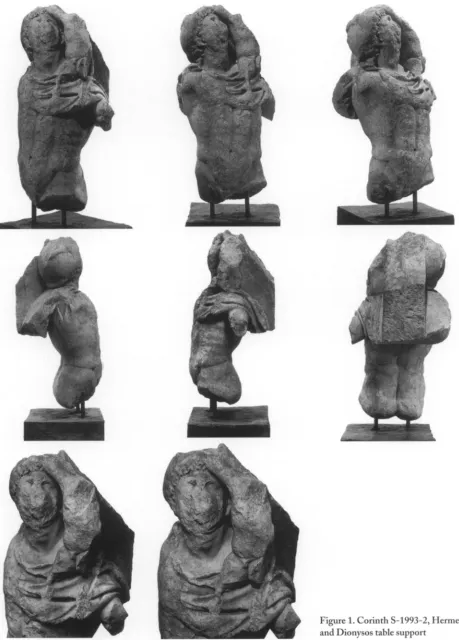
Recent excavations at Corinth in the area southeast of Temple E have revealed a Byzantine complex with enclosed court (Unit 1), and a funerary chapel in Unit 2. An unusual Roman sculpture of Hermes holding the baby Dionysos (Fig. 1), discovered in Unit 2 during the 1993 season, rep- resents a hitherto unknown iconographical treatment of this popular and enduring theme, and may also illustrate how this motif, and the work it- self, took on new meaning in Frankish Greece.' The sculpture was discov- ered during the removal of destruction debris that ran east to west in the tile-paved Room C of Unit 2, which included a series of rooms surround- ing the church at the northern end of the Byzantine monastery altered in the Frankish period (Fig. 2:a-b).2 According to C. K. Williams II, Unit 2 In memory of
Charles M. Edwards (1953-i992)
1. S-1993-2. I thank C. K. Wil- liams II for his generous permission to study and publish this sculpture, and for reading drafts of the paper. N. Bookidis helped in many ways, discussing the sculpture with me and reading the manuscript. In addition to the original photographs she prepared, Dr. Bookidis supplied additional images on short notice; I owe her a special debt of thanks. Thanks also to Luke Walker, Graphic Design student at the
University of Mississippi, who produced Figure 7.
B. S. Ridgway also read a draft of this essay, making valuable suggestions. The anonymous referees made many helpful recommendations and corrections. Remaining mistakes are my own responsibility.
2. Corinth NB 863, pp. 18,24 (June 22-23, 1993). This room is called C in the 12th-century Byzantine phase (see Williams and Zervos 1995, pp. 11-15); for Room C in its Frankish form (Room 3) see Williams et al. 1998, pp. 237-239; Williams and Zervos 1993, pp. 9-12, and 1994, pp. 24-26.
American School of Classical Studies at Athens is collaborating with JSTOR to digitize, preserve, and extend access to
Hesperia
_
__
_S
_
_
_
_
_
| _
: ,
_
_ _
__
_
_
_
_ _1
_
_
_ _
_
;
i I j
. -
S - l K
r i ' i
, Figure 1. Corinth S-1993-2^ Hermes
A ROMAN TABLE SUPPORT AT ANCIENT CORINTH 489
Figure 2a. Corinth, temenos of Temple E: Frankish remains of the end of the 13th century. From
lxr 11- 1 r7 o ~~~~~EXCAVATION OF 1965 _--
Williams and Zervos 1996, fig. 1 - -
UNIT 3
--~~1
Q:V
UNIT _4
0 20M.
Figure 2b. Corinth, Unit 2: actual- state plan, composite remains of the
late 12th and 13th centuries. From VI
Williams and Zervos 1996, fig.2 6 7 8 9
g r < 0\tt q ,~~~
rti
H \1| G (5.j & nt5e
?>
i* igse
HanUNIT
2
0 5
'' -3g 9 ? SM.
was probably constructed in the first third of the 12th century.3 Williams first coupled this destruction stratum in Room C with the Catalan inva- sion of 1312, but more recently has connected it with the earthquake of ca.
1300.4 Room C was repaired early in the 13th century, and went out of use shortly after. During this brief last phase, the north wall of Room C had a door at its center that opened into a courtyard at its north side.
3. Williams et al. 1998, p. 237; Williams, Barnes, and Snyder 1997, p. 21; Witliams and Zervos 1995, pp. 11-12.
The excavator hypothesizes that the fragment was immured in an external wall of Room C until it collapsed into a stratum of architectural debris.5
Sculpted of fine-grained white marble, the male, nude except for a chlamys fastened over his right shoulder, supports a baby on his left arm. The fragment has a preserved height of 0.53 m. The height of the adult's head is 0.13 m. Multiplying this dimension by 7, a standard ratio of head to body height, we can hypothesize that he stood ca. ninety centimeters tall. Some patches of the highly polished surface are preserved on the left side of the neck and shoulder and in the valleys between folds on the chla- mys. The right side of the sculpture is considerably weathered, suggesting that it may have been exposed for some time to the elements. Its surface considerably damaged, his short-brimmed, close-fitting hat, preserving stumps of wings on both sides of the crown, identifies this personage as the god Hermes.6
His hair, where it emerges beneath the hat, was arranged in short curls, executed with a profusion of drill holes, their finished surfaces now largely broken away. Locks of hair frame his face. These strands can be seen most clearly on the left side of the head where it was protected by the baby's body. Much of Hermes' face from the nose down is broken away. His brow, however, marked with a deep furrow, survives, along with the left eye and the inner half of the right eye. A deep drill line defines the contour of the upper right lid and most of the deeply set left eye. The tear- duct is carefully articulated. Pupils and irises are not incised; these details may have been added in paint. The appearance, in photographs, of delib- erately cut detail in the center of the left eye is the result of damage.
Hermes now lacks his raised right arm from the shoulder, the left from mid-upper arm, and both legs from mid-thigh. The infant is missing his head and neck, and a portion of his torso on the left side, including the arm, part of the left leg to the thigh, and most of the right leg to mid- thigh. Hermes raised his right arm clear of his head, perhaps above it, holding an attribute toward which the infant reached. The god held his bent left arm away from his body. He may have grasped the baby's left leg with his left hand or raised his left forearm toward his charge; there are parallels for both poses, as we shall see. Or he may have brandished a caduceus.
The baby sits on Hermes' left shoulder, close to the god's head, dan- gling both legs down over Hermes' chest: scars remain on the chlamys where they rested. The child stretches to the right, resting his right hand on the front of Hermes' head. The god, turning to his own left side, looks up at him in a close, intimate pose.
Hermes, given an athlete's body, active and torsional, twists his lower body to his right side. He probably stepped forward on his left leg. His neck and torso are strikingly muscular. The neck preserves the remains of a bulging tendon on the left side, along with horizontal ridges of flesh that intensify the dramatic upturned position of the head. The muscularity of the epigastric region is apparent, despite the broken and abraded surface. Some details of digitation survive, especially on the left side of the torso. The iliac crests are prominently expressed.
This sculpture of Hermes as a kourotrophos, probably shouldering the infant Dionyos, was not freestanding but adorned a support. Part of a
A ROMAN TABLE SUPPORT AT ANCIENT CORINTH 49I ...~~~~~~~~~~~~~~~~. ...: ... ... : ...
...
: :.: : ,., ., :~~~~~~~~~~~~~~~~~~~~~~~~~~ . ... .
.~~~~~~~~~~~~~~~~~~~~~~~~~~~~~~~~~~~~~~~~~~~~~... i _I 1 | I~~~~~~~~~~~~~~~~~~~~~~~~~~~~~~~~~~~~~~~~~~. ... ...
. 5V S.
Figure 3. Corinth S-437, satyr table support
pillar, measuring about ten centimeters on each side, carved in one piece with the figure, survives on the back. The sides of the pier were worked with a rasp, and the back was finished with the claw chisel. Now broken off at top and bottom, the support extended above and below the figure, which was carved completely free of this pillar from the middle of the shoulder blades and downward. The plastically rendered chlamys, its edges and bottom now broken away in back, was carved in one piece with the support, but billowed out on both sides, providing a dramatic background for the figure. This garment fell over the back of Hermes' left shoulder, where drapery folded over on itself; it was carved more carefully here than on the right side, but the figure was probably meant to be viewed from the front.
While his eyes are not drilled, Hermes' common snail curl coiffure is characterized by deep drill holes. The use of the drill to articulate short, tightly curled locks is attested by the second quarter of the 5th century
B.C., so this feature is not diagnostic for the dating of this sculpture.7 In
Roman Imperial portraits of women, the combination of drilled hair and blank eyes is found in Augustan through Trajanic works. It may be risky, however, to use large Imperial portraits as comparanda for small mytho- logical compositions, especially in the case of this piece, unusual in form and function. At Corinth, two nonjoining fragments from the head of a large, freestanding Roman Hermes with the short curly hairstyle have been given an Antonine date.8 These pieces preserve not only drill holes, but also comma-like drilled grooves defining individual locks of hair. The col- oristic quality of the hair, the defined tearduct, active pose, dramatic mus- culature, and polished surface may place the Hermes and Dionysos group in the Hadrianic period, and perhaps even later in the second half of the 2nd century.
The pillar served a structural function for the sculpture itself, stabiliz- ing the load supported on Hermes' neck. Square trapezophoros supports with roughly consistent dimensions from top to bottom are less common
than struts which taper toward the top.9 According to Stephanidou-
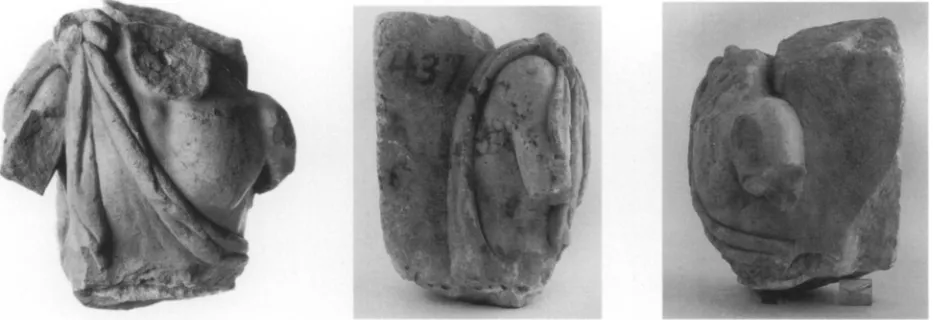
Tiberiou, the thicker, square pillar was more stable.'0 Parallels for the square support can be found among Attic figural trapezophora, including two at Corinth. The upper torso of a satyr (Fig. 3) excavated at the site preserves
7. Figure M, Temple of Zeus at
Olympia, 470-456 B.C. (Ashmole and
Yalouris 1967, figs. 33-36). 8. S-1934 A, B: Sturgeon 1975, pp.292-293, no.3.
9. These table supports were being produced in Attic workshops by the
middle of the 1st century A.C. and
through the third quarter of the 3rd century. Also on trapezophora see Moss 1988 and Cohon 1984.
g ... il _ : g | E ..
:~~~~~~~~~~~~~~~~~~~~~~~~~~~~~~~~~~~~~~~~~~~~~~~~~~~~~~~~~~~~~~~~~~~~~~~~~~~~~~~~~~~~~~~~. ....
I ... l _.: : :: '. I
_~~~~~~~~~~~~~~~~~~~~~~~~~~~~~~~~~~~~~~~~~~~~~~~~~~~~~~~~~~~~~~~~~~~~~~~~~~~~~~~~~~~~~~~~~~~~~~~~~~~... ..
I . ._ _ ... ~~~~~~~~~~~~~~~~~~~~~~~~~~~~~~~z: ., .s
.. ..: ... ...* -
part of a similar square strut with the same measurement of 0.10 m on a side." The figure, however, has a preserved height from neck to waist of around thirteen centimeters, versus ca. twenty centimeters for the Hermes.'2
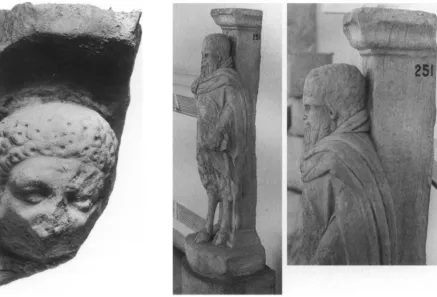
Another fragment of a possible support at Corinth (Fig. 4) preserves most of the head of a bearded male, probably Herakles, with short, drilled curls. His head, like that of Hermes, measures 0.13 m and was carved in a single piece with the top of a substantial strut, similarly proportioned, whose capital bears a round cutting for the tenon of the table leaf, or whatever element it supported.'3 This work corresponds in the dimensions of both figure and support to the Hermes and Dionysos group, but the statue, a herm, is centered frontally on the pillar, and probably adhered to it from the head down. In Athens at the National Museum, a frontal Pan wrapped in himation decorates a similar squared shaft, measuring 0.10 m per side (Fig. 5).34
Figures partially or wholly released from their pillars are uncommon. Moss compiled a small group that includes a satyr, a young male resting against a herm, a female of unknown identity, and images of Erotes carry- ing birds.'5 Other types can be added to this assemblage. Figures of Dio- nysos alone or with satyrs and Pans customarily are carved nearly in the round. Some "Hanging Marsyas" figures adorning table supports were carved almost free of the tree trunk support that was also an essential nar- rative ingredient of the scene.16 It may be that the larger, freestanding proto- types for these figural supports encouraged a three-dimensional quality in their presentation. More complex group compositions include struts sup- porting individual sculptures in which the pillar itself more clearly functions as the support for the table leaf. One parallel for the nearly three-
Figure 4 (left). Corinth S-2329, Herakles table support Figure 5 (center, right). Athens, National Museum NM 251, Pan
table support. Photograph by the author
11. S-437: Stephanidou-Tiberiou 1993, no. 71, and see Appendix, below.
12. Another fragmentary trapezophoros in Athens has a comparable support, but the figure, a Ganymede, is smaller (NM 5730; Stephanidou-Tiberiou 1993, p. 281, no. 132).
13. S-2329: unpublished.
14. Athens, NM 251: Stephanidou- Tiberiou 1993, p. 261, no. 80, pl. 42.
A ROMAN TABLE SUPPORT AT ANCIENT CORINTH 493
> '~~~~~~~~~~~~~~~~~~~~~~~~~~~~~~~Y Yvvupw
E...: . w
_l~
~
~~~~1.
t ' '
. _l
_
Figure 6 (left). Rome, Vatican 2445,
Ganymede and eagle table support.
After Ridgway 1997, pl. 58
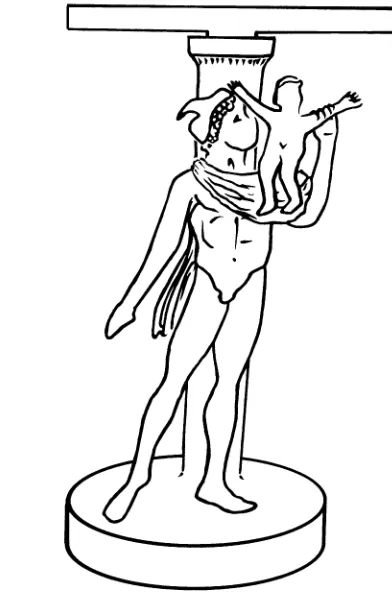
Figure 7 (right). Reconstruction of Corinth S-1993-2, Hermes and Dionysos table support
dimensional Corinth Hermes is the torsional figure of Ganymede on an Antonine trapezophoros in Rome. The youth, carved virtually free of the strut, reaches up toward Zeus, who is in the guise of an eagle, spreading its wings above him (Fig. 6).'7
While the Ganymede trapezophoros preserves its plinth, we do not know the shape and height of the base that originally supported the Corinth work, nor can we be certain how much farther the pillar extended above the figures' heads. The top of the support, with its capital, had to clear Hermes' raised right arm, held free of the head. It may have risen as much as another fifteen to twenty centimeters. If one restores Hermes' height at around ninety centimeters, then the complete work, without base, could have measured one meter and ten to twenty centimeters in height.18 These dimensions conform to those of the well-preserved Pan support in Athens (NM 251), with its well-preserved capital and base, carved in one piece with the figure and pillar (Fig. 5). Pan in this support measures 0.91 m, and the total height of the support is 1.12 m. For the Hermes and Dionysos support at Corinth we can tentatively restore a capital and a base to the pillar, all carved from one piece of marble. The well-preserved top of the fragmentary possible Herakles (Fig. 4), mentioned above, consists of an extension of the pillar, finished in front with a simple cavetto molding. Perhaps the Hermes and Dionysos support had a similar crowning ele- ment (Fig. 7).
What this figural pillar may have supported is uncertain. A marble table leaf is the most likely burden, but another class of figured supports, for balustrades, should be mentioned briefly here. Herms with male and female heads adorned the stage front of the Odeion of Agrippa in its first
17. Vatican 2445: Ridgway 1997, p. 247, pl. 58; Moss 1988, p. 390, no. A5. I thank B. Ridgway for pointing out this parallel. In addition to the Vatican example, a more compressed Attic version also presents the youth in a pose similar to that of Hermes, looking up at the eagle (Stephanidou-Tiberiou 1993, no. 136). More commonly on trapezophora, Ganymede leans languidly against the support with head lowered (Stephanidou-Tiberiou 1993, pp. 125- 131).
phase.'9 The herm shafts, 0.92 m high, measure 0.19 x 0.16 m. A Roman example recovered from Omega House in Athens, on the north slope of the Areopagus, takes the form of a bearded Silenos or Dionysos (?) herm wearing a full-length, long-sleeved garment.20 Camp has reconstructed the room, which contains a horseshoe-shaped swimming pool, with its west wall extending up ca. 1.50 m, surmounted by a balustrade. People on the same story as the balustrade could have looked down into the pool below. The figure, ca. 1.09 m high with its tapered shaft, supported the railing, which kept viewers from falling into the pool. He inclines his head, as if also peering down into the pool. It is just possible that the fragmen- tary Herakles pillar and fragmentary satyr support mentioned above, to- gether with the Hermes and Dionysos group discussed here, supported a railing or balustrade. In any case, there are no surviving parallels for such an installation.
If it adorned a trapezophoros, the Hermes and Dionysos composition is unusual in that respect. Cohon, Moss, and Stephanidou-Tiberiou pro- vide no comparanda in the surviving assemblage of Roman trapezophora for the theme of Hermes holding the infant wine god. In fact, Hermes rarely adorned table supports, and Dionysos only infrequently appeared on them depicted as a child, although the adult god occurred in various poses, alone or accompanied by members of his thiasos.2' There are nu- merous examples with the drunken adult god supported by an adolescent satyr. 2 The composition at Corinth appears to be rare in the corpus of furniture supports and among sculpted images of Hermes and the infant Dionysos. While the motif of Hermes Kourotrophos is familiar in Roman sculpture, parallels for the Corinth work, with Hermes in a torsional pose looking up at the baby seated on his shoulder, are rare, as a survey of this theme in vase painting and sculpture reveals.23 In addition, sculptural comparanda for the baby's pose, with both legs resting against Hermes' chest, are scarce.24
Relatively few Classical images of Hermes carrying Dionysos survive. While there are no depictions of Hermes bearing Dionysos on the re- verses of Classical coins, the adult god appears with Arkas, eponymous hero of Arcadia, on reverses of silver tetradrachms minted by the city of Pheneus, in northeastern Arcadia. These tetradrachms, minted between
370 and 300 B.C., show Hermes carrying Arkas, who is identified by in-
scription. The child perches on Hermes' outstretched left forearm. Hermes grasps a caduceus in his right hand as he runs to his right, looking back at the child, who raises his right hand to the god's head.25
19. Thompson 1950, pp. 64-68, pis. 46, 48-49.
20. Camp 1989, p. 52, pl. 9:5, p1. 10:10.
21. For trapezophora with Dionysos and a young satyr see Stephanidou- Tiberiou 1993, pp. 86-96. A Flavian trapezophoros from Pompeii takes the form of a "Lysippan" Silenos holding a baby. The silen's body grows out of acan- thus leaves, and the support itself
terminates in a feline foot: Vermeule 1981, fig. 11.
22. Stephanidou-Tiberiou 1993, pp. 96-98. On this motif in Roman sculpture see Pochmarski 1990.
23. On the myth see Huskinson 1996, pp. 30-31; Motte 1996; Beau- mont 1998, pp. 71-76; Beaumont 1995, pp. 341-344; LIMC V, 1990, pp. 285- 387, s.v. Hermes (G. Siebert); Baratte 1989; Hadzisteliou-Price 1978, pp. 70-
72; Loeb 1979, pp. 28-56; Zanker 1965, pp. 45-55; Greifenhagen 1931; Heydemann 1885.
24. For the motif on a late 5th-early 4th-century B.C. Attic hydria, see CVA,
Berkeley 1 [USA 18], pp. 48-49, pls. xlvii-xlix.
A ROMAN TABLE SUPPORT AT ANCIENT CORINTH 495
In ancient sculpture, at least two Classical traditions of Hermes Dionysophoros can be identified:
1. Narratives in reliefs illustrating the birth of Dionysos from Zeus' thigh, or Hermes delivering the newborn to the Nymphs. Hermes, often wearing tunic and chlamys, in an active pose, moves toward the Nymphs.26 One of the earliest surviving sculptured images of
Hermes Dionysophoros appears on a late-4th-century B.C. votive
relief in Athens.27 The relief's cave border frames a large cast of divinities, with Hermes, dressed for travel, in the center. He steps up on a rock, passing the bundled infant to a waiting Nymph. 2. Large, three-dimensional sculptures of Hermes holding the baby
Dionysos. No Classical examples of this kind survive, but numer- ous Roman works, discussed below, are thought to reflect earlier traditions. Greek kourotrophoi in the round appear to have become popular by the 4th century B.C. The Elder Kephisodotos' statue of Eirene and Ploutos had been set up in the Athenian Agora probably by 369 B.C. One of the earliest large, three-dimensional images of Hermes and Dionysos may have been the bronze also by Kephisodotos, possibly the father of Praxiteles.28 This lost work suggests to some critics that there may have been family interest in the theme.29
Pausanias (5.17.7) is the only ancient authority who mentions the Hermes and Dionysos group at Olympia. He attributed it to Praxiteles, the famous 4th-century Athenian sculptor, but the evidence for this asso- ciation continues to be disputed.30 Basically frontal, Hermes extends his body laterally in space. Resting his weight on the right leg, he leans to his
26. The decoration of the lost Throne of Apollo at Amyclae (ca. mid- 6th century B.c.) by the Ionian sculptor Bathykles may have included one of the earliest sculptured representations of Hermes holding the baby in an isolated vignette (Faustoferri 1991). According to Pausanias (3.18.11-12), the mytho- logical scenes on the Throne included Ino and Semele with baby Dionysos, and Hermes carrying the infant to Olympos, presumably after Semele's death, to be gestated in Zeus' thigh. But see Pipili 1991. A fragmentary plaster cast in Munich, said to have been taken from the neck of a metal rhyton tenta- tively dated ca. 5th/early 4th century
B.C., may reflect the earliest surviving
sculptured evidence for the delivery theme, albeit in miniature relief (Froning 1981, p. 54, pl. 6; Richter 1960).
27. Giintner 1994, pp. 113-114;
Edwards 1985, pp. 419-437, no. 14. Dedicated by Neoptolemos from the Attic deme Melite, the relief was found reused in Omega House on the south slope of the Areopagus.
28. Pliny, NH 34.87.
29. A Roman type has been con- nected with the Hermes by Kephi- sodotos I (Rizzo 1932, pp. 7-10; Blanco 1957, pp. 40-41, no. 39E) but see Agora XI, pp. 163-165. For a similar image on Roman coins of Pautalia in Thrace (Caracalla) and Anchialos on the Danube, see Head [1877] 1979, pp. 232, 235. Pausanias (3.11.11) reports on a Hermes Agoraios Dionysophoros at Sparta, but does not provide descrip- tion, attribution, or date.
left, holding the baby on his left arm, with the help of a tree trunk support. While this work has established-for modern critics-the standard sculp- tured image of Hermes and Dionysos, its source and date are problematic, and in fact there are few Roman copies.31
Generally in Roman marble sculpture, a frontal Hermes looks down at the baby he supports, usually on the left arm, although sometimes the pose is reversed.32 The god is often partly draped in a chlamys, as in the much restored example in the Boboli Gardens, where he holds the baby away from his body on his own right side.33 There are at least two large torsos, one from Pergamon, the other now in the Bardo Museum (Tunis), where the child was held in front, close to the chest.34 A Hermes from the Hadrianic Baths at Leptis Magna is a variant of the Jason/Sandalbinder type. He rests his right leg on top of a large turtle. The infant, of which only fragments survive, sat on the upraised knee.35 In another unusual Roman composition, a seated Hermes holds the baby in his lap.36
The composition at Corinth does not resemble canonical large-scale frontal Roman sculptures of the pair. Closer parallels for this sculpture exist in the more torsional groups in the round with young satyrs carrying infants. One of the earliest examples, a terracotta figurine (2nd-lst centu- ries B.C.) from the necropolis at Myrina, stands in a torsional pose that
might be a dance step (Fig. 8).37 Turning his head to his right, he looks up at the child sitting on his right arm.
There are also convincing parallels in large-scale, three-dimensional marble. Two examples in different scales have been recovered from a sculp- tor's workshop at Aphrodisias. A third, related, piece, signed by the sculp- tor Flavius Zeno, was one of several sculptures discovered together on the Palatine in Rome.38 In all three, the satyr supports the baby, who sits astride his left shoulder, and steadies him by grasping the child's left hand in his
y1M
Figure 8. Paris, Louvre, Myr 185, Satyr and baby Dionysos, terracotta group. After Bieber 1955, fig. 570
31. Several Late Hellenistic works corresponding to the Hermes in pose and musculature have been recovered, so it is possible that a stock body type was reworked for different composi- tions (Ridgway 1984, p. 85). There are a few works that might be associated with the group at Olympia: a fragmen- tary infant in Corfu (see ES 1325) corresponds in pose and the arrange- ment of drapery to the Olympia Dionysos; the Roman torso of a satyr with traces of a child supported on his arm, in Athens (NM 4800), resembles the pose of the Hermes at Olympia. This satyr and baby group may in fact be important to our understanding of the famous piece since a Pompeian wall painting of a satyr holding Dionysos is the usual source for the restoration of the lost right arm and attribute of the Olympia Hermes (Schefold 1957, pp. 124-125).
32. A bronze figurine of Hermes in the Louvre has been linked with large marble versions (Waldstein 1882).
33. Zanker 1967, p. 40, no. 40. 34. Ridgway 1984, p. 49, note 39. 35. Ridgway 1997, p. 307; Bianchi Bandinelli 1966, pp. 99-100, fig. 155. For the Sandalbinder type see Moreno 1995; Ridgway 1990, pp. 81-82; Ridgway 1984, pp. 88, 94; Inan 1975, pp. 92-95, pl. 42:1-2; Ridgway 1964. If, as Ridgway has suggested, the type is actually a Late Hellenistic creation, predated by a variety of similar images in relief at least as early as the Parthenon frieze, then its adaptation for an image of Hermes Kourotrophos supports the view that types of the god in this role are late developments.
36. Ridgway 1997, pp. 260-261; Gualandi 1976, pp. 141-142, no. 110, fig. 147. For a similar group with Pan supporting an infant on his lap: from
Nimes, Maison Carree, Naples MusNaz 155747: Marquardt 1995, pp. 78-79.
37. Louvre, Myr 185: Mollard- Besques 1963, I, p. 80, pl. 96:b. A tradition of satyr family life in Classical Greek vase painting precedes sculptured groups of satyrs and children. The earliest example is the well known image of a satyr father supporting a baby on his shoulders (Flying Angel Painter's krater in Baltimore, Walters Art Gallery 98.882; Beazley 1918, p. 59, no. 4, fig. 37). The piggyback motif also occurred in Imperial sculpture, for example in the alimenta panel, Arch of Trajan in Benevento, A.D. 114-118.
A ROMAN TABLE SUPPORT AT ANCIENT CORINTH 497
own; both hands are now broken away in the work from Aphrodisias illus- trated here (Fig. 9). Poised on tiptoe, the satyr steps forward on his right foot. He holds a lagobolon in his right hand, resting it against his right shoulder.39
R. R. R. Smith has recently reevaluated the problematic dating of the workshop finds. Epigraphical evidence supports a date for Flavius Zeno within the second quarter of the 4th century A.C., although it is possible that some items in the workshop assemblage could be earlier, finished pieces
reworked by fledgling sculptors.40 The Aphrodisias groups have been con-
nected with a lost Hellenistic original of the 3rd to 2nd century B.C., but
apart from these three examples, no other large-scale replicas of this type are known.4'
Another vanished Hellenistic work is thought to have inspired at least five Roman copies of a different Satyr and Dionysos group, including a much restored version in the Villa Albani (Fig. 10).42 The child, a toddler, rides piggyback on the satyr's shoulders. Dionysos leans over to his right and the satyr looks up toward him, grasping the child's right ankle in his right hand. He raises his left hand toward the boy. The satyr rests his weight on the right side with the left foot drawn well back. These sculp- tures express the close, playful relationship between child and adult. But while both the Aphrodisias groups (cf. Fig. 9) and this type resemble the Corinth piece, they do not correspond to it in all respects, since the child at Corinth appears younger and does not straddle Hermes' upper arm or shoulders.
These three-dimensional groups have counterparts in relief on Ro- man Dionysiac sarcophagi. Matz recognized at least six types, occurring first on sarcophagi dated to just before the mid-2nd century A.C.43 In all
these scenes, the satyrs are members of crowded, complex thiasoi. Some types closely resemble the large sculptures in the round discussed here. The three-dimensional Villa Albani Satyr with Dionysos as a toddler (Fig. 10), for example, corresponds to Matz's Kindertrager A (Type 75, Fig. 11). This piggyback group is the rarest of the relief types, occurring
39. While generally similar in pose and in their sinewy, muscular bodies and unkempt hair, some variations occur among these three sculptures, aside from differences in scale. In both works found at Aphrodisias the baby sits on a goatskin draped over the satyr's left arm, but this pelt is lacking in the Copenhagen example. In the smaller of the two replicas at Aphrodisias the infant leans back; the other one sits straight up.
40. Smith 1998, pp. 258-259. Erim suggested that the unsigned groups found at Aphrodisias might have been sculpted by a follower of Zeno (Rouech6 and Erim 1982). On stylistic grounds, other works bearing
this artist's signature had been considered Hadrianic or Antonine (Erim 1974, p. 772). Erim, while favoring a 4th-century date for the artist, proposed an alternate dating for pieces bearing his signature. He suggested that they might be earlier sculptures revworked and supplied to a 4th-century clientele. According to Rockwell (1991, p. 130), both satyr groups found at the Aphrodisian workshop may have been finished pieces undergoing repairs, so they might have been in the workshop for a long time.
41. Erim 1974, pp. 773-774. 42. Villa Albani 148: Bieber 1955, p. 139; Helbig4 II, p. 247, no. 384. On
the type see Kell 1988, pp. 40-43; Schneider 1990, pp. 288-298, no. 232, pls. 202-203. For a list of replicas see Gercke 1969; also Minto 1913. The best preserved replica is a statuette, the only figure preserving Hermes' legs. The baby holds grapes in his raised right hand, his human ears confirming his identity as Dionysos rather than a baby satyr (Andren 1964, pl. 25). For other baby/satyr groups see Paribeni 1959, pp. 118-119, no. 335, pl. 156; also the fragmentary satyr and baby sculpture in Baltimore: Reeder 1988, p.27.
l4.
Figure 9 (left). Aphrodisias, large Satyr and Dionysos group. Courtesy New York University Excavations at Aphrodisias
A ROMAN TABLE SUPPORT AT ANCIENT CORINTH 499
THi75 TH 76 L - - ! . 7
TH75 TH 76 TH 76 TH 76 TH 77
Figure 11. After Matz 1968 just a few times.44 Matz sees the terracotta dancing Satyr and Baby in the Louvre (Fig. 8), along with a small group of Roman wall paintings and the Villa Albani satyr type, as ancestors of this motif in Dionysiac funerary art. The Aphrodisias groups (cf Fig. 9) resemble Matz's Kindertrager C (Type 77, Fig. 11). Some seven instances of this motif survive on sar- cophagi, some with the pose reversed. None of the sarcophagus reliefs is dated earlier than the early Severan period, but they may still be consider- ably earlier than the Aphrodisias statues. The Corinth sculpture, with few comparanda in the round, is close to Kindertrager B (Type 76, Fig. 11), with pose reversed, because of the baby's frontal position, with both legs over the satyr's chest.45 The earliest occurrence of the relief image is on an early Antonine sarcophagus in Florence.46 Most of the other examples date from later in the 2nd century, possible contemporaries of the Corinth sculpture.
Matz' analysis of satyr types on Roman sarcophagi reveals that poses remain the same, even when other burdens are substituted for babies- thyrsoi, askoi, amphoras, sacrificial animals. He proposes that in all the cases considered here, the small relief versions on sarcophagi were inspired by earlier sculptures in the round.47 Some important changes in meaning do occur, however, in the shift from three to two dimensions, if in fact this is the direction of influence. In the round, satyrs carry the baby Dionysos, depicted as a human child. In relief, they carry infants of their own race, distinguished by pointed ears, and sometimes tails. The identity of both personages in the Corinth group varies from those in the relief versions. A repertoire of poses and personas apparently was manipulated to suit vari- ous genres and themes in Roman sculpture.
As we have seen, the Corinthian group of Hermes and Dionysos is unusually compressed, with the baby very close to Hermes and raised above him. This arrangement may have been important for the legibility of the composition, as well as for its stability. The substantial pier behind Hermes supports his neck and the child resting against him. This pose, suggesting an intimate physical and emotional relation between the two figures, found more commonly in satyr/baby groups, hiere may also serve a structural purpose.
From the Classical period on, the image of Hermes carrying Dionysos represented one stage of a venerable sacred narrative sequence that docu-
44. Matz 1968, pp. 48-49. 45. Matz 1968, p. 49, no. 76. 46. Matz 1968, pp. 255-256, no. 115.
mented the wine god's premature delivery from the womb of dying Semele,
his rebirth from Zeus' thigh, his subsequent foster homes and parents.48 It
is likely that whatever its original setting, the Corinth sculpture expressed to its ancient creator and viewers a precise message appropriate in a spe- cific context at the ancient city. Several other Roman sculptures of Hermes have been recovered from the site; various types and poses can be identi- fied.49 While no other sculptured images of Hermes Kourotrophos have been recognized at Corinth, Trajanic bronze reverse types of Hermes with
Dionysos were minted for the city.50 Running to his left, Hermes supports
a baby on his outstretched left arm, which he holds so far away from his body that the infant does not touch his chest. The more usual relationship of adult to infant appears on Corinthian reverses, with Hermes' head higher than that of his charge. The adult wears petasos and chlamys and holds a caduccus in his right hand.
As Sturgeon and Fuchs have shown, several Roman sculptures of Hermes Dionysophoros, in relief and in the round, come from theaters, an appropriate setting for such images.5" From the Theater of Dionysos in Athens, four surviving Hadrianic or early Antonine panels, which may originally have decorated the scacnae frons, include one with a frontal, chlamys-draped Hermes holding Dionysos on his left side. This pair and a seated Zeus are flanked by nude males carrying shields and identified by
modern critics as the Korybantes.52 Hermes in this Athens relief resembles
Roman three-dimensional sculptures of the god and not the more heavily draped, active figure of earlier narrative reliefs. Sturgeon connects this imagery with scenes on Dionysiac sarcophagi, altars, and other reliefs, sug- gesting that these scenes might have influenced the theater program.53 This theme apparently was more popular in the decoration of eastern the- aters; at least four stage fronts, at Perge (ca. A.D. 120), Side, Sabratha, and
Hierapolis, included birth of Dionysos cycles with images of Hermes and baby Dionysos.54 At Corinth's theater, this motif does not appear. Hermes may have been a participant in the Gigantomachy frieze adorning the scaenae frons, but he does not survive as a kourotrophos.55
Sculptures of Hermes and Dionysos also adorned Roman baths, occa- sionally the frigidarium. We have already considered the unusual Jason/
48. See Hutchinson 1991, p. 224; also pp. 494-495 and note 23 above. 49. S-686, S-705, S-718, S-1934, S-3585.
50. Imhoof-Blumer and Gardner 1964, p. 21, pl. E:LXXXVIII.
51. Sturgeon 1977. On Hermes Dionysophoros in theaters: Fuchs 1987, pp. 37, 133, 191. These works include a small-scale (H. 0.975 m) sculpture in the round from Minturno (Naples, Fuchs 1987, p. 37, no. ElI 1). From the Theater of Dionysos in Athens see the large Silenos in hairy suit carrying Dio- nysos, who holds a mask (NM 257, Karouzou 1968, p. 98; LIMC III, 1986, p. 480, no. 687, s.v. Dionysos [C. Gasparri]). The toddler Dionysos wears
long-sleeved costume and leggings, tunic, mantle, and boots. "Silenos" could be an actor in costume. Gasparri connects this Roman work with Pliny's reference (NH 36.29) to a statue in the Porticus Octaviae. For a similar group of Hairy Silenos and Dionysos, see Marcade 1970, p. 189, no. A4143, pl. 23.
52. Sturgeon 1977, pp. 34-35. 53. Sturgeon 1977, p. 36. The other panels reused in the so-called base of Phaedrus present subsequent phases of Dionysos' career, and Sturgeon (1977, pp. 51-52) proposed that other pieces, now missing, included other episodes from his childhood.
54. In all these scenes, Hermes is much more active than he is in the
Athens frieze. Hermes Dionysophoros at Perge (Fuchs 1987, p. 133; Bernardi Ferrero 1966-1974, III, p. 152); at Side (Bernardi Ferrero 1966-1974, II, p. 141; Fuchs 1987, p. 133); at Sabratha (Fuchs 1987, p. 133; Caputo 1959, pl. 38, fig. 66); at Hierapolis (Fuchs 1987, p. 133; Bernardi Ferrero 1966- 1974,1 , p. 59, fig. 97).
A ROMAN TABLE SUPPORT AT ANCIENT CORINTH 50I
Sandalbinder type from the bath at Leptis Magna.56 Possibly these sculp- tures in public baths alluded to a subsequent episode in Dionysos' child- hood, when he is bathed by the Nymphs, the sculptures evoking this mythic
lustral episode in an actual bath complex.57 There are several Roman baths
at ancient Corinth. A probable site for our sculpture may be the area ten- tatively identified as a bath in its Roman phase, close to the Frankish com- plex in which the work was found. This bath lies on the western side of the excavated Frankish remains south of Temple E, some fifty meters south- west of where the sculpture was discovered. Preliminary investigations of this area reveal an installation whose first phase was possibly Augustan; it
apparently survived into the 5th or 6th century A.C. A complete 1lth- or
12th-century rebuilding disturbed most of the earlier walls.58 A fragment of sculpture, possibly a nonjoining portion from one of Hermes' limbs,
was found in this area.59 This might be a section from an upper arm or
thigh and it has a preserved length of 8 cm and a diameter of 9 cm. It is important to keep in mind that our sculpture probably adorned a table support, with Attic parallels in terms of pillar and figure size, even though there are few surviving thematic comparanda. Evidence for tra- pezophora from Delos, Pompeii, and other sites, in addition to literary testimonia, demonstrates that Roman stone tables with figural supports served a variety of functions, secular and religious.60 In temples, shrines, and household lararia, such tables were used as altars, offering tables, and supports for portable altars, patera, or lamps.6' In domestic contexts they served as stands for statues of lares. Examples from Pompeii and Her- culaneum are thought to have displayed bronze figurines in the atria or peristyles of villas.62 While monopodia, tables with a single central sup- port, were not used for dining, wall paintings depict them laden with glass- ware and vessels and other banqueting supplies.63
The western end of the Roman Forum at Corinth, in the general area where this sculpture was found, is dominated by sacred buildings and precincts. The Hermes and Dionysos support could have been part of the sacred furniture in the precinct of Temple E, over which the Byzantine- Frankish complex had been built. Much sculpture has been recovered from this area, including at least one Roman table support.64 Or, the piece might belong to the unusual building with central hemicycle. This building, which terminates the west end of the Central Shops, was originally identified as a Temple of Dionysos. In his revised interpretation of Pausanias' route through the Roman Forum, Williams has identified this complex as the
56. Also from baths, primarily in North Africa: Manderscheid 1982, no. 116H (Agnano, statuette, Trajanic/ Hadrianic); no. 272 (Shahat, Hadrianic/ Early Antonine); no. 304 (Leptis Magna, Hadrianic). At Corinth, the fragmentary head of a large Polykleitan Hermes was found in Room 1, south pool of the Lechaion Road Bath (Corinth XVII, p. 41; Sturgeon 1975, pp. 290-292, no. 2). In addition, Biers (in Corinth XVII, p. 48) reports frag- ments of a ram, possibly an attribute
from a statue of Hermes, from Rooms 3 and 5.
57. For bathing scenes on Dionysiac sarcophagi see Matz 1968.
58. The building is securely identified as a bath in the Byzantine period; much less can be said of the earlier remains, although segments of flooring built of waterproof herring- bone tiles suggest the presence of an early bath here, according to C. K. Williams II (pers. comm.); and see Williams and Zervos 1995, p. 11;
Williams, Barnes, and Snyder 1997, pp. 37-40.
59. S-1994-3.
60. Cohon 1984, pp. 6-7; Moss 1988, pp. 241-292; Stephanidou- Tiberiou 1993, pp. 58-73.
Hermes sanctuary mentioned by the traveler.65 The foundations, probably from an altar, ca. 2 meters to the north and on axis with the entrance of this structure, support its identification as a temple. The central room, with its multicolored marble flooring, appears to have had several bases, or perhaps tables, along the edge of the interior.66
As we have seen, its secondary context, possibly a Frankish wall in Room C, one of a suite of rooms west of the church, has been connected
with a destruction of ca. A.D. 1300. And as observed above, Hermes' body
is noticeably more weathered on his right side than on the left. If the statue had been embedded in the exterior face of a wall (perhaps the pre- destruction north wall of Room C) with the right side projecting, such a placement would account for this uneven weathering. Just possibly, as spo- Ila immured in the outer wall of a room associated with the funerary chapel of a Frankish religious complex, the statue had a new life not simply as building material, but as sculpture whose pagan iconography was reinter- preted with a Christian message.67 A secondary, Christian, function for the Hermes and Dionysos trapezophoros will be explored briefly here.
The statue's intimate juxtaposition of grown-up and child may have evoked, for Frankish Christians at Corinth, images from Christ's life de- picted in contemporary church art. In the Byzantine world, by the 8th century, some episodes from the pagan cycle of Dionysos' birth became models for the childhood of Christ. The pose of the reclining Virgin Mary echoed that of recumbent, dying Semele,68 and the bathing of the Christ Child, at least once employed as a metaphor for his later baptism, drew on
earlier scenes of Dionysos bathed by his nymph nurses.69 The question of
how pagan sculpture was used, perceived, and interpreted by both Byzan- tine and Western Christians has received considerable recent attention. Whether pagan statues, inscriptions, or even architectural elements em- bedded in Christian churches had specific religious meanings for patrons, designers, and congregations continues to be debated.70 Mango has sug- gested that building blocks, as well as sculptures, may have been perceived as having apotropaic power, and served specific functions when built into a church facade. Saradi-Mendelovici has recently examined the earlier am- bivalent Byzantine view of Classical and Roman sculpture, in which this sculpture was perceived both to be a haven for demons and to have artistic worth.71
Hermes Dionysophoros in the Dionysos birth cycle may have inspired the later figure of St. Christopher, who unwittingly carried the infant Christ across a river. The 8th-century Passion of Christopher places him in Syria;
his martyrdom may have occurred ca. A.D. 250.72 A mid-5th-century Greek
dedicatory inscription from a church in Bithynia provides the earliest evidence for the saint's cult.73 Jacobus de Voragine, in The Golden Legend, recounts the best-known features of his story.74 A giant first named Reprobus, he felt his destiny was to serve the greatest king on earth, whom he eventually determined to be Christ. Christopher carried people across a river at a point where there was no bridge. One of his burdens was Christ, disguised as a mortal child.
In the West, St. Christopher, one of the Fourteen Holy Helpers, was a medieval patron of travelers; anyone who glimpsed his image would be safe from death that day.75 Large murals of the saint bearing the baby Christ commonly decorated the north walls of English and northern
65. Williams and Zervos 1990, pp. 351-356; Williams 1989.
66. Corinth I, iii, pp. 89-90. 67. See Engemann 1998, esp. pp. 173-177 for a discussion of the possible Byzantine reception of a Roman Dionysos and Satyr table support found in the oven of a pottery kiln dating to ca. the 9th century A.C.
at Abu Mina in Egypt.
68.Juhel 1991; Kitzenger 1963, pp. 100-105; Weitzmann 1960, pp. 52- 53.
69. Kitzenger 1963; Nordhagen 1961.
70. On Byzantine reception of Greek and Roman sculpture and other artworks see Engemann 1998; Alchermes 1994; Saradi-Mendelovici 1990; Brenk 1987; Mango 1963.
71. Saradi-Mendelovici 1990, p. 47. 72. Kaftal 1965, p. 24; Drake and Drake 1916, p. 26; Jameson 1894, 11, pp. 439-450; ReallexikonfiirAntike und Christentum II, cols. 1241-1250, s.v. Christophoros (A. Hermann).
73. Benker 1975, p. 8.
A ROMAN TABLE SUPPORT AT ANCIENT CORINTH 503
4~~~~~~~~~~~~~4
Figure 12. St. Chri-topher. Detai
Zan~~- j ipolo), Venie Giovnni Bellin
p . 1 9 6.> .0 , . ... s.N . ? ' 'S,,'., . aS Sw; > e t t t'S S,>,.."'.... . g ' ... s w\', X
Figure 12. St. Christopher. Detail ! r0'iin: b e ;': '
Santi Giovanni ePaolo (San U|N 4;
(1430-1516). After Temnpestini 1999, . i a oS,!,L
European churches, opposite the entrance, and could be viewed from out- side by passersby.76 These wall paintings first appear in the 13th century, although the earliest images of St. Christopher carrying the infant Christ date to the beginning of the 12th.77 Medieval and later images of St. Chris- topher with the infant Christ often echo the intimate pose of Hermes and Dionysos at Corinth, where the adult, supporting the baby on his left side, looks up at him, their heads close together (Fig. 12). Just possibly, the medieval discoverers of the trapezophoros saw a connection between the pagan group and the Christian travelers' saint. They may have considered their complex at Corinth, possibly a pilgrims' refuge, an appropriate set- ting for this unusual Roman sculpture.78 For its 13th-century Frankish viewers, the pagan composition of Hermes holding baby Dionysos at an- cient Corinth may have resonated with meaning that gave it a second life in the Christian world.
76. Farmer 1987, pp. 868-887; Whaite 1929, pp. 8-9.
77. Benker 1975, pp. 46-47. The cynocephalic Christopher of the Eastern church appears, infrequently, as kourotrophos, beginning in the 14th century (Loeschcke 1965, pp. 54-55, pl. 85:3).
APPEN DIX
ROM/\AN TRAPEZOPHORA
AT ANCIENT CORINTH
Excavations at Corinth have produced many Roman trapezophora. They are listed below by theme, with their provenience, reference to Stephanidou- Tiberiou 1993, and Corinth Excavation notebook (NB) entry, when available.
Aphrodite
S-3745 Lechaion Road; Stephanidou-Tiberiou 1993, no. 164
Attis
S-1962 North of School; Stephanidou-Tiberiou 1993, p. 58,
note 65 Dionysos
S-731
S-1462 Asklepieion; Stephanidou-Tiberiou 1993, p. 157
S-1527 Temple E (NB 127, pp. 96-97)
S-1600 Agora Southeast (NB 135, p. 148); Stephanidou-Tiberiou
1993, no. 39
S-2470 Agora North Central (NB 171, p. 69); Stephanidou-
Tiberiou 1993, no. 11
S-2532 St. John's (NB 169, p. 200)
S-71-32 Gymnasium (NB 536, p. 92); Stephanidou-Tiberiou 1993,
no. 40 Eros
S-2830 Stephanidou-Tiberiou 1993, no. 102
Ganymede
S-56 Stephanidou-Tiberiou 1993, no. 127
S-2729 Near Peirene (NB 8, p. 4); Stephanidou-Tiberiou 1993,
no. 124 S-2903
Herakles
S-2329 St. John's (NB 169, p. 360); Figure 4
Hermes and Dionysos
S-1993-2 (NB 863, pp. 18,24); Figure 1
Satyr
S-437 Northwest Shops(?) (NB 15, p. 51); Figure 3; Stephanidou-
Tiberiou 1993, no. 71 S-2742
Satyr and Dionysos
S-762 Anaploga; Stephanidou-Tiberiou 1993, no. 69
T-108 Theater
(bases) S-460 S-1029 S-1376
S- 1726 Agora Southeast (NB 142, p. 18)
S-75-6 Forum Southwest
A ROMAN TABLE SUPPORT AT ANCIENT CORINTH 505
REFERENCES
Agora XI = E. B. Harrison, Archaic and Archaistic Sculpture, Princeton 1965. Ajootian, A. 1996. "Praxiteles," in
Personal Styles in Greek Sculpture, 0. Palagia and J. J. Pollitt, eds., Cambridge, pp. 91-129.
Alchermes, J. 1994. "Spolia in Roman Cities of the Later Empire: Legislative Rationales and Architec- tural Reuse," DOP 48, pp. 167-178. Andren, A. 1964. Antik Skuiptur i
Svensk Samlinger, Stockholm. Ashmole, B., and N. Yalouris. 1967.
Olympia: The Sculptures of the Temple of Zeus, London.
Baratte, F. 1989. "La naissance de Dionysos sur un couvercle de sarcophage de Musee d'Amiens," RA, pp. 143-148.
Beaumont, L. 1995. "Mythological Childhood: A Male Preserve?" BSA 90, pp.339-361.
. 1998. "Born Old or Never Young? Femininity, Childhood, and the Goddesses of Ancient Greece," in The Sacred and the Feminine in Ancient Greece, S. Blundell and M. Williamson, eds. London, pp. 71- 95.
Beazley, J. D. 1918. Attic Red-Figure Vases in American Museums, Cambridge.
Benker, G. 1975. Christophorus: Patron der Schifer, Fuhrleute und Kraftfahrer, Munich.
Bernardi Ferrero, D. de. 1966-1974. Teatri classici in Asia Minore, 4 vols., Rome.
Bieber, M. 1955. The Sculpture of the HellenisticAge, New York. Blanco, A. 1957. Museo del Prado,
Catalogo de la Escultura, Madrid. Brenk, B. 1987. "Spolia from Con-
stantine to Charlemagne: Aesthetics versus Ideology," DOP 41, pp. 103- 109.
Camp, J. McK. 1989. "The Philosophi- cal Schools of Roman Athens," in The Greek Renaissance in the Roman Empire, S. Walker and A. Cameron, eds., London, pp. 50-55.
Caputo, G. 1959. Il Teatro di Sabratha, Rome.
Ciggaar, K. N. 1996. Western Travellers to Constantinople, Leiden.
Cohon, R. 1984. "Greek and Roman Table Supports with Decorative
Reliefs" (diss. New York University). Corinth I, iii = R. L. Scranton,
Monuments in the LowerAgora and North
of the Archaic Temple, Princeton
1951.
Corinth IX, ii = M. Sturgeon, Sculpture. The Reliefsfrom the Theater, Prince-
ton 1977.
Corinth XVII = J. Biers, The Great Bath on the Lechaion Road, Princeton
1986.
Corso, A. 1996. "The Hermes of Praxiteles," NumAntCl25, pp. 131- 153.
de Voragine, J. 1948. The Golden Legend ofJacobus de Voragine, G. Ryan and
H. Ripperger, trans., New York. Drake, M., and W. Drake. 1916. Saints
and Their Emblems, London.
Edwards, C. M. 1985. "Greek Votive Reliefs to Pan and the Nymphs" (diss. New York University). Engemann, J. 1998. "Ein Tischfuss mit
Dionysos-Satyr-Darstellung aus Abu Mina/Agypten,"JAC 41, pp.169-177.
Erim, K. T. 1974. "The Satyr and Young Dionysos Group from Aphrodisias," in Melanges Mansel II,
Ankara, pp. 767-775.
Farmer, D. H. 1987. The Oxford Dictionary of Saints, 2nd ed.,
Oxford.
Faustoferri, A. 1991. "The Throne of Apollo at Amyclae: Its Signifi- cance and Chronology," in Sculpture from Arcadia and Laconia: Proceed-
ings of an International Conference Held at the American School of Classical Studies in Athens, 0. Palagia
and W. Coulson, eds., Oxford, pp. 159-166.
Froning, H. 1981. Marmor- Schmuckreliefs mitgriechischen Mythen im 1. Jh. v. Chr., Mainz.
Fuchs, M. 1987. Untersuchungen zurAusstattung romischer Theater in Italien und der Westprovinzen des Imperium Romanum, Mainz.
Gardner, P. [1883] 1981. British Museum, Catalogue of Greek Coins, repr. Bologne.
nysos Knaben auf dem Schulter,"
in Opus Nobile: Festschrift zum 60. Geburtstag von UyJantzen, P. Zazoff, ed., Wiesbaden, pp. 48- 50.
Greifenhagen, A. 1931. "Kindesheit- mythos des Dionysos," RM 46, pp. 27-43.
Gualandi, G. 1976. "Sculture di Rodi," ASAtene 38, pp. 7-259.
Guntner, G. 1994. Gwttervereine und Gatterversammlungen aufattischen Weibreliefs: Untersuchungen zur Typologie undBedeutung, Wiirzburg.
Hadzisteliou-Price, Th. 1978. Kourotrophos, Leiden.
Head, B. V. [1877] 1979. British Museum Catalogue, Greek Coins of Thrace, repr. London.
Hermann, A. 1954. Reallexikonfzir Antike und Christentum II, cols.
1241-1250 (Christophoros). Heydemann, H. 1885. "Dionysos
Gebuirt und Kindheit," HallWPr 10, pp. 3-58.
Huskinson, J. 1996. Roman Children's Sarcophagi, Oxford.
Hutchinson, V. J. 1991. "The Cult of Dionysos/Bacchus in the Graeco- Roman World,"JRA 4, pp. 222- 230.
Imhoof-Blumer, F. W., and P. Gardner.
1964. Ancient Coins Illustrating Lost Masterpieces of Greek Art, A. N. Oikonomides, ed., rev. ed., Chicago.
Inan, J. 1975. Roman Sculpture in Side, Ankara.
Jameson, 1894. Sacred and Legendary Art, 2 vols., London.
Juhel, V. 1991. "Le bain de l'Enfant- Jesus," CA 39, pp. 111-132.
Kaftal, G. 1965. Iconography of the Saints in Central and South Italian Schools of Painting, Florence.
Karouzou, S. 1968. NationalArchaeo- logical Museum Collection of Sculpture, Athens.
Kell, K. 1988. Formuntersuchungen zu spat- und nachhellenistischen Gruppen, Saarbriicken.
Kitzenger, E. 1963. "The Hellenistic Heritage in Byzantine Art," DOP 17, pp. 97-115.
Loeb, E. H. 1979. Die Geburt der Gotter in dergriechischen Kunst der
klassischen Zeit, Jerusalem.
Loeschcke, W. 1965. "Neue Studien
zur Darstellung des tierkopfigen Christophoros," in Beitrage zur Kunst des christlichen Ostens Erste Studien-Sammlung, Recklinghausen, pp. 37-80.
Manderscheid, H. 1982. Die Skulpturen-ausstattung der kaiser- zeitlichen Thermenanlagen, Berlin. Mango, C. 1963. "Antique Statuary
and the Byzantine Beholder," DOP 17, pp. 55-75.
Marcade, J. 1970. Au Musje de Delos, Paris.
Marquardt, N. 1995. Pan in der hellenistischen und kaiserzeitlichen Plastik, Bonn.
Matz, F. 1968. Die dionysischen Sarkophage I, Berlin.
Minto, A. 1913. "Satiro con Bacco Fanciullo,"Ausonia 8, pp. 90-103. Mollard-Besques, S. 1963. Catalogue raisonne desfigurines et reliefs grecs et romains, 2 vols., Paris.
Moltesen, M. 1990. "The Aphrodisian Sculptures in the Ny Carlsberg Glyptothek," in Aphrodisias Papers I (JRA Supplement 1), C. Rouech6 and K. T. Erim, eds., Ann Arbor, pp. 133-146.
Moreno, P. 1995. "Ermete che si slaccia il sandalo," in Lisippo lArte ela Fortuna, Florence, pp. 230-23 1. Moss, C. F. 1988. "Roman Marble
Tables" (diss. Princeton University). Motte, A. 1996. "Les enfances divines
dans le mythe Grec," EtCl 64, pp. 109-125.
Nordhagen, P. J. 1961. "The Origin of the Washing of the Child in the Nativity Scene," ByzZeit 54, pp. 333-337.
Paribeni, E. 1959. Catalogo delle Sculture di Cirene, Rome.
Pipili, M. 1991. "Hermes and the Child Dionysos: What Did Pausanias See on the Amyklai Throne?," in Stips
Votiva: Papers Presented to C. M. Stibbe, M. Gnade, ed., Amsterdam, pp. 143-147.
Pochmarski, E. 1990. Dionysische Gruppen, Vienna.
Reeder, E. 1988. HellenisticArt in the WaltersArt Gallery, Baltimore. Richter, G. M. C. 1960. "An Ancient Plaster Cast in Munich," in Theoria: Festschriftffir W-H. Schuchbardt, F. Eckstein, ed., Baden-Baden, pp. 179-183.
Ridgway, B. S. 1964. "The Date of the So-Called Lysippan Jason," AJA 68, pp.113-128.
. 1984. Roman Copies of Greek Sculpture: The Problem of the Originals, Ann Arbor.
. 1990. Hellenistic Sculpture I,
Madison.
. 1997. Fourth-Century Styles in Greek Sculpture, Madison.
Rizzo, G. 1932. Prassitele, Milan. Rockwell, P. 1991. "Unfinished Statu-
ary Associated with a Sculptor's
Workshop," in Aphrodisias Papers II
(JRA Supplement 2), R. R. R. Smith and K. T. Erim, eds., Ann Arbor, pp. 127-143.
Rouech6, C., and K. Erim. 1982. "Sculptors from Aphrodisias: Some New Inscriptions," PBSR 50, pp. 102-115.
Saradi-Mendelovici, H. 1990. "Chris- tian Attitudes toward Pagan Monu- ments in Late Antiquity and Their Legacy in Later Byzantine Cen- turies," DOP 44, pp. 47-61.
Schefold, K. 1957. Die Wande Pompejis, Berlin.
Schneider, R. M. 1990. "Satyr tragt Dionysosknaben," Villa Albani III, Berlin.
Smith, R. R. R. 1996. "Archaeological Research at Aphrodisias, 1989-
1992," in Aphrodisias Papers III
(JRA Supplement 20), C. Rouech6 and R. R. R. Smith, eds., Ann Arbor, pp. 11-72.
. 1998. "Hellenistic Sculpture under the Roman Empire: Fisher- men and Satyrs at Aphrodisias,"
in Regional Schools in Hellenistic Sculpture: Proceedings of an Interna- tional Conference Held at the American School of Classical Studies at Athens, March 15-17, 1996,
0. Palagia, ed., Oxford, pp. 253- 260.
Stephanidou-Tiberiou, Th. 1993. Trapezophora me Plastike Diakosmese, Athens.
Stewart, A. 1990. Greek Sculpture:An Exploration, New Haven.
Sturgeon, M. 1975. "A New Group of Sculptures from Ancient Corinth," Hesperia 44, pp. 280-301.
A ROMAN TABLE SUPPORT AT ANCIENT CORINTH 507
Tempestini, A. 1999. Giovanni Bellini, New York.
Thompson, H. A. 1950. "The Odeion in the Athenian Agora," Hesperia 19, pp. 31-141.
Todisco, L. 1993. Scultura Greca delIV Secolo, Milan.
Vermeule, C. C. 1981. "Bench and Table Supports: Roman Egypt and
Beyond," in Studies in Ancient Egypt, theAegean, and the Sudan. Studies in Honor of Dows Dunham, W. K.
Simpson and W. M. Davis, eds., Boston, pp. 180-192.
Waldstein, C. 1882. "Hermes with the Infant Dionysos,"JHS 3, pp. 107- 110.
Weis, A. 1992. The Hanging Marsyas and Its Copies, Rome.
Weitzmann, K. 1960. "The Survival of Mythological Representations in Early Christian and Byzantine Art and Their Impact on Christianity," DOP 14, pp. 43-68.
Whaite, H. C. 1929. St. Christopher in English Medieval Painting, London. Williams, C. K., II. 1989. "A Reevalua-
tion of Temple E and the West End of the Forum of Corinth," in
The Greek Renaissance in the Roman Empire, S. Walker and A. Cameron, eds., London, pp. 156-168.
Williams, C. K., II, and 0. H. Zervos. 1990. "Excavations at Corinth, 1989: The Temenos of Temple E," Hesperia 59, pp. 325-369.
. 1993. "Frankish Corinth: 1992," Hesperia 62, pp. 1-52.
. 1994. "Frankish Corinth: 1993," Hesperia 63, pp. 1-56.
. 1995. "Frankish Corinth: 1994," Hesperia 64, pp. 1-60.
. 1996. "Frankish Corinth: 1995," Hesperia 65, pp. 1-56. Williams, C. K., II, E. Barnes, and
L. M. Snyder. 1997. "Frankish Corinth: 1996," Hesperia 66, pp. 7- 47.
Williams, C. K., II, E. Barnes, L. M. Snyder, and 0. H. Zervos. 1998. "Frankish Corinth: 1997," Hesperia 67, pp. 223-281. Zanker, P. 1965. Wandel der
Hermesgestalt in der attischen Vasenmalerei, Bonn.
. 1967. Klassizistische Statuen, Mainz.
Aileen Ajootian
DEPARTMENT OF CLASSICS UNIVERSITY OF MISSISSIPPI UNIVERSITY, MIss. 38677-I848