The seventh campaign of the excavations in the Athenian Agora conducted by the American School of Classical Studies at Athens covered a period of twenty weeks, ex- tending from January 25 to the middle of June. Prior to the beginning of the actual work of excavation the modern houses on the site were expropriated by the Business Office under the efficient direction of A. Adossides, and were demolished under the supervision of the experienced foreman, Sophokles Lekkas, and under the eyes of the archaeologists of the staff who must recognize and salvage any ancient stones which may have been built into comparatively modern walls. The area then was surrounded, as usual, by a board fence and was laid out in metre squares, corresponding to the architectural ground-plan, for the facilitation of the accurate keeping of records. Following the excavation season con- siderable tidying of the area is always necessary and by the time this has been completed the work of demolition of additional modern houses can be begun in preparation of the terrain for the excavations of the succeeding year.
Emphasis is again laid on the fact that this report of the results of the current campaign is -tentative in character and is subject to revision after further study and investigation.1 It is a pleasant duty to record the continued hearty support and co6peration received from the authorities of the American School and from the officials of the Greek Government. Professor Edward Capps, Chairman of the Agora Commission, closely follows the progress of the work with unfailing enthusiasm and constantly assists it with his wise counsel. Especial appreciation for helpful support is due to His Excellency Mr. K. Georgakopoulos, Minister of Education and Cults, and to Professor G. P. Oikonomos, Director General of Antiquities in the Ministry. The American Minister in Athens, Honorable Lincoln MacVeagh, has also been of frequent assistance with sympathetic advice and with influential support. But this great project could never have been realized had it not been for the vision and generosity of Mr. John D. Rockefeller, Jr., to whom the resurrection of the buildings of the ancient Agora of Athens will be an abiding memorial.
Part of the area excavated during the present season is located south of the Agora itself, lying on the steep slopes of the north side of the Areopagus. Here the deposit of accumulated earth was shallow, some of the cellars of modern houses being actually cut in the living rock, and consequently the total amount of earth renmoved was less than in the
Brief accounts of the work have been published by me in Illustrated London News, Sept. 11, 1937, pp. 430-432, 460; A.J.A., XLI, 1937, pp. 177-189; XLII, 1938, pp. 1-16; by H. Riemann in Arch. Anz., 1937, cols. 95 -114.
21
American School of Classical Studies at Athens is collaborating with JSTOR to digitize, preserve, and extend access to Hesperia
_Pr
~
~
~
~
|preceding year, about 30,000 tons compared with 50,000. Since much of the area still to be cleared lies on this hillside the amlount of earth removed will steadily decrease in the future campaigns. The total area that has been uncovered by this large scale excavation is well revealed in its relation to the neighboring landmarks in a photograph taken from the air on July 26, 1937 by the courtesy of the Topographical Service of the Ministry of Com- munications (Fig. 1). The American Zone, most of which has been excavated, is shown
Fig. 2. Northern Part of Excavated Area
to be limited on the north by the curving line, of the Athens-Peiraeus railway, on the east by the Stoa of Attalos, on the south by the Acropolis and the Areopagus, and on the west by the Kolonos Agoraios with the Hephaisteion on its summit. The blocks of houses directly east of the American Zone, surrounding the cleared section of the Roman Agora, are designated for excavation by the Greek Archaeological Society.
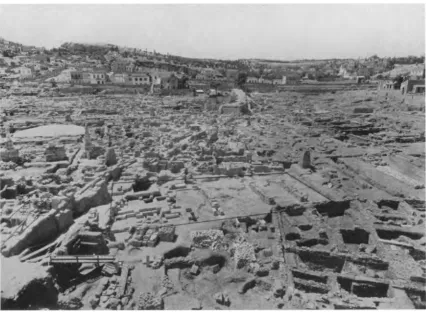
The appearance of the excavated area at- the close of the season is shown in three suc- cessive views (Figs. 2-4) which taken together give a panorama -of the entire field of ex-
314 T. LESLIE SHEAR
cavation, extending from the Acropolis and Areopagus on the south to the Athens-Peiraeus railway on the north. The photographs were taken from the roof of the Hephaisteion, visible in the lower right corner of Figure 4, and the only part of the excavated terrain omitted from the panorama is that lying north, south and west of that temple. The uncovering of this great area has clearly revealed the limits of the Greek Agora except on the north side where it has been proved that the railway forming the northern boundary of the American Zone is not coterminous with the northern limit of the Agora. The site of the Stoa Poikile must be sought north of the railway, but investigation there is not at present practicable. When the special law was drafted that specifies the terms of the American concession the railway was fixed as the northern limit of the Zone for purely practical reasons. The land north of it cannot, therefore, be expropriated under the terms of that law and, moreover, as it is close to one of the more important streets its v alue is much greater than that of the property located farther south in the Zone. It is thus necessary to hypothecate the northern closure of the ancient Agora on the combined evidence of the topographical discoveries and of the descriptions given in classical literature.
It has frequently been emphasized in these annual Reports that an excavation on this great scale in the heart of the most important Greek city of antiquity must be conducted with the utmost care and thoroughness. Detailed evidence of the many strata of successive occupations from the prehistoric age down to modern times must be accurately observed and recorded, for thus only can the complete history of the site be reconstructed. In order to secure this result it is essential that the members of the staff should be highly experienced and efficient scholars in the many branches of archaeological science and technique. By the system of Fellowships supported by the Rockefeller Foundation it has been possible to secure promising men and women, to train them in the specialized technique of excavation, and to retain their services in successive years as they have become increasingly valuable through cumulative field experience. Thus the excavators of the present season are all veterans in the field. The senior member of the group, Homer A. Thompson, has been with the Agora since the beginning of the work, for though holding an Assistant Professor- ship in the University of Toronto he is regularly granted a leave of absence from his Uni- versity for the period of the excavation season.
Eugene Schweigert of Cincinnati, who has satisfactorily maintained the high standard of epigraphical efficiency sponsored by Meritt and his assistants.
Equally important with the recording of progress in the field is the handling of the individual objects discovered when they are delivered to the workrooms at the close of each day. Miss Talcott, who has been in charge of the Catalogue Department since the beginning of the excavations, has developed a system of identifying, cataloguing and filing
Fig. 3. Central Part of Excavated Area
316 T. LESLIE SHEAR
and period. The practical result of this system is that any one of the 32,000 catalogued objects can be produced as readily as any book in a library stack.
One class of objects presents a particularly difficult problem because of the large number found and because of the generally poor state of preservation. These are the coins, of which 70,325 have so far been found in the Agora. Mrs. Shear has developed such an admirable technique in handling this mass of material that all the 10,325 coins secured
Fig. 4. Southern Part of Excavated Area
ment and are entered in a sectional serial list. Since they are usually badly corroded
because of the moisture of the Agora soil they are cleaned by the electrolytic process and
are carefully polished with felt brushes attached to a dental polishing machine. The coins are then identified and each is placed for permanent filing in a new envelope which bears a description of the coin as well as the data of discovery, and a corresponding catalogue card is prepared. The highly satisfactory result achieved during the past season was effected with the efficient assistance of a new appointee in the Department, Miss Margaret Thompson.
Two other Departments of the work are in charge of masters in their respective fields. The artist, Piet de Jong, makes immediate record of any preserved colors on objects as they are found, for these colors are often very fugitive and quickly fade through exposure to the light. Experienced through many years of specialization in painting Greek pottery de Jong makes water-colors of the vases, several of which will be illustrated later in this Report, which give a more accurate impression of the originals, by means of the use of light and shade, than can be secured from photographs with their two-dimensional limita- tions. The architect, an indispensable member of any excavation staff, is J. Travlos, who was attached to the staff in an emergency and has been retained because of his excellent work in the specialized field of archaeological architecture. He surveys the field of work, lays out the areas in metre squares, records on plans any late walls which must be removed to permit the excavation of deeper deposits, makes drawings of individual stones, studies and draws stone by stone the remains of ancient buildings, and makes reconstructions of them based on surviving architectural members. His work, of which an illustration is the ground plan of the area that will be shown later, is characterized by technical accuracy and by remarkable astuteness in interpreting scanty remains of buildings which are often confusing in type and age.
A new Department was added to the staff this season through the codperation of Princeton University and of the American Philosophical Society. A grant from the Society made possible the establishment of a simple chemical laboratory on the site of excavation, and the University gave leave of absence for the second term to Professor E. R. Caley of the Department of Chemistry so that he could organize and direct the new branch of work. Caley had already had considerable experience in studylng and analyzing ancient objects so that he was well equipped to cope with the many and varied problems daily arising in the course of practical work. The results have been of the greatest value both for the specific work in the Agora and for the science of Archaeology in general.
318 T. LESLIE SHEAR
is soluble in oil but not in alcohol, it is clear that the jars were used to contain wine which was kept by the mastic coating from absorption by the porous terracotta. The coating was carelessly brushed on the walls and a residuum of the mastic usually settled in the bottom of the jars, which would have given some slight flavor to the wine. It is possible that this practice of waterproofing the interiors of wine-jars is the origin of the taste for resined wine that still is universal in Greece.
An analysis of a metal object disclosed a composition and treatment of ancient metal such as have not previously been anywhere observed. A band of repousse work is com- posed of a thin inner strip of pure copper whi.ch is plated on both sides with a white metal. The appearance of the surface was that of silver, except for the unusual absence of corrosion, but analysis proved that it was a metal composition consisting of 53% copper, 33% tin, and 14% lead. The large percentage of tin would guarantee a permanent non-corrosive surface which would be specially suitable for objects exposed to the elements. Quantitative analysis of many bronze Athenian coins is providing information that, it is hoped, will permit a more accurate chronological arrangement of the series than h.as hitherto been possible, because of the progressive increase of the proportion of lead in the alloy.
The work of the present season was conducted in the following Sections, designated by letters of the Greek alphabet on the City Plan of the American Zone published in Hesperia, VI, 1937, p. 335, fig. 2; Rho (P), at the northern edge of the Zone; Sigma
('),
in the north- eastern corner; Upsilon (Y), Phi (4) and Chi (X), on the southern side; Theta Theta (00) and Iota Iota (1.1), in the southeastern corner; Omicron Alpha (OA), on the slope of the Acropolis south of Iota Iota (not included in the City Plan); Lambda Lambda (AA), in the northwestern corner, north of the Hephaisteion. Additional work was also done in Pi Theta (110), south of the Hephaisteion, and about the Tholos in Sections Beta (B) and Zeta (Z). The account of the progress of the work, which will be presented under the captions of the various Sections, is largely based on the reports of the excavators in charge of the specified Sections.SECTION RHO
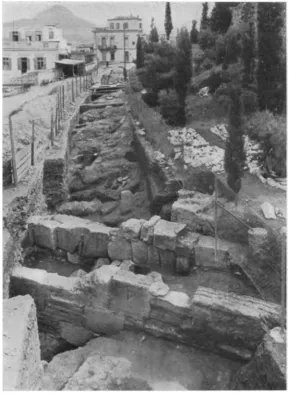
Figure 5 shows a bit of the northern end of the street in the lower left corner, with the Byzantine remains to the right and to the left, while the southern half of the street is visible in the centre background.
The strata of successive deposits were clearly marked. Below modern level came a layer containing early Turkish and late Byzantine pottery and coins, and below this was a deposit with objects of the eleventh and twelfth centuries. Still lower came the main deposit with
Fig. 5. Byzantine Walls at North End of Area
320 T. LESLIE SHEAR
THE TEMPLE OF ARES
The building here found was the most important discovery of the season from the point of view of the topography of the Agora. In the excavation of Section Eta in 1933 some heavy foundation blocks were revealed in place, which were identified from their type as belonging to a building of the fifth century B.C. At that time further exploration was im- possible because of the presence of the modern street. Now with the removal of the street and the overlying Byzantine walls the plan of the building in its entirety has been dis- closed, as it appears in Figure 6, a photograph taken from about the same point as was that reproduced in Figure 5. The building is a large rectangular structure of which the poros foundation stones are preserved in some places, at the east end, to a height of five courses; in other places the blocks are missing but the cuttings in the bedrock show clearly where they had been placed. Both the cuttings and the preserved stones are seen distinctly in the illustration.
The building, oriented east and west, measures 36.36 by 16.76 m. on the course below the euthynteria. The foundation blocks had been carelessly laid throughout the area and many had been removed, probably in late Roman times. They were not set on bedrock but on a thin layer of small stones. Many of them have anathyrosis, drawn edges, and lewis- holes which are not set in places suitable to their present position, an indication that these blocks have been re-used. TJhis view is confirmed by the late type of mason's marks cut on some of them. The ground level, which is partly preserved against the highest blocks on the northern and eastern sides, is of the early Roman period, and to this age may be assigned the construction of the present building. But the appearance of the blocks themselves and the style of the surviving pieces of the superstructure point to the fifth century B.C. as the time of their original fabrication. The architectural pieces include fragments of triglyphs, of a ceiling beam, and of a cornice with mutules from which it is possible to estimate the intereolumniation as 2.80 m. This will permit a restoration on the existing foundations of a Doric temple slightly larger than tlhe Hephaisteion, with six columns on the ends and thirteen on the sides. The temple was originally constructed in the second half of the fifth century B.C. and was entirely rebuilt in the Augustan period, the blocks being carefully lettered and numbered to guarantee their correct placement in the reconstruction. Can this temple be identified with any one mentioned in the ancient records?
and that near the statue of Demosthenes was the Temple of Ares. Not far from the temple stood the statues of the Tyrannicides, from which he passed to the Odeion, and this building he says was near the Enneakrounos. When the rock above the Tholos was uncovered it was clear that the Eponymous Heroes and the other statues had not been placed there since no cuttings for bases existed. It thus became apparent that the statement of Pausanias had been misinterpreted. A clue to the correct explanation had been secured when the Altar
D . X "S t< ' nggp - ' t , .t-0-- f f.i f-- *
Fig. 6. Foundations of Temple of Ares after Removal of Byzantine Walls
of the Twelve Gods was definitely identified at the very north edge of the American Zone, for pseudo-Plutarch (847 A) states that the statue of Demosthenes stood by that altar. Since at the same time it stood near the Temple of Ares this large temple situated just south of the Altar must be identified as the Temple of Ares.
322 T. LESLIE SHEAR
the Orchestra, and there in fact the fragment of the base of the statues was discovered in 1936. The next building in order, the Odeion, has been uncovered and identified, and the Enneakrounos is the partially excavated Fountain House situated farther to
the southwest. Supplementary confirmation of the identification of the temple is provided by the position of another statue, the poet Pindar, which stood by the temple according to Pau- sanias ([, 8, 4), but is located by pseudo-Aeschines (Epis. 4, 3) in front of the Stoa Basileios. For althouLgh the problem of the identification of that stoa is not yet solved the building was certainly situated in the north- west corner of the Agora.
The discovery of this temple has thus provided topographical evidence of the utmost value,
which confirms the identification
of buildings previously uncovered in the excavations and clarifies the description of Pausanias. It is now evident that the word "higher up" (di'CoTeQw) used by Pausanias means higher up the street, and that the traveler after describing the buildings on the west side of the street as far as the Tholos retraced his steps and described in order the buildings on the east side.
SECTION SIGMA
The northern part of this Section, which lies in the northeast corner of the Zone, was excavated in 1936 under the supervision of R. H. Howland, who continued the work in it during the present year. No additional buildings appeared in the area but a road was
I~~~~~~~
found to extend through it in a general direction from north to south. East of the road was a large open space between it and the Stoa of Attalos. This road is part of the main thoroughfare leading from the Agora to the Acropolis, stretches of which had already been exposed in previous years; it can now be
traced with reasonable accuracy from its entrance into the Agora at the northwest corner to its terminus at the approach to the Propylaea. The history of the road indicates a long period of use extending from modern times to the early Roman age. Beneath the level of the modern street was a shallow deposit of the Byzantine-Turkish epoch, below which came a deep stratum of gravelly earth which contained a few fragments of pottery and a great many coins. This deposit, which has a depth of more than two metres, was evidently washed down by heavy rains from the slopes of the Acropolis; it is dated by the coins in the fifth and sixth centuries
A.D. Below it traces appeared of a late Ro-
man deposit of the third and fourth centuries and still deeper came the hard packed sur- face of the early Roman road.
On the east side of the road a well pre- served wall was uncovered which extends through the area for a distance of more than one hundred metres, and separates the open area on the east from the buildings on the west. It was built in the latter part of the fourth century A.D. and was partially
destroyed in the sixth century. Early Byzantine remains were not found east of the wall but they extend up to it on the west side. Adjoining the wall on the west and running parallel to it is another wall which
supports a great drain that is a continuation of the water-channel providing the outlet from the mill-race in Section Iota to the south.
A series of five life-sized marble statues, three standing and two seated figures of mein, was uncovered just west of the wall. They were lying packed close against the wall at
324 T. LESLIE SHEAR
intervals of about seven metres, and apparently they were originally placed in a line facing toward the west with their backs to the wall. The figures represent men clad in voluminous cloaks. All the heads, which were made separately and inset in sockets, are missing, and more or less damage otherwise has been suffered by the statues. The two seated figures are similar in type but they differ in some details. The throne on which the less well preserved figure is seated has a high curved back and has the forepart of a lion forming the front of each of its sides. The other figure, which is shown in Figure 7, is seated on a heavy marble stool without a back but with its sides elaborately decorated with the foreparts of griffins, of which the large wings are carefully carved on the side walls of the stool.
The three standing figures are very similar in pose and costume (Fig. 8). All wear large cloaks which enwrap the bodies and arms, leaving only the hands free. In each case the right forearm is raised with the hand resting in a fold of the garment at the breast.- The left forearm is extended forward horizontally and supports the folds of the cloak. Slight differences are noticeable in the position of the legs and in the quality of the work- manship, but the figures are undoubtedly about contemporaneous and they represent a familiar type of Roman Togatus. It seems probable that a row of statues of philosophers or statesmen was set up along the wall in late Roman times.
Apart from some small monument bases the only structure found east of the wall is a large rectangular foundation which lies juist in front of the central part of the Stoa of Attalos. Since we know from Athenaeus- (V, 212 f) that a bema existed in front of the stoa from which the demagogue Athenion addressed the populace just before the Mithradatic War (87-86 B.C.), this structure measuring 8.50 by 5.95 m. may be safely identified ass the bema. It was built after the stoa with which it is aligned and it was destroyed in the third century A.D. In front of the bema was the broad open assembly place of the Agora as
described by Athenaeus, and in this area remains of buildings are lacking.
SECTION UPSILON
This Section, on the south side of the area, is located on the slope of the Areopagus, of which the rock has been cut for the construction of the cellars of modern houses. Con- sequently no structural remains of antiquity are preserved except some light foundations for Byzantine walls, but the clearance of the area under the direction of R. S. Young revea.led the presence of eight wells and two cisterns which contained vases, pieces of sculpture, and other objects of various periods from the seventh century B.C. to Turkish
times.
SECTION PHI
limnits of the Agora. It was occupied in antiquity by private houses and other small buildings, but ancient and modern habitation failed to delete all traces of a more ancient use of the site as a cemetery, for several gra-ves of the Protogeometric period (ca. 1000 B.C.),
cut in the living rock, had never been disturbed. One grave is that of an adult whose body measures 1.65 m. in length. It was oriented north and south with the head at the south end. The head and upper part of the body were covered by a stone slab on which were pieces of a large round pail-like vessel made of coarse clay and burned at the bottom. The grave contained only one vase, a one-handled Protogeomnetric jug which has the characteristic decoration of its period, a series of concentric semicircles on the shoulder and a black-glazed body with reserved horizontal bands.
An infant's grave of the same period was found close to that of the adult. The tiny bones lay, with the skull acgain at the south end, in a cuttinig in the rock 0.50 m. long. The grave contained no offerings buLt over it was a large round terracotta pail like that found on the first grave. The pot was broken when it was placed on the grave, but it is completely preserved except for one small piece.
A third Protogeometric burial was of the cremation type with the remains of the bones deposited in a large urn which was set in a hole cut for it in the bedrock. Its top had been sheared off in later times but it was probably an amphora, a shape of vase commonly used for urn burials. On one side of it the rock had been further cut away to allow just suf- ficient space for placing beside it a goblet, which was lying on its side with the rim pressed close against the side of the large vase. The goblet is preserved in perfect condition and its surface has the hard smooth fine finish of the well baked specimens of the early Geometric pottery. Other remains of the same -period were found in the area, and it is clear that this entire hillside of the Areopagus was used as a cemetery in the Geometric age.
The scanty remains of the Greek period in the area include black-figured pottery of the sixth century secured from pockets in the bedrock and from a well, and a small rectangular building with polygonal limestone walls which seems to have been constructed in the early years of the fourth century. The Roman age is represented by a house in the southwest corner of the area which was destroyed in the late third century A. D., and by a large
building which was constructed later and may have survived until the sixth century. A well with a deposit of Roman objects beginning late in the first century A.D. proved to be the
deepest that had so far been dug in the Agora, extending down to a depth of 35.30 in. Since the deposit is stratified it furnishes definite evidence for the chronological sequence of Romran pottery.
SECTION CHI
326 T. LESLIE SHEAR
for private houses and small shops, and numerous wells and cisterns which had served such houses contained deposits uncontaminated by modern intrusions. Two children's
graves with unimportant pottery of the late sixth century B.C. probably represent burials
made beneath the floors of houses since this part of the town was not officially available for burial purposes at the late period indicated. A pit near the graves, dated about 480 B.C.
by the pottery in it, contained a great quantity of animal bones which were examined
Fig. 9. Paved Street beside Valerian Wall. View from the North
by N. Gejvall, a visiting student of zoology from the Unliversity of Lund. He identified them as belonging to cattle, pigs, goats, sheep, a hen, a dog, and several kinds of fish. The various wells yielded contents of both thle Greek and Roman periods.
SECTION THETA THETA
Acropolis. It lies just south of Section Eta Eta, excavated last year, and is about 130m. distant from the south end of the Stoa of Attalos. At its soutthwest edge is the small church of Hypapanti which has been left standing. The Valerian Wall, which had previously been uncovered in the Sections to the north, extends through this area dividing it into a narrow western strip and a wider area on the east. Directly west of the wall a stretch of the broad street leading up to the Acropolis was uncovered. It was paved with large blocks,
Fig. 10O. Typical Section of Valerian Wall
most of which are still in place as may be seen in the view looking south shown in Figure 9. Part of the same street was found beside the wall in the northern Sections and the evidence there secured indicates a date in the early Roman period for the laying of the pavement. The street itself served from early times as the main route from the Agora to the Acropolis. The wall here as elsewhere in its course was constructed of re-used blocks of marble and poros, many of them of very large size. At one point an inscribed marble stele firmly fixed in its poros base had been left in its original position and had been incorporated into
328 T. LESLIE SHEAR
the wall. The face of the stele is badly weathered and the inscription has not been entirely deciphered, but it is apparently an Imperial letter dating from the first half of the second century A.D. Adjoining the base
on the north a large block of Pentelic marble had been placed transversely in the wall. This and the erect stele beside it are shown in Figure 10. Only the square bottom of the block appeared in the side of the wall but a little scraping of the rubble packing beneath it revealed traces of letters on its face. It was thereupon removed from the wall and proved to be the base for a bronze statue dedicated by Herodes Atticus (Fig. 11). The footprints of the statue are out- lined in the top of the base and the ends of the iron dowels that supported the heels are still fastened in place by lead. The dedication, written in handsome letters on the front of the base, states that on the vote of the city Herodes Atticus of the Deme Marathon dedicated the statue of his friend the consul, Civica Barbarus. The word "friend" seems to have been added as an afterthought since it is written in much smaller letters than the rest of the inscription and is crowded between two of its lines. M. Ceionius Civica Barbarus was consul in Rome in 157 A.D., but little else is known about him. Perhaps it was the un-
importance of the man that led Herodes to justify the erection of his statue by designating him specifically as his friend.
The most important topographical discovery in this Section is a building that dates from the end of the sixth century B.c., of which the north wall was uncovered last year in
Section Eta Eta on the north. In its original plan the building measured 15.60 by 8.70 m. with its long axis north and south, but not much later it was enlarged by an addition 2.40 m. wide on the east and south sides, so that the measurements of the building in its final form are 18 by 11.10 m. The walls are built of carefully joined polygonal blocks, most of which are of Kara stone, but the highest preserved course, that above the euthynteria in the west wall, is constructed of rectangular blocks of various materials, poros, Kara and Acropolis limestone. The natural slope of the hill is so great that the lowest course of the north wall is nine courses (about 3.15 m.) lower than the remaining block of the south wall, which seems to be a step foundation. Since the bedrock here has been cut and scraped frequently for modern houses little evidence for the history of the building was secured. Some of the blocks were removed in early Byzantine times but in general Turkish and modern filling rested directly on the foundations.
No clue was found to assist in the identification of this small building and all that is now possible is a conjecture based on its size, type, and location. It is situated high up on the hillside southeast of the Agora and not too far from the steep place on the north side of the Acropolis where the Medes ascended. In this general area Pausanias (I, 18, 1-3) places three buildings, the sanctuary of the Dioscuri, the precinct of Aglauros, and the Prytaneion. The new building could not well be either of the first two for they must be located still higher up the slope and closer to the base of the Acropolis, since Lucian (Piscator, 42) describes the hungry philosophers as clambering up to the Acropolis on ladders placed in the Anakeion. But the Prytaneion must have been lower down since it is the last building mentioned by Pausanias before he descends to the lower parts of the city. The antiquity of the new building, its size, and shape would favor the interpretation of it as the Prytaneion, and this identification may be tentatively suggested.
SECTION IOTA IOTA
This Section, excavated under the supervision of A. W. Parsons, adjoins Section Theta Theta on the south. Through its entire length from north to south the course of the Valerian Wall is continued, which is preserved in places to a height of nearly three metres but has been much repaired in modern times. The position of the Section falls on the line along the north base of the Acropolis which separates the upper slopes that were too steep for convenience in building from the lower gentler slopes where structures of considerable size could be located. Only scanty remains of ancient buildings were revealed. Some evidence was secured indicating the presence of a sanctuary of the fifth century B.c., and other structures include a small circular building of early Roman date, a vaulted brick drain of good Roman workmanship, and house walls of a Byzantine settlement of the eleventh and twelfth centuries A.D.
One of the Byzantine walls contained a large statue base of Pentelic marble which bears an inscribed dedication and the signature of the sculptor Praxiteles (Fig. 12). The base,
330 T. LESLIE SHEAR
which is 0.737m. high, has mouldings at the top and the bottom but no cuttings on the top surface. Presumably, therefore, it was constructed to support a marble statue. The inscription records that a statue of Archippe, daughter of Kleogenes of the Deme Aixone, was dedicated by her mother Archippe, wife or daughter of Kouphagoras of Aixone. The letters of the inscription are not made in the best style but their shapes in general are similar to those on the base signed by Praxiteles found in 1936 (Hespe- ria, VI, 1937, pp. 339-342), and they are appropriate for a date in the third quarter of the fourth century. This is evidently, then, the base of a marble statue of a woman that was made by the great Praxiteles. This Archippe cannot be identified with any other known woman of this name, and it is impossible to conjecture why she was honored with a statue made by Praxiteles. The statement of her family relation- ship is not clear. The genitive of the name Kouphagoras after the mother's name allows the mother to be either wife or daughter of Kouphagoras. In the former case he was her second husband, in the latter he was grandfather of the woman honored. Kouphagoras is a rare name which is recorded only in a reference by Herodotus to an Athenian who was father of a combatant at Marathon.
SECTION OMICRON ALPHA
Just south of Section Iota Iota an unimproved road passes along a terrace on the hill- side. This year the government decided to make this into a permanent surfaced highway
to be part of an automobile road encircling the Acropolis. Since the Valerian Wall ran beneath this road it was important that the area should be investigated before the recon- struction work was begun, and permission to undertake this was sought and received by the
Fig. 13. Section of Valerian Wall uncovered in Acropolis Street
Agora administration. The area is included within the limits of the American Zone but as it lies entirely on the rocky slope of the Acropolis it had not previously been assigned a sectional title. For the purposes of record of this investigation the Section was, therefore, called Omicron Alpha (C0 Og ~4xeoff6hewc). The filling of the road proved to be entirely
332 T. LESLIE SHEAR
area had been cleared down to bedrock it was refilled with earth aiid returned in its original condition to the Ministry of Communications for the construction of the highway.
In following the course of the wall up the slope to the south the appearance of some prehistoric remains led to a general investigation of the hillside over an area about 100 m. long and from 15 to 40 m. wide, which resulted in several important discoveries. The line of the wall was traced for its entire extent to the terminus against the bastion at the north- west corner of the Acropolis. Over much of the course the preservation is poor but at the
Fig. 14. Building in Front of Kiepsydra
in the last quarter of the third century after Christ. It was mainly built of re-used blocks which were evidently put together hastily, perhaps for the purpose of providing the city with some means of defense after the walls and buildings had been destroyed by the Herulians in 267.
Fig. 15. Interior of the Klepsydra
334 T. LESLIE SHEAR
structed, is the better preserved, standing in places to a height of two courses. The date of the construction of the stairway has not been definitely determined but the evidence so far available suggests a time about the middle of the first century A.D. The possibility has been
suggested that this is the stair leading up the northwest side of the Acropolis which is depicted on Athenian Imperial coins beginning with the reign of Claudius, and that this construction is to be associated with the layilng of the marble stairs leading to the Propylaea which has been attributed to the initiative of that Emperor.
Fig. 16. Vase of Polished Red Ware of Sub-Neolithic Period
The paved building situated just below the cave of Pan and the Klepsydra has been entirely exposed by the removal of the section of the Valerian Wall which concealed its west end (Fig. 14). This further clearance emphasizes its curious irregular shape, formed
by sides with the following approximate measurements: north, 18 m.; east, 1 im.; south,
25 m.; west, 6 m. It is difficult to conjecture the purpose for which the building was used, unless it was planned as a large water basin. It is probable that its construction was con- temporaneous with that of the monumental stairway.
measuring 4.50 by 2.25 m., with its walls and floor constructed of carefully cut and jointed blocks of poros (Fig. 15). Water is conveyed to the chamber by three inlets set low in its east wall, the flow in the dry season being at the rate of 100 litres per hour as indicated by measurements taken over a period of a few days beginning on July 30. Three periods of construction were noted: the earliest in the fifth or fourth century B.C., the second in the
Fig. 17. Jar of Polished Black Ware. From a Water-color by Piet de Jong
early Roman period, and the third in later Roman times but before the date of the building of the Valerian Wall.
336 T. LESLIE SHEAR
Two periods of the prehistoric age are represented by the wells, four of them having contents of the late Neolithic and of the Early Helladic type, and eight having a Middle Helladic deposit. The deposits of the two periods were distinctive in their respective wells, so that it is evident that the later peoples did not use the wells of their predecessors but cut new shafts through the rock. In general the shafts of the Middle Helladic wells are deeper than those of the Neolithic but they are not made with any greater care. The wells produced a great quantity of pottery in- cluding several handsome vases which are preserved in almost perfect condition. Chips of ob- sidian were present in each well, and mortars of gray volcanic stone used for the grinding of grain were found in wells of both periods. Some human bones and a skull were taken from the ear- lier shafts and animal bones were found in both groups. The latter were examined by N. Gejvall who reported the presence of remains of bones of the following: cow, pig, goat, sheep, stag, red deer, dog, bird, turtle, fish, with which were shells of the murex. Supple- menting the wells a few pockets in the rock containing undis- turbed prehistoric filling prove that the early settlement here must have been one of con- siderable size although no trace of house walls of the period has yet been found.
The earliest prehistoric ware is hand-made and the better specimens have been given a high lustrous polish. They are both black and red in color but one red jar has been unevenly fired so that irregular patches of black appear. This ware seems to belong to the very end of the Neolithic period, on the boundary between the Neolithic and the Early Helladic. The jar of red ware has two lug handles each of which is pierced by two holes aligned with two holes in the base (Fig. 16). Since such an arrangement would be awkward Fig. 18. Middle Helladic Matt-Painted Vase. From a Water-color
for purposes of suspension it is possible that the pot was supplied with a cover which could be held in place by withes or gut passing around the vase through these holes. A some- what similar device appears on a jar of polished black ware but on that example the side lugs have but a single hole each and, as there is no base to the pot, the corresponding pair of holes is placed on the rim (Fig. 17).
Some vases which are certainly of the Early Helladic class were found but it is signi- ficant that in all the great quantity of sherds there was not one piece of a sauce boat, the characteristic Early Helladic shape. A possible inference is that the sauce boat is a shape that was developed later in the period than the time to which the Agora vases are assigned.
Fig. 19. Middle Helladic Jug with Bridged Spout. From a Water-color by Piet de Jong
The vases of the Early Helladic group are large but they are carelessly made by hand of coarse gritty clay. They represent the cheaper type of household ware which is always present in abundance in deposits of all periods.
On the other hand the next period, the Middle Helladic (ca. 2000-1600 B.C.), is represented
338 T. LESLIE SHEAR
same technique is a spouted pitcher of graceful shape and of beautiful fabric (Fig. 19). It has horizontal loop handles and a bridge across the spout at the rim. This vase is un- doubtedly of local manufacture but its shape resembles that of Middle Minoan vases found at Knossos (cf. A. J. Evans, The Palace of Minos, I, p. 268, fig. 199 e). Absolute proof of local origin of the ware is provided by a Fehlbrand, a cup of similar clay and technique, of which the side had been indented by a thumb at the time the vase in leather-hard condition was placed in the kiln.
Fig. 20. Middle Helladic Light-on-dark Ware. From a Water-color by Piet de Jong
SECTION LAMBDA LAMBDA
This Section is located on the north slope of Kolonos Agoraios, lying between the electric railway and Section Kappa Kappa which was excavated last year, and as in that Section the work here was directed by Mrs. D. B. Thompson. The rock slopes steeply toward the north with a drop of more than seventeen metres from the level of the Hephaisteion to the ancient road north of the railway. This deep space was filled with earth dumped here in modern times, below which the ancient remains are few. In the Greek period the slope was
4
Fig. 21. Middle Helladic Spouted Jug. From a Water-color by Piet de Jong
occupied by metal working establishments with their furnaces, water works and casting pits, in which pieces of moulds and of metal waste were still preserved. The entire hill was given over to the bronze-casters, a fact which further confirms the view that the so-called Theseum is in fact the temple of Hephaistos.
340 T. LESLIE SHEAR
city of the period, and several cisterns with stratified deposits provide important chrono- logical evidence for the study of the development of Byzantine pottery.
Fig. 22. Plan of the Agora and its Environs. Drawn by J. Travlos
and Pi Theta in the past two seasons but had not been dug because of lack of time. The area around the Tholos, situated in Sections Beta and Zeta, was the subject of a special detailed investigation by H. A. Thompson, of which the results will be fully published in a later Number of Hesperia.
By way of summarizing the account of the excavations a plan of the excavated buildings is given in Figure 22 which shows their relation to the surrounding terrain. The names assigned to the buildings can be readily secured by reference to the Ground Plan published in Hesperia, VI, 1937, pl. IX, opp. p. 360. The identifications have been based on a com- bination of archaeological and literary evidence, and any divergent theories must reckon with both groups of data. It is futile, for example, to try to identify the great South Stoa as the Stoa Poikile, as has recently been done, since it is certain that the South Stoa was constructed only in the second century before Christ whereas the Poikile existed already in the fifth. Many topographical problems of the area remain still to be solved and un- doubtedly much light will be shed on them when the entire Agora shall have been cleared, but in the meantime the identifications which have been suggested seem to be definitely correct.
POTTERY
The most important additions made by this season's campaign to the Agora collection of pottery are the many prehistoric vases found on the northwest slope of the Acropolis, some of which have already been illustrated. These, like most of the other well preserved
n
342 T. LESLIE SHEAR
t_r.,_H.o.-;a '.. ... ... ;.t
Ski
pieces, were secured from wells, since few early graves were uncovered this year. A brief description will be given of some of the other more important vases, found in various parts of the area, presented in chronological arrangement.
Reference has already been made to the discovery in Protogeometric burials of several Vases of characteristic type. The late Geometric style is represented by considerable material, and to the period of transition from the Geometric to the Proto-attic belongs a panel from a partially preserved amphora which is decorated with an interesting group of figures, the centre of which is occupied by a man and a woman who face each other over a large object of uncertain character (Fig. 23). The woman carries an upright palm branch in each hand while the man holds toward her in his extended hand an object which may be interpreted as a crudely constructed
lyre, since a clearly identified lyre is held by a man in a similar group on a panel of an early Proto-attic hydria in the National Museum, Athens (Col- lignon-Couve, Catalogue des vases peints du Musee National d'Athenes, pl. XX, no. 468). The attendant figures on either side stand with clasped hands and all hold palm branches. Another important fragment of this style is the neck of a hydria which is decorated with a procession of women who stand in similar pose, but who have their hair arranged in long pointed nets and wear skirts of an opaque white color.
A deposit of early Attic pottery of the seventh century was found in a shallow well in Section Upsilon. The vases in the filling, which was uniformly consistent, were cups of characteristic Proto-attic shape, a flat plate decorated with concentric bands, small oinochoai, and one large oinochoe. The contents of this deposit are discussed by R. S. Young in a later article in this Number.
Attic black-figured ware, typical of the sixth century, is illustrated by a nearly complete example which was found in a closed deposit of the period together with several lamps, an archaic terracotta seated figure, and other pottery including a black-glazed patera. The vase is a stand in shape and has a decorative frieze set between two narrow bands of rosettes (Figs. 24 and 25). The scene represents a woman who is mounting a chariot drawn by four horses. Beside this group is a palm tree, and in front of the horses stands a man, clad in voluminous garments, who has a laurel wreath on his head, holds a flower in his raised right hand, and carries a large lyre under his left arm. Behind him a stag is standing
23
344 T. LESLIE SHEAR
beneath the branches of a second palm tree. The presence of the stag and the appearance of the man with the lyre suggest that the figures should be interpreted as Apollo and Artemis. The patera which was in the deposit with the stand is a particularly fine example because of the excellent quality of the glaze and because of its good state of preservation
(Fig. 26).
The vases of the red-figured style of the fifth century illustrate various phases of the development of that type of ware. In the earlier part of the period belongs a fragment of
Fig. 27. The Judgment of Paris on a Red-figured Fragment
a handsome vase, dated by Miss Talcott at about 470 B.C., with a representation of the
the first fruits of the field. It was found in a well on the Kolonos with a closed deposit containing nothing later than the end of the fifth century. Other red-figured pottery with it included a krater and an amphora, the former decorated with a ceremonial scene in which youths with wreathed heads are engaged, and the latter bearing a sacrificial scene in which youths and a maiden are leading a bull to the altar.
Fig. 28. Red-figured Amphora
Considerable household pottery of good quality but with simple decoration, dating from the end of the fif th century, was taken f rom a well in Section Chi. The date of the deposit was established by lamps, black-glazed bowls with stamped designs, and red-figured squat askoi. The household ware included a shallow frying-pan, casseroles of various shapes and sizes, and two-handled jugs with a deep convex shoulder (Fig. 30). The arrangement of the two handles close to one another is peculiar, and it is difficult to perceive any advantage
346 T. LESLIE SHEAR
Fig. 29. Red-figured Vase of Kernos Type
in handling that could be derived from it. The vase has a finely finished surface and is decorated with two bands painted just above the sharp edge of the shoulder.
The usual amount of Hellenistic pottery was secured during the season but most of it is duplication of material that was already in hand. But in regard to the wares of the Roman period much valuable information for establishing their chronological sequence was provided by stratified deposits in several wells, which also produced some unusual individual pieces.
.X.Fg 3 SJu'fHueodWr
A remarkable vase came from a well on the Kolonos with contents dating from the first century B.C. to the first century A.D. This is a one-handled pitcher of red ware with a well
finished surface (Fig. 31), of which the exterior is decorated with three large grotesque figures that were made separately in moulds and attached to the wall of the vase. The
S~
~~
_
_
41
~~~~~~~~~~~~~~~
Fig. 31. Vase of Roman Period decorated with Grotesque Figures. From a Water color by Piet de Jong
348 T. LESLIE SHEAR
Augustus or Tiberius (81st Winckelmannsprogramm, p. 14), and is attributed by him to an Anatolian factory.
A well deposit of the third century A.D. produced four one-handled cups with words
painted around the body in large white, letters of cursive shapes. The word 7?AHIFPAIA
is written in carefully made letters on one complete specimen (Fig. 32). This is probably a proper name for, although the word is not otherwise known, the elements of the compound
_ '.
Fig. 32. Cup of the Roman Period with Inscribed Name. From a Watei-color by Piet de Jong
may be interpreted as meaning ' the old woman who slaughtered. The inscriptions on the similar mugs are more appropriate since one bears a wish for long life, and another a greet- ing to the "1beautiful fair one.
covered, and of the red paint used for the pupils of the eyes, for the nostrils, the lips, the necklace, and for a circle in the middle of the forehead. The presence of the large circle suggests that these vases may have been manufactured for some ritualistic or dedicatory purpose.
Fig. 33. Plastic Vase. Third Century A.D.
350 T. LESLIE SHEAR
SCULPTURE
It is equally surprising that many pieces of sculpture have been found in the area. Most of the works are products of the Roman period but occasionally pieces of an earlier age
Fig. 34. Marble Head of Aphrodite
appear, which have survived from the sack of Sulla and from other destructive upheavals of the city. Only three of the marbles secured last year will be here presented.
of hair and brow, the long narrow eyes, the full cheeks, and the thick lower lip are elRments of the style of Praxiteles and his followers. Although the head was found in a well with contents of the first and second centuries A.D. it does not exhibit any obvious traces of
Roman workmanship, and may be safely regarded as a product of the Greek period. By contrast with this handsome work the finish of the surface and the execution of details of a small head of Aphrodite (height: 0.105 m.) are coarse and careless (Fig. 35). This head,
Fig. 35. Small Head of Aphrodite
which is perfectly preserved, resembles in style the head of the Knidian Aphrodite, and seems to be a Roman copy of a Greek work of the fourth centu.ry B.C. It was made, however,
not later than the Augustan age, the date of the contents of the deposit in which it was found.
The third piece of sculpture is a small marble statue of a sleeping child (Fig. 36). It is not carefully finished, the spirals of the curls, for example, being coarsely made with a large
Fig. 36. Statuie of the Sleeping Eros
seated on a high-backed throne,
wearing a polos on her head
and holding a patera in her right hand (Fig. 38). This is the usual type of representa- tion of the Mother of the Gods, but on her lap is a large object which is probably to be inter-
preted as the sacred winnow- ing basket which was often associated with the cult of Demeter, who was closely af- filiated with the Mother, if not identical with her. The second terracotta is also connected
with the worship of the Mother
T. LESLIE SHEAR
preted as a statue of the sleeping Eros. It is a copy made in the Roman period and, like many other replicas, must have as an ultimate source a famous prototype of the fourth century B.C., which served
as the inspiration for the authors of several grace- ful poems in the Greek anthology (Anth. Pal. XVI, 210-213).
TERRACOTTAS
Many terracotta figurines of all periods were again found this season, as well as the moulds from which they were made. A mould of good workmanship of the late fifth century B.C. shows
a figure of Hermes, which is preserved nearly to the knees (Fig. 37). The god wears a pointed cap and has a chlamys arranged in elaborate folds thrown over his shoulder. He holds a caduceus upright in one hand and a money bag in the other. The locks of the hair are carefully indicated and the modelling of the nude part of the body is ad- mirable.
Two interesting terracottas came from a deposit with contents dating from the fourth to the second century B.C. One is a figure of a goddess who is
(Fig. 39). It is cylindrical in shape like a polos from her head (height:
0.135 m.). The curved front of the
cylinder is framed by thin strips of terracotta irregularly made, giving the impression of the folds of a veil. The surface is divided into three horizontal bands of graduated widths. In the widest at the top is a seated figure of the Mother toward whom an attendant in front holds out a torch. In the middle band are dancing women and in the
lowest are five small figures. This cur-
ious object may have actually crowned the head of a votive statuette of the goddess, or it may itself have been a dedication to her shrine.
Some terracotta toys illustrate the lighter side of the daily life of the
Greeks. One of these is a horse which has a small hole through the nose for a leading string, and large holes through the body at front and back for the axles which supported the four wheels that replaced the legs (Fig. 40). The bridle and collar, indicated in low relief, were probably painted red, and the body of the animal was covered by a white slip, some of which is preserved. Other terracotta toy animals, which were similarly painted, were found with lamps and other objects in a burial of the fourth century A.D. The figures, which are
perfectly preserved, are two cocks, a dog, and Fig. 38. Terracotta Figure of Demeter
354 T. LESLIE SHEAR
Fig. 40. Terracotta Toy Horse
Fig. 41. Terracotta Toys
4
Fig. 42. Lamp with Cover in Place
a standing animal which may be either dog or bear (Fig. 41). All the figures are hollow and have pellets in the interior so that they were probably used by children as rattles.
LAMPS
Lamps of all periods have steadily accumulated with the result that the total number now in the Agora collection is 3117. Several of the more interesting pieces found during the season will be illustrated. One unusual example was among the offerings of miniature vases in a child's grave dating from the second half of the fourth century (Fig. 42). This lamp is fitted with a cover which has a boss on its under side to close the opening in the bowl, and a tongue which fits the channel leading to the nozzle. On its upper side is a low square knob which is pierced by a hole, and on the right side of the lamp is a pierced knob, so that by a string or thong through these holes the lid could be fastened to the lamp and could not be mislaid.
356 T. LESLIE SHEAR
g~~~~~~~~~~~~~~~~~~~~4 2
Fig. 44. Bronze Plastic Lamp
The significance of these scenes is not apparent.
Some well preserved plastic lamps exhibit a variety of shapes. One is a bronze lamp in the form of a bearded dwarf (Fig. 44), which has still in place the bronze wire passing through the head by which it could be suspended. Another is a terracotta example in the form of a boar which crouches on the top of a conventional type of lamp (Fig. 45). A small post extending above the boar's back is pierced with a hole for the purpose of suspension. A third example, taken from a deposit of the third century A.D., is in the form of
The need that was felt of covering the bowl of the lamp in order to keep the oil clean led to the development of the closed receptacle, and the disc thus formed on the top became available for decoration. This later type is illustrated by the three specimens shown in Figure 43 which came from a deposit of the second century A.D., containing also the
two gems described below (Figs. 48 and 49), and various other objects. These lamps are signed on the bottom with the names of the makers, the upper one being by Preimos and the two lower by Elpidephoros. One of the latter has its disc decorated simply with a bull reclining to the right; the other has an elaborate ritualistic scene in which Hermes is represented as leading a rearing ram to the sacrifice. The lamp by Preimos also has a cult scene on the disc. A woman is represented on the left holding a large platter, on which is a cake, on her upraised left arm. She is approaching a circular shrine in which stands a cult statue of a goddess.
FA, 4