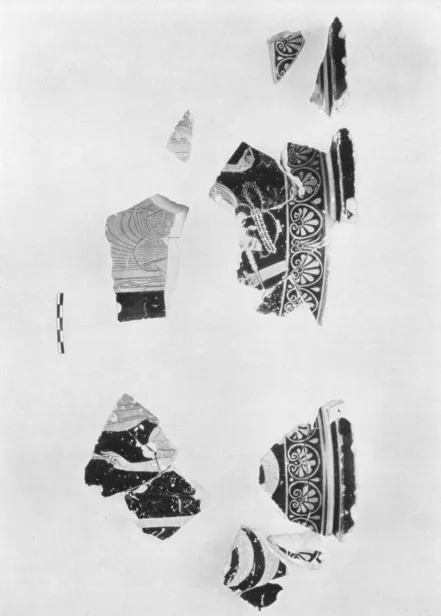
On one of several fragments from a large red-figured stand (Fig. 1) found in the Agora in 1935,1 the signature ElOvyd8deg ho HoXdo may with certainty be restored.2 The principal fragment preserves the head of Apollo, magnificently wreathed in red and white; his shoulder with a bit of chiton and himation; and much of his large lyre. To the left above is the end of the signature, ]rOiO. Here (as on both his Munich amphorae with arming scenes and on his Turin psykter), the painter has set himself down as the soil of the " grey-haired one." A bit of a second inscription, the single letter 0, can be seen at the lower right corner of the fragment which preserves the mid-part of the god's figure; most probably Apollo's name was written beside him.3
To the right stands Artemis, her left hand holding up her skirt. She faces towards the musician; behind her is the sacred palm4 whose spreading branches overshadow her
Agora Inv. P 4683. Nine fragments, found scattered tlhrough a terrace filling of the early fifth centtury, at the foot of the southeast slope of the Kolonos Agoraios.
Height of largest fragment, 0.11 m.; diameter at edge of rim estimated at 0.29i m.; full height estimated at abotut 0.40 m. Purple red for inscriptions, flower sprays, leaves of wreath, lyre-keys and plectron string; white for the berries of the wreath, black relief lines as strings for the lyre; brown for the fold-lines of the chitonis, for the iris of the eye, and for the inner drawing. Relief contours throughout, save on part of the border aind around the hair; the bunch of curls incised. The rim is reserved above; inside the vase, bands of glaze alternate with reserved bands; near the top the bands are narrow and the glaze a shiny black; lower down they are wider, and the glaze rougher.
In studying this vase I have been continuLally indebted to Professor J. D. Beazley. For criticjsmn and suggestions I wish also to thank Mr. L. D. Caskey, Professor H. R. W. Smith, and Dr. Hans Diepolder. To Mr. Eugene Vanderpool I owe my acquiaintance with the stands in Eleusis, Figures 5 and 6, whose publication Professor K. Kourouniotes has generously made possible. I have further to thank Professor Camillo Praschniker for permission to include a photograph, Figure 4, of an ainphora in the Vienna University collection.
2 The new vase adds a seventh to the six signatures of Euthymides already known:
Munich 2307: A. Furtwiingler and K. Reichhold, Griechische Vasenmnalerei, Berlin, 1904-1932, [F. R.], pl. 14;
J. D. Beazley, Attische Vasenmaler des rotfigurigen Stils, Tulbingen, 1925, [Att. V.], p. 63, 1. Mtnich 2308: F. R., pl. 81; Att. V., p. 63, 4.
Turin: J. H.S., XXXV (1915), pls. 5, 6; Att. V., p. 64, 9.
Bonn: J. C. Hoppin, Euthyntides and -His Fellows, Cambridge, Mass., 1917, [Hoppin], pl. 6; Att. V., p. 64,12. Formerly Adria: R. Schone, Le Antichita del Museo Bocchi di Adria, Rome, 1878, pl. 4, 2; Att. V., p. 64, 14. Rlomie, Villa Giulia (other fragments in Florence and in Boston): J. D. Beazley, Campana Fragnlets in Florence, Oxford, 1933, [C. F.], pl. 7, 2-3; pl. Y, 23-24.
3 The god's name appears in this position, written lengthwise of the pot, oii a related amphora in Vienna;
see below, p. 64, note 1, and Figure 4. EuLthymides, xvhose love of inscriptions has often been noted, nay well, likewise, have labelled an unmistakable figure.
4 No attempt is made to render any of the natural details of the tree; the palm shows the stylized version
most usual in archaic red figure (PauLl Jacobsthal, Ornamente griechischer Vasen, Berlin, 1927, pp. 99-101).
American School of Classical Studies at Athens is collaborating with JSTOR to digitize, preserve, and extend access to
Hesperia
.,;iv500XaC
..
i i,,0
w00b X . wiPPi; t0i;
f i v 6 ;iFiXPiX-
K0i;XPiPPSP*aXvi
lSP iXPX
i.C;iw;-i;e >,fffl iVlF > > iP f i & r ^ i S a? ;sS>^ foFi>ffi KtZ;iTPPX iP>zv; v Pv0 S >; 0
* ,. . i S- i , ! -.
Si X X d ; . e a @
.. ::4 , ,.-. ;+2 -e . ... . . . . : ... . ; . ::.: :.:; ... .- ,.- . ... ... .. : , - . . :, .:.
gt wj . : t ; ; : f;?gA : i . .? ,; e . ?
* . : \: 4@ C : ... . . ' . . . * . ... :' : . . ... . . '::; . -''.: W * - .. .; . . :
_*_||L
_|M
;
lw
a0iXiPSi
_#,0
C>ioiXfX
r
:
:00Lt:X
_',;fE
,.,,..s\s, *i
_E___w
i i_'fFei
i;H00iRsa0;
<;
f
r
:;
l
.. _ I
b j
- s--- P ;|0 i i
.: :. > .: . . . >-- * . . t.
:D :: ;; ? g St SS tE -z bo f i j
0' f ; tS [tS E L iE ; r r . > x i
. X . , . _, . , ...
* t . a . t $ ., \ ;; . i T . . ... .
C .iXe d,,; P b v 'SiX -,0 0 f S i f xi
.. ., ,,,.,,,4A@f, ... ,,.S 2,,2. ... . S i S --
: 1 7 v: x " :::: ' . . ... 0 . i!.<i
': ' . . ; '1
. . .
shoulder. Between her arm and the trunk of the tree is part of a third inscription, KA[Xob. Of the figure to the left there is preserved, behind Apollo's head, a raised left hand holding a flower spray. A smiall non-joining fragment should also belong to this fi(rure. On it we can distinguish the lower line of the left breast, the folds of an himation worn scarf-wise over the shoulder, and the lower line of the upper arm, outstretched, with fol(ds of the sleeve falling over it.' One more figure would have filled out the circle of the vase, but of it no fragments have been found. Conjecture might possibly supply Ares, whom Psiax2 represents in a similar concert scene' or, perhaps better, a messenger sucli as Iris. Her spread of wing (compare Fig. 5) would suit the available space; nor would lher association with the Delian palm4 be inappropriate.
The palhuette border which appears above these figures is by no means rare;5 the single initerpolated lotus is, however, odd and agreeably ing,enious. From the manner in wlhich its right side is squeezed in we may believe that it was not part of the original plan, but that it served as an expedient when the spacing of the palmettes did not come out ev-enly. Yet we nee(i not imaogine that the painter much regretted the necessity for punctuatirig hiis border lhere over the head of the principal figure.6 Tlle lotus provides somuetlhingr of an exclamnation point. It does not altogetlher replace the proud inscription, but at least it invites tIs to lin(rer over Eutliymides' Apollo.
That the Agora stan(I belong,s to the time of Eutlhymides' Munich masterpiece witlh r''lieseus carrying off Korone (note 1, below) any comparison of the head of Apollo (Fiig. 2) witlh the hiea(d of Theseus will suggest. The meditative god lacks the aboun(ling vitality
I For a similar arrangement compare Antiope on the reverse of Euthymides' amphora with the rape
of lIorone, AMunichl 2309: F. R., pl. 33; Att. V., p. 63, 3.
2 A4 M. A. IRichter, " The Menon 1'ainter = IPsiax," A. J. A., XXXVIII (1934), pp. 547-554.
Madrid: Corpus Vasornum Antiqutorum [C.V.A], Madrid 1, III Hle, pl. 23, 1 and pl. 24; Att. V., p. 9, 3.
The composition on this vase anid that on the same painter's amphora in Philadelphia (Phtladelphia
Museum Jousrntal, 1914, V, pp. 32, 33; Att. V., p. 9, 4) provide good comparisons with the vases illustrated hcere. 'I'lte conniection between this painiter and Eluthyrnides was pointed out by fHoppin (p. 37) and is
emp)hasized by H1. lH. WV. Smith, New Aspects of the Menon Painter, Berkeley, 1929, pp. 54, 55.
4 In the I-lotneric fHymn to Delian Apollo, 11. 102 if., Iris is sent to summon iEilithyia to Leto's assistance.
s Hloppin, p. 9, 1 (b). In Euthymides' work the pattern appears on the Bonn hydria anid the Munich Theseus amphora. Rlelated ornament, with similar irregularities of execution, appears on botl of the signed
Mlunichl amipholrae. Oni Munich 2308 an abbreviated lotuis alternates regularly with pointed palmettes.
The spindly lotuis of our ornament, springing from no proper calyx, reflects a tendency towards a
loosening up of tile elements of the motif, which appears at abouit the time of transition from black-figuire
to red-figuire painting: Jacobsthal, op. cit., p. 166 ff.; ep. pl. 88 c, where a straight-based lotus comparable
vith ours appears on the same vase as a blossom of the more persistent ftull-calyxed type.
6 There is a fair possibility that the lotus vas deliberate. No evidence of erasure can be seen at
the point wher-e the frames of the adjoining palmettes are attached to the volutes serving as calyx for the
lotus. It is difficuilt to see how something of the sort could have been avoided, if the artist lhad drawn
the fuill culrve of the palmette frame without planining for this junction;
We may, moreover, reasonably enquiire why if the painter had not intended the lotus he would have begun his pattern over the head of the principal figuire, at the very point where the chances of not coming
ouit even might have proved most disastrous. His vase is without hanldles and has no obviouIs distinction
of the hero, but the drawing is no less sensitive and no less superb. Apollo's gaze is singularly softened by the use of a brown wash over the iris of the eye. The outline of his hair is reserved, save for an incised bunch of curls projecting at the back. On the Theseus vase incision is rather the rule.' The reserved outline cannot, however, in the work of our painter be considered as indicative of a late date, for it occurs on the signed hydria in Bonn, where he praises the fair Megakles. 2 To the same time as
this hydria. the years between 510 and 503, the Munich amphorac belong.:'
Apollo's drapery shows no departure from the Euthymidean canon as seen on the Theseus amphora, though the proportion of black fold-lines to brown is somewhat higher. On the skirt of the figure to the right, whom we call Artemis, we remark not the fine radiating folds seen on the dresses of Antiope and hier fleeing companions, but a mnore rigid arrangement, suitable to a standing figure, a treatment with which we may compare Hecuba's skirt and Hector's chiton on the Munich amphora which shows Hector arming. For the hand of Artemis, Heleni's right hand and Antiope's left, again from the Theseus aiiiphora, will supply line for line comparisons. The contrast in the treatment of drapery and details which our fragments provi(le with Euthymides' later chariot amphora in the Louvre4 serves to emphasize their relationship to the vases of the painter's middle period, an(d especially to the Munich amphorae.
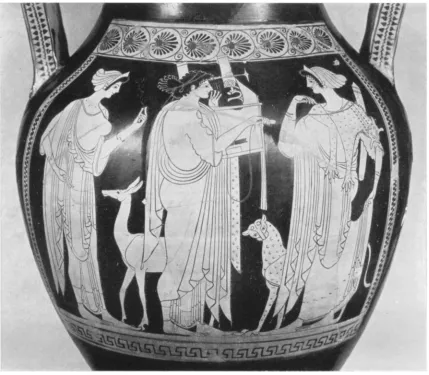
Among many contemporary renderings of the scene on our stand one of the most useful for the reconstruction of its composition appears on an amphora in London5 (Fig. 3) painted by an unnamed follower of Euthymides. The arrangement of the figulres on the Ag,ora vase seems to have been very close to that of the Apollo, Artemis and Leto of this amphora. Another version appears on a fragmentary amphora in the Vienna University collection, the masterpiece of the painter of the London amphorae,6 an imitator
1 Eutliymides seems to use the reserved hair-outline sometimes from clhoice, sometimes from necessity.
On the new fragments, the arm of the lyre, against which Apollo's head in part appears, may have in- fluenced the techniquie of the ouLtline. We may compare the head of Korone on the Munich 'rhesells
amphora. Imitators were nlot always so logical and might cling to the less trouiblesome incision; compare
Figure 3. It is worth noting that on Psiax's Madrid amplhora (p. 61, note 3) Apollo's cuLrls are painted against a reserved background.
2 For AMegakles' chlroiology, see E. Buschor, Giiechische Vasenmalerei, Munich, 1925, pp. 148, 149, and
H. IR. W. Smnith, op. cit., p. 54.
s E. Langlotz, Zutr Zeitbestimmunn g de,' strengrcotfigurqigen Vasenm1alerei, Leipzig, 1920, pp. 61, 62.
4 G 44: Hoppini, pls. 15, 16 and p. 61, fig. 6; Att. V., p. 63, 2; Langlotz, loc. cit.
B
British Museum E 256: HIoppin, pl. 9; there assigned to Euthyinides, but see Beazley's review, J. H. S., XXXVII (1917), p. 235. The new photograph, used here by permission of the Trustees of the British Muiseum, has been providled by Mr. E. J. Forsdyke.
6 Altt. V., p. 65, 1-3, and p. 468; C. F., p. 33, 7. Besides the Eletusis fragmenit, here Figuire 5, MIr. Beazley's
unpublished list, which he kindly allows me to cite, inow includes two black-figur ed amphorae, one in
Bolognia (A. Zannoni, Gli Scavi della Certosa di Bologna, Bologna, 1879, pl. 8; C.V.A., Bologna 2, III He,
pl. 8, 4-5), and another in Agrigento: A, Athena mountinig a chariot; behind the lhorses, Apollo anid
Aitemis; B, Apollo betwveeii Arternis anid Athena. T'his vase I know from a photograph takeIn by Miss
Emilie Ilaspels, who made tlle attribution, and sent to me by Mr. B3eazley.
h'lie amnphorae in Vienna, Bologna and Agrigento, and one of those in London (B.M. E 254: Hoppin,
64 LUCY TALCOTT
of Euthymides who worked in both black- and red-figure. Figure 4 gives a detail from this vase,' showing the head of Leto, and part of the figure of Apollo. This amphora is a much more accomplished piece than that in London; we shall find on it no such ineptitudes as the hand and skirt of Artemis on the latter. But a glance at the
V.~~~~~~~~~~~~~~~~~~~~~~~~~~~~~~~~~~~~~~~~~~~~~~~~~~~~~~~~~~~~~~~~~~~~
.~~~~~~~~~~~~~~~~~~~~~.
Fig. 3. British Museum E 256
drapery of the new Apollo suggests how relative is this excellence. No comparison could better serve to illuminate the freshness and animation, the crisp assurance and the spirit of Euthymides' draughtsmanship.
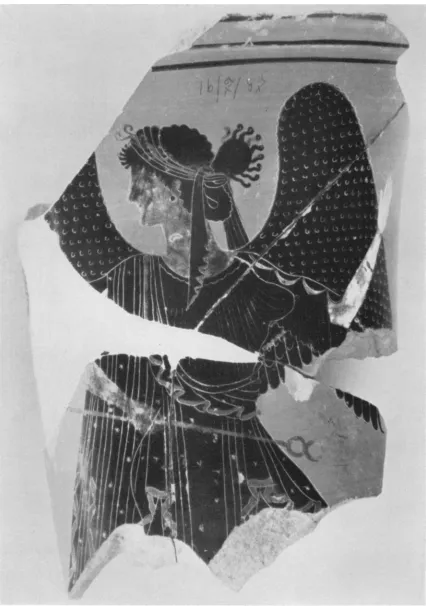
Over ag,ainst the red-figoure Leto of the Vienna amphora we may set a black-figure Iris,' Figure 5, attributed by Professor Beazley to the same painter. This delightful fragment comes, like the Agora pieces, from a large stand, and shows us that not Euthymides only, but at least one other member of his immediate circle, decorated a
js~~~~~~~~~~~~~~~~~~~~~~~~~~'
Fig. 4. Vienna, University. Fragmentary Amphora: Detail (slightly reduced)
vase of just the same shape as his. The form is not a common one in archaic or classical red-figure; of related pieces2 known, no one is preserved complete. We may,
I Eleusis Inv. 1223. Height preserved, 0.22 m. White for the flesh; red for the wreath, the wand, and
the borders of hair-band and hiimation. The fold lines are incised lightly for the chiton, more lheavily for the himation. Inside, at the top, two glazed bands; below, unglazed.
2 Athens, National Museum, Acropolis Collection: B. Graef and E. Langlotz, Die antiken Vasen auis der
Akropolis zu Athen, Berlin, 1933, II, 675, pl. 52; J. D. Beazley, Der Pan-IMaler, Berlin, 1931, 83, pl. 28, 3. Beazley's suggestion that the fragment comes from a stand seems preferable to Langlotz's view that it might have belonged to an incense-burner. Our vase has, however, no trace of any such openings in tile wall as those which characterize this fragment.
Cambridge, Fitzwilliam Museum: C.V.A., Cambridge, III Id, pl.38; Att.V., p.352, 41, the Villa Giuilia painter. TheHague,SchelrtleerCollection: C.V. A.,TheHague 2, I1 Id, pl.4, 4; Att.V., p.421,22, the Kleophon painter.
TN' i Aln
All
N-14
rr,
IfF
- -
-~~~~~~~~~~~~~~~~~~
Fi. 6. less14
however copr_te lc-i'rdsad n fwih'fudlk h rsfamn
atEess silsrae nFgr .O ti ae pe_n lwrrm arwt
I Elcusis Inv. 1244. Heiglht, 0.22 m.; diameter at rim 0.155 m. Artemnis mouinting a clhariot; behiind her,
a man with a spear; behind the horses, Apollo with Ihis lyre; and Dionysos; Hermes leads the way. Red and white freely uised.
Eleusis laiv. 1243 is aniother stand of the same shape decorated with a similar subject. Fori the provenience of these vases see K. Kouirouniotes, " Das eleusinische Heiligtum," Archiv fi4r Religiontsivissenschaft, XXXII, p. 71.
68 LUCY TALCOTT
29 cns o;1i:;zn.
2/ czu oam.
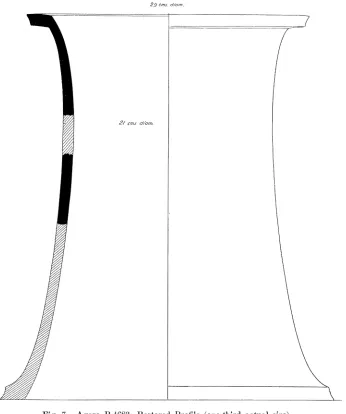
Fig. 7. Agora P 4683: Restored Profile (one-third actual size)
sharp edge. It may be that the Agora stand also had both rims alike, but the vertical face of its upper rim suggests an alternative and in the drawing of the restored profile given in Figure 7 a somewhat more substantial basis is suggested, on the analogy of squatter black-figured stands, in Frankfort and in Toronto.'
We should also compare Athens, National Mtuseum, Inv. 501, from Eleusis: C.V.A., Athens 1, III Hg,
pl. 5, 1-2, a small black-figtured stand on which appear Demeter, Kore and attendants. The prevalence of
tall, polos-shaped stands at Eletisis strengtlhens the possibility, already suggested in connection with the
vase last named, that the shape had a special significance in the worship of the two goddesses.
The tranquil scene of the new vase is remote from those in which Euthymides achieved his most personal and most original successes. Here we have no Theseus, carrying off Korone, no komasts, no discus-throwers or wrestlers, not even the action provided by an arming scene, and notlhing certainly of those " pioneer-studies of movement "I by which Euthymides most strongly iinfluienced the next generation of vase-painters. Our vase is separately significant. By providing Euthymides' version of a thoroughly formal and traditional scene it sets the painter clearly forth in relation both to predecessors and to contemporaries, and enables us to trace an artistic sequence remarkably precise.
rForonito: D. M. Robinson, C. G. Harcum and J. H. Iliffe, A Catalogue of the Greek Vases in the Royal Ontario JMuseum of Ar-chaeology, Toronto, 1930, pl. 27, 284.
I am indebted to Mr. Beazley for calling my attention to the stands of this type. I J. D. Beazley, Greek Vases in Poland, Oxford, 1928, pp. 14, 15.