A Practical Group Authentication Scheme for Smart
Devices in IoT
Anxi Wang
1, Jian Shen
1,*, Leiming Yan
1, Yongjun Ren
1, and Qi Liu
11School of Computer and Software, Nanjing University of Information Science & Technology, Nanjing, China 210044;
[email protected], [email protected]
Abstract
Internet of things (IoT) is used to provide real-time data collection and analysis of the target area by the cooperation of low-cost devices. The authentication towards multiple devices has become the research hot-spot considering of the requirement in real applications. Sensitivity and privacy of data have caused widespread concerns because low-cost devices are neither tamper-proof nor capable of performing public key cryptography efficiently. However, many researchers only focus on the authentication between two devices in the network. They ignore the authentication among group devices attached to one network. In this paper, we propose A Practical Group Authentication Scheme for Smart Devices in IoT. Note that one device group to be authenticated consists of a group of smart devices. The personal digital assistant (PDA) as the group leader controls authentication operations in its group. From the security analysis, our scheme can resist to various attacks. In addition, the performance analysis shows that our scheme has lower computational cost than the existing scheme.
Keywords: Internet of things, group devices authentication, lightweight, practical. Received on 15 June 2018, accepted on 16 July 2018, published on 23July 2018
Copyright © 2018 Anxi Wang et al., licensed to EAI. This is an open access article distributed under the terms of the Creative Commons Attribution licence (http://creativecommons.org/licenses/by/3.0/), which permits unlimited use, distribution and reproduction in any medium so long as the original work is properly cited.
doi: 10.4108/eai.5-3-2019.156719
1. Introduction
Internet of things (IoT) is the reasonable association of physical devices, vehicles, buildings, and other things which are equipped with electronics, software, sensors, actuators and so on. IoT enables these intelligent objects to collect and exchange data [3] [2] [11] for different usages. Nowadays, IoT can be widely used in all walks of life. It can collect the distributed information and connects everything in the world, so applications of IoT mainly includes the following areas: health-care, transport, logistics, smart home, and so on. Note that IoT has very broad application prospects and markets in these areas.*
In IoT, each user can use electronic tags to connect real devices to the network. In the network, users can find one thing's specific location, running state and other
*Corresponding author
environment. In this paper, we pay attention to data security and users' privacy protection by applying identity-based authentication protocol into IoT.
1.1. Related work
In last decades, many security authentication schemes have been proposed for network security [31]. We mainly introduce device authentication schemes in networks here. In [4], Gupta et al. proposed an authentication protocol using elliptic curve cryptography, which can intercept malicious nodes outside the sensor network. However, the protocol uses computationally intensive operations that require huge memory, which may be impractical for resource constrained sensor networks. In [20], Zhang et al. proposed a hierarchical authentication and key management framework for hierarchical wireless networks. However, this solution is implemented between the leader nodes, and there is no authentication method for the common devices in the network. Later, the KDC based authentication scheme was proposed [19], which employs a trusted third party to assist the authentication operations. In [19], two devices agree a pair of keys and store the keys in their database. Note that devices can authenticate themselves so as to generate a session key for data transmission. The drawback of this scheme is the dependence on the trusted third party and the lack of scalability.
The limitation on devices presents big challenges to design secure authentication schemes. Note that ECC [10] achieves high level security with small key size [9] compared with RSA. Using small key size in authentication scheme can achieve higher computation efficiency and save bandwidth, memory and energy. It is obvious that ECC is more suitable for resource limited devices in IoT [7].
1.2. Main Contributions
A user can hold many intelligent devices with the control of a PDA. By collecting and analysing the information from smart devices, the user sends control message to a specified device by PDA to complete the corresponding operation [21].
In this paper, we design a group devices authentication scheme for IoT. The main contributions of this paper are listed as follows:
• We propose an identity-based group devices
authentication scheme. Devices deployed in the same intelligent system form a group. The identity of each device is used into the authentication operation to guarantee the network security before data collection and data analysis stage.
• We design a group conference key agreement
scheme. Through the scheme, a conference key can be generated without consuming large amount of devices' energy resource. The generated key can be
used to guarantee the security during the following data collection operations in IoT.
The rest of the paper is sketched as follows. In Section 2. we discuss some preliminaries. In Section 3, we propose a group authentication scheme to authenticate all devices with a PDA in the network. In Section 4, we provide rigorous security analysis. Then we provide the performance analysis in Section 5. Finally, we conclude this paper in Section 6.
2. Preliminaries
In this section, some necessary preliminaries are introduced, including elliptic curve cryptography, Weil pairing and secret sharing scheme.
2.1. Elliptic Curve Cryptography
In the ECC cryptography system [6], the elliptic curve equation is defined as Ep (a, b): y2 = x3 + ax + b (mod p)
over Fp, where b ∈ Fp, p > 3 and 4a3 + 27b2 (mod p) is not
equal to 0. In general, the security of ECC depends on the following difficult problems [22-26].
• Definition 1 For two different points P and Q over Ep (a, b), the elliptic curve discrete logarithm
problem (ECDLP) [5] is to find an integer s ∈ Fp
such that Q = sP.
•Definition 2 Given three points P, sP and tP over Ep
(a, b) for s, t ∈ Fp, the CDH problem [16] is to find
the point (st)P over Ep (a, b) without knowing s and t
[1].
•Definition 3 G is a generator of G1 and G2 is the
subgroup of Fp2 containing all elements of order q. A
modified Weil pairing is a map e: G1 * G1 = G2. The
properties of the map have been shown in [15].
2.2. Secret sharing
The secret sharing (SS) scheme was proposed by Shamir in 1979 [12] which has been considered as one important tool in information security.
In this paper, we use the SS scheme to accomplish group device authentication. In this subsection, we give an overall review of SS scheme. Note that n users, a server and two algorithms are included. In the generation algorithm, server S selects a random polynomial function f(x) = a0 + a1x + a2x2 + … + at-1xt-1 and sets s = f (0).
Then, users send their public messages xi to S. After getting users' public messages, S computes f(xi) and
returns it to users via a secure channel. In the reconstruction algorithm, each user broadcasts f(xi) to
authentication failed. Security requirements of the SS scheme are as follows:
• Anyone can reconstruct s with t or more than t shares.
• No one can get anything about s with fewer than t shares.
3. Group Devices Authentication
Scheme
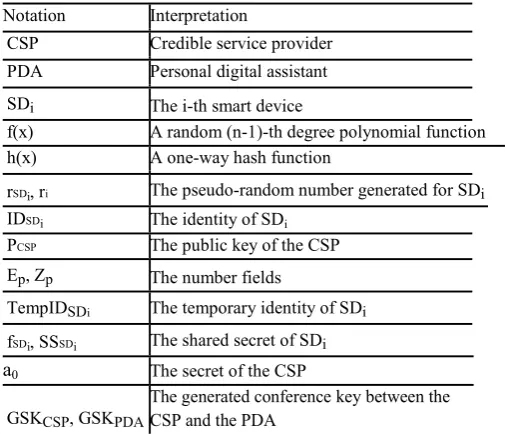
In this section, group devices authentication scheme in IoT is introduced in detail, which is available for multiple lightweight smart devices [30]. Note that smart devices in one group are controlled by a PDA. In our assumption, smart devices in a smart home system have no need to transfer data packages to the credible service provider (CSP). The PDA plays the role of collecting data from devices and uploading to the CSP. Similar to heterogeneous wireless sensor networks (HWSNs), the data upload operation is completed by cluster head nodes [17]. Smart devices communicate with the CSP according to their identities and communicate with the PDA according to their public keys. The CSP gathers secret information from devices and generates the proof by secret sharing scheme. The notations used in our scheme are described in Table 1.
Table 1. Notation used in the group devices authentication scheme
Notation Interpretation
CSP Credible service provider PDA Personal digital assistant SDi The i-th smart device
f(x) A random (n-1)-th degree polynomial function
h(x) A one-way hash function
rSDi, ri The pseudo-random number generated for SDi
IDSDi The identity of SDi
PCSP The public key of the CSP
Ep, Zp The number fields
TempIDSDi The temporary identity of SDi
fSDi, SSSDi The shared secret of SDi
a0 The secret of the CSP
GSKCSP, GSKPDA
The generated conference key between the CSP and the PDA
It is assumed that a large set of group needs to be authenticated where smart devices are assigned in network areas. Moreover, the CSP and the PDA can generate session keys with the help of authorized devices for data uploading.
3.1. Scheme Design
Note that there are n smart devices in our scheme. SD denotes the set of smart devices. Device SDi∈ SD, i = 1,
2, …, n. SDi is registered at the CSP and is controlled by
the PDA to form a group. The polynomial function
𝑓𝑓(𝑥𝑥) =∑𝑛𝑛−1𝑖𝑖=0𝑎𝑎𝑖𝑖∗ 𝑥𝑥𝑖𝑖generated by the CSP is a random (n-1) th degree function. When the input of f(x) is 0, the output is aCSP which is the secret shared by the CSP. Each
smart device obtains a part of aCSP by sending tokens to
the CSP. Note that the authentication operation is executed by the PDA after collecting each device's fSDi.
Here, the group devices authentication scheme can be divided into the initialization phase, device login phase, group authentication phase and key agreement phase. There are three parts involved in our scheme including the CSP, the PDA and devices. In the initialization phase, each part of the system generates necessary information which will be used in the device login phase, group authentication phase and key agreement phase. Then, smart devices will get the shared secret from the CSP in the device login phase. Next, the PDA calculates a0
CSP
from received tokens and compares it with aCSP which is
obtained from the CSP. If two values are equal, the authentication phase is successful. Otherwise, the PDA will run adversary detection operation. At last, the PDA and the CSP generate a session key for data uploading with the help of smart devices.
Initial Phase: The initial phase is done by the CSP, the PDA and SD as follows. SDi selects a random number xi
in a finite field GF (p). Then, SDi sends {IDSDi, xi} to the
CSP. The CSP selects an elliptic curve Ep over Zp, p being
a large prime. Then, the CSP selects a base point P of order d over Ep such that d * P = O. The CSP also chooses
its private key rCSP and computes the corresponding public
key PCSP = rCSP * P. Note that the CSP selects a
polynomial function of (n – 1)-degree function: 𝑓𝑓(𝑥𝑥) = ∑𝑛𝑛−1𝑖𝑖=0𝑎𝑎𝑖𝑖∗ 𝑥𝑥𝑖𝑖 (mod) p. A collision-resistant one-way cryptographic hash function h () is selected by the CSP too. The PDA generates the private key rPDA and
computes the public key as PP DA = rPDA* P. An encrypt
function Encry () and a decrypt function Decry () are selected by the CSP. At the end of this phase, the CSP broadcasts {p, GF (p), Ep, Zp, P, PCSP, h (), Encry (),
Decry ()} to each participant in the system.
Device Login Phase: In this phase, smart devices register after exchanging messages with the CSP. The PDA needs to collect information from all devices to authenticate devices. Here, n devices are registered at the CSP and are assigned into one group by the PDA. If one device does not provide the right part of the shared secret, the authentication scheme cannot pass. As a consequent, the PDA and CSP cannot get the same session key and the adversity detection operation will be performed by the PDA. The device login phase is introduced as follows:
• SDi randomly selects two numbers rSDi and xi for
itself. Then SDi encrypts xi to obtain xSDi = Encry (xi,
= rSDi P. Then SDi delivers (IDSDi, xSDi) to the CSP
via a public channel and broadcasts PSDi to other
devices.
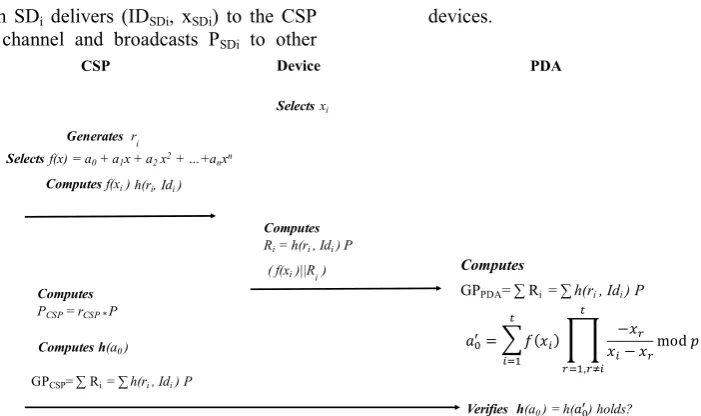
Figure 1. Group authentication phase of the authentication scheme
The CSP generates a random number ri for SDi and
stores (IDSDi, ri) locally. Then, the CSP calculates xi
by the private key rCSP according to xi = Decry (xSDi,
rCSP). After getting xi, the CSP takes xi as the input of
f(x) and gets f(xi). To avoid exposing the shared
secret, the CSP encrypts f(xi) by fSDi = Encry(f(xi),
PSDi). In addition, the secret is aCSP = f (0) = a0.
Finally, the CSP sends (fSDi, h (ri, IDSDi)) to SDi and
delivers h (aCSP) to the PDA for authentication. After
this step, each device obtains the shared secret and necessary information for the following steps.
• SDi computes RSDi = h (ri, IDSDi) * P and acquires
f(xi) from fSDi by its own private key rSDi. SDi stores
{IDSDi, f(xi)} in its own database for special
circumstances. Then, SDi calculates SSSDi = Encry
(f(xi), PPDA) and sends (SSSDi, RSDi) to PDA via a
public channel.
Group Authentication Phase: The main task of this phase is completed by the CSP and the PDA with unconstrained resource. This phase plays the most important role in the whole scheme. The PDA gathers shared secrets from devices and authenticates devices by comparing with h (aCSP). Instead of using devices’ real
IDs, we use the temporary identity TempIDSDi = h (ri,
IDSDi) which is the hash value of a random number ri and
the real IDSDi. The TempIDSDi of device SDi is obtained
from the CSP at the login phase and transferred to the PDA by SDi at the beginning of the group authentication
phase, which provides strong resistance to the tracing problem on smart devices. In addition, the random number ri is selected by the CSP and will be upgraded at
the next round. In this phase, when devices make no response. the PDA will wait until the timer expires. If the PDA does not receive enough shared secret parts from
devices, the PDA will send some empty packets to the CSP to get enough parts of shared secret, which makes the authentication scheme more efficient. Note that the number of empty devices is less than n - 1. The main steps of the group authentication phase are shown as follows:
• After receiving (SSSDi, RSDi) from each device, the
PDA computes group devices key by aggregating RSDi(𝐺𝐺𝐺𝐺𝑃𝑃𝐷𝐷𝐴𝐴 = ∑𝑛𝑛𝑖𝑖=1𝑅𝑅𝑆𝑆𝐷𝐷𝑖𝑖= ∑𝑖𝑖=1𝑛𝑛 ℎ�𝑟𝑟𝑖𝑖, 𝐼𝐼𝐼𝐼𝑆𝑆𝐷𝐷𝑖𝑖� ∗ 𝐺𝐺).
•Then, the PDA resolves f(xi) from SSSDi. After
getting enough parts of shared secrets, the PDA uses Lagrange interpolation method to calculate 𝑎𝑎0′ =
∑𝑛𝑛𝑖𝑖=1𝑓𝑓(𝑥𝑥𝑖𝑖) ∏𝑛𝑛𝑟𝑟=1,𝑟𝑟≠𝑖𝑖𝑥𝑥𝑖𝑖−𝑥𝑥𝑟𝑟−𝑥𝑥𝑟𝑟 𝑚𝑚𝑚𝑚𝑚𝑚𝑝𝑝.
•At last, the PDA compares ℎ(𝑎𝑎0′) with h(aCSP). If ℎ(𝑎𝑎0′) and h(aCSP) are equal, all devices pass the
authentication scheme. In addition, the group session key between the CSP and the PDA will be computed if the authentication scheme succeeds.
Key Agreement Phase: In the key agreement phase, the generated random number of ri as well as sequence
numbers of all devices in IoT are covered into the group session key. The CSP computes
𝐺𝐺𝐺𝐺𝐶𝐶𝑆𝑆𝑃𝑃= ∑𝑛𝑛𝑖𝑖=1ℎ�𝑟𝑟𝑖𝑖,𝐼𝐼𝐼𝐼𝑆𝑆𝐷𝐷𝑖𝑖� ∗ 𝐺𝐺 by itself. The PDA
aggregates all
devices’ information to compute GPPDA which has been
introduced in step 1 of the group authentication phase. The group session key is used to guarantee secure data uploading for the CSP and the PDA. The CSP computes
𝐺𝐺𝐺𝐺𝐺𝐺𝐶𝐶𝑆𝑆𝑃𝑃=𝑒𝑒�𝑎𝑎𝐶𝐶𝑆𝑆𝑃𝑃∗ 𝐺𝐺,𝐺𝐺𝐺𝐺𝐶𝐶𝑆𝑆𝑝𝑝�
=𝑒𝑒(𝐺𝐺,𝐺𝐺) 𝑎𝑎𝐶𝐶𝐶𝐶𝐶𝐶∗∑𝑛𝑛𝑖𝑖=1ℎ(𝑟𝑟𝑖𝑖,𝐼𝐼𝐷𝐷𝐶𝐶𝑆𝑆𝑖𝑖)
and the PDA calculates
𝐺𝐺𝐺𝐺𝐺𝐺𝑃𝑃𝐷𝐷𝐴𝐴=𝑒𝑒(𝑎𝑎0′ ∗ 𝐺𝐺,𝐺𝐺𝐺𝐺𝑃𝑃𝐷𝐷𝐴𝐴) =𝑒𝑒(𝐺𝐺,𝐺𝐺)𝑎𝑎0 ′∗∑ ℎ(𝑟𝑟
𝑖𝑖,𝐼𝐼𝐷𝐷𝐶𝐶𝑆𝑆𝑖𝑖) 𝑛𝑛
𝑖𝑖=1 .
It is obvious that GSKCSP and GSKPDA are equal if the
shared secret is equal in each side.
4. Security Analysis
In this section, some security properties of our scheme are analysed. Our scheme can resist various attacks, such as replay attack, eavesdropping attack, physical attack, man-in-the middle attack, and so on. Moreover, the scheme can also be used to track devices. The PDA controls and monitors the entire network changes in the authentication process.
• Replay Attack. In our scheme, replay attack is prevented by the selected pseudo-random numbers
rSDi and xi. In the device login phase, rSDi and xi are
all selected by the smart device itself. The information communicated between the PDA and the device is protected by the random numbers. In the next authentication round, the device will change the value of rSDi and xi, so replay attack is prevented
[27].
• Eavesdropping. The identity of the smart device and
the secrets are encrypted during communication. Public key encryption is used to protect the communication between the device and the CSP. So, the proposed scheme can resist to eavesdropping.
• Physical Attack. The smart device may be stolen by the adversary and all stored information can be exposed to the adversary. In this case, the PDA can still accomplish the authentication without the stolen
device, since the SS scheme can guarantee the
authentication with disable devices in the group. The
adversary cannot interrupt the authentication operation unless it corrupts all the devices. This is difficult and worthless. Note that the PDA is assumed to be well protected. Physical attacks to the PDA are not taken into consideration in our scheme [28].
•Man-In-The-Middle Attack. Even if the
communicated message sent by the device is blocked, the adversary cannot get xi and private key
together owing to the public key encryption
technology. The PDA will ask for message from other devices after a period time, and the authentication process can be operated without the blocked message. Hence, this attack is prevented by our design [29].
•De-Synchronization Attack. Devices’ real IDs are
hidden, and random numbers are used to substitute real IDs in our scheme. The stored real ID in the device needs no update. If the information between the CSP and devices is not synchronized, the authentication operation will not succeed. Hence, smart devices in IoT are prevented from
de-synchronization attack according to our design.
5. Performance Analysis
In this section, the performance of the proposed scheme
is analysed and simulated compared with b-SPECS scheme [8]. Simulation result shows that our scheme is more lightweight and practical.
According to the design of the group devices authentication scheme, each device receives messages from the CSP and sends messages to the PDA. After receiving these messages, the devices perform necessary operations including addition, pairing computation, point multiplication and so on. For the convenience of evaluating the total computational cost, we let TH, TAO,
TPC, TPM be the time cost of implementing a hash
function, an addition operation, a modified Weil pairing
and an elliptic curve point multiplication. As described in Section 3, the total computational cost in our group authentication scheme is 2TH + 2TPC + TPM + 3TAO. The
comparison between our scheme and b-SPECS scheme is shown in TABLE 2.
The performance of our scheme is simulated by using C programming language with the Pairing-Based Cryptography (PBC) library on Ubuntu OS with Intel Core Xeon E5-2650M processors running at 2.60 GHz and 8 G memory, Ubuntu 14.04 X64. From the simulation result, the time required to perform a hash function, a pairing computation, a point multiplication,
Protocol Properties Computational Cost Round Device Authentication
b-SPECS [8]
3TH + 2TP C + 6TP M +
1TAO 3 yes
Our scheme
2TH + 2TP C + 2TP M +
3TAO 2 yes
and an addition is approximately 8.065 (ms), 2.067 (ms), 3.069 (ms) and 0.016 (ms). The total time cost of each user in our scheme is 2 * 8.065 + 2 * 2.667 + 2 * 3.069 + 3 * 0.016 = 27.65 (ms). Similarly, the total cost in b-SPECS can be computed as 46.779 (ms).
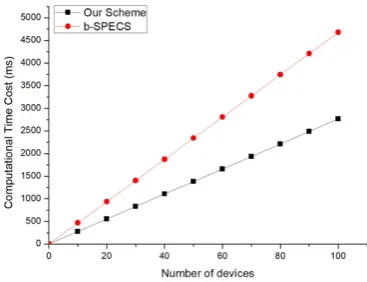
The CSP and the PDA are the trusted third parts which do not consume resources from the smart devices. Therefore, the computational cost consumed by the CSP and the PDA are not taken into consideration. Figure. 2 shows that the computational cost increases as the number of devices increases. It is obvious that the computational cost in our scheme is lower than that in b-SPECS in different number of devices.
Figure 2. Computational cost in different number of users
6 Conclusion
Deploying multiple devices in one group can not only increase the authentication success rate, but also increase the chance for accurate positioning, which satisfies the real application requirements. In this paper, an identity-based group devices authentication scheme is proposed. The authentication scheme is based on the SS scheme, which can efficiently assist the PDA to authenticate the group devices. In addition, an efficient conference key agreement scheme is designed to guarantee the security of data uploading between the PDA and the CSP. The security and performance analysis show the better performance of our scheme compared with the existing scheme.
Acknowledgments.
This work is supported by the National Natural Science Foundation of China under Grant No. U1836115, No. 61672295, and No. 61672290, the Natural Science Foundation of Jiangsu Province under Grant No. BK20181408, the State Key Laboratory of Cryptology Foundation, the CICAEET fund, and the PAPD fund.
References
[1] Dan, B., Franklin, M. (2001) Identity-Based Encryption from the Weil Pairing. Society for Industrial and Applied Mathematics.
[2] Daz, M., Martn, C., Rubio, B. (2016) State-of-the-art, challenges, and open issues in the integration of internet of things and cloud computing. Journal of Network and Computer Applications 67(C), 99-117. [3] Floerkemeier, C., Langheinrich, M., Fleisch, E.,
Mattern, F., Sarma, S.E. (2017) The internet of things. Electronics World 297(6), 949-955.
[4] Gupta, S., Verma, H.K., Sangal, A.L. (2013) Security attacks and prerequisite for wireless sensor networks. International Journal of Engineering and Advanced Technology (5), 558-566.
[5] Gura, N., Patel, A., Wander, A., Eberle, H., Shantz, S.C. (2004) Comparing elliptic curve cryptography and RSA on 8-bit CPUs. In: CHES. vol. 4, pp. 119-132. Springer.
[6] Hankerson, D., Menezes, A.J., Vanstone, S. (2006) Guide to elliptic curve cryptography. Springer Science & Business Media
[7] Hassan, A., Iqbal, U. (2016) Authentication protocols for WSN using ECC and hidden generator. International Journal of Computer Applications 133. [8] Horng, S.J., Tzeng, S.F., Pan, Y., Fan, P., Wang, X.,
Li, T., Khan, M.K. (2013) b-specs+: Batch verification for secure pseudonymous authentication in VANET. IEEE Transactions on Information Forensics and Security 8(11), 1860-1875.
[9] Kumar, S.N. (2015) Review on network security and cryptography. International Transaction of Electrical and Computer Engineers System.
[10] Lu, M. (2012) Study on secret key management project of WSN based on ECC. Journal of Networks 7(4).
[11] Misra, S., Maheswaran, M., Hashmi, S. (2016) Securing the internet of things. Computer Fraud and Security 2016(4), 15-20.
[12] Shamir, A. (1979) How to share a secret. ACM. [13] Shen, J., Liu, D., Liu, Q., Sun, X., Zhang, Y. (2017)
[14] Chen, X., Li, J., Huang, X., Ma, J., & Lou, W. (2015). New publicly verifiable databases with efficient updates. IEEE Transactions on Dependable and Secure Computing, 12(5), 546-556.
[15] Shen, J., Wang, A., Wang, C., Li, J., Zhang, Y. (2017) Content-centric group user authentication for secure social networks. IEEE Transactions on Emerging Topics in Computing.
[16] Shparlinski, I. (2011) Computational diffie-hellman problem. In: Encyclopedia of Cryptography and Security, pp. 240-244. Springer.
[17] Wang, A., Pan, S., Wang, C., Shen, J., Liu, D. (2017) A novel clustering solution for wireless sensor networks. In: International Conference on Green, Pervasive, and Cloud Computing. pp. 313-322. [18] Wang, Z., Karpovsky, M., Bu, L. (2016) Design of
reliable and secure devices realizing shamir’s secret sharing. IEEE Transactions on Computers, 65(8), 2443-2455.
[19] Tang, S., Xu, L., Liu, N., Huang, X., Ding, J., Yang, Z. (2014). Provably secure group key management approach based upon hyper-sphere. IEEE Transactions on Parallel & Distributed Systems, (12), 3253-326. [20] Zhang, J., Shankaran, R., Orgun, M.A., Sattar, A.,
Varadharajan, V.: A Dynamic Authentication Scheme for Hierarchical Wireless Sensor Networks (2012) [21] Shen, J., Wang, A., Yan, L., Ren, Y., Liu, Q. (2018).
Identity-Based Group Devices Authentication Scheme for Internet of Things. In Proceedings of the 11th EAI International Conference on Mobile Multimedia Communications (pp. 45-55).
[22] Zhou, T., Shen, J., Li, X., Wang, C., Tan, H. (2018). Logarithmic encryption scheme for cyber–physical systems employing Fibonacci Q-matrix. Future Generation Computer Systems.
[23] Shen, J., Wang, C., Ji, S., Zhou, T., Yang, H. (2018). Secure Emergent Data Protection Scheme for a Space-Terrestrial Integrated Network. IEEE Network, 33(1), 44-50.
[24] Liu, D., Shen, J., Wang, A., Wang, C. (2018). Lightweight and practical node clustering authentication protocol for hierarchical wireless sensor networks. International Journal of Sensor Networks, 27(2), 95-102.
[25] Zhou, T., Shen, J., Li, X., Wang, C., Shen, J. (2018). Quantum Cryptography for the Future Internet and the Security Analysis. Security and Communication Networks, 2018.
[26] Shen, J., Wang, A., Wang, C., Hung, P. C., Lai, C. F. (2017). An Efficient Centroid-Based Routing Protocol for Energy Management in WSN-Assisted IoT. IEEE Access, 5, 18469-18479.
[27] Shen, J., Wang, A., Wang, C., Xiong, N. N. (2017). A RFID based localization algorithm applying trilateration for wireless sensor networks. Journal of Internet Technology, 18(5), 1167-1175.
[28] Wang, C., Zheng, W., Ji, S., Liu, Q., Wang, A. (2018). Identity-Based Fast Authentication Scheme for Smart Mobile Devices in Body Area Networks. Wireless Communications and Mobile Computing, 2018. [29] Li, X., Tang, S., Xu, L., Wang, H., Chen, J. (2017).
Two-factor data access control with efficient revocation for multi-authority cloud storage systems. IEEE Access, 5, 393-405.
[30] Shen, J., Yang, H., Wang, A., Zhou, T., Wang, C. (2018). Lightweight authentication and matrix-based
key agreement scheme for healthcare in fog computing. Peer-to-Peer Networking and Applications, 1-10.