©2014 JNAS Journal-2014-3-6/600-608 ISSN 2322-5149 ©2014 JNAS
Training Facilities in Using Educational
Technology- a Meta-analysis
Marzieh Ghobadi Pour
Research Scholar, the University of Mysore, India
Corresponding author:
Marzieh Ghobadi Pour
ABSTRACT: Through meta-analysis, this study analyzes the relationship between the Lack of Necessary and Appropriate Training Facilities and the non-use of Educational Technology by Teachers of Schools and Universities in Iran. An extensive search for relevant published and unpublished studies carried out and found 51 studies on Obstacles in Using Educational Technology in the process of teaching and learning in the Education Systems of Iran from 1993 to 2009. 19 research studies with inferential statistics were chosen. The results indicated that the Lack of Necessary and Appropriate Training Facilities had a lot of influences on not using Educational Technology by Teachers of Schools and Universities and it was a big obstacle for using it.
Keywords: Meta-analysis, educational / instructional technology, training facilities/equipment, barrier/obstacle.
INTRODUCTION
One of the learning theories is constructivism. Rorty (1991) announced that constructivism is a philosophical view on how we come to understand or know. Resnick (1989) explained constructivists believe that learning is constructing knowledge from one’s experiences rather than directly receiving information from the outside world. Constructivism refers to a learning approach that emphasizes the importance of experiential exploratory learning. It evolved from the writings of Piaget and Bruner who together focused on the relevance of direct meaningful knowledge construction through experience of the world (Collins & Green, 1992).
ICTs fit to realize and implement the emerging pedagogy of constructivism (Davis, 1997cited in Mikre, 2012). The constructivist approach considers learning as authentic and learner centred. ICT is a great help in the constructivist approach, where one can design simulated and individualized learning environments to students. Educational Technology /ICT makes the learning less abstract and more relevant to their life situations. Creative learning ICT-enhanced learning is student-directed and diagnostic. Educational Technology/ ICT in education is so brilliant. Educational Technology /ICT brings a lot of differences in the teaching – learning process, facilitates learning more active, integrative, creative, collaborative, and evaluative in comparison to the last learning methods. As cited in Yusuf (2005) ICTs have the potential to accelerate, enrich, and deepen skills to motivate and engage students, to help relate school experience to work practices, create economic viability for tomorrow's workers, as well as strengthening teaching and helping schools change.
601
Communication Technology (ICT), and the purchases of computers for school use in such countries as the United States of America has been increasing in such a pace that is difficult to keep track of how many computer machines are now in American Schools.And another survey was reported by Becker (1986) on the instructional uses of computers in United States public and private schools suggested that over one million computers were in American elementary and secondary schools and those more than fifteen million students used them during 1985. The report also says that more than half-a-million teachers used computers for instructional purposes during the same period and half of American secondary schools owed at least 15 computers each.
This story is the same in European countries. Their methods have common features. computer and data projector in each class (for teacher use)
classes equipped with smart boards
establishment of, at least, an information technology class (for the use of students in a room separate from the class; 15 computers, which can be allocated for the courses other than informatics technologies courses.) also establishment of classrooms with more than one computer to be used in courses other than informatics
technologies courses.
teachers and students are given laptop computers for individual use.
Iran as a developing country is going to improve ICT/Educational Technology. The information and communication technology application program (TAKFA) is the most important policy initiative for Iran. Its mission is to foster the development of knowledge based economy by achieving the following objectives:
o Creating infrastructure (network, law and security) for Iran’s information and communications development.
o Compiling and applying a comprehensive system of communications and information. o Developing productive employment.
o Promoting the development of ICT skills at both individual and institutional levels. o Implementing flagship projects.
The main activities of TAKTA that will affect education are:
The application of ICT in schools and workforce development (at primary and secondary schools as well as vocational training institutes).
The application of ICT in higher education (medicine, engineering, social science, arts, etc.).
The development of ICT in cultural issues (Farsi writing and usage, art, culture, etc.) (Sadeghnezhad, 2003).
Abedi, Kaffash, Talesh, (2011) wrote from different Iranian sources that there has been a concerted effort to promote the use of computers in Iranian schools; reports have extolled the virtues of using Information and Communication Technology in classrooms. Statistics showed that the number of computers at schools have a little increased regularly since 1998. In 1980, only one computer would be found in every secondary school, two years later there were 4. In 2003, the average number of pupils per computer in the secondary schools was 8. At present, there are nearly thirty major hardware and software initiatives: from initial computer and printer purchase to various laptops, CD Rom and Independent learning schemes leading to the launch of the national electronic network for schools, providing individual access to all staff and pupils to network. This information is general and it is not a range of curriculum and teacher training directives. However Iranian schools just began to introduce the use of ICT across the curriculum following the release of the ICT in its education strategy plan in 1998.
Nowadays, schools and universities should be equipped with some facilities and technical equipments of Information and communication technology such as computer including hardware and software such as word processor program (MS Word), calculation and table program (MS Excel), presentation preparing program (MS PowerPoint),telephone, fax, data projector, internet and web-based tools with audio-visual contents and animations, width of band, mobile [mobile Internet unit (MIU)], smart board, flash discs, slide shows, writer, scanner, electricity, IWBs, etc.
602
There are a few barriers in applying Educational Technology. Ertmer (1999) divides the barriers into two main categories: first-order and second-order barriers:1) First-order barriers refer to those obstacles concerning essentially different types of resources (e.g., equipment, time, training, support), which are extrinsic to teachers. Lack of adequate resources is a constraining barrier to any integration effort. If teachers do not have sufficient equipment, time, training, or support, it will be very difficult to achieve a meaningful integration.
2) The second - order barriers relate to teachers' underlying beliefs about teaching and learning, teacher-student roles, curricular emphases, assessment practices, etc. (p.59).
Other important obstacles are the difficulties to access the ICT-based teaching software and materials (Tasci, Yaman , & Soran , 2010). The findings of many studies show that the facilities of ICT equipment at schools and particularly in classrooms environment, significantly affect the use of ICT-based methods and materials by teachers in their teaching practices and that issues related to ICT equipment is the most important determiner of integration of ICT into teaching practice. Teachers rarely use ICT equipment when they in some other room at school, rather than the classroom. Apart from the lack of ICT equipment, frequent breakdowns of the equipment and lack of internet connection in the classroom are other important physical factors affecting teachers’ practices (Unal & Ozturk, 2012). Rezaiee (2009) surveyed the barriers of development of e-learning in Agriculture High Education in perspective of students. This study noted the lack of necessary and appropriate training facilities as obstacle in using Educational Technology. Mashaiekhi (2006) administered the deterring factors of teachers in using Educational Technology in the teaching-learning process in view of elementary school teachers in Mazandaran province. Two of obstacles were: The Lack of Necessary and Appropriate Training Facilities & Equipment; and they were used to apply traditional methods because of their simplicity. Lashkari (2003) evaluated the barriers in using Educational Technology application and evaluation of existing facilities in view of elementary school administrators and teachers. The results showed the lack of computer equipments, access to the Internet, necessary and appropriate training facilities at schools as one of obstacles. Farahani Vasheghani (1995) analyzed the barriers in using Educational Technology in the teaching – learning process in view of elementary school teachers in Arak city. This study specified obstacles as the Lack of Necessary and Appropriate Training Facilities (such as soft ware, internet…) and the lack of educational space.
In present paper, theoretical framework is constructivism. This paper gets main information of lots of studies and how we come to understand or know from them (Rorty, 1991) and believes that learning of other studies is constructing knowledge from one’s experiences rather than directly receiving information from the outside world (Resnick, 1989). In spite of research studies in the past decades that have shown Educational Technology is an effective means for increasing educational opportunities and lots of affairs that different organizations in Iran do, but there are many studies on using Educational Technology that they showed that the Lack of Facilities are obstacles in using Educational Technology by most of schools’ and universities’ teachers in Iran. For getting the main and general conclusion from these individual studies, this paper has designed through meta-analysis to find the relationship between the Lack of Necessary and Appropriate Training Facilities and the non-use of Educational Technology by teachers of Schools and Universities in Iran.
Objective of the study
To analyze the relationship between the Lack of Necessary and Appropriate Training Facilities and the non-use of Educational Technology by Teachers of Schools and Universities
Hypothesis
There is no significant relationship between the Lack of Necessary and Appropriate Training Facilities and the non-use of Educational Technology by Teachers of Schools and Universities
Population and sampling
603
MATERIALS AND METHODSDesign and Methodology
The present study is a quantitative review study (providing a report of primary research using statistical methodology) which is analytical in nature and involved the method of meta-analysis. As in primary research, a meta-analysis begins with a well-formulated question and design; meta-analysis is the statistical analysis of a large collection of analysis results of different studies for the purpose of integrating the findings (Glass, 1976) and draw conclusions.
The basic purpose of meta-analysis is to provide the same methodological rigor to a literature review that we require for an experimental research. By far, the most common use of meta-analysis has been in quantitative literature reviews. These are review articles or studies where the authors select a research finding or an effect that has been investigated in primary research under a large number of different circumstances. They then use meta-analysis to help them describe the overall strength of the effect, and under what circumstances it is stronger and weaker.
Methodology used in this research is based on the steps and process of Howitt and Cramer’s meta-analysis (2000):
Define the Variables of the Study
In this stage, the research variables were chosen in relation to the subject of the research. In the present research, after preliminary review of studies in the field of Educational Technology and discussion with certain experts as well as experienced teachers in the field, based on the common observation of the investigator as a teacher, the present variable was identified Lack of Necessary and Appropriate Training Facilities, which is assumed to be influencing teachers of Schools and Universities not to use Educational Technology in teaching-learning process was identified as independent variable and the non-use of Educational Technology was considered as dependent variable, which is major focus of the research.
Plan the database search
The researcherplanned the database searchand prepared preliminary list of studies
related to the topic through the available resources. The researcher planned the search for more number of relevant studies involving the chosen variables. In order to collect data and suitable studies for this research, the researcher went to the following sources* and prepared the preliminary list of 51 studies reported during 1993-2009 related to the selected topic: The Obstacles in Using Educational Technology in the Education Systems of Iran
* Sources:
o visited Research Centers like the Institute of Education Ministry of Education and National Libraries. o visited anumber of universities including Tehran, Isfahan, Allameh Tabatabai, Tarbiat Modarres,
Khorasgan Islamic Azad University, Najaf Abad Islamic Azad University, Teacher Training centers, etc. o searched different websites like http://www.irandoc, http://www.magiran.com, http://en.wikipedia.org/wiki.
http://http:/trc.isfedu.org, http://www.roshdmag.ir, http://www.google.com. o referred the list of studies conducted in other province research centers.
o referred the journals related to the topic like Journal of Literacy Research, Asian Journal of Communication, Journal of Organizational Computing and Electronic Commerce, Journal of Criminal Justice Education. o used the site of Training Institute, databases, indexed list and CDs like database of university of Mysore,
database of different countries.
Obtain research reports and select the studies for analysis
The researcher obtained copies of research reports of all the listed 51 studies, reviewed them in detail and selected 19 studies with inferential statistics for analyses of data (required condition for meta-analysis). The list of all the studies selected was prepared with name of the researcher, year of research and title of the research.
Subject to statistical analysis
Then the selected 19 studies were subjected of statistical analysis, which again is based on the steps of Howitt and Cramer’ meta-analysis (2000). In order to get supported for the consolidated finding of meta-analysis and also to know the details about the variable regarding it influence the non-use of Educational Technology by teachers, an informal interview was.
Calculation of Effect Sizes and Comparison
604
Calculated of Effect Size and z fisher was prepared in chronological order and is presented in table 1. The Effect Sizes of all the 19 studies were combined to get a Composite Effect Size. For this purpose, each effect size (r) was converted into a z – fisher (z r) for the correlation coefficient using table 32.5 (Howitt & Cramer, 2000, p. 387) and the average of all the 19 z-fisher was found out. This average (0.50) was then turned back into Combined Effect Size by using same table 32.5 in the reverse mode, and it was found to be r =0.806 (r).Table1. The characteristics of the done researches on Obstacles in Using Educational Technology in educational systems in Iran
Research code
Name
of researcher The title of research
The year of research The sample size Effect size formula Effect size zr (Z fisher) 1 Parviz
Mashaiekhi
The survey of factors prevent the use of Educational Technology in Elementary school in teaching-learning process in view of teachers in Mazandaran state
1993 945 r =𝑧
√𝑛 0.07 0.07
2 Mashaala Farahani Vasheghani
The survey of obstacle to use Educational Technology in Teaching -learning Process from the perspective of guidance school teachers in Arak
1994 120 r =𝑧
√𝑛 0.15 0.1
3
Ashraf Mirheidari
Obstacles of using Educational
Technology in the learning- teaching process from the perspective of teachers of Educational new system of high school in Isfahan in the year 1996-97
1997 300 r =
√ 𝑡2
𝑡2+𝑑𝑓
0.40 0.42
4 Nasrin Mirdamadi
Obstacles to utilization of Educational Technology in the process of teaching-learning in views of primary school teachers in Isfahan in 1997-1998
1998 330 r =𝑧
√𝑛 0.13 0.13
5 Ghodrate Haji hosseinlo
The survey of obstacles for using Educational Technology in teaching- learning process from the perspective of Khoy city Elementary teachers
1999 170
r =√𝑥2
n
0.26 0.26
6 Hassan Abdolahi Mehr
The survey of obstacles for using Educational Technology in the process of teaching-learning process in the perspective of teachers in Qom , 1 district
2001 648
r = √𝑥2
n
0.36 0.36
7 Reihaneh Baradaran
The survey and identify obstacles of using Educational Technology aids from the perspective of principals in the Girl high schools in Tehran
2002 100
r = √𝑥2
n
0.38 0.40
8 Mossa Piri
Technological obstacles of Educational Technology in the process of teaching - learning
from the perspective of high school teachers in West Azarbaijan province 1998-99
2003 265
r = √𝑥2
n
0.14 0.14
9 Hossein Lashkari
The survey on the amount of use & the obstacles in using Educational Technology application and evaluation of existing facilities in view of elementary school teachers and administrators
2003 180 r =
√ 𝑡2
𝑡2+𝑑𝑓
0.23 0.23
10 Toran Soleimani
The survey of obstacles in the use of Educational Technology in teaching-learning process from the perspective of guidance school teachers in Ardebil city
2003 165
r = √𝑥2
n
0.80 1.09
11 Mansor Kazemzadeh
The survey of obstacles in using Educational Technology in view of teachers in high school in Tehran city
2003 350 r =
√𝑥2 n
0.65 0.77
12 Fatemeh Soghra Dadpour
The survey of obstacles in using Educational Technology in
teaching - learning process from the perspective of high school teachers in Ghaemshahr city
2004 240 r =
√𝑥2 n
0.74 0.95
13 Hassan Pourjavadi
The survey of obstacles for using Educational Technology in the process of teaching-learning process in the perspective of guidance school teachers in Tabriz
2004 759 r =
√𝑥
2
n
0.691 0.84
14 Marzieh Taghvaee
The survey of obstacles for using Educational Technology in the process of virtual teaching in the perspective of high school teachers in Tehran
2005 335 r =
√𝑥2 n
0.08 1.40
15 Masood Samiee
The survey of obstacles in establishing the virtual teaching system in view of teachers
2005 239 r =
√𝑥2 n
605
16 YazdenMoradi
The survey of obstacles of entrepreneurial attitudes of computer students in Tehran applications University
2007 319 r =
√𝑥
2
n
0.385 0.77
17 Neda Sheikh Sadeghi
The amount of the use and obstacles in using Educational Technology and the survey of existing facilities in
Exceptional schools in Isfahan
2007 160 r =
√𝑥2 n
0.42 0.44
18 Mehdi Karimi
The survey of prospects of applying information and communication technology in the process of teaching - Learning at the universities of Isfahan and Isfahan Sanati University
2007 245 r =
√ 𝑡2
𝑡2+𝑑𝑓
0.65 0.77
19 Masoud Rezaie
The survey of obstacles the development e-learning in agricultural higher education in the perspective of students
2009 120 r =
𝑧 √𝑛
0.14 0.14
Average 0.806 0.50
The Significance of the Combined Studies
Hypothesis was tested by considering the probability value for the combined effect size for all the 19 studies considered for the research. For this purpose, the corresponding z score for the given probability (p) value of each study considered for the research was taken from the table 32.4 (Howitt & Cramer, 2000, p.386). Then, the average of all the 19 z score was calculated using the formula z =∑ 𝑧
√𝑛 and the corresponding p value for this average was
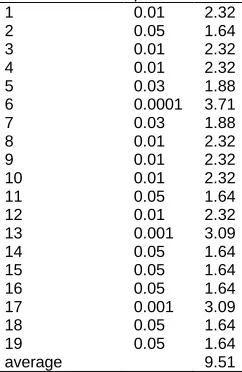
noted as the significance level .The corresponding details are presented in table 2. This table shows that the average of Z score is 9.51 that it's corresponding to p = 0/00001.
considered for the research
Table 2.Calculation of the significance level of all the19 studies
Research code p z 1 0.01 2.32 2 0.05 1.64 3 0.01 2.32 4 0.01 2.32 5 0.03 1.88 6 0.0001 3.71 7 0.03 1.88 8 0.01 2.32 9 0.01 2.32 10 0.01 2.32 11 0.05 1.64 12 0.01 2.32 13 0.001 3.09 14 0.05 1.64 15 0.05 1.64 16 0.05 1.64 17 0.001 3.09 18 0.05 1.64 19 0.05 1.64 average 9.51
Testing of hypothesis
There is no significant relationship between the Lack of Necessary and Appropriate Training Facilities and the non-use of Educational Technology by Teachers of Schools and Universities
Table 3: Analyzing the effect size of forth hypothesis
Statistic Indicator Independent
Hypothesis
N
The number of
hypothesis
The average of effect size
(E Zr)
P
There is no significant relationship between the Lack
of Necessary and A propriate Training Facilities and the non-use of Educational Technology by Teachers of Schools and Universities
606
According to table 3, the hypothesis was rejected as the combined effect size (0.806) of all the 19 studies was found to be significant at 0.00001 level (Cohen's table). Hence, it was concluded that the non-use of Educational Technology in teaching-learning process is significantly related to the Necessary and Appropriate Training Facilities. In other words, it is said that, the lack of Necessary and Appropriate Training Facilities to Use Educational Technology in the classroom transaction had significantly influenced Teachers of Schools and Universities not to use Educational Technology in teaching-learning proces.CONCLUSION
The conclusion that there is a significant correlation between the Lack of Necessary and Appropriate Training Facilities and the non-use of Educational Technology or ICT in the classes by teachers of schools and universities is on par with the results of studies by Farahani Vasheghani (1995), Mirheidari (1997), Mirdamadi (1998), Haji Hosseinlo (1999), Abdolahi Mehr (2001), Baradaran (2002), Piri (2003), Lashkari (2003), Soleimani (2003), Kazemzadeh (2003), Dadpour (2004), Pourjavadi (2004), Taghvaee (2005), Samiee (2005), Mashaiekhi (2006), Moradi (2007), SheikhSadeghi (2007), Karimi (2007), Rezaie (2009) and Unal and Ozturk (2012). Also, Okwudishu (2005) discovered that the unavailability of ICT training facilities hampers the use of ICTs by teachers.
This finding may be explained as follows: Facilities for teachers in terms of number of training programs organized by different agencies apart from their institutes, duration of the program organized, Educational Technology materials used may not be satisfactory. There may not be many numbers of Resource Persons to train teachers. As such teachers may not use Educational Technology effectively in teaching-learning process.
As it has been seen in research findings, there are several challenges pertaining to ICT application in Iran such as lack of proper National Policy for using ICT in education, lack of continuity in ICT use, and lack of systematic training and development programs and lack of writing and editing the school books according to ICT and lack of time and so on.
The government of Iran is centralized and decisions are making by it. Among different programs allocated to educational system, ICT application is an important one. Despite of its high cost, it must be considered more because of its role in improving education and country. As such, any initiative by the government to encourage the use of Educational Technology/ICT by teachers at school and university level should be at the central level for the whole country.
ICT is an essential part of the contemporary world. The field of education has certainly been affected by the dominant influence of ICT and in particular developed countries. ICT has made an impact on the quality and quantity of teaching, learning and research in the tradition and/or distance education institutions using it (Kwacha, 2007). According to Tileston (2004) today, students are born in audio, video and motional world. Therefore, the government should prepared schools and universities for using them as tools for education and training teachers for this purpose. The teachers should know well about new educational media and technology and apply it as useful gadget for teaching. The teacher has an important role to play in the teaching-learning paradigm shift towards using ICT to facilitate the development of cognitive skills in evaluating, analyzing problems and applying the knowledge. So, it is important for teachers to practice and learn in ICT during their pre-service experiences. Therefore, schools of teacher education play a crucial role in preparing future teachers to become proficient in the integration of ICTs into the curriculum and using ICT equipments for better teaching.
While the curricula and teaching methods are important, it is necessary to have appropriate facilities equipments. Teachers of today should realize the significance and need for presenting different learning experiences so as to overcome the individual differences among pupils and make attempts to effectively use media and methods generated by Educational Technology. Increasing the quality of teaching and learning has been an important concern for education. Integration of ICTs enhances the quality of education by helping teachers to do well and by helping students to learn and do more effectively.
Educational Technology increases the quality of educational purposes; these suggestions could be arisen:
The government needs to plan it seriously. The government should provide the funds and budget, needed facilities, technical support for this purpose, infrastructure, computer, software, hardware, data projector, internet and web-based tools, width of band, smart board, flash discs, slide shows, writer, scanner, IWBs, frequent electricity, and whatever is necessary for universities, schools and classes as possible.
607
It must set pre-service classes to familiarize them with new knowledge, theories, skills related to Educational Technology and computer, internet, all equipments and proper curriculum according to it and their usefulness in teaching-learning process. During the in-service classes the government should update them according to new knowledge and inform them that for professional development they must integrate Educational Technology with teaching-learning process.
Administrator’s support is a very important factor for teachers to use Educational Technology in their classes. He/she should support them in different aspects.
More researches are needed in the developing countries to assess their integration of digital technologies and the benefits of ICT facilities at schools and universities.
If educational technology is to improve institutional effectiveness and efficiency, therefore their application in support of teaching - learning process should be considered in every aspect by everyone who is responsible in this process.
REFERENCES
Abdolahi Mehr H. 2001. The survey of obstacles for using of educational technology in the process of teaching-learning process in perspective of teachers in Qom, 1 district. (Unpublished masters' thesis). Qom, Iran.
Abedi KZ, Kaffash H and Talesh RM. 2011. ICT Curriculum in Iran: Opportunity for Research and Development. European Journal of Scientific Research. ISSN 1450-216X. Vol.59 No.1, pp.143-156 © EuroJournals Publishing, Inc. http://www.eurojournals.com/ejsr.htm
Baradaran R. 2002. The survey and identify obstacles for using educational technology aids from the perspective of principals in the girl high schools in Tehran. (Unpublished masters' thesis). Teacher Training University, Tehran, Iran.
Becker AJ. 1986. How computers are used in United States schools: Basic data from the 1989 I.E.A. computers in education
survey.Journal of Educational computing Research, 7, 385-406.
Brittain D. 1988. A model state for technology. School Administrator Special issue; Computer Technology Report, 31.
Collins E and Green JL. 1992. “Learning in classroom settings: making or breaking a Culture”, In Redefining Student Learning: Roots of Educational Change (ed. H.H. Marshall), pp: 59-86. Norwood, N.J: Ablex.
Dadpour FS. 2004. The survey of obstacles in the use of educational technology in teaching and learning process from the perspective of high school teachers in Ghaemshahr city. (Unpublished masters' thesis). Ghaemshahr ,Iran.
Ertmer P. 1999. Addressing first- and second-order barriers to change: strategies for technology integration. Educational Technology Research and Development, 47(4): 47-1.
FarahaniVasheghani M. 1994.The survey of obstacles to use educational technology in teaching and learning process from the perspective of middle school teachers in Arak (Unpublished masters' thesis).
Glass GV. 1976. Primary, secondary and meta-analysis of research. Educational Researcher,5(10), 3-8.
Glass GV, McGaw B & Smith ML. 1981. Meta-analysis in social research.Beverly Hills, CA: Sage.
Hajihoseinlo G. 1999. The survey of obstacles for using of educational technology in teaching- learning process from the perspective of Khoy city elementary teachers. (Unpublished masters' thesis). Azarbaiejan, Iran.
Harper J. 1987. Issues in teaching with the computers. Educational Research, 44(2), 68-77.
Howitt D & Cramer D. 2000. An introduction to statistical in psychology. Second Edition. Pearson Education.
Karimi M. 2007 .The challenges and perspectives of the extent of ICT application in information and communication processes in the process of teaching and learning in Isfahan industrial university and Isfahan University (Unpublished masters' thesis). Isfahan. Iran.
Kazemzadeh M. 2006. The survey of obstacles to the use of educational technology in view of teachers in high school in Tehran city. Tehran, Iran.
Kwacha PZ. 2007. The Imperative of Information and Communication Technologies for Teachers in Nigeria Higher Education. Merlot Journal of Online Learning and Teaching, 3 (4).
Lashkari H. 2003 .The barriers in using educational technology application and evaluation of existing facilities in view of elementary school administrators and teachers. (Unpublished masters' thesis). Isfahan, Iran.
Mashaiekhi P. 1993. The survey of factors prevent the use of educational technology in Elementary school in teaching-learning process in view of teachers in Mazandaran state. (Unpublished masters' thesis). Teacher Training University, Tehran, Iran.
Mikre F. 2012. The Roles of Information Communication Technologies in Education: Review Article with Emphasis to the Computer and Internet. Ethiopian Journal of Education and Sciences. V6(2) P 109-126.
Mirdamadi N. 1998. Obstacles to utilization of educational technology in the process of teaching /learning in views of primary school teachers in Isfahan in 1997-1998. (Unpublished masters' thesis). Isfahan University, Isfahan, Iran.
608
Moradi Y. 2007 . The barriers of entrepreneurial attitudes of computers students in Tehran University. (Unpublished master's thesis). Tehran, Iran.
Okwudishu CH. 2005. Awareness and use of information and communication technology (ICT) among village secondary school teachers in Aniocha South Local Government Area of Delta State. Abraka: Delta State University. (Unpublished B.Sc. (LIS) project).
Piri M. 2003. Technological obstacles of educational technology in the process of teaching - learning from the perspective of high school teachers in West Azarbaijan province 1998-99. Journal of Educational Technology Development. 18(149).43-47. Pourjavadi H. 2004. The survey of obstacles for using of educational technology in the process of teaching-learning process in
perspective of guidance school teachers in Tabriz. (Unpublished masters' thesis). Tabriz, Iran. Resnick LB. 1989. “Developing mathematical knowledge”. American Psychologist 44, pp. 162-169.
Rezaiee M. 2009. The survey of obstacles the development e-learning in agricultural higher education in perspective of students. (Unpublished masters' thesis). Tehran, Iran.
Rorty R. 1991. “Objectivity, Relativism, and Truth”. Cambridge: Cambridge University Press.
Sadeghnezhad T. 2003. ICT in Education: Meta-survey on the Use of Technologies in EDUCATION in Asia and the Pacific 2003-2004 .Asia-pacific regional bureau for education UNESCO Bangkok.
Samiee M. 2006. The survey of obstacles of establishing the virtual teaching system in view of teachers. (Unpublished masters' thesis).Tehran, Iran.
Sheikh Sadeghi N. 2007.The amount of the use and obstacles of using educational technology and the survey of existing facilities in exceptional schools in Isfahan. (Unpublished masters' thesis). Isfahan, Iran.
Soleimani T. 2003. The survey of obstacles in the use of educational technology in teaching and learning process from the perspective of guidance school teachers in Ardebil city. (Unpublished masters' thesis). Tehran University, Tehran, Iran. Taghvaee M. 2005. The survey of obstacles for using of educational technology in the process of virtual teaching in perspective
of high school teachers in Tehran. (Unpublished master's thesis). Beheshti University, Tehran, Iran.
Tasci G, Yaman M and Soran H. 2010. Biyoloji Ogretmenlerinin Ogretimde Yeni Teknolojileri Kullanma Durumlarinin Incelenmesi. Hacettepe Universitesi Egitim Fakultesi Dergisi, 38: 267-278.
Tileston DW. 2004. What Every teacher should know about Media and Technology. united states of America, Corwin press, INC. Tinio VL. 2002. ICT in Education: UN Development Programme. http:www.eprmers.org.
Unal S & Ozturk HI. 2012. Barriers to ITC Integration into Teachers’ Classroom Practices: Lessons from a Case Study on Social Studies Teachers in Turkey. World Applied Sciences Journal .18 (7): 939-944. DOI: 10.5829/idosi.wasj.2012.18.07.1243 Watson DM. 2001. Pedagogy before Technology: Re-thinking the Relationship between ICT and Teaching. Education and
Information Technologies, 6(4), p: 251-266.
Yusuf MO. 2005. Information and communication education: Analyzing the Nigerian national policy for information technology. International Education Journal 6 (3), 316-321.