EXCAVATIONS AT NEMEA, 1980
(PLATES 10-26)
Summary
North of the northwest corner of the Temple of Zeus part of a previously unknown structure was discov- ered. Although its date and function are not yet defined, it does indicate the general lines of the topog-
raphy of the north side of the Sanctuary of Zeus. At the northwest corner of the temple, more information
was gained about the Early Temple, the history of cemeteristory the the area, and hea area, and a large of large cemetery Christian
period. South of an the Basilica and the Xenon helped to define further the architec-
ture and history of the two structures. At the southwest corner of the sanctuary, excavations in the large building first discovered in 1979 (and then tentatively identified as a palaistra) further clarified its history and revealed that its proper identification must be that of a heroon. Work in the stadium was confined to a continuation of the clearing of the eastern side of the race track beyond the 400-foot marker, and the
identification of a significant Byzantine phase in the history of this part of te stadium.
ORK AT NEMEA in 1980 took place north of the Temple of Zeus, at the north- west corner of the temple, south and southwest of temple, south and southwest of the Sanctuary of Zeus, and in the the stadium.1 Once again, this report is arranged topographically.2 An additional aspect was the recording by means of aerial photographs of of the status of work at the site as of July 17, 1980, when all but the work in the stadium had been completed for the year.3 Those photographs include five which are presented here (Pls. 10, 11, 17, 21:a, 26:a).
'The staff consisted of Lynn Kraynak and Christopher Simon, of the University of California at Berke- ley, and Dr. Caroline Belz of the University of California at Los Angeles as excavators; Phyllis Allen of the University of California at Davis and Patricia Felch of the University of California at Berkeley as museum
technicians, cataloguers, and restorers; Craig A. Mauzy of Indiana University as photographer; and Profes-
sor Stella G. Miller of Stanford University as Assistant Director. The work of all was exemplary, and I thank them sincerely.
Thanks for their help also go to the American School of Classical Studies at Athens and to its Direc-
tor, Professor H. R. Immerwahr; to the Greek Archaeological Service and to its Inspector-General, Profes-
sor N. Yialouris; to the Director of Archaeological Parks, Ch. Kritsas; to the Nauplion Ephoreia of Anti-
quities and its Acting Ephor, A. Archontidou-Argyre; and to the town council of Archaia Nemea and its
Mayor, I. Malakos. Our debt to Chancellor A. H. Bowker of the University of California at Berkeley cannot be repaid. It is with a deep sense of loss to the excavation that we acknowledge his retirement from the University.
The operating expenses at Nemea in 1980 were supported by a gifts-and-matching grant from the
National Endowment for the Humanities, and by gifts from 164 private donors. Without this support our work would have been impossible, and we hope that the NEH and our private donors will take pride in their role of increasing our knowledge of Nemea and its history.
2For previous work at Nemea see "Excavations at Nemea, 1973-1974," Hesperia 44, 1975, pp. 144- 172; "Excavations at Nemea, 1975," Hesperia 45, 1976, pp. 174-202; "Excavations at Nemea, 1976," Hesperia 46, 1977, pp. 1-26; "Excavations at Nemea, 1977," Hesperia 47, 1978, pp. 58-88; "Excavations at Nemea, 1978," Hesperia 48, 1979, pp. 73-103; and "Excavations at Nemea, 1979," Hesperia 49, 1980,
pp. 178-205. In the following presentation specific bibliographic references to previous work will be made
only in the case of particularly important or argumentative points.
3We would thank Professor and Mrs. J. Wilson Myers of Michigan State University for their cheerful
and efficient work in the preparation of these photographs which are so useful to us.
American School of Classical Studies at Athens is collaborating with JSTOR to digitize, preserve, and extend access to
Hesperia
46 STEPHEN G. MILLER
B C O D E F G H X1E I J P T TGG Z A BB CC DD EE 1FF HH | N KK |LL MM 0NN 00 3PP RRS
Sj0- t I Wt ; X
- - - - - + ...t / r - 3
_2 ,c, ,'1 - -' - - 2-- - - :
_5 - > _ 28
3 ~ ~ ~ ~ ~ 32
4~~~~~~~~~~~~~~~~~~~~~~~~~~~~~~~~~~~~~~~~~~~~~~~~~~~~~ 33
__
11 (Fig. 1, 2, //s .0 .I. 1h 1atr ato h rnhwsle ihtebt
3? ' X f " - - 3 - - - -5
the il 33 W0e wu wa tlls .eppoe in 196 (i.2, P. 12a) th Dept a ( i thi1atee6oniin H 2
33-330 40 902
40 ', '1 40 ' ' ' '
14 4 i z ! ' + T t i 4 - 1 14
FIG. 1. Grid plan of sanctuary and stadium areas
THE NORTHWEST CORNER OF THlE TEMPLE OF ZEUS AND NORTHWARD Section K 11
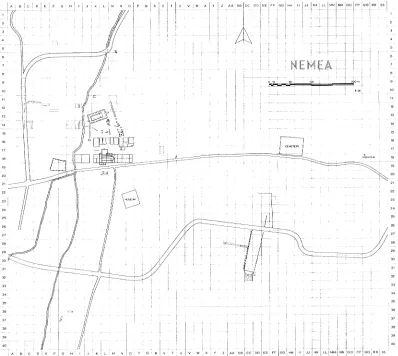
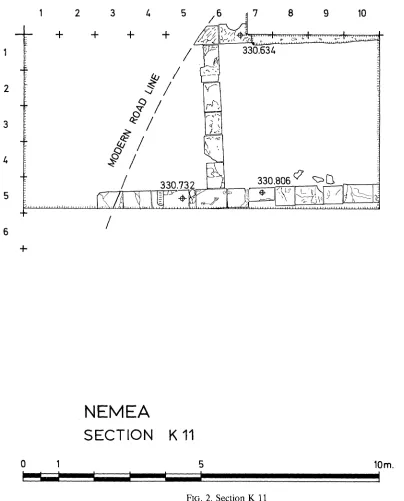
The closing and partial removal of the modern asphalt road just west of the Temple of Zeus allowed the excavation of a small trench in the northwestern corner of Section K 11 (Figs. 1, 2, Pls. 10, 11) .4 The eastern part of the trench was filled with the bat-
tered remains of soft, yellow poros blocks which had suffered extensive damage when the field was deep-plowed in 1965 (Fig. 2, P1. 12:a). Despite their battered condition, the average size of these blocks can be established as 0.50 x 0.70 m. although there is
4We would thank the following for their help in closing this road (Provincial Highway #27): the Hon-
orable Konstantine Papakonstantinou, Vice-President of the Government, the Honorable Christos Goulas,
Governor of the Korinthia, the Honorable Demetrios Nianias, then Minister of Culture, Mr. Constantine
Phryndas, Director of Technical Services for the Korinthia, and Mr. Charalambos Kritsas and Miss Helene
EXCAVATIONS AT NEMEA. 1980
/
+
NEMEA
SECTION
0
ii
1
K 11
lOm.
-
FIG. 2. Section K 11
considerable variation in their dimensions. They served as the foundations for a room with a north-south width of ca. 4.00 m. (the north wall is largely robbed out, but the line of the robbing trench has been recovered; cf. Fig. 2). The southern wall continues beyond the southwest corner of the room for a distance of 3.15 m., at which point it
5
tl
1
2
3
4
5
6
STEPHEN G. MILLER
was cut through by the blade of the grader during the construction of the modern road in 1971. This wall clearly implies a second room to the west of the room just described, but the western and northern walls have been completely destroyed by the modern road construction.
The first layer below the modern disturbance was also below the floor of the building so that its early 5th-century B.C. date gives us only a general tereminus post quem for the construction of the building.5 Much excavation remains to be done to the north, east, and south of the exposed part of the building in order to understand better its form, function, and history. It is already apparent, however, that this building, and probably therefore all of those along the north side of the sanctuary, is oriented in a very nearly north-south direction like the buildings on the south side (Fig. 3). Thus the orientation of the Temple of Zeus and that of the Sanctuary of Zeus are significantly different.
Sections J 13 and K 12,13
The 1980 excavations close to the northwest corner of the Temple of Zeus were focused on the north side of the building, although the work in J 13 extended some four meters west of the line of the west end of the temple. So little of Section K 13 was available for excavation that it was decided to investigate it together with K 12, and only the western half of these two sections was uncovered. The main purpose of exca- vations in this area was to recover more information about the Early Temple of Zeus. Before the work could be undertaken, it was necessary to move some 160 fallen blocks from the 4th-century temple.6
The removal of these blocks revealed an Early Christian cemetery of the 6th cen- tury after Christ. All of the 20 graves were typically simple, tile-lined burials, and many contained only skeletal remains as has been characteristic of similar graves elsewhere in the sanctuary.7 One grave, at J/15,17-13/3,4, although of humble construction, con- tained a skeleton which had been buried with all its finery (PI. 12:b-d).8 Behind its skull, and in a criss-crossed position like hairpins, were two bronze "ear-spoons" (BR 828, BR 829). On the chest were two bronze pins (GJ 49, GJ 50). On the ring finger of the left hand, which lay across the chest, were two silver-plated bronze rings each of which bears a monogram on its bezel (GJ 65, GJ 66; PI. 12:e), and in that hand
5Pottery lot K 11:2.
61t is a pleasure to report that a thorough architectural study of the temple together with a complete
catalogue of its blocks is now being undertaken under the leadership of Professor Frederick Cooper of the University of Minnesota. This work was ably assisted in 1980 by Robin Rhodes of the University of North Carolina and by a team of architects from the Hoger Architectuur Instituut of Ghent, Belgium under the leadership of Professor Hendrik Hendrickx. The members of this team were Pieter Broucke, Louis Caron, Luc de Maesschalk, Gery Janssens de Varebeke, and Pascal Van Rossem. The work was supported by contributions from the Friends of Zeus, a committee of Greek-Americans headed by the Honorable Nich- olas C. Petris, State Senator of California. The hard work and support of all these people deserve, and have, our gratitude.
7Cf. Hesperia 46, 1977, p. 3; Hesperia 48, 1979, p. 85; Hesperia 49, 1980, p. 192. 8Deposit J 13:1.
F G H
11
12
I <I
I I
1/ /0
/
1/
' 4/ I / BATH
HEROON /
t~~~~~~~~~~~~~~~~~~~~~~~~~~~~~~~~~~~~~~~J KEI[S
/|
NEMEA
SANCTUARY OF Z US SOUTH SIDE
8-80
__ CYPRESS
CYPRESS :
00i0 O TREES O O
, 0
XENON
I1IrY77
/ /I
G H I J K L M N
FIG. 3. Restored plan of south side of Sanctuary of Zeus, Archaic to Hellenistic periods
11
12
13
14
>
15 0
z
w
16 Z
t17
17 \.00
00 a)
0
J K L M N 0 p
I E
I
- 1
i iI1 HOUSES
STEPHEN G. MILLER
was clutched a stone plaque the weathered surface of which bears traces of a lightly incised design (ST 518). The right hand, which lay across the right thigh, had two bronze rings (GJ 68, GJ 69) and grasped a worn and indistinguishable bronze coin (C 1624). Finally, two curious bronze "spatulas" (BR 830, BR 835) were in the grave, one on top of the stone plaque in the left hand, the other on the chest (fallen from atop the plaque?).9 The wealth of this burial stands in marked contrast to the poverty of the other graves in the immediate vicinity, and of all other graves of this date found at Nemea. The explanation for this difference is presumably to be sought in the customs of the period and in the socio-economic status of the deceased.
The discovery of this cemetery beneath the fallen blocks of the 4th-century temple shows, once again, that the colonnade of the temple in this region was standing in good repair until at least the 6th century after Christ. It is thus increasingly less likely that the temple suffered any great damage in the earthquakes of ca. A.D. 370 as has been pre-
viously believed.10 We now know that architectural members of the temple fell on top of layers of the 6th century after Christ at the southwest, west, and northwest parts of the temple.
With the removal of the Early Christian layers and graves, the construction and landscaping fill for the 4th-century temple was immediately found, indicating that activi- ty around the temple was minimal from the late 4th century B.C. until the 6th century
after Christ. The construction layers and the foundation trench were not helpful with respect to the chronology of the temple, for they contained nothing later than the last quarter of the 5th century B.c.11 These layers and disturbed layers immediately above them, however, did produce much material of interest as, for example, a Late Proto- corinthian aryballos (P 559; PI. 13:a), a bronze ivy leaf (BR 816; PI. 13:e), and two bronze finger rings, one with a Pegasos on its bezel (GJ 61; PI. 13:d) and one with heral- dic sphinxes surmounted by heraldic goats (GJ 52; PI. 13:c). These layers also produced much material of relevance to the Early Temple of Zeus and its functioning. The founda- tion trench of the 4th-century temple clearly cut into the destruction debris of the Early Temple, and the construction layers of the former showed evidence of a dismantling and clean-up of the latter. This was especially clear in K 12, where, together with the work- ing chips of the 4th-century temple and an iron chisel from that construction (IL 377; PI. 14:a), were many blocks with the characteristic anathyrosis and "ice-tong" lifting holes of the earlier structure, which had been formed into a rough terrace wall about 13 me- ters north of the 4th-century temple (PI. 13:b). Other similar blocks were found in large quantities at the northwest corner of Section J 13 where they had been dumped, appar- ently in an effort to build up the relatively steep slope, down westward to the Nemea River, to a more nearly level platform for the northwest corner of the new temple.
9For this type in general, although precise parallels are not shown, see W. Deonna, Delos, XVIII, Le
mobilier Delien, Paris 1938, pp. 221-223.
"B. H. Hill, The Temple of Zeus at Nemea, Princeton 1966, p. 1. Cf. Hesperia 47, 1978, p. 59; Hesperia
EXCAVATIONS AT NEMEA, 1980
Hopes that excavation of the foundation trench for the 4th-century temple might reveal something of the Early Temple still in situ were frustrated. The foundations of the later temple continue below the euthynteria for a total of seven courses, or about 2.80 m., the lowest two of which project irregularly some 0.32-0.47 m. from the line of the higher foundations. The upper surface of the sixth course (counted down from the euthynteria: the first projecting course) has been worked down to receive thg fifth course (PI. 13:f,g).12 These projecting lower courses appeared, at first glance, to be potential candidates for the foundations of the Early Temple, but the 4th-century foun- dation trench and its fill continued straight down along all seven courses, and the same method of providing a broader base at the bottom of foundations can be observed elsewhere in the fabric of the 4th-century structure.13 On the other hand, the 4th- century foundation trench along the north side of the temple stops abruptly in a line with the western face of the sixth and seventh courses of the west end. The nature of the fill which is hard against the western faces of those courses is, as yet, unknown, but it presents the possibility that these courses along the west end of the temple might belong to an earlier structure.
Despite the disappointing results with regard to the plan of the Early Temple, much was learned about its details, both architectural and historical. This information came largely from the destruction debris of the Early Temple, some of which was dis- covered still in place, some of which had been cut into and dumped out by the con- struction of the 4th-century temple. This disturbed material was still clearly recognizable by its ash and carbon content, as well as by the characteristic artifacts within it. The ceramic contents of the undisturbed debris showed once again that the destruction of the Early Temple is to be dated no earlier than ca. 430, and probably well into the last quarter of the 5th century B.C.14 Althlough the precise cause of this destruction remains uncertain, its violent nature was once more documented in the form of ash, carbon, badly burnt architectural elements, and a number of bronze arrowheads (BR 826, BR 831, BR 833, BR 836, BR 837, BR 842, BR 869; PI. 14:c).15 This debris, which was generally more heavily concentrated toward the west, contained large quantities (nearly 10 kilograms) of melted and broken bronze, much of which was clearly from larger, probably dedicatory, objects. Examples of these are a strigil with the inscription AIOX and a stamped horse and rider on the handle (BR 857; PI. 14:b,d); a fragment of a rim of a vase with an incised guilloche pattern and the letters -]TO[- (BR 845; PI. 14:e); a fragment of a rim from another vessel with the incised letters -]TIM[- (BR 886;
12The same construction technique had been observed earlier along the west end of the temple; cf. Hill, op. cit. (footnote 10 above), p. 28, figs. 5 and 12. The statement, ibid., p. 4, that the foundations "that support the pteron columns are constructed of five to six courses below the euthynteria" must be emended.
13E.g., in the supporting walls for paving slabs at both the east and west ends of the temple.
"Pottery lots J 13:60, 64-67, 69, 71, 77; K 12,13:15-17, 20.
15Cf. Hesperia 44, 1975, p. 160; Hesperia 46, 1977, pp. 9-10; Hesperia 47, 1978, p. 65; Hesperia 48, 1979, p. 82; Hesperia 49, 1980, p. 186.
STEPHEN G. MILLER
P1. 14:g); a fragment of a handle attachment with volute and lion's head in relief (BR 849; PI. 14:f); the head and right forepaw of a crouching lion (BR 898; PI. 14j); the head of a kouros (BR 897; PI. 14:h); and a bronze pin (GJ 67; PI. 14:i).
The destruction debris, both that still in place and that disturbed by the 4th-century construction, once again produced quantities of architectural material. This included much cement, nearly all of which is in the form of slabs 0.05-0.06 m. thick, and some of which had a layer of stucco adhering to it (e.g. A 166; PI. 15:a). This would seem to imply the use of cement for walls or floors, or both, in the Early Temple.
Architectural terracottas also appeared in abundance. Several more pieces from the hip of the roof were recovered and the most informative of these, although badly bro- ken, gives the full dimensions of these tiles as 0.714 x 0.714 m. (AT 230; PI. 15:b). A large number of stamped pan and cover tiles were also found. In 1979 rosette stamps were noted on several of the impressed antefix tiles (e.g. AT 91). This year five more of these stamps were noted, but all on pan tiles (AT 89, AT 116, AT 206, AT 207, AT 222). The "keyhole" stamp which had also been noted last year exclusively on pan tiles reappeared this year on six more pan tiles and on three cover tiles as well (AT 200, AT 202, AT 203). Two new types of stamp were noted. One of these consists of a double impressed line in a "tear-drop" pattern and was noted on three cover tiles (AT 136, AT 197, AT 236; PI. 15:c). The second new stamp type is a deeply impressed "S" which has been found on seven different pan tiles (AT 209, AT 223-AT 228; PI.
15:d).16
Of the series of impressed antefixes found in abundance in 1979 west of the tem- ple, only two small fragments were discovered this year north of the northwest corner
(AT 118, AT 139; PI. 15:f). Many fragments of ridge akroteria, however, were discov- ered in this region. Although no complete akroteria were found, it is possible to recon- struct the essential details of this series (Fig. 4 and PI. 15:e; e.g. AT 117, AT 132, AT
133, AT 138). The base of the akroterion consists of normal cover tiles joining at an angle of about 148? over the ridge of the roof. This base has a total length of 0.457 m. and width of 0.223 m. At the peak of the joining cover tiles there rises the akroterion proper which is 0.038 m. thick and has a total height, together with the base, of about 0.425 m. Vividly painted on both sides, the colors are essentially black over the buff slip of the clay with some details in red or yellow. The lower part is painted with a double volute, the eye of which is deep red. At the center of the eye is a compass point im- pressed in the damp clay, and the eye and the first circle of the volute are concentric from this point; both circles were inscribed before painting. Above the volutes is a five- petaled palmette the outline of which is translated into the shape of the akroterion at this point. The central and flanking petals are painted in the same deep red as the vo- lute eyes; the petals on either side of the central one are black as are the sides of the palmette. On three fragments the red paint does not appear, and its place is taken by a
16The most recent study of tile stamps is by R. C. S. Felsch, "Boiotische Ziegelwerkstatten archaischer
Zeit," AthMitt 94, 1979, pp. 1-40, who does not, however, show any parallels for our examples.
NEMEA
RECONSTRUCTED RIDGE ACROTERION
STEPHEN G. MILLER
greenish yellow color (AT 128-AT 130). The most unusual feature of these akroteria is that the fan-shaped heart of the palmette is cut completely through the clay. Its color would thus have been that of the sky beyond.
These handsome ridge akroteria present a problem for our understanding of the Early Temple. It is immediately apparent that their style is much different from that of the impressed antefixes discovered last year and this. Furthermore, the fabric of the akroteria, a greenish yellow-buff, well-refined clay, is different from the red, coarse clay of the impressed antefixes, the hip tiles, and the stamped pan and cover tiles. Finally, the width of the ridge covers (0.223 m.) is significantly greater than that of the im- pressed antefixes (0.171 m.). Were it not for the place and circumstances of the discov- ery, one would disassociate the akroteria completely from the rest of the tiles of the Early Temple. It may be significant that the ridge akroteria were found almost exclusive- ly on the north side of the temple, while the impressed-antefix series was concentrated on the west. It might then be suggested that there was one size of cover tile on the sides, another on the back of the Early Temple. Aside from aesthetic objections to such an arrangement, the hip tiles, as noted above, presuppose pan tiles of equal widths (0.714 m.) on both the sides and the back of the temple. Pan tiles of equal width should imply cover tiles of equal widths. However we are to understand the relationship of the ridge akroteria to the rest of the roofing system of the Early Temple, the style of the former is sufficient reason to suggest that the ridge akroteria are not original to the building, but rather belong to a repair or remodeling in the later Archaic or early Classi- cal period, if they belong to the Early Temple at all.
It should be noted, as it was last year, that we have yet to discover in all of the debris of the Early Temple the slightest trace of stone column, capital, or entablature.
More evidence was uncovered in 1980 for the construction date of the Early Temple. This came from fairly extensive layers of working chips of the same form of hard lime- stone as that used for the "ice-tong" lifting-hole series of Early Temple blocks. The larger and lower of these layers consistently yielded ceramics of the last quarter of the 7th cen- tury B.C. with some material possibly from the early part of the 6th century.17 This
included, for example, a small cup (P 605; PI. 16:a) and a fragment of a black-glazed krater with a large incised delta (P 610; PI. 16:c). The date for the construction of the Early Temple of Zeus should, therefore, be no earlier than ca. 600 B.C. at the earliest.
A higher and less concentrated layer of working chips also appeared in the excava- ted area. The ceramic date for this layer was in the last third of the 6th century B.C. in Section J 13, but in the second half of the 5th century in Section K 12,13.18 The nature of the excavation in the latter area was such that contamination of the material may have occurred, and the 5th-century date may not be correct. In any event, this evidence for repairs or remodeling to the Early Temple fits well with the evidence of the ridge akroteria discussed above.
"Pottery lots J 13:88 and K 12,13:30.
EXCAVATIONS AT NEMEA, 1980
Evidence for a different sort of activity was noted stratigraphically just above, and therefore slightly later than, this secondary construction layer in K 12,13. The earth here was in no way remarkable, being a relatively soft, light brown, but it contained very large numbers of burnt and unburnt animal bones and much votive material which consisted largely of crude terracotta horses and riders (TC 136-TC 140, TC 143; PI. 16:b). Nearly 100 fragments of such figurines were discovered in this fill together with numerous other artifacts, such as two bronze fibulas (GJ 47, GJ 48; PI. 16:e), a minia- ture iron double ax (IL 376; PI. 16:e), and an Archaic silver coin of Corinth (C 1659; PI. 16:d).19 Excavated in two separate parts, one part of the deposit is dated by the ceramics in the late 5th century, the other in the very early 5th century.20 The true date for the deposit as a whole is probably late Archaic, but future excavations to the east will provide further chronological evidence. The nature of the deposit is clearly votive- sacrificial, but in the absence of ash and carbon to account directly for the burnt bone, we must have to do with a dump which presupposes some clean-up in the sanctuary. It is thus reminiscent of the sacrificial dump discovered south of the Temple of Zeus, although the characteristics of the two, and therefore of two, and therefore of the altars where they originat- the ed, are quite distinct.21
Finally, three distinct layers below that of the original construction of the Early Temple were excavated in Section K 12,13. They contained very few artifacts of any kindnd and had the appearance in excavation of eroded or silted fill. All three layers were datable to the 7th century B.C., and all contained a few fragments of earlier pottery (e.g.
Geometric, Neolithic).22 It would seem correct to infer that until the time of the con- struction of the Early Temple there was very little activity in this part of the Sanctuary of Zeus.
THE XENON AND THE BASILICA Sections L 18 and L 19
These two sections were explored in 1980 in an effort to learn more about the Basilica and about the Xenon which lies, in part, beneath it.23 Both structures have long
been known, but are not yet fully investigated.24 The work this year was limited to two
"9Also from this region, but not in association with the deposit, was found an Aiginetan silver turtle (C 1658; 16:d).
20Pottery lots K 12,13:25 and 24, respectively; Deposit K 12,13:1.
21Cf. Deposit K 14:1; Hesperia 47, 1978, p. 64; Hesperia 48, 1979, pp. 81-82.
22Pottery lots K 12,13:33-35.
23This investigation was occasioned by the presence on the staff of Lynn Kraynak and by the visit of
Professor Slobodan Curcic of the University of Illinois at Urbana-Champaign, who will undertake the final
publication of the Xenon and of the Basilica, respectively.
24The Basilica was first discovered in 1924: C. W. Blegen, "The American Excavations at Nemea,
Season of 1924," Art and Archaeology 19, 1924, pp. 179-182. The first traces of the building beneath the
56 STEPHEN G. MILLER
1 2 3 4 5 6 7 8 9 10 11 12 13 14 15 16 17 | , 19 20
.I _. ?- 33 . 705 334.023 -Ii "' I
I ?XCAVATED . .. ,/ 4 4 7 4
6 : l'.' 33/204.63; ...~ ...~ - ... .~. '3. 2-.- ,. . ...
t2 ~ _334.620l : ,r 2
3 K)::m i;G^C 1C^ 3
^".^ IrnS 33
^
^ TOM^ 1 ,,...,,,,,,,,,,,,,,,,,... UNEXCAVATE .D t ,, , . ,,,,,,,,,,,,?,3 ,~ 4 ~
UNEXCAVATED 4,
^^7I+
[~ P
2-J 334.48 ! f_ t +
1 0 o c
- +' . . .. . . . 34.484 3 j , 3 +
+--. 33:., 7 : |
C
-
-iWHDfK.<J
8 333.88 3340340 ) 8
+ 4 34.383
10 tAQU3DUCT.885 .
334.483 TL VI
11
Pr.7 . B . -
3 .,, 0
'+ UNEXCAVATED c 2
1~~6 ~1i L1LigX '
1E8
+ E AM \:UNEXCAVATED 9 _ 1
19 ! 335.24307 l .' : ' 19
I 3 L 334.481 3 34229 -
1. 335.208 ._... ... . .. , ..
20
^ ^-3 '^ ^ E ^ 4 1JC 4C.20
13 -.:... ...' .... ... ... ...1335..600.. ... .'---. 3--3
2 :? -.333.988 -AQUEDUCT ,'' ;' 7 'AQUEDUCT 334.fl75 . '^ -': 2
14 i^- 1^,^ UNEXCAVATED U GRAVEVATED14 335.28
335.130 . 3
17 - -, ,,, ,:.,,... ...,....,,.,. ' ? .7 . .
1^"^ 1 2 334.39 is5 6 7 8 9 10 11 12 13 15 16 17 18 1934
7I~~~~~~~~~~~~~~~~~~~~~~~~~~~~~~~~~ SECTIONS L18, L19 ? 7NEMEA I I I l l ! T"'~~~~
NEMEA SECTIONS L18, L19 1
EXCAVATIONS AT NEMEA, 1980
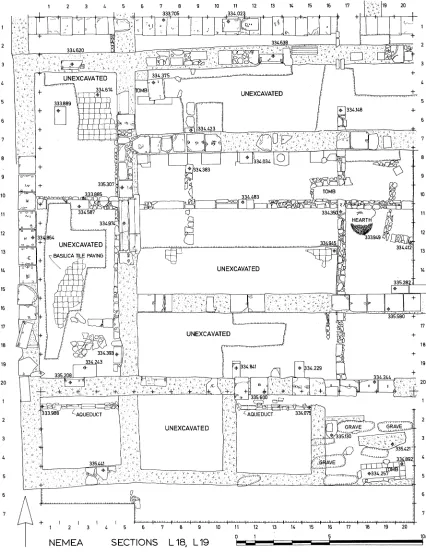
sections although more remains to be done farther to the east within the confines of the Basilica (Fig. 5, PI. 17). Excavation in the southern of the two sections was also limited by the modern road which lies immediately to the south, and in both sections by the need to clean out the backfill of many earlier trenches. Despite these limitations many results emerged, as did artifacts which had been churned up to the modern surface, such as silver coins of Argos and Aigina (C 1804 and C 1816, respectively; PI. 18:a,b).
Throughout the area, where preserved to us, th terracotta-tile paving of the Basili- ca was covered over by layers of the 12th to 13th centuries after Christ.25 There were also numerous intrusions through the paving in paving in the form of graves and pits in the the narthex, nave, and southern rooms. All of these, where datable, belong to the 12th or 13th centuries after Christ.26 Of particular note is the well-built tomb in the nave, which uses the central east-west wall of the Xenon for its south wall (PI. 18:c). Located at L/15,17-18/10, this tomb was discovered in 1924 but at that time could not be dated. Our excavations were fortunate enough to recover a coin of Manuel I (C 1835; PI. 18:a,b) from the northwest exterior corner of the tomb. Thus this tomb also can be no earlier than the second half of the 12th century after Christ.
Our efforts to date the tile paving of the Basilica, and the Basilica itself, were not well rewarded. The fill directly beneath the preserved paving was devoid of any datable material,27 although a few of the Middle Byzantine tombs undercut the tiles in a way which suggested that the former might antedate the latter.28 But since these graves projected upward through the paving and were not covered by it, they must be later than the tile paving. We still lack, then, tangible evidence for the date of the paving and of the Basilica, but the 6th-century (after Christ) date usually assigned to it seems, on the basis of architectural style and the history of Nemea, correct.
Excavation was carried out in two of the southern rooms of the Basilica located in Section L 19: the westernmost and the third from the west (PI. 17, lower left). In both rooms hard, gravel layers of the east-west road south of the Xenon were soon uncov- ered. We excavated these layers down into levels of the late 4th century B.C. and were
Tomb of Opheltes: G. Cousin and F. Durrach, "Inscriptions de Nemee," BCH 9, 1885, p. 24. It is probab-
ly this mound which appears in the left background of a view of the Temple of Zeus in 1810: W. Gell,
Itinerary of Greece, London 1810, facing p. 23. More recently, the building beneath the Basilica was further
explored in 1962 and 1964, as a result of which its identification was changed, first to that of prytaneion
(C. K. Williams, AJA 68, 1964, pp. 201-202; AJA 69, 1965, pp. 178-179; "Archaeological News," Archae-
ology 18, 1965, p. 65) and then to that of Xenon (C. K. Williams, "Nemea," AEXT 20, 1965, B' 1 [1967],
p. 154; BCH 89, 1965, p. 703; AR 1964-65 [JHS 85, 1965], p. 9). Finally, in 1977, a subsidiary structure was uncovered at the east end of the building: Hesperia 47, 1978, pp. 78-80. It will be obvious that the identification of the building is not yet secure, but it seems better to retain the Xenon appellation for the moment rather than to confuse the issue further.
25The best example of these layers was in the third (from the west) of the southern rooms of the Basilica (L/12,15-19/3,4); pottery lots L 19:42, 43.
26Pottery lots L 18:1-5, 26-28, 33, 44; L 19:1-5, 8-15, 17, 19.
27Pottery lots L 19:46, 52, 47; L 18:44, 45, 47.
28E.g., pottery lot L 18:28.
STEPHEN G. MILLER
able to recover three major resurfacings of the road, together with many minor repairs. All belonged to the late 4th century or the very early 3rd century.29 The numismatic evidence for this dating includes a bronze coin of Sikyon (C 1850; PI. 18:a,b). It is also clear that during this same period the aqueduct that runs along outside the south wall of the Xenon was set in place (PI. 18:d). First discovered in the 1920's and further uncov- ered in the 1960's, this aqueduct consists of U-shaped terracotta channel tiles rectilinear on the exterior, concave in the interior, which are about 0.14 m. high and 0.86 m. long with an additional flange of about 0.065 m. Each tile is about 0.26 m. wide at one end, but tapers to a width of 0.21 m. at the flanged end. They are laid with wide and narrow ends abutting rather than in the interlocking fashion for which they were made. The aqueduct is covered by normal, Corinthian-style cover tiles, and both they and the channel tiles are sealed with a hard mortar. The purpose of this aqueduct, which has been uncovered at various places and times all along the south facade of the Xenon, seems to have been to bring water to the bath from the spring that rises some 750 m. to the east (TT 17; cf. Fig. 2).
After the late 4th and early 3rd centuries, the road seems either to have fallen into disuse, or to have shifted from its early Hellenistic line, for the next signs of activity come in the form of a destruction layer; this can be dated no earlier than the mid-2nd century on the basis of its ceramic and numismatic contents which included an unguen- tarium (P 556; PI. 19:a) and a coin of Argos (C 1845, 228-146 B.C.; PI. 18:a,b).3? Over the top of this destruction layer was constructed a scrappy rubble wall which was pre- served only for a length of some three meters in an east-west direction (L/1 1,14-19/4; Fig. 5, PI. 19:b). This wall was soon covered over by silted fill the ceramic date of which is also within the 2nd century B.C., but with a heavy admixture of 3rd-century mate- rial.31 There was no sign of any other activity in the area until the construction of the Basilica.
Trenches were excavated in Section L 18 within the narthex and the nave of the church. The former revealed more of the central east-west wall of the Xenon, the western face of a Xenon wall which lies directly below and serves as the foundation for the wall between the narthex and the nave of the Basilica, and the original floor level of the Xenon which lies at the same level as the top of the foundation for an interior column base at L/1,2-18/5,6; this foundation had been discovered in 1962 (Fig. 5, Pls. 17, center left, 19:c). From the debris which covered this floor it was clear that the Xenon was out of use already at some time in the 3rd century B.C. (see p. 59 below).32 Amid the debris was a fragment of a molded circular marble base, probably from an altar, with a lead dowel still passing through it (A 172; PI. 19:d). The material beneath the floor indicated a date of construction in the last quarter of the 4th century B.C.,33
29Pottery lots L 19:27, 30-32, 36, 38, 41, 59, 61-64.
30Pottery lots L 19:26, 53.
31Pottery lots L 19:22, 25, 50, 51.
32Pottery lot L 18:48; P 631.
EXCAVATIONS AT NEMEA, 1980
and such a date was supported by the discovery of a silver coin of Philip II (C 1815; PI. 18:a,b) in the fabric of the central east-west Xenon wall.
Excavation in the nave of the Basilica revealed still more information about the Xenon. Even in the course of cleaning out old trenches it was possible to establish that the second room from the west on the north side of the Xenon had a row of six bases for interior columns about 1.90 m. north of the central east-west wall and nearly 1.90 m. apart on centers (Fig. 5, Pls. 18:c, 19:e). It was possible to identify these bases with those on an unlabeled sketch plan in B. H. Hill's 1936 notebook, and the second base from the east still preserved the stump of its unfluted column, 0.45 m. in diameter.
Although time prevented any tests below the original floor, a large quantity of destruction debris (tiles, mud brick, plaster) lay directly over the floor (PI. 20:a) and yielded a date in the late 4th or very early 3rd century B.C.34 Such a date was in no way contradicted by the numismatic evidence which included a silver issue of Sikyon (C 1834, 400-300 B.C.; PI. 18:a,b) and a bronze issue of Anaktorion (C 1840, 350-300 B.C.; PI. 18:a,b). We thus have a strong indication of a very short life for the original phase of the Xenon.
A second phase was documented in the form of a series of relatively insubstantial walls which altered the plan of the building considerably. The central east-west wall was re-used, but a new north-south wall was added at L/9-18/9,13 (Fig. 5, PI. 19:e). Far- ther to the east, in the general area where a circular hearth of fist-sized stones had been found at L/17,18-18/11,12 in 1962, a series of three walls was built, essentially at right angles to one another but not to the Xenon (Fig. 5, PI. 20:b). These contained several re-used blocks, including a fragment of a Doric capital (A 176; PI. 16:f) which may be associated with an epistyle found near by (A 174; PI. 16:g); both could belong to the original phase of the Xenon.
The pottery from the floor associated with these walls indicates that they were constructed in the 3rd century B.C., as do two coins of Pyrrhos (C 1836 and C 1837, 295-272 B.C.; the latter is shown in Plate 18:a,b).35 The ceramic content of the layers above these walls shows that they were also destroyed within the 3rd century,36 as does the numismatic evidence which included two coins of the Arcadian League issued at Megalopolis (C 1825 and C 1826, 363 to ca. 280 B.C.; latter, PI. 18:a,b). In association with the use of these walls came three objects which present something of a puzzle. Shaped like saltcellars of the last quarter of the 5th century, with a flat base, slightly convex sides, and a relatively deep concave interior, they are of unglazed terracotta and too small (height barely one centimeter) to have served as real saltcellars (P 619- P 621; PI. 20:d). They are reminiscent of nothing so much as "egg-cups", and clearly have a basically domestic character. Such a character is also implicit for the Xenon in this second, last, and short-lived phase of its history.
34Pottery lots L 18:22-25, 40-42.
35Pottery lots L 18:13, 37, 38. 36Pottery lots L 18:9, 35.
STEPHEN G. MILLER
F
f ~~~~~~~~~~~~+
18 +1^^T+ ^,- 1, + - 18
f~~~ / ~~~+
4 +~~~~~~~~~~~331 +j +
1h
l ;
3~~~~~~~~~~~~~~
1 +s \~ ? I
3 ..Al. IIIRIY * ^ST1II
r
~~~~~~~~~~~~~~~~~~~~~~~~~7V{
t~~~~ ~ ~ ~~~~~~~~~~~~~~~~~~ 1 s
ci^
"
-, lor0.^4
NEEA SECTIONS F 18, F19 18 8 19 _ - - ' ..._
FIG. 6. Sections F 18, F 19, G 18, and G 19 THE HEROON
Sections F 17, F 18, F]19, G 18, andGI19
reel h nrhet crnr f bidig hih a the tettvly Idetfe as-
~~~~~~~~~~~~toW
19 hitr i and f As a c s 19
identification are necessary.
th topgrph of th sactar inti ra osdrtoso iefre st bn
end, without any trace of architecture. There wereG 1, hoevr sign of anin _____? acivt in
theimedat or3o aea prtcuarl i te te 0 oin, llbrnz, isovreti
I Ii . 6 3 7 1 F1 1 8, 2 19, G 18, an 9 19 I 23in
THE HEROON
Sections F 17, F 18, F 19, G 18, and G 19
In 1979 the whole of F 18 and considerable parts of F 19 and G 18 were opened to reveal the northwest corner of a building which was then tentatively identified as a palaistra. The work of 1980 revealed the whole outline of this structure and new details of its history and function. As a consequence, several adjustments in its chronology and identification are necessary.
North of the structure we opened Section F 17 in the hope of learning more about the topography of the sanctuary in this area. Considerations of time forced us to aban- don the effort just as the typical Early Christian farming trenches were beginning to end, without any trace of architecture. There were, however, signs of ancient activity in the immediate area, particularly in the form of the 40 coins, all bronze, discovered in
EXCAVATIONS AT NEMEA, 1980
F 17. A few Roman Imperial examples were recovered, but the bulk were of the late 4th and 3rd centuries B.C. and represented Corinth (10 examples), Argos (5), Phlious
(4), Athens (2), and Aigina, Arkadia, Sikyon, and Philip II (one each).
The closing of the modern asphalt road (see above, footnote 4) made possible the complete clearing of Sections G 18 and G 19 down to Early Christian farming levels. This work, together with the clearing of F 19, exposed the full extent of the building partially uncovered in 1979 (Fig. 6, PI. 21:a). The north wall of the structure has a total length of 30.10 m. and has four interior buttresses at intervals of 6.15-6.30 m. on centers. On the north side of the northeast corner of the structure are a number of badly decomposed blocks which may have formed the foundations for a porch or propy- lon ca. 4.55 x 1.50 m. in size, facing out toward the Temple of Zeus some 110 m. away. The condition of these remains, however, is so poor that a porch cannot be surely restored here. Although about two thirds of the east wall of the structure have been washed away by the Nemea River, whose course flowed through this region in the Early Christian period,37 the northernmost block of the east wall is still preserved and shows that the north and east walls joined at an angle of about 102?. South of an eastward bend in the Early Christian course of the river, the east wall is preserved not only in its soft, yellow poros foundations, but also in its orthostates; five of these are still in place, although the northernmost is slightly askew. These blocks are of a somewhat hard, reddish limestone, not unlike the stone of the Temple of Zeus, and average 0.48 x 0.92 m. in size with a height of about 0.47 m. The total original length of the east wall was 22.35 m., but we do not yet know whether, as seems likely, it had interior buttresses. The south wall, although preserved only in its soft, yellow poros foundations, has not been damaged by Early Christian agricultural activities (this is also true of the southern ends of the western and eastern walls). The south wall has a total length of some 36.65 m. and displays four interior buttresses set at intervals of about 7.10 m. Between the first and second (from the west) buttresses, at F/14-19/19, the upper surface of the foundation displays a setting line and rough cuttings, possibly for dowels (PI. 21:c). This might indicate the position of a threshold for a small door ca. 0.95 m. wide. The west wall joins the south wall nearly at right angles and goes northward for about 4.50 m. At that point the wall bends eastward at an angle of about 160? and then continues in its new northeasterly direction for a distance of 25.40 m. before joining the north wall to form the northwest corner of the structure (PI. 21:b). This northern part of the west wall has four buttresses set at intervals of about 6.30 m., although the southernmost is only 6.05 m. from its northern neighbor. The over-all shape of the building is, then, that of a lopsided pentagon. An explanation for this unusual form will be offered below (p. 63). The shape, as well as the size, suggests that we have to do with an open enclo- sure rather than with a roofed building. The architectural terracottas offered last year as evidence of a roofed structure must be misleading.38
37Pottery lots G 18:33; G 19:13, 14. 38 Hesperia 49, 1980, pp. 194-195.
STEPHEN G. MILLER
Once again, the Early Christians were responsible for churning up large quantities of earlier material throughout the area.39 Fortunately, however, the activities of the 5th and 6th centuries after Christ have not extended to such a great depth in the southern quarter of the building. This allowed us to gain much information about the history of the structure. The robbing trench of the orthostates of the south wall was defined, and a probable date in the late 1st century B.C. or early 1st century after Christ was ascer-
tained for this activity (PI. 20:c).40 We were fortunate to have large quantities of cera- mic and numismatic evidence from outside the south and west walls for the construc- tion date of the building. Both types of evidence agree that the construction took place well into the 3rd century B.C., although the pottery would place the date in the third quarter of that century.41 The numismatic evidence here was especially rich, for these
probably the actual date of construction.
Outside the northeast corner of the structure, in Section G 18 more dating evi- denc came came in the form of a dumped landscaping fill which must have been placed Te n directly after construction of the north wall. Here the ceramic evidence again sug- the gested a date no earlier than the middle of the 3rd century B.C.43 Here, too, there was
4Pottery lots F 19:25, 34, 35 (construction fill); 26, 30, 39, 40, 43, 45 (pre-construction layers).
42C 1737 (Argos, 350-228 B..) and C 1739 (Phlious, 370-280 B.C.), from the construction fill. From
the layers preceding the construction: C 1703 (silver, Argos, 350-228 B.C.), C 1742 (Histiaia, 369-336 B.C.),
C 1757 (Argos, 350-228 B.C.), C 1764 (Demetrios Poliorketes, 306-283 B.C.), C 1768 (Boiotia, 338-315
B.C.), C 1770 (Kleitor, 370-240 B.C.), C 1773 (silver, Argos, 350-228 B.C.), C 1779 (Sikyon under Deme-
trios Poliorketes, 306-283 B.C.), C 1788 (Hermione, 370-300 B.C.), and C 1800 (Pyrrhos, 295-272 B.C.). The
geographical proveniences of the identifiable coins are of some interest: 22 examples of a re from Argos, 15
from Corinth, 7 from Sikyon, 6 from Phlious, 4 from Boiotia, 3 from Athens, 2 from Hermione, and one each from Aigina, Karystos, Kleitor, Histiaia, Lokris, Phokis, Tiryns, Demetrios Poliorketes, and Pyrrhos.
43Pottery lots G 18:36, 37.
44C 1673 (Phlious, 370-280 B.C.), C 1674 (Aigina, post 404 B.C.), C 1680 (Athens, 406-322 B.C.),
C 1684 (Megara, 307-243 B.C.), C 1686 (Philip II, 358-336 B.C.), C 1687 (Corinth, 400-300 B.C.), C 1691 (Corinth, 400-300 B.C.), C 1697 (Corinth, 400-146 B.C.), and C 1700 (Alexander, 336-323 B.C.). It is interesting that these coins, as a group, date about a generation earlier than those of F 19 discussed above
(footnote 42). The explanation probably lies in the fact that the G 18 fill is dumped landscaping fill which
essentially represents aprenre-existing fill brought in from elsewhere. The geographic proveniences of the
identifiable coins from G 18 are as follows: 12 from Corinth, 4 each from Phlious and Sikyon, 2 each of
Philip and Alexander, and one each from Aigina, Athens, and Megara. Striking by their absence, vis-a-vis
the coins of F 19 and of Nemea generally, are coins from Argos. The significance of this phenomenon is not immediately apparent.
EXCAVATIONS AT NEMEA, 1980
One other piece of chronological evidence may also have a religious significance. Immediately inside the foundations of the north wall of the building, set hard up against them and the west face of the easternmost buttress foundation (G/12-18/17), was a relatively small bell-krater (P 539, H. 0.215 m.; PI. 23:b). At the time of its discovery the mouth of the vase was covered by a rough slab (ST 520; PI. 23:a). The vase and its cover slab had been carefully and deliberately set into the foundation trench of the structure, and rested upon and were covered by the working chips of the construction. The contents of the krater, when the slab had been removed, consisted only of earth which was a dark reddish brown with a slightly greasy quality.45 The krater itself is to be dated to the early Hellenistic period, and thus provides one more indication of such a date for the building.
The peculiar shape of this structure seems to be accounted for by its adherence to the essential outlines of an earlier structure. It was already noted in 1979 that the north- west corner of the 3rd-century walls lies above and nearly on the same line as an earlier rubble wall. More of this rubble wall has now emerged farther to the south at F/3,4-19/6,10, where it curves slightly westward and thus bulges out from beneath the west face of the 3rd-century wall. The rubble wall appears again in the southwest corner of the later structure, where it curves sharply to the east and reveals its full width as 1.10-1.20 m. (Fig. 6, PI. 21:a,b). The shape of the later structure was thus dictated by that of the earlier and by the use of squared blocks, which forced a rectilinearity where curvilinear walls had previously existed.
Our efforts to date the rubble wall in the southwest corner of the building were frustrated by a lack of artifacts. The whole of our test trench in that area produced barely a handful of pottery, which can be dated only generally to the Archaic period.46 One interesting feature did appear. A tree pit, very like those excavated in previous years in the Sacred Square southeast of the temple, was found at F/8-19/14,15. This seems clear proof that the early rubble structure was unroofed and served as an enclo- sure or temenos wall, not as a building proper.
The quest for chronological evidence was somewhat better rewarded in the en- larged test trench at the northwest corner of the enclosure walls. Here the pottery was of sufficient quantity to be sure that the early enclosure was functioning by the second half of the 6th century B.C.47
At an even lower level than the early enclosure, and therefore of an earlier date, there is evidence of activity in the form of very large unworked stones. These have been observed in the test trench at the northwest corner of the enclosure and in anoth- er test trench along the west side of the building at F/4,11-19/6,10 (Fig. 6). These stones are not native to this region and clearly were brought here for some purpose, but
45The earth has been preserved for analysis, partly because the excavator, Christopher Simon, believes that we may have discovered the remains of a foundation custom referred to by Aristophanes, Plutus 1198 and Peace 923.
46 Pottery lots F 19:51-60. 47Pottery lots F 18:8, 9, 10, 12.
STEPHEN G. MILLER
we have not yet been able to determine that purpose, nor even to see any architectural form defined by these densely distributed stones. They were, however, clearly out of use by the first half of the 6th century B.C., at which time they were covered over.48
At the southwest corner of the Hellenistic enclosure wall there is also some evi- dence for earlier activity. This is in the form of a rectangular base of squared, soft, yellow poros blocks some of which lie directly under the foundation of the Hellenistic walls. That this base has nothing to do with the later enclosure and is earlier than the early enclosure is shown by the fact that the northeast corner of the base was cut through by the early enclosure wall (PI. 23:c). The original dimensions of this base can be estimated as no less than 2.35 x 4.30 m., but its purpose and its precise date (al- though clearly at least of the Archaic period) cannot be determined.
If we have now been able to define the outlines of the architecture and history of these successive enclosures, we have still to consider the interior of the enclosed space. We noted in 1979 the wealth and diversity of material from this area, and this year produced more of the same. The broad but shallow pit with loose black earth first discovered in 1979 continued southward parallel to the western enclosure wall and about two meters from it. In the southwestern corner of the enclosure the black earth turned eastward for about eight meters before gradually giving out (PI. 23:f). This pit, and the churned-up Early Christian fill directly above it, produced some artifacts of intrinsic interest such as an iron horse bit (IL 386; PI. 23:d), the horn of a bronze statue of a goat (BR 807; PI. 23:e), a terracotta horse and rider (TC 126; PI. 23:g), an iron spear point (IL 380; PI. 24:a), and fragments from the rim of a pithos with the preserved inscription -]KIHIIOE[- (P 547; PI. 24:b). Two more lead curse tablets also appeared, but they have so far resisted attempts at cleaning and deciphering (IL 369, IL 370). Pottery included a one-handler (P 532; PI. 24:c) and a small kalathos (P 533; PI. 24:d). The date for the layer as a whole is indicated by a lamp of the early 3rd century B.C. (L 78; PI. 24:e).49 This seems to be a clean-up or leveling fill from the time of the construction of the later enclosure. It ran hard up against the south face of a hard lime- stone base at F/12-19/12 (Fig. 6). The base thus belongs to the earlier enclosure, and it may have functioned as a small altar.50
The largest quantity of material from within the enclosure came from the eastern portion, in Section G 19, and was centered upon a concentration of fallen stones at G/4,12-19/1,6. Much excavation remains to be done in this area, but a small room about 1.40 by at least 3.15 m. at G/6,7-19/1,3 is already clear. Throughout the section and on top of these stones, but especially to the south and west of them, were masses of very soft, black ashy earth with heavy concentrations of burnt bone and pottery. The latter (PI. 24:f) included an aryballos (P 520), the lid of a trefoil oinochoe (P 522), a
48Pottery lots F 18:13; F 19:74.
49Cf. R. H. Howland, The Athenian Agora, IV, Greek Lamps and Their Survivals, Princeton 1958, Type
30B, and A. Bovon, Etudes peloponnesiennes, V, Lampes d'Argos, Paris 1966, no. 69. Pottery lots F 19:8, 9,
20.
50Note the two bases discovered, although not in situ, along the west side of this same fill at F/19-18/20 and F/8-19/4; Hesperia 49, 1980, p. 195.
EXCAVATIONS AT NEMEA, 1980
blisterware oinochoe (P 586; not illustrated), an alabastron with heraldic roosters (P 524), and a large number of miniatures (P 521, P 523, P 526-P 528, P 537, P 538).51 Skyphoi were also an important part of this group: P 580, P 582, P 538, P 584, P 576 (PI. 24:g). A cup-skyphos from this deposit has graffiti in two different hands (P 546; PI. 25:a,b). One, near the base, seems to read AIFAIpAA; the other can be read, in ret- rograde, as -]th/3po VLKaor[a - -] 'aVE[9TW KEv ]. Not yet deciphered, but belonging to this
deposit, are three lead curse tablets (IL 367, IL 372, IL 373). The coins of this deposit include three silver examples: C 1639 of Sikyon, and C 1645 and C 1649 of Aigina (PI. 25:d). The date of the deposit as essentially in the 6th and first half of the 5th cen- turies B.C. can be seen in all of this material as well as in two lamps (L 76, L 77; PI. 25:c).52 Late in this period would also belong one of the terracotta figurines of a Demeter type (TC 121; PI. 25:e). Two other figurines are not so easy to date on stylistic grounds. One appears to be a horseman wearing a petasos, or perhaps Hermes (TC 116; PI. 25:f). The other represents a small boy whose anatomical details are fairly realistically rendered, but whose face is clearly a caricature (TC 117; PI. 25:g). Indeed, to judge from his profile and the position of his right hand, he would seem to be wearing a mask.
This massive deposit is clearly sacrificial debris which was shifted to its present position in the late 4th century B.C., as indicated by a few ceramic fragments and coins. It was disturbed again in the 5th and 6th centuries after Christ, but it clearly implies heavy religious activity within the enclosure in the late Archaic and early Classical period. The enclosure as a whole is reminiscent, in its shape, of the Pelopion at Olym- pia, and we ought to recognize in it a heroon of some sort. The chthonic connections are clear: the kerykeion of Hermes,53 the lead tablets, the lamps (which are found so rarely elsewhere at Nemea), and the mask-wearing terracotta boy.54 In addition, one should note that the numismatic material is extremely rich; in and immediately around the enclosure have been found some 13% of all the coins discovered in seven years of excavations at Nemea. As a clearly important ancillary cult center on the fringes of the Sanctuary of Zeus, this heroon invites closer identification. Such identification should, however, wait upon more excavation, particularly in the eastern half of the enclosure around the small "room".
THE STADIUM Section EE 25
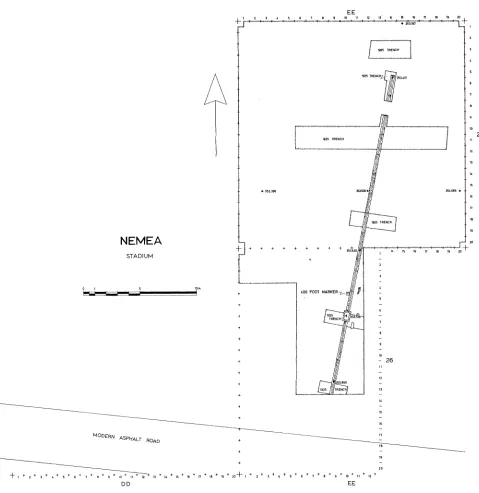
A lack of time and the fact that it has still not been posssible to move the modern road that bisects the stadium restricted our work to the clearing of the eastern part of the race track in Section EE 25 (Fig. 7, PI. 26:a). Here were first uncovered four
51 It has not been possible as of this writing to reassemble all of the hundreds of vases from this depos-
it. The material shown here is only a small sample of the characteristic types. Deposit G 19:1; pottery lots
G 19:2-10, 13, 15, 17, 20, 21.
52Cf. Howland, op. cit. (footnote 49 above), Types 21 and 21D, respectively.
53Hesperia 49, 1980, p. 197, pl. 47:b.
54For the chthonic significance of masks see R. C. S. Felsch, "Apollon und Artemis. Kalapodi Bericht
1973-1977," AA [JdI 95], 1980, pp. 92-94, with bibliography therein.
STEPHEN G. MILLER
EE
2 3 5 6 7 8 9 0 1) 12 13 t1 15. 16 17 18 19 20
IJ
1925 TRENCH
1925 TRENCH 33.401
3s3aj
+ + H + -
2
3
400 FOOT MARKER-zf
6 26 396 13 ! 3 4 5 6 '7 e 9 to 25 11 12 13 T5 16 17 to 19 20 1 SPHLT ROD
+ 1 + 2 + 3 + 4 + 5 + 6 + 7 + 8 - 9 + + 12 + 13 + 15 + 16 + 17 + 18 + 19 + 20+ + 3 + 5 + 6 + + 8 + 9 + 10 + 11 + 12 +
DD EE
FIG. 7. Stadium, Sections EE 25 and EE 26
66
NEMEA
STADIUM
- ..
...
...
...
....
...
...-...
....-...
. ...--
-
t~~--~- ' ' Im lll l I
Lu
-s
4 353.390
.+
3S4.686 * V*
,
'1-
5 10m.
EXCAVATIONS AT NEMEA, 1980
trenches that had been excavated in 1925 on the course of the water channel, and then several layers and pits which contained large quantities of Byzantine material of the 12th and 13th centuries after Christ.55 Thus the northern end of the stadium, as has been previously noted, saw considerable activity during this period.56 Immediately beneath these layers were the clay surface of the track west of the channel and upward sloping, dug bedrock to the east of the channel. Along the east face of the channel was a strip of soft, black earth between the channel and the dug bedrock, about 0.35-0.40 m. wide and 0.40-0.45 m. deep, and ending on a very hard, packed clay surface. This must represent the storm channel to drain off rain water from this side of the track (PI. 26:b).
The stone water channel ends abruptly at EE/14-25/5. Farther to the north the surface slopes away so quickly that it is clear, as we have feared since the beginning of the excavation, that the northern end of the race track will not be preserved to us
(PI. 26:c).
STEPHEN G. MILLER
UNIVERSITY OF CALIFORNIA, BERKELEY
Nemea Excavations
Graduate Group in Ancient History
and Mediterranean Archaeology
Berkeley, CA 94720
ADDENDUM
Two of the curse tablets mentioned above (p. 65), IL 367 and IL 372, have now been read by David Jordan. Although the personal names and some anatomical details are different, both record curses very similar to that reported in Hesperia 49, 1980, p. 196.
55 Pottery lots STAD:137-143.
56 Hesperia 45, 1976, pp. 193-194.
H
t-I
0
.I 4 I'll,
Aerial view: Sanctuary of Zeus and stadium
0861 'VaiaN IV SNOIiVAVDX3 :HIa'IITA[ ' N3Hd3LS
snoz Jo Aj.npulOu :MOIA lU!JaV
~
. I 7
r".r
l ?
, ":
II I V7Id
-I
I :
Section K 11 from northwest
13, before opening, from
d. GJ 50
GJ 49 BR 829
GJ 68 GJ 66
ST 518
GJ 69 GJ 65
BR 830 BR 828 BR 855
e. Detail of GJ 65 (top) and GJ 66
c. Detail of Grave 7 during excavation
STEPHEN G. MILLER: EXCAVATIONS AT NEMEA, 1980 PLATE 12
a.
0
PLATE 13
a. P 559
b. Section K 12 from northwest
p
e.B
1I
e. BR 816
f. Section J 13, foundations of Temple of g. Section J 13, foundations of Temple of Zeus, from northeast
Zeus, from east
STEPHEN G. MILLER: EXCAVATIONS AT NEMEA, 1980
_Tr
Rg
PLATE 14
_ _ _ . .
a. IL 377
U....
b. BR 857
c. BR 833 BR 869 BR 836
BR 842 BR 826
BR 831 BR 837
ei * *
8
5
I
e. BR 845
. BR ....
h. BR 897
d. Detail of horseman stamp on handle of BR 857
BR 849.
f. BR 849
* ...
...
.
- -
i. GJ 67
j. BR 898
STEPHEN G. MILLER: EXCAVATIONS AT NEMEA, 1980
g. BR 886
"Y"001ser;lii-I&i'33LihYi
I t i I
i` I i 11 ,