WAYS OF EFFICIENCY`S INCREASING OF COMPUTER GRAPHICS
PRODUCTION LIFE CYCLE PROCESSES.
Assoc. Prof. Dr. Econ. Abrahamyan V.1, MA Political Sciense, Ter-Sargsyan R.2
Institute of Economics and Business1 - Russian-Armenian (Slavonic) University, Yerevan, Armenia [email protected], [email protected]
Abstract
Computer graphics production is one of the most dynamic branches of IT sphere. Production life cycle optimization is an actual problem, especially for indi-producers and small companies. Research offers a solution based on efficiency`s increasing of preproduction stage of life cycle.
Introduction
Creation of products of computer graphics («computer-generated imagery», for short - CGI or CG) – the unique branch of information technologies sphere adjacent to engineering, industrial design, graphic and cinematography. However the industry of computer graphics has a weak scientific and practical readiness.
Products of 3D graphics have the broadest application in many branches today: animation and film industry, design and engineering (creation of architectural models, industrial prototypes, etc.), creation of computer and console games, interfaces and utilities of the software and applications. According to J’son & Partners Consulting in 2016 the market of the game industry (70% of all content of CG) is estimated at $91,5 billion [2].
Companies engaged in CG are carrying out difficult design, organizational and production and technological processes. For increasing level of efficiency of these processes and improvement of quality of the performed works it is necessary to optimize structure of production life cycle on time.
As the CG industry is rather specific and new, there are no due academic and applied researches on this perspective. The scope of research seems actual from the scientific point of view and having applied value. Results of research may be interesting to CGI specialists and businessmen.
The main subjects of CG production are independent studios and the specialized divisions of the companies (developers of the interactive software, animation and cinema studios).
Computer graphics studio is the organization, carrying-out activities for creation of the digital visual content, including:
1) Materials on visual development. Project visual development is the process of search and implementation of the design and art solutions. This stage includes creation of technical drawings, a concept art, development of the main design of the project. On the basis of the created "package" of materials is enable to start project technical realization.
2) Materials (3D models, animation files, etc.) and technical attributes to them created in specialized software. Attributes settings for models could be "rig & skin", simulations of the physical processes, material set up and "shading", etc.
3) Visualized, rendered or post-processed video series or images.
CGI project life cycle
This research is based on studying of logistic system of the animation studio which is carrying out functions of production of the animation movie with use of technology of three-dimensional computer graphics (further – "project").
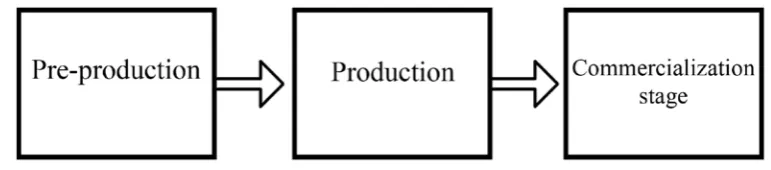
Life cycle of the project (creation of the animation movie) has three main stages – preproduction, production, post-production, and has average duration in 2.5-3 years.
Fig. 1. Life cycle of the animation movie.
At a preproduction stage are performed the following works:
• story and visual development (including work on scenario, storyboard, concept art);
• analyzing of technical problems, specific to this project, possible modernization of the equipment and software;
• researches and development of technical solutions for the project (so called “R&D”);
• determination of terms of work for each division of the company at each production phase.
Production stage includes:
• creation of 3D virtual models of characters and environment;
• creation of rig and skin of a virtual exoskeleton of objects, characters;
• animation (manual or combined with the technology of "motion capture";
• simulation of special effects;
• preparation of scenes for rendering ("layout", lighting and "scene setup");
• process of final image visualization (rendering).
• montage;
• image converting to “stereo” (a possibility of viewing of materials in the "Real 3D" format);
• color correction and post-processing.
Commercialization stage means:
- integration of the materials into the final project (the movie, the interactive software, etc.);
- release and sales.
CG developing studio carries out subcontract activity. Therefore life cycle of the project comes to the end with delivery of the stipulated package of materials for their further integration into the movie. The release, distribution, sales and the accompanying service of the project isn't function of the producer.
Activities at each stage are carrying out by the relevant divisions and specialists of studio
under the general technical guide of the supervisor and coordination the project manager.
CGI projects production efficiency
increasing
The sphere of computer graphics develops extremely dynamically. Produced content has to meet the growing requirements of the market. The period of moral obsolescence of production of CG is made by about 3 years. The major factors influencing process of moral obsolescence of production are:
- dynamics of the sphere of material equipment the quality and quantitative indices of products allowing to increase (emergence of more powerful computing capacities, development of services of "cloud" rendering, creation of the modernized equipment for movement "capture"" and three-dimensional scanning, etc.)
- development and improvement of the software in branch (updating existing and emergence of new CG creation software).
- relevance of visual decisions (production of CG has to meet the requirements and expectations of the market formed by generally large companies of industry).
Level of efficiency and competitiveness of the enterprises of industry directly depends on economically reasonable formation and realization of necessary innovative policy. Within this policy formation of the comprehensive program on development and deployment of new production, new technological processes and methods of the organization of productions is necessary. Each new project of the companies requires innovative solutions thanks to which the balance of three key components is provided: quality, time, resources.
computer graphics. On the basis of results of their analysis possible decisions for carrying out innovative transformations are fulfilled and tested. Project manager creates the program of a technological chain`s changing ("project pipeline") and terms of realization of each stage of the project.
Very few CG companies can increase production efficiency by developing own unique software. That is connected with attraction of large volume of resources. For example Walt Disney animation studio thanks to own programs of global lighting "Hyperion" and render-management "Koda" could achieve an indicator in 1,1 million render-hours a day. For comparison, cumulative need of the previous project of studio made 11,5 million render-hours [4]. New technology would allow to finish visualization of the previous project in 10 days, instead of 3 months put in the project.
The vast majority of CG producers is forced to use the software which is in open access and distributed according to commercial licenses. The similar state of affairs results in formal technological equality of the companies.
Achievement of competitive advantage in the production relation is possible only by means of increase of optimization of structure of life cycle of the project in time.
Using of the economic-mathematical models (EMM) seems useful for determination of technological labor input sizes of production at various stages (structural technological labor input) and sizes of material and production inputs.
It`s necessary to apply logistic principles of the organization of the processes allowing to provide due to system approach coordination of the performed works between various structural divisions of animation studio at project production. Introduction of the concept of optimization of innovative production in time of Time-based Logistics (TBL) allows to create optimum structure of life cycle of production of the animation movie.
The structure of CG project life cycle (the animation movie on the basis of technologies of 3D graphics) can be presented the next graphic way (fig. 2)
Fig.2 CG-elements containing project life cycle.
On graphics: C - expenses (income), t - time, fi - function of life cycle i-oh innovative production, R - the risk phenomena at introduction in production i-oh innovative production, N - the uncertain phenomena at introduction in production i-oh innovative production, t0 - time of emergence of ideas for development and deployment in production i-oh innovative production, t1 - time of formation of the concept of the project, t2 - the analysis of the market, the present resources,
demand for this production, t8 - time of moral obsolescence of this production and its removal from production.
1 - capital investments (one-time costs) of implementation of this innovative project, 2 - production expenses of production of innovative production, 3 – the income from realization of innovative production.
As it was noted above, the computer graphics isn't independent production and has certain terms of moral obsolescence. In structure of life cycle the stage of commercialization is invariable. Certain restrictions are connected also with a production stage. Productions can't be accelerated in a type of the CG existing technologies of creation. Increase of productivity due to extensive quantitative increase in staff of the organization and material and technical resources are extensive doesn`t seems effective.
Reduction of terms of implementation of the project is possible due to optimization of a preproduction stage, since research and development, and also technical training of the beginning of production.
At the stage of research and development the most resource-intensive works are on technical training of production and development of innovative production.
Optimization of a preproduction provides development of intra studio technological documentation (technical project), creation of the database of repeated use (three-dimensional models, animation libraries, etc.).
Competently organized preproduction stage gives the chance to determine the size of the resources necessary for design and introduction in
production of new production, more precisely to define efficiency of the developed project, to estimate a possibility of his realization by own forces, promotes improvement of structure of life cycle of new production on time, to avoid technical failures by production.
During pre-counting of machine-hours for the subsequent rendering it is necessary to carry out tests with various ways of in-scene lighting, methods of texturing and shading, the miscalculation of physical and correct simulation of effects and objects. It allows to define initially correctly methodology of implementation of the project and to determine terms for each of production phases. The correct assessment of necessary production capacities and the present human resource allows to count more effectively need of modernization of material resources and increase in staff of the company that in turn allows to reduce expenses.
Results of research work for one project can remain actual from two to three years (the period of high-quality changes in the sphere of the software). Material and labor inputs at this stage make considerable part from all project. Results of a preproduction in the form of organizational solutions and technical practices ("software scripts") can be reused. The solution of technical and technological problems at a stage of development allows to optimize structure of life cycle of the following realized project due to reduction of a preproduction that promotes increase of efficiency of innovative process.
The most effective for animation studio implementation of two parallel projects, seems the crossed stages of production (fig. 3)
On condition of the effective organization of logistic and organizational processes for every second project need for a stage of research
developments disappears. Thanks to what duration of a production cycle of the second project makes 2 years. Taking into account terms of moral obsolescence of products of CG (3 years) the offered way of the organization of production allows to sell in parallel two CG projects answering to the demand which is present at branch. Creation of the unified method of the organization of a preproduction stage allows to use partially available materials and technical practices for the subsequent projects of studio on the
following three-year production cycle. What in turn, will allow to increase the level of efficiency of innovative processes.
Conclusion
Efficiency of the offered method of the organization of production at animation studio is defined by the following indicators:
- duration of a preproduction stage of life cycle of the animation movie for the second project is cut by half and makes 0,5 years;
- the account part of the budget of the second project as regards the salary fund decreases (on average by 25%);
- parallel implementation of two projects allows to minimize the expenses connected with
depreciation and modernization of technical resources and the software (need of purchase or paid updating of the used software, replacements account of computing capacities, etc. disappears) Parallel production of the animation movies having the general preproduction base allows to reduce prime cost of the second project and to increase operating profit of studio of computer graphics.
References:
[1] Abramyan V. G. Logistics: management of business processes in the integrated logistic chains of deliveries. RAU publishing, Yerevan, 2015, 320 pages.
[2] Ulyanova N. Rosigroekport. Business magazine, M., 02/02/2015 g.