INTERNATIONAL JOURNAL OF PHARMACEUTICAL, CHEMICAL AND BIOLOGICAL SCIENCES
Available online at
www.ijpcbs.com
CELLULASE PRODUCTION OPTIMIZATION
USING CELLULOLYTIC BACTERIA
P. Nisha*
P.G. Department of Biochemistry and Biotechnology, S.S.V. College,
Valayanchirangara, Ernakulam, Kerala - 683 556, India.
INTRODUCTION
Cellulase is an enzyme capable to degrade cellulose in the environment.Cellulases degrade cellulose by the enzyme activities such as
endoglucanase, which is known
ascarboxymethyl cellulose (CMCase) (endo-1,4-β-Dglucanase, EG, EC 3.2.1.4), exoglucanse (known as cellobiohydrolase) (exo-1,4- β –D-glucanase, CBH, EC 3.2.1.91); and β-glucosidase
(1,4-β-D-glucosidase, BG, EC 3.2.1.21)1,2. Many
micro organisms such as bacteria, fungi , actinomycetes and yeasts are capable of
producing extracellular cellulase
enzyme3.Number of studies on cellulase enzyme
production have been concentrate on fungi than with bacterial strains.4,5,6,7.Cellulase producing bacteria were isolated from various habitats like soil, hotsprings, organic matters, faeces of ruminants decayed plant materials, and
composts to obtain effective enzyme
producer8.Production of cellulase enzyme is
very much dependent on Culture and
environmental parameters9 such as
temperature, carbon sources , aeration, incubation time, medium ingredients, pH of the
medium andcellulose quality10.
Cellulase is a complex enzyme and has high demand in biotechnological and industrial areas due to its wide range of application.Major applications of cellulases are in textileindustry for ‘bio-polishing’ of clothes, produce stone washed look of denims and also in household detergents to improve fabric softness and
brightness11.Cellulase could be used in waste
water treatment, the pulp and paper industry and in animal feed12.
Cellulase is also used in various industries like textile, food, detergent and leather industries4 .Besides these ,which is used in the fermentation
of biomass into biofuels13, fibre modification and
they are even used for pharmaceutical applications. Cellulases are used in effluent treatment, wool and dyeing treatment and in cotton preparations .
The aim of this study is to isolate and screening of cellulase enzyme producing bacteria from the polluted water sources. Identify the organism and produce cellulase enzyme using various
growth parameters suchasincubation
temperature, pH,different concentrations of CMC and incubation time by DNS (dinitro salicylic acid)method to optimize the maximum cellulase production.
Research Article
ABSTRACT
Cellulase enzyme is an important enzyme used in various industries and is very expensive one. Cellulase enzyme is easy to produce from micro organisms. Optimum environmental conditions are varies for each organism for the enzyme production. This study is aimed that, maximum cellulase
enzyme production from Micrococcus spbychanging some of the environmental parameters,
enzyme activity assayed by Di Nitro Salicylic acid method with glucose as standard. Theparameters
studieswere incubation temperature, pH, different concentrations of CMC and incubation time .It
was found that, the optimum parameters for higher production of Cellulase enzyme was at 370C of
incubation temperature, pH 8,1.5% of CMC and 72 hr of incubation time,0.9490IU/L.
MATERIALS AND METHODS Isolation of organisms
Water samples were collected from polluted water bodies of different places in agricultural fields. Samples were collected in sterile containersand aseptically transfer to the laboratory within an hour. The isolation of organisms was done by Serial dilution total plate count method. Pure cultures of selected colonies were stored in glycerol stock for the further uses.
Screening of cellulose degrading bacteria Selected colonies were streak plated on CMC agar(Carboxy methyl cellulose -Peptone . 2g, CMC. 2 g , K2HPO4 . 4g , Agar .2g , MgSO4 .0.06g , (NH2)2SO4 . 0.50g , Gelatin .0.4g.) plates to screen for cellulase production by qualitative plate assay. After the incubation period of 24hr
at 370C,CMC agar plates were flooded with 1 %
congo red and allowed to stand for 15 min at room temperature and counterstained with 1MNaCl.Clear zone appearingaroundthe growth of bacterial culture indicating positive result of cellulose hydrolysis. The organism able to produce largest clear zonearound was used for the following studies.
Identification of an Organism
The selected organism was identified based on morphological, biochemical and physiological characters according to Bergey’s manual of determinative bacteriology.
Crude EnzymePreparation
Pre inoculum was prepared innutrient broth using Micrococcus sp ,200µl of pre inoculum was added in to 100ml of sterile CMC broth
medium,Incubate the medium at 370C for 24hr
.1 ml of the broth medium was transferred to micro centrifuge tubes and centrifuged at
4000rpm for 15 min at 40C and discard the
pellet.Supernatant was used as the crude enzyme source which was stored for further enzyme assay.
Optimization of enzyme production
The influence of environmental factors such as
pH, temperature, incubation time and
concentration of carboxy methyl cellulose in cellulase production were studied to determine the optimum growth conditions for higher production of an enzyme. The parameters checked were, pH range from 6 to 9 (6, 7, 8 , 9), incubation time (24, 48, 72hrs) and in 5 different concentrations of CMC (0.5, 1, 1.5, 2 , 2.5%).
Carboxy Methyl Cellulose assay
Cellulase assay parameters like pH, temperature and incubation time were checked separately with 0.5, 1, 1.5, 2 , 2.5% of Carboxymethyl cellulose .Cellulase activity was assayed using
dinitro salicylic acid (DNS) reagent14 by
estimation of reducing sugars released from CMC solubilised in 0.05 M phosphate buffer at pH 8. 0.5 ml of Crude enzyme added to 0.5 ml of CMC in 0.05 M phosphate buffer and incubated at 50˚C for 30 min. Afterthe incubation time, reaction was stopped by adding 1.5ml of DNS reagent and boiled at 100˚C in water bath for 10 min. By measuring absorbance at 540 nm,sugars liberated were determined. One unit (IU) of enzyme activity is expressed as the quantity of enzyme, which is required to release 1μmol of glucose per minute under standard assay conditions.
RESULTS AND DISCUSSION
From the result of serial dilution plate count method, 14 different organisms were isolated from the polluted water bodies .All organisms were screened by qualitative plate assay method on Carboxymethyl cellulose and only three organisms were shown zone of clearance around . More clear zone producer was
identified as Micrococcussp based on Bergey’s
manual of determinative bacteriology and used as a test organism. Cellulase enzyme producing property of some bacterial species such as
Cellulomonassp, Pseudomonassp, Bacillus sp and
Micrococcussp were reported15.
Optimizationresults shown the higher
production of cellulase enzyme was0.9490IU/L . pH is the one of the important factor in enzyme production. High acidic and high basic pH values
adversely affected enzyme production16.The pH
6,7,8 and 9 were checked in this study and maximum enzyme production was assayed at pH 8 than the other low and high pH. MostoftheBacillussp has an optimum pH 5 for
higher production of cellulase17. Substrate
concentration play a major role in production of an enzyme.
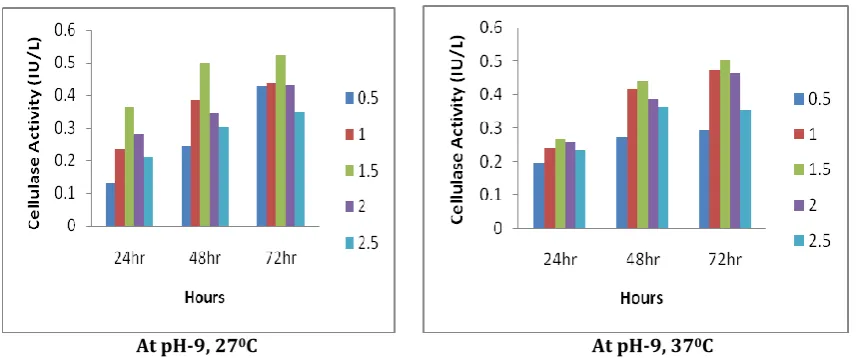
Utilization of CMC as carbon source is best for microbial cellulase production18. In present, 5 concentrations, 0.5, 1, 1.5, 2 , 2.5% of Carboxymethyl cellulose were used for study to determine the optimum concentration of Carboxymethyl cellulose and higher enzyme activity. The higher enzyme activity was at 1.5% and enzyme produced more at 72hr of incubation time.Lesser activity was shown in 24hr and 48hr of incubation time. Some of Streptomyces sp. has been reported to produce higher cellulase enzyme in 72-120 hr of
temperature for Micrococcus spformore enzyme production than 27˚C. Optimum temperature for higher cellulase production was 30°C and the
lowest yield was achieved at 45
°C22.Cellulomonas ASN2 isolated from soil23
exhibited its optimum cellulase activity at pH of
7.5 and temperature of 60˚C24 Bacillus strain M9
and NZ showed more enzyme activity at 72 h incubation.From the optimization results, 1.5% of CarboxyMethylCellulose concentration, pH 8, 72 hr of incubation time and 37˚C of incubation
temperature are the optimum growth
parameters for maximum production of
cellulase enzyme production from Micrococcus
sp. By following this conditions ,could produce
cellulase enzyme easily ,inexpensive production
and without risks. (Figure:-1-Cellulase
Activity (IU/L) is shown below).
Optical density of each sample with reaction mixture was taken at 540 nm in a spectrophotometer .
At pH-7, 27C At pH-7, 37C
At pH-8, 270C At pH-8, 370C
At pH-9, 270C At pH-9, 370C
Fig. 1: Cellulase Activity (IU/L)
REFERENCES
1. Li YH. A novel thermo acidophilic
endoglucanase.Ba- EGA,from a new cellulose degrading bacterium, Bacillus
sp. AC-1.
ApplMicrobiolBiotechnol.2006;70:430-436.
2. Gao J. Production and characterization
of cellulolytic enzymes from the thermo
acidophilic fungal
AspergillusterreusM11 under solid-state cultivation of corn stover. Bioresour Technol. 2008;99:7623-7629.
3. KirkO. Industrial enzyme
applications.Curr.Opin.Biotechnol. 2002;13:345-351.
4. Bhat MK. Cellulases and related
enzymes in biotechnology. Biotechnol Adv. 2000;18:355-383.
5. Bischoff KM. Purification and
characterization of a family 5
endoglucanase from a moderately
thermophilic strain of Bacillus
licheniformis. Biotechnology Letters. 2006;28: 1761-1765.
6. Camassola M. Characterization of the
cellulose complex of Penicillium
echinulatum, Biocatalysts
Biotransformation. AJP. 2004;22:391-396.
7. Haakana H. Cloning of cellulase genes
from Melenocarpusalbomyces and their
efficient expression in
Trichodermareesei. Enzyme Microbial Technology. 2004;34:159-167.
8. Doi RH. Cellulase of mesophilic
microbes: cellulosome and non– cellulosome producers. AnnNYAcadSci. 2008;1125:267–279.
9. Levin L and Forchiassin F. Effect of
carbon and nitrogen sources on the cellulolytic activity of Trametestrogii. Rev Argent Microbiol. 1995;27(1):11-20.
10. Immanuel G. Production of
endoglucanase by using different nitrogen sources by Streptomyces sp. Int J Microbiol. 2007;1:24.
11. Cavaco-Paulo A. Mechanism of cellulase
action in textile processes.
CarbohydrPolym. 1998;37:273-277.
12. Suchita N and Ramesh CK. Bleaching of
wheat straw-rich soda pulp with
xylanase from a
thermoalkalophilicStreptomyces cyaneusSN32. Biores Technol. 2006 ;97:2291-2295.
13. Cherry JR and Fidantsef AL. Directed
evolution of industrial enzymes: an update. Curr Opin Biotechnol . 2003;14:438-443
14. Miller GL. Use of dinitrosalicylic acid reagent for determination of reducing sugar. Anal Chem. 1959;31:426-428.
15. Nakamura K and Kappamura KJ.
Isolation and identification of
crystalline cellulose hydrolysing
bacterium and its enzymatic properties. Ferment Technol. 1982;60(4):343-348.
16. Bhat MK and Bhat S. Cellulose
degrading enzymes and their potential industrial applications. Biotechnol Adv. 1997;15:583-620.
17. Haltrich D. Production of fungal
xylanases. Biores Technol.
1996;58(2):137-161.
18. Fukumori F. Purification and properties
sp. Gen. Microbiol. 1985;131(12):3339-3345.
19. Das A. Production of cellulase from a
thermophilic Bacillus sp isolated from cow dung. American-Eurasian J Agric Environ Sci. 2010;8(6):685-691.
20. Okeke BC and Paterson A. Simultaneous
production and induction of cellulolytic
and xylanolytic enzymes in a
Streptomyces sp. World Journal of
Microbiology and Biotechnology.
1992;8:483-487.
21. Alam MZ. Isolation, Purification,
Characterization of CellulolyticEnzymes Produced by the Isolate Streptomyces omiyaensis. Pak J BiolSci. 2004;7:1647-1653.
22. Harchand RK and Singh S.
Characterization of cellulose complex of Streptomyces albaduncu. Journal of Basic Microbiology. 1997;37(2):93-103.
23. Muhammad Irfan. Isolation and
screening of cellulolytic bacteria from soil and optimization of cellulase production and activity. Turk J Biochem. 2012;37(3):120-128.
24. Sheik Nizamudeen and Bajaj BK. A
novel thermo-alkali
tolerantendoglucanase production
using cost-effective agricultural
residues as substratesby a newly
isolated Bacillus sp. NZ, Food
Technology Biotechnology.