http://www.sciencepublishinggroup.com/j/ijmpem doi: 10.11648/j.ijmpem.20170203.12
Research/Technical Note
Effective Technological Process of Crystallization of
Turning Rollers' Massive Castings: Development and
Analysis
Tamara Skoblo
1, Oksana Klochko
2, *, Efim Belkin
1, Aleksandr Sidashenko
11
Repair Technological Systems Department, Kharkiv Petro Vasylenko National Technical University of Agriculture, Kharkiv, Ukraine 2
Technology of Materials Department, Kharkiv Petro Vasylenko National Technical University of Agriculture, Kharkiv, Ukraine
Email address:
[email protected] (O. Klochko) *
Corresponding author
To cite this article:
Tamara Skoblo, Oksana Klochko, Efim Belkin, Aleksandr Sidashenko. Effective Technological Process of Crystallization of Turning Rollers' Massive Castings: Development and Analysis. International Journal of Mineral Processing and Extractive Metallurgy.
Vol. 2, No. 3, 2017, pp. 34-39. doi: 10.11648/j.ijmpem.20170203.12
Received: June 20, 2017; Accepted: July 12, 2017; Published: July 27, 2017
Abstract:
The paper describes a new method of maximum reducing residual stresses and stabilization of the structure, hardness of the working layer of massive sheet rolls from alloyed cast irons during their crystallization due to controlled decomposition of retained austenite. It is achieved by programmable preheating of the metal form to the temperature of magnetic transformation of doped cementite or special carbides of the castings (depending on the material being processed); meanwhile it is provided an optimum cooling rate with an exposure of up to 6 hours in this interval and maximizes decomposition of retained austenite, minimizes stresses in the working layer. This casting technology is also accompanied by appropriate structural changes. Inhomogeneity of the dislocation structure is noted in various constituent phases. Polygonization and fragmentation along dislocation walls are revealed in the carbide phase. To evaluate the occurring processes, a new method of optical and mathematical description of the phases being formed is used. As a criterion describing the changes in the dislocation structure, we use the parameter - a power dissipation power function. The proposed casting technology for rolls is particularly effective when the proportion of the carbide phase is at least 25%. In this case, the heat treatment of the rolls to relieve stress does not change the stably achieved properties. It is shown that the quality control on the stability of the achieved indicators can be carried out by the coercive force and the level of hardness.Keywords:
Alloyed Cast Iron, Crystallization, Double-Layered Rolls, Decomposition of Retained Austenite, Coercive Force, Hardness, Heterogeneity1. Introduction
To manufacture products and parts that are being operated in wear conditions, high specific pressures, impact and thermal cyclic loads, we use high-alloyed white iron, for example, chromium-nickel, high-chromium, etc., as main structural materials. In particular, such materials are widely used for manufacturing of a working layer of double-layer massive sheet rolls for hot rolling mills [1-4].
Modern white cast iron is complex multicomponent alloys, different in structure and special properties. They have low thermal conductivity, plasticity, and they are characterized by
high shrinkage. In addition, such material tends to increase cracking due to the presence of a significant proportion of retained austenite, which partially decomposes under the influence of increased temperature and pressure during operation. Reducing cracks in rolls can be ensured by complex alloying of cast iron [5-7].
resulting in creating additional structural stresses in the
working layer. This treatment promotes a local
transformation: dispersion hardening and the most complete decomposition of retained austenite. Reducing the proportion of retained austenite ensures that there are no additional stresses in the surface layer during operation, thereby increasing the resistance to cracking [1, 5, 8].
However, this additional heat treatment does not provide the required stable level of hardness of the working layer of forming rolls; it does not allow to predict their operational stability and efficient selection of roll sets [9-11].
Therefore, the authors of the present paper have carried out a number of studies aiming to minimize residual stresses and stabilization of hardness of the working layer during crystallization of low- and high-alloyed cast iron while
manufacturing massive castings due to controlled
decomposition of retained austenite. The main results of our study are presented in the current paper.
In our article, we refer to our works that include the results of the research of phase formation in iron-carbon alloys and of the effective materials development for mill rolls. We also refer to our own publications describing technology of mill rolls production and thermal hardening. These studies continue since 1967 in the framework of an international scientific school under the guidance of Professor, Doctor of Technical Sciences Tamara S. Skoblo [1, 5].
2. Materials and Experiment
Crystallization of castings for such rolls was carried out in a metal form pre-heated to the temperature of the magnetic transformation of cementite or special carbides of cast irons of the working layer with different degrees of alloying. This process ensured the maximum removal of residual stresses and the complete decomposition of the retained austenite, as well as stabilization of hardness without additional heat treatment. At the same time, these parameters were controlled by hardness and the non-destructive method according to the level of the coercive force.
The groups of double-layer cast-iron rolls for hot rolling mills cast by the centrifugal method have been statistically analyzed. The roll barrel size is 670 × 1700 mm, the working layer hardness is 73 D, by Shore. We have studied two types
of rolls with the following chemical compound:
1. roll type No. I: C (2.96%), Cr (1.5%), Mo (0.5%), Ni (4.5%) with carbide phase of cementite type (ЛПХНМд industrial version of the roll);
2. roll type No. II: С (2,72-2,86%), Сr (up to 18%), V (up
to 0,24%), Ni (up to 1,5%) with Сr7С3 and Сr6С23 special
carbides (ЛПХ 18 Нд industrial version of the roll).
The rolls were cast by the centrifugal method into the metal form heated up to 130 º, 150 º, 190 º, 200 º, 210°C (roll type No. I) and up to 200 º, 350 º, 450°C (roll type No. II) in accordance to the different types of basic carbide phase.
The development of a new method of optical and mathematical analysis which does not require the use of special equipment for analysis, the basic comprehensive research has been carried out. The latter includes an estimate of the retained austenite proportion via X-ray structural phase analysis. Besides this, the types of carbide phases previously determined by the chemical method have been estimated [12]. In addition, calculations on the thermodynamic evaluation of the carbide phases separation in the alloyed cast iron have been performed [1, 13].
The X-ray structural phase analysis has been conducted using DRON-7 X-ray diffractometer with monochromatized copper radiation (λ = 1.54 Å).
3. Results and Discussion
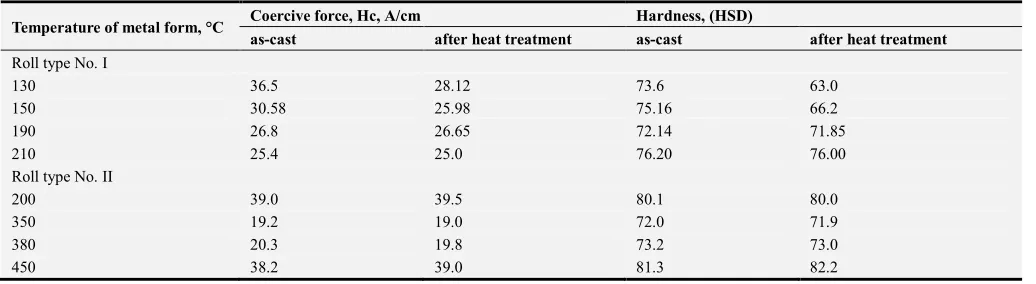
Table 1 represents the results of the analysis of changes in the average hardness and coercive force in the working layer of mill rolls cast in a centrifugal way. It has been found that in order to stabilize the hardness, to achieve the maximum removal of residual stresses and decomposition of retained austenite in the cast iron in the studied castings' working layer, it is necessary to preheat the metal form before pouring the metal of the working layer to the temperature of the carbides magnetic transformation (190 º 210 º and 350 º -380°C, respectively). Such a temperature of the metal form ensures the most complete realization of the magnetostriction phenomenon due to the prolonged residence of the metal of the working layer during crystallization within the temperature range of magnetic transformation (for ~ 6 hours) [14].
Table 1. Average values of hardness and coercive force of the working layer of chromium-nickel and high-chromium rolls at different preheating temperatures of the metal form before pouring the working layer.
Temperature of metal form, °С Coercive force, Hc, A/cm Hardness, (HSD)
as-cast after heat treatment as-cast after heat treatment
Roll type No. I
130 36.5 28.12 73.6 63.0
150 30.58 25.98 75.16 66.2
190 26.8 26.65 72.14 71.85
210 25.4 25.0 76.20 76.00
Roll type No. II
200 39.0 39.5 80.1 80.0
350 19.2 19.0 72.0 71.9
380 20.3 19.8 73.2 73.0
Analysis of the data presented shows that rolls that are cast in metal forms and heated to the temperatures of the magnetic transformation of the cast iron carbide phases within the working layer are hardness stable in the depth of the entire working layer. This is explained by the fact that the temperature of the metallic form while pouring cast iron during crystallization of the metal supports the removal of stresses and the maximum disintegration of retained austenite, which can be controlled according to the level of the coercive force. Note that the considered process takes place when cast iron is within the interval of the magnetic transformation of cementite or special carbides. The disintegration of retained austenite provides the stable hardness.
The hardness level during the heat treatment falls by 13.5% while pouring into metallic form heated up to 130°C (see Table 1). The part of austenite does not decrease significantly: it varies from 13.6 to 11.3% for low-alloyed cast iron and from 20.3 to 19.8% for high-alloyed one in the form heated up to 200°C. When being cast into a metal form heated to the magnetic transformation temperature of low-alloyed cast iron (190° – 200°C), the part of retained austenite does not exceed 6.9 – 8.3%, while the part of high-alloyed austenite (350° – 380°C) decreases more than twice 7.1 – 9.2%.
At the same time, the hardness and the coercive force practically do not change; additional heat treatment is not required. In this case, the level of hardness and the level of the coercive force during heat treatment are almost invariable. It is very important when selecting rolls in a set and their stable operation.
If the part of the carbide phase in the working layer is less than 25%, a sufficient level of stresses of the second kind (structural stresses formed as a result of the magnetostriction phenomenon) is not attained. This assists the complete disintegration of the retained austenite. In addition, during crystallization of the working layer with less than 25% of the carbide phase, the required hardness level (70 – 75 D, by Shore) is not provided. When the content of carbide phases exceeds 40%, the level of such stresses sharply grows, on contrary; it helps to stabilize the retained austenite and do not allow achieving the constant hardness during operation. At the same time, when the content of carbide phases is greater than 40%, a tendency to breaking off the coarser inclusions in the working layer (the hardness level exceeds 80 D, by Shore) increases during operation.
To estimate structural changes occurring during
crystallization while manufacturing castings, changes in the dislocation structure were studied according to the developed method. This reflects the appearance of local stresses arising while providing the special exposure in the magnetic transformation of carbide phases and the heterogeneity development.
It has been found that the analysis by the conventional metallographic and electron microscopic methods does not
allow estimating the emerging local concentration
heterogeneity of the components for the structural constituents of different phases of the alloyed cast iron heterogeneous structure [15]. Therefore, our studies have been carried out on the basis of the complex analysis included the usage of the vacuum etching treatment methods in order to identify dislocations; the analysis is followed by estimating the structural changes formed.
The method of optical and mathematical analysis of metallographic images has also been used in order to trace changes of dislocation structure and its density. The estimate has been provided in accordance with the location of the calculated values on the metallographic structure image digitalized into. bmp format. In the process of analysis the image has been divided into 3 x 3 pixel boxes.
The pictures of microstructures of chromium-nickel iron were subjected to analysis using the previously developed method of optical-mathematical computer analysis [16] to identify and simulate the process of local stresses formation, as well as to study changes in the dislocation structure of various phases occurring in high-carbon alloyed alloys under stress conditions. The method of computer research is based on hydrodynamic analogies with the application of the Navier-Stokes [17] equations that occur while creating phases (diffusion process, density change) [18]. In this case, an estimate of inhomogeneity which determines the intensity of the dislocation structure change and an estimate of the distribution density have been carried out.
As a simulation, the method of detecting dislocations of the structure by etching under deformation in a vacuum of
3×10⁻³ mm Hg was used on a microscope of the Lozinsky
system [19].
During plastic deformation at the interphase boundaries of different phases in the heterogeneous high-carbon alloy, deformation and contact stresses appear due to their different degree of deformability [20, 21]. Such a structure is a system of a stressed layer (carbide phases) and a plastic layer (matrix) containing dislocations at the interphase boundary. Plastic deformation is implemented through dumping of the stresses on concentrators followed be the development of various defects. In the process of deformation (cold working), free energy of the metal rises mainly due to the internal energy increase. The increase of disorder in a deformed metal leads to entropy varying (it may increase as a result of plastic deformation or decrease due to the defects growth during deformation). Therefore, we use an energy parameter (the function of energy power dissipation) as a criterion to describe changes in the dislocation structure and in its density:
= , ∙ , (1)
In (1) is the product of Divergence by Laplacian of
, function where and are coordinates of the
considered spot of the metallographic region. Here
, ≡ ∆ , , , (3)
In the finite-difference approximation, , takes the
form of a 3 x 3 matrix:
,
, , ,
, , ,
, , ,
(4)
The matrix processing is provided through the sequential scanning of each pixel which has been set as a centerpoint inside a 3 x 3 pixel box. Pixels of the image has been set as
coordinates (relative to , : is the row and is the column
number).
, and , take the following form in the
finite-difference approximation:
, , , ! 2 , ; (5)
, , , , , ! 4 , (6)
, is a code of a representative color obtained when
digitalizing a metallographic image. The first term in (1) shows the measure of incompressibility (density of an image fragment, zones of condensation and vacuum), while the second one in (1) describes the diffusion of chemical elements. Hence,
, % , , ! 2 , & ∗
∗ , , , , ! 4 , (7)
To unambiguously identify the dislocation structure in the form of a configuration formed by stresses around a single
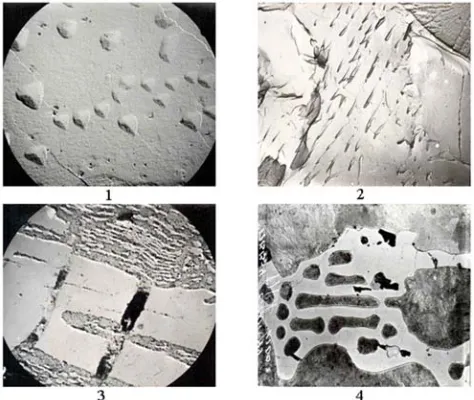
dislocated carbide phase in vacuum, we have studied the samples using the Karl Zeiss electron emission microscope EF-6 within the 250° - 550°C etching range (Figure 1, structures No. 1, 2 and 3). To estimate the inhomogeneity obtained as a result of a change in the dislocation structure and its density, we studied the pictures of the structures of chromium-nickel iron in the deformation zone after crystallization (see Figure 1, structure 4).
Figure 1. Microstructures of chromium-nickel cast iron. Vacuum etching: No. 1 – 3; as-cast: No. 4. Magnitudes: ×500 - No. 4; ×3400 - No. 3; ×4800 - No. 1; ×10000 - No. 2.
Table 2. Distribution of average values of the energy power dissipation function.
Dissipation power value
Photo No. Absolute value Negative value Positive value
Average Mean-square deviation Average Mean-square deviation Average Mean-square deviation
10006.20 41196.30 1496.80 1211.30 62748.20. 85668.90 1
12379.40 43207.00 2118.10 2333.40 73777.90 81271.00 2
9762.10 38830.70 1621.80 1530.90 50897.10 76041.90 3
9131.30 37287.30 1343.90 1238.60 40514.60 70072.50 4
To determine the inhomogeneity that estimates the intensity of changes in the dislocation structure, mean values of the energy dissipation power over the entire image, as well as its fluctuations, have been calculated (Table 2). In this case, since during deformation the energy state of the metal is nonequilibrium, while calculating we consider this parameter with reversed signs. The positive value corresponds to the states of dislocation density increase (compression), while the negative one corresponds to the rarefaction (stress relief zones). We have also found absolute values of the dissipation power characterizing the proceeding process as a whole.
As a result of the analysis of the values obtained, it is established that the law of energy dissipation power distribution, resulting from deformation effects, is close to an exponential one.
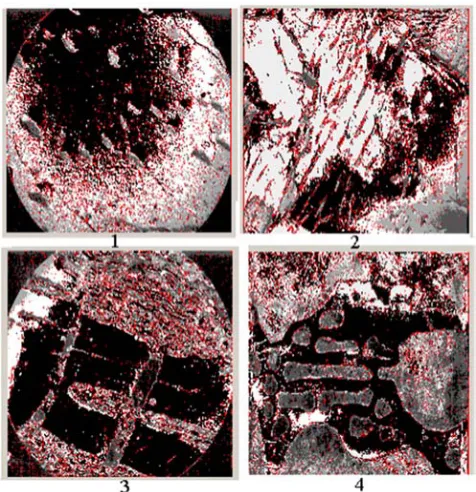
Figure 2 shows the images characterizing the distribution
of absolute values of the energy power dissipation function for each picture. Therewith, the values with a parameter different from zero are displayed on the screen. The black color showed no energy dissipation, i.e. the equilibrium state. When exceeding the absolute value of 11500, characterizing the most energetically unstable state, the red point on the screen was displayed for clarity. Further increase in the threshold value did not make sense, as the computer program did not process correctly this level of readings any more. Obviously, these values are a sensitivity threshold for the optical-mathematical analysis.
By comparison of the obtained values of the dissipation power and the etching figures (Figure 1 and Figure 2, structures No. 1-3), it has been found that the calculated values exceed a predetermined threshold on such structures.
carbon content in chromium-nickel cast iron, it should be taken into account that the plasticity of pearlite under deformation depends on the orientational bound between ferrite and cementite. Since the coincidence of sliding of the ferrite and cementite systems occurs rarely, the deformation along the cementite plates is comparatively rare. The deformation limitation of the ferrite plates leads to the following: even after small processing levels the dislocation density near the cementite plates sharply increases due to the boundary surface of the ferrite-cementite is not only the source of dislocation, but also an obstacle for their motion. The latter enables the cross-slip and the appearance of the cellular structure in pearlite ferrite with forming dislocation walls along the cementite plates. The increase of local stresses and the density of dislocations is observed. Image of the structure 3 (see Figure 2) shows decoration of such regions which appears as a result of diffusion of carbon atoms.
Figure 2. Distribution of absolute values of the energy power dissipation. Red color indicates the dislocation structure. Vacuum etching: No. 1 – 3; as-cast: No. 4.
While heating the samples in the process of vacuum etching, zones of plastic deformation have been observed and further revealed by texture stresses (by parallel folds). Such stresses have been unraveled through dislocation lines and slip bands appeared. The change in the stressed state is characterized by various stages of slip.
When heated up to 500°C, an easy slip of individual dislocations in local regions has been noted. During our observations, as a rule, a single sliding and dislocations system cover large distances. This contributes to forming dislocation walls (see Figure 2, structures No. 1 – 3). We have found out that such dislocations in the carbide phase of chromium-nickel iron are characterized by a small size of etching patterns and are uniformly distributed throughout the
crystal in the plasticity zone at low exposure times during heating. These structures are at a considerable distance from the previously identified ones and slide easily due to the absence of significant segregation of impurity atoms on them (see Figure 2, structure No. 1, dislocation decoration is poorly expressed). The inhomogeneity of the dislocation structure distribution is observed (see Figure 2) while there is no significant heterogeneity within the phase in local zones in terms of chemical composition (see Table 2).
4. Conclusions
The paper represents a new technological process to produce double-layer sheet rolls made of alloyed cast iron cast into metal forms by a centrifugal method; it allows programming conditions for crystallization of casting with the exposure of the working layer for 6 hours within the interval of the magnetic transformation of cementite or special carbides.
Complex studies have shown that the observed can be achieved by preheating metal forms for rolls from chromium-nickel cast iron to 190 º - 210 ° C and for rolls from high-chromium cast iron – to 350 º - 380 ° C. This technology of casting rolls can significantly reduce the share of retained austenite by more than 2 times, stabilize the level of hardness, minimize the stress level, which is important when selecting rolls in a set and their effective operation. The new casting technology is based on the phenomenon of magnetostructural changes and it is recommended to use for alloyed cast iron with a fraction of carbide phases within the range of 25-40%.
To describe the structural changes occurring in this technological process, a new method for the optical-mathematical description of structural changes in various phases is proposed for laboratory modeling when creating stresses of the second kind. The method of describing structural changes is based on the detection of a dislocation structure and the function of the energy dissipation power is used as an estimated parameter.
It is established that long-term being of the working layer metal in the interval of magnetic transformation of carbides additionally creates local deformations with an increased density of dislocations, as well as formation of an ordered structure in the form of walls, breaking this phase.
The revealed structural changes allow to correct the casting parameters, stabilize the properties of the alloy during operation and estimate the degree of their stability according to the coercive force and hardness.
The proposed method of casting rolls makes it possible to exclude thermal treatment to relieve stresses.
References
[2] T. Kudo, S. Kawashima, R. Kurahashi. Development of Monobloc Type High-carbon High-alloyed Rolls for Hot Rolling Mills // ISIJ International. - Vol. 32, 1992, No.11, pp. 1190-1193.
[3] T. S. Skoblo, V. Tokmakov. Application of hard alloy rolls for high quality rolling // Chern. Met. - Bul. NTI, 1992, Vol. 6, pp.3-18.
[4] E. N. Vishnyakova, T. S. Skoblo et al. The Production of Rolling Mill Rolls From High-Chromium Cast Iron // Metall. Gornorudn. Prom-st. – 1987, No.1, pp.28-30.
[5] T. S. Skoblo, N. M. Voroncov, S. I. Rudyuk. Prokatnye valki iz vysokouglerodistyx splavov [Rolling rolls made of high-carbon alloys]: pod. red. T. S. Skoblo. – M.: Metallurgiya, 1994. – 336 p. [in Russian].
[6] Skoblo T, Sandler N, Govor U. Mechanical properties, wear-resistance, and use of cast iron alloyed with vanadium and niobium for rolling rolls // Chernaya metalluriya. - 1967, pp.115-119.
[7] V. M. Kolokoltsev, E. V. Petrochenko. Structure features and properties of high-alloy white irons // Vestnik of Nosov Magnitogorsk State Technical University. – 2013, No.5, pp.3-8.
[8] A. Wiengmoon, J. T. H. Pearce, S. Nusen, T. Chairuangsri. Effects of Si on microstructure and phase transformation at elevated temperatures in ferritic white cast irons // Materials Characterization. - October 2016, Vol.120, pp.159-167. [9] T. S. Skoblo, O. Yu. Klochko, A. I. Sidashenko, R. G.
Sokolov. Heat treatment of two-layer alloyed-iron rollers // Steel in Translation. – September 2013, Vol. 43, Issue 9, p. p. 603-606.
[10] D. Kopyciński, E. Guzik, D. Siekaniec, A. Szczęsny. Analysis of the High Chromium Cast Iron Microstructure after the Heat Treatment // Archives of foundry engineering. – Vol. 14, Issue 3/2014, pp.43-46.
[11] O. Yu. Klochko. Vlijanie nizkotemperaturnoj ciklicheskoj termoobrabotki na strukturnuju neodnorodnost' v massivnyh otlivkah iz vysokohromistogo kompleksnolegirovannogo chuguna [Effect of low-temperature thermal cycling on structural heterogeneity within massive castings from high-chromium complex-iron] // Vіsnik of HNTUSG. - Vol.101, 2010, pp.73-77 [in Russian].
[12] O. I. Nikitina, S. V. Spirina, E. P. Gubenko, T. S. Skoblo, V. P. Danilenko. Isolation of Carbide Phase in Chromium-Nickel and High-Chromium Cast Iron With a Potentiostatic Method // Ind. Lab.(USSR). – 1979, 45 (11), pp.1214-1217.
[13] T. S. Skoblo, E. N. Vishnyakova et al. Thermodynamic evaluation of carbide phase precipitation in high-chromium cast irons //Metallovedenie i Termicheskaya Obrabotka Metallov.-1990, No.1., pp.56-59.
[14] A. I. Sidashenko, T. S. Skoblo, O. Yu. Klochko et al., Ukrainian patent UA 105761, Byull. Izobret., 2016, No. 7. [15] T. S. Skoblo, O. Yu. Klochko, E. L. Belkin. Structure of
high-chromium cast iron. Steel in Translation. – March 2012, Volume 42, Issue 3, pp. 261-268.
[16] T. S. Skoblo, O. Yu. Klochko, E. L. Belkin. Primenenie kompjuternogo analiza metallograficheskih izobrazhenij pri issledovanii structury vysokohromistogo chuguna [The use of computer analysis of metallographic images in the study of high-chromium cast iron structure] // Zavodskaya laboratoriya. Diagnostika materialov. – 2012, 6 (78), pp.35-42 [in Russian].
[17] Patrick J. Roache. Fundamentals of Computational Fluid Dynamics. Publisher: Hermosa Pub, 1998, 648 p.
[18] T. S. Skoblo, E. L. Belkin, O. Y u. Klochko. Obosnovanie primenenij ponyatij uravnenij gidrodinamiki Navje-Stocksa dlya analiza mettalographicheskih izobrazhenij [Application justification of the concepts of fluid dynamics Navier-Stokes equations for the analysis of metallographic images] // Materiały VII Mięzdynarodowej naukowi-praktycznej konferencji. – Przemyśl: 2011, Vol. 21, p. p.94-96 [in Russian].
[19] T. S. Skoblo. Field Emission Microscope Applied to Study of Structure and Properties of Cast Iron // Ind. Lab. – 1972, Vol.38 (8), pp.1217-1219.
[20] M. F. Ashby. The deformation of plastically non-homogeneous materials // Philosophical Magazine. - Vol. 21, 1970, pp. 399-424.