Graphical Abstract
To create your abstract, type over the instructions in the template box below. Fonts or abstract dimensions should not be changed or altered.
A Mitsunobu reaction to functionalized cyclic
and bicyclic N-arylamines
Daniel M. Gill,
abMatthew Iveson
c, Ian Collins
d, Alan M. Jones
a*
N
N
N O
O
O Me Me
N
N NH X
O
O Me Me
O
Mitsunobu conditions
X = O, S not isolated
N
N N O O
MeMe
quantitative
6 steps H
H
HXAc NH
O
1
Tetrahedron Letters
j o u r n a l h o m e p a g e : w w w . e l s e v i e r . c o m
A Mitsunobu reaction to functionalized
cyclic and bicyclic
N
-arylamines
Daniel M. Gill,
abMatthew Iveson
c, Ian Collins
d, Alan M. Jones
a∗
a
School of Pharmacy, University of Birmingham, Edgbaston, B15 2TT, UK
b
School of Chemistry, University of Birmingham, Edgbaston, B15 2TT, UK
c Division of Chemistry and Environmental Science, Manchester Metropolitan University, M1 5GD, UK d
Cancer Research UK Cancer Therapeutics Unit, The Institute of Cancer Research, London SM2 5NG, UK
———
∗ Corresponding author. (A.M.J.) Tel.: +44-(0)121-414-7288; e-mail: [email protected]; web: www.jonesgroupresearch.wordpress.com
The Mitsunobu cyclodehydration reaction1 is defined as the formation of azacycles from α,ω-aminoalcohols via a phosphonium intermediate. Due to the mild reaction conditions and stereoinversion at the reacting centre, the Mitsunobu reaction has found widespread use.2 The Mitsunobu cyclodehydration approach has found specialist uses, although less widespread application,3 due to a variety of alternative methods to access azacycles,4 including acid catalysed dehydration, functionalisation of the alcohol to an appropriate leaving group, and the Appel reaction amongst others. An elegant application of the Mitsunobu cyclodehydration reaction has been reported by Park and co-workers5 to access trans-2,3-disubstituted indolines from N-pivaloyl-2-aminophenethyl alcohols (Fig. 1). The reported mechanism abides by the pKa rule for the Mitsunobu reaction (pKa < 15 for the nucleophilic component)6 with the pKa of the anilide NH calculated7 as ca. 14, and whereby the bulky electron withdrawing pivaloyl group is a pre-requisite for the reaction to occur.
Figure 1.The Mitsunobu cyclodehydration reaction reported by Park and co-workers.5
During the course of our research programme, we encountered Mitsunobu cyclisation reactions occurring in examples where the calculated pKa of the NH group was significantly greater than 15; e.g. for 1 (calculated pKa18.8) (Scheme 1).8
Scheme 1.Previous work8 involving structural reassignment of the
Mitsunobu products resulting from macroetherification.
As shown in Scheme 1, we recently reassigned8 the structure of a cyclin-dependent kinase (CDK) inhibitor as an alternative Mitsunobu product to the proposed macrocyclic ether, that occurred via a Mitsunobu cyclodehydration. Most likely, the phenolic hydroxyl group in 1 acted as an initiating group for the Mitsunobu reaction to deliver 3 over the expected 2.
In an unrelated medicinal chemistry program and the focus of this paper, we again unexpectedly observed the occurrence of a Mitsunobu cyclisation reaction affording the novel structure 8
(Scheme 2).9
A R T I C L E I N F O A B S T R A C T
Article history:
Received
Received in revised form Accepted
Available online
The scope of an unexpected Mitsunobu cyclisation to prepare N-arylated Fsp3-enriched azacycles was investigated. In the current study, we have identified whether a pKa-dependent Mitsunobu cyclodehydration or a pKa-independent Mitsunobu intramolecular reaction was in operation. A Mitsunobu reaction, creating a leaving group, followed by intramolecular nucleophilic displacement was determined to be the dominant pathway.
2009 Elsevier Ltd. All rights reserved.
Keywords:
Mitsunobu Cyclodehydration
Nucleophilic Aromatic Substitution Intramolecular
Cyclisation
NH OH R2
R1
O
tBu
PPh3, DEAD
N R2
R1
O
tBu
MeCN, 25 oC, 6h yields: 50-75%
N N
Br H N
HN OH
OH N N
Br H N
HN O
N N
Br N
HN OH
reported product 2
Structural re-assignment 3 1
DEAD, PPh3 NMM
Scheme 2. An unexpected Mitsunobu cyclodehydration reaction afforded 8
over the expected 7.
The routine conversion of the 5’-alcohol of a carbosugar 6, prepared via microwave assisted SNAr of 4 and 5,to a thioacetate
group using thioacetic acid (measured pKa 3.3)10 under standard Mitsunobu conditions did not afford the expected product 7. Instead a novel product resulting from the NH group (calculated pKa 17.6)7 cyclising onto, the presumably, activated 5’-alcohol was isolated in quantitative yield (99%). Representative nOe correlations that demonstrate the 3D structure and connectivity of
8 are shown in Fig. 2.11
Figure 2.Selected nuclear Overhauser exchange (nOe) correlations detected in the NMR spectrum of 8 that demonstrate the new C-N connectivity resulting from Mitsunobu cyclodehydration.11
Prompted by these results and other examples of both Mitsunobu cyclisation and cyclodehydration reactions,12 as well as the Mitsunobu pKa rule13 we considered several factors as to why 8 was formed in preference to 7:
• Is a thio-Mitsunobu reagent formed? • Is there a steric requirement to cyclisation? • Can the pKa rule be extended?
These observations are addressed in the following sections. The presence of both triphenylphosphine oxide and triphenylphosphine thioxide were detected by mass spectrometry of the crude reaction mixture from the conversion of 6 to 8
(Scheme 2A). The reaction was repeated under identical
conditions with the replacement of thioacetic acid by acetic acid to probe if a thio-Mitsunobu mechanism was operating. Under analogous conditions with acetic acid, 8 was again isolated exclusively, thus ruling out this pathway. The observation of PPh3=S presumably from the reaction of triphenylphosphine with
thioacetic acid14 was therefore shown to be not involved in the reaction pathway of 6 to 8 (Scheme 2A).
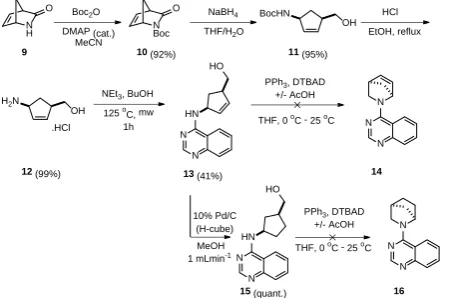
To probe whether steric compression in 6 caused by the acetal protected diol (between the N-orbital of the quinazoline and the hydroxyl leaving group) was the cause or enhanced the rate of cyclisation of 6 to 8, two control compounds 13 and 15 were synthesised without the dihydroxy sugar motif (Scheme 3). Molecular modelling using MM2 calculations showed 13 and 15
to have comparable distances between the reacting NH and OH centres as in 6 (3.7 Å (15)-4.8 Å (13) vs. 5.0 Å (6), respectively).15 The preparation of 13 began with di- tert-butyldicarbonate protection of vince lactam 9 to afford 10 in excellent yield. Sodium borohydride mediated reductive ring cleavage of 10 afforded the ring-opened product, 11.16,17 Acid mediated deprotection of 11 proved facile yielding 12 as the hydrochloride salt. Subjection of a mixture of
4-chloroquinazoline and 12 to microwave assisted SNAr conditions
afforded 13 in modest yield. It was found that subjection of 13 to the standard Mitsunobu cyclodehydration reaction conditions of triphenylphosphine and di-tert-butylazodicarboxylate (DTBAD) did not afford 14 either with or without acetic acid. Instead, recovered starting material and decomposition products resulted. This outcome suggested the steric compression from the 2’,3’ protected alcohols played a significant factor in the high yielding formation of 8 (Scheme 2) possibly due to a pseudo-Thorpe Ingold rate acceleration.17 To further probe the difference between 6 containing an sp3-sp3 bridge and 13 containing an sp2 -sp2 bridge, compound 13 was reduced to afford 15. When subjected to standard Mitsunobu conditions, 15 did not afford a cyclised product, supporting the assertion that the original architecture of 6 enhanced the formation of Mitsunobu cyclisation product 8 over Mitsunobu substitution product 7.
Scheme 3. Preparation of model compounds 13 and 15 for attempted Mitsunobu cyclisations.
pKa and ring size effects in model systems
It became apparent that steric compression played a factor in the formation of 8,enabling the amino and 5’-hydroxyl groups to be in close proximity. However, the question of whether this Mitsunobu cyclodehydration reaction would be possible in simpler and potentially more often encountered systems remained to be studied. Therefore, a simplified system probing the pKa of the secondary amine NH of the aryl amino group and its effect on Mitsunobu cyclisation was investigated. Examples of the reaction precursors prepared are shown in Table 1.
Table 1. Preparation of model SNAr products. Isolated yield from
microwave irradiation reported in brackets. aComparative yield for thermal
SNAr conditions; n.d. not determined. Conditions: heteroaryl chloride (1.0
eq.), aminoalcohol (1.1 eq.), NEt3 (1.5 eq.) and n-BuOH (1 mL) were either
irradiated at 125 oC (30 W) in a microwave reactor for 1 h or refluxed for 16
h. N N NH HO O O Me Me N N NH S O O Me Me O thioacetic acid PPh3, DTAB
THF, 0 oC
expected product 7 0% N N N O O MeMe
isolated 8 99% NH3.TFA
OH O O Me Me N N Cl
mw assisted SNAr 59% 6 5 4 N N N O O H H H H H
H H N
O O H H H H H H N N H N-C rotation H H N
H NBoc
BocHN
H2N
N N HN HO N N N 9 10(92%) 11 (95%)
13 (41%) 14 Boc2O
DMAP (cat.) MeCN
NaBH4
12(99%)
THF/H2O
HCl EtOH, reflux
NEt3, BuOH
125 oC, mw 1h
PPh3, DTBAD +/- AcOH THF, 0 oC - 25 oC
N N HN
HO
15 (quant.) 10% Pd/C (H-cube) .HCl OH N N N 16 O O OH
PPh3, DTBAD
+/- AcOH THF, 0 oC - 25 oC MeOH
1 mLmin-1
N X Cl
mw / thermal H2N( )OH
n N X NH OH n ( ) N N NH OH
21a (87% vs 72%a) N N NH OH N N NH OH
21b (83% vs 70%a)21c (85%) N
NH OH
22a (88%) N NH OH N NH OH
22b (86%) 22c (81%)
N N NH
OH
23a (79% v 65%a) N N NH OH N N NH OH
23b (77% vs 53%a)23c (n.d) N
N NH
OH
24a (75%) N N NH OH N N NH OH
24b (77%) 24c (n.d.) Cl
Br Br Br
Cl Cl
3
The SNAr reaction (Table 1) proved robust with 10 high
yielding reaction products from 12 reactions, with no discernible difference in yield based on the carbon chain length of the aminoalcohol. In two cases, 23c and 24c, the aminopentanol reaction gave a complex mixture which prevented isolation (compared with 21c and 22c, respectively). This may be due to competitive N- and O- nucleophilic substitution when a less reactive electrophile is employed.
Four direct comparisons of microwave irradiation and traditional thermal heating were examined, 21 a-b and 23 a-b. In all cases microwave irradiation proved superior, delivering higher conversions and subsequently, isolated yields of the SNAr
products. All successful SNAr products were subjected to the
standard Mitsunobu conditions (Table 2).
Table 2. Transformation of selected examples of 21-24 to azacycles 25-30. awithout AcOH; baddition of AcOH (1.0 equiv.); c addition of AcSH (1.0
equiv.). Conditions: aminoalcohol (1.0 eq.), (thio)acetic acid (1.0 eq.), PPh3
(1.5 eq.), DTBAD (1.5 eq.) and THF (5 mL) was stirred at 0 oC to 25 oC for
24-48 h.
Table 2 demonstrates that in examples where the pKa of the NH groupis greater than 15, (calculated pKa range 16-22), only trace yields of the cyclised product formed when a more acidic proton donor (AcOH) was not present. In selected examples where an additional proton donor is present (1.0 equiv. of acetic acid), reactions that previously did not deliver the azacycle proceeded in modest yield. Most likely, in these examples an acetate leaving group was installed via a classic Mitsunobu reaction followed by cyclisation.18 Evidence for the acetate leaving group formation was identified in the crude 1H NMR spectra.This is also a plausible mechanism by which 8 formed from 6 in Scheme 2A, via a (thio)acetate leaving group. However, the use of a stronger acid source, thioacetic acid, proved counterproductive in examples 26-28 and 30. All examples of the aminopropanol containing compounds failed to deliver the corresponding 4-membered azacycles (not shown), which could be attributed to the ring strain that would result. The fact that a trace reaction occurred in selected reactions (without an additional proton donor), suggests it may be a possible for the competing Mitsunobu cyclodehydration to operate but may also be due to adventitious water initiating the reaction giving rise to the capricious nature of these reactions when the pKa of the NH group is greater than 15. In all the successful examples of the cyclisation, it was found that heating the reaction, to try to force the reaction to completion, reduced the yield of the product. Importantly, the successful reactions in Table 2 demonstrate that an intramolecular hydrogen bond between the 5’-OH group and one of the oxygens of the acetal in 6 that could possibly activate the alcohol in the Mitsunobu reaction to 8 was not essential for reactivity.
Finally, to probe whether a non-competent mineral acid (eg. HCl) could be used to activate the azodicarboxylate compound to form the betaine Mitsunobu intermediate (but not form a leaving
group) was attempted. Syringe-pump addition of 4.0 M HCl in dioxane to reaction mixtures without a competent acid group (based on calculated pKa)failed to deliver the cyclised products
26, 27 and 30. This information, combined with the previous experiments suggests in the original example (68)19 the pKa effect of the NH group is not as important as the formation of a leaving group on the hydroxyl group and therefore 8 was most likely formed via a Mitsunobu cyclisation instead of a cyclodehydration reaction. Our results suggest the Mitsunobu pKa argument holds.
Herein, we report a complex example of an unexpected Mitsunobu cyclisation reaction. The mode of reaction, steric parameters and pKa effects that induced this reaction were investigated, revealing the steric compression required for 5’-activation in the carbosugar. Furthermore, we investigated a range of potential ring sizes that could be accessed via Mitsunobu cyclisation in a series of 10 aryl aminoalcohols prepared via SNAr
chemistry. It is of importance to note that when the NH group is insufficiently acidic to initiate a cyclodehydration reaction, an additional Mitsunobu-competent acid can rescue the reaction. In this case a traditional Mitsunobu intramolecular reaction creating a leaving group, followed by an intramolecular displacement that no longer involves the Mitsunobu reagents occurs, but remains dependent on the nucleophilicity of the NH group.
Acknowledgments
The authors thank the Institute of Cancer Research (London), Manchester Metropolitan University, and the Centre for Chemical and Materials Analysis in the School of Chemistry at the University of Birmingham for analytical support. D.M.G. thanks the Institute of Clinical Sciences and the College of Medical and Dental Sciences (University of Birmingham) for PhD funding.
References and notes
1. For recent reviews of the Mitsunobu and cyclodehydration reactions see: (a) Fletcher, S. Org. Chem. Front. 2015, 2, 739-752; (b) But, T. Y. S.; Toy, P. H. Chem. Asian J. 2007, 2, 1340-1355. 2. Swamy, K. C. K.; Kumar, N. N. B.; Balaraman, E.; Kumar, K. V.
P. P. Chem. Rev.2009, 109, 2551-2651.
3. (a) Wang, F.; Hauske, J. R. Tetrahedron Lett. 1997, 38, 6529-6532; (b) Whiting, E.; Lanning, M. E.; Scheenstra, J. A.; Fletcher, S. J. Org. Chem.2015, 80, 1229-1234; (c) Garcia-Delgado, N.; Riera, A.; Verdaguer, X. Org. Lett. 2007, 9, 635-638.
4. (a) Wang, Y.; Oriez, R.; Kuwano, S.; Yamaoka, Y.; Takasu, K.; Yamada, K.-I. J. Org. Chem. 2016, 81, 2652-2664; (b) Davies, S. G.; Fletcher, A. M.; Foster, E. M.; Houlsby, I. T. T.; Roberts, P.; Schofield, T. M.; Thomson, J. E. Org. Biomol. Chem. 2014, 12, 9223-9235
5. Kang, K. H.; Kim, Y.; Im, C.; Park, Y. S. Tetrahedron2013, 69, 2542-2549.
6. For pKa effects in the Mitsunobu reaction see: (a) Mitsunobu, O.
Synthesis, 1981, 1, 2; (b) Huges, D. L. Organic Reactions, 1992,
42, 335 (John Wiley & Sons, Inc., New York); (c) Wada, M.; Mitsunobu, O. Tetrahedron Lett. 1972, 13, 1279.
7. ACE & JChem® pKa calculator, available at:
https://epoch.uky.edu/ace/public/pKa.jsp
8. Jones, A. M. Molbank2015, M859.
9. (a) Cheeseman, M. D.; Westwood, I. M.; Barbeau, O.; Rowlands, M.; Dobson, S.; Jones, A. M.; Jeganathan, F.; Burke, R.; Kadi, N.; Workman, P.; Collins, I.; van Montfort, R. L. M.; Jones, K. J. Med. Chem. 2016, 59, 4625−4636; (b) Jones, A. M.,Westwood, I. M., Osborne, J. D., Matthews, T. P., Cheeseman, M. D., Rowlands, M. G., Jeganathan, F., Burke, R., Lee, D., Kadi, N., Liu, M., Richards, M.; McAndrew, C., Yahya, N., Dobson, S. E., Jones, K., Workman, P., Collins, I., van Montfort, R. L. M. Sci. Rep. 2016, 6, 34701.
10. Bordwell, F. G. Acc. Chem. Res. 1988, 21, 456-463. 11. See ESI.
N X
N N N
25 (r.s.ma)
pKa = 16
26 (<5%,a,c39%b
)
pKa = 16 N
N
N N
27 (<5%,a,c 43%b
)
pKa = 22
28 (<5%a,c)
pKa = 22
N N N
30 (<5%,a,c42%b
)
pKa = 20 N
N N
29 (decomp.a)
pKa = 19 Br Cl DTBAD, PPh3
+/- HXAc N
X NH OH
n
( ) N
N N N
21-24 25-30
n
( )
12. Selected examples of Mitsunobu macrocyclisation: (a) Lucking, U.; Siemeister, G.; Schafer, M.; Briem, H.; Kruger, M.; Lienau, P.; Jautelat, R. ChemMedChem 2007, 2, 63-77; (b) Arasappan, A.; Chen, K. X.; Njoroge, C. F. G.; Parekh, T. N.; Girijavallabhan, V.
J. Org. Chem. 2002, 67, 3923-3926; (c) Chen, K. X.; Njoroge, F. G.; Pichardo, J.; Prongay, A.; Butkiewicz, N.; Yao, N.; Madison, V.; Girijavallabhan, V. J. Med. Chem. 2006, 49, 567-574. 13. For references to the pKa rule see: (a) Mitsunobu, O. Synthesis
1981, 1-28; (b) Huges, D. L. The Mitsunobu Reaction “Organic Reactions” Vol. 42, eds, by P. Beak, et al., John Wiley & Sons, Inc., New York, 1992, 335; (c) Wada, M.; Mitsunobu, O.
Tetrahedron Lett. 1972, 13, 1279-1282.
14. (a) Guzaev, A. P. Tetrahedron Lett. 2011, 52, 434-437; (b) Sugimoto, H.; Tatemoto, S.; Toyota, K.; Ashikari, K.; Kubo, M.; Ogura, T.; Itoh, S. Chem. Commun. 2013, 49, 4358-4360; (c) Tran, C. T.; Williard, P. G.; Kim, E. J. Am. Chem. Soc. 2014, 236, 11874-11877; (d) Attanasi, O. A.; Bartoccini, S.; Favi, G.; Filippone, P.; Perrulli, F. R.; Santeusanio, S. J. Org. Chem. 2012,
77, 9338-9343.
15. See ESI for molecular modelling comparisons.
16. Kudoh, T.; Fukuoka, M.; Ichikawa, S.; Murayama, T.; Ogawa, Y.; Hashii, M.; Higashida, H.; Kunerth, S.; Weber, K.; Guse, A. H.; Potter, B. V. L.; Matsuda, A.; Shuto, S. J. Am. Chem. Soc.2005, 127, 8846.
17. Hensbergen, A. W., Mills, V. R., Collins, I., Jones, A. M.
Tetrahedron Lett. 2015, 56, 6478-6483.
18. Chuchani, G.; Al-Awadi, N.; Dominguez, R. M.; Kaul, K. J. Phys. Org. Chem. 2001, 14, 180-186.
19. Typical procedure: (3aR,4S,7S,7aS )-2,2-Dimethyl-5-(quinazolin-4-yl)hexahydro-4,7-methano[1,3]dioxolo[4,5-c]pyridine (8). The heterocycle-substituted amino alcohol (1.0 eq.), thioacetic acid (1.0 eq.), triphenylphosphine (1.5 eq.) and di-tert-butyl azodicarboxylate (DTBAD) (1.5 eq.) were dissolved in anhydrous THF (5 mL) at 0 oCand allowed to gradually warm to 25 oC with
stirring over 24 h. The reaction mixture was purified by gradient elution flash column chromatography (Ethyl acetate : petroleum ether; 25:75) to afford 8 as a clear oil (45 mg, 99%). 1H NMR
(500 MHz, CDCl3) δ = 8.57 (s, 1H), 8.02 (dd, J = 8.5, 1.5 Hz, 1H),
7.80 (dd, J = 8.5 Hz, 1.5 Hz, 1H), 7.69 (dd, J = 7.0 Hz, 1.5 Hz, 1H), 7.38 (ddd, J = 8.5, 7.0, 1.5 Hz, 1H), 4.94 (dd, J = 2.0, 1.0 Hz, 1H), 4.46 (dt, J =5.5, 1.5 Hz, 1H), 4.27 (dd, J = 5.5, 1.5 Hz, 1H), 3.98 (dd, J = 10.0, 4.0 Hz, 1H), 3.24 (dd, J = 10.0, 1.5 Hz, 1H), 3.11 (s, 1H), 2.74 (dd, J = 4.0, 2.0 Hz, 1H), 1.65 (dt, J = 10.5, 1.5 Hz, 1H), 1.49 (s, 3H), 1.32 (s, 3H); 13C NMR (125 MHz, CDCl3) δ
= 158.8, 154.5, 151.6, 133.1, 132.1, 128.7, 124.9, 116.0, 110.5, 80.2, 79.1, 60.9, 51.4, 40.6, 30.5, 25.6, 24.3; LCMS (100% AUC) ESI: m/z 298 [M+H]+; HRMS calcd. 298.1556 (C
17H20N3O2,
[M+H]+); found 298.1533.
Supplementary Material