http://www.sciencepublishinggroup.com/j/tecs doi: 10.11648/j.tecs.20180301.11
ISSN: 2575-498X (Print); ISSN: 2575-4971 (Online)
A Study of Categorization and Causes of Speech Errors
Qi Zhu
1, Binhe Liu
21
Department of International College for Chinese Studies, Nanjing Normal University, Nanjing, China 2
Department of Foreign Language, Jiangyan High School, Jiangyan, China
Email address:
To cite this article:
Qi Zhu, Binhe Liu. A Study of Categorization and Causes of Speech Errors. Teacher Education and Curriculum Studies. Vol. 3, No. 1, 2018, pp. 1-5. doi: 10.11648/j.tecs.20180301.11
Received: December 4, 2017; Accepted: December 15, 2017; Published: January 18, 2018
Abstract:
With the furthering of Cognitive linguistics, speech errors have arrested attention of many scholars. The article is mainly focused on the common phenomenon—speech error, intended to probe into the complicated process of language with the basis of categorization and causes, based on the comprehensive theoretical analysis. At the same time, the article also tends to point out the significance of its application in English teaching, especially in the domain of oral language. A motivating teaching strategy is tentatively recommended to create situations that may encourage the production of self-repairs and give the learners more opportunity to use the target language.Keywords:
Speech Errors, Production of Language, Psychological Factors, Teaching Significance1. Introduction
The phenomenon of speech errors has been a spot of interest for exploration and investigation; consequently, a large quantity of researchers has investigated the speech errors by using convergent measures and, furthermore, some investigators have made detailed and systematic analysis of naturally occurring errors of production, yielding useful and valuable results. With assiduous efforts, they have established many models of speech production and theories as well and laid bare many a rule concerning the speech, linguistically, psychologically and cognitively. However, there are still vast gap to be probed into. In order to reveal language law and deeply study the process of language production as well as the relationship between languages and thought, it is significant to do research in speech errors, which occur frequently in the daily language communication. Under such circumstance, this kind of discussions can offer referenced ways for people to have a better understanding of the speech generation, which can consequently improve the communication efficiency and reduce the embarrassing misunderstandings. On this basis, it is significant for language application, especially in the domain of English teaching, since speech errors have much value in research, communication and practice.
In recent years, along with the development of the study of error analysis, Chinese researchers have got a new view on the
categorization and causes of errors. For the categorization of errors: it can be divided into true and false errors, explicit errors and implicit errors, semantic, textual and pragmatic errors as well as overall errors and partial errors [1]; some scholars classify them into positive and negative errors [2]; another researchers consider that errors consist of extralingual errors and intralingual errors. [3]
For the causes of errors, Yang Lina (2013) [4] summarizes the causes of verb errors as negative transfer of mother tongue, negative transfer of target language, constraints of cultural factors, learning skills, communicative approach and the influence of learning environment after studying the Chinese learning progress of Korean students; Xie Fu (2015) [5] suggests that the causes can also be considered from the cognitive difficulty and pragmatic factors on the basis of acknowledging the negative transfer of mother tongue and negative transfer of target language.
2. Literary Review
out that scientific analysis of speech errors, which is commonly referred to as “slips of the tongue”, started in the early 1970s, marked with a series of academic articles by Fromkin (1971) [6], ending the suspicion imposed on speech errors in linguistic field. Speech error is a general term, which is on the contrary of the speech that has no error and is continuous. [7] However, in Longman Dictionary of Language Teaching and Applied Linguistics (2003) [8], the phenomenon is defined as follows: “the mistakes that the speaker made in the process of pronunciation and sentence making.” In the eyes of Boomer and Laver (1968) [9], “it is a kind of deviation of the speaker’s intention.” which means that it is not the pronunciation error caused by the dislocation of pronouncing organ and misunderstanding of words. As for Zhang Ning’s (1990) [10] part, it is the mistake made by people who occasionally and unintentionally deviate the pronunciation, meaning of the words and grammar that he wants to use in the speech act.
3. Discussion
3.1. Speech Errors
Different scholars tend to embed operable definitions of speech errors on account of manifold research perspectives and purposes and those definitions, to various extents, help to master the merit of speech errors. Speech error is on the contrary of the speech that has no error and is continuous. Anyway, it is safely concluded that speech errors generally refer to the unsuccessful speech in the normal oral communication. From the syntactic aspect, a speech error only has one deep structure, but has many surface structures. Owing to the fact that speech errors have many morphological manifestations, it can be expressed in many language forms. But it has one real intention. According to
the relationship of structures and intention, the
categorization falls into six.
3.1.1. The Types of Speech Errors
Generally speaking, speech errors are systematic which typically fall into the following categories: exchange, anticipation, perseveration, blends, shifts and substitutions.
1).Exchange errors: hissed all my mystory lectures (missed all my history lectures)
2).Anticipation errors: a leading list (reading list)
3).Perseveration errors: a phonological fool (phonological rule)
4).Blends: moinly (mostly, mainly), impostinator
(imposter, impersonator)
5).Shifts: Mermaid moves (mermaids move) their legs together.
6).Substitutions: sympathy for symphony (form), finger for toe (meaning)
Maybe, this classification is not complete enough, but it enjoys the privilege of covering the common types of slips of the tongue appearing in the daily life. As far as the examples to be analyzed in the later part is concerned, it is evident that a majority of speech errors might just as well be ascribed to the domain of phonological level less than grammatical one. According to statics of Fromkin, it was illustrated that the highest occurrence frequency of slips of the tongue happens in three levels: phoneme, morpheme and word.
3.1.2. The Complexity of Speech Errors
Although it is easy to find in our surroundings, the special research on speech errors are far from enough, due to the limitation of their characteristics. A large quantity of linguists argue that there exist tremendous difficulties in gathering slips of the tongue, which often appear in the natural speech acts and is seldom recorded or repeated by the speaker for they are uttered unconsciously; at the same time, the hearer may well know what the speakers want to say and it is the same what he listens to. Even if the hearer notices the error speech, he still wants to continue listening and infers the expressions of the speaker on the basis of the pronunciation type. Therefore, it is harder for researchers to notice the occurrences of mistakes. Or, whenever people realize mistakes, they do not record it, resulting in the incomplete record. Zhang Ning(1990) [10] put forward the proposal that slips of tongue be not usually found and only when we sort out the sound record one word by one can find many slips of the tongue that are not noticed at all during the process of hearing. The explanation of Anne Cutler (1982) [11] about the phenomenon is similar to “shadowing”: the hearer always endeavors to comprehend the intention of the speaker from the imperfect information he perceived through reconstituting, the pronunciation, words and syntactic structure. It seems that there does exist an inner regulation mechanism and can adjust the slips of the tongue of the speaker without noticing the occurrence of it. The tacit agreement between the speaker and the hearer has become a habit. To conclude, there are lots of inconveniences in collecting linguistic materials of the slips of the tongue, which leads to the situation that the record is from sufficient. Consequently, the research in this language phenomenon is not comprehensive and systematic; on the other hand, it is urgent need for this field to strengthened and reinforced.
3.2. Language Production
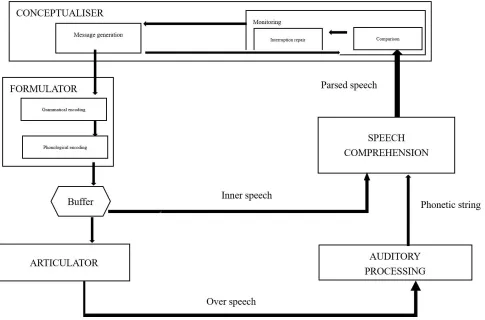
Figure 1. Language Production System.
In the first period, it is thought and language that have access to exchanging each other, under the condition of speakers’ intentions, knowledge, and the context. The initial speaker put forward notion and then formulate a message, which, of course, is thought of as a semantic structure, instead of the real language, containing information that can be conveyed by a discourse. The message formed in the previous period is programmed to construct a sentence representation through the formulator depicted in the figure above. Just as what has been shown in thee sketch, the period can be divided into two parts, grammatical encoding and phonological one. During the process of grammatical encoding, the specifications in the message will be matched by forms of the mental lexicon. According the grammar rules, the words in the form will be endowed with grammatical functions and a phrasal representation is built, specifying the hierarchical relation between syntactic constituents and their linear order. In the part of phonological encoding, the process first determines the prosody of the sentence and the phonological form of the words, which includes the phonological segments and metrical structure of the words. At the same time, the segments are assigned to structural positions in these words. In the last period of articulator, the motor control is a dominating factor, through which the message undergoing the previous periods is likely to be translated into articulation of utterance. After some required articulate movements, the message is
spoken out with the help of language forming through the complicated periods. In a word, from the figure, it is explicit that language production is an integrated complexity with too many dynamic factors involved in.
3.3. The Causes of Speech Errors
The causes of speech errors can be analyzed form manifold aspects, including internal causes and external causes. The former consists of physiological causes and psychological causes; and the external causes are made up of cognitive, social, and cultural factors. Because of limited material, the essay is focused on some main causes from these levels.
3.3.1. The Psychological Cause
regarded as a speech error for the “died” is the proper form from the perspective of semantics, which, on the other hand reflects the genuine thought in the student’s mind that he was lying, attempting to conceal the real reason. Though there is probability that Freud’ theory is appropriate in some cases, the more common explanation is that humans produce speech in a continuous process of separate stages, each devoted to a single level of linguistic analysis. Errors typically occur at one level, but not the others, during the production process. Furthermore, Sigmund Freud largely ascribed the repressed thought to the libido as the main motivation of the mistakes.
3.3.2. The Psycholinguistic Cause
Besides the famous psychological causes, there are a number of other detailed explanations concerning the particularly bewildering phenomenon. The physiological factors that can cause speech errors include gender, age and physical conditions and so on.
First, gender may be the factor to cause speech errors. The research results of linguists and psychologists suggest that male and female have many differences in speech manifestations and features, which have indispensable influences to the speech communication, especially to the speech communication with the opposite gender. For example, the female is usually conversational and likes to ask questions. The female speech is respectively elegant and indirect. So, it is possible to appear speech errors in the communication between male and female.
Second, the age of people also has direct influence to the communication process. Children, adults, youths and elders all have many different features in speech manifestations and habits. The communication between people in the same and different generation have plenty of differences both in means and effects.
Third, physical conditions may influence communication. The speech manifestations when people are healthy and vigorous and when people are sick, drunk and extremely tired are different. When a person is sick, drunk or extremely tired, he may be fuzzy-headed and make some speech errors.
In addition, the mistakes made by the normal people when they are speaking are called slips of the tongue. However, when these mistakes are made by the people who have damaged brain or other diseases, their speech may have more problems and this phenomenon is called speech dysfunction. Speech dysfunction is also the physiological cause of speech errors. According to the four elements of speech which are phonation, articulation, language and fluency, speech dysfunction can be divided into sound abnormity, articulation abnormity, language abnormity and fluency abnormity. There into, aphasia is the manifestation of language abnormity and stutters and palilalia are mainly the manifestation of fluency abnormity. All these symptoms will cause the production of speech errors.
4. Conclusions
In foreign language teaching, Chinese teachers traditionally tend to correct students’ mistakes in classes (both oral and written) themselves. Especially in the intensive reading class
and composition class, they may strictly point out any error made by students and patiently (in most cases) tell students why they can’t speak or write in such a way. Sometimes they may warn students not to make such mistakes again. Although in the oral class, teachers’ attention is mainly on the fluency of expression and seldom make corrections on students’ errors in production, they almost never notice the role of self-repairs, not to say encouraging students to make self-repairs. Although as a negative feedback, teacher correction plays a part in first language acquisition and prevents fossilization of incorrect linguistic forms in SLA, its effectiveness in foreign language learning and teaching remains open to question in the past decades. So learners can be encouraged to develop and make use of the strategy of self-repair. From a pedagogical point of view, self-repair may be regarded as part of an education for autonomous learning. If teaching aims to lead to what Dickinson calls “learning how to learn”, then self-repair is a spur in that direction because it encourages responsibility and independence in the learner. Thus, self-repair should be encouraged as preferred classroom strategy. But how might self-correction be practiced in the classroom?
knowledge in a logical way with fluent spoken English and convey ideas in English mixed with Chinese, which leads to the continuous exchange of codes and it is another important factor in the occurrence of speech errors.
5. Discussion
Form the detailed analysis above, speech errors fall into six categories: exchange errors, anticipation errors, perseveration errors, blends, shifts and substitutions. The research about speech errors is helpful to reveal the language law, deeply study the process of language production with the help of psychology and analyze the relationship between language and thought, so it is of great significance to the English teaching in Chinese classes. Speech errors occur frequently in the language communication and its research can offer reference methods for people to understand the production of speech, which can improve the communication efficiency and reduce the misunderstanding. So it has much value in research, communication and practice and is of importance to the language application and theory development. In the English teaching classes, it is better for teachers to speak the accurate language in a logical way to cultivate the proficient use of foreign language of trainees. Of course, it still needs further evidence and exploration to reveal the essence of speech errors.
References
[1] ZHU Qizhi, ZHOU Xiaobing. On Grammatical Errors [J]. Applied Linguistics, 2007,(01):111-118.
[2] Zhao Jing. A Study on the Errors Made by Foreign Students in Chinese Language Learning [J]. Modern Chinese, 2013,(02):150-151.
[3] WANG Yanfei. On the Outer Clause Errors and Inner Clause Errors—A Case Study of ‘Ba’ Sentences [J]. Applied Linguistics, 2014,(01):136-144.
[4] Yang Lina. Error Analysis of Chinese Verbs by Korean Students [J]. Language Planning, 2013,(33):61-62.
[5] Xie Fu. Types of Errors in Acquiring “Verb-copying Sentence” by Foreign Students, Causes and Teaching Strategies [J]. Language Teaching and Linguistic Studies, 2015,(02):26-34.
[6] Fromkin, V. A. The Non-anomalous Nature of Anomalous Utterances [J]. Language, 1971 (47):27-52.
[7] Gui Shichun. <Experimental Psychological Linguistics Outline> [M]. Changsha: Hunan Education Publishing House, 1991.
[8] Jack C. Richards and Richard Schmidt. Longman Dictionary of Language Teaching and Applied Linguistics [Z]. Beijing: Foreign Language Teaching and Research Press, 2003.
[9] DS Boomer, JD Laver. Slips of the Tongue [J]. The British Journal of Disorders of Communication, 1968, 3(1):2-12.
[10] Zhang Ning. The study of the language and a slip of the tongue [J]. Journal of Foreign Languages, 1990(4).
[11] Anne Cutler. Slips of the Tongue and Language Production [M]. Amsterdam: Mouton, 1982.