The Use Of Mental Models And Ill-Structured
Problems In Determining Students‟ Alternative
Conceptions In Stoichiometry
Norrie E. Gayeta
Batangas State University, College of Teacher Education Paharang West Batangas City, Philippines
Abstract: This study determined the most common alternative conceptions of students in stoichiometry using mental models and ill-structured problems. Qualitative and quantitative research methods were used in the study with conceptual understanding test as the main data gathering instruments. Respondents were third year Bachelor of Secondary Education, Biological Science students. Frequency and percentage were the statistical tools applied to answer the question presented in the study. Results showed that students manifested alternative conception in illustrating model of certain chemical reactions, particularly the reactants of the reaction. Moreover there were inconsistency in the reasoning of the students on how chemical reactions takes place. There was an indication of misconception between atom and molecule among students. Students‟ conceptions of atom and molecule were ambiguous, for the students, the two concepts could be used interchangeably. Participants also manifested alternative conception in balancing chemical equation, determining the limiting reactant and excess reactants, and finding the mass of the reacting compound. The study recommends to continuously diagnose students‟ misconception in other science courses, and further study areas where alternative conceptions exist and identify teaching and assessment strategies to correct misconceptions.
Keywords: alternative conceptions, ill-structured problems, mental models, stoichiometry
Introduction
The acquisition of knowledge and mastery of scientific concepts may only be attained when scientific misconceptions are identified and dispelled. Thus, the identification of students‟ misconceptions and the assessment of students‟ alternative conceptions, especially of abstract concepts, are key objectives for science educators. Science teaching should be imparted in such a manner that a positive kind of change can take place to the students. That after attaining information relating to scientific facts and theories, students conceptions become more rational and logical [1]. The identification and reduction of student misconceptions of science has been identified as integral to increasing student acquisition of science knowledge and understanding, thus increasing student‟s science literacy [2]. Constructivism as defined by Brashier [3] is a learning theory in which educators view students as active participants who construct their understanding of concepts, and as meaning makers that can transfer pre-organized knowledge. Conceptual change theorists recognize that there exists a conceptual framework in the minds of the students that needs to be changed. It is commonly understood as dealing with the restructuring of existing knowledge based on new information. The heart of all conceptual change strategies is the knowledge-restructuring component of prior conceptions. Prior conceptual understanding is an important component in conceptual change teaching strategies [4]. Prior knowledge has crucial role on the learning process and learning performance. Many learners do not appear to possess or partially possess correct preconceptions before instruction. The incorrect and incomplete prior knowledge can block knowledge construction processes if not diagnosed and changed during learning. Acceptance of revising thinking provides many opportunities for learners to advance their knowledge and refine their thinking [5]. Ideas that are developed without having any prior knowledge of the subject are not necessarily wrong but can be described as alternative,
misconceptions is the use of metal models. Mental structures
allows a child or an adult to create or construct new knowledge or to modify previously constructed knowledge and to modify and construct new structures [8]. Vosniadou [9] suggests that an important characteristic of mental models is their ability to be explored extensively and run in the mind„s eye, so to speak, in order to generate predictions and explanations. She hypothesizes that mental models mediate in the generation of explanations, suggesting that mental models become the vehicles through which implicit physical knowledge enters the conceptual system. In model-based learning, it is assumed that learners construct mental models of phenomena in response to particular learning tasks by integrating pieces of information about the structure, function/behavior, and causal mechanisms [10]. Learners then use and continuously re-evaluate their models and either discard or revise them as needed. Mental modeling, then, is a process of constructing, testing, and adjusting a mental representation of a complex phenomenon in order to understand it. According to Gilbert [11] and Nersessian (12]), models are essential in scientific reasoning. These were employed by scientists as representation of the structure and the behavior of systems that allow scientists to manipulate representations and construct explanations for processes underlying the phenomena. Harrison and Treagust [13] describe scientific models as abstract, and simplified representations of systems or phenomena that make their central features explicit and visible and which can be used to generate explanations and predictions. Park [14]) in his study explored student perceptions of atomic structure and how students learn about this concept by analyzing student mental models of atomic structure. Changes in student mental models served as a valuable resource for comprehending student conceptual development. His study revealed that conceptual development can be achieved, either by elevating mental models toward higher levels of understanding or by developing a single mental model. Another method of assessing items designed to reveal known misconception is the used of ill-structured problems. Ill-structured problems can be constructed such that distractors can target the known misconceptions. As pointed by Sadler [15], carefully constructed ill-structured problems can be seen as “windows into students‟ ideas” and “markers” of progress that reveal information about student‟s understanding and they may be useful for targeting instruction. Jonassen [16] described several dimensions of problem solving based largely on a continuum of problems from well-structured to ill- structured. The degree to which learners interact with new information lies from low cognitive engagement to high meta-cognitive engagement. Learners must become self-regulated and effortful analyzing and synthesizing new information in order to restructure what they know. These are skills that consistently required of ill-structured problems. It is widely accepted that students‟ performance during problem solving is affected by students‟ knowledge structures [17]. Students who do not have conceptually organized knowledge have difficulties in solving problems. It is also known that students‟ problem solving performances are influenced by not only their knowledge structure but also various cognitive variables [18]. To Bransford [19] an important characteristic involved in ill-structured problem solving is "metacognition" --the ability to monitor one's current level of understanding and decide when it is not adequate. It is necessary to provide guidance to students
when necessary, such as "pay attention to students' interpretations" when students are constructing new knowledge based on their previous knowledge in ill-structured problem solving tasks. Chemistry is one of the science subjects that students must have a good level of understanding. Science educators must know the students‟ alternative conceptions to be able to help them change so that these will become coherent with those of the scientific conceptions. The used of mental models and ill-structured problems can engage the students in their learning process in a way that leads them to change their alternative conceptions for the scientific conception Chemistry teachers are responsible for preparing students to become scientifically literate individuals. They must be aware on how students move from their prior knowledge to scientifically acceptable ideas. They need to provide students with opportunities to recognize what prior knowledge they already possess, expand on their incomplete schema, and confront inaccurate prior knowledge or misconceptions. Therefore, teachers must accurately assess students‟ alternative conception that will help them identify the effective and innovative learning strategies that may be utilized in improving it. Thus, to address this issue of misconceptions conceptions, this research attempted to determine students‟ alternative conceptions in stoichiometry using mental models and ill-structured problems for the students to continuously be involved in the used of concepts that are scientifically acceptable.
OBJECTIVES OF THE STUDY
This study aimed to determine the most common alternative conceptions of the students in stoichiometry using mental models and ill-structured problems among Bachelor of Secondary Education (BSED) major in Biological Science students.
MATERIALS AND METHODS
limiting reactants. Upon the completion of instructional
process students‟ new conceptions were determined using the test. Oral interview was also conducted to selected students to clarify their answer and explanations to some of the items in the Conceptual Understanding Test. Results of the Conceptual Understanding Test on Stoichiometry provided the data which were subsequently analyzed to determine in which items of the test the students manifested alternative conceptions.
RESULTS AND DISCUSSION
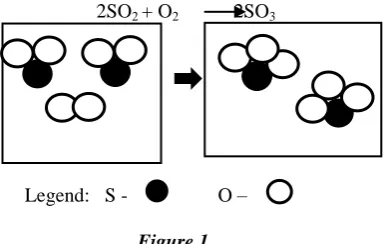
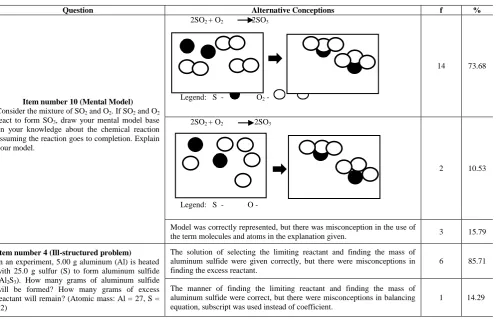
As seen in Table 1, there are two items from the Conceptual Understanding Test where the students manifested alternative conceptions, item 10 in part I and item 4 in part II. It is very evident from the table that a total of nineteen participants have misconception in illustrating mental model in the reaction between SO2 and O2 forming SO3. Fourteen (73.68 %), out of 19 students with alternative conceptions on this item used correct representation for oxygen, the second reactant, but misrepresented SO2, the first reactant. All of them got the correct representation of the product and were also able to give the correct reason for the reaction. See Figure 1 for the correct answer.
2SO2 + O2 2SO3
Legend: S - O –
Figure 1
The common misconceptions as reflected from students‟ answers are the use of single block dot to represent S instead of representing SO2. Follow-up interview with the students revealed that they did not include O2 attached to S since it is already represented in the second reactant. It only means that students thought that O2 in SO2 is just the same as the O2 molecule in the second reactant. Thus, they just represented S and O2 in the reactant side. However, the table also reveals that there are still 2 (10.53 %) of the participants with the same problematic conceptions in representing SO2 but also encountered misconception even in representing O2, the second reactant. In the model, students used six single white dot for O, to represent the total of 6 oxygen atom from the balanced equation. This only means that students‟ model is flawed mental model. According to Vosniadou [9]), when the learner‟s mental model conflicts with the correct one, scientific model is flawed. Flawed means that mental model is coherent but incorrect. He added that the successful modification of a flawed mental model is called the mental model transformation. One way to design a holistic transformation is to have students examine a visual depiction or diagram of the flawed mental model, then contrast it with a diagram of the correct model, in terms of the predictions, explanations and elements of each model. Table also reveals that there are 3 (15.79 %) of the participants that also possess alternative conception in item 10. The three participants got the correct model but there were inconsistencies in the reasons given. The term atom was used in giving reasons
instead of molecules. The interviews provided further evidence that students‟ conceptions of atom and molecule were ambiguous. Students believed that atom and molecule can be used interchangeably and that the two concepts have the same meaning. This finding is in line with Resullar‟s [20] study that identified two types of misconceptions, namely, vernacular misconceptions and conceptual misunderstanding. Her study revealed that most of the students‟ misconceptions were attributed to language and to previous learning in school. Lack of direct translation of the science terms to the vernacular, resulted in different interpretations of science concepts. Conceptual misunderstanding was passed on to students from their elementary years. More conceptual misunderstanding developed as students constructed different models and interpretations, which happened to conflict with the scientific views. Another item where there are common alternative conceptions is in item 4 of the ill-structured problem part of the test. A total of seven participants manifested alternative conception on this item. Six of them (85.71 %) presented the solution of solving the limiting reactant and finding the mass of aluminum sulfide correctly, but there were misconceptions in finding the excess reactant. Only 1 (14.29 %) of the participants manifested alternative conception in the correct use of coefficient and subscript in the balanced equation. Results reveal that the most common alternative conception of the students was in finding the amount of excess reactant. Reflected from the students‟ answers is that they did not consider the reactant that yielded the least number of moles of the product or the limiting reactant as bases in finding the amount of excess reactant. This means that the misconception rooted from students‟ knowledge structure regarding the excess reactant. This finding therefore is consistent with the idea of Gerace [17] that students‟ performance during problem solving is affected by students‟ knowledge structures. Students who do not have conceptually organized knowledge have difficulties in solving problems.
Table 11
Common Alternative Conceptions of Students in Stoichiometry
CONCLUSIONS
Mental models and ill-structured problems can be used in determining alternative conceptions among students. The most common alternative conceptions of students in stoichiometry were those in illustrating mental model of certain chemical reaction, particularly the reactants of the reaction, and in solving excess reactant.
RECOMMENDATIONS
It is recommended to continuously diagnose students‟ misconceptions and address the same in other science courses using interactive engagement techniques which are anchored on constructivist approach for teaching. The use of mental model and ill-structured problem in determining alternative conceptions should be tried out in different disciplines and venues. Further study to address the areas where alternative conceptions exist and to identify teaching and assessment strategies to correct misconceptions.
REFERENCES
[1]. R.W. Powell, J. C., & Trowbridge, L.W. Basic Goals of Science Education. Pearson Allyn Bacon Prentice Hall, 2010.
[2]. P. R. Harvard, Understanding Students Weaknesses. National Science Foundation. 2013
[3]. K. E. Brashier, http://www.worldcat. org/identifies/np-brashier. 2000
[4]. C. B. Lee & D. Jonassen, Fostering Conceptual Change with Technology. Singapore: Cengage Learning Asia Pte Ltd, 2013.
[5]. N. A. Branscombe, K. Castle, & A. G. Dorsey, Early Childhood Curriculum: A Constructivist Perspective. USA: Houghton Mifflin Company, 2003.
[6]. H. D. Barke, S. Yitbarek., & A. Hazari, Misconceptions in Chemistry: Addressing Perception in Chemical Education. Berlin Heidelberg: Springer, 2009.
[7]. C. J. Wenning “Levels of Inquiry Model Science Teaching: Learning Sequences to Lesson Plans”
www2.phy.ilstu.edu/pte/publications/Sample-learning-sequences.pdf. 2011.
[8]. D. A. Jacobsen, Methods for Teaching: Promoting Students Learning. 6th ed. USA: Prentice Hall, 2000.
[9]. S. Vosniadou, International Handbook of Research on Conceptual Change. New York: Routledge, 2008.
[10].J. D. Gobert, & A. Pallant, “Fostering Students‟ Epistemologies of Models via Authentic Model-Based Tasks”. Journal of Science Education and Technology, 13(1), 7-22. 2004.
[11].J. K. Gilbert, Visualization: A Metacognitive Skill in Science and Science Education. Netherlands: Springer, 2005.
Question Alternative Conceptions f %
Item number 10 (Mental Model)
Consider the mixture of SO2 and O2. If SO2 and O2
react to form SO3, draw your mental model base
on your knowledge about the chemical reaction assuming the reaction goes to completion. Explain your model.
2SO2 + O2 2SO3
L
Legend: S - O2 -
14 73.68
2SO2 + O2 2SO3
Legend: S - O -
2 10.53
Model was correctly represented, but there was misconception in the use of
the term molecules and atoms in the explanation given. 3 15.79
Item number 4 (Ill-structured problem)
In an experiment, 5.00 g aluminum (Al) is heated with 25.0 g sulfur (S) to form aluminum sulfide (Al2S3). How many grams of aluminum sulfide
will be formed? How many grams of excess reactant will remain? (Atomic mass: Al = 27, S = 32)
The solution of selecting the limiting reactant and finding the mass of aluminum sulfide were given correctly, but there were misconceptions in finding the excess reactant.
6 85.71
The manner of finding the limiting reactant and finding the mass of aluminum sulfide were correct, but there were misconceptions in balancing equation, subscript was used instead of coefficient.
[12].N. J. Nersessian, Model-based reasoning in
conceptual change. New York: Kluwer, 2008.
[13].A. G. Harrison, & D. F. Treagust, “Learning about Atoms, Molecules and Chemical Bonds: A case Study on Multiple-model Use in Grade II Chemistry. Studies in Science Education, 84, 353-381. 2010.
[14].M. S. Park Eun Jung, “Student Perception and Conceptual Development as Represented by Student Mental Models of Atomic Structure. Published Dissertation, Ohio State University, United States. 2006.
[15].P. M. Sadler, Psychometric Models of Student Conceptions in Science; Reconciling Qualitative Studies and Distractor-driven Assessment Instruments, 2008. Journal of Research in Science Teaching, 35(3), 265-296.
[16].D. H. Jonassen, Computers as Mindtools for Schools: Engaging Critical Thinking. Columbus, OH: Merrill/Prentice-Hall, 2000.
[17].W. Gerace, “Problem Solving and Conceptual Understanding”. Paper presented at the Proceedings of the 2001 Physics Education Research Conference PERC Publishing, Rochester, NY. 2001.
[18].C. F. Bauer, “Attitude Toward Chemistry: A Semantic Differential Instrument for Assessing Curriculum Impacts, 2008. Journal of Chemical Education, 85(10), 1440.
[19].J. Bransford, Preparing Teachers for a Changing World: What Teachers Should Learn and be able to Do. 2012. https:// books. google.com.ph/books.
[20].C.D. Resullar, “Assessment of Student Misconception on Basic Concepts of Measurement and Matter: Suggested Activities for Conceptual Change. Master‟s Thesis, Ateneo de manila University, 2004.