271 |
P a g e
STRAIN DISTRIBUTION ON DOZER BLADE CUTTING
EDGE OF DIFFERENT GRADES OF ADI USING ASNYS 15.0
1
Baldev Singh Rana,
2Dr.D.G Mahto,
3Dr. S.S. Sen,
4Rakesh Thakur
1
PG Student, Green Hills Engineering College Solan, Himachal Pradesh, India 2
Professor Green Hills Engineering College Solan, Himachal Pradesh, India
3Principle Green Hills Engineering College Solan, Himachal Pradesh, India
4PG Student, Punjab Engineering College Chandigarh, Chandigarh,India
ABSTRACT
In this research work, the calculation of strain in the dozer blade cutting edge of different grades of ADI is done
with FEA approach. A 3D model of dozer blade cutting edge is prepared in CATIA V5 with standard
dimensions and then it is imported in ANSYS 15.0.The eight-node three-dimensional brick type elements are
used during analysis. The properties of different grades of ADI are as per American Society of Testing and
Materials ASTM A897M-90 standards. The meshing of dozer blade cutting edge model is done and for the
strain the digging forces being applied at the tip of the cutting edge. The calculations of the strain on different
grades of ADI are based on the maximum distortion energy theory (MDET).After calculating the strain for the
different ADI grades a best suitable grade is suggested for this particular application.
Keywords
–
Dozer Blade, Finite Element Analysis, Austempered Ductile Iron,American Society Of TestingAnd Materials, Maximum Distortion Energy Theory
.
I. INTRODUCTION
Finite element analysis (FEA) is a very important tool to check the behavior of component after practical
application of stress on it. Cutting edges are main working parts on dozer blade. These are the most crucial
components on any dozer. They have to sustain with the different kinds of stresses being applied continuously at
them during operation. Therefore, cutting edges must be designed accurately and efficiently to avoid the
deformation and unwanted halts in the operations.
Moreover, the selection of dozer blade cutting edge material is a very crucial step. Austempered ductile iron
(ADI) is well suited for this particular application because of its unmatched properties. ADI has a unique
microstructure called ausferrite. This ausferrite microstructure sets ADI apart from as-cast ductile iron,
quenched & tempered or surface hardened ductile iron. Excellent property combinations of strength, ductility,
and toughness are produced from ausferrite.
The ranges of properties available for ADI are dependent on the choice of heat treatment parameters. In 1990
ASTM established five standard grades of ADI (ASTM 897-90 and 897M-90) which are listed in Table 1.
When normal stresses are applied to an ADI part (dozer blade cutting edge in this case) in service, a localized
strain which hardens the material can occur. As a result, ADI exhibits excellent abrasion resistance. This
International Journal of Advanced Technology in Engineering and Science www.ijates.com
Volume No.02, Issue No. 06, June 2014 ISSN (online): 2348 – 7550
272 |
P a g e
Table 1: ASTM A897M-90 Property table for ADI
Grade Tensile Strength (MPa) Yield Strength (MPa) Elongation (%) Impact Energy (J) Typical Hardness (HBW)
1 850 550 10 100 269-321
2 1050 700 7 80 302-363
3 1200 850 4 60 341-444
4 1400 1100 1 35 366-477
5 1600 1300 N/A N/A 444-555
II. METHODOLOGY
In the present work, finite element analysis (FEA) of dozer blade cutting edge is done. A strain at the dozer
blade cutting edge tip is found out using maximum distortion energy theory.
The dozer blade cutting edge 3D model is prepared in CATIA V5 and the analysis part is carried out in ANSYS
15.0. The force is applied at tip of dozer blade cutting edge and the magnitude strain is noted down. The strain
values are different to the different grades of ADI. The minimum value of strain is checked out among different
grades of ADI and therefore, a best suited grade is suggested for this particular application.
Grade Young‟s Modulus (GPa) Poisson‟s ratio (ν) Density (Kg/m3)
1 159.3 0.25 7096.5
2 157.9 0.25 7087.2
3 156.5 0.25 7077.9
4 155.1 0.25 7068.6
5 153.8 0.25 7059.3
Table 2 Values of Young’s Modulus, Poisson’s ratio and Density for different grades of ADI
III. FINITE ELEMENT MODEL
In this study, a three-dimensional elastic-plastic finite element model is used to simulate the strain in dozer
blade cutting edge caused by maximum dozer digging force and simulations are performed using ANSYS 15.0.
The region of interest is the area near the holes where the holes geometry changes sharply and therefore, the
maximum strain is observed. We are interested in „structural analyses‟ and „solid‟ is selected as element type.
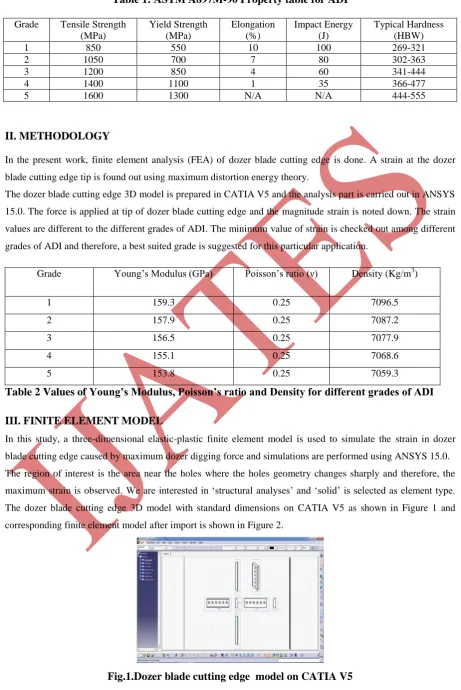
The dozer blade cutting edge 3D model with standard dimensions on CATIA V5 as shown in Figure 1 and
corresponding finite element model after import is shown in Figure 2.
273 |
P a g e
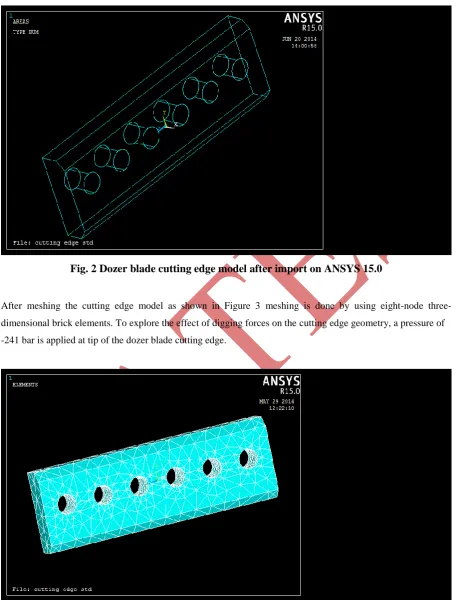
Fig. 2 Dozer blade cutting edge model after import on ANSYS 15.0
After meshing the cutting edge model as shown in Figure 3 meshing is done by using eight-node
three-dimensional brick elements. To explore the effect of digging forces on the cutting edge geometry, a pressure of
-241 bar is applied at tip of the dozer blade cutting edge.
Fig. 3 Dozer blade cutting edge model after meshing
IV. RESULTS AND DISCUSSIONS
In the results, a static elastic-plastic finite element model is employed to study the distribution of strain due to
International Journal of Advanced Technology in Engineering and Science www.ijates.com
Volume No.02, Issue No. 06, June 2014 ISSN (online): 2348 – 7550
274 |
P a g e
of ADI and also represents major and minor strain induced areas. The strain intensity increases from blue to redas in the color strip in the pictures. The regions showing with red color are major strain induced areas and blue
colored regions are minors strain induced regions.
Fig.4 Strain developed on ADI grade I
275 |
P a g e
Fig.6 Strain developed on ADI grade III
International Journal of Advanced Technology in Engineering and Science www.ijates.com
Volume No.02, Issue No. 06, June 2014 ISSN (online): 2348 – 7550
276 |
P a g e
Fig.8 Strain developed on ADI grade V
V. CONCLUSION AND FUTURE SCOPE
Following conclusions and future recommendations are made from the present research work.
The grade V of ADI is best suitable as a cutting gdge material for this particular and typical application
of dozer blade cutting edge.
Material selections for the solid bodies greatly influence the mechanical behavior of the parts under
loading conditions.
Research based on both industry and university could eliminate the lack of data in the analysis and help
to obtain more realistic simulation results.
Fracture and fatigue analysis on the components could be beneficial to investigate the working life of
the dozer blade cutting edge. Therefore, more sensitive performance calculations could be made.
Virtual reality studies for the dozer operator could be useful for the future work.
Research on materials other than ADI with different mechanical properties may be used for analysis.
REFERENCES
[1] SAE J1057a, Identification Terminology of Earthmoving Machines (June, 1975). [2] SAE J173, Specification Definitions-Dozers (May, 1970).
[3] SAE Standard J1265 - "Dozer Capacity" IS 4988-2 (1968): Glossary of terms and classification of earth moving machinery
[4] SAE Internationals, SAE J1179: “Hydraulic Excavator and Backhoe Digging Forces” 400
277 |
P a g e
[5] Karl-Erik Rydberg “Hydrostatic Drives in Heavy Mobile Machinery –New Concepts and Development”Copyright © 1997 Society of Automotive Engineers, Inc.
[6] K. L. Hayrynen and J. R. Keough“Austempered Ductile Iron-The State of the Industry in 2003
[7] John R. Keough, PE, Kathy L. Hayrynen, PhD, “Automotive Applications of Austempered Ductile Iron (ADI): A Critical Review.
[8] Bhaveshkumar P. PATEL, Jagdish M. PRAJAPATI “Evaluation Of Bucket Capacity, Digging Force
Calculations And Static Force Analysis Of Mini Hydraulic Backhoe Excavator” Machine Design,
Vol.4(2012) No.1, ISSN 1821-1259
[9] Sanjiv Singh “Learning to Predict Resistive Forces During Robotic Excavation”1995
[10]Sanjiv Singh 1997 “The State of the Art in Automation of Earthmoving” In ASCE Journal of Aerospace Engineering, Vol 10, # 4, October 1997 ¸¹© ASCE
[11]S.H Punale R.J.Rogers G.RNadkarni “ Finite Element modeling of Elastic Modulus in Ductile Irons:Effect of Graphite Morphology”AFS Transcations 1998
[12]BHAVESHKUMAR P. PATEL, DR. J. M. PRAJAPATI, BHARGAV J. GADHVI “An Excavation Force Calculations And Applications: An Analytical Approach” International Journal of Engineering
Science and Technology (IJEST) ISSN : 0975-5462 Vol. 3 No. 5 May 2011
[13]Jan Kohout, Stanislav Věchet“Some Peculiarities in Deformation and Fracture Behaviour of Austempered Ductile Cast Iron” ISSN 1392–1320 MATERIALS SCIENCE (MEDŽIAGOTYRA). Vol. 11, No. 4. 2005
[14]D. Myszka “AUSTENITE-MARTENSITE TRANSFORMATION IN AUSTEMPERED DUCTILE
IRON” A R C H I V E S O F M E T A L L U R G Y A N D M A T E R I A L S Volume 5
[15]Srinivasmurthy Daber , K. S. Ravishankar ,P. Prasad Rao “Influence of austenitising temperature on the formation of strain induced martensite in austempered ductile iron” Journal of Materials Science Volume 43, Issue 14 , pp 4929-4937
[16]A.A. Nofal, L. Jekova1“NOVEL PROCESSING TECHNIQUES AND APPLICATIONS
[17]OF AUSTEMPERED DUCTILE IRON(REVIEW)” Journal of the University of Chemical Technology and Metallurgy, 44, 3, 2009, 213-228
[18]J.R Keough and K.L. Hayrynen (2010)[21] “Design with Austempered Ductile iron(ADI)”AFS Proceedings 2010 Paper 10-129
[19]D. MYSZKA_, A. WIECZOREK__“AN ASSESSMENT OF THE APPLICABILITY OF
AUSTEMPERED DUCTILE IRON CONTAINING Mo AND Ni FOR MINING MACHINES PARTS” A R C H I V E S O F M E T A L L U R G Y A N D M A T E R I A L S Volume 58 2013 Issue 3 DOI: 10.2478/amm-2013-0108
[20]Mohammad BabaZadeh1, HaMiD PourAsiabi*2, Hamed PourAsiabi3z “Wear Characteristics of ADIs; A Comprehensive Review on Mechanisms and Effective Parameters” ISSN 2090-4304 Journal of Basic and Applied Scientific Research
[21]David J. Kerkes, “ANALYSIS OF EQUIPMENT LOADS ON GEOCOMPOSITE LINER SYSTEMS” 1
Proceedings of the Geosynthetics '99 Conference, IFAI, Boston, MA, April 1999, pp 1043-1054.
[22]Adel Nofal (2014)[39] “Advances in the Metallurgy and Applications of ADI” Journal of Metallurgical Engineering (ME) ISSN Online: 2168-5568
[23]*D. Holz, A. Azimi, M. Teichmann,S. Mercier “REAL-TIME SIMULATION OF MINING AND EARTHMOVING OPERATIONS: A LEVEL SET-BASED MODEL FOR TOOL-INDUCED TERRAIN DEFORMATIONS” CM-Labs Simulations Inc. www.cm- abs.com645 Wellington Street, Suite 301 Montreal, Canada H3C 1T2
[24]Shamanth*, D Sethuram **,K Narasimha Murthy***(2012)[34] “ TENSILE STRENGTH AND MECHANCAL PROPERTIES EVALUATION OF PERMANENT MOULD DUCTLE IRON SUB-JECTED TO NOVEL TWO STEP AUSTEMPERING PROCESS” International Journal of Engineering Research and Applications (IJERA) ISSN: 2248-9622