The Possibility Of Applying YouTube
To Motivate Learning Autonomy
Yiling Chen, Ph.D., Nanhua University, Taiwan
ABSTRACT
The notion of collaborative learning and teaching in foreign language education has been popular for decades. This concept focuses on learners and encourages them to learn a language by experiential and shared learning. The learners are believed to learn best if they learn through the conscious or unconscious internalization of their own or observed experiences which build upon our past experiences or knowledge. There is an assumption that the learning that can result from the experience, if the activities are manifested ‘properly’, is a commodity called ‘knowledge’. This tends to be the view of the training and development literature (Moon, 2001). Within this concept, the role of teachers as collaborators in the teaching and learning process represents a change to traditional educational patterns. Moreover, increasing numbers of instructors are realizing the importance of motivating learning autonomy among students in EFL (English as a Foreign Language) classrooms. In this paper, I will consider to what extent the concept of a teacher as a collaborator can be applied to the university EFL classes in Taiwan, and how to motivate EFL learners’ autonomy via YouTube. Attention is first paid to the theoretical grounding of the concept and the characteristics of a teacher as a collaborator. Following this, the English education contexts in Taiwan is highlighted in order to consider how far this concept can be achieved. Finally, conclusions will be drawn from this small-scale exploration.
Keywords: Teacher as Collaborator; Learning Autonomy; Learning a Language
INTRODUCTION
hen educators consider foreign language education, the main aspects in our mind are learners and teachers. There is a great variety in the literature on foreign language acquisition both in the reasons why individuals learn foreign languages, and in their success in doing so. We also find variety in the ways in which teachers conduct their teaching activity. There is a notion of collaborative learning and teaching in foreign language education, which “has emerged over the last ten years as the significant concept within the field of language education” (Nunan, 1992, p.1). This concept focuses on learners and encourages them to learn language by experiential and shared learning. Within this concept, the role of teachers as collaborators in the teaching and learning process represents a change to the traditional educational patterns.
The author carried out experimental teaching (namely ‘collaborative teaching’, which is different from traditional lecturing teaching) for a semester at a university. The course chosen for experimental teaching was ‘Freshmen English: Listening and Speaking’ for non-English majors. During the academic year, the first semester was taught in the traditional way, and the second semester was taught by collaborative teaching. However, the process of experiment and data are not the main concern of this paper. Therefore, the researcher will not focus on the presentation of data and reflective notes of the collaborative teaching while carrying out the experiments.
Instead, in this paper the researcher will only consider to what extent the concept of a teacher as a collaborator can be applied to the English (as foreign language) educational contexts a university in Taiwan. Attention firstly is paid to the theoretical grounding of the concept and characteristics of a teacher as a collaborator. Following this, the English educational context in school is highlighted in order to consider how far this concept can be achieved. Finally, conclusions will be drawn from this small-scale exploration.
LITERATURE REVIEW
In this part, the researcher will investigate the idea of experiential learning, and a constructivist approach, underpinning the concept of collaborative learning and teaching. Then, the researcher will explore its influence on foreign language education.
2.1 Experiential Learning
It is believed that when students sense they are finding out something that is important and useful to them, using their own powers of observation and interpersonal skills, everything changes. Therefore, we, as teachers, should not only lecture in class but also encourage hands-on exercises. We want to be sure that they ‘really learn something useful and meaningful’; the notion of ‘experiential learning’ emerged in the 1960s (McKeachie and Svinicki, 2006).
Kolb’s (1984) general theoretical model of experiential learning has had outstanding influence. In experiential learning, personal experience is viewed as the central point for learning, giving “life, texture, and subjective personal meaning to abstract concepts and at the same time providing a concrete, publicly shared reference point for testing the implications and validity of ideas created during the leaning process” (ibid, p21). However, experience also needs to be processed consciously by reflecting upon it. Learning is thus regarded as a recursive cycle, as Kolb shows, integrating concrete experience, reflective observation, abstract conceptualization and active experimentation. In order to achieve optimal learning, the knowledge acquired in any one mode needs to be continued by further processing in the next. Thus, concrete experience, “with an involvement in personal experiences and an emphasis on feeling over thinking” (ibid, p68), should be followed by reflective observation, ‘focusing on understanding the meaning of ideas and situations by careful observation, being concerned with how things happen by attempting to see them from different perspectives and relying on one’s own thoughts, feeling and judgment’; this in its turn is followed by abstract conceptualization, “using logic and a systematic approach to problem-solving, with an emphasis on thinking, manipulation of abstract symbols and a tendency to neat and precise conceptual systems”(ibid, p69); which is followed be active experimentation, with an emphasis on practical applications and getting things done, influencing people an changing situations, and taking risks in order to accomplish thing. In this model, reflection plays an important role in the process by providing a bridge between experience and theoretical conceptualization. Kolb’s model presents a procedure of learner’s learning.
Concerned with foreign language learning, Kohonen points out that experiential learning theory suggests that effective foreign language learning might involve: “(1) abundant, comprehended input in the target language with an emphasis on understanding the content of the texts and thereby using language as a vehicle of learning about the subject matter rather than as an end in itself; (2) learner reflection on language structure and an explicit teaching of the systemic structure of the target language, aiming at a conscious control of the language;(3) comprehensible output, emphasizing the importance of the learner’s productive use of the target language in interactive communication; (4) corrective feedback by the teacher and peer, aiming at an internalization of the criteria of acceptable and accurate language use through self-assessment and reflection in cooperative learning team” (Kohonen, 1989, p. 29). From this viewpoint, what teachers should do in the classroom is to create an appropriate environment in which learners learn by using the target language as a tool, help learners realize and control their own learning and to reflect upon it by themselves, provide supportive feedback instantly and effectively, and reinforce their awareness of self-assessment. In these circumstances, teachers shift their power to learners, putting learners at the centre of teaching and learning process, and increase the degree of learner’s self-direction in learning. This notion is similar to ‘learner-centered curriculum’, where learners are regarded as the centre of the curriculum construction as it is believed that learners learn best when they are ready to learn (Ellis, 2004). However, the most distinctive difference between the two beliefs is that teachers initiate the beginning stage of learning and gradually switch direction back to learners in the theory of experiential learning.
2.2 Constructivism
methods (p.79)”. The concept of collaborative teaching and learning, therefore, should have its own theoretical grounding in terms of educational psychology. This theoretical grounding can be traced back to constructivism, a concept from cognitive psychology.
Many psychologists have contributed their views to the development of constructivism. Piaget’s work (1966, 1972, 1974) emphasized the constructive nature of the learning process. The main assumption is that individuals are actively involved from birth in constructing personal meaning, which is their own personal understanding, from their individual experience. Piaget’s theory is based on learners passing through a series of stages: sensory-motor, pre-operational, concrete operational, and formal operational (Dykmoke and Harrison, 2008). Piaget’s stages do have a message for the language teachers. It is helpful for teachers to understand a learner’s learning process, and not to expect learners to achieve what is beyond their stages. However, people’s learning by constructing meaning does not always fit into such explicit stages. As Claxton (1990) argues, in implicit theories about learning states, learning is a much untidy process with learning occurring in a much more unstructured way including normal schooling and various social experiences. Particularly in language learning, language can be learned through the analytic (learning chunks of language) and synthetic (learning language in a structured way, step by step) dimensions (Nunan, 1991). In other words, learning can happen in both explicitly in a well-structured way and implicitly a disorganized way.
In Bruner’s work (1960, 1966), Bruner considers the development of conceptual understanding and of cognitive skills and strategies as the central aims of education; and views as one central element the need to “learn how to learn, which he considered to be the key to transferring what was learnt from one situation to another” (Bruner, 1960, p. 4). According to this viewpoint, humans have the ability to construct general theories about their experience, which enable them to apply intellectual structures built in one situation to a range of different situations. Learners ‘theorize experience and construct mental structures or schemas for representing it’ (Desforges and Lings, 1998, p. 389).
In considering of a constructivist approach to learning, it is also helpful for teachers to understand the process and how a teacher can best make use of a constructivist approach. Firstly, since learning can occur explicitly and implicitly, teachers are able to teach learners in either a structured way, the traditional teacher-fronted approach, or an unstructured way, in which teachers teach learning strategies to learners and then let learners learn according to a learner’s own needs. Secondly, in order to help knowledge application, teaching involves identifying existing schemas and arranging experiences which challenge learners and subsequently providing for the construction of more advanced intellectual structures (Desforges and Lings, 1998).
Although experiential learning and a constructivism are different concepts, they can be linked together to help teachers think about another way of teaching and learning, that is, collaborative teaching and learning. In collaborative teaching and learning, teachers allow pupils to experience for themselves in certain settings, and pupils start and work with what they already know—this can also come out in discussion with the teacher cooperatively (Dymoke and Harrison, 2008). This kind of approach also affects foreign language education.
2.3 Influence on foreign language education
The context of foreign language education is changing with many new competing theories, including the development of experiential learning. Kohonen (1989: p30) mentions that ‘current pedagogical thinking seems to be shifting away from the traditional behavioristic model of teaching as transmission of knowledge towards an experiential model whereby teaching is seen as transformation of existing or partly understood knowledge, based on constructivist view of learning’. Miller (1988) presents a table to compare the traditional model with the experiential model. The experiential model, compared with the traditional transmission model, has its own features (Kohonen, 1989, p.31-32). Learning is the process of the transformation of knowledge that is viewed as open to negotiation and redefinition by challenging existing constructions of meaning. From this point, learning also can become the discovery of knowledge.
Learners, as active participants, largely cooperate in small groups. The emphasis is on self-direction learning. The more learners take responsibility in making decisions, the greater is their degree of self-direction. This learner-centered approach involves a basic trust in the learners’ willingness and ability to deal with different learning tasks, a respect for themselves and choices. By doing so, they will develop a feeling of ownership and responsibility for their own learning. In other words, autonomous learning is being developed. Evaluation is carried out by means of a process-oriented form, reflection on process, self-assessment, and criterion-referenced assessment.
In considering the above features, in the experiential model, control of the process is shifted from the teacher towards the learner. Learners are at the centre. Learning starts with the goals chosen by learners themselves. To a great extent, the teacher cooperatively facilitates learners to achieve their goals in a small group setting. These distinctions, compared to the traditional model, not only influence physical settings in foreign language education, such as the structuring the classroom, but also have great effects on the role of the teacher in learning and teaching process. In next part, the focus will be shift to the characteristics of a teacher as a collaborator in the cooperative foreign language class.
2.4 Characteristics of a teacher as a collaborator
McKeachie and Svinicki (2006) point to six facets of the teacher’s self-definition in experiential learning which are: (1) a formal authority, (2) an expert, (3) a socializing agent, (4) a facilitator/ collaborator, (5) an ego ideal, and (6) a person. Based on the experiential model and to some extent devolved learning, the teacher’s behaviour in the collaborative foreign language class represents changes. For instance, the teacher has less authority, decreases the quantity of utterances, and changes his/her speech style from facing the whole class to working with small interactive groups. So, in this part, the characteristics of a teacher as a collaborator are discussed, and is concerned respectively with inquiring, creating/planning, observing and facilitating (McDonell, 1992).
2.4.1 Inquiring
While teachers in collaborative contexts will want to follow general good practice (thinking about their learners, and reflecting on their own practices), there are some particular aspects to which they need to attend. Firstly, so as to plan for the learner, the collaborative language teacher needs to know about the learner in terms of the learner’s age, language level, abilities, interests, and previous learning experience. Secondly, lessons should be set up so that the focus of language is on communication of meaning, since using language meaningfully to the learner promotes learning (Nunan, 1989). Thirdly, in terms of attitudes and expectations, collaborative learning teachers are likely to believe that not only the learner can learn but also the teacher can learn as well. Finally, the collaborative teacher tends to believe in an experiential model of pedagogy that releases learners from a dependence on instruction. In other words, teachers value collaboration and encourage cooperation among the students within their classroom.
2.4.2 Creating/ Planning
Because the collaborative classroom is process-oriented, teachers have to realize that the learning environment is highly structured and well organized. The Key for structuring a successful collaborative classroom are to be found in creating a social climate, setting goals, planning and structuring tasks, establishing the physical arrangement of the classroom, assigning students to groups and roles, and selecting materials and time (Johnson et al.,1984).
Creation of the social climate refers to the learning environment, which is positive, caring, supportive, tolerant of errors and trusting. Teachers and learners have equal partnership. A teacher’s power and control are reduced. Individuals are valued and mutually respected. Thus, learners gain confidence, and become responsible for their learning. While planning and programming for the learner, teachers reflect on what they know about students and what would be appropriate in terms of approach and resources. So, the teacher needs to take time to understand a learner’s previous background.
purposefully and meaningfully in the context of experiencing specific cooperative skill’ (McDonell, 1992, p.166).
The physical arrangement of classroom should be flexible, rather than highly structured, so as to facilitate group learning, a popular approach used in the collaborative language class. Learners should be able to group easily, and relevant materials, such as books and a dictionary, should be readily accessible as well. However, teachers need to consider some negative points in forming a learning group. For instance, groups should be far enough apart not to interfere with one another (Johnson and Johnson, 1987).
Since group learning is crucial in the collaborative language class, assigning learners to groups should be considered carefully. Teachers should base groups on factors on what they know about learners well, such as their language proficiency level. In addition, teachers need to think about other issues. For example, how long is the group going to work together? How often are learners put in the same group?
Learning material is an important element. Material selected should be authentic, purposeful, culturally relevant and suitable for the multilevel classroom in order to promote interaction in a language-rich environment. In a word, in order to organize successful a collaborative language class, teachers have to consider all the issues mentioned above and show the creativity.
2.4.3 Observing
Observation is not only the basis of decision making about each learner’s progress, but also gives a basis for reflection on our own teaching and learning practices. Collaborative small-group learning gives teachers the opportunity to observe, reflect and intervene in a supportive way. By observing, teachers obtain information on a learner’s knowledge level, interests, strengths and weaknesses, and so on. After observing, teachers can provide instant feedback as supportive intervention to help learners realize and reflect on their own learning practices. ‘The recognition that the teacher and learner contributed to one another’s learning and maintained a constructive working relationship is what makes cooperative learning so different from traditional approaches’ (McDonell, 1992, p.169).
2.4.4 Facilitating
Facilitating learners means that the teacher is prepared to stand aside to give the learner a more meaningful role. Teachers are prepared to intervene and assist in the problem-solving process and support and encourage the learner’s desire to learn. As Cohen (1986) states, facilitating the learner means to give feedback, redirect the group with questions, encourage the group to solve its own problems, extend activity, encourage thinking, manage conflict, observe students and supply resources. Maggie’s class, as Freeman (1992) shows, provides a vivid example of facilitating pupils. When Kris (Maggie’s pupil) realizes her mistake, Maggie tells her to fix it by herself, instead of offering correct answer directly. When Kris does not understand, Maggie turns to someone else for an explanation. By doing so, Maggie integrates authority for explanation with control over peer activity. As Maggie says, ‘the researcher could tell them, but they get sick of hearing me talk. Besides, the researcher thinks it sticks better when it comes from them’ (ibid, p.73). This role of a teacher as a collaborator that facilitates learners is different from the role of a teacher as facilitator. The former means that a teacher is more active in the teaching and learning process, and prepares to give support at any time, whereas the latter means that a teacher absolutely stands back and allows pupils to be more independent in the teaching and learning process.
To sum up, as a result of the ideas of experiential learning and the constructivist approach, the role of a teacher in the collaborative foreign language class is distinctive. A teacher is more likely to be called a collaborator/ facilitator, or a learner among learners, rather than a teacher. This kind of role is conducive to arouse a learner’s self-awareness and learning desire so as to encourage her/him to be autonomous in learning. However, although this view sounds worthy in principle, we would argue that, due to external influences, such as cultural dimensions, it may be difficult to apply in practice. Thus, in the following part, the researcher will only explain the research design and explore the applicability of this experiment in foreign language education in a university context.
RESEARCH DESIGN
in the first semester and only 37 left in the second semester. The first semester was lectured in a traditional way. In other words, was responsible for all the teaching preparation and lecturing. In the second semester, the responsibility of teaching had shifted to students. The researcher grouped them and asked them find a topic they want to teach/ share from YouTube. In the beginning of the second semester, the researcher gave them a list of channels on YouTube and they could choose anything they like from those channels. Each week, students were required to download a video clip and explain it in class.
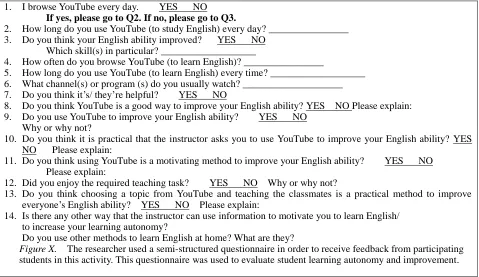
In addition, researcher also encouraged students engage themselves in an English environment daily. This part is valuable because the researcher believes that students learn best when they have learning autonomy. The researcher tried to help students generate learning autonomy and confidence in learning English through YouTube because it is free and the materials are authentic and abundant. For the first month, students were encouraged to watch any English video they like for 30 minutes everyday. From the second month to the third month, they were encouraged to watch English lessons for 15 minutes daily and then they could watch any English video they like for another 15 minutes. From the forth month on, they were encouraged to indulge themselves in English for at least an hour every day. Students were strongly recommended to watch famous speeches (such as in TED) in English and imitate the speakers. At the end of the semester, a semi-structured questionnaire (see Figure 1) was used to evaluate their learning autonomy and improvement. 34 students (out of 37) showed up on the day of doing the questionnaire.
1. I browse YouTube every day. YES NO If yes, please go to Q2. If no, please go to Q3.
2. How long do you use YouTube (to study English) every day? ________________ 3. Do you think your English ability improved? YES NO
Which skill(s) in particular? ___________________
4. How often do you browse YouTube (to learn English)? ________________
5. How long do you use YouTube (to learn English) every time? ___________________ 6. What channel(s) or program (s) do you usually watch? ____________________ 7. Do you think it’s/ they’re helpful? YES NO
8. Do you think YouTube is a good way to improve your English ability? YES NO Please explain: 9. Do you use YouTube to improve your English ability? YES NO
Why or why not?
10. Do you think it is practical that the instructor asks you to use YouTube to improve your English ability? YES NO Please explain:
11. Do you think using YouTube is a motivating method to improve your English ability? YES NO Please explain:
12. Did you enjoy the required teaching task? YES NO Why or why not?
13. Do you think choosing a topic from YouTube and teaching the classmates is a practical method to improve everyone’s English ability? YES NO Please explain:
14. Is there any other way that the instructor can use information to motivate you to learn English/ to increase your learning autonomy?
Do you use other methods to learn English at home? What are they?
Figure X. The researcher used a semi-structured questionnaire in order to receive feedback from participating students in this activity. This questionnaire was used to evaluate student learning autonomy and improvement.
Figure 1: A Semi-structured Questionnaire
DISCUSSION
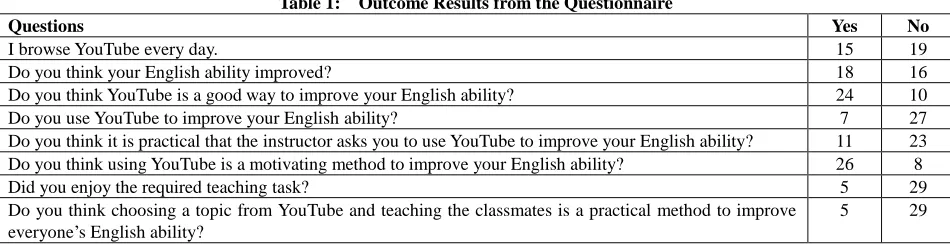
Table 1: Outcome Results from the Questionnaire
Questions Yes No
I browse YouTube every day. 15 19
Do you think your English ability improved? 18 16
Do you think YouTube is a good way to improve your English ability? 24 10
Do you use YouTube to improve your English ability? 7 27
Do you think it is practical that the instructor asks you to use YouTube to improve your English ability? 11 23 Do you think using YouTube is a motivating method to improve your English ability? 26 8
Did you enjoy the required teaching task? 5 29
Do you think choosing a topic from YouTube and teaching the classmates is a practical method to improve everyone’s English ability?
5 29
The concept of a teacher as a collaborator seems very influential and significant. According to this concept, the learner is able to choose the language learning that is occurring and take responsibility for it; the teacher acts as a monitor for this independent learning. The aim is to encourage the learner to learn autonomously. However, from the researcher’s point of view, this concept would be difficult to apply to foreign language education in Taiwan, since it challenges the educational and cultural context in Taiwan. The researcher would like to explain this from two aspects.
Firstly, this concept challenges the meaning of teacher in Taiwanese cultural context. In a collaborative learning class, one major change is the role of the teacher. The teacher is most likely to be a member of the learners’ group, a collaborator. This change is not entirely ‘new’ but still too ‘advanced’ to be accepted. Our culture pays a high degree of respect to the role of teacher, which even can be traced back thousands of years. As a culture, we transmit the notion of Confucius: to respect the teacher. As a culture, we believe that the teacher is the person who teaches knowledge and copes with the complexity of life. As a culture, we also advocate that someone will be the
father forever, once he/she is your teacher. In this cultural context, children are educated to respect their teachers and follow their teacher’s words. Moral Education in primary and secondary schools imbue children with these ideas. In this context, if the concept of a teacher as a collaborator were applied to mainstreams schools, the effects would have repercussions not only on the thinking of teachers and students, but also on the whole educational context. Take this experimental teaching for example; undergraduates are not young pupils anymore, but they could not even accept the notion of collaborative teaching, which required their efforts to do something by themselves instead of reciting textbooks. Most of the students were reluctant to research or do reports on their own, mainly because it was not the objective with which they had grown up. In addition, it may also because those students were not English majors; they did not see the importance of learning English well, let along the responsibility or autonomy of learning English. One of the students even commented in the questionnaire that “it was a teacher’s job” to prepare what to teach, not theirs. It might be easy to change one’s thought, but it will certainly be difficult to change a notion which has been passed on for thousands of years. In this sense, the concept of the teacher as a collaborator would be restricted in its application in certain educational contexts.
know what to teach. As a result, the motivation of both high and low level pupils was decreased. It was difficult to design collaborative class activities. Thus, the outlook for the application of this concept is not very optimistic. Although the researcher thought students might learn better when materials were related to their daily lives or were presented by peers, the lessons were often in chaos when student-teachers taught. However, the researcher still believes collaborative teaching should be encouraged and exercised in a university context.
No matter whether the students would go on studying or find an employment after graduation, the communicative ability, creativity, and responsibility would be valued highly. These skills can be developed in collaborative teaching. However, although the concept of a teacher as a collaborator has its value, the degree of applicability in Taiwan it is limited in some cultural and educational contexts.
CONCLUSION
In this paper, attention was firstly paid to the theoretical grounds for the concept of collaborative learning and teaching and the characteristics of a teacher as a collaborator. Following that, the application of using YouTube to encourage their autonomy was considered. The conclusion drawn from this exploration is that although the concept of a teacher as a collaborator is valuable, and is one that aims at encouraging autonomous learning, it is difficult to apply this to foreign (English) language education for non-English majors in because of the boundaries of culture and the educational context. Universities are regarded as ‘authority-free teaching lands’, and teachers are allowed to try any innovative teaching methods; it is somehow complex to encourage non-English majors to learn English autonomously in this university. However, this does not mean that the researcher rejected entirely the idea. It is still worthwhile for individual Taiwanese foreign language teachers to reflect on personal experience and improve professional skills by considering this concept, and implementing at any schools if possible. As Andresen et al. (2000) points out, collaborative learning is where learners are personally engaged or where their related experience plays a significant role in the process of learning and cognition development. Most importantly, the researcher was trying to generalize the finding to the entire teaching context in Taiwan. What happened in this class cannot be regarded as the whole phenomenon in other classes or even in Taiwan. Therefore, it will be worthwhile to carry out a large-scale or comparative study in different educational contexts.
AUTHOR INFORMATION
Yiling Chen, Ph.D., is a professor at Nanhua University, Dept of Foreign Language & Literature, 55, Sec 1, Nanhua Road, Dalin Township, Chiayi County, Taiwan. E-mail: [email protected]
REFERENCES
1. Alexander, R. (2000) Culture & Pedagogy: international comparisons in Primary education. Oxford: Blackwell.
2. Andresen, L., Baud, D. and Cohen, R. (2000) ‘Experience-based learning’ in Understanding Adult Education and Training, Sydney: Allen and Unwin, pp. 225-39.
3. Brown, H. D. (2000) Principles of Language Learning and Teaching. Fourth Edition, White Plains, N.Y.: Addison Wesley Longman.
4. Bruner, J. S. (1960) The Process of Education. Cambridge, Mass.: Harvard University Press. 5. Bruner, J. S. (1966) Towards a Theory of Instruction. Cambridge, Mass.: Harvard University Press. 6. Claxton, G. (1990) Teaching to Learn: a Direction for Education. London: Cassell.
7. Cohen, E.G. (1986) Designing Group Work. New York: Teachers College Press.
8. Desforges, C. and Lings, P. (1998) Teaching Knowledge application: advances in theoretical conceptions and their professional implications. British Journal of Educational Studies, 46(4), pp 368 -398.
9. Dykome, S. and Harrison, J. (2008) Reflective Teaching and Learning. London: SAGE Publications Ltd. 10. Ellis, A.K. (2004) Exemplars of Curriculum Theory. NY: Eye On Education.
11. Freeman, D. (1992) Collaborative: constructing shared understandings in a second language classroom. In Nunan, D.(ed.) Collaborative Language Learning and Teaching. Pp 56-80. Cambridge: Cambridge University Press.
12. Johnson, D. and Johnson, R. (1987) Learning Together and Alone. Englewood Cliffs, N.J.: Prentice Hall. 13. Johnson, D., Johnson, R., Holubec, E., and Roy, P. (1984) Circles of Learning. Alexandria, VA:
14. Johnson, K. (2001). An Introduction to Foreign Language Learning and Teaching. Harlow: Longman. 15. Kohonen, V. (1989) Experiential Language Learning: second language learning as cooperative learner
education. In: Nunan, D. (1992)(ed.) Collaborative language Learning and Teaching. Pp 14-39, Cambridge: Cambridge University Press.
16. Kolb, D. (1984) Experiential Learning. Experience as the Source of Learning and Development.
Englewood Cliffs, N.J.: Prentice-Hall.
17. McDonell, W. (1992) The Role of The Teacher in The Cooperative Learning Classroom. In: Kessler, C.(ed.)
Cooperative Language Teaching. Pp 163-174, Englewood Cliffs, N. J.: Prentice Hall Regents.
18. McKeachie, W.J. and Svinicki, M. (2006) Teaching Tips: Strategies, Research, and Theory for College and University Teachers. Boston, MA: Houghton Mifflin Company.
19. Miller, J. (1988) The Holistic Curriculum. Toronto: OISE Press.
20. Nunan, D. (1989) Designing Tasks for the Communicative Classroom. Cambridge: Cambridge University Press.
21. Nunan, D. (1991) Syllabus Design. Oxford: Oxford University Press.
22. Nunan, D. (1992) Collaborative Language Learning and Teaching. Cambridge: Cambridge University Press.
23. Piaget, J. (1966) The Origins of Intelligence in Children. New York: International Universities Press. 24. Piaget, J. (1972) The Principles of Genetic Epistemology .New York: Basic Books.
25. Piaget, J. (1974) To Understand is to Invent. New York: Viking Press.