APPLICATION OF ANN LOGIC CONTROLLER FOR
IMPROVEMENT OF POWER QUALITY USING UPQC
Paladugula V Aditya
1, Tella Nagaraju
21
P.G.Student, Dept. of EEE, Sree Vahini Institute of Science & Technology, Tiruvuru, A.P, (India)
2
Asst. Prof, Dept. of EEE, Sree Vahini Institute of Science & Technology, Tiruvuru, A.P, (India)
ABSTRACT
This project report emphasis enhancement of power quality by using UPQC with ANN logic controller (FLC),
and with the conventional proportional-integral (PI) controller. The unified power quality conditioner (UPQC)
is being used as a universal active power conditioning device to mitigate both current and voltage harmonics at
a distribution side of power system network. The proposed ANN logic controllers (FLC) are capable of
providing good static and dynamic performances compared to PID controller
I. INTRODUCTION
Power Quality (PQ) has become an important issue since many loads at various distribution ends like adjustable
speed drives, process industries, printers, domestic utilities; computers, microprocessor based equipment etc.
have become intolerant to voltage fluctuations, harmonic content and interruptions. Power Quality (PQ) mainly
deals with issues like maintaining a fixed voltage at the Point of Common Coupling (PCC) for various
distribution voltage levels irrespective of voltage fluctuations, maintaining near unity power factor power drawn
from the supply, blocking of voltage and current unbalance from passing upwards from various distribution
levels, reduction of voltage and current harmonics in the system and suppression of excessive supply neutral
current. Conventionally, passive LC filters and fixed compensating devices with some degree of variation like
thyristor switched capacitors, thyristor switched reactors were employed to improve the power factor of ac
loads. Such devices have the demerits of fixed compensation, large size, ageing and resonance. Nowadays
equipment using power semiconductor devices, generally known as active power filters (APF's), Active Power
Line Conditioners (APLC's) etc. are used for the power quality issues due to their dynamic and adjustable
solutions. Flexible AC Transmission Systems (FACTS) and Custom Power products like STATCOM (STATic
synchronous Compensator), DVR (Dynamic Voltage Restorer), etc. deal with the issues related to power quality
using similar control strategies and concepts. Basically, they are different only in the location in a power system
where they are deployed and the objectives for which they are deployed. In this paper, various extraction
algorithms for generating reference signals and various modulation techniques for generating pulses already
developed and published are discussed. Criterion for selection of dc link capacitor and interfacing filter design
are also discussed.
II. UNIFIED POWER FLOW CONTROLLER
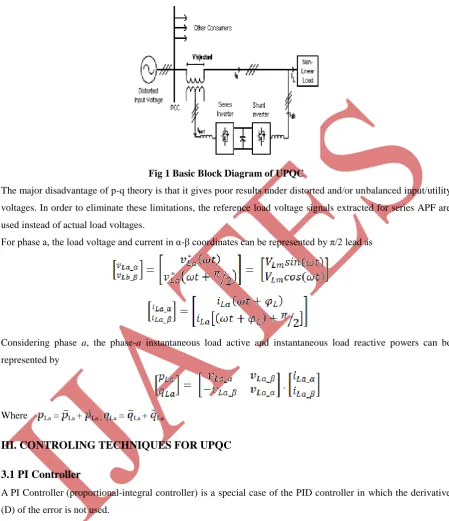
Basic block diagram of UPQC is shown in Fig 1. The voltage at PCC may be or may not be distorted depending
on the other non-linear loads connected at PCC. Here we assume the voltage at PCC is distorted. Two voltage
the load. It acts as shunt APF, helps in compensating load harmonic current as well as to maintain dc link
voltage at constant level. The second inverter is connected in series with utility voltage by using series
transformers and helps in maintaining the load voltage sinusoidal.
Fig 1 Basic Block Diagram of UPQC
The major disadvantage of p-q theory is that it gives poor results under distorted and/or unbalanced input/utility
voltages. In order to eliminate these limitations, the reference load voltage signals extracted for series APF are
used instead of actual load voltages.
For phase a, the load voltage and current in α-β coordinates can be represented by π/2 lead as
Considering phase a, the phase-a instantaneous load active and instantaneous load reactive powers can be
represented by
.
Where La = La + La , La = La + La
III. CONTROLING TECHNIQUES FOR UPQC
3.1 PI Controller
A PI Controller (proportional-integral controller) is a special case of the PID controller in which the derivative
(D) of the error is not used.
The controller output is given by
The lack of derivative action may make the system more steady in the steady state in the case of noisy data. This
is because derivative action is more sensitive to higher-frequency terms in the inputs. Without derivative action,
a PI-controlled system is less responsive to real (non-noise) and relatively fast alterations in state and so the
3.2 Artificial Neural Networks
Artificial Neural Networks are relatively crude electronic models based on the neural structure of the brain. The
brain basically learns from experience. It is natural proof that are beyond the scope of current computers are
indeed solvable by small energy efficient packages. This brain modeling also promises a less technical way to
develop machine solutions. Now, advance in biological research promise an initial understanding of the natural
thinking mechanism. This research shows that brain stores information, as patterns. Some of these patterns are
very complicated and allow us the ability to recognize individual faces from any different angles. This process
of storing information as patterns, utilizing those patterns, and then solving problems encompasses a new field
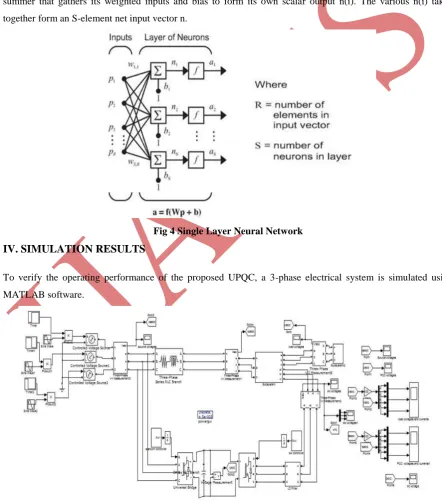
in computing. A one-layer network with R input elements and S neurons follow. In this network, each element
of the input vector p is connected to each neuron input through the weight matrix W. The ith neuron has a
summer that gathers its weighted inputs and bias to form its own scalar output n(i). The various n(i) taken
together form an S-element net input vector n.
Fig 4 Single Layer Neural Network
IV. SIMULATION RESULTS
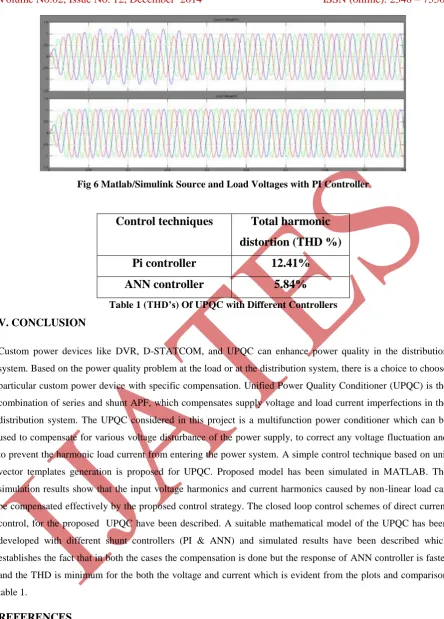
To verify the operating performance of the proposed UPQC, a 3-phase electrical system is simulated using
Fig 6 Matlab/Simulink Source and Load Voltages with PI Controller
Table 1 (THD’s) Of UPQC with Different Controllers
V. CONCLUSION
Custom power devices like DVR, D-STATCOM, and UPQC can enhance power quality in the distribution
system. Based on the power quality problem at the load or at the distribution system, there is a choice to choose
particular custom power device with specific compensation. Unified Power Quality Conditioner (UPQC) is the
combination of series and shunt APF, which compensates supply voltage and load current imperfections in the
distribution system. The UPQC considered in this project is a multifunction power conditioner which can be
used to compensate for various voltage disturbance of the power supply, to correct any voltage fluctuation and
to prevent the harmonic load current from entering the power system. A simple control technique based on unit
vector templates generation is proposed for UPQC. Proposed model has been simulated in MATLAB. The
simulation results show that the input voltage harmonics and current harmonics caused by non-linear load can
be compensated effectively by the proposed control strategy. The closed loop control schemes of direct current
control, for the proposed UPQC have been described. A suitable mathematical model of the UPQC has been
developed with different shunt controllers (PI & ANN) and simulated results have been described which
establishes the fact that in both the cases the compensation is done but the response of ANN controller is faster
and the THD is minimum for the both the voltage and current which is evident from the plots and comparison
table 1.
REFERENCES
[1] B.Singh, K. Al-Haddad, and A. Chandra. “A review of active power filters for power quality
improvement. “IEEE Trans. Ind. Electron., vol.45. no.5.pp. 960-971, Oct.1999.
[2] C.A. Quinn and N.Mohan. “Active filtering of harmonic currents in three-phase, four-wire systems with
three-phase and single-phase nonlinear loads” in proc. 7th IEEE APEC,1992. Pp. 829-836.
Control techniques
Total harmonic
distortion (THD %)
Pi controller
12.41%
[3] H. Akagi, Y. Kanazawa and A.Nabae, “Instantaneous reactive power compensators comprising switching
devices without energy storage components.” IEEE Trans. Ind. Appl., vol. 1A-20, no. 3. Pp. 625-630.
May/jun. 1984.
[4] Y.Komatsu and T.Kawabata.“A control method of active power filter in unsymmetrical and distorted
voltage system”, in Proc. Conf. IEEE Power Converters., 1997. Vol. 1, pp. 161-168.
[5] M.T.Haque, “Single-phase PQ theory.” In Proc. 33rd IEEE PESC,2002, vol.4, pp. 1815-1820.
[6] J.M. Correa, S.Chakraborty, M. G. Simoes, and F.A.Farrent, “A single phase high frequency AC
microgrid with an unified power quality conditioner”,in Conf. Rec. 38th IEEE Ias Annu. Meeting, 2003,
vol. 2, pp. 956-962.
[7] V.Khadkikar, A. Chandra, A.O. Barry, and T.D. Nguyen, “Application of UPQC to protect a sensitive load
on a polluted distribution network.” In Proc. IEEE PES General Meeting, Montreal, QC, Canada, 2006. 6
pp.
[8] V.Khadkikar, A. Chandra, A.O. Barry, and T.D. Nguyen, “Conceptual analysis of unified power quality
conditioner (UPQC).”, in Proc. IEEE ISTE, 2006, pp 1088-1093.
[9] M.Aredes, K.Heumann, and E.H.Watanabe, “An universal active power line conditioner”, IEEE Trans.
Power Del., vol.13, no. 2, pp. 545-551, Arl.1998.
[10] R. Faranda and I. Valade, “UPQC compensation strategy and design aimed at reducing losses, “ in Proc.
IEEE ISIE, 2002, vol. 4, pp. 1264-1270.
PALADUGULA V ADITYAreceived his Bachelor of technology from EEE- SREE RAMA
INSTITUTE OF TECHNOLOGY & SCIENCE (JNTUH, Kakinada). He is currently
pursuing Masters in SREE VAHINI INSTITUTE OF SCIENCE & TECHNOLOGY
(JNTUK) in the department of Power Systems.
TELLA NAGARAJU working as Asst. Prof at SREE VAHINI INSTITUTE OF SCIENCE
& TECHNOLOGY. He received his Masters from ADAM'S ENGINEERING COLLEGE,
JNTUH. He has 2 years working experience in teaching. He guided several UG & PG