doi:10.1155/2010/504956
Research Article
Synchronization of Discrete-Time Complex
Networks with Randomly Occurring Coupling and
Distributed Time-Varying Delay
Yang Tang
1, 2and Jian-an Fang
11College of Information Science and Technology, Donghua University, Shanghai 201620, China 2Institute of Textiles and Clothing, Kowloon, Hong Kong Polytechnic University, Hong Kong Correspondence should be addressed to Yang Tang,[email protected]
Received 6 December 2009; Accepted 19 March 2010
Academic Editor: A ˇgacik Zafer
Copyrightq2010 Y. Tang and J.-a. Fang. This is an open access article distributed under the Creative Commons Attribution License, which permits unrestricted use, distribution, and reproduction in any medium, provided the original work is properly cited.
The synchronization problem of new discrete-time complex networks with randomly occurring coupling and distributed time-varying delay is investigated. Compared with the previous work, the distributed delay is assumed to be timevarying. Moreover, the effects of both variation range and probability distribution of distributed time-varying delay are taken into consideration. The randomly occurring coupling and distributed delay in complex networks are considered by introducing two Bernoulli stochastic variables. By using some novel analysis techniques, Kronecker product and Lyapunov functional candidate, some delay-distribution-dependent conditions are derived to ensure that the discrete-time complex network with randomly coupling and distributed time-varying delay is synchronized in mean square. A numerical simulation example is provided to verify the effectiveness and the applicability of the proposed approach.
1. Introduction
Synchronization is an important property of complex networks, which can be seen in natural, social, physical and biological fields, and has been found applications in everywhere of real world 1–17. In engineering applications such as network-based control, time-series analysis, and image processing, it is often necessary to formulate a discrete-time analog of the continuous-time networks. Recently, synchronization of discrete-time complex networks has drawn much interests8,9,11–14.
networks with timedelay has been investigated by many researchers 4, 6–12, 16, 17. It is worth mentioning that the distributed delay occurs frequently in networks and it has been drawing increasing research attention 6, 16, 17. Very recently,Liu et al. introduced the distributed delay in the form of constant delay into the discrete-time systems 9,10. However, in practice, time-varying delay in networks occurs commonly in most designs. Therefore, the study of complex networks with distributed time-varying delay is more important than those with constant delays.
In the existing references for complex networks, the deterministic time-delay case was wellstudied; see, for example,6,7,9,11,12. Actually, the time delay, in such networks exist in a stochastic fashion18, 29. In29, if some values of the time delay in a probabilistic universal learning networks are very large but the probabilities of the delay taking such large values are very small, then it may lead to a more conservative result if only the information of variation range of the time delay is considered. For this case, if one derives the criteria by only using the variation range of time delay, the results could lead to more conservative. In 18, the randomly discrete delay in networks was introduced without considering distributed delay. On the other hand, another interesting random phenomenon, randomly occurring coupling term in complex networks, has been largely overlooked. For networks with communication constraints, such random occurring coupling may be subject to random abrupt changes, which may have resulted from abrupt phenomena such as random failures, changes in the interconnections of subsystems and sudden environment changes, and so forth. An example for randomly occurring coupling is the blackouts in complex bulk power grids in many nations30, which result in huge losses. To the best of our knowledge, the synchronization problem for discrete-time complex networks withdistributed
time-varyingdelay has received very little attention, not to mention the case that randomly
occurring couplingandrandomly distributed delayare also involved.
Motivated by the above discussions, the aim of this paper is to investigate the synchronization of discrete-time complex networks with randomly occurring coupling and distributed delay in mean square. By using two stochastic variables which satisfy Bernoulli random binary distribution, we propose a new model of complex networks. The effects of both variation range and probability distribution of distributed delay are considered to derive the stability criteria. The proposed results take some well-studied models as special cases. Via a Lyapunov-Krasovskii functional and some new analysis techniques, some sufficient conditions for synchronization in mean square are established for the addressed networks with randomly occurring coupling and distributed delay. An illustrative example is given to show the effectiveness of the proposed results.
2. Preliminaries
Notations
Throughout this paper,RnandRn×mdenote, respectively, then-dimensional Euclidean space
and the set of all real matrices. The superscript “T” denotes matrix transposition and the notationX ≥ Y resp.,X > Y, whereX and Y are symmetric matrices, means thatX−Y
conditional ony.| · |stands for the Euclidean vector norm inRn. The Kronecker product of
matricesQ∈Rm×nandR∈Rp×qis a matrix inRmp×nqand denoted asQ⊗R.
Consider complex networks with mixed time-varying delays and randomly occurring coupling:
xik1 fxik gxik−τk
−1
m −dk
hxikm ρk N
j 1
w1ijΓxjk
1−ρk N
j 1
w2ijΓxjk, i 1,2, . . . , N,
2.1
where xik xi1k, xi2k, . . . , xinkT ∈ Rn is the state vector of the ith node; fxik f1xi1k, . . . , fnxinkT, gxik g1xi1k, . . . , gnxinkT, and hxik h1xi1k, . . . , hnxinkTare unknown but sector-bounded nonlinear function; τk and dk denote discrete and distributed time-varying delays, respectively; Γ > 0 represents the inner coupling matrix between the subsystems;Wq wqijN×Nis the coupling
configuration matrices representing the coupling strength and the topological structure of the networks satisfying
wqij wqji≥0
i /j, wqii N
j 1,j /i
wqij, q 1,2, i, j 1,2, . . . , N. 2.2
ρkis a stochastic variable that describes the following random events for the system2.1:
Event 1: system2.1experiencesW1, Event 2: system2.1experiencesW2.
2.3
Letρkbe a Bernoulli distributed sequence defined by
ρk
1, if Event 1 occurs,
0, if Event 2 occurs, 2.4
whereρksatisfies Prob{ρk 1} E{ρk} ρ0, and Prob{ρk 0} ρ0.
Remark 2.1. Recently,Liu et al. introduced the distributed delay in discrete-time systems 9,
10. However, the distributed delay in their well-studied works is considered as constant distributed delay or infinite distributed delay. Due to the fact that time-varying delay takes the usual time delay as special case, in this paper, we aim to investigate synchronization of complex networks with the time-varying distributed delay. In next section, we use some novel techniques to deal with the interval time-varying distributed delay in discrete-time systems.
Remark 2.2. In the existing results, the synchronization of complex networks with
determinis-tic coupling or coupling with stochasdeterminis-tic disturbances has been well studied; see, for example,
the probability distribution of the coupling terms. To our knowledge, this represents the first attempt to take into account the occurrence of different coupling terms in a probabilistic way by binary description for the addressed complex networks. In this paper, we call this coupling term as randomly occurring coupling.
Remark 2.3. As mentioned in the introduction, randomly occurring coupling in complex
system resides in every field of our world. For example, the blackouts in complex bulk power girds are a case of randomly occurring coupling. In usual time, the connections are normal, which means thatρ0ρ0. If the blackouts happen in complex bulk power girds, the case of ρk 0 occurs and the connections break down.
Throughout this paper, the following assumptions and definitions are needed.
Assumption 2.4. For for allu, v ∈ Rn, the nonlinear function f·and g· are assumed to
satisfy the following sector-bounded condition
fu−fv−H1u−v
Tfu−fv−H
2u−v
≤0,
gu−gv−M1u−v T
gu−gv−M2u−v
≤0,
hu−hv−L1u−vThu−hv−L2u−v≤0,
2.5
whereH1,H2,M1,M2,L1, andL2are real constant matrices.
Remark 2.5. This assumption was first introduced in25 and has been subsequently used
in many recent networks papers see, e.g., 9, 11, 12, 16. The nonlinear functions in
Assumption 2.4 are known as sector-like descriptions of the nonlinearities, which are in a more general form than the usual Lipschitz condition.
Assumption 2.6. The discrete time-varying delay τk and distributed time-varying delay
dkare bounded, namely, 0 < τm ≤ τk ≤ τM, 0 < dm ≤ dk ≤ dM. And the distributed
delay’s probability distribution can be observed; that is, assume that dktakes values in
dm
1 :dM1 ordm2 :dM2 and Prob{dk∈d1m :d1M} ξ0, wheredm≤d1m< dM1 < dm2 < d2M≤ dM, and 0≤ξ
0≤1.
Define the two mapping functions
d1k:Z≥0−→
dm1 :dM1 , d2k:Z≥0−→
dm2 :dM2 , 2.6
where for anyk0 ∈Z≥0such thatdk0 ∈dim :diM,we haved k0
i dk0 i 1,2. Then, define the two sets
R1 {k|k∈Z≥0, dk d1k}, R2 {k|k∈Z≥0, dk d2k}. 2.7
Clearly,R1∪ R2 Z≥0andR1∩ R2 Φ empty set. Define a stochastic variable as
ξk
1, k∈ R1, 0, k∈ R2.
In the following, we denote xk, xki,xk−τk,τk,dk,d1k,d2k,ρk, and ξk, by xk,xki, xτ, τk,dk,dk,1,dk,2,ρk, and ξk, respectively. From the above discussion,
the complex networks with randomly distributed time-varying delay and coupling can be described in compact form by using Kronecker product “⊗of matrices:
xk1 Fxk Gxτ ξk −1
i −dk,1
Hxki 1−ξk −1
i −dk,2
Hxki
ρkW1⊗Γxk
1−ρk
W2⊗Γxk,
2.9
where xk xk,T1, xTk,2, . . . , xTk,NT, Fxk fTxk,1, fTxk,2, . . . , fTxk,NT, Gxτ
gTx
τ,1, gTxτ,2, . . . , gTxτ,NT,Hxk hTxk,1, hTxk,2, . . . , hTxk,NT.
Remark 2.7. Clearly, in 9, 11, 12, the variation range of the discrete delay is employed
to derive the stability criteria. However, in practical situation, if some values of the delay are very large but the probabilities of the delay taking such large values are very small, it may result in a more conservative result if only the variation range of mixed time delays is considered. By using the new functionsdk,1, dk,2, ξk,2.1can be converted into an equivalent
form2.9. In2.9, the probabilistic effects of the mixed time delays have been translated into the parameter matrices of the transformed system. Thus, it can be seen that, based on the new model2.9, the synchronization conditions can be derived.
Remark 2.8. Note that the introduction of time delay in the form of binary stochastic variable
was first proposed in 31 and then successfully used in18, 32,33. In 18, the authors employ stochastic discrete time-varying delay to investigate the stability of neural networks. Different with this paper, we consider the randomly distributed time-varying delay in networks. It is also worth mentioning that it is easy to extend our main results to randomly discrete delay in complex networks.
Remark 2.9. FromAssumption 2.6and the definitions ofρkandξk, it can be seen thatρkand
ξkare Bernoulli distributed white sequences with Prob{ξk 1} E{ξk} ξ0and Prob{ξk
0} ξ0. Moreover, it can be shown thatE{ρk−ρ0} 0,E{ξk−ξ0} 0,E{ρk−ρ02} ρ0ρ0, andE{ξk−ξ02} ξ0ξ0.
Definition 2.10. The discrete-time complex networks with randomly distributed time-varying
delay and occurring coupling are synchronized in mean square if the following holds:
lim
k→∞E xk,i−xk,j
2
0, ∀1≤i < j≤N. 2.10
3. Main Results
Before we give the main results of this paper, the following lemmas are needed.
Lemma 3.1. The Kronecker product has the following properties:
1 αA⊗B A⊗αB,
3 A⊗BC⊗D AC⊗BD,
4 A⊗BT AT⊗BT.
Lemma 3.2. LetU αijN×N, P ∈Rn×n, x xT1, xT2, . . . , xNT
T, wherex
i xi1, xi2, . . . , xinT ∈
Rn, andy yT
1, y2T, . . . , yNT
T, wherey
i yi1, yi2, . . . , yinT ∈ Rnk 1,2, . . . , N. IfU UT
and each row sum ofUis zero, then
xTU ⊗Py − 1≤i<j≤N
αij
xi−xj
T
Pyi−yj
. 3.1
Lemma 3.3see9. LetM ∈ Rn×nbe a positive semidefinite matrix, letx
i ∈Rnbe a vector, and
letai≥0 i 1,2, . . .be scalars. If the series concerned are convergent, then the following inequality
holds:
∞
i 1 aixi
T
M
∞
i 1 aixi
≤
∞
i 1 ai
∞
i 1
aixTiMxi. 3.2
Lemma 3.4see9. LetA aijm×n, B bijp×q, andC cijm×q AB. If the sum of all
elements in each column ofA(row ofB) is zero, then the sum of all elements in each column (row) of
Cis zero. Moreover, ifAis a symmetric matrix and the sum of all elements in each row ofAis zero,
then, for any positive integern, the sum of all elements in each row ofAnis zero.
For the sake of simplicity, we denote bywqij2, q 1,2,thei, j entry of the matrix
W2
q q 1,2. Now, we give our main result in this paper as follows.
Theorem 3.5. Under AssumptionsA1-A2, the discrete-time complex networks with randomly
definite matricesP, Q, R1, R2and diagonal matricesV, S, Zwith appropriate dimensions such that the
following matrix inequalities hold:
Ξij
Proof. We construct the following Lyapunov-Krasovskii functionalVxk, kby
Vxk, k
4
i 1
where
E{ΔV1xk, k} E{V1xk1, k1|xk} −V1xk, k
FTx
kU⊗PFxk GTxτU⊗PGxτ ξ0 −1
i −dk,1 HTx
kiU⊗P
× −1
i −dk,1
Hxki ξ0 −1
i −dk,2 HTx
kiU⊗P −1
i −dk,2
Hxki
ρ0xTkW1⊗ΓTU⊗PW1⊗Γxkρ0xTkW2⊗ΓTU⊗PW2⊗Γxk
2FTxkU⊗PGxτ 2ξ0FTxkU⊗P −1
i −dk,1
Hxki
2ξ0FTxkU⊗P −1
i −dk,2
Hxki 2ρ0FTxkU⊗PW1⊗Γxk
2ρ0FTxkU⊗PW2⊗Γxk2ξ0GTxτU⊗P −1
i −dk,1
Hxki
2ξ0GTxτU⊗P −1
i −dk,2
Hxki 2ρ0GTxτU⊗PW1⊗Γxk
2ρ0GTxτU⊗PW2⊗Γxk2ξ0ρ0 −1
i −dk,1
HTxkiU⊗PW1⊗Γxk
2ξ0ρ0 −1
i −dk,1
HTxkiU⊗PW2⊗Γxk
2ξ0ρ0 −1
i −dk,2
HTxkiU⊗PW1⊗Γxk
2ξ0ρ0 −1
i −dk,2
HTxkiU⊗PW2⊗Γxk−xTkU⊗Pxk,
E{ΔV2xk, k} E{V2xk1, k1|xk} −V2xk, k
≤τM−τm1GTxkU⊗QGxk−GTxτU⊗QGxτ.
Similarly, we have
have fromLemma 3.1that
Then, one can derive fromA2that readily from3.16that
E{ΔVk} ≤λ0E
Lettingmbe a positive integer, the summation of both sides of3.17from 1 tomwith respect tokyields
Remark 3.6. If the distributed time-varying delay reduces to infinite distributed delay and binary descriptions were removed from3.5, the model reduces to model studied in 9, and then the results obtained in this paper are equivalent to those of Theorem 1 in9. On the other hand, the authors studied the stability problem in neural networks with randomly discrete delay18. It is worth mentioning that we can easily extend our results to the case of stability problem of neural networks with randomly distributed delay.
Remark 3.7. In6,7,9, the synchronization problem of complex networks with deterministic
coupling has been studied. In practical situations, the coupling in networks may be subject to some noise. In4,11,12, synchronization of complex networks with stochastic disturbances has been well studied. However, another interesting phenomenon, randomly occurring coupling term in complex networks, has been largely overlooked. In this paper, we introduce a Bernoulli stochastic variable to describe the stochastic occurring coupling.
If the randomly occurring coupling does not happen in complex networks, that is,
ρk 1, then we can obtain the following results.
Corollary 3.8. Under AssumptionsA1-A2, the discrete-time complex networks with randomly
distributed time-varying delays are synchronized in mean square, if there exist positive definite
matrices P, Q, R1, R2 and diagonal matrices V, S, Z with appropriate dimensions such that the
following matrix inequalities hold:
If the distributed time-varying delays do not occur stochastically, that is,ξk 1, then we have the following results.
Corollary 3.9. Under assumptionsA1-A2, the discrete-time complex networks with distributed
time-varying delays is synchronized in mean square, if there exist positive definite matricesP, Q, R1
and diagonal matricesV, S, Zwith appropriate dimensions such that the following matrix inequalities
hold:
Ξij
⎡ ⎢ ⎢ ⎢ ⎢ ⎢ ⎢ ⎢ ⎣
Ξij11 Ξij12 SMˇ Ξij14 ZLˇ Ξij16
∗ Ξij22 0 P 0 P
∗ ∗ Ξij33 0 0 0
∗ ∗ ∗ P−Q 0 P
∗ ∗ ∗ ∗ Ξij55 0
∗ ∗ ∗ ∗ ∗ Ξij66 ⎤ ⎥ ⎥ ⎥ ⎥ ⎥ ⎥ ⎥ ⎦
<0, 1≤i < j ≤N,
Ξij11 −ρ0Nw12ijΓPΓ−ρ0Nw2ij2ΓPΓ−P−VH−SM−ZL,
Ξij12 −ρ0Nw1ijPΓ−ρ0Nw2ijPΓ VH,ˇ
Ξij14 −ρ0Nw1ijPΓ−ρ0Nw2ijPΓ,
Ξij16 −ρ0Nw1ijPΓ−ρ0Nw2ijPΓ,
Ξij22 P−V,
Ξij33 τM−τm1Q−S,
Ξij55
dM1 1
2
dM1 −dm1d1Mdm1 −1R1−Z,
Ξij66 P− 1 dM
1 R1.
3.22
If both coupling and distributed time-varying delays do not occur randomly, that is,
ξk 1 andρk 1, then we have the following results.
Corollary 3.10. Under AssumptionsA1-A2, the discrete-time complex networks with distributed
and diagonal matricesV, S, Zwith appropriate dimensions such that the following matrix inequalities
We consider the following discrete-time complex networks with randomly coupling and distributed time-varying delay consisting of three nodes:
50
Let the nonlinear vector-valued functions be given by
fxik −0.5xi1k tanh0.2xi1k 0.2xi2k,0.95xi2k−tanh0.75xi2kT, gxik hxik 0.2xi1k−tanh0.1xi1k,0.1xi2kT, i 1,2,3.
4.3
It can be verified that
H1
We can obtain LMI solution in the following:
P
It is clear that the condition of Theorem 3.5is satisfied. Therefore, the synchronization of complex networks2.9can be achieved. For this example, all the stability criteria in9,11,12
50 40
30 20
10 0
k
x11−x21
x12−x22
x11−x31
x12−x32
−3 −2 −1 0 1 2 3
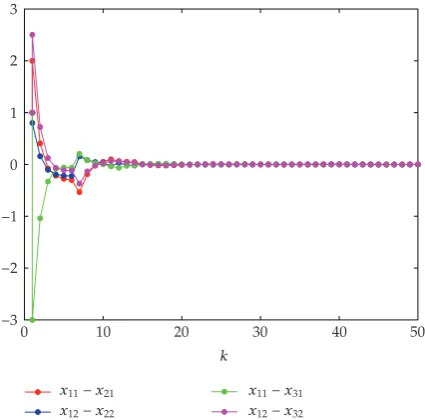
Figure 2:Synchronization errors.
well as the coupling term and distributed delay occur randomly. However, using our criterion inTheorem 3.5, we conclude that the complex networks with randomly occurring coupling and distributed time-varying delays 2.9 can be uniformly synchronized in mean square since the LMI in3.3is feasible using LMI Toolbox.
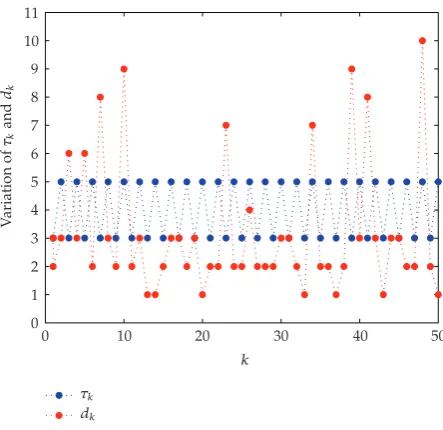
Figure 1 shows the variation of τk and dk. It can be observed from Figure 2 that
the discrete-time complex networks with randomly occurring coupling and stochastic distributed time-varying delay can be synchronized in mean square.
5. Conclusion
In this paper, we have investigated the synchronization of novel discrete-time complex networks with randomly occurring coupling and distributed time-varying delay. By employing some new techniques, the Kronecker product and linear matrix inequalityLMI techniques, the synchronization criteria have been established for discrete-time complex networks with randomly distributed time-varying delay, as well as randomly occurring coupling. In the end of this paper, we have exploited a numerical example to show the usefulness of our results.
Acknowledgments
This research was partially supported by the National Natural Science Foundation of China
Grant no. 60874113, the Research Fund for the Doctoral Program of Higher Education
Grant no. 200802550007, the Key Creative Project of Shanghai Education Community
References
1 C. W. Wu and L. O. Chua, “Synchronization in an array of linearly coupled dynamical systems,”IEEE Transactions on Circuits and Systems I, vol. 42, no. 8, pp. 430–447, 1995.
2 X. F. Wang and G. Chen, “Synchronization in small-world dynamical networks,”International Journal of Bifurcation and Chaos, vol. 12, no. 1, pp. 187–192, 2002.
3 J. L ¨u and G. Chen, “A time-varying complex dynamical network model and its controlled synchronization criteria,”IEEE Transactions on Automatic Control, vol. 50, no. 6, pp. 841–846, 2005.
4 J. Cao, Z. Wang, and Y. Sun, “Synchronization in an array of linearly stochastically coupled networks with time delays,”Physica A, vol. 385, no. 2, pp. 718–728, 2007.
5 J. Cao, P. Li, and W. Wang, “Global synchronization in arrays of delayed neural networks with constant and delayed coupling,”Physics Letters A, vol. 353, no. 4, pp. 318–325, 2006.
6 J. Cao, G. Chen, and P. Li, “Global synchronization in an array of delayed neural networks with hybrid coupling,”IEEE Transactions on Systems, Man, and Cybernetics, Part B, vol. 38, no. 2, pp. 488–498, 2008.
7 W. Yu, J. Cao, and J. L ¨u, “Global synchronization of linearly hybrid coupled networks with time-varying delay,”SIAM Journal on Applied Dynamical Systems, vol. 7, no. 1, pp. 108–133, 2008.
8 H. Gao, J. Lam, and G. Chen, “New criteria for synchronization stability of general complex dynamical networks with coupling delays,”Physics Letters A, vol. 360, no. 2, pp. 263–273, 2006.
9 Y. Liu, Z. Wang, J. Liang, and X. Liu, “Synchronization and state estimation for discrete-time complex networks with distributed delays,”IEEE Transactions on Systems, Man, and Cybernetics, Part B, vol. 38, no. 5, pp. 1314–1325, 2008.
10 Y. Liu, Z. Wang, and X. Liu, “State estimation for discrete-time Markovian jumping neural networks with mixed mode-dependent delays,”Physics Letters A, vol. 372, no. 48, pp. 7147–7155, 2008.
11 J. Liang, Z. Wang, Y. Liu, and X. Liu, “Global synchronization control of general delayed discrete-time networks with stochastic coupling and disturbances,”IEEE Transactions on Systems, Man, and Cybernetics, Part B, vol. 38, no. 4, pp. 1073–1083, 2008.
12 J. Liang, Z. Wang, Y. Liu, and X. Liu, “Robust synchronization of an array of coupled stochastic discrete-time delayed neural networks,”IEEE Transactions on Neural Networks, vol. 19, no. 11, pp. 1910–1921, 2008.
13 W. Lu and T. Chen, “Synchronization analysis of linearly coupled networks of discrete time systems,” Physica D, vol. 198, no. 1-2, pp. 148–168, 2004.
14 W. Lu and T. Chen, “Global synchronization of discrete-time dynamical network with a directed graph,”IEEE Transactions on Circuits and Systems II, vol. 54, no. 2, pp. 136–140, 2007.
15 Y. Tang, Z. Wang, and J.-A. Fang, “Pinning control of fractional-order weighted complex networks,” Chaos, vol. 19, no. 1, Article ID 013112, 9 pages, 2009.
16 Y. Tang, J.-A. Fang, and Q. Miao, “On the exponential synchronization of stochastic jumping chaotic neural networks with mixed delays and sector-bounded non-linearities,”Neurocomputing, vol. 72, no. 7–9, pp. 1694–1701, 2009.
17 Y. Tang, R. Qiu, J.-A. Fang, Q. Miao, and M. Xia, “Adaptive lag synchronization in unknown stochastic chaotic neural networks with discrete and distributed time-varying delays,”Physics Letters A, vol. 372, no. 24, pp. 4425–4433, 2008.
18 D. Yue, Y. Zhang, E. Tian, and C. Peng, “Delay-distribution-dependent exponential stability criteria for discrete-time recurrent neural networks with stochastic delay,” IEEE Transactions on Neural Networks, vol. 19, no. 7, pp. 1299–1306, 2008.
19 S. Xu and J. Lam, “A new approach to exponential stability analysis of neural networks with time-varying delays,”Neural Networks, vol. 19, no. 1, pp. 76–83, 2006.
20 Y. Zhang, D. Yue, and E. Tian, “Robust delay-distribution-dependent stability of discrete-time stochastic neural networks with time-varying delay,”Neurocomputing, vol. 72, no. 4–6, pp. 1265–1273, 2009.
21 Y. He, Q.-G. Wang, M. Wu, and C. Lin, “Delay-dependent state estimation for delayed neural networks,”IEEE Transactions on Neural Networks, vol. 17, no. 4, pp. 1077–1081, 2006.
22 W.-H. Chen, X. Lu, and D.-Y. Liang, “Global exponential stability for discrete-time neural networks with variable delays,”Physics Letters A, vol. 358, no. 3, pp. 186–198, 2006.
24 O. M. Kwon and Ju H. Park, “Exponential stability analysis for uncertain neural networks with interval time-varying delays,”Applied Mathematics and Computation, vol. 212, no. 2, pp. 530–541, 2009.
25 Y. Liu, Z. Wang, and X. Liu, “Global exponential stability of generalized recurrent neural networks with discrete and distributed delays,”Neural Networks, vol. 19, no. 5, pp. 667–675, 2006.
26 V. Singh, “Improved global robust stability of interval delayed neutral networks via split interval: genralizations,”Applied Mathematics and Computation, vol. 206, no. 1, pp. 290–297, 2008.
27 R. Samli and S. Arik, “New results for global stability of a class of neutral-type neural systems with time delays,”Applied Mathematics and Computation, vol. 210, no. 2, pp. 564–570, 2009.
28 Ju H. Park, O. M. Kwon, and S. M. Lee, “State estimation for neural networks of neutral-type with interval time-varying delays,”Applied Mathematics and Computation, vol. 203, no. 1, pp. 217–223, 2008.
29 K. Hirasawa, S. Mabu, and J. Hu, “Propagation and control of stochastic signals through universal learning networks,”Neural Networks, vol. 19, no. 4, pp. 487–499, 2006.
30 U.S.-Canada Power System Outage Task Force, “Final Report on the August 14th Blackout in the United States and Canada: Causes and Recommendations,” April 2004,http://www.nerc.com/.
31 A. Ray, “Output feedback control under randomly varying distributed delays,”Journal of Guidance, Control, and Dynamics, vol. 17, no. 4, pp. 701–711, 1994.
32 Z. Wang, F. Yang, D. W. C. Ho, and X. Liu, “Robust H∞filtering for stochastic time-delay systems with missing measurements,”IEEE Transactions on Signal Processing, vol. 54, no. 7, pp. 2579–2587, 2006.