S
i
mulat
i
on of mode conver
si
on from UHR-mode wave to LO-mode wave
i
n an
i
nhomogeneou
s
pla
s
ma w
i
th d
i
fferent wave normal angle
s
Mohammad Javad Kalaee, TakayukiOno, Yuto Katoh, Masahide Iizima∗, and YukitoshiNishimura†
Department of Geophysics, Graduate School of Science, Tohoku University, Japan
(Received September 21, 2008;Revised June 29, 2009;Accepted July 24, 2009;Online published December 21, 2009)
We haveinvestigated a linearmode conversion process among UHR-mode, Z-mode, and LO-mode waves by a computer simulation solving Maxwell’s equations and themotion of a cold electron fluid. The characteristics of the wave coupling process occurringin the coldmagnetized plasma were examinedin detail for the case of aninhomogeneity of plasma density lying perpendicular to the ambientmagnetic field. The dependence of the conversion efficiency on theincident wave normal angle, wave frequency, background plasma frequency, and steepness of density gradient was studied. The results show that an efficientmode conversion occurredin the conversion process fromZ-mode to LO-mode waves rather than fromthe coupling between UHR-mode to
LO-mode waves. They also show that the highest conversion efficiency was obtained under the specific condition of the wave normal angle for the incident waves. In the specific case of such critical wave normal angles, we found that perpendicular components of refractiveindexes became zero at the site ofmode conversion, which
is consistent with previously published results. We also show that the range of the critical normal angle varied depending on both the plasma frequency and the wave frequency. The simulation results also reveal that, when the steepness of the density gradient was takeninto consideration, efficientmode conversion could be expected evenin the case of themismatch of the refractiveindexes preventing the close coupling of plasma waves.
Key words:Mode conversion, numerical simulation, LO-mode, wave generation process.
1.
Introduct
i
on
A large variety of plasma waves existin space plasmas, depending on the conditions of themedium. The refrac-tive index is determined by the characteristics of waves, such as the wave frequency and the wave normal angle, and by plasma parameters, such as the number density of the plasma and the backgroundmagnetic field strength. In an
inhomogeneous plasma where these parameters vary as a function of position, the local refractiveindexis a function of position (Stix, 1992). Themode conversion,identified as a changein the propagationmodes of plasma waves,is one of the generationmechanisms of radio emissions occurring
in an inhomogeneous plasma. Mj lhus (1983, 1990) di s-cussed the linearmode conversion of an ordinary polarized electromagnetic wavein amagnetized plasma with a den-sity gradient parallel to the magnetic field and developed an expression for the conversion coefficient as a function of theincident wave normal angle. Themagnetic field leads to a narrowing of the range of angles ofincidence, leading to linear conversion when compared with the case of the unmagnetized field.
Themode conversion of upper-hybrid-resonance (UHR)
mode waves (ωp < ω ≤ ωuh) to Z-mode (ωz < ω ≤ ωp) ∗Now at Shukutoku University, Japan.
†Now at Solar-Terrestrial Environment Laboratory, Nagoya University,
Japan.
Copyright cThe Society of Geomagnetismand Earth, Planetary and Space Sci -ences (SGEPSS);The Seismological Society of Japan;The Volcanological Society of Japan;The Geodetic Society of Japan;The Japanese Society for Planetary Sci -ences;TERRAPUB.
and LO-mode waves has been investigated for the pur-pose of understanding the origin of planetary radio emi s-sions, where ω is the wave frequency, ωp is the electron plasma frequency, ωuh is the upper hybrid resonance fre-quency, and ωz is the cutoff frequency of Z-mode. The
mode conversion theory proposed by Oya (1971) has been applied for the generation process of Jovian decametric ra-diation (Oya, 1974) and auroral kilometric radiation (AKR) (Benson, 1975). Oya (1974) assumed a sharp boundaryin the vicinity of the position whereω=ωp. He showed that conversion rates of 1–50% are obtained when a wave
nor-mal direction of anincident waveis nearly parallel to the boundary normal direction while the Jovianmagnetic field vectoris close to the boundary normal direction within an angle range of 10–15◦. He also showed that the conversion rate becomes lower and lower when the angle between the boundary normal direction and themagnetic field vector be-come larger and larger. Even though his resultis limited up to 75◦,it can be suggested that the conversion rate becomes very low for the perpendicular case.
Themode conversionmechanismconsists of three pro-cesses. In the first process, field-aligned precipitating beams and/or anisotropies of velocity distribution of ener-getic electrons create electrostatic electron cyclotron
har-monic waves. These electrostatic waves propagate toward lower plasma density regions until these waves encounter the electrostatic resonance frequency, as has been experi
-mentallyidentified by Warren and Hagg (1968). In the sec-ond process, the electrostatic electron cyclotron harmonic waves are converted to UHRmode waves, being reflecting
back toward higher plasma density. These waves are fur-ther converted to the Z-mode radio waves toward the hi gh-density region. In the third process, the Z-mode waves propagate into the plasma frequency layer of ω = ωpe, where these waves have a chance to convertinto ordinary (LO-mode) waves. There are a number of variations of the conversionmechanisms to explain the radiation of
LO-mode waves fromthe planetary plasma. A typical exam -ple is non-thermal continuumradiation, which is one of the common radio emissionsin planetarymagnetospheres. Jones (1977) proposed the conversion process of conti n-uumradiationin which Z-mode waves are directly gener-ated by energetic electrons and then converted to the
LO-mode wavein the region close to the plasmapause. The fun-damental characteristics of observed continuum radiation have been explained by the proposed mechanism (Jones, 1980, 1987). Observations and theories have been summ a-rized by Hashimotoet al.(2006).
The linear mode conversion process has been mainly studied by assuming the Wentzel-Kramers-Brillouin (WKB) approximation in which the spatial scale of an
inhomogeneityis large enough relative to the wave length of incident waves. However, observational results show that the WKB approximation would often be violated
in the magnetosphere during disturbed periods. Also, a difficulty in theoretical treatment arises when the waves encounter a resonance layer, as has been discussed by Takano et al. (2005). A numerical experiment can be a highly useful tool for a guiding theory in discussions of
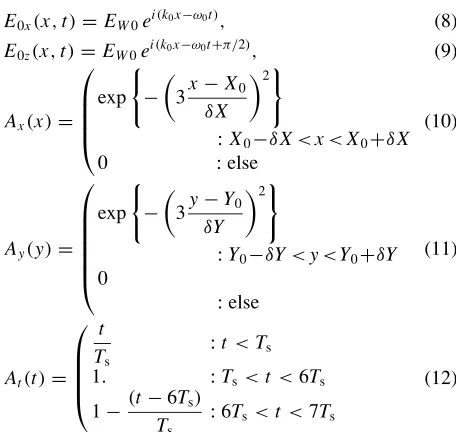
mode conversion processes under such an environment. Using a full-particle code, Ueda et al. (1998) studied a themode conversion processin themagnetosphere has not yet been studied, and a self-consistent simulation that is free fromthe WKB approximation has not been used in previous studies. In the study reported here, we discuss the properties ofmode conversion processes by performing numerical experiments with different wave normal angles and different incident wave frequencies under the same plasma conditions, such as plasma frequency and steepness of the density gradient. Based on the simulation results, we discuss the parameter dependence of conversion efficiency on the direction of the propagation vector. The dependence of the conversion efficiency on the background plasma frequency and steepness of density gradientis also studied. We describe the simulation model used in our study in (Region-B) smoothly connected by aninhomogeneous region where the density gradient∇Nis assumed with the spatial scale ofr. are solved using the two-step Lax-Wendroff scheme. Each physical value is normalized to a dimensionless quantity, (Region-B), respectively, smoothly connected by ani
so as to satisfy the conditionin which the spatial scale of the density gradient corresponds to five wavelengths of the
incident waves.
We generate plasma waves by oscillating theEx andEz
componentsin the wave generation region, while the wave vectorkof the generated wavesisintroduced to be aligned along the x-axis that describes the direction, making an oblique propagating to the external magnetic field. The
initial wave form is given by due to reflected waves fromthe boundary of the simulation box, we set damping regions at the edges of the simulation systemto suppress the reflection of outgoing waves.
Here, we discuss two cases of themode conversion pro-cess. In the first case, we consider the “single”mode con-version process fromUHR-mode wave to Z-mode and
LO-mode waves. In the second case, we consider the “double”
mode conversion process not only fromUHR-mode wave to Z-mode and LO-mode waves but also fromZ-mode to
is belowωpBbut above the cutoff frequency of the Z-mode
in the Region-B. Under this condition, theincident waves simulation results, we observed the generation of LO-mode wave through themode conversion process.
In order to examine the coupling properties between UHR-mode and LO-mode waves, we performed Fast Fourier transform(FFT) analysis on both the wave electric field andmagnetic field to obtain the spatial distributions of frequency and wave number spectra. In each simulation run, we confirmed that the polarization of theincident wave
is according to the UHR wave. We estimated the wave
nor-mal angle of the converted LO-mode wave by analyzingits polarization. In Runs 1-A to 1-E, the wave normal vectors of the converted LO-mode wave are almost parallel to the externalmagnetic field. waves propagateinto the region where the local plasma
Fig. 2. Dispersion relationin the wavenumber-ωp/ωcspace;wave frequencyis 2.03ωc. Blue, red, green and gray curves correspond to the wave normal angles of 0, 90, 58 and 8.7 degrees. The definitions of the points A, B, C and D are describedin the text.
Fig. 3. The conversion efficiency as a function of the wave normal angle of theincident UHR-mode waves. The red curveis a Gaussian fitting curve.
quencyis equal to the wave frequency, a part of the wave energyis converted to LO-mode waves. The other part of the wave energyis converted to Z-mode waves, which prop-agate furtherinto the higher density region, while the con-verted LO-mode waves propagate toward the lower density region. For the calculation of the efficiency of the mode conversion process, we estimated the Poynting vector of each wave componentincluding theincident (UHR-mode) and LO-mode waves;we calculated the ratio given by
Eff=P(LO)/P(Inc) (13)
P=EMax×BMax
2μ0
(14)
whereEff,P,EMax,BMax, andμ0 represent the efficiency, Poynting vector,maximumamplitude of the wave electric field and wavemagnetic field obtained fromthe FFT analy-sis, and permeability of the vacuum, respectively. The con-version efficiency estimated fromthe simulation resultsis summarizedin Table 1. In Fig. 3, we show the variationin
the efficiency as a function of the wave angle. We found that themaximumconversion efficiency was obtainedin Run 1-C, but the efficiencyitself was very weak.
By considering Snell’s law and usinginitial settings so that the external magnetic field vectoris directed perpen-dicular to the density gradient, the parallel component of the refractiveindex should be constant during the propa-gation of the incident waves propagatedin an inhom oge-neousmedium(Jones, 1987). We considered the refractive
indexn=n+n⊥at the conversion point whereω=ωp, andn andn⊥ are parallel and perpendicular components of the refractiveindex, respectively, with respect to m ag-netic field direction. In Run 1-C, for whichitis assumed that theincident wave normal angleis 58◦and the wave fre-quencyis 2.03ωc, we estimated that, at the conversion point,
n = 0.5745 and n⊥ = 0.93 for the UHR-mode waves and thatn=n =0.5745 for the LO-mode waves. How-ever, for other wave normal angles, the parallel components of the refractiveindexes of the UHR-mode and LO-mode waves do not become the same value, resultingin weak cou-pling between UHR-mode and LO-mode waves.
3.2 Case 2:double-mode conversion
We next consider the double-mode conversion process fromUHR-mode wave to Z-mode and LO-mode waves and from Z-mode waves to LO-mode and UHR-mode waves. We assumeincident UHR-mode waves with different wave normal angle and different wave frequencies so as to discuss the variation of the conversion efficiency.
Prior to discussing the parameter dependences, we show a typical example of the double-mode conversion process reproducedin simulation resultsin Fig. 4. Here we assume the same plasma parameters usedin the case thatθ =58◦
in the previous section, except that the plasma frequency
in Region-B isωpB = 2.54ωc. As discussedin the case of the single-mode conversion, a part of theincident
con-Fig. 4. Spatial distribution of theExcomponent of the electric fieldin the simulation systemat (a)t=52.5ωc−1and at (b)t=157ω−c1.
dition, however, the transmitted waves cannot propagate further into the region-B because the wave frequency is lower than the cutoff frequency of Z-mode waves in the Region-B. Therefore, the transmitted Z-mode waves are reflected when they encounter the local cutoff frequency, eventually coming back to the condition where the wave frequency reachesω =ωpe, resultingin themode conver-sion fromZ-mode to LO-mode waves.
Figure 4(a) and (b)indicate the spatial distributions of the
Ex component att =52.5ω−c1 andt = 157ω−c1, whichis before and after themode conversion process, respectively, which occurred aroundt =60ω−1
c . We can clearly observe the LO-mode wavesin Fig. 4(b). The wave normal vectors of the converted LO-mode wave are directed almost parallel to the externalmagnetic field. By analyzing the polari za-tion of the LO-mode wave (Ex/Ez ≈1.73 andkx ≈0.4, ky ≈1.03), we estimate that the wave normal angle of the
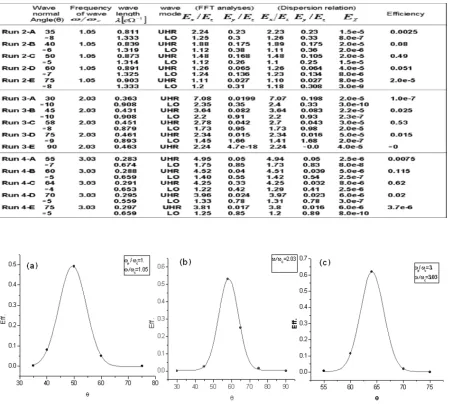
Table 2. Summary of simulation results and parameters usedin Case 2, consist of wave normal angle,incident frequency, wave length, ratio of electric field components and efficiency. For Run 2-A to 2-E,ωpA=1ωcandωpB=1.47ωc, for Run 3-A to 3-E,ωpA=2ωcandωpB=2.54ωc, and for Run 4-A to 4-E,ωpA=3ωcandωpB=3.72ωc.
Fig. 5. Variations of the conversion efficiency depending on the wave normal angle of theincident UHR-mode waves. Each panel corresponds to the results obtained by (a) Runs 2-A to 2-E, (b) Runs 3-A to 3-E, and (c) Runs 4-A to 4-E.
3.2.1 Dependence on wave normal angle We first study the variationin the conversion efficiency with respect toits dependence on theincident wave normal angle. By assuming the same background plasma condition as used to obtain the result shownin Fig. 4, we performfive simulation runs (Run 3-A to 3-E) with different propagation angles, as givenin themiddle panel of Table 2, withωpA/ωc=2 and ωpB/ωc = 2.54. The assumed propagation angle and sim -ulation results are summarizedin Table 2, while theinitial settings usedin Fig. 4 correspond to Run 3-C of Table 2. Applying the same sequence usedin Case 1, we analyze the simulation results in order to examine the coupling prop-erties between UHR-mode and LO-mode waves. The ob-tained conversion efficiency as a function of the incident wave normal angleis shownin Fig. 5(b). We find that the highest conversion efficiency of 0.52is obtainedin Run 3-C and that the conversion efficiency decreases exponentially with varying theincident propagation angle.
3.2.2 Dependence on background plasma frequency
In the previous section, we report that the high conversion efficiency was achievedin the coupling between Z-mode and LO-mode waves. Here, we study the variationin the conversion efficiency under the condition of different back-ground plasma frequencies. As shownin upper and lower panels of Table 2, we first assume that the plasma frequency
in the Region-A and Region-B to be ωpA/ωc = 1 and ωpB/ωc =1.47, respectively, while theincident wave fre-quencyisω = 1.05ωc. We also assume thatωpA/ωc =3 and asin Region-B,ωpB/ωc = 3.72, whileω = 3.03ωc. The efficiency for each wave normal angle estimated from
simulation resultsis summarizedin Table 2. Figure 5(a) and (c) also show the variationin the conversion efficiency as a function of theincident wave normal angle. By com
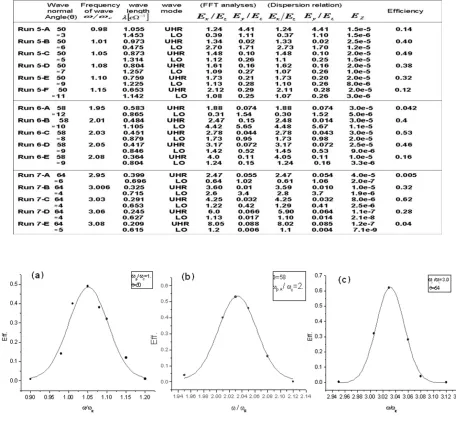
Table 3. Summary of simulation results and parameters usedin Case 2 (continued), consist of wave normal angle,incident frequency, wave length, ratio of electric field components and efficiency. For Run 5-A to 5-F,ωpA=1.ωcandωpB=1.47ωc, for Run 6-A to 6-E,ωpA=2ωcandωpB=2.54ωc, and for Run 7-A to 7-E,ωpA=3ωcandωpB=3.72ωc.
Fig. 6. Variations of the conversion efficiency depending on the wave frequency of theincident UHR-mode waves under condition of (a)ωpA/ωc=1.0, (b)ωpA/ωc=2.0, and (c)ωpA/ωc=3.0.
3.2.3 Dependence on wave frequency Finally, we study the dependence of the conversion efficiency on the wave frequency of theincident UHR-mode waves. In this survey, we carry out three sets of simulations as given in Table 3, while the sameωpAis assumedin each set. Namely, we assume thatωpA/ωc = 1.0, ωpB/ωc = 1.47, andθ = 50◦ in the first set, ωpA/ωc = 2.0, ωpB/ωc = 2.54, and θ = 58◦ in the second set, andωpA/ωc = 3.0, ωpB/ωc = 3.72, andθ =64◦ in the third set. The simulation results of these sets are summarizedin Table 3, and the estimated conversion efficiencies as a function of the frequency of the incident UHR-mode wave are shown in Fig. 6. The simulation results reveal that the peak of the conversion efficiencyis obtained in each set of simulations and that the condition of the effectivemode conversionis sensitive to the relation between the background plasma frequency and the frequency of theincident UHR-mode wave.
3.2.4 Summary and discussion of Case 2 Based on the simulation results of Case 2, we found that the conver-sion efficiency of the double-mode conversion process is strongly dependent on the wave normal angle and the wave frequency of the incident waves. This tendencyis com
-monly found in simulations assuming a different plasma frequencyin the simulation system. Here, we discuss the coupling properties of UHR, Z-mode, and LO-mode waves
in detail based on the cold plasma theory. When we con-sider the dispersion relation for wavesin a cold plasma,
n2=n2+n⊥2 =1− 2X(X−1)
2(X−1)−Y2sin2θ± (15)
-Fig. 7. (a) Variation of wave normal angleθdepending on the local plasma frequency. Red, green and blue lines correspond to the settings usedin Run 2-C, 3-C, and 4-C. Under these settings, the conditionin which bothn=nc
andn⊥,LO=n⊥,Z =0 are satisfied atθ=0 as shown by the points A, B and Cin the diagram, resultingin the highest conversion efficiency. (b, c) Variations of the wave normal angleθunder the cases corresponding to the condition thatn =ncis satisfied at the location of themode conversion. Each panel corresponds to the settings usedin (b) Run 7-E and (c) Run 3-B.
nary (ordinary)mode. By taking Snell’s lawinto consi d-eration and by assuming that the externalmagnetic fieldis directed perpendicular to the density gradient, the parallel component of the refractiveindex should be constant
dur-ing the wave propagation in an inhomogeneous medium. Itis also clear fromEq. (15) that the twomodes coalesce when the quantity vanishes. Thisin turn requires that the conditions of X = 1 andθ = 0 should be sim ultane-ously satisfied,n2
⊥ = 0. Namely, thatn⊥,LO = n⊥,Z =0 wheren⊥,LOandn⊥,Zare perpendicular components of the refractiveindex of LO-mode and Z-mode waves, respec-tively. Based on this discussion, we can estimate the paral-lel component of the refractiveindex of theincident
UHR-mode wave corresponding to the highest conversion effi-ciencyin the double-mode conversion process by referring to the value of(nc)2 = 1+YY. Here,nc is a critical value for the parallel component of the refractiveindex obtained fromEq. (15) where the condition = 0is satisfied and two branches of ordinarymode and extraordinarymode are connected. The parallel components of the refractiveindex
of both ordinary and extraordinary waves become the same value for the wave parameters corresponding to the highest conversion efficiency, asis expected according to Snell’s law. For example, in Figs. 5(b) and 6(b), we obtain the highest conversion efficiency when we assumeω=2.03ωc andθ = 58◦. Meanwhile, the estimated critical value for the wave frequency ofω = 2.03ωcis(nc)2 =(0.5745)2, corresponding to θ = 58.3◦; these are consistent with the simulation results. Figure 7(a) showsθ determined from
the dispersion relation as a function ofωp/ωcfor the ordi -narymode and extraordinarymode for the cases ofn=nc
under different settings. Figure 7(a)indicates that these two curves (extraordinary-mode and ordinary-mode branches) connect at the region whereωp/ωcis equal to the wave fre-quency under each setting. The coupling between these two
modes can be strong at point A forθ =50◦, at point B for θ=58.3◦, and at point C forθ =64◦. Note that,in the case thatn=nc
, the curves of the ordinary- and extraordi
nary-mode branches are disconnected for a real value ofn⊥. This
ef-Fig. 8. Variation of the wave normal angleθsatisfying the condition ofn =nc
as a function of the local plasma frequency. Each curve shows the
contour line of the wave frequency normalized by the local plasma frequency;contour lines are drawn every 0.01ωp. The ringsindicate the positions of threeincident wave normal angles that usedin Run 2-C, 3-C, and 4-C.
ficiency. Two typical examples are shownin Fig. 7(b) and 7(c). The region of evanescence develops between the two branches, and themode conversion can only take place by the effect of tunneling through the evanescent region. By referring to these results, we find that the estimations based on the theory are consistent with the simulation results.
Based on this exploration and on the results of the sim u-lation, we can also estimate theincident angle
correspond-ing to the highest efficiency. Figure 8 shows the relation among the wave frequency, incident wave normal angle, and background plasma frequency that lead to themost ef-ficientmode conversion. The lowest curve, corresponding to ω ≈ ωp, indicates that the smallest wave normal an-gleθLowincreases withincreasing background plasma fre-quency. For the highest mode conversion efficiency, the wave normal angle to the incident wave should be in the range ofθLow≤θ < π/2.
In each set of simulations for both Cases 1 and 2, we changed the initial wave normal angles ofincident
UHR-mode waves having a fixed wave frequency so as to be able to discuss the dependence of conversion efficiencies. In these simulations, the spatial scale of the density gradientis fixed to five wavelengths ofincident waves. This assum p-tionis used so as to clarify the fundamental properties of the conversion process. However, since the wavelengthi t-self varies depending on theinitial wave normal angle, this assumptionis equivalent to the condition that the different spatial gradient is assumed in each run. Figure 9 shows the relative spatial scale of the density gradient usedin the simulations of Run 3 with different wave normal angles, while values are normalized by the scale usedin Run 3-C,
L0. Under the condition that the spatial scale of the density gradientis sufficiently larger than the wavelength of thei n-cident UHR-mode waves, as we discuss later, the effect of the variation shownin Fig. 9 would be negligible because the conversion efficiency rapidly decreases with deviations fromthe critical wave normal angles. However, as has been shownin Fig. 10(a),in the case that the density gradientis close to the wavelength of the waves, the conversion effi-ciency varies depending on the spatial scale of the density
Fig. 9. The spatial scale of theinhomogeneous region usedin Runs 3-A to 3-E. The values are normalized by the scale usedin Run 3-C (L0).
gradient. Even though the spatial scale of the density gradi -ent shownin Fig. 10(a)is of the same order, the wavelength scale variation significantly alters the conversion efficiency. We should therefore pay attention to this point when we ap-ply the results of this study to the discussion of themode conversion process under the realistic condition.
Here, however, we would like to discuss the fundamental properties of themode conversion process by assuming one propagation angle ofincident waves and by normalizing the
inhomogeneity with the wavelength of the wave. Under the condition that theincident waves have the broad-band fre-quency spectra, the spatial scale of theinhomogeneity seen by each wave component should become different from
each other, and the resultant wave spectra of converted
LO-mode waves would be influenced by the variation in the conversion efficiencies due to this difference. Our sim ula-tionmodel can handle such broad-bandincident waves and can discuss the efficiencies of the conversion process under the conditionin which waves having various wavelengths coexist. For future discussions on these simulation results under the broad-band settings, our results should serve as
Fig. 10. Conversion efficiency as a function of the spatial scale of the density gradientin the case of (a)ω=2.03ωcwithθ=65◦and (b)ω=2.03ωc withθ=58◦. The former case correspond to the conditionin which the curves of the extraordinary and ordinarymode branches are disconnected for the real number ofn⊥, whilein the latter case the curves of the extraordinary and ordinarymode branches are connected for the real number ofn⊥.
3.3 Case 3: effects of thespatialscale of the density gradient
In the previous section, we report that themismatch of the refractiveindex at the site ofmode conversion resultsin the decrease of the conversion efficiency (Fig. 7(b) and (c)). As shownin Fig. 7, the width of themismatchis described by the differencein local plasma frequencies between the locations where the wave normal angles of ordinary- and extra-ordinary-mode waves become zero. Under the WKB approximation, the differencein local plasma frequencies
is described by the variationin the number density of the plasmamedium in a spatial scale sufficiently larger than the spatial scale of wavelength. In the case that the spatial scale of the density gradient is the order of wavelength, however, we can expect efficient mode conversion due to the tunneling effect (Katoh and Iizima, 2006) even if the
mismatch of the local plasma frequencies prevents the close coupling of plasma waves.
If n = nc
, the ordinary- and extraordinary-mode branches do not meet for real values of n⊥. Therefore, the width of the mismatch that develops between these branches andmode conversion can only take place by tun-neling through the evanescent zone. Since the efficiency of the tunneling effect varies depending on the spatial scale of the density gradient (Katoh and Iizima, 2006), we change the width (L) of theinhomogeneous region toλ, 2λ, 4λ, or 8λaccording to the wavelength of theincident waves. Here, we note that the spatial resolution usedin our studyis high
enough to describe the propagation of plasma wavesin the simulation systemproperly;as an example, one wavelength ofincident UHR-mode wavesis expressed by using over 45 grids in the case that the local plasma frequency is 2.0e and the wave frequencyis 2.03e, with the wave normal angle of 65◦.
We considered two examples typically showing the effect of the steepness of the density gradient. In the first case, we assume thatθ =65◦ forω =2.03ωcwhileωpA = 2.0ωc and ωpB = 2.54ωc, which corresponds to the condition wheren = nc. The results of the simulation show that the efficiency of themode conversionincreases exponen-tially with decreasing width of theinhomogeneous region, as shownin Fig. 10(a). In the second case, as a comparison with the first case, we assume thatθ=58◦forω=2.03ωc, while the plasma frequenciesin Region-A and Region-B are the same as those usedin the first case. Note that param e-ters assumedin the second case correspond to the condition wheren=nc
. The simulation results shownin Fig. 10(b) reveal that the conversion efficiency obtained under the case of the critical wave normal angleisindependent of the width of theinhomogeneous region. The simulation results shown
in Fig. 10(a) and (b) suggest the possibility that, by consi d-ering the steepness of the density gradient, we can apply the
mode conversion theory to explain the observational results that areinconsistent with estimations reportedin previous studies. Here, we estimate the ratioδof the grid size overL
(a)
(b)
Fig. 11. (a) Variation of wave normal angleθdepending on the local plasma frequencyωpfor the case thatω=2.03ωc0withinitialincident wave normal angles ofθ = 58◦(blue curve) andθ =65◦(red curve). The beaming angleα= π/2−θ estimated fromthe asymptotic value of the blue curveis consistent with the prediction of the LMCW theory, while the estimated beaming angle fromthe red curveis smaller than the predicted beaming angle. (b) The relative wave amplitude profile as a function of estimated wave normal angle of LO-mode waves escaping to free space.
For the first case, assumingθ =65◦forω =2.03ωce,δis 1.34×10⁻²forL =λ, 6.7×10⁻³forL=2λ, 3.4×10⁻³ for L = 4λand 1.7×10⁻³ for L = 8λ. For the second case,δis 1.36×10⁻²forL =λ, 6.8×10⁻³ forL =2λ, 3.4×10⁻³forL =4λ, and 1.7×10⁻³forL=8λ.
Jones (1987, 1988) applied the linearmode conversion “window” (LMCW) theory to explain the generation pro-cess of nonthermal continuum radiation. The prediction of the LMCW theory is that the LO-mode radiation em -anating fromthe radio windowis beamed away fromthe
magnetic equatorial plane at an angleα = tan−1ω c/ωp (Jones, 1988), while the frequency of waves emitted from
the radio window is determined by the local plasma fre-quency at the site of mode conversion. For the incident wave withω=2.03ωc, the prediction of LMCTisα=35◦. The beaming angle can be also estimated by the asymptotic value of the wave normal angle toward the lower plasma density region. Figure 11(a)indicates the variation of the wave normal angle as a function ofωp/ωc0 for θ = 58◦ (blue curve) under the condition thatnis constant, where ωc0is the local electron cyclotron frequency at the conver-sion point. We estimate 35◦ of the wave normal angle, whichis consistent with the LMCT prediction. However, by considering the effect of the steep density gradient, we obtain a smaller value of the wave normal angle of
LO-mode waves. As an example, we show the variation of the
wave normal anglein the case ofθ = 65◦ (red curve)in Fig. 11(a). In this case, we obtain the asymptotic value of 28◦, showing that the wave radio angle could be smaller than that of the LMCT prediction. This discrepancyis ex-plained by the limitation of the LMCT theory, which as-sumes that themode conversion only occursin the case of the close coupling of plasma waves at the site ofmode con-version. Jones’ alphais related to the condition that two branches of the ordinary and extraordinarymode are con-nected. Under such condition, obviously the wave radio angle becomes the same as the LMCT prediction. In our study, evenin the case that two branches are separated, we show that themode conversion takes place with satisfying the Snell’s lawin the case that the density gradientis on the order of the wavelength. Figure 11(b) shows the relative wave amplitude profile as a function of radio window angle obtained from the results of Fig. 5(b). The relative wave amplitudein each angleis estimated fromthe conversion efficiency by comparison with the value of Run 3-C.
4.
Conclu
si
on
s
We report here our studies on the properties of themode conversion processes using 2D electron fluid simulations. Our simulation results confirmthat the wave energy of the UHR-mode waves tend to be convertedinto the LO-mode waves through themode conversion process. As a first case, we considered the single-mode conversion process with di f-ferent wave normal angle and found that the efficiency of the mode conversion fromUHR-mode wave to LO-mode wave was weak and that a large amount of wave energy was converted to the transmitted Z-mode waves. We also found that the results of our study are consistent with those of previous theoretical works. In our second case, we con-sidered the double-mode conversion process,including the
mode conversion process fromZ-mode to LO-mode waves, normal angles and the background plasma frequency that leads to the highest conversion efficiency.
The conversion process fromZ-mode waves to LO-mode waves, discussedin Case 2, has been studied theoretically by Jones (1987), who treatsmode conversion processes
us-ing the warmplasma theory with the density gradient per-pendicular to the backgroundmagnetic field. Our sim ula-tion resultsindicate that the wave normal angle of LO-mode wavesis nearly parallel tomagnetic field at the site ofmode conversion, whichis consistent with previously reported re-sults, such as those of Jones (1976, 1987) and Lembege and Jones (1982). We also found that thereis a possibility that we can apply themode conversion theory for the explana-tion of observation results that are inconsistent with esti
-mations reportedin the previous studies. The simulation results of Case 3 revealed that, by considering the steepness of the density gradient, we can expect efficientmode con-version, evenin the case that themismatch of the refractive
indexes prevents the close coupling of plasma waves. The results of our study demonstrate that our simulation
model can adequately treat plasma wave processes in an
inhomogeneous plasmamedium. We have considered the oblique of propagation of theincident UHR waves while the density gradientis fixed to the perpendicular direction to the externalmagnetic field. This assumption can be applied to the equatorial region of the plasmapausein the Earth’s
innermagnetosphere and to the case of field-alignedi rreg-ularitiesin the polar region. On the other hand, although we can expect that an efficient conversion process does take placein the storm-timeinnermagnetosphere, the assum p-tion usedin our studymay be violated under such disturbed plasma conditions. By assuminginitial plasma settingsi n-ferred fromthe observation data, we can discuss the con-version process under a realistic conditionin the disturbed plasma condition;such studies will beimportantin the fu-ture study.
Acknowledgments. The authors would like to express their si n-cere thanks to both reviewers for the constructive comments and suggestions. The computations were performed by the KDK sys-temof research Institute for Sustainable Humanosphere (RISH) at Kyoto University as a collaborative research project. This work was supported by Tohoku University Global COE pro-gram“Global Education and Research Center for Earth and Plan-etary Dynamics” and by Grant-in-Aid for Scientific Research theory,J. Geophys. Res., 113, A01219, doi:10.1029/2007JA012319, 2008. observations and theories,inPlanetary Radio Emissions II, edited by Rucker, H. O., S. J .Bauer, and B. M. Pedersen, 255–293, Austrian Acad. Sci., Vienna, Austria, 1988.
Katoh,Y., Hybrid simulations of particle acceleration processes due to wave particle interactions, Ph.D. thesis, Tohoku University, Sendai, electron cyclotron plasma wave to the O-mode electromagnetic wave,
Planet. Space Sci.,22, 687–708, 1974.
Warren, E. S. and E. L. Hagg, Observation of electrostatic resonances of theionospheric plasma,Nature,220, 466–468, 1968.