R E S E A R C H
Open Access
On a generalized diffusion equation arising in
petroleum engineering
Suliman Al-Homidan
1, Ryad A Ghanam
2and Nasser-eddine Tatar
1**Correspondence:
1Department of Mathematics and
Statistics, King Fahd University of Petroleum and Minerals, Dhahran, 31261, Saudi Arabia
Full list of author information is available at the end of the article
Abstract
In this work we investigate a model which describes diffusion in petroleum engineering. The original model, which already generalizes the standard one (usual diffusion equation) to a non-local model taking into account the memory effects, is here further extended to cope with many other different possible situations. Namely, we consider the Hilfer fractional derivative which by its nature interpolates the Riemann-Liouville fractional derivative and the Caputo fractional derivative (the one that has been studied previously). At the same time, this kind of derivative provides us with a whole range of other types of fractional derivatives. We treat both the
Neumann boundary conditions case and the Dirichlet boundary conditions case and find explicit solutions. In addition to that, we also discuss the case of an infinite reservoir.
1 Introduction
In order to modernize the public water service of the town of Dijon, France, Henry Darcy made several experiments and wrote an interesting document which soon formed the basis of the theory of fluid conduction. His work was about the download flow of wa-ter through filwa-ter sands. He established a (diffusion) equation, well known nowadays as ‘Darcy’s law’, which plays the same role as Fourier’s law in heat conduction theory and Ohm’s law in the electricity conduction theory (see [, ]). Of course, this law has its limi-tations. It is restricted to the situations where the flow through the pores can be modeled as Stokes flows. In particular, for large values of the Reynolds number (or at high values of flow rates) Darcy’s law is not valid anymore. It losses its accuracy. Apart from that, Darcy’s law has proved its usefulness in many applications such as the recovery of fuel from un-derground oil reservoirs. It defines the rock permeability (which controls the directional movement of the flow rate).
Many researchers have shown interest in this law and have worked extensively on ex-tending and generalizing it to more complicated situations and in different contexts. For instance, they observed that this flow is ‘linear’: Darcy himself assumed that the flow is weak and as such the pressure drop is linearly related to the flow discharge rate. This motivated them to extend this law to the ‘nonlinear’ case. They also considered the case when the inertial forces (and/or the deformation of the solid) are not negligible as com-pared with those arising from viscosity. In particular, they generalized the law from Stokes to ‘non-Stokes’ flows in porous media. In fact, it has been found that more general physi-cal formulations may be obtained by including new parameters and forces in the equation
itself. Moreover, we may mention here the transition from a single phase to multiphase and from fixed to growing porous media.
In [] Caputo modified the standard diffusion equation
∂p
∂t =k
∂p
∂x
by introducing a fractional derivative (in the sense of Caputo) in Darcy’s law [] to take into account the memory effects that may prevail in the fluid. The equation became
∂p
∂t =k
∂ ∂x
c
Dα+p
, <α< , ()
wherecDα
+ denotes the Caputo fractional derivative defined by
C
Dα +f
(t) = ( –α)
t
(t–s)–αf(s)ds, t> , <α< .
Similar equations have been derived in other situations like the one in [] which describes anomalous subdiffusion particles (and pis the probability density function) and in [] when studying the Stokes first problem (see also []). A natural question which arises is: what about the commonly used Riemann-Liouville fractional derivative,
RL
Dα +f
(t) = ( –α)
d dt
t
(t–s)–αf(s)ds, t> , <α< ,
or other types of fractional derivatives?
It is well known by now that the Caputo fractional derivative is often preferred over the Riemann-Liouville fractional derivative at least for two main reasons. The Caputo derivative allows us to use the usual initial data (likep(x, ) =f(x)), whereas the Riemann-Liouville derivative requires the prior knowledge ofDα–p(x, ) =g(x) when the order of the equation isα(say <α< ). In addition to that, the Caputo derivative of a constant is zero which is not the case for the Riemann-Liouville derivative.
In the present note, we consider a generalized fractional derivative which encompasses both fractional derivatives as special cases and provides a whole range of other types of fractional derivatives in between. This derivative was introduced by Hilfer in [–]
Dα,β+ f
(t) =
Iβ(–α)d dtI
(–α)(–β)f
(t), <α< , ≤β≤,
where
Iα +f
(t) = (α)
t
(t–s)α–f(s)ds, t> ,α> ,
Using the Laplace-Fourier transform, we find the explicit solution for our equation un-der appropriate boundary conditions. We prove here that, in our case, all these un-derivatives when considered in diffusion equation () lead to similar solutions. Consequently, there is no major benefit in treating separately these derivatives unless there is a need to unify these treatments.
For more on fractional calculus and more on interesting fractional differential equations and treatments, we refer the reader to [–].
In the next section, we present some material needed in our arguments. In Section we consider the modified diffusion equation with Neumann boundary conditions and indi-cate how to find an explicit solution. Section contains the Dirichlet boundary conditions case. Finally, in Section we treat the infinite reservoir case. Our results are illustrated by some graphs.
2 Preliminaries
In this section we present some definitions and results which will be needed later in our arguments (see [–] for more).
Definition The Riemann-Liouville fractional integral of orderαoff is defined by
Iα+f
(t) = (α)
t
(t–s)α–f(s)ds, t> ,α>
when the right-hand side exists.
Definition The Riemann-Liouville fractional derivative of orderαoff is defined by
RL
Dα +f
(t) = ( –α)
d dt
t
(t–s)–αf(s)ds, t> , <α<
when the right-hand side exists. Note that
RL
Dα+f
(t) = d
dt
I–αf(t).
Definition The Caputo fractional derivative of orderαoff is defined by
C
Dα+f
(t) = ( –α)
t
(t–s)–αf(s)ds, t> , <α<
(the prime here is for the derivative) when the right-hand side exists. Note that
C
Dα+f
(t) =
I–α d dtf
(t).
The relationship between these two types of derivatives is given by the following theo-rem.
Theorem [] We have
RL
Dα+f
(t) =CDα+f
(t) + t
–α
( –α)f
Definition The Hilfer fractional derivative off of orderαand typeβis defined by
whenever the right-hand side exists.
Note that whenβ= ,
which is the Riemann-Liouville fractional derivative (see Definition ), and whenβ= ,
which is the Caputo fractional derivative (see Definition ).
For <α< , the Laplace transforms of these derivatives are given by
LRLDα It is clear that the differences in these Laplace transforms are in the ‘initial’ dataf(+),
(I–α+ f)(+) and (I(–α)(–β)+ f)(+) (this last one is natural initial data for the Hilfer derivative). The natural space for the Hilfer fractional derivative is
C–γα,β[a,b] = f ∈C–γ[a,b],Dα,βa+ f ∈C–γ[a,b]
However, here, since our problem is of order one, solutions must be much smoother.
3 The problem
We shall investigate the following linear generalized fractional diffusion problem:
⎧
This problem, for the Caputo fractional derivative, was derived and studied in []. Here we consider the more general (Hilfer) fractional derivativeDα,β+ which covers both the Riemann-Liouville derivative and the Caputo derivative (in addition to many others for β in the interval (, )). Following the argument in [], we introduce the dimensionless variables:PD=pi–pip,tD=Lηt andXD=Lx, whereη=μφkCt.
The next two lemmas will, in particular, show that we obtain the same explicit solution using the Laplace transform as in the case of Caputo derivative (see []).
Lemma If t=CtD,then Dμ,νt p(x,t) =C–μDμ,νtD p(x,t), <μ< , ≤ν≤, ≤x≤L,t> .
The proof is complete.
Lemma Assume that f(t)is continuous on[,A]for some A> ,then
lim
t→+I
α
Proof Let ≤t≤A, then
t
(t–s)α–f(s)ds≤
t
(t–s)α–f(s)ds
≤M
t
(t–s)α–ds≤M–(t–s)
α
α
t
=M αt
α
,
whereMis a bound forf(t) on [,A].
In view of our problem (), the solutionp(x,t) must be at least absolutely continuous. Its continuity nearby zero implies by Lemma thatI–α
+ f(+) =I (–α)(–β)
+ f(+) = . Therefore
all three derivatives have equal Laplace transforms (see ()-()) (if in additionf(+) = ).
This fact together with Lemma shows that the argument in [] is valid without any changes.
Observe that the change of variables has lead top(xD, ) = , which by Theorem implies that both the Riemann-Liouville derivative and the Caputo derivative are equal. Another way to see this fact is from the next two lemmas.
Definition A functionf(t)∈L(a,b) (the space of summable functions) is said to have a
summable fractional derivativeDα
+f ifI+–αf ∈AC([a,b]) (the space of absolutely contin-uous functions).
Lemma [, p.] If f(t)has a summable fractional derivativeRLDβ
+f with <β< ,
then we have
I+α RLDβ+f(t) =I+α–βf(t) –
I–βf(+) (α) t
α–.
Lemma [, p.] If f(t)∈C[a,b], <α< ,then(CDα
+Iαf)(t) =f(t),t∈[a,b].
Now, Definition , Definition and Lemma imply that
Dα,βf(t) =Iβ(–α)DI(–α)(–β)f(t) =CD–β(–α)I(–α)(–β)f(t)
=CD–β(–α)I–β(–α)–αf(t)
=CD–β(–α)
I–β(–α)RLDαf(t) + I
–αf(+)
( –β( –α))t
–β(–α)
. ()
This holds iff(t) has a summable fractional derivativeDα
+f(t) that isI–α+ f ∈AC([,T]), which is the case whenf itself is absolutely continuous on [,T] for someT> . In our case,p(x,t) is absolutely continuous. Lemma ensures thatI–α+ f() = . Therefore,
Dα,β+ f(t) =CD–β(–α)I–β(–α)RLDα+f(t) =RLDα+f(t)
by Lemma ifRLDα
+f(t) is continuous. This is the case iff(+) = andf is continuously
differentiable becauseI–α
+ mapsC[,T] intoC[,T] (it also mapsCγ[,T] intoC[,T],
4 Dirichlet boundary conditions
In addition to that, we have
and
P∗(x) =pi–g() –
x L
h() –g().
Definition The finite Fourier sine transform off(x), <x<L, is defined by
Fs(n) =
L
f(x)sinnπx L dx,
and its inverse is
f(x) =
L ∞
n=
Fs(n)sin
nπx L .
Theorem The following holds:
Fs
∂v
∂x
= –nπ
L Fc(v),
where Fcis the finite Fourier cosine transform and
Fs
∂v
∂x
= –nπ
L Fc
∂v
∂x
= –n
π
L Fs(v) + nπ
L
v(,t) –v(L,t)·cosnπ.
Applying first the Laplace transform to the equation in(),we find
sP(x,s) –P(x, ) =k ∂
∂x
sαP(x,s) –sβ(α–)I(–α)(–β)P++f¯∗(x,s), ()
where P andf¯∗denote the Laplace transforms of P and f∗,respectively.
In view of Lemma , equation () reduces to
sP(x,s) =ksα∂ P
∂x(x,s) +f¯
∗(x,s) +P∗(x). ()
Next, we apply the Fourier sine transform to () to get
sP(n,s) = –n
πk
L s
αP(n,s) +F
s
¯
f∗(x,s) +P∗(x),
where the ‘hat’ is for the Fourier sine transform. Therefore,
P(n,s) = s–αF
s[f¯∗(x,s) +P∗(x)]
s–α+nπk L
. ()
From the relation
Fs(a+bx) =
L nπ
it follows that
Furthermore, it is easy to see that
Fs
Using the inverse of the Fourier sine transform, we find
P(x,s) =
and then, inverting the Laplace transform, we obtain
P(x,t) =
Now, appealing to the formula
and
Taking into account ()-() in (), we obtain
L–P(n,s)=
Finally, relation () leads to
P(x,t) =
5 Explicit solution in an infinite reservoir
In this section we consider a similar problem but in an infinite reservoir, which is the case in many practical situations.
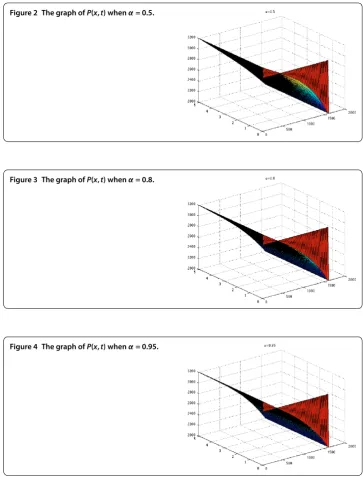
Figure 2 The graph ofP(x,t) whenα= 0.5.
Figure 3 The graph ofP(x,t) whenα= 0.8.
Figure 4 The graph ofP(x,t) whenα= 0.95.
The Laplace transform with respect to the time variable applied to the equation in () gives
sp¯(x,s) –p(x, ) =k∂
∂x
sαp¯(x,s) –sβ(α–)I(–α)(–β)px, ++f¯(x,s).
As p(x, ) =g(x) and (I(–α)(–β)p)(x, ) = , by the continuity ofp(x,t) nearby t= (see
Lemma ), we get
sp¯(x,s) =ksα∂ p¯
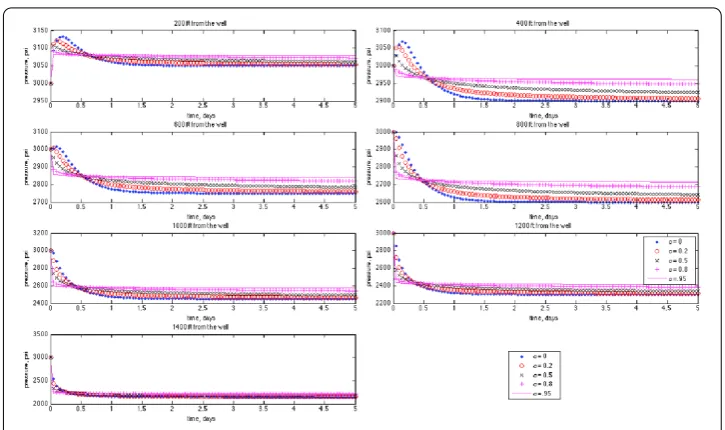
Figure 5 The pressure curve at various distances from the well.
Figure 6 The pressure curve at various times.
Next, we apply the Fourier transform (fˆ(y) = √ π
+∞
–∞ f(x)eixydx) to this last equation ()
to arrive at
spˆ¯(y,s) = –ksαypˆ¯(y,s) +fˆ¯(y,s) +gˆ(y).
Therefore
and hence
ˆ¯
p(y,s) = fˆ¯(y,s)
s+ksαy+ ˆ g(y)
s+ksαy. ()
Now, the inverse Laplace transform of () yields
ˆ p(y,t) =
t
E–α,
–ky(t–s)–αfˆ(y,s)ds+gˆ(y)E–α,
–kyt–α,
and the inverse Fourier transform gives
p(x,t) =
∞ –∞
t
E–α,
–ky(t–s)–αfˆ(y,s)ds
·e–iyxdy
+
∞
–∞gˆ(y)E–α,
–kyt–αe–iyxdy.
Finally we mention that this type of fractional derivative was also studied in [] and refer the reader to [, ] for other interesting problems and methods.
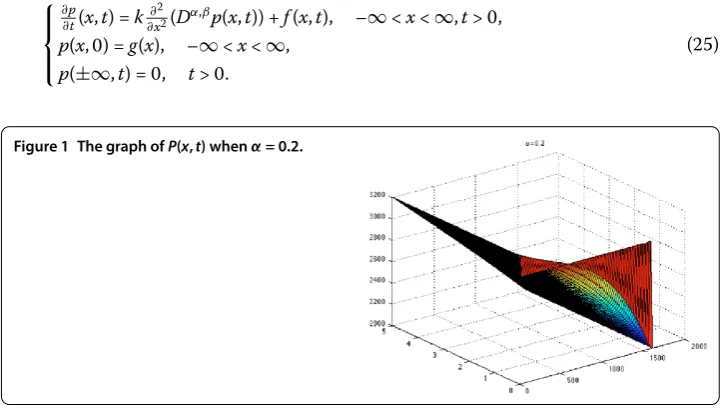
The graphs in Figures - correspond to different orders and the following data:f(x,t) = ,P(x, ) = ,,P(,t) = ,,P(,,t) = ,,k= .e+.
Competing interests
The authors declare that they have no competing interests.
Authors’ contributions
SA and NT solved the problems. RAG participated in establishing the explicit solution and carried out the numerical treatment. All authors read and approved the final manuscript.
Author details
1Department of Mathematics and Statistics, King Fahd University of Petroleum and Minerals, Dhahran, 31261, Saudi
Arabia. 2Department of Mathematics, University of Pittsburgh at Greensburg, Greensburg, PA 15601, USA.
Acknowledgements
The authors are grateful for the financial support and the facilities provided by King Fahd University of Petroleum and Minerals and King Abdulaziz City for Science and Technology (KACST) NSTIP research grant No. 11-OIL1663-04.
Received: 5 June 2013 Accepted: 7 November 2013 Published:03 Dec 2013 References
1. Darcy, H: Les Fontaines Publiques de la Ville de Dijon. Dalmont, Paris (1856)
2. King, M: Darcy’s law and the field equations of the flow of underground fluids. Bull. Int. Assoc. Sci. Hydrol.2(1), 23-59 (1957)
3. Caputo, M: Diffusion of fluids in porous media with memory. Geothermics28, 113-130 (1999)
4. Metzler, R, Klafter, J: The random walk’s guide to anomalous diffusion: a fractional dynamics approach. Phys. Rep.339, 1-77 (2000)
5. Salim, TO, El-Kahlout, A: Solution of fractional order Rayleigh-Stokes equations. Adv. Theor. Appl. Mech.1(5), 241-254 (2008)
6. Langlands, TAM: Solution of a modified fractional diffusion equation. Physica A367, 136-144 (2006) 7. Hilfer, R: Fractional time evolution. In: Hilfer, R (ed.) Applications of Fractional Calculus in Physics, p. 87. World
Scientific, Singapore (2000)
8. Hilfer, R: Fractional calculus and regular variation in thermodynamics. In: Hilfer, R (ed.) Applications of Fractional Calculus in Physics, p. 429. World Scientific, Singapore (2000)
9. Hilfer, R: Experimental evidence for fractional time evolution in glass materials. Chem. Phys.284, 399-408 (2002) 10. Gorenflo, R, Mainardi, F: Fractional calculus: integral and differential equations of fractional orders. In: Fractals and
Fractional Calculus in Continuum Mechanics. Springer, New York (1997)
11. Herzallah, MAE, El-Sayed, AMA, Baleanu, D: On the fractional-order diffusion-wave process. Rom. J. Phys.55(3-4), 274-284 (2010)
12. Kilbas, AA, Srivastava, HM, Trujillo, TJ: Theory and Applications of Fractional Differential Equations. North-Holland Mathematics Studies, vol. 204, van Mill, J (ed.). Elsevier, Amsterdam (2006)
14. Oldham, KB, Spanier, J: The Fractional Calculus. Academic Press, New York (1974)
15. Podlubny, I: Fractional Differential Equations. Mathematics in Sciences and Engineering, vol. 198. Academic Press, San Diego (1999)
16. Sandev, T, Metzler, R, Tomovski, Z: Fractional diffusion equation with a generalized Riemann-Liouville time fractional derivative. J. Phys. A, Math. Theor.44, 255203 (2011)
17. Malek, NA, Ghanam, RA, Al-Homidan, S: Sensitivity of the pressure distribution to the fractional orderαin the fractional diffusion equation (submitted)
18. Samko, SG, Kilbas, AA, Marichev, OI: Fractional Integrals and Derivatives. Theory and Applications. Gordon & Breach, Yverdon (1993)
19. Kou, C, Liu, J, Ye, Y: Existence and uniqueness of solutions for the Cauchy-type problems of fractional differential equations. Discrete Dyn. Nat. Soc.2010, Article ID 142175 (2010)
20. Furati, KM, Kassim, MD, Tatar, N-e: Existence and uniqueness for a problem involving Hilfer fractional derivative. Comput. Math. Appl.64(6), 1616-1626 (2012)
21. Baleanu, D, Diethelm, K, Scalas, E, Trujillo, JJ: Fractional Calculus Models and Numerical Methods. Series on Complexity, Nonlinearity and Chaos. World Scientific, Singapore (2012)
22. Baleanu, D, Machado, JAT, Luo, AC: Fractional Dynamics and Control. Springer, Berlin (2012)
10.1186/1687-1847-2013-349