Volume 2011, Article ID 589863,12pages doi:10.1155/2011/589863
Research Article
QoS-Aware Active Queue Management for
Multimedia Services over the Internet
Bor-Jiunn Hwang,
1I-Shyan Hwang,
2and Pen-Ming Chang
21Department of Computer and Communication Engineering, Ming Chuan University, Tao-Yuan 33348, Taiwan 2Department of Computer Science and Engineering, Yuan Ze University, Chung Li 32003, Taiwan
Correspondence should be addressed to I-Shyan Hwang,[email protected]
Received 21 October 2010; Accepted 7 February 2011
Academic Editor: Fabrizio Granelli
Copyright © 2011 Bor-Jiunn Hwang et al. This is an open access article distributed under the Creative Commons Attribution License, which permits unrestricted use, distribution, and reproduction in any medium, provided the original work is properly cited.
Recently, with multimedia services such as IPTV, video conferencing has emerged as a main traffic source. When UDP coexists with TCP, it induces not only congestion collapse but also anunfairnessproblem. In this paper, a new Active Queue Management algorithm, called Traffic Sensitive Active Queue Management (TSAQM), is proposed for providing multimedia services in routers. The TSAQM is comprised of Dynamic Weight Allocate Scheme (DWAS) and Service Guarantee Scheme (SGS). The purpose of DWAS is to fairly allocate resources with high end-user utility, and the SGS is to determine the satisfactory threshold (TH) and threshold region (TR). Besides, a multiqueue design for different priority traffic, and threshold TH and threshold region TR is proposed to achieve the different QoS requirements. Several objectives of this proposed scheme include achieving high end user utility for video services, considering the multicast as well as unicast proprieties to meet interclass fairness, and achieving the QoS requirement by adaptively adjusting the thresholds based on the traffic situations. Performance comparisons with the GRED-I are in terms of packet dropping rate and throughput to highlight the better behavior of the proposed schemes due to taking into account the fairness and different weights for video layers.
1. Introduction
To improve thecongestion collapseproblem, the early TCP protocol prompted the study of end-to-end congestion avoidance and control algorithms [1]. Recently, several applications, such as IPTV and VoIP, using User Datagram Protocol (UDP) without employing end-to-end flow and congestion control, are increasingly being deployed over the Internet. When UDP coexists with TCP, it induces not only a congestion collapse problem but also anunfairnessproblem that each flow cannot get the same treatment, causing an unstable Internet and lower link utilization. The congestion control methodologies can be categorized asthe Primaland
the Dual [2]. The Primal congestion control is the source node dynamically adjusting the sending rate or window sizes depending on the indication information fed back from the Internet. Due to the limitations of Prime methodology, the Dual plays a more important role through assisting in the provision of more accurate and quick feedback. The congest control algorithm forDualis implemented in routers
gathering traffic flow information, such as flow numbers and traffic load, and sends implicit or explicit feedback to the sender or receiver node for revising the sending rate or making active queue management.
The multimedia streaming applications, such as IPTV and video conference, have emerged as one of the main traffic sources with less tolerance for delay and jitters. Usually, the scalable layered coding (SVC) [3] technique is used to increase the end-user utility under diversified environments. The SVC is an extension of H.264/AVC using the layered structure scheme to generate multilayer with one base layer and several enhancement layers. Therefore, a receiver can subscribe an appropriate scenario based on the network status and required transmission quality. To ensure the efficient use of network resources, this kind of application adapts the multicast technique to deliver the contents. Besides, the multicast service over a wireless
environment results in enhanced resource efficiency and
When the wireless technique is mature enough to be the last mile solution, the IPTV multicast services under the wire and wireless environments, such as the integration of EPON and WiMAX [5], will become a trend. However, all the proposed active queue management mechanisms do not consider the multicast services, and the proposed algorithms assume the same weight for unicast and multicast connec-tions. However, this is unfair for the multicast connection, which will cause poor system performance in light of the entire network average video quality. Therefore, in this paper, we will propose a QoS-aware active queue management method with multiqueues multithresholds, in which the property of video coding as well as multicast delivery is taken into account in one shot.
The rest of the paper is organized as follows.Section 2 surveys the related works. The system design is described in detail in Section 3. The system performance is analyzed and discussed in Section 4. Finally, the paper draws the conclusions inSection 5.
2. Related Works
ThePrimalmethodology has two types, which are classified based on the way of reaction to congestion, adjusting the congestion window size, termedWindow-Based, or the packet transmission gap, termedRate-Based.The Rate-based is more suitable for delivering real-time traffic because it can provide a more smooth transmission rate and it has no need to wait for an ACK message from the receivers [6–
8]. The Primal methodologies [9,10] use the fluid model
to analyze the Internet traffic load or use probing-based methods including the probe gap model (PGM) and probe rate model (PRM) to estimate the residue bandwidth in the bottleneck [11–13]. In essence, those algorithms regarding the amount of packet loss and value of RTT’s variation imply that network congestion occurs. However, the packet loss is not only due to congestion occurrence but also the environment interference, that is, fading or interference in the wireless channel or high bandwidth delay environment.
The Dual methodology, Active Queue Management (AQM), can be divided into two main categories including theclosed-loop controland theopen-loop controldepending on whether the algorithm uses feedback information. For closed-loop control, the most well-known proposals are RED, Adaptive-RED (ARED) [14], and BLUE [15]. The RED’s main idea is using two predefined thresholds, mini-mum and maximini-mum thresholds to separate the queue length as three congestion grades and adjust the packet dropping rate according to different situations. The ARED dynamically adjusts RED’s thresholds based on the observed queue length and tries to maintain the queuing delay within a target range. BLUE [15] uses packets loss and link-idle events as the critical factors to adjust the packet dropping probability rather than the queue length. In the open-loop control, the most promising proposals are RAP [16], XCP [17], and its extended researches [18, 19]. The main objective of this category is to achieve the incoming data rate equal to the output link capacity of the router, and each traffic flow is allocated the same bandwidth simultaneously ensuring lower
queue sizes. This category can eliminate the high bandwidth-delay product network effect on the TCP’s throughput, which is inversely proportional to the RTT, to satisfy the TCP-friendly property[8]. However, the above congestion control algorithms only adopt the homogeneous fairness resource allocation method.
The studies [20–22] alleviate this problem by modifying the AQM design. In [20], the proposed algorithm rearranges the order of packets in the queue of the router and dynami-cally adjusts the packet dropping rate and the target queuing average size based on the packet arrival time, incoming traffic’s requirements, and delay hint. The study in [21] uses three levels of RED to emulate the class-based design that each level sets parameters according to different traffic requirements and based on that determines if the incoming packet is accepted. The research in [22] provides different dropping rate adjusting algorithms for TCP and UDP with TCP-friendly property for the diversity traffic characteristics. However, the above surveyed algorithms cannot satisfy the delay and throughput requirements simultaneously since it only adopts one-queue design for all types of traffic.
In regard to delivery video, several researches [23–26] utilize the video coding technique to improve throughput and end-user utility when congestion occurs. In view of the video coding technique, the literature in [23] concerning XCP extending research adds an addition header field to record how many resources have been assigned to each flow so the sender can know which layers should be delivered. In the literatures [24–28], they support different QoS using priority dropping queue management and a packet marking technique. In [29], the authors adopt the SCED+ scheduler for guaranteeing the delay requirement. In researches [19,25–30], the proposed various algorithms satisfy the QoS requirements by utilizing the scheduler and marking technique. However, it is too complex and results in additional process overhead in the router.
Traffic
Figure1: System design.
In this paper, the Traffic Sensitive Active Queue Man-agement (TSAQM) scheme is proposed to overcome those problems. Several objectives of this proposed scheme are described as follows: first, a Dual methodology congestion control algorithm is proposed to meet the QoS requirement of different services using the multiqueues multithresholds mechanism cooperating with the weight-based scheduler algorithm;second, it achieves high end-user utility for video service; third, it considers the multicast as well as unicast proprieties to meet interclass fairness;fourth, it has the ability to adaptively adjust the parameters of TSAQM according to the time-varying traffic loads.
3. System Design
The system design, as shown in Figure 1, has four types
of traffic including UDP CBR (constant bit rate) traffic,
UDP VBR (variable bit rate) multicast traffic (MVBR),
UDP unicast traffic with VBR (UVBR), and TCP traffic.
The threshold TH denotes the mean of maximum and minimum thresholds; the threshold region TR denotes the value between maximum and minimum thresholds. The
Traffic Sensitive Active Queue Management (TSAQM) with
Dynamic Weight Allocate Scheme (DWAS) and Service Guarantee Scheme (SGS) is proposed for QoS-aware active queue management.
3.1. System Environment. Based onFigure 1, the four queues with four thresholds and weight-based scheduler are
pro-posed; in addition, four individual FIFO queues, Q =
{q1,q2,q3,q4}, are set for different traffic classes, T =
{t1,t2,t3,t4}, respectively, where the traffic class t1 is the
UDP traffic with CBR (BCBR), the traffic classes t2 and t3
are the multicast and the unicast UDP traffic with VBR, and the traffic classt4 is TCP traffic. For traffic types of VBR,
each flow contains VL video layers and the bandwidth of each layer is denoted as LB = {lb1, lb2, lb3,. . ., lbVL}. The
arrival rates and service rates for different traffic classes are
λ = {λ1,λ2,λ3,λ4} andμ = {μ1,μ2,μ3,μ4}, and the QoS
requirement vector is denoted asR= {r1,r2,r3,r4}, including
the delay, packet dropping rate, and throughput.
Since the performance of GRED-I [31] is better than both RED and GRED [32,33], each queue applies GRED-I buffer management with threshold TH and threshold region TR for different traffic classes in the proposed TSAQM scheme, in which threshold TH and threshold region TR denote the vector of each queue’s threshold and threshold region, respectively. The purpose of the threshold for different traffic classes, TH = {th1, th2, th3, th4}, is estimated to determine
the packet dropping rate, and the threshold region for different traffic classes, TR = {tr1, tr2, tr3, tr4}, where the
tri =(thi−σi, thi+σi) with threshold rangeσifor different
traffic classes,i=1, 2, 3, 4, is cooperated with TH to estimate suitable parameters for current traffic conditions. Further, to achieve effective resource utilization, the dynamic weight-based scheduler is adopted with weights for different traffic classes, W = {w1,w2,w3,w4}, as a scheduler mechanism.
The system terminologies are summarized inTable 1.
3.2. Traffic Sensitive Active Queue Management (TSAQM).
The flowchart of TSAQM, shown inFigure 2, has two main
tasks: one is to allocate resources with fairness and high end-user utility in the Dynamic Weight Allocate Scheme (DWAS), and the other is to determine the satisfactory threshold (TH) and threshold region (TR) in the Service Guarantee Scheme (SGS).
Table1: System terminologies.
Notation Description
T= {t1,t2,t3,t4} is the TCP trat1is the CBR UDP traffic class.ffic class,t2andt3are the multicast and the unicast VBR UDP traffic class, andt4
λ= {λ1,λ2,λ3,λ4} Vector of each traffic class’s arrival rate.
μ= {μ1,μ2,μ3,μ4} Vector of each traffic class’s service rate.
R= {r1,r2,r3,r4} Vector of each traffic class’s QoS requirement.
BCBR Constant bitrates traffic’s requirement bandwidth.
VL Number of video layers including one base layer and VL−1enhanced layers. LB= {lb1, lb2. . ., lbN} Vector of SVC video source’s each layer requirement bandwidth.
TH= {th1, th2, th3, th4} Vector of each queue’s threshold.
TR= {tr1, tr2, tr3, tr4} Vector of threshold region tri=(thi−σi, thi+σi).
σ= {σ1,σ2,σ3,σ4} Vector of the threshold range cooperated with TH as the reinitiated TSAQM critical term. W= {w1,w2,w3,w4} Vector of each queue’s scheduler weight.
Start
DWAS dynamic distributes bandwidth to
each class
SGS determines thresholds and threshold regions
End
Figure2: Flowchart of TSAQM.
3.2.1. Dynamic Weight Allocate Scheme (DWAS). The DWAS, shown inFigure 3, has two phases: the first is to satisfy the minimum throughput requirement of each traffic class, and the second is to use the DRBS (Distribute Residue Bandwidth Scheme) to distribute the residue bandwidth with Diff er-TCP-Friendly to all traffic classes, except the CBR traffic. The DWAS distributes bandwidth to trafficsT = {t1,t2,t3,t4}
based on the traffic priority and current active connections, N = {n1,n2,n3,n4}, for different traffic classes. The traffic
classes t1, t2, and t3 have the property that the data rate
is constant or has staircase-like bit rates, and traffic class, t4, is throughput sensitive without a minimum throughput
requirement. However, to satisfy the Differ-TCP-Friendly, the DWAS allocates bandwidth to traffic class,t4, using the
assumption that the minimum requirement of traffic class,
t4, is the maximum throughput requirement of CBR and
VBR.
The DWAS algorithm is shown inAlgorithm 1, in which the allocation procedure is in t1, t2, t3, andt4 order. The
bandwidth allocation unit for VBR traffic is the bandwidth of each layer of SVC. In DWAS, only the bandwidth of the first video layer is allocated, that is, lb1, to meet minimum
requirement oft2 andt3. Fort4, the bandwidth is allocated
as the maximum of both lb1andBCBRin DWAS. If there is
residue bandwidth, then DRBS is executed. The final step of DWAS is to normalize the weights of each traffic type. The purpose of DRBS is to allocate the residue bandwidth in lb2, lb3, and lb4order. While all the layer’s bandwidthes
are met or the residue bandwidth is insufficient for any class’s requirement, the resource will be equally divided to all traffic classes, except CBR traffic, based on the proportion of current active connection(s). The details of the procedure of the DRBS algorithm are shown inAlgorithm 2.
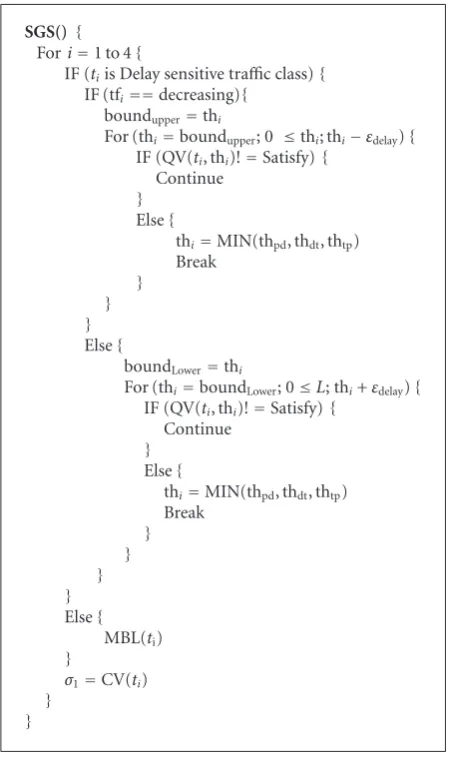
3.2.2. Service Guarantee Scheme (SGS). The SGS algorithm is shown in Algorithm 3. If the incoming traffic class, ti,
is delay-sensitive traffic, it checks that the trend flag, tfi,
is in a decreasing trend (higher than the upper bound) or an increasing trend (less than lower bound of threshold region). When the trend flag indicates that the situation is decreasing, then the threshold, thi, subtractsεdelay; otherwise,
it adds εdelay, whereεdelay is the adjusting TH unit. Then,
the SGS verifies the adjustment outcome using the Quality Verification (QV) function to verify whether the current threshold setting meets the required QoS.
The detail of the QV function is shown inAlgorithm 4, where the parameters in terms of throughput (TP), delay time (DT), and packet dropping rate (PD) are obtained from the one-dimensional Markov-chain model, and it will be explained in detail in the next section. When the traffic class is throughput sensitive, it uses the Modify BLUE LIKE (MBL) function, shown inAlgorithm 4, to be responsive to the current traffic load by adjusting the packet dropping rate. According to the QV function, it compares the QoS requirements of the ith traffic class, ri, to TP, DT, and
PD, respectively, for verifying the current TH setting. In case the requirements cannot be met, the SGS chooses the minimum value as the TH setting value for guaranteeing the delay requirement. According to the MBL function, if the current queue size is longer than TR or equal toL, the thi
subtractsεthroughput; otherwise, it addsεthroughput, while there
Table2: Parameter terminologies.
Notation Description
L System capacity.
Lc= {lc1, lc2lc3lc1} Current queue size.
Bw Router’s link bandwidth.
Brw Router’s link residue bandwidth.
Freeze time Used for adjusting the threshold of throughput-sensitive traffic.
Time pdelay From the previous update to the present time of the delay-sensitive traffic class.
Time pthroughput From the previous update to the present time of the throughput-sensitive traffic class.
εdelay Unit of the adjusting threshold for the delay-sensitive traffic class.
εthroughput Unit of the adjusting threshold for the throughput-sensitive traffic class.
N= {n1,n2,n3,n4} Vector of active connection(s) for each traffic. TF= {tf1, tf2, tf3, tf4} This flag is used to indicate the queue’s growth trend.
Start
Satisfy the minimum requirement of each class
Router has
Figure3: Flowchart of DWAS.
adjusting TH unit. Finally, the variation of connection (CV) is used as a main critical factor based on the varying packet queue for each connection to determine the threshold range (σi):
whereδi andρiare the average number of connections and
service rates of traffic classi, respectively,χk andθk are the
number of current active connections and arrival rates of the
kth record, respectively, and PN is the history data quantity from the previous update to the present time.
The TSAQM monitors the system condition and, based on the result of the threshold region information, determines the proper moment to update the system parameters. This can avoid unnecessary initiation, since there is no additional bandwidth for lower priority traffic, and the initial timing is defined inTable 3.
3.2.3. Description of TP, DT, and PD. The one-dimensional
Markov-chain model, shown in Figure 4, is adopted to
estimate the throughput (TP), delay time (DT), and packet dropping rate (PD), which is aM/M/1/L/th queuing system under the First-In-First-Out (FIFO) service discipline. The traffic arrival follows a Poisson process with an average arrival rateλand the service time is exponentially distributed with mean 1/μand the total system capacity isLwith one threshold:
Refering to [33,34], the packet dropped behavior can be regarded as the trend to decrease the arrival rate. A linear dropping equation,di, (obtained from (2)) is used to
represent the packet dropped behavior and the maximum dropping probability, dmax, is 1. Let Pi be the probability
of statei, 0 ≤ i ≤ L, and, based onFigure 8, the balance equations, (3), (4), and (5) can be obtained:
d0×λ×P0=μ×P1, (3)
The probabilityP0andPican be expressed as follows:
DWAS (){
Algorithm1: DWAS algorithm.
Based on the M/M/1/L/th model and Little’s formula, the throughput, delay time, and packet dropping rate can be obtained from
Algorithm2: DRBS algorithm.
4. Performance Analysis
The proposed algorithms are implemented in the routers; the network simulator 2 (NS-2) is used to estimate the performance of TSAQM and adopt the dumbbell topology as the simulation topology, shown inFigure 5, which there are n sources, n destinations, and two routers [14]. The bandwidth between the source (or destination) and the router is 100 Mbps, and the bandwidth between routers is 10 Mbps. The buffer space at the router is set to 100 packets, as shown in Tables4,5, and6which show the parameters of traffic class and video source, respectively. The traffic arrival rates of four types follow the Poisson process. For the data rate of the CBR the reader is referred to [35]. The VBR video source is the “HARBOUR” generated by JSVM [36], and the TCP traffic is generated as the FTP Traffic Model [35].
SGS(){ Fori=1 to 4{
IF (tiis Delay sensitive traffic class){ IF (tfi==decreasing){
boundupper=thi
For (thi=boundupper; 0 ≤thi; thi−εdelay){ IF (QV(ti, thi)!=Satisfy){
Continue }
Else{
thi=MIN(thpd, thdt, thtp) Break
} } } Else{
boundLower=thi
For (thi=boundLower; 0≤L; thi+εdelay){ IF (QV(ti, thi)!=Satisfy){
Continue }
Else{
thi=MIN(thpd, thdt, thtp) Break
} } } } Else{
MBL(ti)
}
σ1=CV(ti)
} }
Algorithm3: SGS algorithm.
Table3: Initial timing.
For the delay sensitive traffic class: (1) Exist one traffic’sLC>(tri+αi) (2) Exist one traffic’sLC<(tri−αi) For the throughput sensitive traffic class:
(1)LC>(tr +α) (2)LC≥L
(3)Time p>Freeze time
simulation scenarios for different CBR and MVBR traffic arrival rates. Besides, the results of peak of SNR (PSNR) are given to estimate the impact on video quality.
4.1. TSAQM for Different CBR Traffic Arrival Rates. In this case, the arrival rate of CBR is varied from 0.06 to 0.14 (flows/sec), and the others are fixed and set to be 0.065 (flows/sec). Figures 6(a), 6(b), and 6(c) show the average packet dropping rate, delay time, and connection throughput, respectively, for different CBR arrival rates.
QV(ti, thi){
IF (PD(ti)≤ri·delay){ thpd=thi
}
IF (DT(ti)≤ri·droprate){ thdt=thi
}
IF (TP(ti)≥ri·throughput){ thtp=thi
}
IF (allriis Satisfied){ Return Satisfy }
Else{
Return NoSatisfy }
} MBL(ti){
IF (lci>thi+ trilci=L){
thi=thi−εthroughput//increase packet drop rate
}
IF (Time pthroughput>Freeze time){
thi=thi+εthroughput//decrease packet drop rate
} }
Algorithm4: QV and MBL functions.
0 th th + 1 L
λd0
μ
· · · · · ·
Threshold
λdth−1
μ
λdth
μ
λdth+1
μ
λdL−1
μ
Figure4: One-dimensional Markov-chain model.
Figure 6(a)shows the packet dropping rate of the CBR,
MVBR, and UVBR for different CBR arrival rates. The
100 Mbps 100 Mbps
Figure5: Simulation topology.
Table4: System environment parameters.
Environment variable Value Router queue size 100 (packet size)
Router number 2
Node number 10
Link capacity 10 Mbps
Simulation time 1200 seconds Maximum dropping rate 1.0
εdelay 1
εthroughput 1
Scheduler Weighted fair queuing
Table5: Parameters of traffic class.
Traffic class Mean of
Multicast VBR 360 46∼240 150 N/A Unicast VBR 360 46∼240 150 N/A
FTP 180 N/A N/A N/A
Table6: Video information.
Layer Frame size Frame rate (frame/sec) Data rate (kbps)
1 176×144 0.9375 46
2 176×144 1.8750 26
3 176×144 3.7500 38
4 176×144 7.5000 54
5 176×144 15.0000 76
Figure 6(b)shows the delay time of the CBR, MVBR, and
UVBR for different CBR arrival rates in which the proposed TSAQM can achieve the latency guideline of CBR and MVBR traffics. For the same reason, the delay time of CBR is the lowest and UVBR is the highest using the DRBS distributing strategy. When the arrival rate of CBR is higher than 0.1 (flows/sec), the delay time of UBVR is slightly higher than 150 ms. Besides, there are two reasons for the unstable delay time. First, the frame variation of the “HARBOUR” is more intense, meaning that the variation of entering queue rate is higher than the smooth one. Second, the proposed TSAQM
0.105
Figure 6: (a) Packet dropping rate. (b) Delay time of the CBR,
uses the TR to avoid reinitiating because the burst traffic arriving will result in a higher TR value and cause a higher delay than the estimated TSAQM, especially for the heavy load case.
Figure 6(c)shows the average connection throughput of
CBR, MVBR, and UVBR and total throughput of TCP for different CBR arrival rates. This shows that the proposed TSAQM can achieve the required transmission rate for CBR, MVBR, and UVBR. The mean throughput of the CBR is about 64 kbps for different CBR arrival rates. Besides, where the arrival rate of the CBR is 0.085 (flows/sec), the throughput of TCP clearly increases because the 4th layer packets of UVBR are dropped, as shown inFigure 6(a). This is the same phenomenon for the case where the arrival rate of CBR is 0.1 (flows/sec).
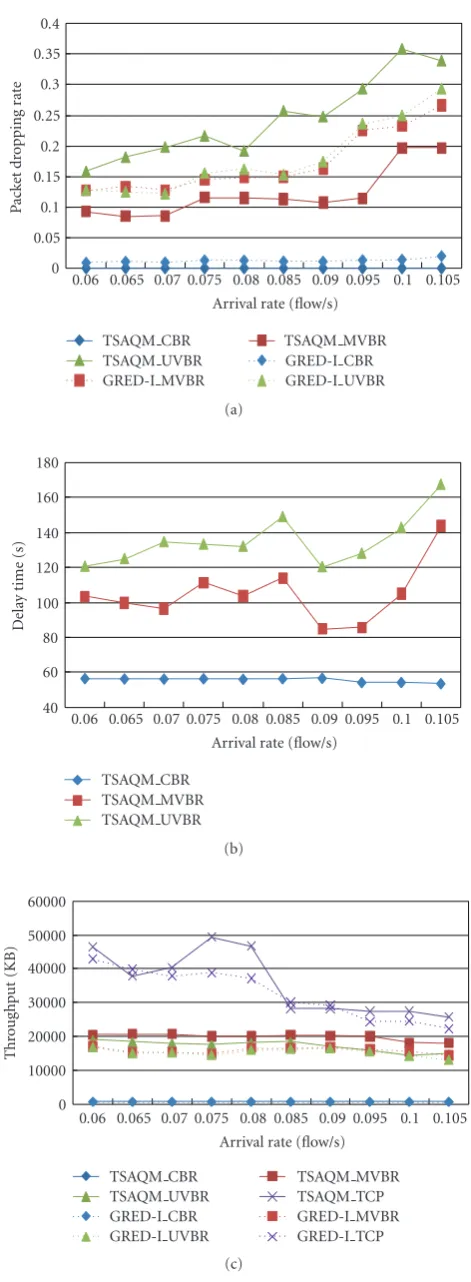
4.2. TSAQM for Different MVBR Traffic Arrivals. In this case, the arrival rate of the MVBR is varied from 0.06 to 0.14 (flows/sec), and the others are fixed and set to be 0.065 (flows/sec). Figures 7(a), 7(b), and 7(c) show the average packet dropping rate, delay time, and connection throughput, respectively, for different MVBR arrival rates. Performance comparisons with the GRED-I [31] are pre-sented in terms of packet dropping rate and throughput to highlight the better behavior of the proposed schemes.
Comparing Figures7(a)with6(a), the packet dropping
rates of the CBR, MVBR, and UVBR in Figure 6(a) are
higher than those in Figure 7(a) because the data rate of MVBR is higher than CBR. Besides, the packet dropping rate increases more rapidly than inFigure 6(a)for the UVBR when the MVBR arrival rate is increased. However, the impact on MVBR is slight for an increasing MVBR arrival rate.Figure 6(a)also shows that, in the case of the arrival rate of MVBR being at 0.085 (flows/sec) and 0.1 (flows/sec), the DRBS does not allocate the bandwidth to the 4th and the 3rd layer video streams, respectively, for the MVBR.
Figure 7(b)shows the delay time, of the CBR, MVBR,
and UVBR for different MVBR arrival rates. This shows
that the proposed TSAQM can achieve the latency guideline
of CBR and MVBR traffic through the DRBS distributing
residue bandwidth to them first. ComparingFigure 7(b)with
Figure 6(b), unstable results are shown inFigure 7(b)for an
arrival rate between 0.08 (flows/sec) and 0.1 (flows/sec). The reason is the same as varying the CBR arrival rate case that affects frame variation and the TR will be obvious because the MVBR traffic is increasing. Since the DWRR adopts the packet based scheduler, the DWAS will be affected since the packet size varies greatly, and it is more obvious than in Case 1.
Figure 7(c) shows the average connection throughput
of CBR, MVBR, and UVBR, and total throughput of TCP for different MVBR arrival rates. This also shows that the proposed TSAQM can achieve the required transmission rate for CBR, MVBR, and UVBR. The mean throughput of CBR is about 64 kbps for different MVBR arrival rates.
Figure 7(a) shows that most packets in the 5th layer video
stream for UVBR are dropped when an arrival rate is 0.070 (flows/sec); therefore, TCP receives more bandwidth. In the
0.105
Figure 7: (a) Packet dropping rate. (b) Delay time of the CBR,
case of 0.075 (flows/sec), since a few of the packets of the 4th layer video stream for UVBR and more packets of the 5th layer video stream for MVBR are dropped, the TCP achieves the highest throughput. Since the arrival rate is higher than 0.085 (flows/sec), more packets of MVBR and UVBR are dropped, and the throughput of TCP is decreased due to increasing the total UVBR as the UVBR arrival rate increases.
To compare with GRED-I, as shown in Figure 7(a),
because the GRED-I cannot discriminate between the MVBR and UVBR, the packet dropping rates are almost the same for GRED-I UVBR and GRED-I MVBR. This is unfair for the multicast connection. Additionally, the video packets are dropped randomly which will cause poor system performance in light of the entire network average video quality. Figure 7(c) shows performance results in terms of throughput of the CBR, MVBR, UVBR, and TCP. The comparison of the TSAQM highlights better performance for MVBR, UVBR, and TCP with respect to the throughput. In particular, the proposed algorithms have taken into account the fairness and different weights for video layers. The insignificant video packets, that is, belonging to the 4th and the 3rd layer video streams, have higher dropping probability.
4.3. Results of Peak of SNR (PSNR). To estimate video quality, the arrival rate of MVBR is varied from 0.06 to 0.14 (flows/sec), and the others are fixed and set to be 0.065 (flows/sec). Figures 8(a),8(b), and 8(c) show the peak of SNR (PSNR) of Y, U, and V, respectively, for MVBR, UVBR, and system for different MVBR rates. According to Figures
8(b)and8(c), the variation in PSNR for U and V is about
2.5 dB (i.e., between 36.5 dB and 39 dB). The decrease is more obvious for Y under an increasing CBR arrival rate, and the variation is about 6 dB, as shown inFigure 8. In addition, the values of MVBR are higher than UVBR for all cases because more packets of UVBR are dropped.
5. Conclusions
In this paper, the proposed Traffic Sensitive Active Queue Management (TSAQM) is implemented in routers to over-come problems of current AQM algorithms. Based on the simulation results, several objectives of this proposed scheme are achieved including using a multi-queue, multi-threshold mechanism cooperating with a weight-based scheduler algorithm to meet the QoS requirement of high end-user utility for video service, which considers the multicast and adaptively adjusts the parameters of the TSAQM according to the time-varying traffic loads. Also, it shows that the TSAQM can achieve the QoS requirement in a time-varying Internet by adaptively adjusting the thresholds based on the traffic situations. Performance comparisons with the GRED-I are presented in terms of packet dropping rate and throughput to highlight the better behavior of the proposed schemes due to taking into account the fairness and different weights for video layers. Future research will emphasize several issues, most notably, implementation complexity, the same service class with diversity QoS and diversity capacities of downlink.
0.09 0.085 0.08 0.075 0.07 0.065 0.06
Arrival rate (flow/s) 0
10 20
PS
NR
(Y
)
TSAQM UVBR TSAQM MVBR System
(a) PSNR of Y
0.09 0.085 0.08 0.075 0.07 0.065 0.06
Arrival rate (flow/s) 0
10 20 30 40
PS
NR
(U
)
TSAQM UVBR TSAQM MVBR System
(b) PSNR of U
0.09 0.085 0.08 0.075 0.07 0.065 0.06
Arrival rate (flow/s) 0
10 20 30 40
PS
NR
(V
)
TSAQM UVBR TSAQM MVBR System
(c) PSNR of V
Figure8: PSNR of (a) Y, (b) U, and (c) V for MVBR, UVBR, and
References
[1] V. Jacobson, “Congestion avoidance and control,”ACM SIG-COMM Computer Communication Review, vol. 25, no. 1, pp. 157–173.
[2] F. P. Kelly, A. K. Maulloo, and D. Tan, “Rate control for communication networks: shadow prices, proportional fairness and stability,” Journal of the Operational Research Society, vol. 49, no. 3, pp. 237–252, 1998.
[3] J. Reichel, H. Schwarz, and M. Wien, “Scalable Video Coding—Working Draft I Joint Video Team of ITU-T VCEG and ISO/IEC MPEG,” Doc. JVT-N020, January 2005. [4] J. E. Wieselthier, G. D. Nguyen, and A. Ephremides, “On
the construction of energy-efficient broadcast and multicast trees in wireless networks,” inProceedings of the 19th Annual Joint Conference of the IEEE Computer and Communications Societies (INFOCOM ’00), pp. 585–594, March 2000. [5] K. Yang, S. Ou, K. Guild, and H. H. Chen, “Convergence of
ethernet PON and IEEE 802.16 broadband access networks and its QoS-aware dynamic bandwidth allocation scheme,” IEEE Journal on Selected Areas in Communications, vol. 27, no. 2, pp. 101–116, 2009.
[6] J. Widmer, R. Denda, and M. Mauve, “A survey on TCP-friendly congestion control,”IEEE Network, vol. 15, no. 3, pp. 28–37, 2001.
[7] S. Ryu, C. Rump, and C. Qiao, “Advances in internet conges-tion control,”IEEE Communications Surveys & Tutorials, vol. 5, no. 1, pp. 28–39, 2003.
[8] S. C. Tsao, Y. C. Lai, and Y. D. Lin, “Taxonomy and evaluation of TCP-friendly congestion-control schemes on fairness, aggressiveness, and responsiveness,” IEEE Network, vol. 21, no. 6, pp. 6–14, 2007.
[9] Y. Xia, D. Harrison, S. Kalyanaraman, K. Ramachandran, and A. Venkatesan, “Accumulation-based congestion control,” IEEE/ACM Transactions on Networking, vol. 13, no. 1, pp. 69– 80, 2005.
[10] H. Shimonishi, T. Hama, and T. Murase, “TCP congestion control enhancements for streaming media,” in Proceedings of the 4th Annual IEEE Consumer Communications and Networking Conference (CCNC ’07), pp. 303–307, January 2007.
[11] J. X. Wang, A. W. Y. Su, Y. C. Chen, and J. N. Hwang, “Effective congestion and error control for scalable video coding extension of the H.264/AVC,” inProceedings of the IEEE International Symposium on Circuits and Systems (ISCAS ’08), pp. 1834–1837, May 2008.
[12] D. T. Nguyen and J. Ostermann, “Congestion control for scalable video streaming using the scalability extension of H.264/AVC,”IEEE Journal on Selected Topics in Signal Process-ing, vol. 1, no. 2, pp. 246–253, 2007.
[13] S. S. Wang, H. F. Hsiao, and S. Y. Lee, “Layered congestion control for scalable video coding based on the efficient band-width inference,” inProceedings of the 9th IEEE International Symposium on Multimedia Workshops (ISM ’07), pp. 417–420, December 2007.
[14] G. Chatranon, M. A. Labrador, and S. Banerjee, “A survey of TCP-friendly router-based AQM schemes,”Computer Com-munications, vol. 27, no. 15, pp. 1424–1440, 2004.
[15] W. C. Feng, K. G. Shin, D. D. Kandlur, and D. Saha, “The Blue active queue management algorithms,”IEEE/ACM Transactions on Networking, vol. 10, no. 4, pp. 513–528, 2002.
[16] N. Dukkipati, M. Kobayashi, Z. S. Rui, and N. McKeown, “Processor sharing flows in the internet,” inProceedings of the 13th International Workshop on Quality of Service (IWQoS ’05), vol. 3552 ofLecture Notes in Computer Science, pp. 271–285, June 2005.
[17] D. Katabi, M. Handley, and C. Rohrs, “Congestion control for high bandwidth-delay product networks,” inProceedings of the Conference on Applications, Technologies, Architectures, and Protocols for Computer Communications (SIGCOMM ’02), pp. 89–102, August 2002.
[18] F. Abrantes and M. Ricardo, “XCP for shared-access multi-rate media,”ACM SIGCOMM Computer Communication Review, vol. 36, no. 4, pp. 27–38.
[19] M. Lestas, A. Pitsillides, P. Ioannou, and G. Hadjipollas, “Queue length based internet congestion control,” in Pro-ceedings of the IEEE International Conference on Networking, Sensing and Control (ICNSC ’07), pp. 584–589, April 2007. [20] M. Claypool, R. Kinicki, and A. Kumar, “Traffic sensitive
active queue management,” inProceedings of the 24th Annual Joint Conference of the IEEE Computer and Communications Societies (INFOCOM ’05), pp. 2764–2769, Miami, Fla, USA, March 2005.
[21] J. Chung and M. Claypool, “Dynamic-CBT and ChIPS— router support for improved multimedia performance on the internet,” in Proceedings of the 8th ACM International Conference on Multimedia, pp. 239–248, November 2000. [22] H. S. Chae, M. R. Choi, and T. K. Cho, “Congestion control
for mixed TCP and UDP traffic,” IEICE Transactions on Communications, vol. E88-B, no. 10, pp. 4097–4101, 2005. [23] H. F. Hsiao and J. N. Hwang, “A max-min fairness congestion
control for layered streaming of scalable video,”IEEE Transac-tions on Circuits and Systems for Video Technology, vol. 16, no. 9, pp. 1074–1085, 2006.
[24] S. R. Kang, Y. Zhang, M. Dai, and D. Loguinov, “Multi-layer active queue management and congestion control for scalable video streaming,” in Proceedings of the 24th International Conference on Distributed Computing Systems, pp. 768–777, March 2004.
[25] K. Nahm, J. Shin, J. Kim, and C.-C. J. Kuo, “Enhanced service differentiation for layered video multicast in differentiated service networks,” inViual Communications and Image Pro-cessing, vol. 4671 ofProceedings of SPIE, pp. 46–57, 2002. [26] X. Yang, J. Liu, and N. Li, “Congestion control based on
priority drop for H.264/SVC,” inProceedings of the Interna-tional Conference on Multimedia and Ubiquitous Engineering (MUE ’07), pp. 585–589, April 2007.
[27] C. K. Siew, G. Feng, F. Long, and M. H. Er, “Congestion control based on flow-state-dependent dynamic priority scheduling,” IEE Proceedings Communications, vol. 152, no. 5, pp. 548–558, 2005.
[28] T.-L. Sheu and Y.-S. Chi, “Intelligent stale-frame discards for real-time video streaming over wireless ad hoc networks,” EURASIP Journal on Wireless Communications and Network-ing, vol. 2009, Article ID 486165, 10 pages, 2009.
[29] G. G ´omez, J. Poncela Gonz´alez, M. C. Aguayo-Torres, and J. T. Entrambasaguas Mu˜noz, “QoS modeling for end-to-end performance evaluation over networks with wireless access,”EURASIP Journal on Wireless Communications and Networking, vol. 2010, Article ID 831707, 17 pages, 2010. [30] Y. Huang, R. Gu´erin, and P. Gupta, “Supporting excess
[31] L. Wang, G. Min, and M. Awan, “Modeling and evaluation of congestion control for different classes of network traffic,” Concurrency Computation Practice and Experience, vol. 19, no. 8, pp. 1141–1156, 2007.
[32] M. May, C. Diot, B. Lyles, and J. Bolot, “Influence of active queue management parameters on aggregate traffic performance,” Tech. Rep. RR3995, INRIA, 2000.
[33] G. Iannaccone, M. May, and C. Diot, “Aggregate traffic performance with active queue management and drop from tail,”ACM SIGCOMM Computer Communication Review, vol. 31, no. 3, pp. 4–12, 2001.
[34] H. Beigy and M. R. Meybodi, “A general call admission policy for next generation wireless networks,” Computer Communications, vol. 28, no. 16, pp. 1798–1813, 2005. [35] “Mobile WiMAX—Part 1: A Technical Overview and