CSEIT17218 | Received: 30 Jan 2017 | Accepted: 06 Feb 2017 | January-February-2017 [(2)1: 24-28]
International Journal of Scientific Research in Computer Science, Engineering and Information Technology © 2017 IJSRCSEIT | Volume 2 | Issue 1 | ISSN : 2456-3307
24
Alive Human Detection Robot
Mohit Bais, Kanupriya Madan, Ankit Bharti, Prof. Prity Yadav
Department of ECE, Dronacharya Group of Institutions Greater Noida, Greater Noida, Uttar Pradesh, India
ABSTRACT
In this paper, a new approach for detecting alive human beings in natural and man-made disasters using a specific set of sensors, ATMEGA16 Microcontroller, existing GSM technology and PLC systems. Many areas of world are getting affected due to sudden natural calamities like earthquakes, floods, wild-fires, storms and human induced disasters industrial and transportation accidents and one of the threatening to humans that is terrorists‟ attacks. We observe that people die by getting trapped in these drastic disasters on a large scale just because they don’t get help at that instant of time, when they require to be rescued. So the proposed alive human being detection system uses a specific set of sensors that includes PIR, temperature, vibration, IR, Ultra sonic detector, etc. which gives the information about the presence of an alive human body. GSM technology will give an alerting message to control room of the affected sites‟ to give proper rescue to the affected victims through PLC logical programming. Also we are using HMI system. Therein, a microcontroller ATMEGA16 holds all of these sensors dealing with movable robot systems. By this project, it will be a great help indeed to rescuers in detecting the m alive humans at the disaster sites on required time. This is also user friendly, economical, semi-autonomous and efficient device by software programming interfacing for detection.
Keywords : Human Nature, PLC logical Programming, GSM Technology.
I.
INTRODUCTION
The advent of new high speed technology and the growing computer capacity provided realistic opportunity for new robot controls and realization of new methods of control theory. This technical improvement together with the need for high performance robots created faster, more accurate and more intelligent robots using new robots control devices, new drivers and advanced control algorithm. This project deals with live person detection robot is based on P89V51RD2BN Microcontroller. This robot follows which is drawn over the surface. Here we are using PIR Sensor for detect the human. This project is mainly used in the earth quake rescue operation. Internally is consists of IR Sensors. The infrared sensors are used to sense the live person. Once the people are located it immediately gives audio alert visual alert to the authorities so that help can reach the live person faster. All the above systems are controlled by the microcontroller.
The Microcontroller is used to control the motors. It gets the signals from the PIR Sensor and it drives the motors according to the sensor inputs. Two DC Motors are used to drive the robot. The Microcontroller is programmed to send the live human information to remote control place through the RF Transceiver (Bluetooth module HC 05)
II.
METHODS AND MATERIAL
1. MPLAB IDE – For controller programming 2. Or-CAD – For circuit design
3. Eagle – For PCB design
4. Visual Studio for PC interface programming.
C. Theory
Alive human detector uses PIR sensor to detect alive humans. As an alive human body emits thermal radiation, which is received and manipulated by the PIR sensor (passive infrared sensors) to detect humans. They detect change in the heat and this can be used to detect movement of people. It has digital output and can be directly given to the digital pins and no ADC is needed. It operates at 5v dc. It detects motion by measuring changes in the infrared (heat) levels emitted by surrounding objects which can be detected by checking a sudden change in the surrounding IR patterns.
Obstacle sensors detect the obstacle and send the analog signals to avr microcontroller. aver is programmed to guide the robot automatically depending on obstacle detected. alive human sensor detects the human who is alive and signal is given to Avro microcontroller. AVR is programmed to send the alive human information to remote control place through the GSM modem. serial communication device provides the communication between the Avro microcontroller and gsm modem using wireless pc interfacing with web camera.
D. Microcontroller
89V51RD2BN is the microcontroller used in the project. Signals from PIR sensors are given to the microcontroller and this microcontroller will digitize the signal and send it to the RF Transceiver bluetooth module head quarter 05.. The controller has peripheral features like inbuilt ADC, required to get the signals from the various sensors. Beside this the microcontroller that is used in this project has some additional advantages. This microcontroller is a powerful microcontroller which provides a highly flexible and cost effective solution. It has features like 8K byte of In-system programmable flash memory, 4.0V to 5.5V operating range, 32 programmable I/O lines, fully static operation 0Hz to 33Hz. PIR SENSOR: PIR SENSOR As live human body emits thermal radiation it is received and manipulated by the PIR sensor to detect humans. PIR sensors are passive infrared sensors. They detect change in the heat and this can be used to detect movement of people. It has digital output and can be directly given to the digital pins and no ADC is needed. It operates at 5V DC The PIR (Passive Infra-Red) Sensor is a pyro electric device that detects motion by measuring changes in the infrared (heat) levels emitted by surrounding objects. This motion can be detected by checking for a sudden change in the surrounding IR patterns. When motion is detected the PIR sensor a high signal on its output pin. This logic signal can be read by a microcontroller or used to drive a transistor to switch a higher current load. Detection range up to 7 feet away. Some additional advantages of using PIR sensor are, -Single bit output
1. Bluetooth protocol: Bluetooth specification v2.0 EDR
2. freqency:2.4GHZ ISM band
3. modulation: GFSK(Gaussian frequency shift keying)
4. speed: Asynchronous 2.1Mbps(Max)/160kbps, Synchronous 1Mbps
5. Power supply: 3.3VDC 50mA
F. Motor and Motor Drive
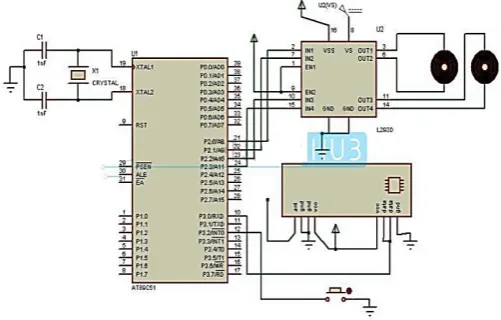
Motor denotes the robot which can move over earthquake prone areas. Motor drive is the interfacing circuit between microcontroller and robot. The project uses DC motor. DC motors have polarity and direction of rotation depends on direction of current. But a DC motor cannot be interfaced to the microcontroller directly because it requires much higher voltage and current. Motor drive is used for this. It is built using annpn transistor –BC547. It acts as an interfacing device to supply required power to the motor.
Figure 1. Circuit Diagram for a Human Detector Robot
G. Working
The combinational frequency that arrives at the input of the DTMF decoder IC will be decoded into four output bits.The strobe pin of the decoder IC will be high if and only if there is a signal at its input.Tho output bits are available as Q3,Q2,Q1,Q0.The output of the decoder is given to port C of microcontroller.PIC16F873A is the microcontroller used here.It is a 28 pin package IC,which has 3 ports and all the 3 ports are being used here.Port A is the input port.To this port the temperature sensor is connected.Port B is the output port.Connections to the motor drivers are done from this port.These motor drivers drive three gear motors
which work on a power supply of 6volts.Two of these act as whels of the robot and the other one is for controlling the movement of arm that holds the temperature sensor.
As a whole the robot’s movement is controlled with the key pressed on mobile phone.The path covered by the robot is viewed in a PC using a wireless camera.Temperature sensor senses the temperature of the victim and it will be compared with the already set reference temperature of the pic.If the measured temperature is greater than the reference temperature alarm will be activated, indicating that detected body is alive.
Alive Human Being Detector is an autonomous robot for detecting alive humans in destructed environments. This Alive human body detection system uses temperature sensor, mobile phone, wireless camera and PIC microcontroller to transmit and analyze conditions of human body. The task of identifying human being in rescue operations is difficult for the human agent but it is simple for the robotic agent. In order to detect a human body, an autonomous robot must be equipped with a specific set of sensors that provide information about the presence of a person in the environment around. This system uses a temperature sensor in order to detect the existence of living humans and a low cost camera in order to acquire a video of the scene as needed. The wireless camera shows the path moved by the robot that is displayed on a laptop at the control section. This approach requires a relatively small number of data to be acquired and processed during the rescue operation. This way, the real-time cost of processing and data transmission is considerably reduced. This system has the potential to achieve high performance in detecting alive humans in devastated environments relatively quickly and cost-effectively.
III.
RESULTS AND DISCUSSION
A. Advantages
1. This System is an effective and a safe.
2. The System is safe even for the user because of the use of robotics and no manual work. 3. The system uses transceiver and this makes the
system both accurate and reliable.
B. Disadvantages
1. Battery backup for camera is weak which can be overcome by using a solar panel.
2. The initial cost may be high if very high range sensors are being used in commercial usage.
C. Application
For detecting alive humans in destructive environment. War field or in the earth quake affective areas. Military applications.
IV.
CONCLUSION
By this project it will be a great help indeed to rescuers in detection of the human beings at the disaster sites. This is also user friendly, economical, semi-autonomous and efficient device by software programming interfacing for detection. This proposed model system will be a comb ination of a stationary and a mobile robot system especially for the disaster affected chaotic areas.
The purpose of the proposed system is to provide a cost effective robot for rescuing human beings in catastrophic conditions. The proposed system is superior to other existing robots due to the use of sensors that are cheaper and easily available. It is not feasible for rescue personnel to individually visit the site (war field, earthquake-stricken area, mines etc) and check who is alive and who needs rescue. So, in such circumstances, the proposed system can be of great importance. It can be deployed to detect alive human beings and send the information regarding the situation of the spot to rescue team for proceeding further rescue operation. Furthermore, the reliability of detection is enhanced by two level sensors. The first level sensor is OMRON D6T sensor which detects the presence of human. This is primary sensor. The second level sensor used is PIR sensor. It is used to detect the motion of the
human. So if one sensor fails, other sensor can also provide sufficient information for us. This prototype can be further enhanced in the future by incorporating an IR camera that can exactly capture IR pattern emitted by human body. In addition, to know the exact location, GPS system can be added. For increasing the range of communication with the rescue team, etc.
V.
FUTURE SCOPE
applications", u.s.7176469b2, abbrev. Feb, 13.2007.[2]. Reiner quad, Taunusstein, Karlheinz Stock, Loach, "Infrared detector with direction identification capability", u.s.4914298a, abberev.appr, 3.1990.
[3]. Larry Hurwitz, Alpine, ut(us), "Apparatus and
method for generating alerts",
u.s.20100311385a,abberv:dec,9.2010.
[4]. Mr.SpVijayaragavan and Hardeep pal Sharma, "Live human detection robot for earthquak rescue operation", International journal of buisnessintelligents, vol.02,issue 01,page:83-87,june: 2013.
[5]. Rajive Joshi, Pratap
Chandrapoudel,PankajBhandari,"An embedded autonomous robotic system for alive human body detection&rescue operation", Raidhur, karnataka,vol.4, issue 5,page:1-4, may 2014. [6]. Stevenf Barrett, Daniel j. Packand Mitchell a.
Thornton :( 2007, december 15).Atmel AVR microcontroller primer: programming and interfacing.(paperback
eddition)online].Available:www.amazone.in. [7]. Wouterdekort (2013, august 6).programming in
c.(kindle
[8]. John Pissokas and Chris Malcolm designed a robot for the contest Robo-cup 2001 on the topic of "Experiments with Sensors for Urban Search and Rescue Robots"
[9]. Jean Schultz, Jill L. Drury, Holly A. Yanco presented a paper on "Evaluation of Human-Robot Interaction Awareness in Search and Rescue IEEE, 2004, PP. 2327- 2332.
[10]. RufaidaShamroukh, FahedAwad "Detection of surviving humans in destructed environments using a simulated autonomous robot "IEEE Transaction_2009 March 24
[11]. Ying-Wen Bai, Li- Sih Shen and ZongHan Li "Design and Implementation of an Embedded Home Surveillance System by Use of Multiple Ultrasonic Sensors" IEEE Transactions on Consumer Electronics, Vol. 56, No. 1, February 2010, PP. 119-124