International Journal of Scientific Research in Computer Science, Engineering and Information Technology © 2016 IJSRCSEIT | Volume 1 | Issue 2 | ISSN : 2456-3307
Multiple Eye Detection and Tracking Using Competitive
Approaches In Driver Analysis
Tina Trueman
1, Gowthami J
2 1Teaching Fellow, Department of Information Science and Technology
2
PG Student, Department of Computer Science and Engineering
Anna University, Chennai, tamil Nadu, India
ABSTRACT
In this paper the Reliable detection and tracking of eyes is an important requirement for attentive user interfaces. It mainly applied in driver analysis. The system uses a small monochrome security camera that points directly towards the driver’s face and monitors the driver’s eyes in order to detect fatigue. In such a case when fatigue is detected, a warning signal is issued to alert the driver. This work describes how to find the eyes, and also how to determine if the eyes are open or closed. If the eyes are found closed for three consecutive frames, the system draws the conclusion that the driver is falling asleep and issues a warning signal. And we present an innovative approach to the problem of eye tracking. They are Region Based Segmentation and Region growing algorithm. A number of traditional eye detectors, chosen for their own properties, are combined by this two different competitive schemes with the aim to obtain a higher degree of robustness and reliability.
Keywords: Boosting, Competitive approach, Tracking
I.
INTRODUCTION
An image is digitized to convert it to a form which can be stored in a computer's memory. Once the image has been digitized, it can be operated upon by various image processing operations. Eye detection and tracking can be classified as
Shape-based, Feature-based, Appearance-based.
II.
METHODS AND MATERIAL
System Design
This describes about the system architecture and individual module diagrams, which deal with a detection-based statistically motivated redundancy exploiting the wiener filter where the parameters of the method are learned from photo metrically, geometrically, graphically similar patches.
2.1 System Architecture
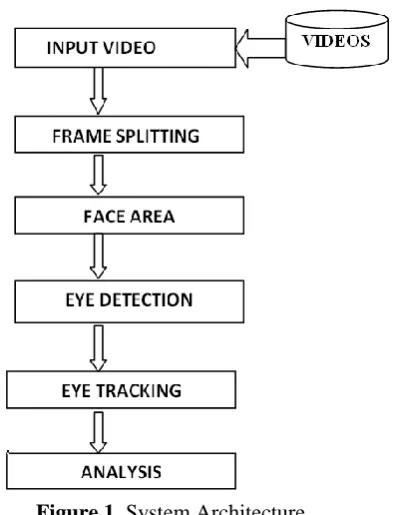
Figure 1. System Architecture
2.2 Image Segmentation Methods
2.2.1 Edge based methods:
Link up edges to form hopefully meaningful object boundaries.
2.2.2 Region based methods:
Based on local homogeneity conditions:
Region growing.
Region splitting and merging.
2.2.3 Clustering methods: (similarity of grey level values ).
The characteristics are
Could use other features like color and texture. Use heuristics to help initialization and stopping. Candidate pixels are chosen based on connectivity.
2.4 Region Growing Algorithm Start with an initial seed pixel.
Choose neighboring pixels, based on a connectivity and merge
Pixels that satisfy the homogeneity condition. A final tidying operation is often performed to
remove very small regions.
2.5 Region Splitting Algorithm
A homogeneity condition, H, or predicate, P, is defined
Let R0 represent the entire image.
Test P(Ri ) (where i > 0 represent sub-regions). If P(Ri) = FALSE subdivide current region into 4. If P(R i) = TRUE stop.
Goto step 3 until all new P(R i) = TRUE.
III.
RESULTS AND DISCUSSION
3.1 Input Video The input video is of the form .mpeg, .avi etc.,
The input video is split into number of frames and send it for face graph matching.
3.2 FRAME SPLITING
Converting the video into number of frames. The number of frames are based on the remove the background face object only detect. There are a number of methods for measuring eye movement. The most popular variant uses video images from which the eye position is extracted.
Face area to find the frame to separate face using histogram based. Canny edge reduction using to remove the background face object only detect.
Canny edge detector
1) Smooth image with a Gaussian optimizes the trade-off between noise filtering and edge localization
2) Compute the Gradient magnitude using
approximations of partial derivatives 2x2 filters
3) Thin edges by applying non-maxima suppression to the gradient magnitude
4) Detect edges by double thresholding.
3.4 Eye Detection
pre-The top and sides of the face are detected to narrow down the area of where the eyes exist. Using the sides of the face, the centre of the face is found, which will be used as a reference when comparing the left and right eyes. Moving down from the top of the face, horizontal averages (average intensity value for each y coordinate) of the face area are calculated. Large changes in the averages are used to define the eye area.
The following explains the eye detection procedure in the order of the processing operations. All images were generating in Mat lab using the image processing toolbox. Moving down from the top of the face, horizontal averages (average intensity value for each y coordinate) of the face area are calculated. Large changes in the averages are used to define the eye area.
Iris recognition is an automated method
of biometric identification that uses mathematical pattern-recognition techniques on video images of the iris of an individual's eyes, whose complex random patterns are unique and can be seen from some distance.
Iris recognition is an automated method of biometric identification that uses mathematical pattern-recognition techniques on video images of their ides of an individual's eyes, whose complex random patterns are unique and can be seen from some distance. This techniques for eye detection and tracking can be classified as shape-based, feature-based, appearance-feature-based, and hybrid, based on their geometric and photometric properties.
Not to be confused with another, less prevalent, ocular-based technology, retina scanning, iris recognition uses camera technology with subtle infrared illumination to acquire images of the detail-rich, intricate structures of the iris. Digital templates encoded from these patterns by mathematical and statistical algorithms allow the identification of an individual or someone pretending to be that individual. Databases of enrolled templates are searched by matcher engines at speeds measured in the millions of templates per second per (single-core) CPU, and with infinitesimally small False Match rates.
3.5 Eye Tracking
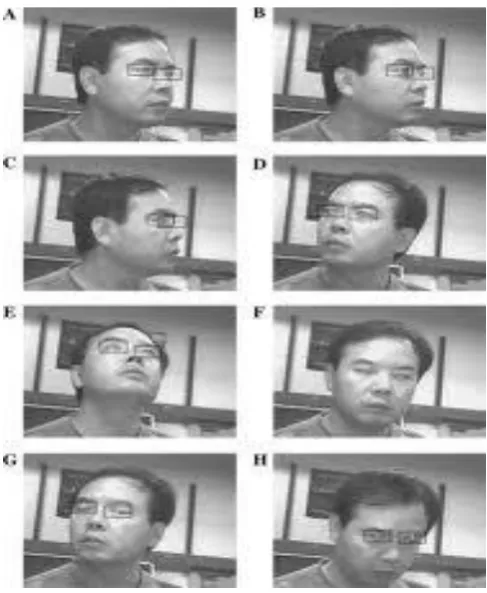
Eye tracking is the process of measuring either the point of gaze (where one is looking) or the motion of an eye relative to the head. An eye tracker is a device for measuring eye positions and eye movement. Eye trackers are used in research on the visual system, in psychology, in cognitive linguistics and in product design. There are a number of methods for measuring eye movement. The most popular variant uses video images from which the eye position is extracted.
Figure 2. Tracking eye in different angels in human face.
3.6 Eye Status
The state of the eyes (whether it is open or closed) is determined by distance between the first two intensity changes found in the above step. When the eyes are closed, the distance between the y – coordinates of the intensity changes is larger if compared to when the eyes are open.
Consecutive number of closed frames is needed to avoid including instances of eye closure due to blinking. Criteria for judging the alertness level on the basis of eye closure count is based on the results found in a previous study.
As a proof of concept, we propose a single-camera remote eye tracker that uses a competitive approach to combine the results of a set of eye detectors and show that a significant improvement in robustness and reliability is obtained. We also provide a method to select the eye detectors which compose the set, thus
building a complete framework enabling the
construction of a robust and reliable tracking system.
We address two competitive approaches to select the best estimate among those returned by the set of detectors (SCA,B-SCA).
In single competitive approach (SCA), the proximity between the eye detectors results is used to estimate the reliability of each technique. In boosted single competitive approach(B-SCA), we reformulate the boosting algorithm to improve the reliability of the SCA, extending the boosting concept from learners to trackers.
3.8 Analysis
We measure the response rate (%) for each technique and we show the further improvement obtained using our schemes. Response rate indicates the number of frames in which a technique gives a result. The results
show that the solutions implemented reduce
considerably the mean error of the single techniques. The schemes also provide more continuity and robustness in producing results, contrary to the single
techniques. Also, the schemes how promising results if compared with the selected fusion techniques.
IV. CONCLUSION
This paper finds the problem of eye detection and tracking. Traditional eye detectors, chosen for their properties, are combined by two different competitive schemes (simple competitive and boosted competitive). The described approach features high reliability and can deal with severe changes in working conditions such as illumination, pose changes, and distance of the tracked face from the camera. To illustrate the work, to introduced a proof-of-concept single-camera remote eye tracker and discussed its implementation and the obtained experimental results. The experimental results showed significant improvements both with respect to the use of single detectors and to the use of some well-known simple fusion and merging approaches. The approach is not constrained to the specific application to eye tracking and therefore should be in principle applicable to other tracking cases. The actual possibility to generalize the work is currently investigating.
V.
FUTURE WORK
In this work the image is retrieved from the database for the comparison of eye detection , In future the image is compare directly from the cameras soon as it captured immediately. Currently there is not adjustment in zoom or direction of the camera during operation. Future work may be to automatically zoom in on the eyes once they are localized. Using 3D images is another possibility in finding the eyes. The eyes are the deepest part of a3D image, and this maybe a more robust way of localizing the eyes.
need for the noise removal function, cutting down the computations needed to find the eyes.
VI. REFERENCES
[1] Aryuanto Soetedjo, "Eye Detection Based-on Color and Shape Features," in International Journal of Advanced Computer Science and Applications IJACSA ,JUNE 2012.
[2] Brian Heflin, "For Your Eyes Only" IEEE Trans. Pattern Anal. Mach. Intell., vol. 58, no. 3,pp. 478– 500, Mar. 2012.
[3] Mohamed A. El-Sayed, "An Identification System Using Eye Detection Based On Wavelets And Neural Networks" International Journal of Computer and Information Technology (ISSN: 2279 – 0764) Volume 01– Issue 02, November 2012.
[4] Brian Heflin, "For Your Eyes Only" IEEE Trans. Pattern Anal. Mach. Intell., vol. 58, no. 3,pp. 478– 500, Mar. 2012.